
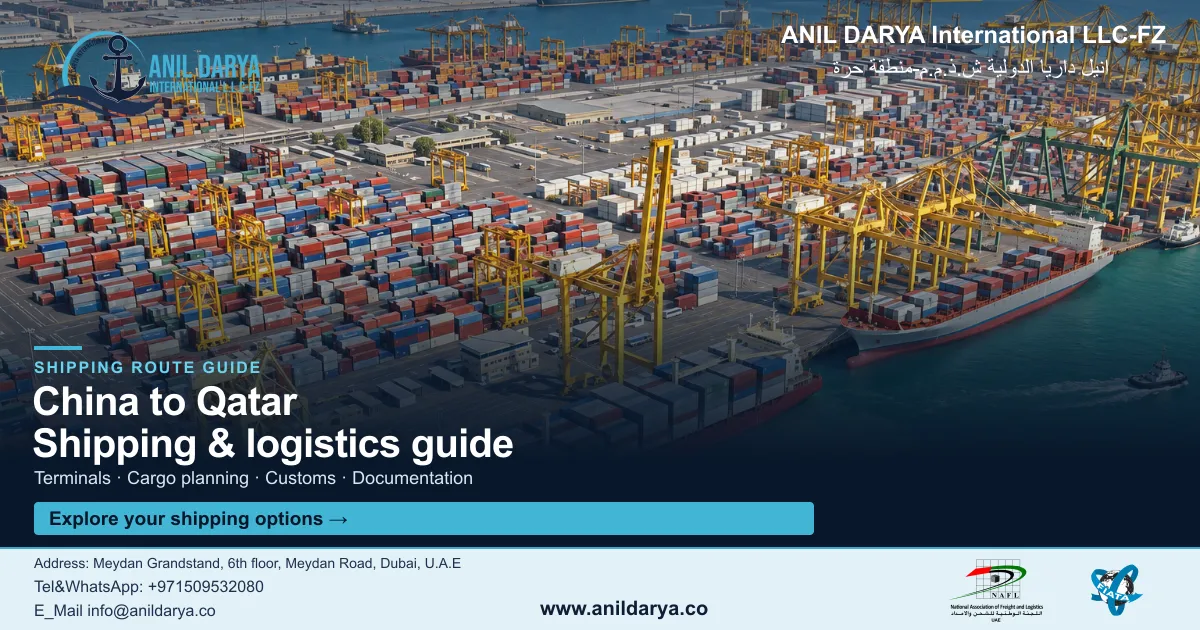
Shipping from China to Qatar is mostly a sea freight move: a container loads at Shanghai, Ningbo, Shenzhen or another Chinese port and discharges at Hamad Port, south of Doha, either on a direct service or after a relay at a hub such as Jebel Ali. The supplier files the Chinese export declaration, and the Qatari consignee or its broker clears the goods with the General Authority of Customs on Al Nadeeb, paying duty of 5% of CIF on most goods. Anil Darya books the ocean freight from Dubai and coordinates both ends.
China to Qatar shipping at a glance
| Item | Detail |
|---|---|
| Main Chinese load ports | Shanghai, Ningbo, Shenzhen (Shekou, Da Chan Bay), Guangzhou (Nansha), Qingdao, Tianjin, Xiamen |
| Main Qatar discharge port | Hamad Port (UN/LOCODE QAHMD), run by Mwani Qatar |
| Routings | Direct services that call Hamad, or a relay at a hub such as Jebel Ali onto a Gulf feeder |
| Published carrier transit examples | ONE AG4: Nansha to Hamad 18 days, Da Chan Bay 17 days. ONE AG1: Shekou 22, Ningbo 27, Shanghai 29 days (2025 brochure) |
| Modes | FCL, LCL, reefer, flat rack and breakbulk, dangerous goods |
| China export filing | Export declaration by the consignor with China Customs, after goods reach the customs area and 24 hours before loading |
| Qatar customs authority and system | General Authority of Customs (GAC), Al Nadeeb single window |
| Standard duty in Qatar | 5% of CIF value (GCC common tariff); steel 20% |
| VAT in Qatar | Not introduced, according to a GCC customs guide checked in April 2026 |
| Bill of lading | The shipping line's own B/L, issued and released through us as the line's agent |
| Who clears in Qatar | The consignee or its customs broker, agreed before the cargo ships |
How does shipping from China to Qatar work when we book it from Dubai?
This is a cross-trade lane. The cargo never needs to touch the UAE, but the booking and the coordination run from our office in Dubai. Three parties carry the work, and each has a clear job.
| Stage | Who does it | What it covers |
|---|---|---|
| Origin in China | The shipper or its origin agent | Pickup, packing, container stuffing, the Chinese export declaration |
| Ocean freight | Anil Darya, booking with the shipping line | Space, equipment, DG or out-of-gauge approval, the carrier's bill of lading, tracking to Hamad |
| Destination in Qatar | The consignee or its customs broker | The Al Nadeeb declaration, duty, permits, delivery order and trucking from the port |
We act as agent for many shipping lines, so the bill of lading on this lane is the carrier's own B/L. It is issued and released to you through us. We do not issue a house bill of lading for these moves, and we do not offer customs clearance in Qatar. What we do is make sure the Qatar side is ready before we confirm the booking: we check that the consignee has a broker, an import licence and any permit the goods need.
The Incoterm decides who pays which leg. Under FOB the Chinese supplier clears export and loads at the port, and the buyer in Qatar pays the ocean freight. Under CFR or CIF the supplier pays the freight to Hamad, but the consignee still pays destination charges and duty. Our guide to Incoterms 2020 in sea freight shows where risk passes in each case.
Which Chinese ports load cargo for Qatar?
Pick the port nearest the factory. Trucking a box across China to reach a port with a better sailing rarely pays unless the saving on the sea leg is large.
| Region | Load port | Typical supplier base |
|---|---|---|
| Yangtze River Delta | Shanghai, Ningbo | Shanghai, Jiangsu, Zhejiang |
| Pearl River Delta | Shenzhen (Shekou, Da Chan Bay), Guangzhou (Nansha) | Guangdong: Shenzhen, Dongguan, Foshan, Guangzhou |
| North China | Qingdao, Tianjin (Xingang) | Shandong, Hebei, Beijing, Tianjin |
| Fujian coast | Xiamen | Xiamen, Quanzhou, Fuzhou |
On the published schedules we opened, South China ports have the shortest sea time to Hamad. North China ports such as Qingdao and Tianjin sit at the start of long rotations, so their cargo spends more days on board before it reaches the Gulf.
Arrival in Qatar: the Hamad Port gateway
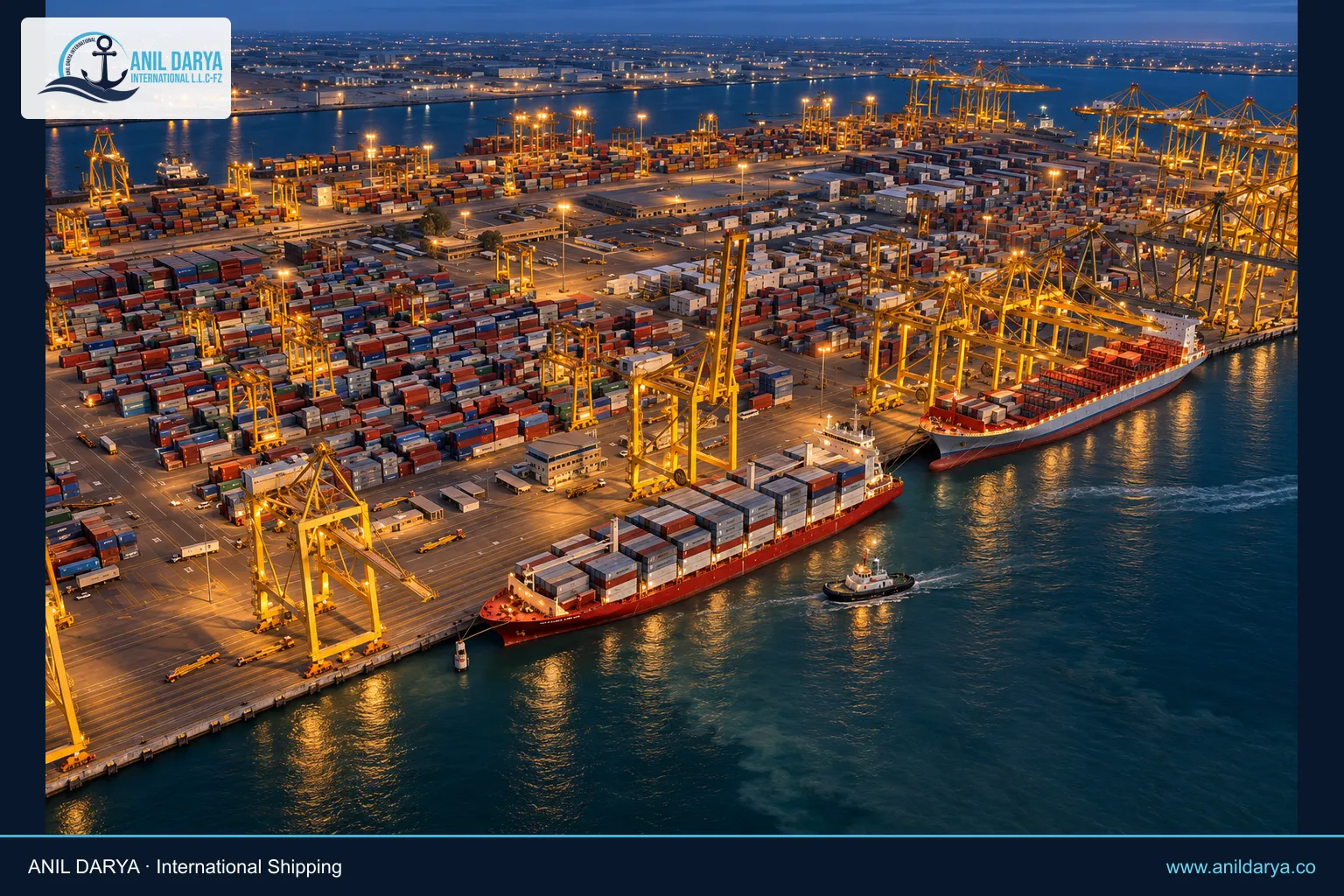
Hamad Port is Qatar's container gateway. Mwani Qatar, the state ports company, says operations began in December 2016 and the port was inaugurated on 5 September 2017. The site covers 29 square kilometres and is planned for 7.5 million TEU a year at full build-out. It has container terminals, a General Cargo Terminal, a multi-use terminal and a Centralised Customs Inspection Area, and a free zone sits next to the port.
For you, that means one discharge port for almost every China to Qatar booking. Containers, LCL, reefers, breakbulk and project pieces all arrive at Hamad, and Doha is a short truck ride north of it.
Direct sailings and transhipment: what the carriers publish
Some services call Hamad straight from China. Others discharge in the Gulf at a hub, and a feeder ship carries the box on to Qatar. Both work. The difference is days on the water and the number of times the container is handled.
Examples from carrier documents we opened:
| Carrier and service | China ports on the rotation | Published days to Hamad |
|---|---|---|
| ONE AG4 (Asia Gulf Express 4) | Nansha, Da Chan Bay, then Port Klang and Jebel Ali | Nansha 18, Da Chan Bay 17 |
| ONE AG1 (Asia Gulf Express 1) | Xingang, Qingdao, Shanghai, Ningbo, Shekou, then Singapore and Gulf ports | Xingang 38, Qingdao 35, Shanghai 29, Ningbo 27, Shekou 22 |
| Milaha MGX2 (Milaha Gulf Express 2) | Shanghai, Ningbo, Shekou, then India and Gulf ports including Hamad | Fortnightly direct link, 3 vessels of 3,000 TEU (profile updated September 2024) |
Both ONE services call Jebel Ali before Hamad on the same voyage, so the box stays on board. On AG1, Shanghai to Jebel Ali is 20 days and the vessel reaches Hamad 9 days after leaving Jebel Ali, because it calls other Gulf ports first. On AG4, Jebel Ali to Hamad is 1 day. These figures come from ONE's 2025 Middle East service brochure, and carriers change rotations often, so we check the live schedule for every booking.
Direct calls are not new on this lane. Gulf Times reported that MSC's first vessel on its New Falcon service left Shanghai on 5 January 2017 and reached Hamad Port on 26 January.
Where a service ends at Jebel Ali, the box can be relayed onto a Gulf feeder. Milaha's Intra Gulf Express (MIG) is one weekly service linking Jebel Ali and Hamad, with two vessels of 1,015 TEU nominal and 90 reefer plugs each, according to its January 2025 profile. A relay adds handling and waiting time, so ask whether your quote is direct or transhipped.
[AMIR-FACT: the carriers and services we actually book from China to Hamad, our real port-to-port transit days from Shanghai, Ningbo and Shenzhen, and whether we usually book direct or via a Jebel Ali relay]
Sea freight from China to Qatar: FCL, LCL and reefer
Most buyers choose between a full container and a shared one. The right answer depends on volume, cargo value and how many suppliers you buy from.
| Option | Use it for | Watch out for |
|---|---|---|
| FCL 20ft | Dense, heavy cargo: tiles, steel parts, cable drums | Weight limits on the road and on the carrier's box |
| FCL 40ft or 40ft high cube | Furniture, lighting, household goods, mixed stock from one supplier | Free time at Hamad and truck booking |
| LCL | First orders and small lots | Consolidation cut-off in China, unpacking at a freight station in Qatar, release tied to the shared box |
| Reefer | Frozen or chilled food, some chemicals | Reefer plugs on the vessel and the feeder, health certificates in Qatar |
| Flat rack or open top | Machinery slightly out of gauge | Carrier acceptance, lashing, limited equipment at smaller ports |
A useful rule: once your LCL lot passes about half a container, price an FCL as well. On a long lane with a possible relay, a sealed box that nobody opens until Hamad often arrives sooner and in better shape. Our article on FCL vs LCL costs explains the break-even, and our sea freight service page lists the container types we book.
If you buy from several factories in one region, the shipper's agent can load them into one container at a Chinese warehouse. You then have one B/L and one Qatar declaration instead of several small ones.
Breakbulk, project cargo and dangerous goods
Qatar buys a lot of steel, machinery, transformers and plant equipment from China for building and energy work. Pieces that fit a 40ft flat rack can move on a container service. Larger or heavier pieces need breakbulk or heavy-lift tonnage. Hamad's General Cargo Terminal handles this kind of cargo, but the vessel decision is made at the Chinese end.
- Get drawings, weights, dimensions and lifting points for every piece from the supplier.
- Decide flat rack or breakbulk, then agree the load port with the carrier.
- Agree lashing and securing with the carrier and the Chinese terminal.
- Build one piece-by-piece packing list that matches the invoice and the B/L.
- Give the consignee's broker the list before arrival so the declaration covers every piece.
Remember that steel pays 20% duty in Qatar, not 5%. On a large steel order that changes the landed cost more than the freight does. Our break bulk and project cargo team plans the ocean leg.
Dangerous goods from China
Lithium batteries, paints, adhesives, solvents and many cleaning chemicals are dangerous goods at sea. Two rules decide whether they can sail. In China, customs inspects the packaging used for exported dangerous goods: a performance check of the packaging type and a use check of how the goods are actually packed. Without those results the shipper cannot book the cargo as DG. At sea, the IMDG Code 2024 edition (Amendment 42-24) has been mandatory since 1 January 2026, so the SDS and DG declaration must follow it.
On the Qatar side, the official prohibited list includes ammunition, explosives, flammable goods and radioactive material. Some DG therefore need an approval before import, and some cannot go at all. Ask the consignee's broker to confirm the product is allowed before we ask the carrier for DG acceptance. Our dangerous goods shipping team checks the papers against the line's rules.
The China export side: who files the declaration
China Customs controls exports. According to the Shanghai municipal government's guidance, the consignor declares the export goods once they arrive in the customs supervision area and 24 hours before loading. Filing can be electronic or on paper at a customs window, done by the exporter itself or by a customs broker.
- The exporter needs foreign trade operator registration and recordation as a customs declaration entity. This can be done through the China International Trade Single Window.
- The documents behind the declaration are the contract, invoice, packing list and any licence the goods need.
- Goods under statutory inspection, such as DG packaging, need the inspection result first.
We do not file in China. The shipper or its origin agent does, and we coordinate the cut-off and the documents with them. If you buy EXW, you still need a Chinese party to act as exporter, which is why FOB is usually simpler. Make sure the values and descriptions on the Chinese export declaration match the invoice the Qatari broker will file.
Qatar customs clearance for goods from China
The General Authority of Customs clears all cargo at Hamad. The main law is Law No. 40 of 2002, alongside the GCC common customs law. Declarations go through Al Nadeeb, a web-based single window where the importer or clearing agent submits and tracks the declaration, routes it to other agencies for approvals, authorises a clearing agent and pays duty online.
Only a licensed importer can bring goods in. The US government's Qatar guide says all importers need an import licence registered with the Ministry of Commerce and Industry, and that rule also covers foreign-owned businesses in Qatar. That is why the clearance belongs to the consignee and its broker. Goods are generally inspected at the customs station with the owner or a representative present.
| Document | Comes from | Qatar rule to follow |
|---|---|---|
| Commercial invoice | Chinese supplier | Official invoice with the HS code for each item |
| Packing list | Chinese supplier | Matches the invoice, the cartons and the B/L |
| Certificate of origin | Issuing body in China | Official COO showing HS codes; origin must match the invoice and the goods |
| Bill of lading | Shipping line, released through us | Consignee and notify party match the Qatari importer |
| Manifest | Carrier | Filed by the carrier |
| Import licence | Consignee | Registered with the Ministry of Commerce and Industry |
| Customs declaration | Consignee or its broker | Filed on Al Nadeeb |
| Permits and certificates | Shipper or consignee | Food, meat, telecom, chemicals and other restricted goods |
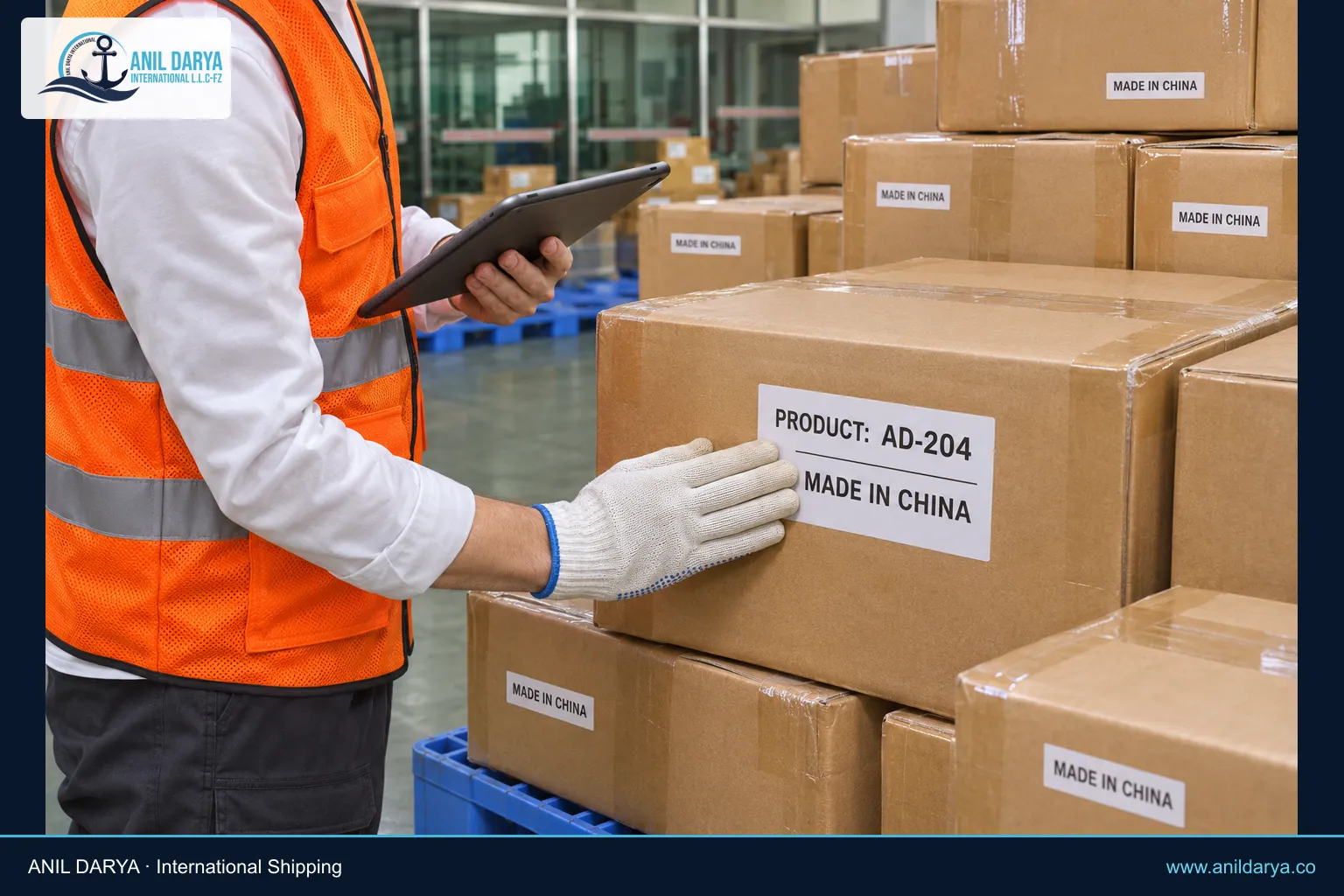
Three details trip up China shipments more than any others. First, every piece and carton must be marked "Made in China" or show the country of origin, and that must match the invoice and COO, or the shipment can be returned. Second, since January 2025 Qatar uses 12-digit HS codes for all imports and exports, so an 8-digit code from a Chinese invoice template is not enough. Third, Invest Qatar says documents must be attested, translated and verified, so ask the broker what attestation it needs before the supplier prints the COO.
Duty, excise and the VAT question
Qatar applies the GCC common external tariff. Duty is 5% of the CIF invoice value for most goods, and over 600 goods are exempt under the GCC customs union. Duty and taxes at destination are paid by the consignee or its broker.
| Goods | Qatar duty |
|---|---|
| General goods | 5% of CIF |
| Records and musical instruments | 15% |
| Steel | 20% |
| Urea and ammonia | 30% |
| Alcoholic beverages | 100% |
| Cigarettes and tobacco | 100%, or QAR 1,000 per 10,000 cigarettes if higher |
| Fresh or chilled chicken (Amiri Decree 45 of 2026) | Raised from 5% to 18% |
| Tomatoes, eggplants, zucchini (same decree) | Raised from 0% to 15% |
The 2026 decree takes effect 60 days after publication in the Official Gazette, so check the rate for your HS code on the day you price. Exempt groups include basic foods such as rice, wheat and flour, goods for free zones, returned goods and goods under ATA Carnet.
Qatar charges excise tax on tobacco, energy drinks and sweetened beverages. Under decisions in force since 17 September 2026, excisable goods must be registered with the General Tax Authority before they are imported. Qatar has not introduced VAT, according to a GCC customs guide verified in April 2026, so for most goods from China the duty is the main tax at import.
Conformity marks, permits and restricted goods in Qatar
We found no Qatari pre-shipment inspection programme in the official sources we checked. Conformity is handled through product rules that the consignee must meet before or at import.
| Cargo from China | Rule that applies | Who sorts it |
|---|---|---|
| Household electrical goods (low voltage) | Gulf Conformity Mark (G-Mark) under the GSO technical regulation | Supplier, with a GSO notified body |
| Children's toys | G-Mark under the GSO toys regulation | Supplier, with a GSO notified body |
| Phones, routers, radio devices | Import authorisation from the Communications Regulatory Authority (CRA) | Consignee |
| Other regulated products | Conformity certificate from the maker, self-declaration or accredited lab tests | Supplier and consignee |
| Meat and poultry | Health certificate and halal slaughter certificate from an approved centre | Shipper |
| Ammunition, explosives, narcotics, counterfeit goods | Prohibited | Do not ship |
| Flammable goods, radioactive material | Prohibited or controlled | Check with the broker before booking |
| Alcohol and tobacco | Licensed importer only, 100% duty, excise registration | Consignee |
QIMA, a GSO notified body, lists Qatar among the GCC states where the G-Mark is mandatory for low voltage equipment and toys. Ask the supplier for the G-Mark certificate before production ends.
Where Dubai fits: relay, consolidation and re-export
Most China to Qatar cargo should go straight to Hamad. Dubai helps in three cases, and each one changes the paperwork.
- Relay at Jebel Ali. Your box moves on the carrier's through bill of lading to Hamad and changes ship at Jebel Ali. You do not handle it in Dubai. Read our Jebel Ali port guide for how the port works.
- Stock held in a Dubai free zone. Some traders keep Chinese stock in JAFZA and send smaller lots to Qatar and other GCC markets. Goods in a UAE free zone are treated as outside the GCC for customs, so a shipment to Qatar is a full import there and pays duty in Qatar. Our article on re-exporting through JAFZA explains the model.
- Goods cleared into the UAE first. Under the GCC customs union, duty is collected at the first point of entry. If the goods paid duty in Dubai, they are not charged again in Qatar when payment is proven with the import declaration. Without that proof, duty is collected in Qatar.
When the cargo is cleared or re-exported in Dubai, the UAE customs clearance is ours, for a fee. We file the declaration with Dubai Customs and send the Qatari broker a clean document set.
[AMIR-FACT: whether we route China to Qatar cargo via Jebel Ali (relay or JAFZA stock) in practice, how often, and the extra days it adds compared with a direct call]
Typical cargo on the China to Qatar lane
| Cargo | Usual mode | Point to check |
|---|---|---|
| Steel sections, pipes, rebar, coils | FCL, flat rack or breakbulk | 20% duty, piece list for the broker |
| Building materials, tiles, sanitary ware | FCL 20ft | Weight limits, breakage packing |
| Machinery and generator sets | Flat rack or breakbulk | Lifting points, carrier approval |
| Furniture and household goods | FCL 40ft high cube | Origin marks on every carton |
| Electrical goods and lighting | FCL or LCL | G-Mark for low voltage items |
| Phones and network equipment | LCL or FCL | CRA import authorisation |
| Toys and consumer goods | LCL or FCL | G-Mark for toys, labels |
| Batteries, paints, chemicals | FCL as DG | China packaging check, IMDG papers, Qatar approval |
How to arrange shipping from China to Qatar, step by step
This is the order we follow on a cross-trade booking. The step people skip is the fourth one, and it causes the most trouble.
- Send us the cargo details. Commodity, HS code, weight, volume, supplier city, delivery point in Qatar, Incoterm and ready date.
- We quote the ocean leg. You see the carrier, whether the service calls Hamad direct or relays at a hub, and the published transit.
- Check the product rules. G-Mark, CRA, food or DG approvals are started now, not after loading.
- Agree the Qatar clearance. The consignee names its customs broker and confirms the import licence and permits. We contact the broker before we confirm the booking.
- Book the space. For DG, reefer or out-of-gauge cargo we get the line's acceptance first.
- Origin work. The shipper or its origin agent arranges pickup, stuffing, the verified gross mass and the Chinese export declaration. We coordinate cut-offs with them.
- Documents. The supplier issues the invoice, packing list and COO with matching HS codes and origin marks. We send drafts to the broker for a check.
- Sailing and B/L. The line issues its bill of lading, released to you through us, and we track the box to Hamad.
- Clearance and delivery. The broker files on Al Nadeeb, the consignee pays duty, and the box is collected and returned within free time.
[AMIR-FACT: one real China to Qatar cross-trade shipment we booked: cargo, load port, carrier and routing, days to Hamad, and how the consignee's broker cleared it]
What drives the cost
We do not publish rates on this page because they move with the market. These are the items that make up a quote.
| Cost factor | Why it matters |
|---|---|
| Ocean freight | Set by the carrier, service and season; direct and relayed services price differently |
| Container size and type | 20ft, 40ft, reefer, flat rack each price separately |
| LCL volume | Charged per cubic metre or tonne, plus consolidation and unpacking |
| Origin charges in China | Pickup, terminal handling, export filing, paid under the Incoterm |
| Destination charges at Hamad | Terminal handling, delivery order, inspection, trucking |
| Special cargo | DG, reefer and out-of-gauge surcharges and limits |
| Duty and excise in Qatar | 5% of CIF for most goods, 20% for steel, more for tobacco and alcohol |
| Free time | Demurrage and detention once the line's free days run out |
| Insurance | Worth it on a long sea leg with a possible relay |
Ask for a quote that splits origin, ocean and destination charges, so offers compare on the same basis.
Checklist before the cargo leaves China
- Consignee's customs broker named and contacted, import licence confirmed.
- 12-digit Qatar HS code confirmed and printed on the invoice and COO.
- "Made in China" or country of origin on every piece and carton.
- Invoice, packing list, COO and B/L draft show the same weights, counts and consignee.
- Attestation level of the COO and invoice agreed with the broker.
- G-Mark certificates for electrical goods and toys, CRA approval for telecom items.
- For DG: China packaging inspection results, SDS, IMDG declaration, Qatar approval, carrier acceptance.
- Excisable goods registered with the General Tax Authority.
- Duty rate checked, including steel at 20% and the 2026 changes.
- Routing known: direct call or relay, and free time at Hamad agreed.
- Cargo insurance arranged.
Mistakes to avoid on this lane
- Shipping before destination clearance is agreed. If no broker and licence are ready, the box sits at Hamad and storage runs.
- Using an 8-digit HS code. Qatar needs 12 digits.
- Missing or mismatched origin marks. Qatar can return the shipment.
- Pricing steel at 5% duty. It is 20%.
- Booking DG before the Chinese packaging inspection is done.
- Assuming free zone stock in Dubai is duty-paid. It is treated as outside the GCC, so Qatar charges duty.
- Comparing a direct quote with a relayed one on price alone. The relay adds days and handling.
- Electrical goods or toys without a G-Mark.
Frequently asked questions
How long does sea freight from China to Qatar take?
It depends on the port and service. ONE's 2025 brochure shows Nansha to Hamad in 18 days on AG4, and Shekou 22, Ningbo 27 and Shanghai 29 days on AG1. Add origin pickup, export filing, clearance in Qatar and delivery.
Which port in Qatar receives containers from China?
Hamad Port, south of Doha, run by Mwani Qatar. Its UN/LOCODE is QAHMD. Containers, LCL, reefers and breakbulk from China all discharge there.
Is there a direct ship from China to Qatar?
Yes. Several published services call Hamad from Chinese ports, for example ONE's AG1 and AG4 and Milaha's MGX2. Other services discharge at Jebel Ali and relay the box on a Gulf feeder.
What is the import duty on goods from China to Qatar?
Most goods pay 5% of the CIF value under the GCC common tariff. Steel pays 20%, urea and ammonia 30%, and alcohol and tobacco 100%. The consignee or its broker pays the duty.
Does Qatar charge VAT on imports from China?
Qatar has not introduced VAT, according to a GCC customs guide verified in April 2026. Excise tax does apply to tobacco, energy drinks and sweetened beverages.
Who clears the cargo in Qatar?
The consignee, through its own import licence or a customs broker it authorises on Al Nadeeb. We do not clear in Qatar, but we agree the broker before we confirm the booking.
Who issues the bill of lading on a cross-trade booking?
The shipping line issues its own bill of lading. Anil Darya acts as agent for many lines, so the B/L is issued and released to you through us.
Can goods from China go to Qatar through Dubai?
Yes. The box can relay at Jebel Ali on a through B/L, or the goods can be held in a Dubai free zone and re-exported. Free zone goods pay duty in Qatar, and we handle the Dubai customs side for a fee.
Do electrical goods from China need a certificate for Qatar?
Low voltage household electrical goods and children's toys need the Gulf Conformity Mark (G-Mark). Telecom and radio devices need CRA import authorisation. Arrange both before the goods ship.
Get a quote for shipping from China to Qatar
Send us the supplier city, cargo details, ready date and your broker's contact in Qatar, and we will come back with a carrier, routing and price. Use our freight rate inquiry form, or contact our team to talk through a DG, steel or project shipment first. You can also read more about our Dubai freight forwarding team.
Sources
- ONE: Middle East service brochure (AG1 and AG4 rotations and transit times, 2025)
- Milaha: Milaha Gulf Express 2 (MGX2) service profile, updated September 2024
- Milaha: Intra Gulf Express (MIG) service profile, January 2025
- Gulf Times: Direct service between Hamad Port and Shanghai launched (January 2017)
- Mwani Qatar: Hamad Port
- Invest Qatar: Customs laws, duty rates, documents, exemptions and Al Nadeeb
- US International Trade Administration: Qatar import requirements and documentation
- US International Trade Administration: Qatar standards for trade
- US International Trade Administration: Qatar moves to 12-digit HS codes
- EY Tax News: Qatar excise update and tariff increases (September 2026)
- Goods Across Borders: GCC customs union explainer (verified April 2026)
- UAE ICP: Customs union for GCC states (duty at the first point of entry)
- QIMA: Gulf Conformity Mark (G-Mark), GSO notified body
- Gulf Times: CRA import authorisation for telecom and radio equipment (January 2016)
- Shanghai Municipal Government: Customs registration and export declaration
- CIRS: China customs inspection of exported DG packaging
- IMO: IMDG Code 2024 edition (Amendment 42-24)
- Dubai Customs: Submit customs declaration (import, export and re-export)
- JAFZA: About the Jebel Ali Free Zone
Reviewed: 11 November 2026