
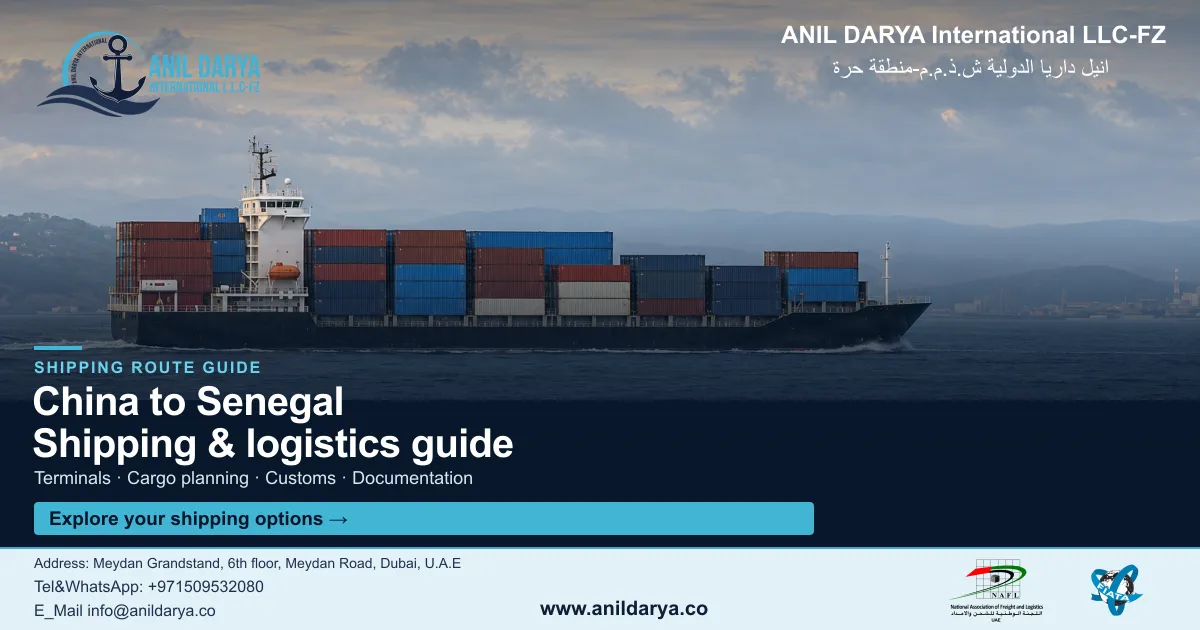
Shipping from China to Senegal almost always ends at one terminal: DP World Dakar, the only container terminal in the country. Most boxes change ship at least once on the way, usually at a Mediterranean hub such as Algeciras or Tangier, before a West Africa loop drops them at Dakar. Before arrival, the consignee needs a validated BESC cargo tracking note from COSEC and a licensed Senegalese broker to file in GAINDE. We book the ocean freight from Dubai, release the carrier's bill of lading to you and keep the factory in China and your broker in Dakar on one timetable.
Shipping from China to Senegal at a glance
| Item | Detail |
|---|---|
| Main modes | Sea FCL, sea LCL, reefer, flat rack and open top, breakbulk, dangerous goods by sea |
| Usual Chinese load ports | Shanghai, Ningbo, Qingdao, Tianjin, Shenzhen (Yantian, Shekou), Guangzhou (Nansha), Xiamen |
| Senegal port | Dakar: DP World terminal, 900,000 TEU capacity, 3 berths, 13 m draft |
| Future port | Ndayane, about 50 km south of Dakar; phase 1 expected by 2028 (DP World) |
| Usual routing | Transhipment at a hub, then a West Africa service that calls Dakar |
| China export filing | The consignor or its broker, no later than 24 hours before loading |
| Cargo tracking note | BESC from COSEC, mandatory for goods to Senegal, validated before arrival |
| Customs systems | GAINDE 2000 for the declaration, ORBUS Infinity single window |
| Duty | ECOWAS CET bands, 0% to 35% of CIF value |
| Levies and VAT | Statistical fee 1%, PCS 1%, ECOWAS levy 0.5%, COSEC levy 0.4% by sea, VAT 18% |
| Who clears in Senegal | The consignee's licensed broker (transitaire), agreed before the box sails |
Who does what on a China to Dakar cross-trade booking
On this lane the cargo never enters the UAE. The box goes from a Chinese terminal to Dakar, and we manage the booking from our Dubai desk. Each party has a fixed job.
- The factory in China, or the forwarder it uses there, picks up or packs the goods, stuffs the box and lodges the Chinese export declaration.
- We secure space with the line, send the factory its cut-off dates, and check that the invoice, packing list and B/L carry the details COSEC and Senegalese customs will look for.
- Your transitaire in Dakar files the GAINDE declaration, pays duty and taxes with the consignee's money and collects the box from the terminal.
The bill of lading is the shipping line's own. Anil Darya is an agent for many shipping lines, so the line issues its B/L for your cargo and we hand it over to you. Your broker in Dakar then presents a carrier B/L, which is the document the line's local agency asks for before it releases the box, and the same document COSEC wants attached to the BESC.
Pick the Incoterm before you pick a ship. FOB China suits most Senegalese buyers: the factory deals with Chinese export formalities, and you control the freight, the insurance and the timing at Dakar. EXW leaves you without an exporter of record in China, which causes trouble at the export filing. Our guide to Incoterms 2020 for sea freight shows where cost and risk pass in each term.
Chinese load ports for Senegal cargo
Start from the port nearest the factory. On this lane the hub connection matters more than the load port.
| Supplier region | Usual load port | Notes for Dakar cargo |
|---|---|---|
| Zhejiang, Jiangsu, Yiwu market | Ningbo, Shanghai | Most sailings and LCL groupage options for mixed small orders |
| Guangdong (Guangzhou, Foshan, Dongguan, Shenzhen) | Nansha, Yantian, Shekou | Furniture, tiles, electricals and motorbike parts often load here |
| Shandong and north China | Qingdao, Tianjin | Machinery, tyres and steel; ask how many transfers the routing has |
| Fujian | Xiamen | Shoes, garments and stone; fewer options, so compare routings |
Dakar: the one container gateway in Senegal
DP World runs the container terminal at the Port Autonome de Dakar and describes it as the only container terminal in Senegal. Its published facts: 15 hectares, a 710 m quay with 3 berths, 13 m draft, 6 quay cranes, 20 rubber-tyred gantries, 560 reefer plugs and a capacity of 900,000 TEU a year. The terminal handles IMDG dangerous goods and out-of-gauge project cargo, and it has rail and road links inland.
DP World says the terminal offers window berthing, which cut average vessel waiting from 35 hours to zero. So the risk on this lane sits in the transhipment leg and the paperwork, not in waiting outside Dakar.
A second gateway is coming. DP World is building Ndayane, about 50 km south of Dakar, with the Government of Senegal and British International Investment. Phase 1 brings an 840 m quay, an 18 m draft and 1.2 million TEU of capacity, with completion expected by 2028. Until then, plan every China container for Dakar.
Sea freight from China to Senegal: hubs and connecting services
Most Far East to West Africa loops serve the Gulf of Guinea ports and do not call Dakar. Cargo for Senegal is therefore usually carried on a mainline vessel to a hub, then moved onto a West Africa service. The Dakar calls we found on carrier pages all start from the Mediterranean hubs.
| Carrier service | Published rotation | Role for China cargo |
|---|---|---|
| ONE MAX (Mediterranean Africa Express) | Algeciras, Tangier, Dakar, Tema, Lekki, Abidjan, back to Algeciras; from 7 July 2026 | ONE says it links Far East Asia with West Africa through the Algeciras and Tangier hubs |
| Maersk WAF 2 | Algeciras, Tangier, Dakar (rotation from October 2026) | Connecting leg from the Mediterranean hubs to Dakar |
| Hapag-Lloyd WA1 | Tanger Med, Dakar, Abidjan, Tanger Med (announced 2025) | Connecting leg from Tanger Med to Dakar |
So a typical booking looks like this: Ningbo or Shanghai to Tangier or Algeciras on the line's Asia to Europe network, a short wait at the hub, then the feeder to Dakar. Ask for both legs, the hub and the connecting vessel in writing before you accept a quote.
Forwarder sites quote anything from about 30 to 55 days for this lane, and they do not agree with each other. We did not find a carrier schedule page with a China to Dakar day count we could read with confidence, so we give none here. Use the carrier's schedule for your actual sailing and add time for the hub connection.
[AMIR-FACT: the carriers and services we actually book from China to Dakar, the transhipment hub on each (Algeciras, Tangier or other), and our real port-to-port transit days from Shanghai/Ningbo and from Nansha/Yantian]
FCL, LCL and reefer options for Dakar
| Option | Typical China to Senegal cargo | What to watch at Dakar |
|---|---|---|
| 20ft dry | Tiles, steel fittings, cables, sanitary ware, other heavy goods | Weight limits per box and per truck inland |
| 40ft dry or high cube | Furniture, solar panels, household goods, motorbikes in kits | Maersk gives 10 free days for dry boxes at Dakar |
| LCL | First orders, samples, mixed lots from Yiwu or Guangzhou | Each consignee in the box needs its own papers and BESC data |
| Reefer | Frozen food, some medicines | Maersk gives only 3 free days for reefers at Dakar |
| Flat rack or open top | Machinery slightly over standard size | Carrier acceptance on both legs, including the feeder |
Every shipper in an LCL box shares the risk of one late document. If you buy from several factories, ask them to deliver to one warehouse near the load port and ship one FCL under one B/L and one BESC. Our FCL vs LCL guide shows where the switch usually pays, and our sea freight service covers booking and equipment.
Dangerous goods, breakbulk and project cargo to Senegal
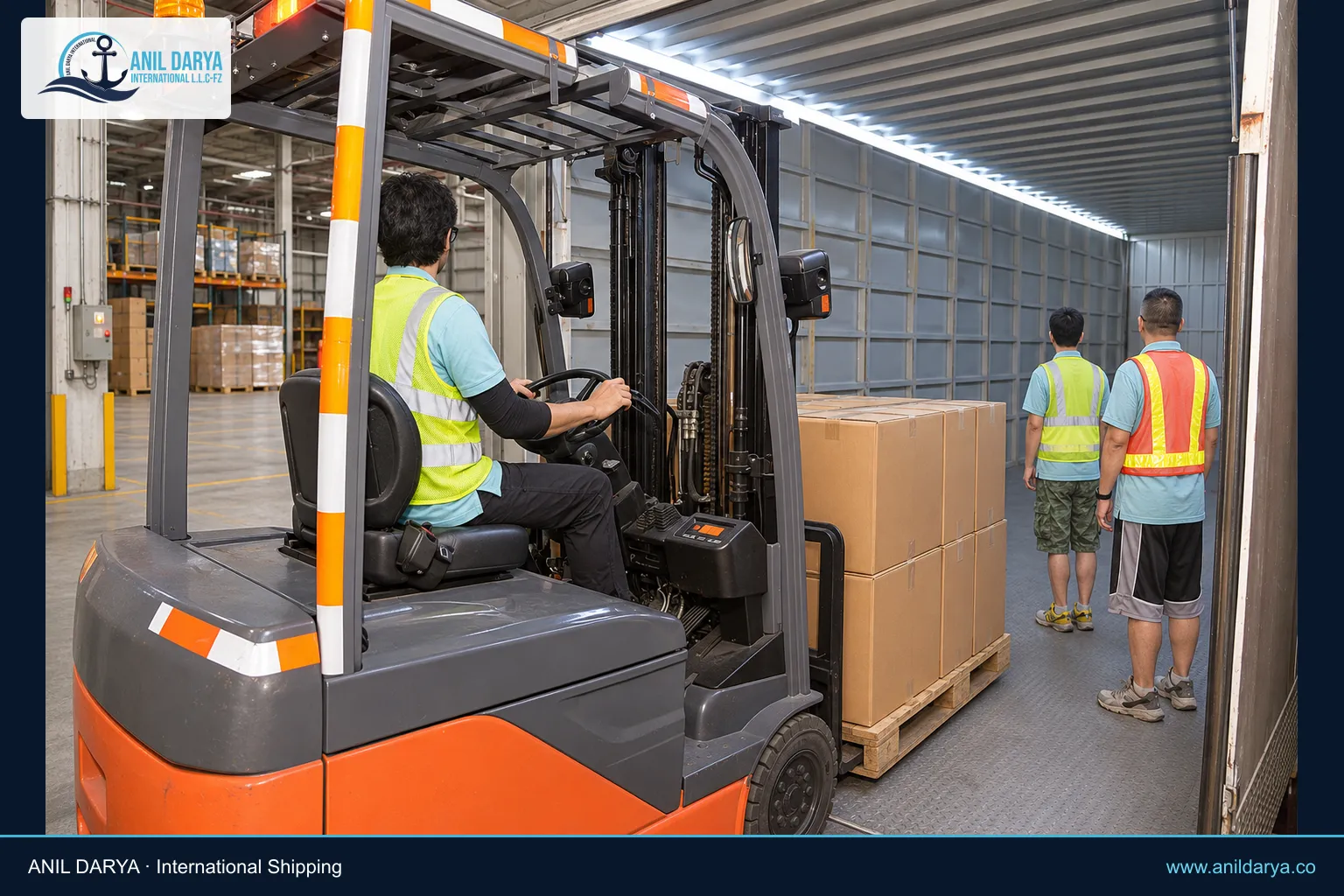
A good share of what Senegal buys from China is regulated for sea transport: lithium batteries in solar kits and e-bikes, paints, adhesives, aerosols, cleaning chemicals and LPG fittings. They move under the IMDG Code. Its 2024 edition (Amendment 42-24) became mandatory on 1 January 2026, so the factory's Safety Data Sheet and DG declaration must follow it.
Chinese customs inspects packaging used for exported dangerous goods. The factory needs a packaging performance certificate for the package type and a use certificate for the filled packages, and lines in China will not confirm a DG booking without them. With transhipment, the line must also accept the class on the feeder and at the hub, so a DG approval for the first ship alone is not enough. Our dangerous goods team checks the UN number, class and packing group against each leg before you commit.
DP World Dakar lists IMDG handling and out-of-gauge project cargo among its yard services. Generators, crushers, steel structures and plant often fit a flat rack or open top. Larger pieces go as breakbulk, and then the sailing date of the general cargo or heavy-lift ship drives the plan. Send drawings, weights, lifting points and the centre of gravity for each piece. See our break bulk and project cargo service.
The China export side: the supplier's filing
Chinese customs law places the export declaration on the consignor. The Shanghai municipal government's customs guide says the consignor declares the goods once they reach the customs supervision area and at least 24 hours before loading. The consignor must also hold foreign trade operator registration.
- Your factory or its origin forwarder handles pickup, stuffing and the export declaration. We send them the booking number, the vessel and the cut-offs.
- The goods description, quantity and value on the Chinese declaration should match the invoice your broker uses in Dakar. GAINDE checks value, origin and classification, and mismatched papers are an easy way into the red channel.
- Ask the factory for a certificate of origin. COSEC lists it among the documents for Senegalese clearance.
The BESC cargo tracking note: get it before the ship arrives
COSEC, the Senegalese Shippers' Council, says the Bordereau Electronique de Suivi de Cargaison (BESC) is mandatory for goods going to Senegal and must be set up before the cargo arrives. Without it, the customs file in Dakar is incomplete.
- The importer opens an account on the BESC platform and uploads its NINEA tax number and its RCCM trade register entry. COSEC reviews and activates the account.
- The account must hold credit before a BESC can be submitted. COSEC accepts bank transfer (more than 3 working days to credit), payment at its counter, or Visa card through ORBUSPAY, which credits at once.
- The BESC is created with the shipment data, the carrier B/L, the commercial invoice and the freight invoice if it is separate.
- COSEC checks the file and validates the BESC, or sends a notice listing what to correct.
Two things follow for China cargo. The B/L must exist first, so the BESC cannot be finished until the ship has sailed from China. And the freight figure on the BESC comes from the freight invoice, so ask us for it as soon as the B/L is issued. COSEC's own platform notes that the data is meant to reach it from the port of loading well before arrival, so the customs file is ready when the ship berths.
[AMIR-FACT: on our China to Dakar bookings, who in practice creates the BESC (consignee, its broker, or us with the freight invoice), and how many days before arrival it is usually validated]
Senegal import customs: documents, GAINDE and release
Senegalese customs (the Direction Générale des Douanes) runs clearance through GAINDE 2000, alongside the ORBUS Infinity single window. Anyone can declare goods worth 200,000 FCFA or less, but above that a licensed customs broker is generally required. We do not sell customs clearance in Senegal. Before we confirm the booking, we check that your transitaire has accepted the job and knows what is coming.
| Document | Who provides it | What to check |
|---|---|---|
| Carrier bill of lading | Shipping line, released through us | Consignee matches the NINEA holder; marks and weights match the packing list |
| Commercial invoice | Chinese supplier | Full description and HS code per line; value matches the export declaration |
| Packing list | Chinese supplier | Carton count and gross weight equal to the B/L |
| Certificate of origin | Chinese supplier | Same goods and invoice number |
| Transport insurance | Buyer under FOB | Covers the transhipment leg |
| BESC | Importer's account with COSEC | Validated before the vessel arrives |
| DPI and AV | Importer, through ORBUS | For goods above the value thresholds |
| Special permits | Importer | Health, plant health or regulated-import permits where the goods need them |
The DPI is the prior import declaration and the AV is the attestation of verification. COSEC lists the DPI "for certain goods" and the AV "when required". A 2020 French customs guide to exporting to Senegal put the DPI threshold at 1,000,000 FCFA FOB and the AV threshold at 3,000,000 FCFA FOB, with the AV tied to a check before shipment. These figures are older, so ask your broker for the current rule before the factory loads, because a check in China has to happen before the box is sealed.
Once the broker files, GAINDE gives the declaration a number, calculates duty and taxes and assigns a control channel: green, yellow or red by risk level. Controls can mean a document check, a physical inspection, a check on value, origin or classification, or a scanner. After payment, customs issues the Bon à Enlever (BAE) release note, and the broker pays port, storage and handling charges to take the box out. COSEC notes that Senegal also allows clearance to start before the ship arrives, which is the best way to protect your free days.
The line releases the container on the original B/L, signed container guarantee forms and payment of its local charges, which Maersk, for example, invoices to the consignee from the day the ship arrives.
Import duty, levies and VAT on goods from China
Senegal applies the ECOWAS Common External Tariff, and goods from China are third-country imports. Senegalese customs states that duty, the statistical fee and the community solidarity levy are charged on the CIF value. Duty and taxes at destination are paid by the consignee or its broker, not by the Chinese supplier and not by us.
| Charge | Rate | Base |
|---|---|---|
| Customs duty, category 0 to 3 | 0%, 5%, 10% or 20% | CIF value |
| Fifth CET band | 35% | CIF value, for a limited list of tariff lines |
| Statistical fee (RS) | 1% | CIF value, third-country goods |
| Community solidarity levy (PCS) | 1% | CIF value |
| ECOWAS levy | 0.5% | CIF value, third-country goods |
| COSEC levy | 0.4% | Sea cargo |
| VAT | 18% | CIF plus duty and statistical fee, unless exempt |
Customs' own worked example for cars shows how the charges stack. For a new passenger car by sea, 20% duty plus the levies gives 22.9%, VAT adds 21.78% and a 2% registration duty adds the rest, for a cumulative 47.54% of the value. A used car comes to 48.97% and a used utility vehicle to 36.81%. Excise also applies to some goods, such as cosmetics, drinks and tobacco. Get the full figure for your HS code from your broker before you agree a price in China.
Restricted goods and product rules in Senegal
Most consumer goods from China clear without a licence, but some groups need an approval, a standard or special marking first.
| Goods from China | What applies in Senegal |
|---|---|
| Radio and telecom equipment, phones, routers | Approval from the telecoms regulator (ARTP) |
| Reinforcing steel and some food staples | Must meet Senegalese standards |
| Medicines | Import authorisation |
| Petroleum products | Import licence from the energy ministry |
| Food, batteries, alcohol and cigarettes | Marking rules for sale in Senegal |
| Goods marked to look made in Senegal | Prohibited marking |
| Used vehicles | Age limit and customs reference values |
| Food, animal and plant products | Sanitary or plant health permits |
Send us the HS code of each line before booking, so your broker sees the list before the box sails.

Cargo for Mali through Dakar
Dakar is also a transit port for landlocked Mali, and many Chinese goods for Bamako arrive this way. COSEC describes the transit regime: an acquit-à-caution transit declaration, a bank guarantee and customs tracking to the exit office. Lines set separate free time for this flow. Maersk, for example, gives 10 days of demurrage and 23 days of detention for dry boxes in transit to Bamako, against 10 days for boxes delivered in Senegal. The B/L, the BESC and the transit papers must name the right consignee and final destination from the start, so tell us at booking if the cargo is for Mali.
Routing via Dubai: consolidation, free zone stock and transhipment
A direct booking from China to Dakar is the simplest choice for most cargo. Dubai earns a place in the plan when your supply chain already passes through the UAE, for example when a Senegalese buyer combines Chinese goods with stock bought in the Gulf.
| Option | How it works | What to watch |
|---|---|---|
| Consolidation in Dubai | Chinese goods and goods from other origins share one box for Dakar | Duty follows real origin, so origin papers must match each item |
| Free zone stock and re-export | You hold stock in Jafza and ship to Dakar as orders come in | Dubai Chambers issues certificates of origin for re-exported goods |
| Transhipment at Jebel Ali | The box arrives from China and connects to a sailing for Dakar | Dubai Customs handles transit as its own regime, separate from import |
Jafza sits beside Jebel Ali port, so holding and splitting stock is practical. See our Jebel Ali port guide and our article on re-exporting through Jafza. When cargo is landed, consolidated or re-exported in Dubai, we handle the UAE customs clearance for a fee.
[AMIR-FACT: whether we route China to Senegal cargo through Jebel Ali in practice (transhipment or Dubai consolidation), the lines used from Jebel Ali to Dakar and the real extra days compared with a routing via a Mediterranean hub]
Typical cargo from China to Senegal and the papers each needs
| Cargo | Usual equipment | Extra points to plan |
|---|---|---|
| Electrical goods, cables, phones, small appliances | FCL or LCL | ARTP approval for radio and telecom items; batteries may be DG |
| Solar panels, inverters, lithium batteries | 40ft high cube | DG papers and Chinese packaging certificates for batteries |
| Motorbikes, tricycles and spare parts | 40ft high cube | Fuel and batteries declared; CKD or SKD status on the invoice |
| Tiles, sanitary ware, steel and building materials | 20ft for heavy goods, breakbulk for long steel | Reinforcing steel must meet the Senegalese standard |
| Textiles, garments and shoes | 40ft or LCL | Correct origin and marking on every carton |
| Machinery and plant | FCL, flat rack or breakbulk | Drawings, piece list and carrier acceptance on the feeder leg |
| Vehicles | Containers or ro-ro, as the carrier offers | Age limit for used vehicles; cumulative taxes near 36% to 49% |
Step by step: shipping from China to Senegal with Anil Darya
- Send us the product, HS code if you have it, weight, volume, factory city, ready date and the delivery point in Senegal or Mali.
- Name your transitaire in Dakar. We agree with them which documents they need and who pays what at the terminal, and only then confirm the booking.
- Agree the Incoterm with the factory. FOB China is the usual choice.
- Have your broker check DPI, AV, ARTP or other permits, so any check in China happens before stuffing.
- Make sure the importer's NINEA, RCCM and funded BESC account are in place.
- We book space with the line and send the factory the booking, cut-offs and the draft carrier B/L.
- The factory or its origin agent stuffs the box and files the Chinese export declaration.
- We check consignee, notify party, description and weights on the draft B/L, the line issues it after loading, and we release it to you with the freight invoice.
- The BESC is created and validated, your broker files in GAINDE before arrival, and the box leaves Dakar once the BAE is issued.
[AMIR-FACT: one real China to Senegal cross-trade shipment we handled (cargo, load port, hub, carrier, what we coordinated and the outcome at Dakar), cleared for publication]
What drives the cost of shipping from China to Senegal?
We do not publish prices, because rates move with every sailing. These are the parts of your total.
| Cost part | What moves it | Usually paid by |
|---|---|---|
| Origin charges in China | Trucking distance, export filing, terminal handling, LCL groupage | Supplier under FOB |
| Ocean freight | Box type, season, carrier, number of transfers, surcharges | Buyer under FOB |
| DG and out-of-gauge premiums | Class, lashing, flat rack or breakbulk | Buyer under FOB |
| BESC and COSEC levy | Platform charge and the 0.4% levy on sea cargo | Consignee |
| Dakar local charges | Terminal handling, line documentation fee, container guarantee | Consignee |
| Duty, levies and VAT | HS code, CIF value, excise | Consignee or its broker |
| Demurrage and detention | Late BESC, late filing, red channel checks | Whoever caused the delay, under your contract |
Free time at Dakar is short for reefers. Maersk's published Senegal tariff gives 10 free days for dry boxes and 3 for reefers, then charges per container per day. A missing BESC can cost more in storage than you saved on freight. Our article on demurrage and detention shows how those charges build up.
Checklist before the cargo leaves China
- Incoterm written into the contract and insurance covering both legs.
- HS code agreed with your broker and the CET band, levies and VAT checked.
- Transitaire named and the clearance plan agreed before booking.
- NINEA, RCCM and a funded BESC account ready.
- DPI, AV and any permit checked, with a pre-shipment check booked if needed.
- Chinese export declaration filed with values that match the invoice.
- For DG: UN number, SDS, Chinese packaging certificates and acceptance on every leg.
- For Mali: final destination and transit consignee on the B/L from the start.
Mistakes that hold China cargo at Dakar
- Shipping before destination clearance is agreed. If no transitaire has taken the job, the box waits at the terminal while free days run out.
- Leaving the BESC until the ship arrives. It needs an active, funded account, the B/L and the freight invoice.
- Planning on the first ship only. A DG class or an oversize piece accepted on the mainline can still be refused on the feeder.
- Invoices that do not match the Chinese export declaration or the packing list weights.
- Missing the DPI or AV step, which has to be done before the factory loads.
- Pricing with duty only and forgetting the levies, 18% VAT and excise.
Frequently asked questions
Which port in Senegal receives containers from China?
Dakar. DP World's terminal there is the only container terminal in Senegal. Ndayane, about 50 km south, is under construction, with phase 1 expected by 2028.
Is there a direct ship from China to Dakar?
Most cargo changes ship at least once. The Dakar calls we found on carrier pages start from Algeciras and Tangier, such as ONE's MAX, Maersk's WAF 2 and Hapag-Lloyd's WA1. Ask for the hub and the connecting vessel with every quote.
How long does sea freight from China to Senegal take?
It depends on the load port, the hub and the connection. Forwarder estimates range widely, so ask for the carrier's schedule for your sailing, then add time for the BESC, clearance in Dakar and inland delivery.
What is the BESC and who needs it?
The BESC is the electronic cargo tracking note managed by COSEC. It is mandatory for goods going to Senegal and must be validated before the cargo arrives, using the B/L, the commercial invoice and the freight invoice.
What duty and VAT apply to goods from China?
Duty follows the ECOWAS CET at 0% to 35% of CIF value by HS code. On top come a 1% statistical fee, 1% PCS, 0.5% ECOWAS levy, 0.4% COSEC levy for sea cargo and 18% VAT, plus excise on some goods.
Does Anil Darya clear customs in Senegal?
No. The consignee's licensed broker clears the goods in Dakar, and duty and taxes at destination are paid by the consignee or its broker. We agree the plan with that broker before we confirm the booking.
Can I ship goods from China to Mali through Dakar?
Yes. Dakar handles transit cargo for Mali under a transit declaration with a bank guarantee and customs tracking to the exit office. Tell us at booking so the B/L and BESC name the right destination.
Can cargo from China to Senegal go through Dubai?
Yes, where it helps. Goods can be consolidated with other origins in Dubai, held in Jafza and re-exported, or transhipped at Jebel Ali. We clear cargo through UAE customs for a fee when it is landed in Dubai.
Get a quote for shipping from China to Senegal
Send us the factory city, the goods, the ready date and the name of your transitaire in Dakar, and we will come back with a routing, the hub, the carrier and a price. Use our freight rate inquiry form, or contact our team to plan a DG, breakbulk or Mali transit shipment first. You can also read about our Dubai freight forwarding team.
Sources
- COSEC: FAQ (BESC steps, clearance procedure, documents, 200,000 FCFA broker rule, transit regime)
- COSEC: BESC platform presentation
- Douanes sénégalaises: Table of duties and taxes (CIF base, RS, PCS, ECOWAS levy, 18% VAT)
- Douanes sénégalaises: Cumulative tax rates for vehicles (COSEC levy, VAT base)
- ECOWAS: Common External Tariff bands
- French customs: 10 questions on exporting to Senegal (2020; DPI and AV thresholds, permits, marking)
- GAINDE 2000: ORBUS single window
- DP World: Dakar terminal facts
- DP World: Senegal and the Port of Ndayane
- Maersk: Senegal import information (free time, Bamako transit, release)
- Maersk: Europe to West Africa service enhancement, WAF 2 rotation (September 2026)
- AJOT: ONE launches the MAX Mediterranean Africa service
- Tanger Med: Hapag-Lloyd West Africa services including WA1
- Shanghai Municipal Government: Customs registration and export declaration
- CIRS: China Customs inspection of DG packaging for export
- IMO: IMDG Code 2024 edition (Amendment 42-24)
- Dubai Customs: Customs declaration regimes
- Dubai Chambers: Certificates of origin for re-exported goods
- Jafza: About the Jebel Ali Free Zone
Reviewed: 11 November 2026