
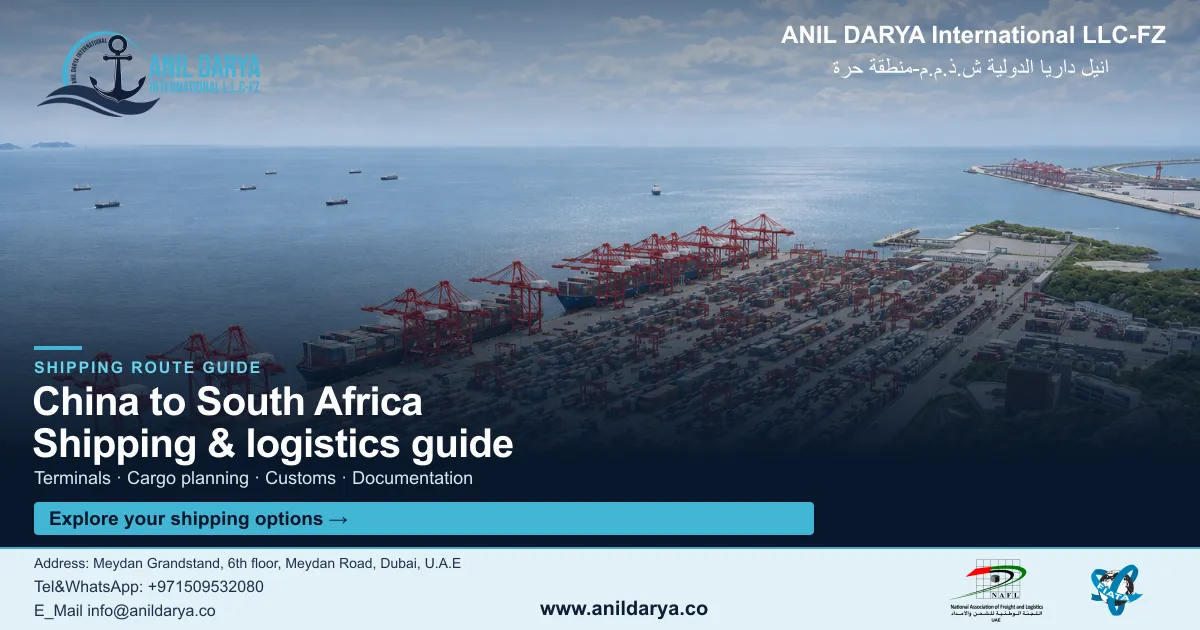
Shipping from China to South Africa is mostly a container trade: boxes loaded at Shanghai, Ningbo, Shekou, Nansha or Qingdao and discharged at Durban, with Cape Town and Ngqura as the other main gateways. The Chinese supplier files the export declaration, and the South African buyer's customs broker clears the goods with SARS, where duty is valued on an FOB basis and import VAT is 15%. We book the sea freight from Dubai, release the carrier's bill of lading through us and keep the supplier and the broker working to the same plan.
Shipping from China to South Africa at a glance
| Item | Detail |
|---|---|
| Main modes | Sea FCL, sea LCL, reefer, flat rack, breakbulk, dangerous goods by sea |
| Usual Chinese load ports | Shanghai, Ningbo, Shenzhen (Shekou, Yantian), Guangzhou (Nansha), Qingdao, Xiamen, Tianjin |
| Main South African port | Durban: 2,732,190 TEU invoiced by the ports authority in 2025 |
| Other container ports | Cape Town (843,599 TEU), Ngqura (747,847 TEU), Port Elizabeth (130,715 TEU), 2025 figures |
| Inland link to Gauteng | 688 km rail corridor from Durban to City Deep, Kascon, Pretcon and Kaalfontein |
| China export filing | Consignor or its customs broker, at least 24 hours before loading |
| South African importer | Must be registered with SARS; foreign importers need a registered agent in South Africa |
| Customs value | FOB at the port of export in China |
| Import VAT | 15% of customs value plus 10% uplift plus duty |
| Product approvals | NRCS Letter of Authority for regulated products; ITAC permit for used and controlled goods |
| Who clears in South Africa | The consignee's customs broker, agreed with us before the booking is confirmed |
Who does what on a China to South Africa cross-trade
The goods sail straight from China to South Africa. Only the booking and the coordination run from Dubai.
- The Chinese supplier, or a forwarder it appoints in China, collects the goods, stuffs the container or delivers to an LCL warehouse, and lodges the Chinese export declaration.
- We secure space with the shipping line, send the supplier the booking and cut-off dates, check the papers against SARS, NRCS and ITAC rules, and follow the box until it is discharged.
- Your customs broker in South Africa lodges the SARS declaration, pays duty and VAT from the importer's funds and arranges release and delivery.
On this lane you receive the shipping line's bill of lading, not a forwarder's document. We are agents for many shipping lines, and the line's B/L for your Durban or Cape Town box is issued and released to you through our Dubai office. If a South African bank holds a letter of credit, it checks the consignee, notify party and discharge port on that B/L before paying your supplier.
The Incoterm sets who pays for which leg. On this lane FOB China fits South African customs well, because SARS values imports at the FOB point anyway. Under an EXW contract SARS asks for a breakdown of costs up to the Chinese port, so you end up building an FOB price on paper. Our guide to Incoterms 2020 for sea freight shows where cost and risk pass under each term.
Which Chinese port to load at
Load at the port nearest the factory. Moving a box across China to catch one sailing rarely pays.
| Supplier region | Usual load port | What to ask for South Africa |
|---|---|---|
| Guangdong (Shenzhen, Dongguan, Foshan, Guangzhou) | Shekou, Yantian, Nansha | Which South African port the loop discharges at, Durban only or Durban and Cape Town |
| Zhejiang, Jiangsu and Shanghai, including Yiwu | Ningbo, Shanghai | LCL cut-off at the consolidation warehouse and the weekly sailing day |
| Shandong and north China | Qingdao, Tianjin | Whether the service starts there or a feeder takes the box south first |
| Fujian | Xiamen | Whether Xiamen is on the loop that week or the box is trucked or fed |
Durban, Cape Town or Ngqura: choosing the discharge port
Choose the port by where the goods are going. Most Chinese cargo for Johannesburg, Pretoria and the rest of Gauteng lands at Durban and moves inland by road or on Transnet's Container Corridor, a 688 km rail line to the inland terminals at City Deep, Kascon, Pretcon and Kaalfontein.
| Port | 2025 container volume | Best for |
|---|---|---|
| Durban | 2,732,190 TEU | Gauteng, KwaZulu-Natal and most inland buyers; the widest choice of Far East services |
| Cape Town | 843,599 TEU | Buyers in the Western Cape, on loops that call Cape Town after Durban |
| Ngqura | 747,847 TEU | Eastern Cape industry; about half its 2025 boxes were transhipment containers |
| Port Elizabeth | 130,715 TEU | Smaller container volumes for the Eastern Cape |
The volumes are the containers invoiced by the National Ports Authority for the 2025 calendar year. A loop that calls only Durban means Cape Town cargo goes on by road, rail or a coastal feeder, which adds cost and time. Ask which port each quote discharges at before you compare prices.
Free time at Durban is short
Durban Gateway Terminal's operating procedures for early 2026 say import containers not cleared by customs, or held by any government department, must leave the terminal as an overstay on the third day of free storage. A box held for a missing NRCS letter or ITAC permit soon moves to a depot at extra cost, so get approvals before the ship sails.
Direct loops or transhipment?
Most container services on this trade are long weekly loops. They load at several Chinese ports, call Southeast Asia and then cross the Indian Ocean to South Africa. Ocean Network Express, for example, published two Asia to South Africa loops in June 2026:
- South Africa Connection (SAC): Shanghai, Ningbo, Xiamen, Nansha, Singapore, Durban, Singapore, Shanghai.
- South Africa Service (SAS): Qingdao, Shanghai, Ningbo, Shekou, Hong Kong, Singapore, Durban, Cape Town, Singapore, Qingdao.
So one loop goes to Durban only, and the other calls Durban and then Cape Town. Rotations change, so check the port list on each booking. If your load port is not on a loop, the box is fed or transhipped at a hub and reloaded on the mainline vessel, which adds handling and days.
| Routing | What happens | When it suits you |
|---|---|---|
| Same vessel from a Chinese loop port | Loaded in China, discharged in South Africa without changing ship | Most FCL cargo from Shanghai, Ningbo, Shekou or Nansha |
| Feeder or hub transhipment | Box moves to a mainline ship at a hub | Smaller Chinese ports, or when the direct loop is full |
| Via Jebel Ali, Dubai | China to Jebel Ali, then onward to South Africa | Cargo combined with goods already in Dubai, or stock held in a free zone |
[AMIR-FACT: the carriers and services we actually book from China to Durban and Cape Town, whether each is direct or transhipped (and where), and our real port-to-port transit days from Shanghai/Ningbo and from Shekou/Nansha]
Sea freight from China to South Africa: FCL, LCL and reefer
Pick the equipment by the goods and by the inland leg in South Africa, not only by cubic metres.
| Option | Typical China cargo | South African point to plan |
|---|---|---|
| 20ft FCL | Tiles, steel parts, fasteners, cable, dense machinery parts | Road weight limits on the truck from Durban to Gauteng |
| 40ft / 40ft high cube | Solar panels, furniture, appliances, mixed stock from one factory | Terminal free time and depot space at the inland terminal |
| LCL | First orders, samples, small mixed lots from Yiwu or Guangzhou | Each supplier's goods may need its own NRCS or ITAC paper |
| Reefer | Frozen food, some pharmaceuticals, temperature-sensitive chemicals | Import permits from the food or health authority before sailing |
| Flat rack / open top | Machinery over standard height or width | Carrier acceptance, lashing, and an abnormal-load route inland |
Buying from several factories in one region? Combine the orders near the load port. One box, one B/L and one SARS declaration cost less than four LCL releases. Our FCL vs LCL guide shows where a full box starts to pay, and our sea freight service covers equipment and booking.
Dangerous goods, breakbulk and project cargo
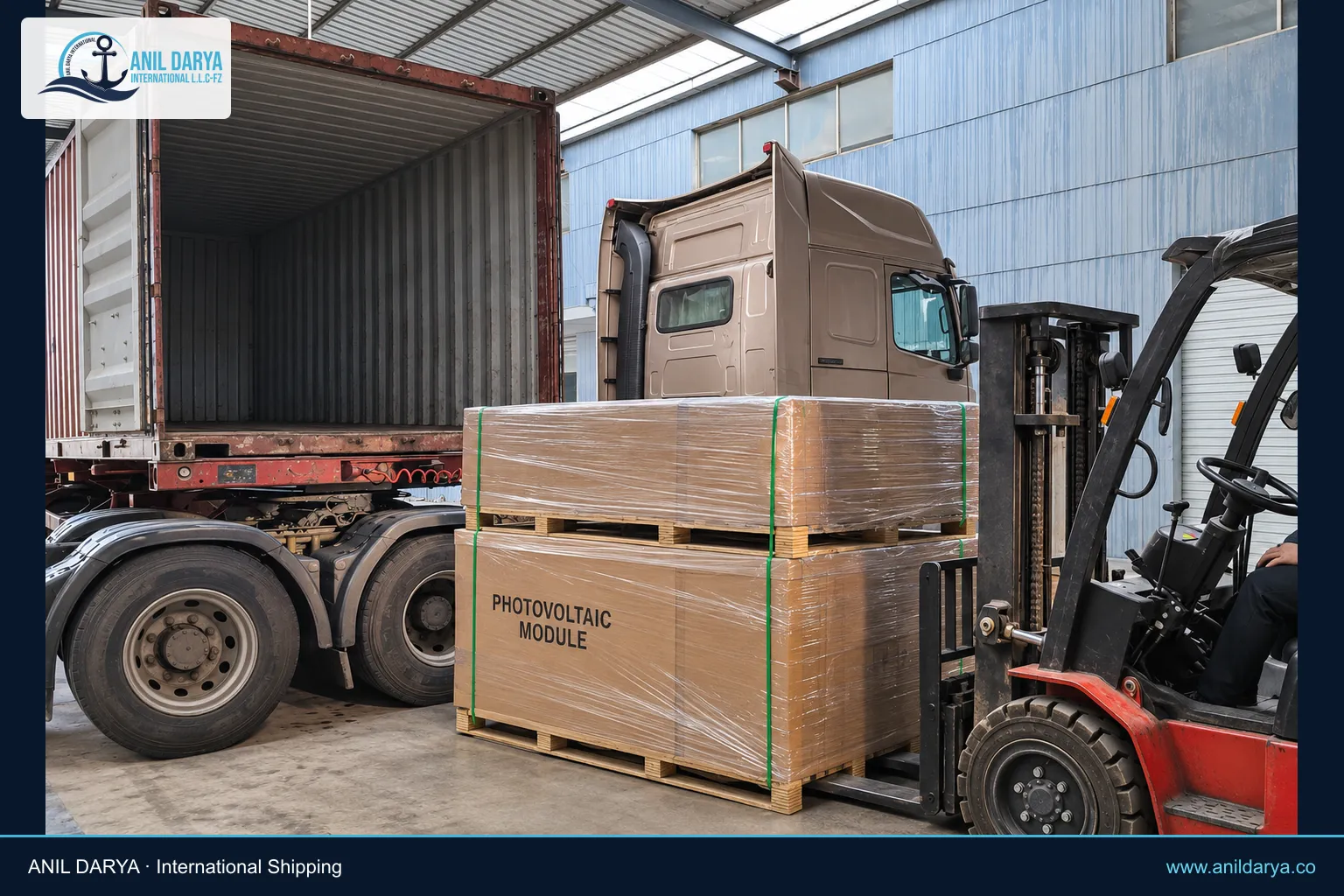
A large part of what South Africa buys from China is dangerous goods at sea. Lithium batteries for home backup and solar systems, paints, resins, adhesives, aerosols and pool chemicals all need a DG booking. The 2024 edition of the IMDG Code (Amendment 42-24) has been mandatory since 1 January 2026, so the Safety Data Sheet and the DG declaration must follow it.
China Customs inspects the packaging of exported dangerous goods. The supplier needs a performance inspection result for the packaging design and a use identification certificate for the filled packages. Ask for both before you book, since a carrier will not accept DG at a Chinese terminal without them. South African port rules then require the ship's arrival notice, including dangerous goods on board, 72 hours ahead, and the DG papers must match from load port to discharge. Our dangerous goods team checks the UN number, class and packing group against the line's acceptance rules before you commit.
Crushers, conveyors, transformers, steel structures and mining equipment for South African sites often do not fit a standard box. Pieces that fit a flat rack can travel on container ships. Larger or heavier units move as breakbulk on multipurpose or heavy-lift vessels into the Transnet multipurpose terminals at Durban, Richards Bay or Port Elizabeth. We need drawings, weights, dimensions and lifting points for each piece before we can pick the vessel. See our break bulk and project cargo service.
The China export side: who files what
The Chinese export declaration belongs to the consignor, which on most South African orders is the factory or trading company. China Customs, as the Shanghai municipal government explains it, takes the declaration once the goods reach the customs supervision area and at least 24 hours before loading. The consignor files itself or through a customs broker. It needs market entity status and registration as a foreign trade operator, which can be done through the China International Trade Single Window.
- The supplier or its origin forwarder books the truck, stuffs the box and files the export entry. We share the vessel, cut-off and booking number with them.
- The goods description, HS code and value on the Chinese export entry should match the commercial invoice your broker gives SARS. A mismatch is an easy reason for a SARS query.
- Under EXW the supplier still acts as exporter of record in China, since a South African buyer cannot normally file there.
South African import customs: SARS registration and the declaration
Every importer into South Africa, local or foreign, must be registered with SARS customs. Registration runs through the Registration, Licensing and Accreditation platform on SARS eFiling. A foreign importer, for example a Dubai trading company selling to South Africa on delivered terms, must also nominate a registered agent in South Africa on form DA 185 D. That agent takes full liability towards customs for the foreign principal. Without one, SARS suspends the application.
Your broker lodges the goods declaration with SARS. Customs checks it against the invoice, the bill of lading, the certificate of origin and any permits, and may ask for more documents or samples. The answer comes back as a CUSRES message: release, a hold for another government agency, or a physical inspection that the broker books at the port.
| Document | Who provides it | What to check on a China shipment |
|---|---|---|
| Commercial invoice and packing list | Chinese supplier | Price at FOB point, HS code, weights, the same description as the export entry |
| Carrier bill of lading | Shipping line, released through us | Consignee name as registered with SARS, notify party, port of discharge |
| Certificate of origin | Issuing body in China | Supplier name and goods match the invoice |
| NRCS Letter of Authority | Importer, from NRCS | Covers the exact model and is valid before arrival |
| ITAC import permit | Importer, from ITAC | Needed for used goods and controlled items such as new tyres |
| Goods declaration | Consignee's customs broker | Lodged on time, with the new or used indicator correct |
SARS sets deadlines after landing. Loose and break-bulk cargo must be declared within 14 days in total, and goods in a container depot within 28 days. Undeclared goods may be moved to the State Warehouse. We do not clear customs in South Africa. Your broker does, and we agree the plan with them before your booking is confirmed.
Duty and VAT on goods from China
Duty and taxes at destination are paid by the consignee or its broker. SARS lists three groups of charges: customs duty, including additional ad valorem duty on some luxury goods; anti-dumping and countervailing duty where an order applies to the product; and import VAT. The duty rate depends on the tariff heading, the customs value and sometimes the quantity.
Two points catch buyers used to other markets. First, South Africa values imports on the FOB price at the port of export, so the sea freight from China is not part of the value for duty. Second, import VAT is not 15% of the invoice. SARS charges 15% on an added tax value made up of three parts:
- The customs value (FOB).
- Plus 10% of that customs value.
- Plus the duty charged.
The 10% uplift is waived only for goods that originate in and are imported from Botswana, Eswatini, Lesotho or Namibia, so it applies to China-origin cargo. VAT-registered importers usually recover import VAT as input tax, but the cash leaves your account at clearance, so budget for it. Get the tariff heading agreed with your broker before the order is placed, because a change of heading after arrival changes both the duty and the VAT.
NRCS, ITAC and other approvals for Chinese goods
South Africa checks many products at the border against compulsory specifications. These are technical rules, based on South African national standards, for safety, health and the environment. NRCS approves products that meet them and issues Letters of Authority to manufacturers and importers, so the products can be imported or offered for sale. The approval sits with the importer and the exact product, not with the shipment.
- Electrotechnical products: regulated electrical goods need an NRCS Letter of Authority, and NRCS keeps a searchable list of approved letters. Check every new model from a Chinese supplier.
- Automotive products: NRCS homologates vehicles and tyres and keeps a database of approved safety helmets.
- Chemicals and construction materials: cement, chemical disinfectants and some building materials fall under NRCS's chemical, mechanical and materials unit.
- Pre-packed goods: NRCS legal metrology rules cover quantity marking on pre-packages.
ITAC controls a separate list. An import permit is needed for all used or second-hand goods, including used electronic and medical equipment, and for controlled goods such as new pneumatic tyres, chemicals listed in the 1988 UN Convention, gambling devices and fossil fuels. ITAC says about 276 tariff lines are under import control and most applications take three to five working days. Clothing, textiles and footwear must meet SARS labelling rules. Non-compliant goods are detained and, if the problem cannot be fixed, re-exported off the African continent or destroyed at the importer's cost.
[AMIR-FACT: the typical lead time our South African consignees see for an NRCS Letter of Authority on a new Chinese electrical product, and which product groups most often hold China cargo at Durban]

Restricted and prohibited goods in South Africa
SARS sorts goods into absolutely prohibited, restricted and free. Restricted goods need an authority from the relevant agency before they arrive, and the declaration must flag whether goods are new, used or second-hand. On China cargo, these are the groups that come up most often.
- Used machinery, used electronics and other second-hand goods: ITAC permit in all cases.
- Used or second-hand motor vehicles for commercial or resale purposes: ITAC does not issue import permits for these.
- New tyres: ITAC permit, and NRCS rules for tyres.
- Waste and scrap: under ITAC import control.
Goods that pass through South Africa in transit to a neighbouring country do not need an authority under SARS policy, though the transit itself has its own customs procedure. Ask your broker to check the HS code against the restriction list before you pay a deposit.
Routing via Dubai: Jebel Ali, consolidation and re-export
For most China to South Africa cargo a sailing straight from China is simplest. Dubai helps when your business already runs through the UAE.
| Option | How it works | What to watch |
|---|---|---|
| Transhipment at Jebel Ali | The box arrives from China and connects to a vessel for Durban | Dubai Customs lists transit as its own declaration type, separate from import; extra port days |
| Consolidation in Dubai | Chinese goods are combined with goods from other origins in one container | Each item still needs its NRCS or ITAC paper; origin papers must match each line |
| Free zone stock and re-export | You hold Chinese stock in Jafza and ship to South Africa as orders arrive | The foreign seller importing into South Africa needs a SARS-registered agent |
When cargo is landed, consolidated or re-exported in Dubai, we clear it through UAE customs for a fee. Our Jebel Ali port guide covers the terminals, and our article on re-exporting through Jafza explains the free zone steps.
[AMIR-FACT: whether we route China to South Africa cargo via Jebel Ali in practice (transhipment or Dubai consolidation), the carriers used from Jebel Ali to Durban, and the real extra days compared with a direct sailing]
Typical cargo on this lane and what each needs
| Cargo | Usual equipment | Extra papers to plan |
|---|---|---|
| Solar panels, inverters, lithium batteries | 40ft high cube; DG booking for batteries | SDS, Chinese DG packaging certificates, NRCS approval for electrical items |
| Electrical appliances, lighting, cables | FCL or LCL | NRCS Letter of Authority per model |
| Machinery and mining equipment | FCL, flat rack or breakbulk | Drawings and piece list; ITAC permit if used |
| Tyres | 40ft high cube | ITAC permit and NRCS tyre rules |
| Clothing, textiles, footwear | 40ft or LCL | Care and content labels that meet SARS rules |
| Furniture, tiles, sanitary ware, steel | 40ft for furniture, 20ft for heavy goods | Weight planning for the truck or rail leg inland |
| Chemicals, paints, adhesives | FCL, DG approved | Full DG papers; NRCS rules for disinfectants and some chemicals |
Step by step: shipping from China to South Africa with Anil Darya
- Send us the product, HS code if you have it, weight, volume, supplier city, ready date and the delivery point in South Africa.
- Name your customs broker in South Africa and confirm the importer is registered with SARS. We agree the clearance plan with the broker before we confirm the booking.
- Check approvals: NRCS Letter of Authority, ITAC permit, labels and any food or health permit. Start them before the goods are made.
- Agree the Incoterm with the supplier. FOB China is usually the cleanest for a South African importer.
- We book space with the shipping line and give the supplier the booking, the cut-offs and the draft carrier B/L.
- The supplier or its origin agent stuffs the container and files the Chinese export declaration at least 24 hours before loading.
- We check consignee, notify party and port of discharge on the B/L, plus the DG papers where needed, before the line issues it.
- The vessel sails, the carrier B/L is released to you through us, and your broker lodges the SARS declaration so the box can leave the terminal inside its free time.
[AMIR-FACT: one real China to South Africa cross-trade shipment we handled (cargo, load port, discharge port, carrier, what we coordinated and the outcome), cleared for publication]
What drives the cost of container shipping from China to South Africa?
We do not publish prices, because they change with every sailing. These are the parts of the total and what moves each one.
| Cost part | What moves it | Usually paid by |
|---|---|---|
| Origin charges in China | Pickup distance, export filing, terminal handling, LCL consolidation | Supplier under FOB |
| Ocean freight | Container type, season, carrier, direct or transhipped, discharge port | Buyer under FOB |
| DG and out-of-gauge | DG surcharge, flat rack or breakbulk premium, lashing | Buyer under FOB |
| Destination charges | Terminal handling, delivery order, depot moves | Consignee |
| Duty and VAT | Tariff heading, FOB value, 10% VAT uplift | Consignee or its broker |
| Approvals | NRCS testing and levies, ITAC permits | Importer |
| Inland transport | Road or rail to Gauteng, weight, abnormal loads | Consignee |
| Storage and detention | Late approvals, slow clearance, short free time | Whoever caused the delay, under your contract |
A missing Letter of Authority can cost more in depot storage and container detention than any saving on the freight rate. If you want a second view on a quote, our Dubai freight forwarding team can walk through it line by line.
Checklist before the container leaves China
- Importer registered with SARS, or a registered agent nominated for a foreign importer.
- Customs broker in South Africa named and the clearance plan agreed.
- HS code agreed with the broker and the duty checked.
- NRCS Letter of Authority in place for regulated products.
- ITAC permit in place for used goods, tyres or other controlled items.
- Labels on clothing and footwear checked against SARS rules.
- Invoice priced or broken down to the FOB point at the Chinese port.
- Chinese export declaration filed and matching the invoice.
- For DG: UN number, SDS, Chinese packaging certificates, DG declaration and line approval.
- Discharge port on the B/L matches where the buyer wants the box.
Mistakes that hold China cargo in South Africa
- Shipping before destination clearance is agreed. If no broker in South Africa has accepted the job, the box ages at the terminal while you look for one.
- Arriving without an NRCS Letter of Authority. Electrical goods are held until the approval is shown, and terminal free time runs out fast.
- Assuming used goods are free to import. Every used or second-hand item needs an ITAC permit.
- Calculating VAT on the invoice only. SARS adds 10% to the customs value and then adds duty before it charges 15%.
- Buying EXW without a cost breakdown. SARS will ask for charges up to the Chinese port to fix the FOB value.
- Booking a Durban-only loop for a Cape Town buyer, then paying for the move down the coast.
- Foreign seller with no SARS agent. A Dubai or Chinese company importing into South Africa needs a registered agent first.
Frequently asked questions
Which South African port do ships from China arrive at?
Most container cargo arrives at Durban, the busiest container port in South Africa with 2,732,190 TEU invoiced in 2025. Cape Town and Ngqura are the other main gateways, and some loops call Durban and then Cape Town.
How long does sea freight from China to South Africa take?
It depends on the load port, the loop and whether the box is transhipped. Ask for the routing and published transit on each quote, then add time for Chinese export filing, NRCS or ITAC approvals, SARS clearance and the inland leg.
How is import VAT calculated on goods from China?
SARS charges 15% VAT on the customs value plus 10% of that value plus the duty. South Africa uses the FOB price at the Chinese port as the customs value, so ocean freight is not in the value for duty.
Do I need an NRCS Letter of Authority for products from China?
You do if the product falls under a compulsory specification, as many electrical goods, tyres, helmets, cement and disinfectants do. NRCS issues the letter to the importer or manufacturer once the product meets the rules, and it should be in place before the goods arrive.
Can a foreign company import into South Africa?
Yes. A foreign importer must register with SARS and nominate a registered agent in South Africa on form DA 185 D. The agent takes full liability towards customs for the foreign principal.
Does Anil Darya clear customs in South Africa?
No. Your customs broker in South Africa clears the goods, and duty and taxes are paid by the consignee or its broker. We agree the plan with that broker before your booking is confirmed, then coordinate the documents and the arrival.
Can China to South Africa cargo go through Dubai?
Yes, where it helps. Cargo can tranship at Jebel Ali, be consolidated in Dubai with goods from other origins, or be held in a free zone and re-exported. When the cargo is landed in Dubai, we clear it through UAE customs for a fee.
Get a quote for shipping from China to South Africa
Tell us the supplier city, the goods, the ready date and the South African port or city, and name your customs broker there. We will come back with a routing, the carrier and a price. Use our freight rate inquiry form, or contact our team to plan a DG, breakbulk or project move first.
Sources
- National Ports Authority of South Africa: Containers invoiced by port, 2025 calendar year
- Transnet Freight Rail: Container Corridor, Durban to Gauteng
- Durban Gateway Terminal: Standard operating procedures, 1 January to 31 March 2026
- Ocean Network Express: Asia-South Africa services update, SAC and SAS (June 2026)
- SARS: Imports (documents, declaration deadlines, State Warehouse, ITAC permits)
- SARS: Importer registration (foreign importers, registered agent, RLA on eFiling)
- SARS: Duties and taxes for importers
- SARS FAQ: How is VAT calculated on imported goods?
- SARS SC-CR-A-03: Valuation of Imports, effective 11 December 2025 (FOB basis)
- SARS SC-CC-32: Prohibited and Restricted Goods, effective 17 February 2025
- ITAC: Import control (used goods, controlled goods, turnaround)
- ITAC: Guidelines for importing used or second-hand vehicles
- NRCS: Imports and exports (approvals and Letters of Authority)
- NRCS: About compulsory specifications
- Shanghai Municipal Government: Customs registration and export declaration
- National Ports Act, Port Rules: Rule 18 notice of arrival (72 hours, dangerous goods)
- Transnet Port Terminals: Break-bulk services (multipurpose terminals)
- CIRS: China Customs inspection of packaging for exported dangerous goods
- IMO: IMDG Code 2024 edition (Amendment 42-24)
- Dubai Customs: Customs declaration types (import, export, transit, transfer)
- Jafza: About the Jebel Ali Free Zone
Reviewed: 11 November 2026