
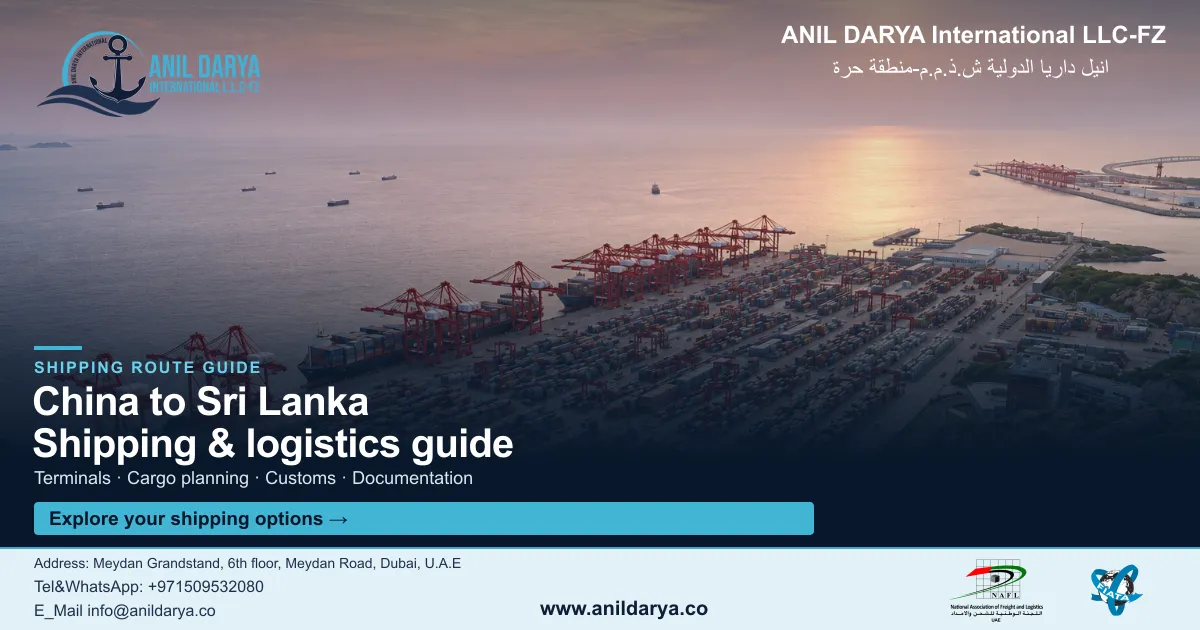
Shipping from China to Sri Lanka is a short container trade by Asian standards: boxes load at Shekou, Nansha, Ningbo, Shanghai or Qingdao and discharge at Colombo, with Hambantota as the second gateway for vehicles and some boxes. The Chinese supplier lodges the export declaration, and the Sri Lankan buyer's Customs House Agent files a CusDec in ASYCUDA World once the ship is in. Because both countries are in the Asia-Pacific Trade Agreement, some Chinese goods pay a lower duty than the general rate, but only with the right certificate of origin. We book the ocean freight from Dubai, release the carrier's bill of lading through us and keep the supplier and the agent in Colombo on one plan.
Shipping from China to Sri Lanka at a glance
| Item | Detail |
|---|---|
| Main modes | Sea FCL, sea LCL, flat rack and breakbulk, dangerous goods by sea, Ro-Ro for vehicles |
| Usual Chinese load ports | Shenzhen (Shekou, Yantian), Guangzhou (Nansha), Ningbo, Shanghai, Qingdao, Xiamen, Tianjin |
| Main Sri Lankan port | Colombo: 8,291,178 TEU handled in 2025 (Sri Lanka Ports Authority figures) |
| Second port | Hambantota: 428,036 TEU and 726,153 vehicles in 2025, 17 m alongside at most berths |
| Published sailing example | 23 days Shekou to Colombo on one direct ONE service in its February 2026 schedule, calling India and Pakistan first |
| China export filing | Consignor or its customs broker, 24 hours before loading |
| Sri Lankan import entry | CusDec in ASYCUDA World, lodged by a Customs House Agent after arrival and the delivery order |
| Duty bands | 0%, 10%, 20% and 30% general rates from 1 April 2026; APTA rates on some lines |
| VAT and SSCL | 18% VAT and 2.5% SSCL on most lines, on CIF plus 10% plus duty and levies |
| Product checks | SLSI import inspection, Import Control Licence, TRC, NMRA, CDDA and food checks where the line requires |
| Who clears in Sri Lanka | The consignee's Customs House Agent, agreed with us before the booking is confirmed |
Who does what on a China to Sri Lanka cross-trade
- Your Chinese supplier, or the forwarder it uses in China, collects the goods, stuffs the box or delivers to the LCL warehouse, and files the export declaration with China Customs.
- We take space with the shipping line, send the supplier the booking number, vessel and cut-offs, check the invoice and packing list against what Sri Lanka Customs will ask for, and follow the box to discharge.
- The Customs House Agent in Colombo or Hambantota lodges the CusDec, settles duty and levies from the importer's money and arranges delivery from the terminal.
The bill of lading you receive is issued by the shipping line itself. We act as agent for many lines, so the carrier's B/L for your Colombo container is released to you through our Dubai office once freight is settled. Under a letter of credit, give us the bank's exact consignee and notify wording before the line drafts it.
FOB China and CFR Colombo are the common terms on this lane. Sri Lanka Customs values goods at CIF, so whichever term you buy on, the freight and insurance end up in the value for duty. Our guide to Incoterms 2020 for sea freight shows where cost and risk move under each term.
Which Chinese port to load at
Load at the port nearest the factory, and ask the right question for each region.
| Supplier region | Usual load port | Question to ask for Sri Lanka |
|---|---|---|
| Guangdong: Shenzhen, Dongguan, Foshan, Guangzhou | Shekou, Yantian, Nansha | Does the loop call Colombo directly, and before or after the Indian ports? |
| Zhejiang, Jiangsu, Shanghai, Yiwu | Ningbo, Shanghai | Is it the same vessel to Colombo, or a relay in South China or a hub? |
| Shandong and the north | Qingdao, Tianjin | How many days the feeder or relay adds before the mainline sailing |
Colombo or Hambantota: where your cargo lands
Almost every container from China for the Sri Lankan market discharges at Colombo. Your box lands at one of five terminals: Jaya Container Terminal (JCT), East Container Terminal (ECT), South Asia Gateway Terminal (SAGT), Colombo International Container Terminal (CICT) or Colombo West International Terminal (CWIT). The carrier's arrival notice tells your agent which one.
| Port | Published facts | Best for China cargo |
|---|---|---|
| Colombo | 8,291,178 TEU in 2025; SLPA container freight station at Peliyagoda with a 19,500 m² LCL warehouse | Containers for Colombo, the Western Province and most of the island; LCL |
| Hambantota | 428,036 TEU and 726,153 vehicles in 2025; 14 berths, 17 m at the main berths | Vehicles by Ro-Ro, bulk, breakbulk and project cargo for the south |
If the buyer is near Colombo, discharge at Colombo. Use Hambantota for vehicles or a southern project site, and price the road leg first.
Direct services and transhipment on the China to Sri Lanka lane
Some China to Colombo sailings are Asia to Indian subcontinent loops that call India before Colombo. The order of calls changes the transit far more than the distance does.
One published example: Ocean Network Express's export schedule from South China for February 2026 lists a direct service from Shekou that calls Nhava Sheva (15 days), Mundra (17 days) and Karachi (19 days) before Colombo at 23 days. ONE counts those days from the last Hong Kong or Guangdong port. On the same schedule, a second Shekou service that normally lists Colombo shows the Colombo call as omitted on all four February sailings. Check the port list for the actual voyage before you accept a quote.
| Routing | What happens | When it suits you |
|---|---|---|
| Same vessel from a Chinese load port | Box stays on one ship from China to Colombo | FCL from Shekou, Nansha, Ningbo or Shanghai on a loop with a Colombo call |
| Transhipment at a hub | Box is discharged at a hub and loaded on a vessel calling Colombo | Smaller Chinese ports, or when the direct loop is full or skips Colombo |
| Via Jebel Ali, Dubai | China to Jebel Ali, then a second sailing to Colombo | Cargo combined with stock already in Dubai, or held in a free zone |
The same ONE schedule reminds shippers of China's advance manifest rule: when cargo tranships through a mainland Chinese port, the shipping instructions are due 24 hours before the CY or SI cut-off, whichever comes first. Late instructions mean a rolled box.
[AMIR-FACT: the carriers and services we actually book from China to Colombo, which are same-vessel and which tranship (and where), and our real port-to-port days from Shekou/Nansha and from Ningbo/Shanghai]
Sea freight from China to Sri Lanka: FCL, LCL and special equipment
Choose the equipment by the goods and by how they will be checked in Colombo, not only by volume.
| Option | Typical Chinese cargo | Point to plan in Sri Lanka |
|---|---|---|
| 20ft FCL | Tiles, steel sections, fasteners, cable, dense machine parts | Weight on the truck from the terminal to the warehouse |
| 40ft / 40ft high cube | Furniture, appliances, solar panels, garments, mixed stock from one factory | Free days at the terminal while the CusDec is processed |
| LCL | Trial orders, spare parts, small lots from Yiwu or Guangzhou markets | Unpacking at a container freight station; one bad set of papers can slow the whole box |
| Flat rack / open top | Machinery, generators and plant over standard height or width | Carrier acceptance and lashing, then a route to site |
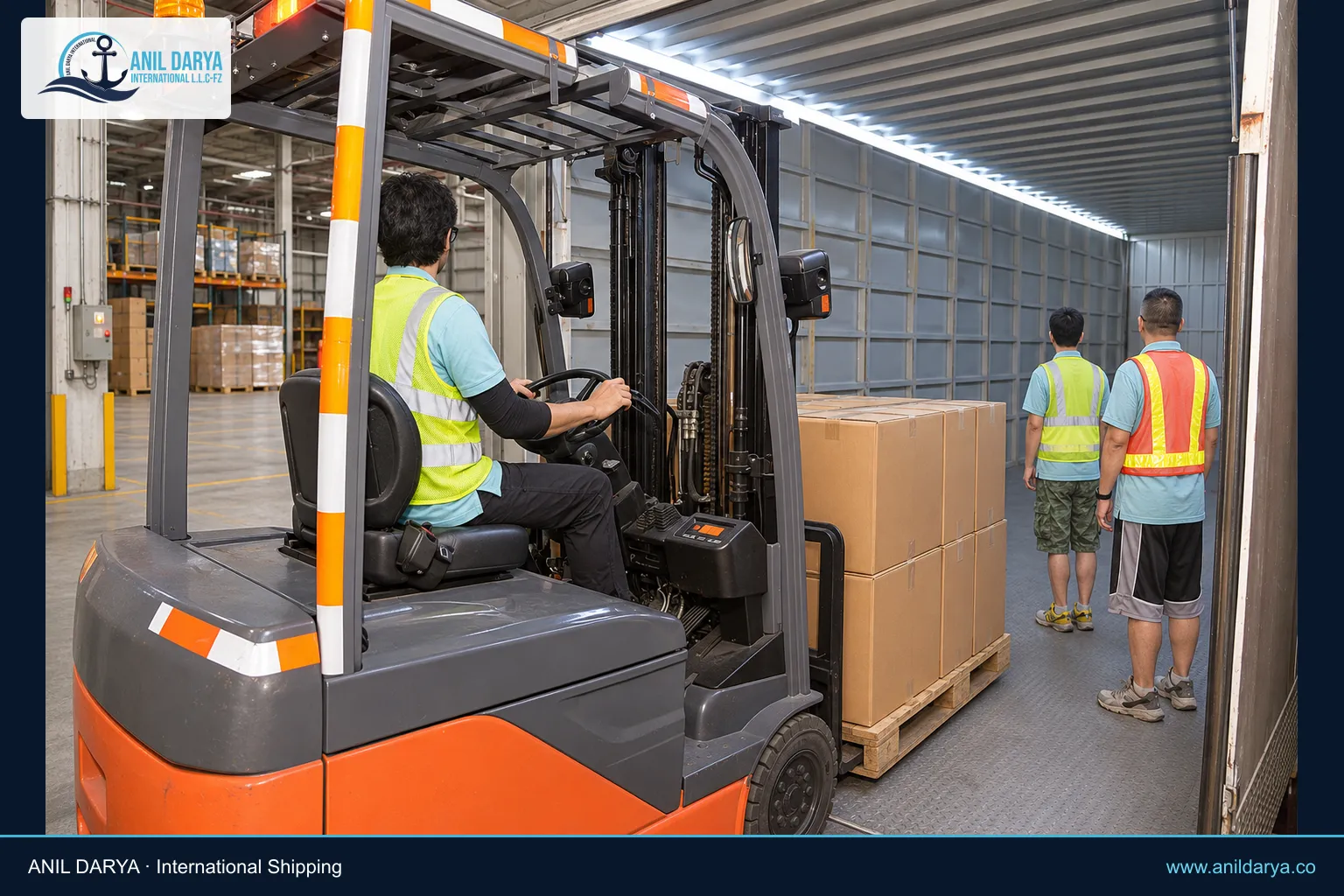
LCL cargo is unpacked in Colombo under customs control, so each shipper's papers in the box must match the manifest. If you buy from three or four factories in the same province, have them deliver to one warehouse near the load port and ship one container under one B/L. You pay for one CusDec and one delivery instead of several. Our FCL vs LCL guide shows where a full box starts to pay, and our sea freight service covers equipment and booking.
Dangerous goods, breakbulk and project cargo
Lithium batteries, paints, resins, adhesives, aerosols and cleaning chemicals from China are dangerous goods at sea. Since 1 January 2026 the 2024 edition of the IMDG Code (Amendment 42-24) is mandatory, so the Safety Data Sheet and the DG declaration must follow it.
Before a carrier accepts DG at a Chinese terminal, China Customs wants two packaging documents from the supplier: a performance inspection result for the packaging design and a use identification certificate for the filled packages. Ask the factory for both before you book. On the Sri Lankan side, toxic chemicals and pesticides are under licence control, so the importer's licence has to exist before the container sails. Our dangerous goods team checks the UN number, class and packing group against the line's acceptance before you commit.
Transformers, crushers, steel structures and plant for Sri Lankan projects often do not fit a box. Pieces that fit a flat rack can travel on a container service. Larger units go on multipurpose or heavy-lift ships, and Hambantota publishes bulk, breakbulk and project cargo handling on its general purpose and multipurpose berths. We need drawings, weights, centre of gravity and lifting points for every piece before we can pick a ship. See our break bulk and project cargo service.
The China export side: who files and when
China Customs takes the export declaration from the consignor, normally the factory or the trading company that sells to your Sri Lankan buyer. According to the Shanghai municipal government's customs guide, the declaration is made after the goods reach the customs supervision area and 24 hours before loading. The consignor files itself or hires a customs broker, and needs market entity status and registration as a foreign trade operator, which it can complete online through the China International Trade Single Window.
- The supplier or its forwarder in China handles the truck, stuffing, export filing and terminal delivery. We give them the booking, vessel and cut-off dates.
- The HS code, description and value on the Chinese export entry should agree with the invoice your Sri Lankan agent gives Customs, and with the certificate of origin if you claim APTA.
Sri Lanka Customs: CusDec, registration and documents
Sri Lanka Customs says import consignments are declared through a Customs House Agent and submitted online. The CusDec can only be lodged after the goods arrive and after the shipping agent issues the delivery order. That is why your agent should have every document in hand before the ship berths, not after.
The carrier's side starts earlier. Under Gazette Notification No. 1886/55 of 31 October 2014, the inward cargo report must reach Customs no later than 72 hours before the ship arrives at its first Sri Lankan port. A vague description on the B/L shows up in that report before the box is even landed.
The importer needs a Taxpayer Identification Number and Customs registration. Under Imports and Exports (Control) Regulations No. 06 of 2026, from 19 June 2026 banks verify that registration before sending an advance payment for imports, so an unregistered buyer cannot pay your supplier's deposit.
| Document | Who provides it | What to check on a China shipment |
|---|---|---|
| Commercial invoice | Chinese supplier | Transaction value, clear description, HS code that matches the export entry |
| Packing list | Chinese supplier | Weights, package count and marks match the invoice and B/L |
| Carrier bill of lading | Shipping line, released through us | Consignee is the importer on the CusDec; Colombo or Hambantota as port of discharge |
| Delivery order | Shipping agent in Sri Lanka | Needed before the CusDec can be lodged |
| APTA certificate of origin | Designated authority in China | Only if you claim the AP rate; every line must qualify on its own |
| Licences and approvals | Importer and the agency | Import Control Licence, SLSI clearance, TRC, NMRA or CDDA as the line requires |
| CusDec | Consignee's Customs House Agent | Lodged in ASYCUDA World after arrival and the delivery order |
Customs sends cargo to examination by risk, and the importer pays the right duty before release. Payment goes through Bank of Ceylon or People's Bank, at a branch or online. Customs lists small fixed charges as well: Rs. 250 per declaration, Rs. 100 seal charge per container and Rs. 1,600 overtime on FCL cargo. We do not clear customs in Sri Lanka. Your agent does, and we agree the plan with them before your booking is confirmed.

Import duty, VAT and levies on Chinese goods
Duty and taxes at destination are paid by the consignee or its agent. Sri Lanka Customs collects a stack of charges, each set per HS code in the National Imports Tariff Guide, and each with its own base.
| Charge | How Sri Lanka Customs calculates it |
|---|---|
| Customs duty (general or preferential) | CIF value x duty rate, or quantity x unit rate |
| EDB Cess | CIF value x cess rate, or quantity x unit rate |
| Ports and Airports Development Levy (PAL) | CIF value x PAL rate |
| Excise (Special Provisions) Duty | (CIF + 15% of CIF + duty + cess + PAL) x excise rate |
| Surcharge | Duty x surcharge rate |
| VAT | (CIF + 10% of CIF + duty + cess + PAL + excise + surcharge) x VAT rate |
| SSCL | Same base as VAT x SSCL rate |
From 1 April 2026 the general duty bands moved from 0%, 15% and 20% to 0%, 10%, 20% and 30%. The 2026 tariff guide shows VAT at 18% and SSCL at 2.5% on most lines. Cess and PAL are to be phased out by 2029, but today they still sit in the landed cost. The order matters: VAT is charged on a base that already includes duty and every levy, so a higher duty band raises the VAT too. Agree the HS code with your agent before the order is placed.
APTA: can Chinese goods get a lower duty in Sri Lanka?
Sometimes. Sri Lanka Customs lists China and Sri Lanka among the members of the Asia-Pacific Trade Agreement, and each tariff line in the 2026 guide carries an AP column for APTA rates beside the general rate. No bilateral China agreement appears in the tariff guide's list of preferential schemes, so APTA is the route to check.
The tariff guide says a preferential rate is charged only when the goods are proved to the satisfaction of the Director General of Customs to have been produced in the partner country, under the terms of the Gazette resolution. Under the APTA rules of origin, that proof is a certificate of origin issued by an authority designated by the exporting government. Two practical points follow:
- Many lines show no AP concession. Check the AP column and the origin of each line.
- APTA's direct consignment rule allows transit through a non-member country only for geographical or transport reasons, and only if the goods do not enter trade there or undergo any operation beyond unloading, reloading or keeping them in good condition. Plain transhipment can meet that; reselling, repacking or mixing the goods on the way needs a check with your agent first.
[AMIR-FACT: whether our Sri Lankan consignees actually claim APTA rates on China cargo, for which product groups, and which issuing body in China their suppliers use for the certificate]
SLSI, licences and restricted goods
Every tariff line has an ICL/SLSI column. An L means the line needs an Import Control Licence, and an S means the product sits under the Sri Lanka Standards Institution's import inspection scheme. Read that column for every product on the order before the factory starts production.
The SLSI scheme runs under Gazette Notification No. 2064/34 of 29 March 2018, made under the Imports and Exports Control Act No. 1 of 1969. SLSI accepts a consignment on one of five grounds:
- a certificate of conformity from an accredited laboratory;
- a certificate of conformity from the national standards body of the exporting country;
- import from a manufacturing plant registered with SLSI;
- a national product certification mark compatible with the Sri Lanka Standard;
- the manufacturer's record of compliance.
For a first order, get a lab certificate of conformity for the exact model before shipping.
| Goods from China | Approval named by Sri Lanka Customs |
|---|---|
| Mobile phones, routers and accessories | Telecommunications Regulatory Commission (TRC) and Import Control Licence |
| Medicines and medical equipment | National Medicines Regulatory Authority (NMRA) and Import Control Licence |
| Cosmetics | Cosmetics, Devices and Drugs Authority (CDDA) |
| All food items, fruit and vegetables | Imported Food Inspection Unit (IFIU) |
| Outboard engines over 25 HP, motorcycle engines over 250cc | Ministry of Defence and Import Control Licence |
The US Commercial Service guide adds that used or reconditioned air conditioners and refrigerators are controlled, and that remote-controlled toys, toxic chemicals and pesticides are under licence control. Vehicles follow their own rules and valuation, so confirm the current position with your agent before you buy a car or truck in China for Sri Lanka.
Routing via Dubai: Jebel Ali, consolidation and re-export
A direct sailing is simplest. Dubai helps when your trade already runs through the UAE.
| Option | How it works | What to watch |
|---|---|---|
| Transhipment at Jebel Ali | The box arrives from China and connects to a ship for Colombo | Dubai Customs treats transit as its own declaration type; check APTA direct consignment |
| Consolidation in Dubai | Chinese goods are combined with goods from other origins in one container | Each line keeps its own origin; APTA may not apply after mixing |
| Free zone stock and re-export | You hold Chinese stock in Jafza and ship to Sri Lanka as orders come in | The Sri Lankan buyer must be registered with Customs before paying |
When cargo lands, is consolidated or is re-exported in Dubai, we clear it through UAE customs for a fee. Our Jebel Ali port guide covers the terminals, and our article on re-exporting through Jafza explains the free zone steps.
[AMIR-FACT: whether we route China to Sri Lanka cargo via Jebel Ali in practice (transhipment or Dubai consolidation), the carriers used from Jebel Ali to Colombo, and the real extra days compared with a direct sailing]
Typical cargo on this lane and what each needs
| Cargo | Usual equipment | Papers to plan |
|---|---|---|
| Fabric, yarn and garment accessories | 40ft or LCL | HS code by fibre and weave; AP column check; SLSI for listed items such as sewing thread |
| Machinery and spare parts | FCL, flat rack or breakbulk | Catalogues, drawings, piece list; licence if used |
| Phones, routers, electronics | LCL or FCL | TRC approval and Import Control Licence before shipping |
| Solar panels, inverters, lithium batteries | 40ft high cube; DG booking for batteries | SDS, Chinese DG packaging certificates, SLSI where listed |
| Tiles, sanitary ware, steel, building materials | 20ft for heavy goods | Weight per container; ICL/SLSI column for each item |
Step by step: shipping from China to Sri Lanka with Anil Darya
- Send us the product, HS code if known, weight, volume, supplier city, ready date and the delivery point in Sri Lanka.
- Name the Customs House Agent in Sri Lanka and confirm the importer has a TIN and Customs registration. We agree the clearance plan with that agent before we confirm the booking.
- Check the tariff line: general rate, AP rate, PAL, cess and the ICL/SLSI column. Start licences, SLSI certificates and sector approvals now.
- Agree the Incoterm with the supplier, and ask for an APTA certificate of origin if the AP rate is worth claiming.
- We book space with the shipping line, confirm the Colombo call on that voyage and send the supplier the booking, cut-offs and draft carrier B/L.
- The supplier or its origin agent stuffs the container and lodges the Chinese export declaration 24 hours before loading.
- We check consignee, notify party, description and port of discharge on the B/L, plus DG papers where needed, before the line issues it.
- The ship sails, the carrier B/L is released to you through us, and your agent lodges the CusDec once the delivery order is out, so the box leaves inside its free time.
[AMIR-FACT: one real China to Sri Lanka cross-trade shipment we handled (cargo, load port, discharge port, carrier, what we coordinated and the outcome), cleared for publication]
What drives the cost of container shipping from China to Sri Lanka?
We do not publish prices, because rates change with every sailing. These are the parts of a landed cost.
| Cost part | What moves it | Usually paid by |
|---|---|---|
| Origin charges in China | Trucking distance, export filing, terminal handling, LCL warehouse | Supplier under FOB |
| Ocean freight | Container type, season, carrier, same vessel or transhipped | Buyer under FOB, supplier under CFR |
| DG and out-of-gauge | DG surcharge, flat rack or breakbulk premium, lashing and survey | As agreed in the contract |
| Destination charges | Terminal handling, delivery order, LCL unpacking | Consignee |
| Duty, levies and VAT | Duty band or AP rate, PAL, cess, excise, VAT and SSCL on CIF | Consignee or its agent |
| Approvals | SLSI certificates or testing, licence and agency fees | Importer |
| Agent and inland delivery | Agent's fee, examination, distance from the port | Consignee |
| Storage and detention | Late papers, a held approval, slow payment of duty | Whoever caused the delay, under your contract |
A missing SLSI certificate or TRC approval can cost more in storage and container detention than any saving on freight. Our article on demurrage and detention shows how those charges build up. Our Dubai freight forwarding team can go through any quote line by line.
Checklist before the container leaves China
- Importer has a TIN and is registered with Sri Lanka Customs.
- Customs House Agent named and the clearance plan agreed.
- HS code agreed for every line, with general rate, AP rate and levies checked.
- ICL/SLSI column read; licence and SLSI certificate in hand where needed.
- TRC, NMRA, CDDA or food approvals in place for the goods that need them.
- APTA certificate of origin issued, if you claim the preference.
- Colombo call confirmed on the actual voyage, not just the service.
- For DG: UN number, SDS, Chinese packaging certificates, DG declaration and line approval.
Mistakes that hold Chinese cargo in Colombo
- Shipping before destination clearance is agreed. With no Customs House Agent on the job, no CusDec can be lodged and the box ages at the terminal.
- Ignoring the S and L marks. Goods under SLSI or licence control wait at the port until the paper exists.
- Assuming every Chinese product gets the APTA rate. Many lines have no concession, and without the certificate you pay the general rate.
- Breaking direct consignment. Reworking or reselling the goods in a third country before Sri Lanka can cost you the preference.
- Paying a deposit through an unregistered buyer. Since June 2026 the bank checks Customs registration before it remits.
Frequently asked questions
Which Sri Lankan port do ships from China arrive at?
Most containers arrive at Colombo, which handled 8,291,178 TEU in 2025 across five container terminals. Hambantota on the south coast handles vehicles, bulk, breakbulk and a smaller number of containers.
How long does sea freight from China to Sri Lanka take?
It depends on the load port and the order of calls. ONE's February 2026 South China schedule showed 23 days from Shekou to Colombo on a direct service that called India and Pakistan first. Ask for the routing on each quote and add time for export filing and the CusDec.
Do goods from China get a lower import duty in Sri Lanka?
Some do, under the Asia-Pacific Trade Agreement, which both countries belong to. The AP column in the tariff guide shows the rate, and you need an APTA certificate of origin from the designated authority in China to claim it.
What is the import VAT on Chinese goods in Sri Lanka?
VAT is 18% on most lines and SSCL is 2.5%. Both are charged on CIF plus 10% plus duty, cess, PAL, excise and any surcharge, so they are higher than 18% of the invoice.
Does Anil Darya clear customs in Sri Lanka?
No. Your Customs House Agent clears the goods, and duty and taxes are paid by the consignee or its agent. We agree the plan with that agent before your booking is confirmed and coordinate the documents and the arrival.
Can China to Sri Lanka cargo go through Dubai?
Yes. It can tranship at Jebel Ali, be consolidated in Dubai with other goods, or be held in a free zone and re-exported. When cargo lands in Dubai we clear it through UAE customs for a fee. Check APTA origin rules before mixing or reselling the goods there.
Get a quote for shipping from China to Sri Lanka
Send us the supplier city, the goods, the ready date and the Sri Lankan delivery point, and name your Customs House Agent. We will come back with a routing, the carrier and a price. Use our freight rate inquiry form, or contact our team to plan a DG, breakbulk or project move first.
Sources
- Ocean Network Express (East Asia): West Asia service export schedule ex South China, February 2026 (Shekou to Colombo days, CCAM note)
- Sri Lanka Ports Authority: Port of Colombo terminals
- Sri Lanka Ports Authority: General cargo services (CFS Peliyagoda)
- Baird Maritime: Colombo West terminal and SLPA 2025 volumes (October 2026)
- HIPG: Hambantota port infrastructure
- HIPG: Ro-Ro and container records, 2025 volumes
- HIPG: Bulk, project and breakbulk cargo
- Sri Lanka Customs: Import procedures (CusDec, delivery order, manifest rule, charges, payment)
- Sri Lanka Customs: Central Cargo Examination Directorate (documents, risk-based examination, LCL)
- Sri Lanka Customs: Cargo clearing process and restricted items needing approvals
- Sri Lanka Customs: Computation of import levies
- Sri Lanka Customs National Imports Tariff Guide 2026, Chapter 52 (AP column, ICL/SLSI, VAT, SSCL)
- Sri Lanka Customs National Imports Tariff Guide 2025, preamble (APTA members, preferential rate conditions)
- Export Inspection Council of India: Asia-Pacific Trade Agreement text and rules of origin (Rules 5 and 7)
- Daily FT: Customs duty bands from 1 April 2026 and para-tariff phase-out (July 2026)
- Sri Lanka Standards Institution: Import inspection
- US International Trade Administration: Sri Lanka prohibited and restricted imports
- D. L. and F. De Saram: Import payment rules, Regulations No. 06 of 2026
- Shanghai Municipal Government: Customs registration and export declaration
- CIRS: China Customs inspection of packaging for exported dangerous goods
- IMO: IMDG Code 2024 edition (Amendment 42-24)
- Dubai Customs: Customs declaration types (import, export, transit)
- Jafza: About the Jebel Ali Free Zone
Reviewed: 11 November 2026