
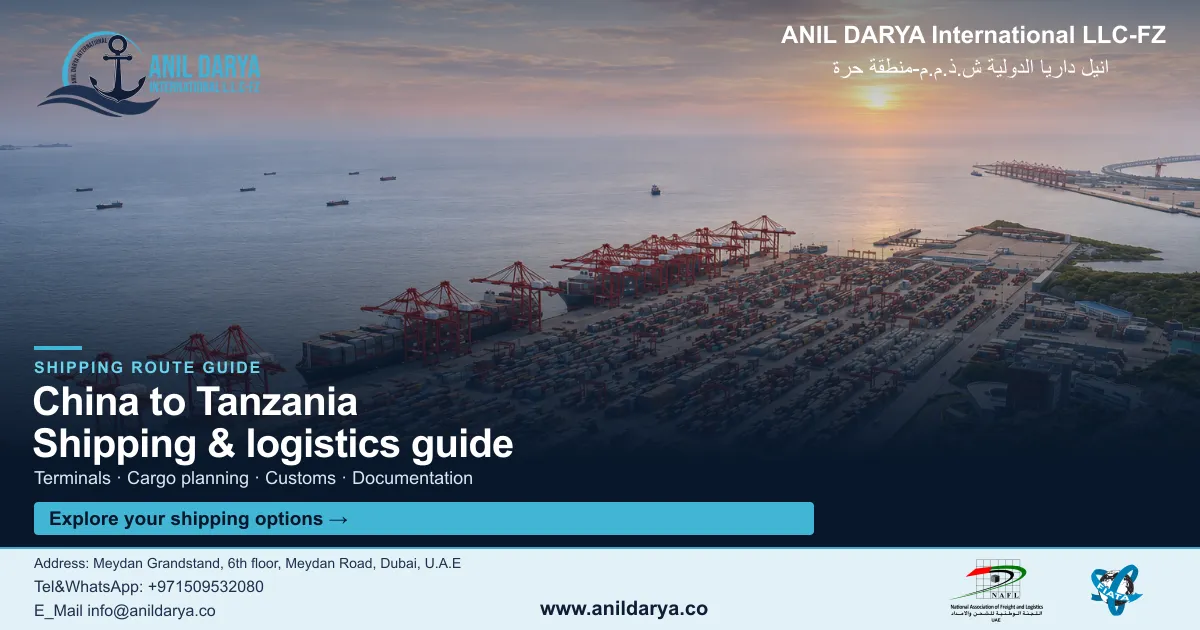
Shipping from China to Tanzania usually means a container loaded at Shanghai, Ningbo, Nansha, Shekou or Qingdao and discharged at the Port of Dar es Salaam, with a call at Port Klang in Malaysia on the way. Your Chinese supplier files the export declaration with China Customs, a TBS-appointed inspector issues a Certificate of Conformity for regulated goods before loading, and the consignee's licensed clearing agent clears the cargo with the Tanzania Revenue Authority. We book the ocean freight from Dubai and coordinate both ends, so this guide explains who does what on this lane.
China to Tanzania shipping at a glance
| Item | Detail |
|---|---|
| Main Chinese load ports | Shanghai, Ningbo, Nansha (Guangzhou), Shekou (Shenzhen), Qingdao |
| Main Tanzanian discharge port | Dar es Salaam (UN/LOCODE TZDAR), about 95% of Tanzania's international trade |
| Smaller Tanzanian ports | Tanga (north) and Mtwara (south), mostly reached by feeder or by road from Dar es Salaam |
| Typical routing | Weekly loops via Port Klang (Malaysia) on the carrier pages we opened |
| Published port-to-port days | Emirates Shipping Line FNX: Shekou 17, Nansha 18, Ningbo 21, Shanghai 23, Qingdao 25 days to Dar es Salaam |
| China export filing | Consignor or its customs broker, after goods enter the customs area and at least 24 hours before loading |
| Tanzania pre-shipment check | TBS PVoC: Certificate of Conformity from CCIC, Intertek, SGS, TUV Rheinland or WSCT in China |
| Tanzania import filing | Licensed clearing and forwarding agent lodges in TANCIS, at least 7 days before arrival |
| Import duty (EAC tariff) | 0%, 10%, 25% or 35% by goods category |
| VAT on import | 18% into Mainland Tanzania, 15% into Zanzibar |
| Free port storage at Dar es Salaam | Local FCL 5 days, transit FCL 15 days (TPA tariff, January 2026) |
| Our role | Ocean booking from Dubai, carrier B/L released through us, coordination with shipper and consignee's broker |
How shipping from China to Tanzania works as a cross-trade
On this lane the cargo never touches the UAE unless you choose to route it that way. It moves from a Chinese port to Dar es Salaam, and we arrange it from our office in Dubai. That model is called cross-trade. It suits Tanzanian importers who already work with us on other lanes, trading companies in the UAE that sell Chinese goods into East Africa, and buyers who want one contact for the sea leg.
| Task | Who handles it |
|---|---|
| Ocean freight booking with the shipping line | Anil Darya, from Dubai |
| Factory pickup, container stuffing, Chinese export declaration | The shipper or its origin agent, coordinated with us |
| PVoC inspection and Certificate of Conformity | The exporter or importer, with a TBS-appointed inspector in China |
| Bill of lading | The shipping line's own B/L, issued and released to you through us as the line's agent |
| Tanzanian customs clearance and delivery | The consignee's licensed clearing and forwarding agent |
| Duty, VAT and levies in Tanzania | Paid by the consignee or its broker |
The bill of lading on this lane is the carrier's own document. Anil Darya acts as agent for many shipping lines, so the line's B/L is issued and released to you through us. We do not issue a house bill of lading on cross-trade bookings.
We do not sell customs clearance in Tanzania. Before we confirm a booking, we ask the consignee to name its clearing agent in Dar es Salaam and confirm that the agent has the documents it needs. Only then does the cargo go on board.
Load ports and the discharge port
Which Chinese port should you ship from?
Pick the port nearest the factory. A long truck haul inside China costs more than most buyers expect, and the direct services to Dar es Salaam call the big coastal ports anyway.
| Supplier region | Load port on the services we checked | Notes |
|---|---|---|
| Shanghai, Jiangsu, Zhejiang | Shanghai (Waigaoqiao), Ningbo | Both on the FNX loop and the DP World China Africa Link |
| Guangdong (Guangzhou, Foshan, Dongguan, Shenzhen) | Nansha, Shekou | Shortest published transit to Dar es Salaam on FNX |
| Shandong and north China | Qingdao | ESL calls FNX the first service to link Qingdao directly with Dar es Salaam |
| Fujian, Tianjin and other ports | Feeder or truck to a mainline port | Ask for the full routing before you book |
The Tanzanian side: Dar es Salaam and the smaller ports
The Tanzania Ports Authority (TPA) says Dar es Salaam handles about 95% of the country's international trade. It also lists the landlocked markets the port serves: Zambia, DR Congo, Burundi, Rwanda, Malawi, Uganda and Zimbabwe. On the FNX schedule, ships from China berth at the terminal of Tanzania East Africa Gateway Terminal Limited (TEAGTL).
Tanga and Mtwara are smaller TPA ports. None of the China services we checked list them as a direct call. Cargo for the north or the south usually discharges at Dar es Salaam and moves on by feeder or truck, so plan that leg and its cost from the start.
Direct services and transhipment on the China to Dar es Salaam lane
Most sailings from China to Dar es Salaam are direct loops, meaning your container stays on one ship from the Chinese port to Tanzania. Those loops still stop on the way, and the carrier pages we opened all name Port Klang in Malaysia as the intermediate call.
| Service | Rotation as published | Frequency | Published transit to Dar es Salaam |
|---|---|---|---|
| Emirates Shipping Line Fanaka (FNX) | Qingdao, Shanghai, Ningbo, Nansha, Shekou, Port Klang, Dar es Salaam, Port Klang, Qingdao | Weekly, 8 ships of 2,000 to 2,400 TEU, 56-day round trip | Shekou 17, Nansha 18, Ningbo 21, Shanghai 23, Qingdao 25 days |
| DP World China Africa Link (announced 2 November 2026) | Shanghai, Ningbo, Nansha, Port Klang Westport, Dar es Salaam, Maputo, Singapore, Shanghai | Weekly, starting late November 2026 | Not yet published |
Read port-to-port days as sailing time only. They leave out the wait for the weekly cut-off, any berth queue at Dar es Salaam, clearance and the inland leg. A loop that calls Mombasa first, or a booking that switches ships at a hub, adds days. Ask for the exact routing on every quote, including whether the box stays on one vessel.
[AMIR-FACT: which carriers we actually book from China to Dar es Salaam, and our real port-to-port and door-to-door days from Shanghai, Ningbo and Nansha on recent bookings]
Routing through Dubai: when it helps
Most China to Tanzania cargo should go direct. In three cases a stop in the UAE can make sense, and each one changes the paperwork, so decide before the supplier ships.
| Option | When it fits | What changes |
|---|---|---|
| Relay via Jebel Ali | No suitable direct sailing, or you are combining China cargo with a UAE sailing to Dar es Salaam | Two ocean legs; carriers such as Emirates Shipping Line (GIA, 15 days Jebel Ali to Dar es Salaam) publish the second leg |
| Consolidate in Dubai | You buy from Chinese suppliers and from UAE or other origins for the same Tanzanian buyer | One container from Dubai to Dar es Salaam instead of several LCL lots |
| Hold stock in JAFZA, then re-export | You sell to several East African buyers and want stock close to them | Goods sit in a customs bonded zone, then ship under a re-export declaration when sold |
JAFZA describes itself as the largest customs bonded zone in the Middle East, and Dubai Customs says a free zone company must file a customs declaration before goods are sold into the UAE mainland. Goods held there for re-export are not cleared into the mainland. Our article on re-exporting through JAFZA explains the set-up, and our Jebel Ali port guide covers the terminal side. Where your cargo is cleared, consolidated or re-exported in Dubai, Dubai customs clearance is a service we do for a fee.
A Sharjah-side option also exists for the second leg: GT Lines runs a direct Khorfakkan to Dar es Salaam shuttle with 9 days published transit. Our Sharjah port shipping guide covers that side of the UAE.
[AMIR-FACT: whether we have routed China cargo for Tanzania via Jebel Ali (relay, Dubai consolidation or JAFZA re-export), which carriers we used for each leg, and when it beat a direct sailing]
Sea freight from China to Tanzania: FCL, LCL and special cargo
| Mode | Good for | Plan for |
|---|---|---|
| FCL 20ft | Tiles, steel bars, nails, heavy machinery parts | Weight limits on Tanzanian roads and the carrier's payload cap |
| FCL 40ft and 40ft high cube | Furniture, solar panels, household goods, mixed stock from one supplier | PVoC inspection before the door is sealed |
| LCL | First orders, samples, a few cubic metres | Release depends on the whole shared box clearing at Dar es Salaam |
| Reefer | Chilled or frozen food, some chemicals | Shelf-life rule under PVoC, TPA cold storage surcharge |
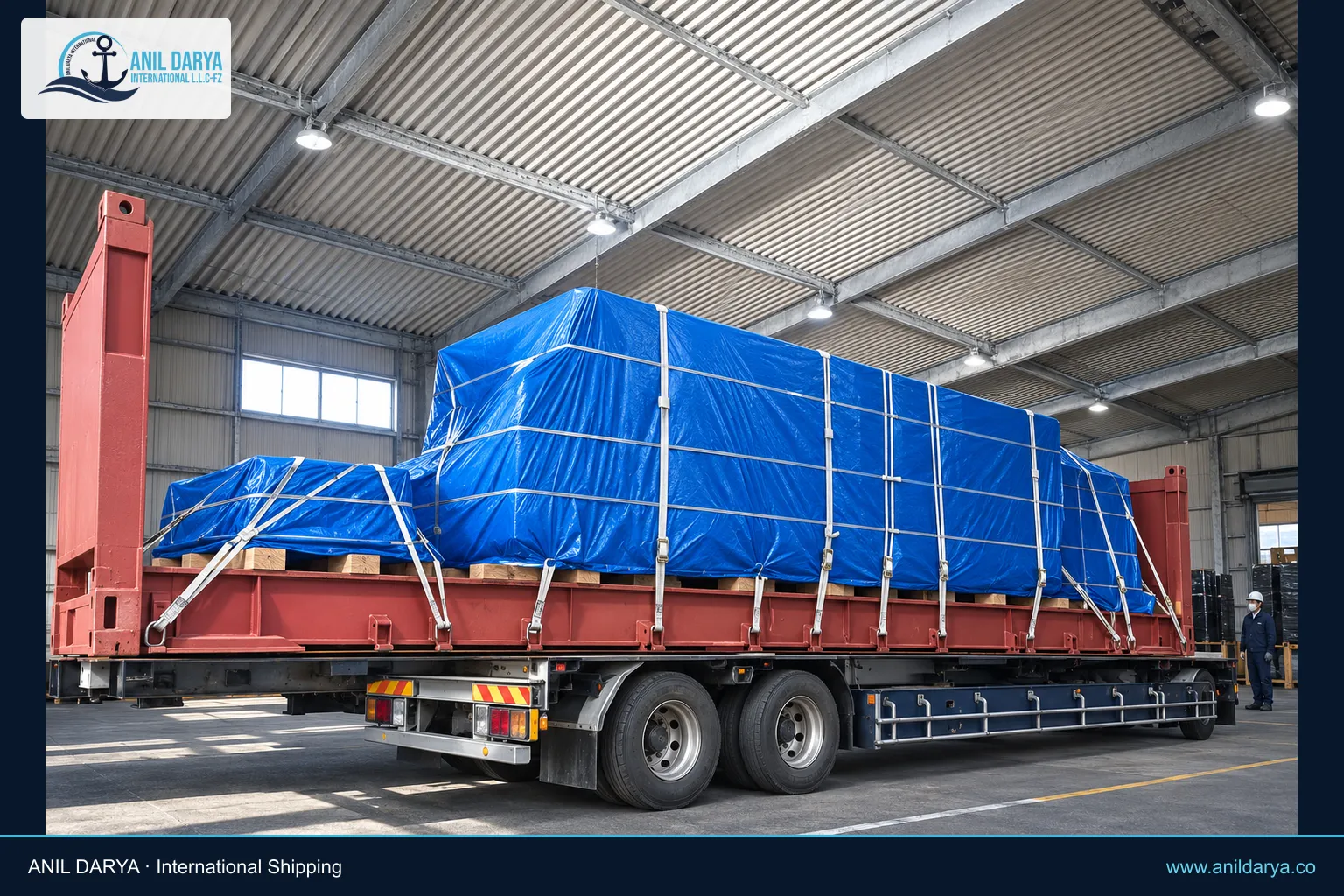
| Flat rack and open top | Generators, transformers, construction machines | Lashing plan, TPA 30% out-of-gauge handling surcharge |
| Breakbulk and project cargo | Steel structures, plant, heavy lifts | Vessel choice, port crane or ship's gear, inland road permits |
FCL or LCL from China?
LCL looks cheaper per cubic metre, but on this lane it also means a consolidation cut-off in China, a stop at a container freight station in Dar es Salaam and a wait for every co-loader's papers. If you have more than half a container, price both. Our guide to FCL vs LCL costs shows how to find the break-even, and our sea freight service covers equipment choice.
Machinery and project cargo
Chinese plant for Tanzanian mining, energy and road projects often arrives out of gauge. If a piece fits a 40ft flat rack by size and weight, a container service gives you a weekly sailing. If it does not, you need breakbulk tonnage, and the vessel date drives the whole plan. Get drawings, weights and lifting points from the supplier before you ask for a rate. Our break bulk and project cargo team plans the vessel and stowage side.
Dangerous goods on this lane
Lithium batteries for solar systems, paints, adhesives, solvents and cleaning chemicals are common in Chinese orders for Tanzania, and all of them can be dangerous goods. The checks happen at both ends.
- China. China Customs inspects the packaging used for exported dangerous goods, both the packaging type and how the real goods are packed. Ask the supplier for the packaging inspection results before you book, because the line will not accept the DG booking without them.
- At sea. The IMDG Code 2024 edition (Amendment 42-24) has been mandatory since 1 January 2026. The SDS and DG declaration must follow it.
- Dar es Salaam. TPA requires DG to be declared by class, not trade name. A daily DG surcharge starts 24 hours after discharge (USD 24 per TEU for containers), and DG handling carries a 10% surcharge. Plan direct delivery.
- Mining chemicals. Under GN No. 184 of 2025, TASAC alone clears chemicals used by mining companies and some other listed items. Keep them on their own bill of lading.
Our dangerous goods shipping team checks the UN number, class, SDS and carrier acceptance before we confirm space.
The China export side: who files and when
China Customs (GACC) controls the export. According to the Shanghai municipal government's guidance, the consignor declares the goods after they reach the customs supervision area and no later than 24 hours before loading. It can file itself or through a customs broker. The consignor must hold market entity status, be registered as a foreign trade operator and be recorded with customs, which can be done online through the China International Trade Single Window.
In practice this means your supplier, or its origin agent, files the declaration. A buyer in Tanzania or Dubai cannot act as exporter of record in China. That is why FOB is usually the cleanest term for this lane: the supplier clears export and loads the goods, and the ocean freight booked through us starts at the Chinese port. Under EXW you need a Chinese party willing to export in its own name. Our Incoterms 2020 guide shows where costs and risk pass.
Make sure the value and goods description on the Chinese export declaration match the commercial invoice your consignee's agent will give TRA. Differences invite questions at both ends.
TBS PVoC for goods shipped from China
Pre-shipment Verification of Conformity (PVoC) is the Tanzania Bureau of Standards (TBS) check that regulated goods meet Tanzanian standards before they leave the exporting country. It rests on section 4(1)(s) of the Standards Act No. 2 of 2009. TBS says regulated consignments that arrive without a Certificate of Conformity (CoC) will be rejected or fined.
Who inspects in China
TBS lists China Mainland, Macau, Hong Kong, Mongolia and Taiwan as zone 17. Five service providers cover it: China Certification and Inspection Group (CCIC), Intertek, SGS, TUV Rheinland and World Standardization Certification and Testing Group (WSCT). CCIC also inspects used motor vehicles exported from China to Tanzania.
| PVoC route | Fee on declared FOB value (TBS schedule) | Minimum and maximum |
|---|---|---|
| Route A | 0.50% | USD 250 to USD 5,000 |
| Route B | 0.45% | USD 250 to USD 5,000 |
| Route C | 0.25% | USD 250 to USD 5,000 |
How the certificate is issued
- The supplier or importer sends a request for certification to the inspector, with invoice, packing list and conformity documents such as accredited test reports.
- The inspector reviews the documents and takes samples for testing if the proof is not enough.
- The goods are physically inspected. For high-risk products, the inspector witnesses loading and seals the container.
- The CoC is issued. TBS says it is valid for three months from the date of issue.
- The importer submits the CoC to TBS through its online system for authentication, then the clearing agent uses it at the port.
Two practical points. First, food must arrive with at least 75% of its shelf life left (or 12 months for products with more than 18 months' shelf life), and other goods with at least 50%. Second, Intertek, one of the appointed inspectors, states a penalty of 15% of CIF value plus destination inspection for regulated goods shipped without a CoC. Book the inspection before the container is stuffed, not after.
Tanzania import customs, duty and VAT
Declaration and documents
TRA clears imports under the East African Community Customs Management Act 2004. The importer must appoint a licensed clearing and forwarding agent, who lodges the declaration in TANCIS. TRA urges agents to lodge at least 7 days before the vessel arrives, and TANCIS rejects incomplete declarations or weak goods descriptions automatically.
| Document (TRA list) | Comes from | Check before sailing |
|---|---|---|
| Final commercial invoice | Chinese supplier | HS code, unit price, Incoterm, consignee matches the B/L |
| Packing list | Chinese supplier | Package count and weights match the B/L |
| Bill of lading | Shipping line, released through us | Consignee and notify party are the Tanzanian importer and its agent |
| Agent's authorisation letter | Importer | Signed before arrival |
| Import permits (TMDA, TBS, TASAC and others) | Importer | Applied for before the supplier ships |
| Exemption documents, if any | Importer | Valid for the goods and the date |
| TBS Certificate of Conformity | PVoC inspector in China | Issued before loading for regulated goods |
Duty, levies and VAT
Goods from China pay the EAC Common External Tariff, because China is outside the EAC. TRA's 2025/2026 summary gives these bands and charges:
| Charge | Rate |
|---|---|
| Raw materials, pharmaceuticals, capital goods, agricultural implements | 0% duty |
| Semi-finished goods | 10% duty |
| Final consumer or finished commercial goods | 25% duty |
| Fully finished goods or special items | 35% duty |
| Railway Development Levy (home consumption, Mainland) | 2% of CIF |
| Customs Processing Fee | 0.6% of FOB |
| VAT on imports into Mainland Tanzania | 18% |
| VAT on imports into Zanzibar | 15% |
Some sensitive items carry higher specific rates, and listed goods also pay excise. Duty and taxes at destination are paid by the consignee or its broker. Check the HS code with the clearing agent before the order is placed, because the band decides most of the landed cost.

Typical cargo on this lane and the rules that apply
| Cargo | What to check first |
|---|---|
| Building materials (steel bars, roofing sheets, tiles, pipes) | PVoC status and the HS code band |
| Solar panels, inverters and lithium batteries | DG classification of batteries, PVoC, any exemption claimed |
| Machinery and spare parts | Dimensions for flat rack or breakbulk, capital goods duty treatment |
| Vehicles and motorcycles | CCIC inspection for used vehicles, excise by vehicle age |
| Electronics and household goods | PVoC and the 25% band for finished goods |
| Food and cosmetics | TBS registration, shelf-life rule, TMDA where relevant |
| Chemicals | DG rules, TASAC exclusive items for mining chemicals |
Prohibited and restricted goods in Tanzania
TRA lists narcotic drugs, tear gas substances, seditious or obscene material and used tyres for light commercial vehicles and passenger cars as prohibited. Live animals, plants, firearms, ammunition and ivory are restricted and need a permit from the relevant authority. TBS also publishes a list of banned products on its PVoC page, so check it for consumer goods.
TASAC has sole clearance rights over arms and ammunition, mineral concentrates, chemicals used by mining companies, government trophies and some live animals. If one bill of lading mixes these with general cargo, TASAC clears the whole consignment.
Transit cargo from China through Dar es Salaam
Many China containers discharged at Dar es Salaam are not for Tanzania. For Rwanda, Burundi and Uganda, TRA says goods under the EAC Single Customs Territory are declared once in the destination country. Cargo for Zambia, Malawi, DR Congo and Zimbabwe moves under a transit declaration in Tanzania and clears in the destination country. Transit FCL gets 15 free days in the port against 5 for local cargo. Show the final destination and consignee on the B/L from the start, because changing it after arrival costs time and charges.
How to arrange shipping from China to Tanzania, step by step
- Send us the cargo details. Supplier address, commodity, HS code, weights and volume, ready date, Incoterm and any DG.
- Agree destination clearance first. The consignee names its licensed clearing agent in Tanzania, and we confirm with them that the documents and permits are in order. We do not confirm the booking until this is agreed.
- Check PVoC and permits. The importer confirms whether the goods are regulated and applies for TMDA, TBS or other permits.
- Get the routing and rate. We compare direct loops and, where useful, a relay via Jebel Ali.
- Book the PVoC inspection. The supplier arranges it with a zone 17 inspector before stuffing.
- Confirm the booking with the line. DG, reefer and out-of-gauge cargo get carrier acceptance first.
- Origin handling. The shipper or its origin agent collects the cargo, stuffs the container and files the Chinese export declaration before the cut-off. We coordinate dates with them.
- Check the draft B/L against the invoice, packing list and CoC.
- Release the B/L. The carrier's bill of lading is issued and released to you through us.
- Pre-lodge in TANCIS. The consignee's agent lodges at least 7 days before arrival.
- Clear and collect. The consignee or its broker pays duty, VAT and levies, and takes delivery within the free days.
[AMIR-FACT: one real China to Tanzania cross-trade shipment we handled (cargo, load port, carrier, how PVoC and the consignee's clearing agent were coordinated, result), with client approval to mention it]
What affects the cost of shipping from China to Tanzania?
We do not publish rates, because they change with every sailing. These are the parts of the total and what moves them.
| Cost part | What moves it |
|---|---|
| Origin charges in China | Pickup distance, export filing, terminal handling, LCL consolidation |
| Ocean freight | Container type, load port, season, carrier, surcharges |
| PVoC | Route A, B or C and the FOB value, within the TBS minimum and maximum |
| Special cargo | DG surcharges, flat rack or breakbulk premiums, lashing |
| Destination charges in Dar es Salaam | Terminal handling, line local charges, CFS charges for LCL |
| Port storage | Days beyond the TPA free period, DG and out-of-gauge surcharges |
| Duty and taxes | HS code band, CIF value, VAT, levies |
| Inland delivery | Truck or rail, distance, transit bonds for neighbouring countries |
| Container demurrage and detention | Clearance delays and slow return of the empty |
The costs you can avoid are mostly on the Tanzanian side: a missing CoC, a late TANCIS lodgement and storage after the free days. All three are planning problems, not freight problems.
Checklist before the supplier ships
- Incoterm agreed, and the supplier knows it files the Chinese export declaration.
- Consignee's licensed clearing agent in Tanzania named and briefed.
- HS code and duty band confirmed with that agent.
- PVoC status checked, and a CoC issued before loading if needed.
- TMDA, TBS or other permits approved.
- Invoice, packing list, CoC and draft B/L show the same consignee, counts and weights.
- TASAC items on a separate bill of lading.
- Final destination, local or transit, shown on the documents.
- DG papers: UN number, class, SDS, China packaging results, DG declaration.
- Cargo insurance arranged for the whole route.
Common mistakes to avoid
- Shipping before destination clearance is agreed. With no clearing agent ready, the container sits in Dar es Salaam while free days run out.
- Loading regulated goods without a CoC. The penalty and destination inspection cost more than inspection in China.
- Booking an EXW purchase with no Chinese exporter of record. Nobody can file the export declaration.
- Treating transit days as door-to-door days. Cut-off waits, berthing and clearance add to the published sailing time.
- Declaring batteries or chemicals as general cargo. The line can refuse or fine the booking.
- Mixing TASAC items with general cargo on one bill of lading.
- Choosing LCL for a near-full container. You pay CFS charges and wait for every co-loader.
Frequently asked questions
How long does shipping from China to Tanzania take?
Emirates Shipping Line's FNX service publishes 17 days from Shekou, 18 from Nansha, 21 from Ningbo, 23 from Shanghai and 25 from Qingdao to Dar es Salaam. Door to door takes longer, because cut-off, clearance and delivery come on top.
Which port in Tanzania do ships from China use?
Dar es Salaam. It handles about 95% of Tanzania's international trade, and the China services we checked call there. Cargo for Tanga or Mtwara usually continues by feeder or road.
Do goods from China need a PVoC certificate for Tanzania?
Regulated goods do. A TBS-appointed inspector in China (CCIC, Intertek, SGS, TUV Rheinland or WSCT) issues the Certificate of Conformity before shipment. Goods arriving without one can be rejected or fined.
What import duty and VAT apply to goods from China?
The EAC Common External Tariff applies: 0%, 10%, 25% or 35% by category. VAT is 18% into Mainland Tanzania and 15% into Zanzibar, plus a 2% Railway Development Levy and a 0.6% Customs Processing Fee.
Who clears the cargo in Tanzania?
A licensed clearing and forwarding agent appointed by the consignee, who lodges in TANCIS at least 7 days before arrival. We coordinate with that agent before we confirm the booking but do not clear goods in Tanzania ourselves.
Who issues the bill of lading on a China to Tanzania booking with you?
The carrier does. On a Chinese load port to Dar es Salaam booking you receive the shipping line's own B/L, and because we act as agent for many lines, it is issued and released to you through our Dubai office. Send it, or its release details, to your Tanzanian clearing agent before the vessel arrives.
Is it worth routing China cargo for Tanzania through Dubai?
Usually not for a single full container. It can help when you consolidate goods from several origins in Dubai, hold stock in JAFZA for several African buyers, or lack a suitable direct sailing.
Can I ship machinery or project cargo from China to Dar es Salaam?
Yes. Pieces that fit a flat rack move on the weekly container loops. Larger pieces move as breakbulk. TPA adds a 30% surcharge on handling out-of-gauge cargo, so include it when comparing options.
Get a quote for your China to Tanzania shipment
Send the supplier location, cargo details, ready date and your clearing agent's name through our freight rate inquiry form, and we will come back with sailings and a price. For DG, breakbulk or a Dubai routing, contact our team first. You can also read about our Dubai freight forwarding team.
Sources
- Emirates Shipping Line: FHX and FNX service advisory and brochure (rotation, vessels, transit table)
- DP World: China Africa Link announcement, 2 November 2026
- Emirates Shipping Line: GIA service advisory, 25 July 2025 (Jebel Ali to Dar es Salaam)
- GT Lines: KTX Khorfakkan Tanzania Express announcement, 27 July 2026
- Tanzania Ports Authority: Dar es Salaam Port
- Tanzania Ports Authority: Tariff Book Sea Ports, January 2026
- Tanzania Revenue Authority: Import procedures
- Tanzania Revenue Authority: Taxes and duties at a glance 2025/2026
- Tanzania Revenue Authority: Value Added Tax
- Tanzania Revenue Authority: Single Customs Territory
- Tanzania Bureau of Standards: Pre-shipment Verification of Conformity
- Tanzania Bureau of Standards: Guideline for PVoC Programme 2025
- Tanzania Bureau of Standards: Contracted PVoC service providers, zones and fees
- Tanzania Bureau of Standards: Summarised PVoC procedure, August 2026
- Intertek: Exports to Tanzania PVoC
- Clyde & Co: TASAC exclusive items regulations, GN No. 184 of 2025
- Shanghai Municipal Government: Customs registration and export declaration
- CIRS: China customs inspection of exported DG packaging
- IMO: IMDG Code 2024 edition
- JAFZA: Jebel Ali Free Zone
- Dubai Customs: FAQ (free zone sales to mainland)
Reviewed: 11 November 2026