
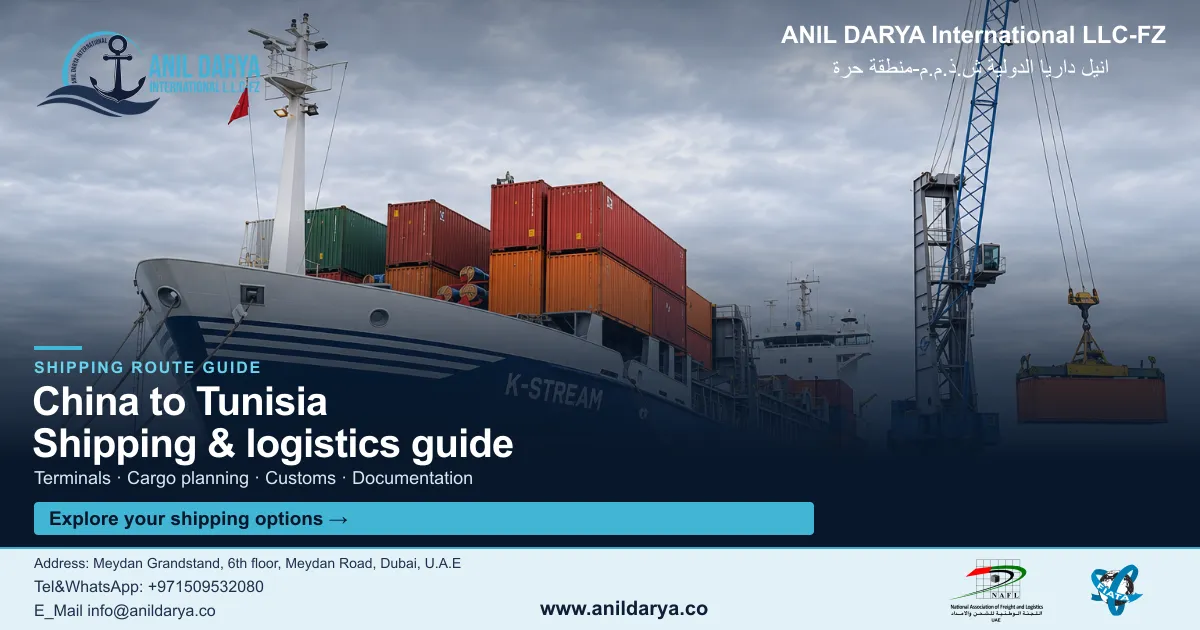
Shipping from China to Tunisia almost always means two ships: a large Asia to Mediterranean vessel to a hub such as Malta, Gioia Tauro or Algeciras, then a feeder to Radès, the container port of Tunis, or to Sfax in the south. Before the factory loads, the Tunisian importer must domicile the deal with its bank and check whether the product falls under technical control or the prior-check list. We book the ocean freight from Dubai, release the carrier's bill of lading to you and keep your supplier and your Tunisian customs broker on one timetable.
Shipping from China to Tunisia at a glance
| Item | Detail |
|---|---|
| Trade type | Cross-trade: China to Tunisia, booked and coordinated from Dubai; the box need not touch the UAE |
| Main modes | Sea FCL, sea LCL, flat rack and breakbulk, dangerous goods by sea (with limits) |
| Usual Chinese load ports | Shanghai, Ningbo, Shenzhen (Yantian, Shekou), Guangzhou (Nansha), Xiamen, Qingdao, Tianjin |
| Main Tunisian gateway | Radès: 76% of Tunisia's container traffic in TEU; container berths with 8.8 m draft |
| Other container ports | Sfax (south), Sousse (centre), Bizerte (north) |
| Usual routing | Mainline ship to a Mediterranean hub, then a feeder to Tunisia |
| China export filing | Consignor or its customs broker, at least 24 hours before loading |
| Before the order | Bank domiciliation of the pro forma; import authorisation for goods outside the free-import regime |
| Tunisian customs system | Tunisie TradeNet (TTN) and SINDA, with the DDM declaration |
| Import taxes | Duty by HS code on CIF value (0% to 50%), 3% customs fee on duty, 1% FODEC, VAT 19% standard |
| Who clears in Tunisia | The consignee's Tunisian customs broker, agreed before the cargo ships |
How a China to Tunisia cross-trade booking works
Three parties handle the box, and their papers must match.
- The Chinese supplier or its forwarder stuffs the container, trucks it to the terminal and files the export declaration.
- We book space with the shipping line from Dubai, check the shipping instructions against Tunisian rules, track the box through the hub and release the B/L.
- Your Tunisian customs broker files the declaration on TTN, settles duty and taxes with the importer's money and collects the box at Radès or Sfax.
The bill of lading you receive is the carrier's own B/L. Anil Darya is an agent for many shipping lines, so the line issues the document and we release it to you once freight is settled. In Tunisia this matters twice. The importer's bank wants transport proof before it lets foreign currency leave the country, and the line's office at Radès needs an original or a release it recognises before it issues the delivery order.
FOB China works well here: the factory clears export, and you control the carrier, the hub and the discharge port. Under CFR or CIF the supplier picks the routing, which can land the box at Sfax when your broker works in Tunis. Our guide to Incoterms 2020 for sea freight sets out who pays and who carries the risk under each term.
Which Chinese ports to load at for Tunisia
Start from the factory. Mainline ships from China discharge at a hub, so pick the port with the best link to your carrier's hub.
| Supplier region | Usual load port | What to ask before booking |
|---|---|---|
| Zhejiang, Jiangsu, Shanghai, Yiwu | Ningbo, Shanghai | Which Mediterranean hub the line uses for Radès, and how often the feeder sails |
| Fujian | Xiamen | Whether the loop calls Xiamen directly or feeds it from another port |
| Guangdong, Shenzhen, Foshan | Yantian, Shekou, Nansha | Whether there is an extra Asian transhipment before the long leg |
| Shandong, Hebei, north China | Qingdao, Tianjin | Total transit with two changes of ship, and the risk of rolled cargo at each hub |
Radès, Sfax, Sousse or Bizerte: where your container lands
Tunisia's commercial ports are state-owned, and most are run by the Office de la Marine Marchande et des Ports (OMMP). In 2024 they handled 28 million tonnes of goods, including 491,973 containers, according to the WTO's 2025 review of Tunisia.
Radès, the container port of Tunis
Radès is the geographic extension of La Goulette, beside Tunis. OMMP says it handles 76% of the country's container traffic in TEU and 79% of containerised tonnage. The main basin is dredged to 10.5 m, the outer channel to 12 m, and the two container berths (1 and 6) are 350 m long with an 8.8 m draft. That depth explains the feeder pattern: the big Asia ships stay at the hubs. Maersk notes that Radès and Tunis are treated as the same port on its bookings, so a letter of credit can name Radès.
Sfax
Sfax is a multi-purpose port in the south, mainly solid bulk such as phosphates, salt and cereals, plus containers. Its approach channel is dredged to 11 m and its 15 berths offer 2,704 m of quay at 10.5 m. It suits buyers in Sfax, Gabès and the south, who would otherwise truck from Radès.
Sousse and Bizerte
Sousse handles general goods at about 8.5 m alongside; Bizerte is mainly an oil port. Both have only a few container feeders, so check the service before you name them on the booking.
Sea freight from China to Tunisia: hubs, feeders and transit time
OMMP publishes the regular container lines that call each port. Its list for Radès shows weekly feeders from Malta (Seago Line, CMA CGM), from Gioia Tauro (MSC), and from Valencia, Algeciras and Tanger Med (X-Press Feeders). It also shows a fortnightly Evergreen link from Piraeus via Bizerte. For Sfax it lists CMA CGM from Malta four times a month and Maersk from Malta three times a month. China cargo usually joins one of these feeders after the long leg.
| Hub named on the OMMP list | Feeder to Tunisia | Lines named by OMMP |
|---|---|---|
| Malta | Radès weekly; Sfax up to four times a month; Sousse fortnightly | Seago Line, CMA CGM, Maersk |
| Gioia Tauro, Italy | Radès weekly | MSC |
| Valencia, Algeciras, Tanger Med | Radès weekly | X-Press Feeders |
| Piraeus, Greece | Bizerte and Radès every 15 days | Evergreen |
The mainline leg depends on the carrier. One current example: from mid-November 2026, Maersk's new AE18 loop rotates Shanghai, Xiamen, Tanjung Pelepas, Algeciras, Tangier and back, with the first sailing, Maersk Edirne voyage 647W, set to leave Shanghai on 22 November 2026. Algeciras and Tangier both appear on the OMMP feeder list for Radès, but the connection your box makes is the carrier's choice, so ask for the full routing at booking.
We found no carrier schedule page with a China to Radès or Sfax day count we could read with confidence, and forwarder estimates vary by weeks. Use the carrier's schedule for the exact sailing, then add the hub dwell, the feeder and clearance.
[AMIR-FACT: the carriers and services we actually book from China to Radès and to Sfax, the hub used (Malta, Gioia Tauro, Algeciras/Tanger Med or other), and our real port-to-port transit days from Shanghai/Ningbo and from Shekou/Nansha]
FCL, LCL and special cargo for Tunisia
| Option | Typical China to Tunisia cargo | What to watch |
|---|---|---|
| 20ft dry | Tiles, steel parts, dense machinery, chemicals in drums | Weight limits on the truck leg from Radès |
| 40ft or 40ft high cube | Electrical goods, furniture, textiles, solar panels | One domiciled pro forma should match the whole box |
| LCL | Spare parts, samples, mixed small orders | Each supplier's goods need their own correct invoice; one bad line can hold the whole consolidation at the port |
| Flat rack or open top | Generators, transformers, construction plant | Maersk accepts OOG and breakbulk to Tunisia subject to its approval process |
| Reefer | Food ingredients, pharmaceuticals | Maersk gives 5 free days on reefers against 12 on dry boxes, so plan clearance first |
Compare FCL and LCL shipping, see our sea freight service, and send drawings and weights for heavy plant to our break bulk service.
Dangerous goods into Tunisia: the port limits
DG cargo from China to Tunisia is possible, but the Tunisian end is strict. Maersk's import rules for Tunisia say:
- IMO class 1 (explosives) and class 7 (radioactive) are not accepted.
- Tunisian ports have no fire park, so IMO units go by direct delivery: picked up from the ship and moved out of the port at once.
- Each DG booking needs prior approval from the import desk and the consignee's written confirmation before it is confirmed.
- If an IMO tank is not collected on arrival, it is re-stowed at the customer's cost.
- DG and non-DG goods may not share a shipment bound for Tunisia, under local customs rules.
In China, customs inspects DG packaging for export, so the shipper needs packaging certificates before the line accepts the booking. In Tunisia, your broker and truck must be ready the day the feeder berths. Plan lithium batteries, paints, adhesives and chemicals early with our dangerous goods team.
The China export side: who files what
Under Chinese customs rules the consignor makes the export declaration, alone or through a customs broker. Both must hold market entity status, and the exporter must be registered as a foreign trade operator. The declaration is lodged once the goods are in the customs supervision area and at least 24 hours before loading. Registration runs online through the China International Trade Single Window.
Two things on this lane start in China but belong to Tunisia. First, if your product is on Tunisia's prior-check list, the invoice must come from the manufacturer itself, not a trading company. Second, the certificate of origin from China should be in Arabic, English or French, the languages Tunisian customs accepts, and it is valid for six months. Ask for both with the order, not at loading.
Before you order: importer set-up, bank domiciliation and payment
Tunisia checks the deal before the goods arrive, so the paperwork starts at the purchase order.
Register the importer
An importer registers in the National Business Register (RNE) and obtains a customs code from the Directorate-General of Customs; that code is its identity on TTN. Foreign firms must set up an international trading company to trade from Tunisia, so the consignee is usually a local company.
Domicile the transaction at a bank
Imports are checked before clearance. The importer must domicile the operation with an intermediary approved by the Central Bank of Tunisia and submit the commercial contract, meaning the pro forma or final invoice. WTO notes that domiciliation can now be fully paperless. If the order changes after domiciliation, tell the bank before the goods ship, or the invoice and the bank file will not match at the port.
Payment after shipment
Tunisian law does not let foreign currency leave the country to pay for imports until the bank holds documents confirming the goods were shipped to Tunisia, such as the carrier's B/L. A supplier asking for 100% in advance needs to know this before it quotes.
Goods outside the free-import regime
Most goods are free to import. Products on the exclusion list need an import authorisation, issued within one month of a complete application.
Technical control and the prior-check list
Many Chinese consumer and electrical products meet one of two checks. Find out which applies before production.
Technical control at import
Under Decree 2010-1684 and an Order of 18 September 2010, the products listed in a 2005 Order fall into three regimes: list A, systematic control; list B, certification; list C, compliance with specifications. List A alone covers 2,034 tariff lines, including 228 for electrical machinery and electronics and 133 for mechanical and computing machinery. The control takes place at the port of clearance, takes at least 24 hours depending on risk, and the file can go through TTN before the goods arrive. Raw materials and semi-finished goods for the importer's own production, samples and returned goods are exempt.
The 2022 prior-check system
Since 17 October 2022, about 497 tariff lines, mainly machinery, electrical equipment and prepared foods, need prior authorisation and must be imported directly from the foreign production plant. The file includes a manufacturer's invoice, an official certificate of the manufacturer's legal status, proof of its quality system, trademark details and a certificate that the product meets current standards. Spare parts, renewable energy equipment and raw materials for industry are exempt. Ask your broker whether your code is on this list: if it is, buying through a trading company or from Dubai stock can block the import.
Tunisian customs clearance: TTN, SINDA and the DDM
Clearance runs on the Tunisie TradeNet (TTN) platform and the customs system SINDA. Since 2018 the cargo manifest has been filed electronically in advance. A new customs system, NSID, is being phased in alongside SINDA, with the full switch due by the end of 2026. Your broker should confirm which one handles your declaration.
WTO's 2025 review sets out the sequence:
- The broker registers the detailed declaration (DDM) after the shipping agent validates the manifest.
- Invoices and any certificate of origin are attached; customs checks the DDM and assigns a number.
- The system selects a channel: green (about 71% of imports), amber for a document check (20%) or red for physical inspection (9%).
- Every import is scanned, and duty and taxes are paid, electronically since 2024.
- Customs issues the release order, and the goods leave the port after port charges are paid and the truck is cleared to enter.
Customs brokerage in Tunisia is reserved for Tunisian nationals, so your buyer's broker will be a local firm, and we agree the plan with it before we confirm space.
Bill of lading rules that hold boxes
Maersk's Tunisia import page sets out these B/L rules:
- A Tunisian party must appear as consignee or notify, with name, address, phone and email; otherwise the box stays on board and goes back to the transhipment port.
- After discharge, the consignee cannot be amended to read "to order"; it must name the final receiver.
- Changes to the B/L, destination or weight must be made at least 3 days before arrival, or customs fines follow.
- Cargo left uncleared is auctioned by customs after 4 months and 15 days from discharge.
| Document | Why the broker needs it |
|---|---|
| Commercial invoice | Sets the transaction value; must match the domiciled pro forma |
| Bill of lading | Carrier's B/L with a Tunisian consignee or notify |
| Bank domiciliation | Proves the transaction was registered before clearance |
| Certificate of origin | Needed for goods on the proof-of-origin list and for any preference claim |
| Technical control or prior-check approval | For products on list A, B or C, or on the 2022 list |
| Import authorisation | For goods outside the free-import regime |
Import duty, VAT and other taxes on goods from China
All Tunisian duties are ad valorem and charged on the CIF value. Customs accepts the declared transaction value and adjusts it only if it rejects that value, using the WTO valuation methods. The tariff now has 11-digit lines and 11 rates: 0%, 7%, 10%, 15%, 17%, 20%, 27%, 30%, 36%, 43% and 50%. The simple average applied rate rose to 23.8% in 2025, and only 27.4% of lines are duty-free.
- Customs duty: by HS code, up to 50% for food, beverages, textiles, clothing and footwear.
- Customs service fee: 3% of the total duty paid.
- FODEC: 1% of the declared value.
- Excise duty: on drinks, tobacco, vehicles, fuels and some other goods, charged on CIF value.
- VAT: 19% standard, 13% and 7% for listed goods, charged on customs value plus duties and taxes. The base rises by 25% for importers not registered for VAT.
- Advance tax: 10% of customs value plus duties on about 819 consumer product lines, 15% for importers behind on their tax filings.
Duty and taxes at destination are paid by the consignee or its broker. Get a landed-cost calculation by HS code before you sign with the factory.
Trade agreements: why goods made in China pay the full rate
Tunisia has free trade deals with the EU, the UK, EFTA, Türkiye, the Agadir partners (Egypt, Jordan, Morocco), the Pan-Arab Free Trade Area, COMESA and the AfCFTA. The WTO's 2025 list of Tunisia's regional trade agreements contains none with China, so plan on the normal rate for Chinese-made goods.
Origin follows the goods, not the ship. Tunisia treats a product as originating where it was wholly obtained or substantially processed, meaning at least 40% local value added. A Chinese air conditioner stored or repacked in Dubai stays Chinese, and Arab-area preferences need Arab origin. If you plan to split or store cargo in Dubai, confirm origin and duty with the Tunisian broker first.
Restricted goods and products that need authorisation
Tunisia restricts imports for safety, public order, health, the environment, morals and cultural heritage. The products excluded from the free-import regime, listed in Decree 94-1742, include:
- Used machinery, used motor vehicles and retreaded tyres.
- Pharmaceutical products, explosives, ammonium nitrate and several chemical groups.
- Arms and ammunition.
- Spent cells and batteries, and metal and plastic waste.
- Printed matter, jewellery and precious metals, works of art and antiques.
Pharmaceutical imports go through the Central Pharmacy, passenger vehicles and some farm products are under quota, and CITES species need permits.
Routing via Dubai: when it helps and when it hurts
Most cargo should go direct through a Mediterranean hub. Dubai helps when your supply chain already runs through the UAE.
| Option | How it works | What to check for Tunisia |
|---|---|---|
| Consolidation in Dubai | China goods join goods from other origins in one box for Radès | One domiciled invoice per seller; products on the prior-check list must still come straight from the factory |
| Free zone stock and re-export | You hold stock in Jafza and ship to Tunisia as orders arrive | Dubai Chambers certifies re-export origin, but the goods stay Chinese-made for Tunisian duty |
| Relay at Jebel Ali | The box arrives from China and connects to a sailing towards the Mediterranean | Dubai Customs runs transit as its own regime, separate from import |
See our Jebel Ali port guide and our article on re-exporting through Jafza. When cargo is landed, consolidated or re-exported in Dubai, we handle the UAE customs clearance for a fee.
[AMIR-FACT: whether we have routed China cargo for Tunisia through Jebel Ali (relay, Dubai consolidation or Jafza re-export), the carrier and hub used from Jebel Ali to Radès or Sfax, and the real extra days against a direct sailing]
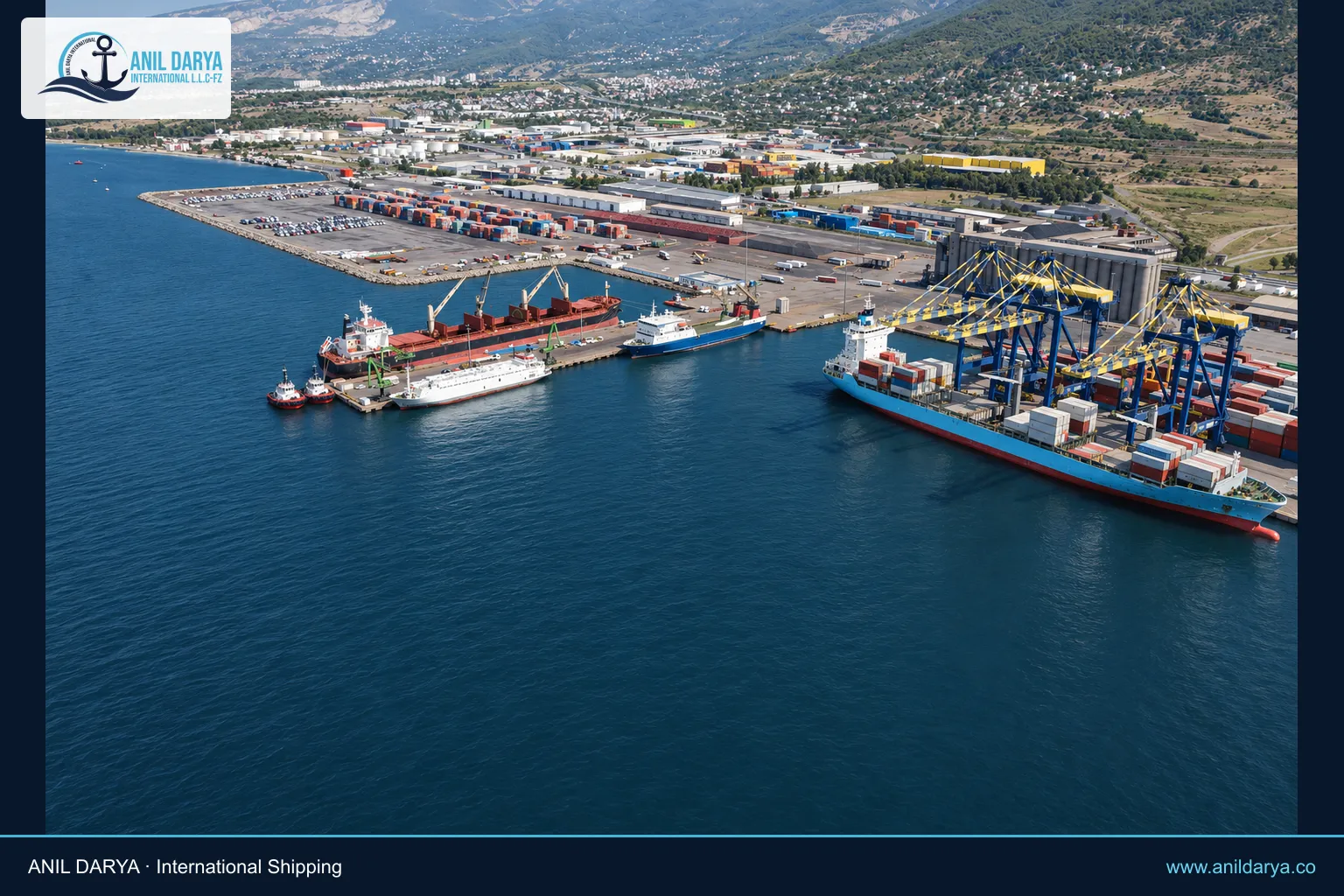
Typical cargo on this lane and the checks each needs
China supplied nearly 11% of Tunisia's imports in 2023. Typical consignments:
| Cargo | Usual equipment | Tunisian check to plan |
|---|---|---|
| Household appliances and electricals | 40ft high cube | Technical control list or 2022 prior-check list; manufacturer's invoice |
| Fabrics, trims and garment inputs | 40ft or LCL | Duty up to 50% on textiles and clothing |
| Machinery and production lines | FCL, flat rack or breakbulk | New machinery only; used machinery needs authorisation |
| Auto and electrical components | FCL or LCL | Raw materials and semi-finished goods for own production are exempt from technical control |
| Solar panels, inverters, batteries | 40ft high cube | Batteries move as DG; direct delivery from the ship |
| Food and food-contact goods | Reefer or dry FCL | National Food Safety Authority control and higher duty bands |
Step by step: shipping from China to Tunisia with Anil Darya
- Send us the supplier's city, goods, HS codes, weights, ready date and Tunisian delivery city.
- Your broker confirms the duty, VAT and advance tax, and whether technical control, the prior-check list or an authorisation applies. Destination clearance is arranged with the consignee's broker before the cargo ships, and we coordinate this before we confirm the booking.
- The importer domiciles the pro forma at its bank and files any prior-check or authorisation request.
- We quote the carrier, hub and discharge port, and book space once you accept.
- The supplier loads the box, issues the invoice, packing list and certificate of origin, and files the Chinese export declaration.
- We check the B/L draft (Tunisian consignee or notify, full contacts), track the box through the hub and release the carrier's B/L to you through us.
- Your broker files the DDM on TTN and lodges any technical control file before the feeder arrives.
- At Radès or Sfax the box is scanned, the channel is set, duty and taxes are paid, and the release order is issued.
- The box is trucked to the consignee and the empty is returned to the line's yard in the same city.
[AMIR-FACT: one real China to Tunisia cross-trade shipment we handled (cargo, Chinese load port, hub, Radès or Sfax, carrier, what we coordinated with the supplier and the Tunisian broker, and the outcome), cleared for publication]

What drives the cost of container shipping from China to Tunisia?
We do not publish rates, because they change with every sailing. Your landed cost has these parts:
| Cost part | What moves it | Usually paid by |
|---|---|---|
| Origin charges in China | Trucking, export filing, terminal handling, LCL loading | Supplier under FOB |
| Ocean freight and feeder | Carrier, hub, season, box type, surcharges | Buyer under FOB |
| Tunisian port and line charges | Terminal handling, delivery order, storage; port charges go straight to the port authority | Consignee |
| Technical control or prior check | Product list, sampling, laboratory tests | Importer |
| Duty, fees, VAT and advance tax | HS code, CIF value, VAT registration | Consignee or its broker |
| Demurrage and detention | Days beyond free time (Maersk: 12 for dry, 5 for reefer) | Whoever caused the delay, under your contract |
Most surprise costs come from a box that lands before the bank or technical control file is ready. Our article on demurrage and detention explains how these charges build up.
Checklist before the cargo leaves China
- Incoterm agreed and cargo insurance in place.
- Importer registered in the RNE, with a customs code.
- Pro forma domiciled at an approved bank, values matching the final invoice.
- HS code checked against the exclusion list, technical control lists and the 2022 prior-check list.
- Tunisian broker named and the clearance plan agreed before booking.
- B/L draft showing a Tunisian consignee or notify with full contact details.
- Certificate of origin in Arabic, English or French.
- For DG: UN number, SDS, Chinese packaging certificates, line approval and a truck ready for direct delivery.
Mistakes that hold cargo at Radès and Sfax
- Shipping before destination clearance is agreed. With no broker ready to file, the box sits at Radès while free days run out.
- Booking a prior-check product through a trading company. The rule asks for import direct from the production plant.
- Consigning the B/L "to order" or to a foreign buyer. The box can stay on board and return to the hub.
- Correcting the B/L less than 3 days before arrival, which brings customs fines.
- Paying the supplier 100% before shipment, then finding the bank will not release currency until it sees transport documents.
- Assuming routing via Dubai brings a duty preference for goods made in China.
Frequently asked questions
Which Tunisian port receives containers from China?
Mostly Radès, the container port of Tunis, with about three quarters of Tunisia's container traffic. Sfax suits buyers in the south. China cargo usually changes ship at a Mediterranean hub first.
Is there a direct ship from China to Tunisia?
Not as a rule. Radès's container berths have an 8.8 m draft, so mainline ships discharge at hubs such as Malta, Gioia Tauro or Algeciras and feeders bring the boxes to Tunisia. Ask the carrier for the full routing.
How long does sea freight from China to Tunisia take?
It depends on the load port, the loop and the feeder. Use the carrier's schedule for the exact sailing, then add hub, inspection and clearance time.
What import duty and VAT apply to goods from China?
Duty runs from 0% to 50% of the CIF value by HS code, with a 3% customs fee on the duty and a 1% FODEC. VAT is 19% for most goods, on value plus duties. Some consumer goods also carry a 10% advance tax.
Do Chinese goods get preferential duty in Tunisia?
No agreement with China appears in the WTO's 2025 list of Tunisia's trade agreements, so Chinese goods pay the normal rate. Storing or repacking them in Dubai does not change their origin.
Does Anil Darya clear customs in Tunisia?
No. The consignee's Tunisian customs broker files the declaration on TTN and clears the goods. Duty and taxes at destination are paid by the consignee or its broker. We agree the plan with that broker before we confirm the booking.
Can China cargo for Tunisia go through Dubai?
Yes, to combine it with other stock or to hold it in Jafza. Check first that the product is not on the 2022 prior-check list, which requires import direct from the factory. We handle UAE customs clearance for a fee whenever the cargo is landed in Dubai.
Get a quote for sea freight from China to Tunisia
Tell us the supplier's city, the goods and HS codes, the ready date, the Tunisian city and your broker's name, and we will come back with a carrier, a hub and a price. Use our freight rate inquiry form, or contact our team to plan DG or breakbulk cargo first. You can also read about our Dubai freight forwarding team.
Sources
- WTO: Trade Policy Review of Tunisia, November 2025
- WTO Secretariat report WT/TPR/S/479/Rev.1: customs procedures, tariff, taxes, technical control, ports
- trade.gov: Tunisia import tariffs, customs formality fee and VAT
- trade.gov: Tunisia import requirements and payment rules
- trade.gov: Tunisia customs regulations and TTN
- OMMP: Port of Radès, traffic, depths and regular container lines
- OMMP: Port of Sfax, berths and regular container lines
- OMMP: Port of Sousse and its container lines
- OMMP: Port of Bizerte-Menzel Bourguiba
- Maersk: Tunisia import rules (B/L, DG, free time)
- Maersk: Gemini network enhancements, new AE18 service (19 October 2026)
- Shanghai Municipal Government: Customs registration and export declaration
- CIRS: China Customs inspection of DG packaging for export
- Dubai Customs: Customs declaration regimes
- Dubai Chambers: Certificates of origin for re-exported goods
- Jafza: About the Jebel Ali Free Zone
Reviewed: 11 November 2026