
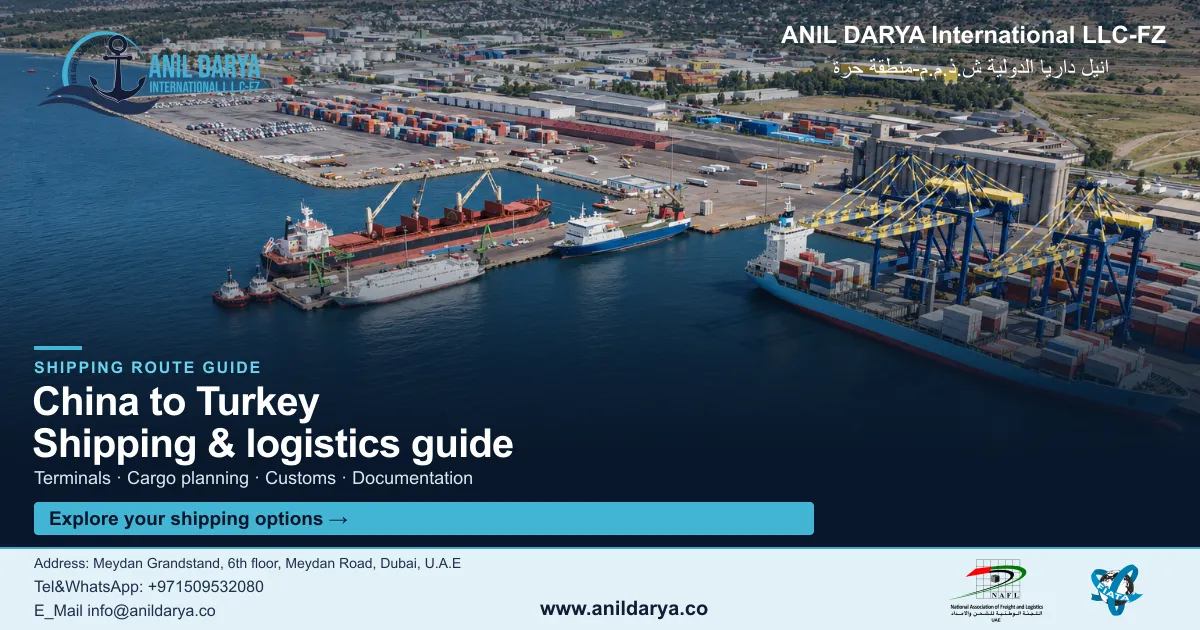
Shipping from China to Turkey is mostly container freight into the Marmara ports around Istanbul (Ambarli, Izmit Bay, Tekirdag, Gemlik), Aliaga near Izmir, or Mersin on the south coast. We book the ocean freight with the shipping line from Dubai and coordinate the move, while the Chinese supplier files the export declaration and the Turkish consignee's customs broker clears the goods in the Ministry of Trade's BILGE system, with TAREKS checks where they apply, customs duty by the 12-digit GTIP code and import VAT, mostly at 20%.
Shipping from China to Turkey at a glance
| Item | Detail |
|---|---|
| Trade type | Cross-trade: the cargo sails from China to Turkey and need not touch the UAE; we book and coordinate it from Dubai |
| Main Chinese load ports | Shanghai, Ningbo, Shekou and Yantian (Shenzhen), Nansha (Guangzhou), Qingdao, Tianjin, Xiamen |
| Main Turkish discharge areas | Ambarli (Istanbul), Kocaeli (Izmit Bay), Tekirdag, Mersin, Aliaga (Izmir), plus Gemlik and Iskenderun |
| Container volume in Turkey, 2025 | 13,996,579 TEU at all Turkish ports; the top five port areas handled 83.9% of it |
| Routings | Asia to Mediterranean loops that call Turkey, or a relay through a hub such as Asyaport at Tekirdag |
| Bill of lading | The shipping line's own B/L, issued and released to you through us as agent for the line |
| China export filing | The consignor or its customs broker, after the goods reach the customs area and 24 hours before loading |
| Turkish declaration | BILGE, filed by a broker with Ministry of Trade access; the importer needs a Turkish tax number |
| Tariff code | 12-digit GTIP; the first 6 digits are the HS code |
| Customs duty | Turkish tariff aligned with the EU Common Customs Tariff for industrial goods; additional customs duty on some products of some origins, China included |
| Import VAT | 20% standard rate, with 1% and 10% for listed goods; charged on CIF value plus duty |
| Product checks | TAREKS application for every code listed in the 2026 Product Safety and Inspection Communiques |
Who does what on a cross-trade booking from Dubai
Three parties share the work, and each one's papers must agree with the others'.
| Party | Job on a China to Turkey shipment |
|---|---|
| Chinese supplier or its origin agent | Packs and stuffs the cargo, trucks it to the terminal, files the China Customs export declaration, supplies test reports and the certificate of origin |
| Anil Darya, Dubai | Books the line, checks the shipping instructions against the Turkish broker's needs, follows the box to discharge, arranges the carrier's B/L |
| Turkish consignee and its customs broker | Supplies the tax number, opens any TAREKS application, files in BILGE, pays duty and VAT, collects the box |
Your bill is the shipping line's own, not a house bill. We act as agent for a number of lines, so the carrier's B/L, or its release, passes to you through our Dubai office once freight is settled.
We do not clear goods in Turkey. Before we confirm any booking, we ask the Turkish buyer which broker will file the declaration, then check with that broker the full GTIP, whether TAREKS or a permit applies, and what the certificate of origin must say. A container from Ningbo that lands in Ambarli with no broker briefed and no TAREKS file open simply waits in the yard while free time runs out.
Which Chinese load port and which Turkish port?
Pick the load port by the factory and the Turkish port by the buyer's warehouse. The wrong one can add a long truck leg.
Chinese ports by supplier region
| Supplier region | Usual load port |
|---|---|
| Shanghai, Jiangsu, Zhejiang (Yiwu, Suzhou, Hangzhou) | Shanghai, Ningbo |
| Guangdong (Shenzhen, Dongguan, Foshan, Guangzhou) | Shekou, Yantian, Nansha |
| Shandong, Hebei, Tianjin | Qingdao, Tianjin |
| Fujian | Xiamen |
Turkish ports by consignee region
The Ministry of Transport and Infrastructure's 2025 maritime bulletin gives these container totals by port authority area.
| Port area | TEU in 2025 | Suits buyers in |
|---|---|---|
| Ambarli, Istanbul (Marport, Kumport, Mardas) | 3.43 million | Istanbul's European side and Thrace |
| Kocaeli, Izmit Bay (Gebze, Dilovasi, Korfez) | 2.50 million | Gebze, Kocaeli, Istanbul's Asian side, Sakarya |
| Tekirdag (Asyaport, Ceyport) | 2.14 million | Tekirdag, Corlu, Cerkezkoy industrial zones |
| Mersin (Mersin International Port) | 1.97 million | Adana, Gaziantep, Kayseri, Konya and the south |
| Aliaga, Izmir | 1.70 million | Izmir, Manisa, Denizli and the Aegean |
Bursa buyers often take Gemlik, where Gemport and Borusan sit on the bay. For Hatay and the far south-east, LimakPort Iskenderun is closer than Mersin. Within Ambarli, Kumport lists 16.5 m of water and 2.1 million TEU of capacity. Check which terminal your sailing actually uses.
Direct calls or a relay: how boxes from China reach Turkish terminals
Some Asia to Mediterranean loops call Turkish ports on the way. Other boxes are discharged at a hub and carried on by a smaller ship.
Two published examples show how both patterns work. Asyaport at Tekirdag, a deep-water terminal of the MSC Group and the Soyuer family with 18 m alongside, lists 22 line services, one of them a Far East service, and it was Turkey's top transit port by TEU in the first quarter of 2024. Kuehne+Nagel's July 2026 carrier update lists a CMA CGM regional loop (TULYB) calling Ambarli, Gebze, Gemlik and Aliaga together with Piraeus, Alexandria, Marsaxlokk and North African ports, the kind of service that feeds boxes between hubs and Turkish terminals.
| Routing | What it means for you | Watch |
|---|---|---|
| Asia loop calling your Turkish port | One ship from China, fewer handlings, simpler tracking | Turkish calls are added and dropped between seasons; confirm the call on the booking |
| Asia loop to a Turkish hub, then feeder | Box changes ship inside Turkey, for example at Asyaport | The feeder leg to Gemlik, Izmit or Aliaga adds days and a second terminal |
| Asia loop to a hub outside Turkey, then regional loop | More sailing choices from China | Missed connections at the hub; DG and out-of-gauge must be accepted on both ships |
[AMIR-FACT: the shipping lines we actually book from China to Ambarli, Izmit, Mersin and Aliaga, which run direct and which relay (and where), and our real port-to-port days on each]
How long does shipping from China to Turkey take?
We found no carrier schedule page for this lane that we could read with confidence, and the forwarder guides we checked disagree, some within the same page. So we do not print a port-to-port figure. Ask for the routing, any hub and the vessel's estimated arrival with each quote, and compare quotes on those.
For door to door, add these steps to the sea leg:
- Trucking in China and the export filing, due 24 hours before loading.
- LCL consolidation, and any wait at a relay hub.
- The BILGE declaration, TAREKS review and any inspection in Turkey.
- The truck from the port to the buyer.
Sea freight from China to Turkey: FCL, LCL and special equipment
Full box or shared box
A 40ft high cube suits furniture, lighting, household goods and textiles. A 20ft box suits tiles, fasteners, cable drums and parts that hit the weight limit before the box is full.
LCL works for a few pallets, but in Turkey the shared box is released only when every consignee in it has cleared, and a single TAREKS hold on someone else's lot can keep yours in the CFS. Once you pass about half a box, price both. Our FCL vs LCL cost comparison walks through the sums, and our sea freight service lists the equipment we book.
Reefer, flat rack and open top
For reefers, check plug availability at the discharge terminal and, on a relay, at the hub. Flat racks and open tops carry machinery and steel structures. On a relay, both ships must accept the unit, so we confirm every leg before we quote a date.
Breakbulk, project cargo and dangerous goods into Turkey
Heavy and oversized pieces
Presses, transformers, solar equipment and steel structures often come from Chinese makers. If the largest piece fits a 40ft flat rack by size and weight, a container loop gives you more sailings. If it does not, the plan moves to a breakbulk or heavy-lift ship and a multi-purpose berth.
- Mersin International Port has 13 multi-purpose berths next to its 8 container berths.
- Kumport in Ambarli lists project cargo services and cranes up to 104 tonnes.
- Mardas in Ambarli lists mobile cranes of 100 to 140 tonnes.
We collect drawings, weights and lifting points, then agree stowage and lashing with the carrier. Our break bulk and project cargo team handles these bookings, and the guide to flat rack, open top and out-of-gauge cargo explains the equipment choice.
Dangerous goods
Common DG on this lane includes lithium batteries in e-bikes, power tools and solar storage, plus paints, resins and aerosols. Sea DG moves under the IMDG Code, 2024 edition (Amendment 42-24), mandatory from 1 January 2026. You need the UN number, proper shipping name, class, packing group, a current Safety Data Sheet from the Chinese factory and UN-approved packaging.
Turkish terminals set their own limits. Shore facilities that handle dangerous cargo need a compliance certificate from the maritime administration. Marport's 2025 guide says Classes 1, 6.2 and 7 are not handled in its area, and Asyaport does not accept Classes 1 and 7. Our dangerous goods desk gets acceptance from the line, any second carrier and the Turkish terminal before you commit to a sailing. Batteries also fall under their own TAREKS communique, so the importer's file has to be ready too.
Where Dubai fits on a China to Turkey shipment
Most boxes go straight from China to Turkey. Dubai helps in a few cases; price each against a straight booking.
| Option | What happens | When a Turkish buyer uses it |
|---|---|---|
| Consolidation in Dubai | Lots from several Chinese suppliers, and sometimes UAE or Indian goods, are combined in Dubai into one shipment | Mixed suppliers, staggered ready dates, one arrival in Turkey |
| Stock in a Dubai free zone | Goods sit in a Jebel Ali Free Zone warehouse and are re-exported to Turkey in smaller lots | One stock serving Turkey, the Gulf and Africa; faster call-off |
| Jebel Ali as a relay | The box from China connects at Jebel Ali to a service for Turkey | Only when a quoted routing makes sense on date and price |
Our Jebel Ali port guide covers the terminals and the free zone, and the article on re-exporting through JAFZA explains how held stock moves on. When goods are consolidated or stored in Dubai, UAE customs clearance is a service we provide for a fee. The Turkish side stays with the consignee's broker either way.
Do not expect a duty saving from this. The UAE-Türkiye CEPA, in force since 1 September 2023, gives its rates only to goods that originate in the UAE under its rules. Turkey's Ministry of Trade says customs duty and commercial policy measures are applied according to the country of origin, so a Chinese-made pump stored in Jebel Ali is still a Chinese pump at Mersin.
[AMIR-FACT: whether we have moved China to Turkey cargo through Dubai (consolidation, free zone stock or a Jebel Ali relay), and the extra days and UAE steps it really added]
Export side in China: the declaration and who files it
China Customs controls the export. Shanghai's municipal guidance says the consignor declares export goods after they reach the customs supervision area and 24 hours before loading, and may appoint a customs broker. The exporter needs market entity status, foreign trade operator registration and customs recordation, all of which can be done online through the China International Trade Single Window.
That is your supplier's or its origin agent's job. We share the booking, cut-off and shipping instructions with them, but we do not collect cargo or file declarations in China. FOB suits most Turkish buyers because you choose the line and hold the bill. Under EXW, someone in China still has to act as exporter of record, so name that party in the contract. Our Incoterms 2020 guide for sea freight shows where cost and risk pass under each term.
The description, HS code, quantity and value on the Chinese export declaration should match the invoice the Turkish broker files.
Turkish import customs: BILGE, documents and time limits
Customs in Turkey sits within the Ministry of Trade. Anyone with a Turkish tax number issued under the Tax Procedural Law can import. Declarations are filed by computer in BILGE, and access needs a username and password from a Customs and Trade Regional Directorate, which is why nearly every importer uses a licensed broker. Duty and taxes at destination are paid by the consignee or its broker.
The clearance sequence
- A summary declaration for the cargo is lodged before the ship enters Turkish waters.
- The box is unloaded into temporary storage at a place customs has approved, usually the terminal's bonded yard.
- For sea cargo, the goods must be given a customs treatment, usually release for free circulation, within 45 days of the summary declaration.
- The broker files the declaration in BILGE with the invoice, origin certificate and any TAREKS result or permit.
- Customs assigns a check level, may examine the goods, and releases them once duty and VAT are paid.
Documents for Chinese cargo
| Document | Comes from | Point to watch |
|---|---|---|
| Commercial invoice | Chinese supplier | Same values, Incoterm and descriptions as the export declaration |
| Packing list | Chinese supplier | Piece counts and weights that match the B/L |
| Bill of lading | Shipping line, released through us | Turkish consignee with full name, address and tax number |
| Certificate of origin | Issuing body in China | In English, in duplicate, with no corrections; proves non-preferential origin |
| CE evidence | Chinese factory or notified body | Declaration of conformity or certificate for CE-marked products |
| Test reports and photos | Chinese factory | Needed for the TAREKS file on listed codes |
| Health or phytosanitary certificates | Chinese authorities | Plants, plant products and animal products |
The 12-digit GTIP
Turkey classifies goods with a 12-digit Customs Tariff Statistics Position, or GTIP. The first six digits are the HS code, digits 7 and 8 follow the EU Combined Nomenclature, digits 9 and 10 are national subheadings and the last two are statistical. The 6-digit code on a Chinese invoice is only the start. Duty, additional duty, VAT, TAREKS and permits all follow the full GTIP, and the Ministry gives Binding Tariff Information free of charge, valid for six years, if you need a firm ruling.

TAREKS, CE evidence and product checks
TAREKS is the Ministry of Trade's web-based, risk-based system for safety and quality checks on imports. The 2026 Product Safety and Inspection Communiques were published in the Official Gazette on 31 December 2025 and took effect at once. A TAREKS application is now needed for every code listed in their annexes, even where the product itself is not sent to inspection.
Several communiques hit typical Chinese cargo directly:
- Radio equipment, communique 2026/8.
- Toys, communique 2026/10.
- Construction materials, communique 2026/14.
- Batteries and accumulators, communique 2026/15.
- Machinery, communique 2026/32, new for 2026.
For radio equipment, toys, construction materials and batteries, photos taken in the bonded area must be uploaded to the application, and a refusal to sign a sampling report ends the file with a rejection. Separately, Turkish buyers must be able to show CE evidence for products that need it, through a notified body certificate or the maker's declaration of conformity. Ask the Chinese factory for these papers before the goods are packed.
Customs duty and VAT on goods shipped from China to Turkey
Duty rates and additional customs duty
For industrial goods, Turkey's tariff follows the EU Common Customs Tariff under the customs union with the EU. Agricultural and some sensitive goods have Turkish rates. We found no official source showing a preferential trade agreement between Turkey and China, so Chinese goods pay the full third-country rate for their GTIP.
On top of that, Turkey applies additional customs duty to certain products from certain countries, and China is one of them. These duties are set by product code and origin in Turkey's annual import regime decision, so the broker has to check two things for each line: the standard rate and any additional duty for Chinese origin. Budget for both before you order.
Why the origin certificate matters
Turkey's Ministry of Trade says origin decides how duty and commercial policy measures apply, and a certificate of origin shows non-preferential origin. The broker uses it to apply the right additional duty, so a missing or corrected certificate means queries.
Import VAT and special consumption tax
Imports pay VAT. Turkey's rates are 1%, 10% and 20%, and most manufactured goods pay 20%. VAT is charged on the CIF value plus duty and other charges due before release. Special consumption tax is added for four groups: fuels and oils, vehicles (including motorcycles, yachts and aircraft), tobacco and alcohol, and luxury products. For Chinese cars, e-motorcycles and similar goods, price the full landed cost before you commit.
Typical cargo on this lane and what to check
China was Turkey's largest source of imports in 2025, at USD 49.57 billion out of USD 365.37 billion, according to TÜİK data reported in January 2026.
| Cargo | Usual equipment | Check before it ships |
|---|---|---|
| Machinery and spare parts | 20ft, 40ft, flat rack, breakbulk | Machinery TAREKS communique, CE evidence, lifting plan |
| Electronics, phones, routers | LCL or 40ft | Radio equipment communique, phone registration rules |
| Steel products and coil | 20ft, breakbulk | Additional duty for the GTIP, weight limits |
| Solar panels, inverters, batteries | 40ft, DG for separate batteries | UN number, SDS, battery communique, terminal DG limits |
| Toys and household goods from Yiwu | LCL or 40ft high cube | Toy communique, labels, consolidation timing |
Restricted and prohibited goods in Turkey
Turkey lets anything be imported unless it is banned or needs a permit. These are the controls that most often catch Chinese cargo, from the Ministry of Trade's import guidance:
- Used, refurbished, renovated or faulty goods need Ministry permission unless an exemption applies. That includes used construction machines.
- Used or refurbished mobile phones need permission, and phones must be declared to the Information and Communication Technologies Authority.
- Vehicles need a Letter of Conformity.
- Food, plants and animal products need control or health certificates; agricultural goods are supervised by the agriculture ministry.
- Some wastes, chemicals and scrap are banned or need a permit.
- Rough diamonds need a Kimberley Process certificate.
Goods declared as free of controls but later found to need one can be forfeited, with a penalty of twice their customs value. Send us the GTIP before booking and let the broker confirm it.
Step by step: how we run a China to Turkey booking
- You send the cargo details: commodity, HS code, weight, volume or dimensions, supplier city, Turkish delivery city, ready date, Incoterm and any DG.
- We price the routings: load port, Turkish terminal, direct call or relay, and sailings that fit your date.
- The buyer names its broker. We confirm with the broker the tax number, full GTIP, additional duty, TAREKS file and any permit, and agree the clearance plan before we confirm the booking.
- The supplier prepares test reports, CE papers and the certificate of origin while production finishes.
- We book the ocean freight with the line from Dubai and send the booking to the supplier or its origin agent.
- The supplier or origin agent stuffs the box, files the Chinese export declaration and delivers before cut-off.
- We check the draft B/L against the invoice, packing list and the broker's needs, then the line issues its B/L and we release it to you.
- The broker gets the documents while the ship is at sea, opens TAREKS and prepares the BILGE declaration.
- At the Turkish terminal, customs sets the check level and the consignee or its broker pays duty and VAT.
- The box is released, trucked to the buyer and returned empty within free time.
[AMIR-FACT: one real China to Turkey cross-trade shipment we booked from Dubai (cargo, load port, Turkish port, routing, days to discharge, any problem solved)]
What drives the cost of this lane
We price each booking on its own facts. These parts make up the landed cost.
| Cost part | Who usually pays | What moves it |
|---|---|---|
| Origin charges in China | Depends on Incoterm | Pickup distance, export filing, LCL consolidation |
| Ocean freight and surcharges | Buyer under FOB, supplier under CFR or CIF | Box type, season, direct call or relay, DG or out-of-gauge |
| Turkish terminal and line charges | Consignee | Terminal tariff, delivery order, CFS handling for LCL |
| Broker and TAREKS costs | Consignee | Number of lines, inspections, lab tests |
| Duty, additional duty, VAT | Consignee or its broker | GTIP, Chinese origin, CIF value |
| Storage, demurrage, detention | Whoever holds up the box | Days beyond free time |
Turkish customs allows 45 days to assign a customs treatment to sea cargo, but carrier free time on the box is far shorter. Our article on demurrage and detention shows how the daily charges add up.
Checklist before the cargo leaves China
- Turkish broker named and briefed before the booking is confirmed.
- Full 12-digit GTIP confirmed, with standard and additional duty checked.
- TAREKS application prepared for listed codes; CE papers and test reports in hand.
- Certificate of origin in English, in duplicate, with no corrections.
- Invoice, packing list, export declaration and draft B/L agree; tax number on the B/L.
- Discharge terminal chosen by the buyer's location; relay port known.
- For DG: UN number, SDS, acceptance on every leg and at the Turkish terminal.
Mistakes to avoid on this lane
- Shipping before destination clearance is agreed. Without a briefed broker and an open TAREKS file, the box sits in the terminal while storage and demurrage run.
- Budgeting on the 6-digit HS code. Additional duty for Chinese origin follows the full GTIP and can change the landed cost a lot.
- Assuming Dubai routing brings CEPA rates. Chinese goods keep Chinese origin.
- Forgetting that batteries, toys, radio equipment and machinery now have their own TAREKS rules.
- Booking DG to a terminal that refuses the class. Marport and Asyaport both exclude some classes.
- Choosing the port by freight price alone. Mersin suits a Gaziantep buyer, not a Gebze one.
Frequently asked questions
Which Turkish port is best for cargo from China?
The one closest to the buyer. Ambarli, Izmit Bay and Tekirdag serve Istanbul and the Marmara belt, Gemlik serves Bursa, Aliaga serves Izmir and the Aegean, and Mersin or Iskenderun serve the south and centre.
Is there a direct ship from China to Turkey?
Some Asia to Mediterranean loops call Turkish ports; others relay through hubs such as Asyaport at Tekirdag. Check the routing on each booking.
How long does sea freight from China to Turkey take?
It depends on the load port, the loop and any relay. We give the routing and the vessel's estimated arrival with each quote rather than a fixed figure, because published estimates for this lane vary widely.
Can a Dubai company book shipping from China to Turkey?
Yes. We book the freight with the line from Dubai and coordinate the Chinese supplier and the Turkish broker. The cargo does not have to pass through the UAE.
Who issues the bill of lading?
The shipping line. As agent for many lines, we pass the carrier's own bill to you, or release it on your instruction once freight is paid.
Do you clear customs in Turkey?
No. A Turkish customs broker files the declaration in BILGE. We agree the clearance plan with that broker before we confirm the booking.
What duty and VAT do Chinese goods pay in Turkey?
The tariff rate for the 12-digit GTIP, plus additional customs duty where the product is listed for Chinese origin, plus import VAT, mostly 20%, on the CIF value and duty. Duty and taxes at destination are paid by the consignee or its broker.
Do Chinese products need TAREKS?
If the product's code is in the annexes of the 2026 Product Safety and Inspection Communiques, the importer must file a TAREKS application before release. Toys, radio equipment, batteries, construction materials and machinery are all covered.
Get a quote for shipping from China to Turkey
Send us the supplier city, the Turkish delivery city, the cargo details and the ready date, and we will come back with routings and a price. Use our freight rate inquiry form, or contact our team to talk through a DG, breakbulk or project shipment first.
Sources
- Ministry of Transport and Infrastructure: Maritime statistics bulletin 2025 (container handling by port area)
- Ministry of Trade: Import regime FAQ (tax number, summary declaration, 45 days, used goods, phones, penalties)
- Ministry of Trade: Tariff FAQ (12-digit GTIP, Binding Tariff Information)
- Ministry of Trade: Origin of goods FAQ (origin and duty, certificate of origin)
- Ministry of Trade: Digital customs FAQ (BILGE access)
- Ministry of Trade: UAE-Türkiye CEPA (entry into force)
- Abu Dhabi Customs: UAE-Türkiye CEPA conditions (origin rules)
- Investment Office of the Presidency of Türkiye: Tax guide (VAT rates, special consumption tax)
- US International Trade Administration: Türkiye import tariffs (customs union, additional customs duty, VAT base)
- US International Trade Administration: Türkiye import requirements (documents, certificate of origin, CE evidence, TAREKS)
- EY: Türkiye 2026 product safety and inspection communiques (TAREKS)
- Hurriyet Daily News: 2025 foreign trade figures from TÜİK (imports from China)
- PSA International: Mersin International Port fact sheet 2026 (berths)
- Kumport: Terminal facts (depth, capacity, crane capacity, project cargo)
- TURKLIM: Mardas port facts (mobile cranes)
- Marport: Dangerous cargo handling guide, June 2025
- Asyaport: Terminal facts (depth)
- Asyaport: About us (MSC Group and Soyuer family)
- Asyaport: Line and service list (22 services, Far East service)
- Asyaport: Container services (DG classes not accepted)
- Ports Europe: Asyaport top TEU transit port in Turkey, Q1 2024
- Kuehne+Nagel: Carrier services update, July 2026 (CMA CGM TULYB rotation)
- Shanghai Municipal Government: customs registration and export declaration
- IMO: IMDG Code 2024 edition (Amendment 42-24)
Reviewed: 11 November 2026