
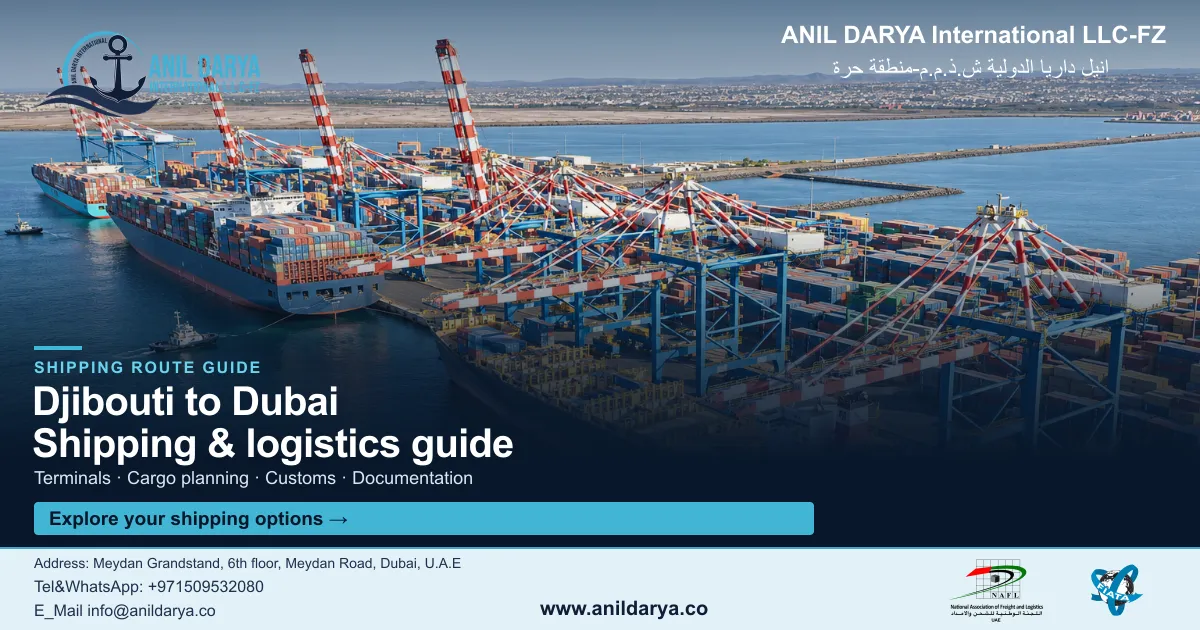
Shipping from Djibouti to Dubai is mostly about cargo that passes through Djibouti rather than cargo made there: Ethiopian exports railed to the Doraleh terminals, and goods leaving Djibouti's free zones. The box loads at the SGTD container terminal or the Doraleh Multipurpose Port and usually reaches Jebel Ali through a transhipment hub. At the UAE end it clears through Dubai Customs at 5% duty on the CIF value plus 5% import VAT. This guide covers the routings we could verify, the export papers on the Djibouti side, port free time and the UAE clearance.
Djibouti to Dubai shipping at a glance
| Item | Detail |
|---|---|
| Main Djibouti container terminal | SGTD, Doraleh: 1.8 million TEU capacity, 1,050 m quay, 18 to 20 m depth, 800 m rail station with 3 lines |
| Multipurpose terminal | Doraleh Multipurpose Port (DMP): 6 berths, 1,200 m quay, 15.3 m depth, ships up to 100,000 DWT, direct rail link |
| Main UAE arrival port | Jebel Ali (DP World), four container terminals |
| Published routing example | Djibouti to Mundra 6 days (ESL SRS), then Mundra to Jebel Ali 4 days (ESL GIA), plus the wait for the connection |
| Ethiopian cargo | Railed from Ethiopia to SGTD and DMP; about 12 hours by rail against about 3 days by road |
| Djibouti customs system | ASYCUDAWorld; in 2021, 1,621 export declarations against 92,080 transit declarations |
| Port free time for exports (2018 tariff) | 3 days for local export containers, 8 days for transit export containers; none for DG, out-of-gauge and flat racks |
| ECTN | Applies to cargo unloaded in Djibouti, not to exports leaving it |
| UAE customs duty | 5% of CIF value for most goods; alcohol 50%, cigarettes 100% |
| UAE import VAT | 5%, deferred to the VAT return for registered importers that link their customs number with the FTA |
What cargo moves from Djibouti to Dubai?
Djibouti's own export trade is small. Djibouti Customs' figures for 2021 show 1,621 export declarations against 77,473 import declarations and 92,080 transit declarations. Before its transit system was automated, 85% of the declarations it processed were for goods in transit to Ethiopia. The US Commerce Department says upwards of 90% of Ethiopia's foreign trade passes through Djibouti.
So a shipment from Djibouti to Dubai is usually one of three things:
| Cargo type | Where it starts | Who files the origin papers |
|---|---|---|
| Ethiopian export in transit | Ethiopia, railed or trucked to Doraleh | The shipper's Ethiopian agent for the export, and a Djibouti forwarder for the transit and loading |
| Free zone re-export | A company in a Djibouti free zone | The free zone company through DPFZA, plus its Djibouti forwarder |
| Djiboutian local export | A Djibouti business | The exporter's licensed Djibouti clearing agent |
Tell us at booking which one you have. It decides the port free time, the papers and the wording on the bill of lading.
How does cargo get from Djibouti to Jebel Ali?
We could not find a carrier schedule that publishes a direct Djibouti to Jebel Ali transit. What carriers do publish are services that connect Djibouti with a hub, and hub services that call Jebel Ali. Emirates Shipping Line is one example:
| Leg | Service | Published days | Notes |
|---|---|---|---|
| Djibouti (SGTD) to Mundra | ESL SRS, 2 ships of 1,800 TEU, 21-day round trip of Mundra, Jeddah and Djibouti | 6 | ESL offers transhipment via Mundra |
| Mundra to Jebel Ali | ESL GIA, weekly, 5 ships of 2,800 TEU | 4 | Jebel Ali at DP World Terminal 3 |
That gives 10 days at sea across the two legs, before the wait at Mundra for the connecting ship, which can be longer than either leg. Other carriers route through other hubs, and some may call both ports on one loop. At booking, ask for the full routing, the transhipment port and the planned connecting vessel, not just a transit number.
[AMIR-FACT: our real transit Djibouti to Jebel Ali (days), direct or via which hub, and the carriers or services we actually book on this lane]
Which Djibouti terminal will your cargo load at?
The carrier's service decides the terminal. Check it on the booking confirmation.
| Terminal | What the authority says | Typical export use |
|---|---|---|
| SGTD container terminal, Doraleh | 1.8 million TEU, 1,050 m quay, 18 to 20 m depth; train station inside the terminal; main gateway to Ethiopia and a transhipment hub | Containers, including boxes railed from Ethiopia |
| Doraleh Multipurpose Port | 6 berths, 1,200 m quay, 15.3 m depth, bulk, breakbulk, containers and Ro-Ro, direct rail connection | Bagged and bulk cargo, breakbulk, vehicles and equipment |
| Port de Djibouti (historic port) | Has handled Ethiopia's maritime traffic since 1998, moved to and from Addis Ababa by truck and rail | General cargo and livestock handling under the port tariff |
Which UAE port should your cargo arrive at?
Most cargo for Dubai and Jafza arrives at Jebel Ali. DP World runs four container terminals there with over 80 weekly services to more than 150 ports, and handles breakbulk, project cargo and IMDG dangerous goods. Our Jebel Ali port guide explains the terminals.
- Consignee in Dubai or Jafza: Jebel Ali.
- Site in Abu Dhabi: ask whether the hub service also reaches Khalifa Port in Abu Dhabi.
- Consignee in Sharjah or the northern emirates: compare Sharjah port shipping with a truck from Jebel Ali.
Ethiopian exports through Djibouti: rail, road and transit papers
If your supplier is in Ethiopia, the cargo crosses two customs territories before it sails. The Ethiopian export is cleared on the Ethiopian side by the shipper's agent. Then the goods move to Djibouti in transit and load for the UAE.
| Link | What the official source says | What it means for you |
|---|---|---|
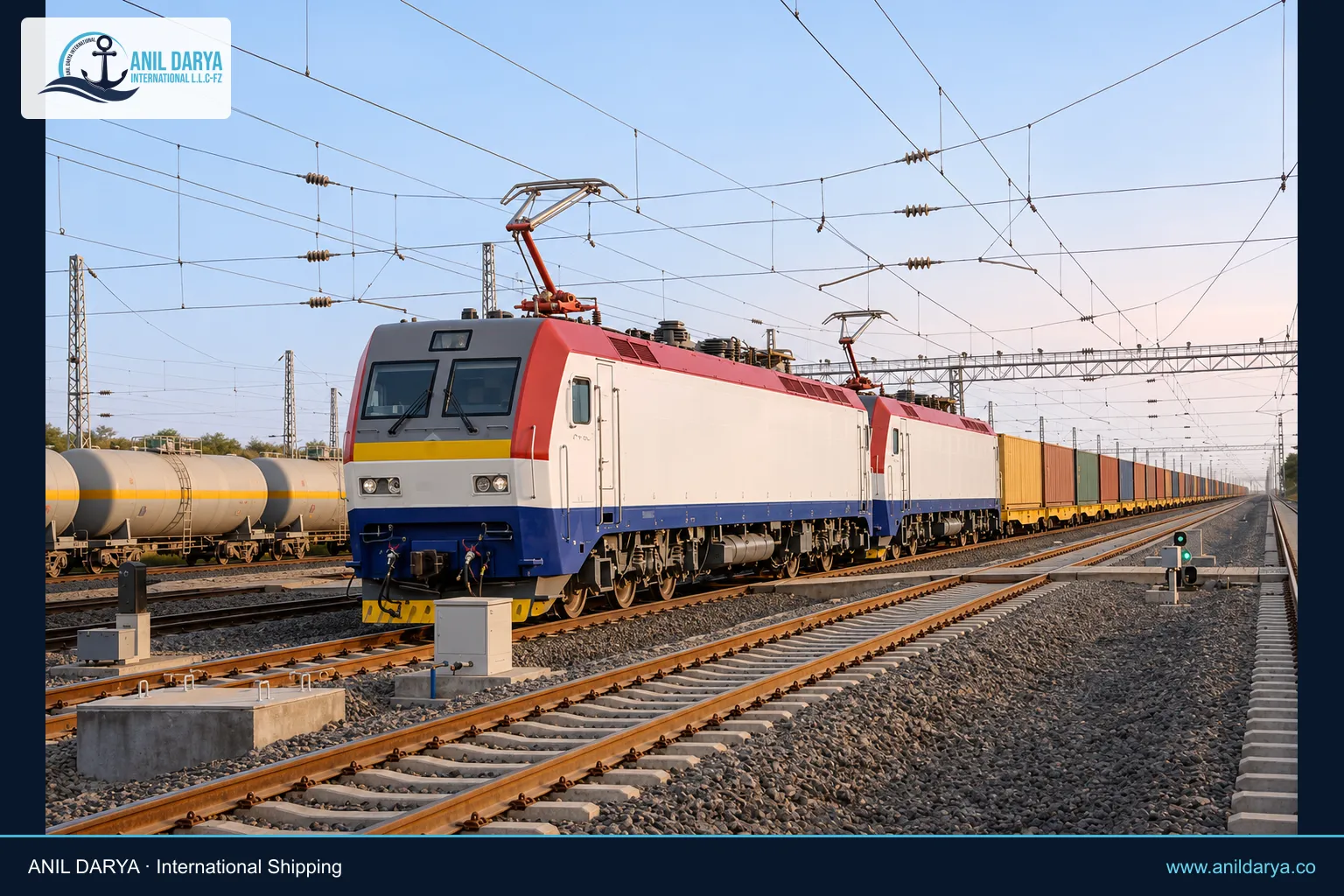
| Djibouti to Addis Ababa railway | Commercial operations since January 2018; about 12 hours by rail against about 3 days by road; up to 4 to 5 trains a day between the terminal and Ethiopia; capacity of 4 million tons of freight | Boxes can reach the quay by rail without a long truck run |
| Rail at the port | Connected to SGTD and DMP; SGTD has an 800 m station with 3 lines | Containers go from train to terminal stack directly |
| Road | Djibouti Customs says 1,500 trucks cross the Djibouti and Ethiopia border every day | The truck option for cargo that does not suit rail |
| Transit customs | Transit runs in ASYCUDAWorld; Djiboutian freight forwarders generate the T1 transit documents and attach the papers electronically | The shipper needs a Djibouti forwarder for the transit leg |
Transit export containers get 8 free storage days at the port under the 2018 tariff, against 3 for local exports. Time the train or truck so the box arrives close to the vessel cut-off. Ethiopia has an electronic single window for trade, but the Ethiopian export procedure itself sits with your supplier and its licensed agent.
[AMIR-FACT: whether we have booked Ethiopian exports through Djibouti to the UAE, who handled the Ethiopian and Djibouti legs, and the real door-to-door days from Addis Ababa to the UAE]
The Djibouti export side: papers and port rules
We book space with the carrier and run the UAE end. The export papers in Djibouti stay with the shipper and its licensed agent there. These are the rules that shape the timeline.
Who can clear the export in Djibouti?
Under Decree 2015-063, freight forwarders and clearing agents in Djibouti need a permit from the Djibouti Ports and Free Zones Authority (DPFZA). A forwarder or clearing agent must be a Djiboutian national or a company under Djiboutian law whose shares are all held by Djiboutians. That is why the shipper appoints a licensed Djibouti agent to lodge the export or transit declaration in ASYCUDAWorld.
Certificates for free zone exporters
DPFZA is the interface between free zone companies and government agencies, and issues certificates on request:
- Sanitary and phytosanitary certificates in 3 to 5 working days, with a 48-hour emergency procedure. The goods must still be in Djibouti for the inspection; no certificate is issued once they have left.
- Certificates of origin. A free zone company that adds at least 25% of value in production in Djibouti may claim "Made in Djibouti".
Goods that were only stored in the free zone keep the origin of the country where they were made. Ask the supplier for that country's certificate of origin, because Dubai Customs lists a certificate of origin for every declaration.
Port free time and storage for exports
The Djibouti ports tariff book of January 2018 sets these grace periods for export cargo. After them, the cargo owner pays storage.
| Cargo | Free storage | After the free period |
|---|---|---|
| Local export container | 3 days | USD 5.65 per TEU a day from day 4 to day 10, rising in steps to USD 11.00 from day 21 |
| Transit export container | 8 days | USD 5.65 per TEU a day from day 9, rising in steps |
| Breakbulk, open yard | 3 days local, 8 days transit | USD 0.05 per tonne or m3 a day |
| IMDG, out-of-gauge and flat rack containers | None | Charged from day 1 |
| Livestock in the livestock park | None | Daily fee per head |
The tariff dates from 2018, so confirm current charges with the terminal or the line for each booking.
Do exports from Djibouti need an ECTN?
No. CTN Djibouti describes the ECTN as required for shipments loaded on or after 15 June 2023 that are destined for unloading in Djibouti. It is an import-side document. Your export from Djibouti does not need one, although some destination countries run their own cargo tracking notes.
Dangerous goods and special cargo from Djibouti
The Djibouti tariff is strict on DG. IMDG containers get no free storage. Class 1, 2.1, 2.3 and Class 3 cargo with a flashpoint go by direct delivery from inland transport, and Class 7 is not accepted unless the authority instructs otherwise. For an export, that means the DG box should arrive at the terminal close to loading, with the SDS, DG declaration, UN packaging, labels and carrier acceptance already in place. Remember both carriers on a transhipment routing must accept the class. Our dangerous goods shipping service checks that before you book.
Out-of-gauge pieces and flat racks also get no free storage, and a hub routing adds a second lift. For heavy or oversized items we need dimensions, weight, lifting points and photos before we ask for space. See our break bulk and project cargo service.
Dubai customs clearance for cargo from Djibouti
Dubai Customs accepts five regimes: import, export, transit, transfer and temporary admission. It lists an invoice, a packing list, a certificate of origin and a permit from the controlling authority for restricted goods. For sea cargo you also need the bill of lading and the shipping line's delivery order.

Customs code or clearing agent
Any business using Dubai Customs services must register and hold a customs business code, which is done online through Dubai Trade. A clearing agent with a Dubai Economic Department clearing and forwarding licence, its own customs code and your authorisation can file for you. If you have no code yet, we arrange clearance through a licensed agent with your authorisation.
| Document | Who provides it | Why Dubai needs it |
|---|---|---|
| Commercial invoice | Shipper in Ethiopia or Djibouti | Customs value and HS code |
| Packing list | Shipper | Inspection and release |
| Certificate of origin | Country where the goods were made, or DPFZA for qualifying free zone goods | Origin of the goods |
| Bill of lading | Carrier | Title to the goods; check the transhipment port on it |
| Delivery order | Line's agent in Dubai | Releasing the container |
| Health or phytosanitary certificate | Exporting authority or DPFZA | Food, plants and animal products |
| UAE permit | UAE authority for the product | Restricted goods only |
Which declaration fits your cargo?
- Goods for the UAE mainland: import, with duty and VAT at clearance.
- Goods for a Jafza warehouse: transfer into the free zone; duty only if they later enter the mainland.
- Equipment coming for a time: temporary admission, with a deposit equal to the duty refunded on re-export in time, or no deposit under an ATA carnet.
- Goods only passing through the UAE: transit.
How much duty and VAT will you pay in Dubai?
Dubai Customs charges 5% of the CIF value for most goods, with 50% on alcohol and 100% on cigarettes. On a transhipment routing the freight is higher than on a direct sailing, and freight is part of the CIF base, so keep the freight invoice with the file.
Import VAT is 5% of the customs value, including insurance, freight, customs fees and any excise tax. A VAT-registered importer whose customs registration number is registered with the Federal Tax Authority pays nothing at the border; the VAT is prepopulated in its return. Others pay before release.
| Charge | Rate | Base |
|---|---|---|
| Customs duty, most goods | 5% | CIF value |
| Customs duty, alcohol | 50% | CIF value |
| Customs duty, cigarettes | 100% | CIF value |
| Import VAT | 5% | Customs value plus customs fees and excise tax |
Free zone storage and re-export in Dubai
Some cargo from the Horn of Africa reaches Dubai to be sold on, for example coffee or pulses bought by traders. Jafza, next to Jebel Ali Port and close to Al Maktoum International Airport, has operated since 1985 and has over 11,000 companies. Deliver goods meant for re-export under a free zone transfer or a transit declaration, not an import. For the next buyer, Dubai Chambers issues certificates of origin for re-exported goods at AED 100 and quotes two hours; for transhipment goods it asks for the Dubai Customs transit bill. Our guide to Jafza re-export covers the free zone route.
Restricted goods for the UAE
Dubai Customs says some goods need special approval from the competent authority before release, and that goods against the country's values and morals are banned. From this lane, approvals usually come up for coffee, pulses, seeds and other food, meat and live animals, plants, medicines and chemicals. Get the approval in place before the box leaves Djibouti, because the transhipment leg leaves little room to fix paperwork at the end.
Shipping from Djibouti to Dubai step by step
- Send us the cargo details. Commodity, HS code, weight, volume, where the goods start (Ethiopia, a Djibouti free zone or Djibouti itself) and the UAE delivery address.
- Prepare your UAE side. Customs business code, VAT number linked to it, and any UAE approval.
- Book space. We compare routings, confirm the load terminal, the hub and the arrival port, and send the cut-off to the shipper. DG and out-of-gauge cargo get acceptance from every carrier on the route.
- Origin clearance. The shipper's agents clear the Ethiopian export where relevant, and a licensed Djibouti forwarder lodges the transit or export declaration in ASYCUDAWorld.
- Move the box to the terminal by rail or truck, inside the 3 or 8 free days.
- Check documents before sailing. Invoice, packing list, certificate of origin and draft bill of lading must match.
- Track the transhipment. We follow the connection at the hub and update the arrival date.
- File the Dubai declaration before the vessel arrives, arrange payment of the duty and VAT, and collect the delivery order.
- Deliver and return the empty. We truck the cargo to your site or Jafza warehouse and return the container inside free time.
[AMIR-FACT: one real Djibouti (or Ethiopia via Djibouti) to UAE shipment we handled: cargo, load terminal, hub, arrival port and how clearance went, cleared for publication]
What decides the cost of shipping from Djibouti to Dubai?
| Cost factor | Why it matters |
|---|---|
| Routing | A hub routing adds a second port call, handling and days |
| Inland leg from Ethiopia | Rail or truck to Doraleh, plus transit papers |
| Djibouti port dues and handling | Different for local and transit cargo |
| Port storage | Starts after 3 or 8 days, at once for DG and out-of-gauge |
| Container type | Reefers, flat racks and open tops cost more than dry boxes |
| UAE destination charges | Terminal handling, delivery order, clearance and trucking |
| Duty and VAT | 5% duty on CIF, 5% VAT unless deferred |
Delays at either end turn into container charges. Our article on demurrage and detention shows how they build up, and our sea freight service page explains what we book.
Checklist before cargo leaves Djibouti
- Cargo type confirmed: Ethiopian transit, free zone re-export or local export.
- Licensed Djibouti forwarder appointed by the shipper.
- Ethiopian export papers done, for Ethiopian cargo.
- Certificate of origin from the country of manufacture, or DPFZA for qualifying free zone goods.
- Health or phytosanitary certificate for food and plants, issued while the goods are still in Djibouti.
- Full routing, hub and arrival port confirmed with the carrier.
- Rail or truck slot timed inside the free days.
- DG: SDS, DG declaration and acceptance from every carrier on the route.
- UAE customs code active, VAT linked, approvals in place.
Common mistakes on the Djibouti to Dubai lane
- Assuming a direct sailing. Most routings go through a hub, so plan for the connection.
- Railing the box down too early. Local export containers get only 3 free days.
- Asking DPFZA for a certificate after the goods have sailed. It will not be issued.
- Using a free zone origin certificate for goods that were only stored there.
- One carrier accepting the DG class while the connecting carrier does not.
- Late Dubai declaration. The cargo waits at Jebel Ali while storage runs.
Frequently asked questions
How long does shipping from Djibouti to Dubai take?
We found no carrier schedule with a direct Djibouti to Jebel Ali transit. One published routing is 6 days Djibouti to Mundra on ESL's SRS service and 4 days Mundra to Jebel Ali on its GIA service, plus the wait for the connection. Ask for the full routing at booking.
Which port in Djibouti do containers for Dubai leave from?
Containers usually load at the SGTD terminal at Doraleh. Breakbulk, bulk and vehicles can use the Doraleh Multipurpose Port. The carrier's service decides the terminal.
Can Ethiopian exports be shipped to Dubai through Djibouti?
Yes. Upwards of 90% of Ethiopia's foreign trade passes through Djibouti. Containers come down by rail in about 12 hours or by road, move in transit under T1 documents, and load at Doraleh for the UAE.
Do I need an ECTN to ship from Djibouti to Dubai?
No. The Djibouti ECTN applies to cargo destined for unloading in Djibouti. It is not required for exports leaving Djibouti.
How many free days do export containers get at Djibouti?
Under the 2018 tariff, local export containers get 3 free storage days and transit export containers get 8. DG, out-of-gauge and flat rack containers get none.
What is the customs duty on goods from Djibouti in Dubai?
Dubai Customs charges 5% of the CIF value for most goods, 50% on alcohol and 100% on cigarettes, plus 5% import VAT.
What documents do I need to clear Djibouti cargo in Dubai?
An invoice, packing list, certificate of origin, bill of lading and delivery order, plus a UAE permit for restricted goods. Food and plant products also need a health or phytosanitary certificate.
Who handles the export paperwork in Djibouti?
A forwarder or clearing agent licensed by DPFZA, which must be Djiboutian-owned. The shipper appoints it. We book the sea freight and run the UAE side.
Get a quote for shipping from Djibouti to Dubai
Send us the cargo, where it starts and your UAE delivery address, and we will come back with a routing and a price, including clearance in the UAE. Use our freight rate inquiry form or contact our team. You can also read more about our Dubai freight forwarding team.
Sources
- Emirates Shipping Line: SRS service brochure, 8 April 2026 (Djibouti to Mundra)
- Emirates Shipping Line: GIA service advisory and brochure, 25 July 2025 (Mundra to Jebel Ali)
- DPFZA: SGTD container terminal
- DPFZA: Doraleh Multipurpose Port
- DPFZA: Djibouti to Addis Ababa railway
- DPFZA: Maritime transport accreditation (forwarders and clearing agents)
- DPFZA: Goods services (sanitary, phytosanitary and origin certificates)
- Port de Djibouti: Home (Ethiopia traffic since 1998)
- Djibouti Ports: Tariff Book, 1 January 2018 (grace periods, storage, DG rules, livestock)
- ASYCUDA: Djibouti transit procedure automation (2021 declaration figures)
- CTN Djibouti: ECTN requirement
- US International Trade Administration: Ethiopia customs regulations
- DP World: Jebel Ali Port
- Dubai Customs: Submit customs declaration (regimes and documents)
- Dubai Customs: FAQ (duty, business code, clearing agents, temporary admission, restricted goods)
- Federal Tax Authority: VAT guide, section 3.5 (import VAT)
- Jafza: About Jebel Ali Free Zone
- Dubai Chambers: Issuing a certificate of origin
Reviewed: 10 November 2026