
Shipping from Dubai to Argentina usually means a container from Jebel Ali to Buenos Aires or Dock Sud, transshipped on the way, with air cargo to Ezeiza for urgent goods. Argentina's customs is run by ARCA (the agency that replaced AFIP), and its import rules have changed several times since late 2023, so every rule on this page carries a date. This guide covers ports, modes, published transit times, documents, duty, the statistics fee, VAT, restricted goods and each step from Dubai to your consignee.
Shipping from Dubai to Argentina at a glance
| Item | Detail |
|---|---|
| Main UAE load ports | Jebel Ali (AEJEA), with Khor Fakkan (AEKLF) as an alternative on some services |
| Main Argentine container gateways | Port of Buenos Aires (Puerto Nuevo, ARBUE) and Dock Sud next to it; Zarate and Campana up the Parana river |
| Published fastest sea transit | About 44 days Jebel Ali to Buenos Aires with 2 transfers (Fluent Cargo schedule data, checked November 2026) |
| Air cargo | DXB or DWC to Buenos Aires Ezeiza (EZE); freighter flights from DWC 2 to 4 times a week |
| Customs authority | General Customs Directorate (DGA), part of ARCA, created by Decree 953/2024 |
| Import licences | Fully eliminated as of April 2025; the SEDI statistical filing ended on 26 February 2025 |
| Import duty | Mercosur tariff by NCM code, charged on CIF value; simple average 11.0% (WTO, 2026) |
| Statistics fee | 3% on definitive imports, extended to 31 December 2027 by Decree 1140/2024 |
| Import VAT (IVA) | 21% general rate; 10.5% for goods listed in the VAT law annex |
| Tax perceptions at import | Advance VAT (up to 20%) and income tax (6%) collected at customs unless the importer holds an exclusion certificate |
Which mode should you use from Dubai to Argentina?
Most cargo on this lane goes by sea in containers. There is no road option.
| Your cargo | Best mode | Why |
|---|---|---|
| A full container or more of general goods | FCL by sea | Lowest cost per unit; the box stays sealed through transshipment |
| A few pallets or cartons | LCL by sea | You pay for the space you use, but release depends on the whole consolidated box |
| Machinery, steel structures, oversized pieces | Flat rack, open top or breakbulk | For cargo that does not fit a standard box |
| Chemicals, batteries, aerosols, perfumes | DG container or DG air | Needs carrier acceptance for every leg, including the transshipment port |
| Samples, spare parts, urgent stock | Air cargo to Ezeiza | About a day in the air instead of six weeks or more at sea |
A simple rule for this lane: sea transit is long, so if the goods are needed in Argentina within a month, price air first. If not, start with sea and compare FCL and LCL once you know the volume.
Sea freight from Dubai to Argentina: ports, routing and FCL or LCL
Loading in the UAE
Sea freight from Dubai to Argentina normally loads at Jebel Ali. Our Jebel Ali port shipping guide covers the terminals, cut-offs and export steps there. Some carriers load the Argentina service at Khor Fakkan on the east coast instead, and the published schedule data shows a Hapag-Lloyd routing from there.
Which Argentine port should your cargo go to?
The Port of Buenos Aires and Dock Sud form one port complex on the Rio de la Plata, and together they take most of Argentina's containers. Official figures compiled by Argenports and reported by DatamarNews in December 2024 show the gap between the main ports clearly.
| Port | Containers handled in 2024 (period) | Best for |
|---|---|---|
| Buenos Aires (Puerto Nuevo terminals) | 675,232 TEU (January to November) | Most import containers and LCL for the Buenos Aires region |
| Dock Sud (Exolgan terminal, Avellaneda) | 434,196 TEU (January to November) | Containers for Greater Buenos Aires; same complex, different terminal |
| Zarate | 79,787 TEU (January to September) | Vehicles and ro-ro, some containers, north of the capital on the Parana |
| Campana (Euroamerica terminal) | 2,068 TEU (January to September) | Industrial cargo for the Campana and Zarate area |
| Bahia Blanca | 7,555 TEU (January to October) | Petrochemicals, energy and project cargo for the south |
For most consignees, Buenos Aires or Dock Sud gives you the most sailings. Pick a river port only when the consignee is close to it and a carrier quotes a through rate.
FCL or LCL?
- FCL (full container load). You book a whole 20ft, 40ft or 40ft high cube. It suits larger volumes, heavy goods and anything you do not want handled at the transshipment port.
- LCL (less than container load). Your cargo shares a box with other shippers. It is unpacked at a bonded warehouse in Buenos Aires, so your release also depends on the other cargo in the box.
On a lane with two transshipments, LCL can add handling risk as well as time. Our guide to FCL vs LCL costs shows how to compare the two, and our sea freight service page explains what we book.
How long does sea freight from Dubai to Argentina take?
There is no direct sailing in the schedule data we checked. Cargo is transshipped, usually at a hub in the Mediterranean, Asia or Brazil, depending on the carrier's network.
| Published routing | Transit | Transfers | Frequency |
|---|---|---|---|
| Jebel Ali to Buenos Aires, CMA CGM | 43 days 18 hours | 2 | Every 2 to 4 weeks |
| Khor Fakkan to Buenos Aires, Hapag-Lloyd | 48 days 7 hours | 1 | Every 1 to 2 weeks |
These figures come from Fluent Cargo's schedule data as shown in November 2026. They are port to port and do not include waiting time at the transshipment hub if a connection is missed. Other sites quote very different numbers for this lane, so check the vessel schedule and estimated arrival on your booking before you promise a date to your buyer.
[AMIR-FACT: the carriers we actually book from Jebel Ali to Buenos Aires or Dock Sud, the transshipment hub on each, and our typical port-to-port days]
Breakbulk, project cargo and dangerous goods
Breakbulk and project cargo
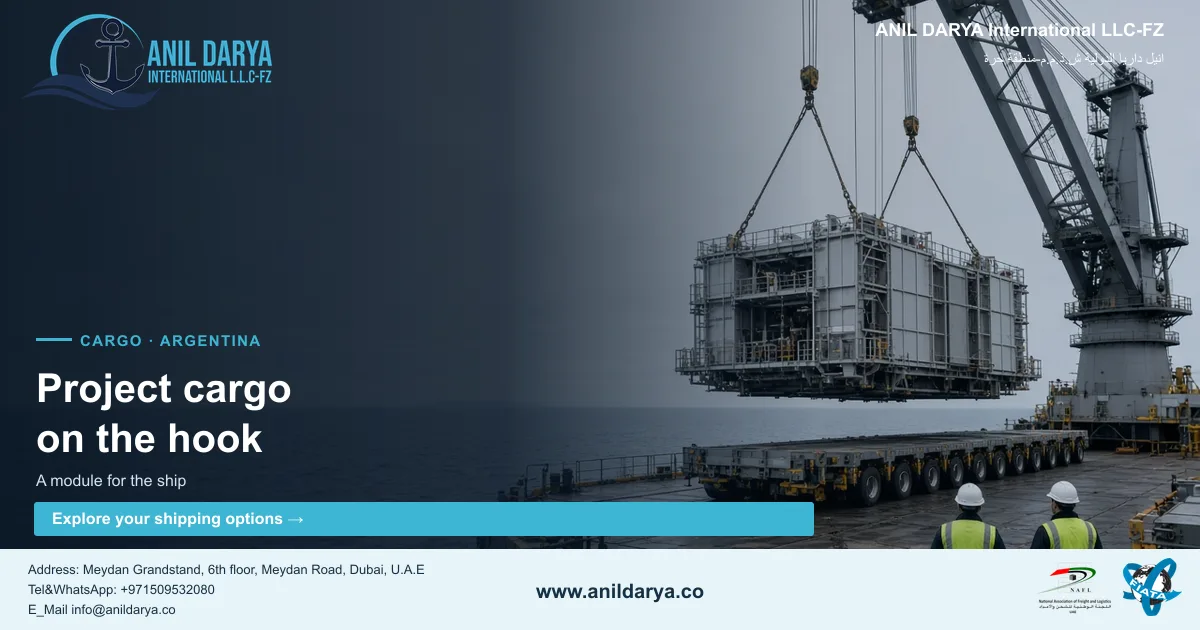
Cargo that fits a container but is too tall or wide goes on flat racks or open tops, which keeps it on the regular container network and its transshipment hubs. Cargo that does not fit a container at all needs a breakbulk or heavy-lift vessel, and sailings from the Gulf to the east coast of South America are less frequent than container services.
If a piece fits a 40ft flat rack by size and weight, the container network gives you more sailings. If it does not, the breakbulk sailing date drives the whole plan. We collect drawings, weights and lifting points, agree lashing with the carrier and plan the road move to the quay. See our break bulk and project cargo service.
Dangerous goods
DG cargo to Argentina must be packed, marked and declared under the IMDG Code for sea or IATA rules for air. Every carrier on the routing, including the feeder from the transshipment hub, must accept it. At APM Terminals Buenos Aires (Terminal 4), IMO Class 1 and Class 7 cargo needs an IC05 or TLMD authorisation from customs before the vessel arrives. The terminal says that without it the container will not be landed.
You need a correct UN number, proper shipping name, class and packing group, a safety data sheet, a signed DG declaration and UN-approved packaging. Our dangerous goods shipping team gets acceptance for each leg before you commit to a sailing, and sends the DG data to the consignee's agent early so the Argentine side can file on time.
Air cargo from Dubai to Argentina
Air cargo suits samples, spare parts, electronics and urgent orders. Fluent Cargo's data shows passenger-aircraft routes from Dubai International (DXB) to Buenos Aires Ezeiza (EZE) of about 19 hours 58 minutes, with departures every 1 to 2 days. It also lists an Emirates Boeing 777 freighter from Al Maktoum (DWC) to Ezeiza 2 to 4 times a week, at about 22 hours 46 minutes.
Air freight is priced on chargeable weight, which is the higher of actual weight and volume weight. Argentine customs rules are the same for air as for sea, with one extra point from the US Commercial Service guide: freight or agent fees cannot appear on the air waybill and must be prepaid, and electronic air waybills are not accepted. See our air cargo service for what we arrange from Dubai.
Argentine customs rules for imports as of November 2026
Argentina applies the Customs Code (Law 22.415). Customs is run by the General Customs Directorate (DGA), which sits inside ARCA, the agency created by Decree 953/2024 to replace AFIP.
What has changed since late 2023?
| Date | Change | What it means for you |
|---|---|---|
| December 2023 | DNU 70/2023 amends the Customs Code | Importers can handle the customs declaration themselves or through an authorised person; registration as a customs broker is no longer required to act as one |
| 29 December 2023 | ARCA (then AFIP) General Resolution 5472/2023 | Creates the importer/exporter profile and the broker/declarant profile used to file customs operations |
| December 2024 | PAIS tax on foreign currency eliminated | One less charge on paying the supplier |
| 1 January 2025 | Decree 1140/2024 in force | 3% statistics fee kept until 31 December 2027 |
| 26 February 2025 | General Resolution 5651/2025 | SEDI statistical import declaration eliminated |
| 27 February 2025 | General Resolution 5655/2025 | Importers can again apply for certificates that exclude them from VAT and income tax perceptions |
| April 2025 | Import licensing system fully eliminated (US Commercial Service) | No import licence or pre-approval step for general goods |
In practice, most general goods no longer need an import licence or a statistical pre-declaration. Product rules from SENASA and ANMAT still apply.
Who can file the import declaration?
Since DNU 70/2023, the importer can file the customs declaration for its own account or through an authorised person, and it stays responsible for any wrong declaration. The importer needs a CUIT tax number and an active importer profile with ARCA. In practice most importers still use a despachante de aduana (customs broker), and we work with the consignee's chosen broker or a clearing agent in Argentina. We do not file declarations in Argentina ourselves.
How clearance works in Argentina
- The carrier reports the cargo to customs and the container is discharged into the terminal's bonded area.
- The importer or its broker files the import declaration in ARCA's SIM customs system, with the NCM code, CIF value and supporting documents.
- The system assigns a control level: release on documents, a documentary check or a physical inspection. At APM Terminals Buenos Aires, inspections are held one day and the import delivery can happen the next day.
- Duty, the statistics fee, VAT and any perceptions are paid.
- Customs authorises release, the terminal issues the gate pass, and the truck collects the container on a booked appointment.
What documents do you need to ship cargo from Dubai to Argentina?
The US Commercial Service lists these documents for all sea shipments, whatever the value: a commercial invoice (original and three copies), a bill of lading, a packing list and, if the exporter buys cover, an insurance certificate.
- Written in Spanish, with the goods described in Spanish.
- One original and three copies, each with an original ink signature from an authorised person.
- Shows invoice number, date, exporter, consignee, quantities, prices, currency, Incoterm, origin, means of transport and port of entry.
- Dated before the bill of lading.
The bill of lading must show weight and volume for each package and in total, and state "Freight Paid" or "Freight Payable at Destination". The packing list should preferably be in Spanish, with gross and net weights and marks that match the invoice.
| Cargo | Core documents | Often also needed |
|---|---|---|
| General goods | Spanish invoice (original plus 3 copies), packing list, bill of lading or air waybill | Importer's CUIT on the documents |
| Textiles, apparel, footwear, consumer goods, some machinery | Core set | Certificate of origin, valid six months from certification |
| Food, plant and animal products | Core set | SENASA sanitary or phytosanitary requirements; INAL rules for packaged food |
| Medicines, cosmetics, medical devices | Core set | ANMAT registration or notification |
| Electrical goods, toys, steel, lighters, bicycles | Core set | Certification seal and number on the product |
| Dangerous goods | Core set | DG declaration, SDS; Class 1 and 7 need customs authorisation before arrival |
A certificate of origin is also required for goods under anti-dumping, countervailing or safeguard duties. If your goods were made outside the UAE and only shipped through Dubai, the certificate must show the real country of origin.
Import duty, statistics fee and VAT in Argentina
Argentine import taxes stack on top of each other, so the landed cost is often much higher than the duty rate alone suggests.
| Charge | Rate | Base and source |
|---|---|---|
| Import duty (derecho de importacion) | Set by NCM code under the Mercosur nomenclature; WTO lists a simple average MFN rate of 11.0% for 2026, and 18.6% of tariff lines are duty-free | CIF value at the port or airport of entry |
| Statistics fee (tasa de estadistica) | 3%, with legal maximum amounts | Definitive imports; extended to 31 December 2027 by Decree 1140/2024; exemptions include goods of Mercosur origin |
| VAT (IVA) | 21% general; 10.5% for goods in the annex to article 28 of the VAT law | Customs value plus duty and fees |
| VAT perception | Up to 20% | Advance payment of VAT, credited later; excluded if the importer holds a certificate |
| Income tax perception | 6% | Advance payment of income tax; same certificate rules |
Preferential duty applies only to goods with Mercosur or ALADI origin under those agreements. Goods of UAE origin, and goods from other countries shipped through Dubai, pay the normal rate for their code unless an agreement in force says otherwise.
Perceptions and exclusion certificates
Perceptions are advance payments of VAT and income tax collected at customs. ARCA said in February 2025 that these can reach 20% for VAT and 6% for income tax on definitive imports. Under General Resolution 5655/2025, importers that keep building up credit balances can apply for an exclusion certificate again. Ask your consignee whether it holds one, because it changes the cash needed at clearance.
Restricted and prohibited goods
The US Commercial Service guide (last updated 1 August 2025) lists these groups. Some rules on used goods have been relaxed since, so treat this as the list to check, not the final answer.
| Goods | Rule listed |
|---|---|
| Used cars | Prohibited, Decree 110/1999 |
| Used motorcycles and bicycles | Prohibited, Resolution 790/1992 |
| Certain used machinery, equipment and parts | Restricted, Resolution 909/1994 as amended |
| Used clothing (codes 6309.00.10 and 6309.00.90) | Prohibited |
| Used and retreaded tyres | Prohibited, Law 25,626 |
| Household incandescent bulbs | Prohibited, with low-wattage and low-voltage exceptions, Law 26473 |
| Paints and varnishes with high lead content | Prohibited above 0.06 g of lead per 100 g of non-volatile mass |
| Toys and childcare goods with high phthalates | Prohibited, Resolution 583/2008 |
| Hazardous waste | Prohibited, Law 24051 |
| Food, plants and animal products | Controlled by SENASA |
| Medicines, cosmetics, food supplements | Controlled by ANMAT and INAL |
Send us the HS code, description and origin of each line before booking. We flag anything that needs a certificate, and the consignee's broker confirms the Argentine side.
What does shipping from Dubai to Argentina cost?
We do not publish a fixed price, because rates on this lane change with every sailing and every transshipment. Your total is built from these parts.
| Cost element | What drives it |
|---|---|
| UAE origin charges | Trucking to Jebel Ali or Khor Fakkan, export declaration, terminal handling, documents |
| Ocean or air freight | Container size or chargeable weight, carrier, routing, season, surcharges |
| Argentine terminal charges | Terminal handling, LCL unpacking at the bonded warehouse, storage after free time, inspection moves |
| Customs in Argentina | Broker's fee, certificates, inspections |
| Duty and taxes | NCM duty rate, 3% statistics fee, 21% or 10.5% VAT, perceptions unless excluded |
| Delivery in Argentina | Truck from the terminal to the consignee |
| Delay costs | Demurrage and detention if the box is not cleared and returned on time |
The Incoterm decides who pays each block. Our guide to Incoterms 2020 for sea freight explains the split, and our note on demurrage and detention shows how storage costs build up when clearance is slow.
How to ship cargo from Dubai to Argentina: step by step
- Agree the Incoterm with your buyer, so both sides know who books freight and who clears in Argentina.
- Ask the buyer to confirm the NCM code, the duty, any SENASA, ANMAT or certification rule, and whether it holds a perception exclusion certificate.
- Check the importer has a CUIT and an active importer profile with ARCA, and has chosen a customs broker if it will not file itself.
- Send us the cargo details: goods, HS codes, weight, volume, packing and the delivery address in Argentina.
- We compare carriers, routings and Argentine ports, then book space from Jebel Ali or Khor Fakkan.
- We check the Spanish invoice, packing list, certificate of origin and bill of lading data so they match line by line.
- We arrange trucking, the UAE export declaration, loading and sealing.
- We send the documents and the arrival notice to the consignee's broker well before the vessel reaches Buenos Aires.
- The broker files the declaration, taxes are paid, customs releases the cargo and it is delivered.
[AMIR-FACT: one real Dubai to Argentina shipment we handled (cargo, mode, port, total days, any problem solved), cleared for publication]
Checklist before you ship to Argentina
- Importer's CUIT confirmed and printed on the invoice and bill of lading.
- Commercial invoice in Spanish, signed in ink, original plus three copies, dated before the bill of lading.
- NCM code agreed with the buyer's broker, with duty and VAT rate known.
- Certificate of origin issued if the goods need one, showing the real country of manufacture.
- SENASA, ANMAT, INAL or product certification arranged where the goods need it.
- Used goods checked against the current prohibited list before booking.
- DG acceptance from every carrier on the routing, and customs authorisation for Class 1 or 7.
- Free time at the Argentine terminal known, with clearance planned before it ends.
- Cash for duty, fees, VAT and perceptions ready at the importer's end.
Common mistakes on the Dubai to Argentina lane
| Mistake | What happens | How to avoid it |
|---|---|---|
| English-only invoice or photocopied original | Clearance held until a correct invoice arrives by courier | Issue a Spanish invoice with ink signatures before sailing |
| Following an old guide that mentions SIRA or SEDI | Time lost on filings that no longer exist, or missed new rules | Use ARCA rules dated 2025 or later, confirmed by the broker |
| Quoting only the duty rate to the buyer | Landed cost far above the quote once fees, VAT and perceptions are added | Show every charge in the tax table above |
| Shipping used goods without a check | Cargo refused or stuck in the terminal | Confirm admissibility in writing before booking |
| Assuming a direct sailing | Missed buyer deadlines after a missed connection at the hub | Plan around published transit with transfers, not best case |
| Class 1 or 7 DG without prior authorisation | Container not landed at Buenos Aires | Have the consignee's broker file before arrival |
Frequently asked questions
How long does shipping from Dubai to Argentina take by sea?
Published schedule data in November 2026 shows about 44 days from Jebel Ali to Buenos Aires with two transfers, and about 48 days from Khor Fakkan with one transfer. Add time for clearance and delivery, and check the estimated arrival on your booking.
Which Argentine port should I ship to from Dubai?
For most cargo, Buenos Aires or Dock Sud, which handled about 675,000 and 434,000 TEU in the first eleven months of 2024. Zarate is the main vehicle and ro-ro port, and Bahia Blanca suits energy project cargo in the south.
Do I still need an import licence or SEDI for Argentina?
No, for general goods. The SEDI statistical declaration was eliminated on 26 February 2025 by General Resolution 5651/2025, and the US Commercial Service reports that import licensing was fully eliminated as of April 2025. Product rules from SENASA, ANMAT and others still apply.
What taxes are paid on imports into Argentina?
Import duty by NCM code on the CIF value, a 3% statistics fee kept until 31 December 2027, VAT at 21% or 10.5%, and advance perceptions of up to 20% VAT and 6% income tax unless the importer holds an exclusion certificate.
Do I need a customs broker to import into Argentina?
Not by law since DNU 70/2023: the importer can file for its own account or through an authorised person. Most importers still use a despachante de aduana because the filing and product rules are detailed.
Does the commercial invoice have to be in Spanish?
Yes. The US Commercial Service guide says the invoice must be in Spanish, with one original and three copies, each signed in ink, and dated before the bill of lading.
Can I ship a used car from Dubai to Argentina?
Used cars are listed as prohibited under Decree 110/1999 in the US Commercial Service guide updated in August 2025. Rules on used goods have been changing, so get written confirmation from an Argentine customs broker before you ship.
Get a quote for shipping from Dubai to Argentina
Send us your cargo details and we will come back with routings and prices to Buenos Aires or another Argentine port. Use our freight rate inquiry form, or contact our team to talk through a breakbulk, vehicle or DG shipment first. You can also read more about our Dubai freight forwarding team.
Sources
- Fluent Cargo: Dubai to Buenos Aires by air and sea (transit, transfers, frequency, carriers)
- Fluent Cargo: United Arab Emirates to Argentina (Khor Fakkan routing)
- DatamarNews: Buenos Aires, Dock Sud and Zarate container volumes 2024 (Argenports data)
- US Commercial Service: Argentina import requirements and documentation (licensing, SEDI, invoice, origin)
- US Commercial Service: Argentina customs regulations (DGA, ARCA, Decree 953/2024)
- US Commercial Service: Argentina import tariffs (CIF basis, NCM)
- US Commercial Service: Argentina prohibited and restricted imports
- US Commercial Service: Argentina labeling and marking requirements
- Decree 1140/2024: statistics fee of 3% to 31 December 2027
- VAT law, consolidated text (article 28: 21% general rate, reduced rate for annex goods)
- ARCA: exclusion certificates for VAT and income tax perceptions on imports (RG 5655/2025)
- Aduana News: RG 5472/2023 importer/exporter and declarant profiles
- eAduana: customs brokers and self-filing after DNU 70/2023
- CIRA: General Resolution 5818/2026 (broker registration under DNU 70/2023)
- WTO tariff profile: Argentina (average MFN rate 2026)
- Interworld Freight: Argentine ports (Zarate vehicle gateway, Bahia Blanca project cargo)
- APM Terminals Buenos Aires: import and export procedures
Reviewed: 10 November 2026