
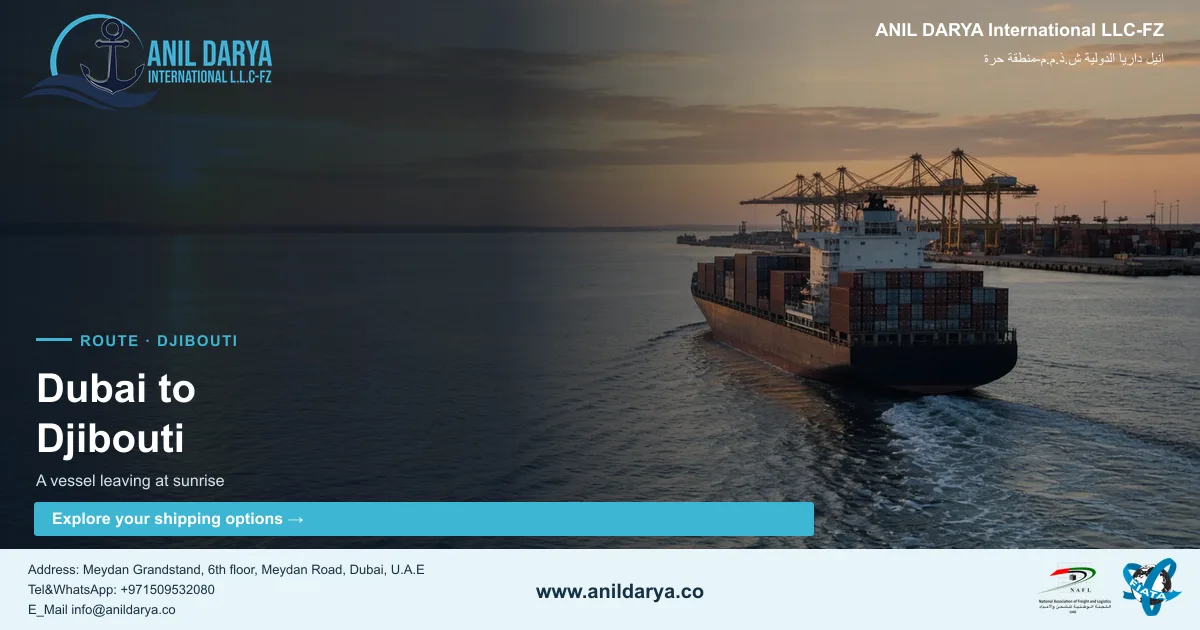
Shipping from Dubai to Djibouti usually means a container from Jebel Ali to the Doraleh terminals, with breakbulk, vehicles and bulk going through the Doraleh Multipurpose Port or the historic Port of Djibouti. A large share of this cargo does not stop in Djibouti at all: it moves on by rail or truck to Ethiopia. This guide covers the terminals, the ECTN rule, port free time, dangerous goods limits, the Ethiopia corridor, and the order in which to do things.
Shipping from Dubai to Djibouti at a glance
| Item | Detail |
|---|---|
| Main UAE load port | Jebel Ali (Dubai) |
| Main Djibouti container terminal | SGTD (Société de Gestion du Terminal à Conteneurs de Doraleh, formerly DCT): 1.8 million TEU capacity, 1,050 m quay, 18 to 20 m depth |
| Multipurpose terminal | Doraleh Multipurpose Port (DMP): 6 berths, 1,200 m quay, 15.3 m depth, vessels up to 100,000 DWT; bulk, breakbulk, containers and Ro-Ro |
| Historic port | Port de Djibouti (PDSA): container terminal of 350,000 TEU a year, general cargo, Ro-Ro, livestock and dry bulk |
| Port and free zone authority | Djibouti Ports and Free Zones Authority (DPFZA), with Great Horn Investment Holding (GHIH) as its investment arm |
| Cargo tracking note | ECTN required for containerised shipments loaded on or after 15 June 2023, including free zone cargo; cargo in transit to Ethiopia exempt when the bill of lading says so |
| Port free storage (2018 tariff book) | 3 days for local import and export containers, 8 days for transit and transhipment |
| DG, out-of-gauge and flat rack | No free storage; some classes must go straight to inland transport |
| Onward to Ethiopia | Djibouti to Addis Ababa railway (about 12 hours by rail) and the corridor road network |
| Local clearing agents | Freight forwarders and clearing agents need a DPFZA permit and must be Djiboutian-owned |
How cargo moves from the UAE to Djibouti
Djibouti is in the Horn of Africa, and its ports work as a gateway for its own small market and for the much larger Ethiopian market behind it. Port de Djibouti says it has handled Ethiopia's maritime traffic since 1998, with cargo moved to and from Addis Ababa by truck and rail. That shapes almost every decision on this lane: whether the box is cleared in Djibouti or moves on in transit, which terminal it lands at, and how much free time you get.
Most general cargo goes by container ship. Steel, machinery, vehicles and project cargo go as breakbulk, Ro-Ro or on flat racks. Air cargo is used for urgent parts, samples and high-value goods.
Ports and gateways on both ends
| End | Gateway | What it handles |
|---|---|---|
| UAE | Jebel Ali Port, Dubai | Containers, breakbulk, DG and project cargo for this lane |
| UAE | Dubai International (DXB) and Al Maktoum International (DWC) | Air cargo |
| Djibouti | SGTD container terminal, Doraleh | Containers, with an 800 m rail station of 3 lines inside the terminal |
| Djibouti | Doraleh Multipurpose Port (DMP) | Bulk, breakbulk, containers and Ro-Ro, with a direct rail connection |
| Djibouti | Port de Djibouti (PDSA) | Containers, general cargo, project cargo, vehicles, livestock, steel, wheat, fertilizer and clinker |
| Djibouti | Horizon Terminal | Petroleum and liquid bulk, 371,000 m3 of storage |
| Djibouti | Djibouti international airport (JIB) | Air cargo |
Your carrier's service decides the discharge terminal, so check it on the booking and the arrival notice. See our Jebel Ali port shipping guide for how the load end works.
Sea freight from Dubai to Djibouti: FCL or LCL?
You have two container options on this lane.
- FCL (full container load). You book a whole 20ft or 40ft box. It suits larger shipments, and it is the cleaner choice for Ethiopia transit cargo, because the sealed box can move on by rail or truck without being opened in Djibouti.
- LCL (less than container load). Your cargo shares a box with other shippers and is unpacked at a container freight station. It suits small volumes for local Djibouti consignees. The port tariff lists separate charges for transfer to the CFS and for stripping, so ask what is included in your quote.
Reefer cargo is possible. The PDSA container terminal lists 126 reefer plug points, and the tariff charges plug-in, monitoring and power per day. Tell us the set temperature and ventilation at booking. Our guide to FCL vs LCL costs shows where the break-even usually falls, and our sea freight service page explains what we book.
Transit times and sailings
We could not find a carrier schedule page that publishes a fixed Jebel Ali to Djibouti transit time. Forwarder and aggregator sites give figures from under a week to about a month, which tells you how much depends on the service: a direct call is quick, while a routing through a transhipment hub can add a lot of waiting. At booking, ask for the actual vessel, the full routing, any transhipment port and the estimated arrival, not a generic number.
[AMIR-FACT: Our real port-to-port transit Jebel Ali to Djibouti (days), direct or via which hub, and the carriers or services we actually book on this lane]
The ECTN: the document most shippers miss
Djibouti requires an Electronic Cargo Tracking Note (ECTN) for containerised shipments. CTN Djibouti, which describes itself as the authorised agency that issues ECTNs, says the rule covers shipments loaded on or after 15 June 2023, applies to all containerised shipments to Djibouti including free zone cargo, and exempts goods in transit to Ethiopia when the bill of lading states this.
When DPFZA announced the scheme in 2023, the Ethiopian Maritime Authority reported that the ECTN is obtained by the exporter when loading containers for Djibouti, that its number must appear on the bill of lading, and that the application needs the bill of lading, the commercial invoice and the freight invoice.
| Your cargo | ECTN needed? | What to do |
|---|---|---|
| Container for a consignee in Djibouti | Yes | Apply before loading and put the ECTN number on the bill of lading |
| Container for the Djibouti free zones | Yes | Same as local cargo |
| Container in transit to Ethiopia | Exempt if the bill of lading states transit to Ethiopia | Get the exact wording from the consignee and the carrier before the bill is issued |
A simple rule: agree who applies for the ECTN when you agree the sale. Under most Incoterms the seller in Dubai holds the documents at loading, so it is usually easiest for the exporter's side to file it. Fees and rules can change, so confirm both at booking.
Shipping to Ethiopia via Djibouti: rail and road
If your buyer is in Ethiopia, the cargo is discharged in Djibouti and then moves inland. Djibouti's port authority describes two links.
| Link | What the official source says | What it means for you |
|---|---|---|
| Djibouti to Addis Ababa railway | Commercial operations since January 2018; about 12 hours by rail against about 3 days by road; up to 4 to 5 trains a day from the terminal to Ethiopia; freight capacity of 4 million tons | Containers can be railed from the port without a long truck leg |
| Rail links at the port | Connected to the SGTD container terminal and the DMP cargo terminal; SGTD has an 800 m train station with 3 lines | Boxes can move from terminal to train directly |
| Djibouti Ports Corridor Road (DPCR) | A 567 km road network built to connect Djibouti's ports with neighbouring countries | Truck option for cargo that does not suit rail |
| General cargo at the historic port | Port de Djibouti presents its general cargo operation as a central distribution point for all of Ethiopia | Breakbulk and project cargo can be routed from there |
The port tariff treats transit cargo differently from local cargo. Transit import and export containers get 8 free storage days against 3 for local cargo, and transit vehicles get 8 days against 3. That gap matters, but it is still short for inland moves, so line up the rail or truck booking before the vessel arrives.
On the Ethiopian side, the main receiving point for rail containers is the Mojo (Modjo) dry port. Ethiopia's state shipping and logistics enterprise told the Ethiopian News Agency in 2018 that the railway was moving containers to the Mojo terminal 106 at a time, and the Ethiopian Maritime Authority reported an expansion of the dry port in July 2026. Ethiopian clearance, duty and the inland carrier sit with your buyer and their licensed Ethiopian agent. We book the ocean leg, prepare the Dubai documents, and make sure the bill of lading carries the transit wording the Ethiopian side asks for.
[AMIR-FACT: Whether we book cargo from Dubai to Ethiopia through Djibouti, and how: who handles the Djibouti transit and inland leg in practice, and our real door transit to Addis Ababa]
Breakbulk, Ro-Ro and project cargo to Djibouti
Djibouti has more than one place to land heavy cargo. Doraleh Multipurpose Port has 6 berths on a 1,200 m quay at 15.3 m depth and takes bulk, breakbulk, containers and Ro-Ro. The historic port's general cargo side handles breakbulk, heavy and over-dimensional project cargo, vehicles, steel and coal, and lists a 120-tonne port weighbridge, 150,000 MT of open storage for steel and an off-dock vehicle store for 7,000 units.
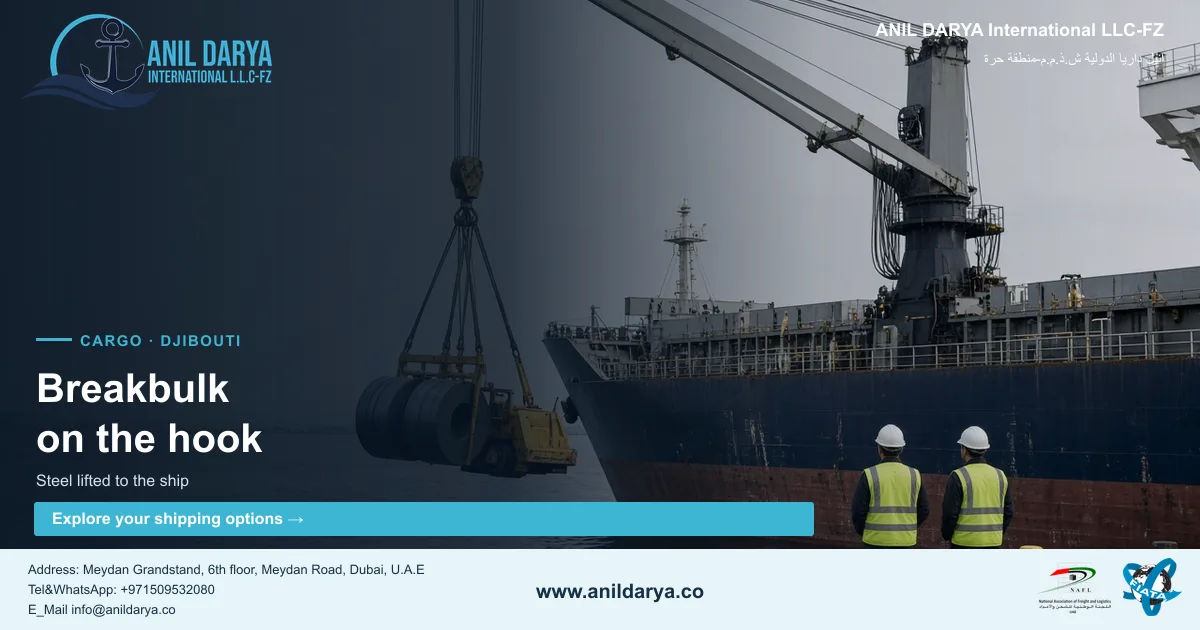
The port tariff gives no free storage for out-of-gauge and flat rack containers, so project cargo should leave the port quickly. A practical decision rule: if a piece fits a 40ft flat rack by size and weight, a container service usually gives you more sailings and a single bill of lading. If it does not fit, you need conventional breakbulk or heavy-lift tonnage, and the sailing date drives the whole plan. For Ethiopia, also check the piece against the rail wagons and road limits before you commit.
For any heavy or oversized piece we need dimensions, weight, centre of gravity, lifting points and photos before we ask a carrier for space. See our break bulk and project cargo service, and for bulk shipments our article on Dubai to Africa bulk shipping.
Dangerous goods on the Djibouti lane
Djibouti's port rules for dangerous goods are strict, and they affect how fast your consignee must act. The 2018 tariff book sets these rules:
| Rule | What the tariff says |
|---|---|
| Acceptance | Dangerous cargo is received only after written application and approval; the ship agent must show it in the EDI file and manifest; handling follows the IMDG Code |
| Free storage | None for IMDG containers |
| Class 1, 2.1, 2.3 and flammable Class 3 | Direct delivery to inland transport |
| Class 7 (radioactive) | Not accepted unless the appropriate authority instructs otherwise |
| Class 5.2, 6.2 and 8 | If not physically cleared 15 days after discharge, reshipped to the load port by the shipping line |
| Undeclared DG | Penalty per offence for undeclared IMDG boxes or boxes arriving without hazard labels, higher for repeat offences |
The tariff dates from January 2018, so we confirm current rules with the carrier for each booking. For the Dubai side you need the correct UN number, proper shipping name, class and packing group, a Safety Data Sheet, a signed DG declaration, UN packaging and labels, and carrier acceptance before the cargo moves. Our dangerous goods shipping service covers how we plan this.
Air cargo from Dubai to Djibouti
Air freight from Dubai lands at Djibouti's international airport (JIB). It suits spare parts, documents, samples, medicines and urgent goods where a few days matter more than cost. Check whether your goods count as dangerous goods for air, since air rules are stricter than sea rules for many products. Our air cargo service page explains how we book space.
Djibouti customs: documents and local rules
Clearance in Djibouti is handled by your consignee's clearing agent. DPFZA licenses freight forwarders and clearing agents, and its permit rules require them to be Djiboutian nationals or companies wholly owned by Djiboutians. That is why the consignee's licensed local agent, not the Dubai shipper, files the import.
Documents for a Djibouti shipment
| Document | Who prepares it | Note |
|---|---|---|
| Commercial invoice | Shipper | Also needed for the ECTN and the Dubai export declaration |
| Packing list | Shipper | Marks and weights must match the bill of lading |
| Certificate of origin | Shipper (Dubai chamber or authority) | Part of the Dubai Customs declaration set; agree with the consignee if they need it |
| Bill of lading | Carrier, through us | Must carry the ECTN number, or the Ethiopia transit wording if exempt |
| Freight invoice | Carrier or forwarder | Needed for the ECTN application |
| ECTN | Usually the exporter's side | Before loading, for containerised cargo |
| DG declaration and SDS | Shipper | For any IMDG cargo |
| Sanitary or phytosanitary certificate | Shipper, or requested in Djibouti | DPFZA issues these for free zone companies on request, in 3 to 5 working days |
Duties and taxes in Djibouti
According to the WTO's latest trade policy review of Djibouti, the country has no formal customs tariff. Its domestic consumption tax (TIC) works like one, in five bands of 0%, 8%, 10%, 20% and 23%, with 23% the most common rate and a simple average of 18.2% in 2022. Imports also pay VAT, excise and some other taxes. The review notes that all import declarations are filed electronically in Sydonia World, which is linked to Ethiopian customs, the free zones and the port system, with a module for regional transit. Ask the consignee's clearing agent for the TIC band and other taxes on your HS code before you ship. Transit cargo for Ethiopia is not cleared for local use in Djibouti.
Free zones in Djibouti
If the consignee is a free zone company, the rules change. The Djibouti Free Zone has run since October 2004 on 40 hectares close to the ports and airport, and supports warehousing, processing and re-export. The Djibouti International Free Trade Zone opened its first phase of 240 hectares in July 2018. Free zone cargo still needs an ECTN, and the tariff book says port dues follow the cargo's final destination.
Restricted goods
The WTO review says most of Djibouti's import bans and restrictions come from international conventions it has signed, such as CITES and the Stockholm and Rotterdam conventions on chemicals, and that it keeps no import quotas. Food, medicines and chemicals can still need certificates, and Class 7 cargo is not accepted at the port without the authority's instruction. Ask the consignee to confirm permits with their clearing agent before booking.
What drives the cost of shipping from Dubai to Djibouti?
Rates change with every booking, so here are the factors that move your total cost:
| Cost factor | Why it matters | What you can do |
|---|---|---|
| Container size and type | Reefers, flat racks and open tops cost more than dry boxes | Use a dry box when the cargo allows |
| Routing | A transhipment hub adds handling and days | Ask for the full routing at booking |
| Origin charges in the UAE | Trucking, export declaration, terminal handling | Send documents on time to avoid extra trips |
| ECTN | A fee per shipment, and delays if missing | Apply before loading |
| Djibouti port dues and handling | Charged per freight ton or container, different for local, transit and transhipment cargo | Declare the right status from the start |
| Port storage | Starts after 3 or 8 days, at once for DG and out-of-gauge | Plan clearance or inland pickup before arrival |
| Inland leg to Ethiopia | Rail or truck from the port, plus Ethiopian charges | Get the buyer's inland plan in writing |
| Duties and taxes | Apply to goods cleared for Djibouti use | Confirm the HS code and rate with the local agent |
The Incoterm you agree with your buyer decides who pays which part. Our guide to Incoterms 2020 for sea freight explains the split, and our article on demurrage and detention shows how line charges add up after free time.
How to ship from Dubai to Djibouti, step by step
This is how we handle a typical FCL export from Dubai to Djibouti. We book space, prepare documents, arrange trucking and export clearance in the UAE, and work with your consignee's clearing agent in Djibouti.
- Confirm where the cargo ends up. Djibouti, a Djibouti free zone, or Ethiopia in transit. This decides the ECTN, the bill of lading wording and the free time.
- Check the goods. Confirm the HS code, any permits, and DG class if it applies.
- Get a quote and pick the service. We compare routings and confirm the discharge terminal.
- Book space. For DG, reefer or out-of-gauge cargo we get carrier acceptance first.
- Arrange the ECTN, or the transit wording for Ethiopia cargo, before loading.
- Prepare documents in Dubai. Invoice, packing list, certificate of origin and draft bill of lading, matching on names, weights and HS codes. These also support the Dubai Customs export declaration.
- Pick up, stuff and seal. We collect the empty, stuff at your site or a warehouse, seal the box and truck it to Jebel Ali before the cut-off.
- Release the bill of lading. We check the draft, release the final bill after sailing and send the documents to the consignee.
- Arrival in Djibouti. The clearing agent clears for local use, or the inland carrier collects transit cargo within the free days.
[AMIR-FACT: One real Dubai to Djibouti (or Djibouti transit to Ethiopia) shipment we handled: cargo type, mode, terminal and what we did, cleared for publication]
Checklist before you ship to Djibouti
- Final destination confirmed: Djibouti, free zone, or Ethiopia transit.
- ECTN applied for, or transit wording agreed for the bill of lading.
- HS code confirmed with the consignee's clearing agent.
- Permits or certificates in place for food, medicines, chemicals or similar goods.
- Invoice, packing list and bill of lading match on weights, marks and descriptions.
- For DG: SDS, DG declaration, packaging, labels and carrier acceptance.
- For Ethiopia: rail or truck booked before arrival, inside the 8 transit free days.
- For project cargo: drawings, lift points and inland route checked.
- Free time with the carrier agreed, and cargo insurance arranged.
Common mistakes on the Djibouti lane
- No ECTN number on the bill of lading. The box can be held at discharge until it is fixed.
- Wrong transit wording. Ethiopia cargo without the transit statement on the bill can be treated as needing an ECTN.
- Planning on 8 free days for local cargo. Local import containers get 3.
- Treating DG like general cargo. There is no free storage, and some classes must leave the port at once.
- No inland plan for Ethiopia. The box waits in the port while storage runs.
- Mismatched documents. Different weights on the invoice and the bill delay clearance.
Frequently asked questions
How do I ship goods from Dubai to Djibouti?
Most goods go by container from Jebel Ali to the Doraleh terminals. You book FCL or LCL, prepare the invoice, packing list and bill of lading, arrange the ECTN, and the consignee's licensed clearing agent clears the cargo in Djibouti.
Which port in Djibouti receives cargo from Dubai?
Containers usually land at the SGTD terminal at Doraleh or the Doraleh Multipurpose Port. Breakbulk, vehicles and bulk can also use the Doraleh Multipurpose Port or the historic Port of Djibouti. Your carrier's service decides which.
Is an ECTN required for Djibouti cargo?
Yes, for containerised shipments loaded on or after 15 June 2023, including free zone cargo. Goods in transit to Ethiopia are exempt if the bill of lading states this. The ECTN number goes on the bill of lading.
Can I ship to Ethiopia through Djibouti?
Yes. Cargo is discharged in Djibouti and moves inland by the Djibouti to Addis Ababa railway, which takes about 12 hours, or by road. Ethiopian clearance is handled by the buyer's licensed Ethiopian agent.
How many free days do I get at the port of Djibouti?
The 2018 port tariff gives 3 free storage days for local import and export containers and 8 days for transit and transhipment containers. DG, out-of-gauge and flat rack containers get no free storage.
Can I ship dangerous goods from Dubai to Djibouti?
Yes, with written port approval and full IMDG paperwork. Some classes must go straight to inland transport, Class 7 is not accepted without the authority's instruction, and Class 5.2, 6.2 and 8 boxes not cleared within 15 days are sent back.
Do I need a clearing agent in Djibouti?
Yes. Forwarders and clearing agents need a DPFZA permit and must be Djiboutian-owned, so the consignee uses a licensed local agent. We work with the consignee's agent or a destination agent they choose.
How long does shipping from Dubai to Djibouti take?
It depends on the service. A direct sailing is much faster than one routed through a transhipment hub. Ask for the actual vessel, the routing and the estimated arrival when you book.
Get a quote for shipping from Dubai to Djibouti
Send us the commodity, HS code, weight, volume or dimensions, and whether the cargo stays in Djibouti or goes on to Ethiopia, and we will come back with a routing and a price. Use our freight rate inquiry form, or contact our team to talk through a breakbulk, project or DG shipment first. You can also read more about our Dubai freight forwarding team.
Sources
- Djibouti Ports and Free Zones Authority: About us (role, GHIH, ports and free zones)
- DPFZA: SGTD container terminal
- DPFZA: Doraleh Multipurpose Port
- DPFZA: Horizon Terminal
- DPFZA: Djibouti to Addis Ababa railway
- DPFZA: Djibouti Ports Corridor Road
- DPFZA: Djibouti Free Zone
- DPFZA: Djibouti International Free Trade Zone
- DPFZA: Maritime transport accreditation (forwarders and clearing agents)
- DPFZA: Goods services (sanitary and phytosanitary certificates)
- Port de Djibouti: Home (Ethiopia traffic since 1998)
- Port de Djibouti: Container terminal
- Port de Djibouti: General cargo
- Djibouti Ports: Tariff Book, 1 January 2018 (free storage, DG rules)
- CTN Djibouti: ECTN requirement
- Ethiopian Maritime Authority: Djibouti ECTN scheme (reprint of Capital, June 2023)
- Ethiopian Maritime Authority: Logistics, dry ports and rail
- Ethiopian News Agency: Ethio-Djibouti railway and Mojo dry port (July 2018)
- WTO: Trade policy review of Djibouti, summary (WT/TPR/S/430)
- Dubai Customs: Submit customs declaration
Reviewed: 10 November 2026