
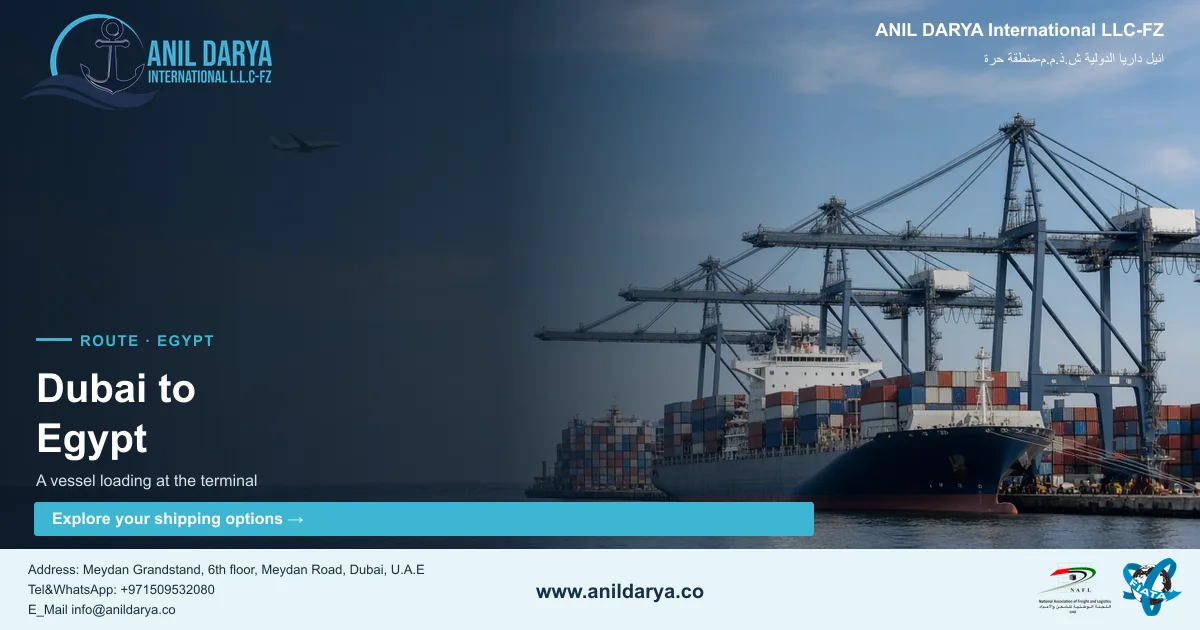
Shipping from Dubai to Egypt is mostly done by container ship from Jebel Ali to an Egyptian port such as Alexandria or Sokhna, or by air to Cairo. Whatever the mode, the shipment must be registered in Egypt's Advance Cargo Information (ACI) system before it leaves the UAE: your Egyptian buyer gets an ACID number on the Nafeza platform, and the exporter sends the documents through CargoX. Get that step right and the rest of the clearance follows a normal path.
Dubai to Egypt shipping at a glance
| Item | Detail |
|---|---|
| Main UAE origin points | Jebel Ali Port (sea), Dubai airports (air) |
| Main Egyptian seaports for containers | Alexandria (with Dekheila), Sokhna, Port Said, Damietta |
| Main Egyptian cargo airport | Cairo International (CAI) |
| Customs authority | Egyptian Customs Authority, under Customs Law No. 207 of 2020 |
| Single window | Nafeza, run by Misr Technology Services |
| Pre-shipment rule | Advance Cargo Information (ACI): cargo data and documents at least 48 hours before the cargo ships from the export country |
| ACI dates | Pilot from 1 April 2021, mandatory for sea cargo from 1 October 2021, mandatory for air cargo from 1 January 2026 |
| Shipment ID | ACID, a 19-digit number issued to the Egyptian importer through Nafeza |
| Exporter document channel | CargoX, the certified blockchain service provider for Nafeza |
| Core ACI documents | Commercial invoice (PDF plus Nafeza Excel template), packing list, copy of the bill of lading, certificate of origin |
| Import VAT | 14% standard rate (VAT Law No. 67 of 2016) |
| Customs duty | By HS code; PwC reports 0% to 60% of CIF value for most goods, up to 135% for cars and luxury goods |
| Product registration | Some consumer goods need the foreign factory or brand owner registered with GOEIC (Decree 43 of 2016) |
Sea or air: which way should you ship from Dubai to Egypt?
On this lane you choose between container shipping and air freight. Breakbulk and DG are variations of those two.
| Mode | Best for | Egyptian entry point | What decides it |
|---|---|---|---|
| Sea, FCL | Full 20ft or 40ft containers, heavy goods, regular stock | Alexandria, Sokhna, Port Said or Damietta | Volume, weight, which port is nearest your consignee |
| Sea, LCL | A few pallets or cartons that can wait for consolidation | Usually the main container ports | Cost per cubic metre, release time at the destination CFS |
| Breakbulk and project cargo | Machinery, steel, generators, oversized pieces | Ports with general cargo berths | Dimensions, weight, lifting and road plan |
| Dangerous goods | Chemicals, batteries, paints, gases | Depends on class and carrier acceptance | IMDG or IATA rules, packaging, product permits |
| Air | Urgent spares, samples, electronics, high-value goods | Cairo International | Deadline, chargeable weight |
A simple rule: if the goods fill most of a container, price FCL first. For a few cubic metres, compare LCL with air, because destination charges on small LCL lots can close the gap.
Egyptian ports and airports for cargo from Dubai
Pick the gateway nearest to where the goods are used, because inland trucking adds time and cost.
| Gateway | Type | Usually suits |
|---|---|---|
| Alexandria and Dekheila | Main seaport, containers, general cargo and bulk | Alexandria, the Delta and northern Egypt |
| Sokhna | Seaport, containers and general cargo | Consignees in Cairo and the Suez Canal Economic Zone |
| Port Said | Seaport, containers | Port Said area and transshipment |
| Damietta | Seaport, containers and bulk | The eastern Delta |
| Cairo International Airport (CAI) | Air cargo | Greater Cairo and onward trucking |
On the UAE side, almost all container cargo for Egypt loads at Jebel Ali Port. If your cargo sits in Abu Dhabi, we can also compare a sailing from Khalifa Port. Confirm the consignee's port before you book. Changing it after loading is slow and expensive.
Sea freight from Dubai to Egypt: FCL, LCL and transit
FCL or LCL?
FCL means you book a whole 20ft or 40ft container for one consignee and one ACID. It suits heavy cargo and anything close to a full box.
LCL means your cargo shares a container with other shippers. It is consolidated in Dubai and unpacked at a container freight station in Egypt. Each shipper's cargo still needs its own ACID and documents, and the consolidator's master bill of lading must carry a valid master ACID too. One wrong file in the box can slow the whole unpacking. Our guide to FCL vs LCL costs shows where the break-even usually sits.
How long does sea freight from Dubai to Egypt take?
We did not find a carrier schedule page that publishes a direct Jebel Ali to Alexandria or Jebel Ali to Sokhna transit time we could cite. Figures on rate websites and forwarder pages for this lane disagree by more than two weeks, which tells you they depend on the service, the transshipment port and the season. We quote the actual sailing and transit for your booking instead of a fixed number.
[AMIR-FACT: the carriers we actually book from Jebel Ali to Alexandria and Sokhna, with typical port-to-port days and sailing frequency]
Plan the ACI timeline around the sailing, not the arrival. Nafeza wants the cargo data at least 48 hours before the cargo ships, so a late ACID can make you miss the vessel even when the cargo is ready. Our sea freight service from Dubai covers FCL and LCL bookings to the main Egyptian ports.
Breakbulk, project cargo and dangerous goods to Egypt
Breakbulk and project cargo
Machinery, steel structures, transformers and generators that do not fit a standard box go one of two ways: on a flat rack or open top container on a container service, or as conventional breakbulk on a general cargo or heavy-lift vessel. The decision rule:
- Fits a 40ft flat rack by size and weight: a container service usually gives you more sailings.
- Too big or heavy for a flat rack: you need breakbulk or heavy-lift tonnage, and the vessel date drives the whole plan.
- Many pieces for one site: plan cranes, trailers and clearance once for the full set, not piece by piece.
Breakbulk still needs an ACID. The packing list should show every piece with dimensions and weight, because that is what the Egyptian side checks against the cargo. Read how we plan flat rack, open top and out-of-gauge cargo, or see our break bulk and project cargo service.
Dangerous goods
Dangerous goods move under the IMDG Code by sea and IATA rules by air, and each carrier decides which classes it accepts. For every DG shipment we need:
- UN number, proper shipping name, class and packing group.
- A Safety Data Sheet for each product. Nafeza lists the material safety data sheet among the extra documents an ACI file may need.
- A signed dangerous goods declaration.
- UN-approved packaging, labels and placards.
- Any Egyptian approval the product needs, confirmed by the consignee before the cargo leaves Dubai.
Our dangerous goods shipping team gets carrier acceptance before you commit to a sailing.
Air cargo from Dubai to Egypt
Air freight from Dubai lands mainly at Cairo International Airport. It suits spare parts, documents, samples, electronics and anything where a day costs more than the freight. Price is based on chargeable weight, which is the higher of actual weight and volume weight, so light bulky cargo costs more than its scale weight suggests.
Air cargo no longer skips ACI. CargoX states that ACI became mandatory for air shipments to Egypt on 1 January 2026, and the ACID must appear in the Other Customs Information (OCI) field of the air waybill. See our air cargo service for what we book.
Egypt's ACI system: ACID, Nafeza and CargoX explained
ACI is the rule that most often stops cargo for Egypt. Nafeza describes it as a customs procedure that needs cargo data or documents, including the pro-forma invoice and draft bill of lading where they exist, at least 48 hours before the cargo ships from the export country. Customs uses the data to assess risk before the goods arrive.
Who does what in the ACI process?
| Party | What they do |
|---|---|
| Egyptian importer (or its customs broker) | Registers on Nafeza, gets an electronic signature device, enters the shipment data and receives the ACID |
| Egyptian Customs | Checks the data and issues the ACID; the US Commerce Department describes issuance within 48 hours |
| UAE exporter | Holds a verified CargoX account, puts the ACID on every document and sends the ACI documents through CargoX |
| Sea freight forwarder | Registers and verifies on CargoX and provides the bill of lading; does not file the documents itself |
| Air freight forwarder | May file on the exporter's behalf with a formal delegation |
| Carrier | Needs the ACID on the booking and bill of lading before loading |
Which documents go into the ACI file?
Nafeza lists the documents most ACI files need. Each upload must be under 5 MB.
- Commercial invoice, as a PDF and in the Nafeza Excel template.
- Packing list (PDF).
- A copy of the bill of lading, never the original (PDF).
- Certificate of origin (PDF).
Depending on the cargo, Nafeza may also ask for a bill of materials, certificate of analysis, fumigation certificate, inspection certificate, insurance certificate, EUR.1 movement certificate, halal certificate, health certificate, material safety data sheet, phytosanitary certificate, veterinary certificate or a cover letter.
What goes wrong with ACI?
- No ACID on the documents. The US Commerce Department's guide states that shipments without an ACID are refused entry and must be re-exported at the shipper's expense.
- Invoice data does not match Nafeza. The invoice you upload must match what the importer entered.
- Exporter not verified on CargoX. Verification needs a third-party company check and a prepaid account, so do it before your first order, not the week of shipment.
- A filing sent with errors. CargoX says a sent filing cannot be recalled. You resend corrected documents under the same ACID.
Ask your buyer for the ACID as part of the purchase order.
What documents do you need to ship from Dubai to Egypt?
On top of the ACI file, the physical shipment and the Egyptian clearance need a document set. The table shows what changes by cargo type.
| Cargo type | Core documents | Usually also needed |
|---|---|---|
| General cargo (FCL or LCL) | Commercial invoice, packing list, certificate of origin, bill of lading, all showing the ACID | Legalisation of invoice and certificate of origin where the buyer or bank asks for it |
| Food and agricultural goods | Core set | Health, phytosanitary or veterinary certificate, halal certificate where relevant |
| Consumer goods on the GOEIC list | Core set | Proof the factory or brand owner is registered with GOEIC |
| Dangerous goods | Core set | DG declaration, SDS, product approvals |
| Machinery and project cargo | Core set with a piece-by-piece packing list | Bill of materials, drawings and weights |
| Air cargo | Invoice, packing list, certificate of origin, air waybill with ACID in the OCI field | As for the cargo type above |
Certificate of origin and legalisation
Dubai Chambers issues two kinds of certificate of origin: non-preferential certificates for goods produced in the UAE, and certificates for foreign goods being re-exported. The exporter applies online and needs an active Dubai Chambers membership. Most cargo from Dubai to Egypt is re-export cargo, so the certificate shows the real country of manufacture, not the UAE.
The US Commerce Department's Egypt guide says the commercial invoice and certificate of origin are usually legalised by the Egyptian consulate in the country of origin. Ask your buyer early whether their bank or clearing agent needs legalised copies, because legalisation adds days.
Payment terms and letters of credit
If your sale runs on a letter of credit, do not ship before the Egyptian bank confirms the LC is open. The US Commerce Department warns that shipping early can bring fines up to the value of the goods.
Egyptian customs clearance: how it works on arrival
The Egyptian Customs Authority clears goods under Customs Law No. 207 of 2020, written to simplify procedures and speed up release. The US Commerce Department summarises the process this way: the importer enters the data and gets the ACID, the exporter sends the documents, the importer certifies them, the vessel sails, the importer pays taxes and fees, the cargo is discharged, a joint port committee inspects it, and customs clears it.
Inspection is risk-based. Shipments in the green lane skip sampling and physical inspection, though random audits still happen. The General Organization for Export and Import Control (GOEIC) inspects goods, and duties are paid in Egyptian pounds. The importer, or a licensed Egyptian customs broker acting for it, handles the clearance. We prepare the UAE side and work with your consignee's clearing agent.
Who can import into Egypt?
Importing for trade in Egypt needs registration in the Importers Register under Law No. 121 of 1982. Ministerial Decree No. 271 of 2026, in force from 22 July 2026, replaced the register's executive regulations. GOEIC keeps the register and must decide a complete application within 15 days. Companies with less than 51% Egyptian ownership can now register for a limited period. If your buyer is new to importing, ask about this before you agree a delivery date.
Factory and brand registration with GOEIC
Ministerial Decree 43 of 2016 requires factories and trademark owners that export listed products to Egypt to register with GOEIC. The list covers many consumer goods, including dairy, confectionery, juices and bottled water, cosmetics and toiletries, household appliances, furniture, tableware, bathroom fixtures, toys, watches, lighting, clothing, footwear and textiles. If your products are on it, check the manufacturer's registration before you ship, because the goods are not released without it.
Customs duty and VAT when you ship from Dubai to Egypt
Customs duty
Duty depends on the HS code of each item. PwC's tax summary for Egypt reports duty rates between 0% and 60% of the CIF value for most goods, with higher rates up to 135% for passenger cars, non-essential luxury goods and alcohol. Industrial machinery is generally 0% to 5%, and trucks and heavy equipment 10% to 20%. Check your exact line in the customs tariff published on Nafeza.
Egypt and the UAE are both members of the Greater Arab Free Trade Area (GAFTA). Goods that meet GAFTA's rules of origin may qualify for preferential duty. Most goods re-exported from Dubai were made elsewhere, so they usually pay the normal rate for their country of manufacture.
Import VAT at 14%
Egypt's standard VAT rate is 14% under VAT Law No. 67 of 2016, in force since July 2017. On imports, VAT is charged on the CIF value plus customs duty and other taxes. Machinery and equipment for setting up production lines is taxed at a reduced 5%. Some goods also carry a schedule tax, for example alcohol and cigarettes.
| Charge | Basis | Who pays |
|---|---|---|
| Customs duty | CIF value, rate by HS code | Importer, in Egyptian pounds |
| VAT | 14% on CIF plus duty and other taxes | Importer |
| Schedule tax | Specific goods only | Importer |
| Port, terminal and clearance charges | Set by the port, terminal, line and broker | Usually the importer, depending on the Incoterm |
The Incoterm on your sale decides who pays what. Under FOB or CFR the buyer pays Egyptian duty and VAT. Under DDP you do, which is rarely practical for Egypt. Our guide to Incoterms 2020 for sea freight explains each term.
Restricted goods and products that need approvals
We could not find a single official prohibited-goods list for Egypt to cite. The official sources do show which goods need extra paperwork: GOEIC-listed consumer goods need a registered factory, food, plant and animal products need health, phytosanitary or veterinary certificates, and DG needs safety data sheets. Telecom equipment, medicines and cosmetics can also need a sector regulator's approval. Your buyer's clearing agent confirms this for the HS code before you ship.
What does shipping from Dubai to Egypt cost?
We do not publish fixed rates because they change with every sailing. These are the parts of the bill and what moves each one.
| Cost item | What drives it |
|---|---|
| Ocean or air freight | Container size or chargeable weight, carrier, season, transshipment |
| UAE origin charges | Trucking to Jebel Ali or the airport, terminal handling, export declaration |
| Documents | Certificate of origin, legalisation, CargoX filing fee per ACID |
| Egyptian destination charges | Terminal handling, CFS charges for LCL, delivery order, storage |
| Duty and taxes | HS code, CIF value, 14% VAT |
| Delays | Missing ACID, GOEIC holds, inspection, demurrage and detention |
The line nobody prices is storage while cargo waits for a document. Our article on demurrage and detention shows how those charges add up.
How to ship from Dubai to Egypt: step by step
- Confirm the buyer side. Ask your Egyptian buyer to confirm it is on the Importers Register, whether your products need GOEIC registration, and which port its clearing agent uses.
- Register on CargoX. As the exporter, open and verify your CargoX account. We register as the forwarder for sea bookings.
- Get the ACID. The buyer enters the shipment on Nafeza and sends you the 19-digit ACID.
- Book space. We book the sailing or flight, with carrier acceptance first for DG or out-of-gauge cargo, and put the ACID on the booking.
- Prepare documents. Invoice, packing list and certificate of origin, all showing the ACID, plus the invoice in the Nafeza Excel template. Legalise where needed.
- File the ACI documents. You send them through CargoX at least 48 hours before the cargo ships.
- Export from the UAE. We arrange trucking, container stuffing, the UAE export or re-export declaration and gate-in before the cut-off.
- Release the bill of lading. We send the bill, which must carry the ACID, and you release originals or telex release once paid.
- Clearance in Egypt. The consignee's broker pays duty and VAT, the port committee inspects if selected, and the cargo is released.
[AMIR-FACT: one real Dubai to Egypt shipment we handled (cargo type, port, how ACI was managed, door-to-door days)]
Checklist before you ship to Egypt
- Buyer registered as an importer in Egypt.
- Products checked against the GOEIC Decree 43 list, with the factory or brand registered if needed.
- Exporter account on CargoX open and verified.
- ACID received and copied to every document.
- Invoice matches the Nafeza data and is also in the Nafeza Excel template.
- Certificate of origin from Dubai Chambers, legalised if the buyer asks.
- Health, phytosanitary or other certificates ready for food and regulated goods.
- HS code, duty rate and 14% VAT agreed with the buyer.
- Incoterm written on the contract and the invoice.
- For DG: SDS, DG declaration, packaging and carrier acceptance.
- Cargo insurance arranged.
Common mistakes on the Dubai to Egypt lane
- Booking before the ACID exists. The carrier will not load cargo for Egypt without a valid ACID.
- Different numbers on different documents. A weight or value that differs between the invoice, packing list and Nafeza data causes holds.
- Uploading the original bill of lading to CargoX. Nafeza asks for a copy only.
- Forgetting GOEIC registration. The goods arrive and cannot be released until the factory is registered.
- Assuming GAFTA covers re-exports. Goods made outside the Arab region do not get GAFTA duty treatment just because they ship from Dubai.
- Treating air as ACI-free. Since 1 January 2026, air shipments need ACI too.
- Shipping on an LC before it is open. You risk not getting paid.
Frequently asked questions
What is an ACID number for Egypt?
The ACID is a 19-digit Advance Cargo Information number that the Egyptian importer gets through the Nafeza platform. It must appear on the invoice, packing list, certificate of origin and bill of lading or air waybill for every shipment to Egypt.
Who applies for the ACID, the exporter or the importer?
The Egyptian importer, or its customs broker, applies on Nafeza. The UAE exporter then sends the shipment documents through a verified CargoX account under that ACID.
When must the ACI documents be sent?
Nafeza says the cargo data and documents are needed at least 48 hours before the cargo ships from the export country. File as soon as the documents are final.
Does ACI apply to air cargo from Dubai to Egypt?
Yes. ACI has been mandatory for sea cargo since 1 October 2021 and, according to CargoX, for air cargo since 1 January 2026. The ACID goes in the OCI field of the air waybill.
What is the VAT rate on imports into Egypt?
The standard rate is 14% under VAT Law No. 67 of 2016, charged on the CIF value plus duty and other taxes. Machinery for new production lines is taxed at 5%.
Is there customs duty on goods shipped from Dubai to Egypt?
Usually yes. Duty is set by HS code, mostly between 0% and 60% of CIF value according to PwC. GAFTA preference applies only to goods that meet its Arab origin rules, which most re-exports from Dubai do not.
Which Egyptian port should I use for cargo from Dubai?
Use the port nearest to where the goods are used and where your buyer's clearing agent works. Alexandria serves the north and much of Cairo's trade, and Sokhna is often used for Cairo and the Suez Canal Economic Zone.
Get a quote for shipping from Dubai to Egypt
Send us the cargo details, the Egyptian port or city and, if you have it, the ACID, and we will come back with a routing and a price. Use our freight rate inquiry form, or contact our team if you want to talk through an ACI file, a breakbulk move or a DG shipment first.
Sources
- Nafeza: Advance Cargo Information System (definition, 48 hours, phases, importer steps, CargoX)
- Nafeza: Documents required to create an ACI file
- CargoX: ACI Egypt (registration, documents, air ACI from 1 January 2026, OCI field, resubmission)
- Intertek: Egypt ACID number (19 digits)
- US International Trade Administration: Egypt import requirements and documentation
- US International Trade Administration: Egypt customs regulations
- PwC Worldwide Tax Summaries: Egypt, other taxes (VAT and customs duties)
- German-Arab Chamber (AHK Egypt): Registration of manufacturers, Decree 43/2016
- Baker McKenzie: Egypt importers register, Decree 271 of 2026
- Dubai Legislation Portal: Dubai Chambers Resolution No. 7 of 2024 on certificates of origin
- Wikipedia: Greater Arab Free Trade Area (members)
- Fluent Cargo: Dubai to Cairo (Cairo International Airport, Egyptian seaports)
Reviewed: 10 November 2026