
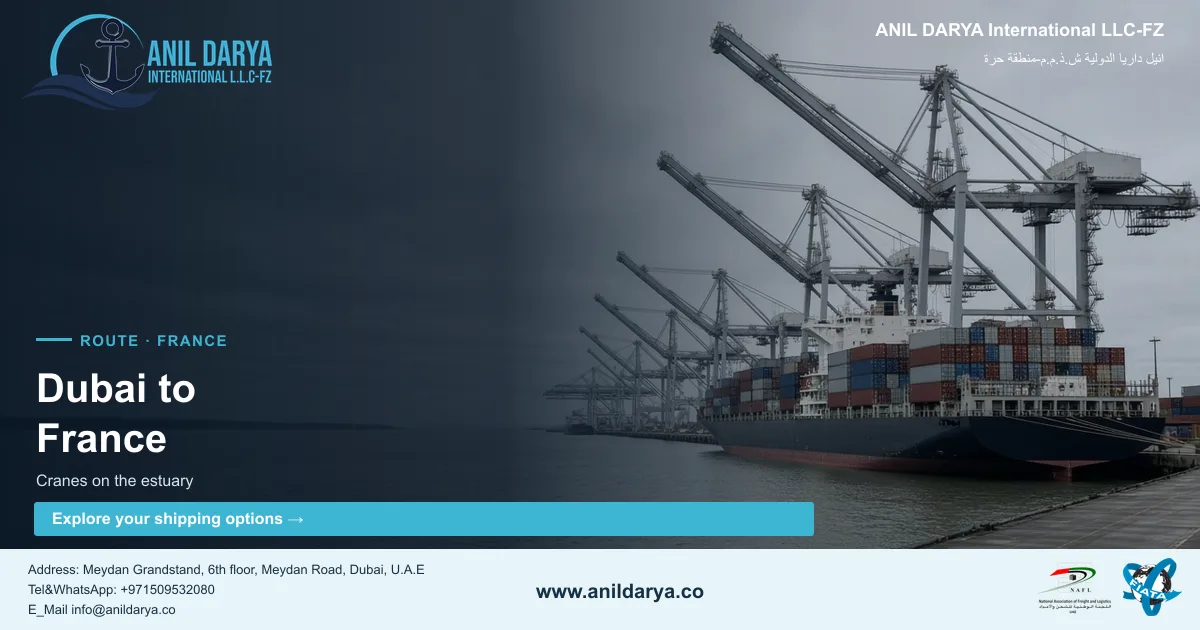
Shipping from Dubai to France usually means a container from Jebel Ali to Le Havre, Marseille-Fos or Dunkirk, with air cargo to Paris for urgent goods. France is in the EU customs union, so the importer needs an EORI number, a customs declaration filed in the French DELTA system, the EU duty rate for the goods code and import VAT, which is 20% for most goods. This guide covers ports, modes, documents, duty, VAT, controlled goods and each step from Dubai to your consignee.
Shipping from Dubai to France at a glance
| Item | Detail |
|---|---|
| Main UAE load port | Jebel Ali (AEJEA), with Khor Fakkan and Abu Dhabi as alternatives |
| Main French container gateways | Le Havre (HAROPA PORT, 3.21 million TEU in 2025 across the Seine ports), Marseille-Fos (about 1.45 million TEU in 2025), Dunkirk |
| Modes | FCL, LCL, flat rack and breakbulk, dangerous goods, air cargo |
| Customs authority | French customs (DGDDI, douane.gouv.fr), applying EU customs law |
| Importer ID | EORI number, free through the SOPRANO service, active 24 hours after issue |
| Import declaration | Electronic, in DELTA G or DELTA IE (import since 26 March 2025) |
| Duty rates | EU Common Customs Tariff, looked up in TARIC by goods code and origin |
| Trade agreement with the UAE | None in force; EU-UAE free trade talks launched on 28 May 2025 |
| Import VAT | 20% normal rate; reduced rates of 10%, 5.5% and 2.1% for listed goods |
| How VAT-registered firms pay import VAT | Self-assessed on the French VAT return, mandatory since 1 January 2022 |
| Security filing | Entry Summary Declaration (ENS) in the EU's ICS2 system before arrival |
| Carbon rule | CBAM for steel, aluminium, cement, fertilisers, hydrogen and electricity |
Which mode should you use from Dubai to France?
Most cargo from Dubai to France moves by sea in containers. Air cargo is for urgent, light or high-value goods. Road freight is not a practical option on this lane, so this guide does not cover it.
| Your cargo | Best mode | Why |
|---|---|---|
| A full container or more of general goods | FCL by sea | Lowest cost per unit, box stays sealed to France |
| A few pallets or cartons | LCL by sea | You pay for the space you use |
| Machinery, steel, vehicles, oversized pieces | Flat rack, open top or breakbulk | Fits cargo that does not go in a standard box |
| Chemicals, batteries, aerosols, perfumes | DG container or DG air | Needs carrier acceptance and French port DG rules |
| Samples, spare parts, urgent stock | Air cargo | Hours of flying time instead of weeks at sea |
A quick decision rule: if the goods must be in France within a week, price air. If not, start with sea and compare FCL and LCL once you know the volume and weight.
Sea freight from Dubai to France: ports, FCL and LCL
Sea freight from Dubai to France normally loads at Jebel Ali. Our Jebel Ali port shipping guide covers the terminals and export steps there. On the French side, pick the port by where your consignee is. The truck, train or barge leg inside France can cost more than the port choice saves.
Which French port should your cargo go to?
| Port | What it offers | Best for consignees in |
|---|---|---|
| Le Havre (HAROPA PORT) | France's main container gateway on the Seine axis; Port 2000 deep-sea terminals; rail and river links to Paris; 145,000 TEU moved by train to and from Le Havre in 2025 | Paris region, Normandy, northern and central France |
| Marseille-Fos | Mediterranean gateway, about 1.45 million TEU in 2025; 16% of containers leave by rail and 5% by river | Provence, the Rhone valley, Lyon and the south |
| Dunkirk | Terminal des Flandres with a 1,600 m deep-water quay and two berths dredged to 17.5 m | Hauts-de-France, Lille and the north-east |
HAROPA PORT groups Le Havre, Rouen and Paris on the Seine. It reported a record 3.21 million TEU in 2025, up 4%, with 2.3 million TEU of hinterland traffic. If your buyer is in or near Paris, Le Havre is usually the first port to price, because containers can move on by road, by train or by barge up the Seine.
For Lyon and the south, Marseille-Fos is often closer, and for Lille and the north-east, Dunkirk can cut the inland leg.
FCL or LCL?
- FCL (full container load). You book a whole 20ft, 40ft or 40ft high cube. It suits larger volumes, heavy goods and cargo you do not want handled with other shipments.
- LCL (less than container load). Your cargo shares a box with other shippers. It is packed at a container freight station in the UAE and unpacked in France, so your release can also depend on the other cargo in the box being cleared.
For France the break-even is often lower than people expect. A full box landed at Le Havre can go on by train or barge up the Seine to the Paris region as one unit, while an LCL load is first unpacked in France and waits for the rest of the box to clear. Our guide to FCL vs LCL costs shows how to compare them, and our sea freight service page explains what we book to French ports.
Transit times and sailings
Transit time depends on the carrier, the French port and whether the service is direct or transshipped. Published schedule data for this lane varies a lot, so treat these figures as a guide only.
| Port pair | Quickest option listed | Sailing frequency listed |
|---|---|---|
| Jebel Ali to Marseille | 26 days 19 hours, 1 transfer | Every 2 to 4 weeks |
| Jebel Ali to Dunkirk | 29 days 4 hours, 2 transfers | Every 2 to 4 weeks |
| Jebel Ali to Le Havre | About 38 days, 1 transfer | Every 2 to 4 weeks |
| Khor Fakkan to Le Havre | About 53 days, 1 transfer (most frequent option) | Every 1 to 2 weeks |
Source: Fluent Cargo schedule data. Always check the vessel schedule and estimated arrival on your booking before you promise a delivery date to the buyer.
[AMIR-FACT: the carriers we actually book from Jebel Ali to Le Havre, Marseille-Fos and Dunkirk, and our typical port-to-port days on each]
Breakbulk, project cargo and dangerous goods to France
Breakbulk and project cargo
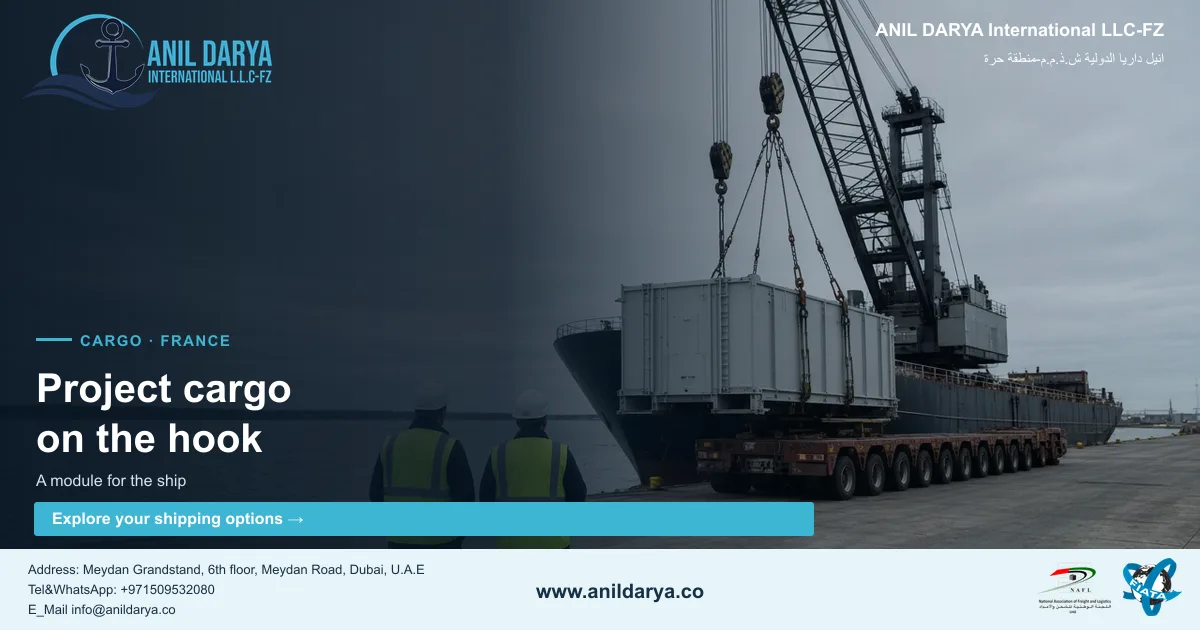
Cargo that fits a container but is too tall or wide goes on flat racks or open tops. Cargo that does not fit a container at all moves as breakbulk on a general cargo or heavy-lift vessel. HAROPA lists heavy-lift and out-of-gauge handling at Le Havre's Terminal de France and Terminal de l'Atlantique, and breakbulk at Terminal de l'Atlantique.
Measure each piece against a 40ft flat rack first. If it fits by size and weight, a container service to Le Havre, Marseille-Fos or Dunkirk usually gives you more sailings. If it does not, you need breakbulk or heavy-lift tonnage to a French terminal that takes it, such as Terminal de l'Atlantique at Le Havre, and that sailing date drives the whole plan. We collect drawings, weights and lifting points, agree lashing with the carrier and plan the road move from the UAE site to the quay. See our break bulk and project cargo service.
Dangerous goods
DG cargo to France must be packed, marked and declared under the IMDG Code for sea or IATA rules for air. In French seaports, a national regulation made by the order of 18 July 2000 governs the transport and handling of dangerous goods, and each port adds its own local rules. At Le Havre, ships carrying dangerous goods must take a pilot.
You need a correct UN number, proper shipping name, class and packing group, a safety data sheet, a signed DG declaration and UN-approved packaging. Our dangerous goods shipping team gets carrier acceptance before you commit to a sailing and sends the DG data to the consignee's agent in France early, so the port declaration is not late.
Air cargo from Dubai to France
Air cargo suits samples, spare parts, electronics, cosmetics and urgent orders. Fluent Cargo lists direct flights from Dubai International (DXB) to Paris Charles de Gaulle (CDG) with 2 to 4 departures a day and a flying time of about 7 hours 25 minutes.
Air freight is priced on chargeable weight, which is the higher of the actual weight and the volume weight. French customs rules are the same as for sea: the consignee needs an EORI, a declaration is filed and duty and VAT are due. See our air cargo service for what we arrange from Dubai.
French customs: EORI, DELTA and who files
France applies the EU's Union Customs Code. French customs (the DGDDI) runs import clearance, and every commercial declaration is electronic.
Do you need an EORI number to import into France?
Yes, for any business that carries out customs operations. French customs issues it free through the SOPRANO service on douane.gouv.fr, and it is active 24 hours after issue. The number is FR plus the company's SIREN, or FR plus a SIRET at site level.
- A company established in France applies in France.
- A business with no EU establishment registers in the EU country of its first customs operation. If that is France, it sends a commercial register extract and a document showing France will be the country of the first operation.
- A company with its head office in another EU country registers there, not in France.
French customs warns about fake sites that charge for EORI help. Apply only on douane.gouv.fr, and do it before the goods sail.
The ICS2 safety and security filing
Every shipment entering the EU needs an Entry Summary Declaration (ENS) in the Import Control System 2 (ICS2). ICS2 went live for sea cargo on 3 June 2024, and forwarders filing house-level data had a connection window from 4 December 2024 to 1 April 2025. The carrier files the ENS, but a forwarder or importer that holds data the carrier lacks must file that part. In practice, send accurate goods descriptions, HS codes and the consignee's EORI at booking.
How customs clearance works in France
- Before arrival, the ENS is lodged in ICS2 and the carrier files its manifest with French customs.
- The declaration can be lodged up to 30 days before the goods are presented, so clearance can start before the vessel berths.
- The importer or its customs representative files the import declaration electronically in DELTA G or DELTA IE.
- Customs checks the declaration and may ask to see documents or inspect the goods. French customs targets physical checks rather than checking every box.
- Duty is paid, import VAT is paid or self-assessed, and customs authorises the goods to leave the port.
Who can file the declaration?
French customs says the declarant can lodge the declaration personally or through a customs representative, acting in the importer's name (direct representation) or in its own name on the importer's behalf (indirect representation). Most importers use a French customs representative, and we work with the consignee's chosen agent or a clearing agent in France.
What documents do you need to ship to France?
EU rules do not require you to attach every supporting document to the declaration. French customs says the declarant must hold them when the declaration is lodged and show them if customs asks.
| Cargo | Core documents | Often also needed |
|---|---|---|
| General goods | Commercial invoice, packing list, bill of lading or air waybill, certificate of origin | Importer's EORI and French VAT number on the documents |
| Food, plant and animal products | Core set | Health or phytosanitary certificates, checks at the border inspection post |
| Steel, aluminium and other CBAM goods | Core set | Importer's authorised CBAM declarant status above 50 tonnes a year |
| Dangerous goods | Core set | DG declaration, SDS, data for the French port DG declaration |
| Machinery and electrical goods | Core set | Proof of EU product compliance (such as CE marking) held by the importer |
| Vehicles | Core set | Ownership and technical documents for registration in France |
Customs duty and VAT when you ship from Dubai to France
EU customs duty and the TARIC database
France charges the EU's common customs duty, not a French rate. You find it in TARIC, the EU's integrated tariff database, by entering the goods code and country of origin. TARIC also shows anti-dumping duties, tariff quotas, prohibitions and other measures for that code. It does not show VAT or excise, which are national.
The EU has no trade agreement in force with the UAE. Talks were formally launched on 28 May 2025 and the first round began on 24 June 2025. Until an agreement is signed and in force, goods of UAE origin pay the normal third-country duty. Goods made elsewhere and shipped through Dubai pay the duty for their real origin, so the certificate of origin must match.
Import VAT in France
The normal VAT rate is 20% in mainland France and Corsica. France also has reduced rates of 10%, 5.5% and 2.1% for listed goods. In the health sector, for example, medicines not reimbursed by social security are at 10%, and reimbursed medicines are at 2.1%. Cosmetics and hygiene products stay at 20%.
| Rate | Examples from official guidance |
|---|---|
| 20% | Most goods, including cosmetics, soap, shampoo and masks |
| 10% | Human medicines not reimbursed by social security |
| 5.5% | Some essential goods, such as female sanitary products |
| 2.1% | Medicines reimbursed by social security |
Import VAT is charged on the customs value plus duties, taxes and costs such as transport and insurance up to the first place of destination in France. Check the rate for your exact product with the importer's tax adviser before you quote a landed cost.
Self-assessing import VAT
Since 1 January 2022, every business identified for VAT in France must self-assess import VAT on its VAT return instead of paying it to customs. No prior authorisation is needed. A foreign company that wants to import without a French VAT number must first get one from its business tax office. Individuals still pay import VAT to customs.
CBAM for steel and aluminium
The EU's Carbon Border Adjustment Mechanism (CBAM) definitive regime applies from 1 January 2026. It covers cement, iron and steel, aluminium, fertilisers, electricity and hydrogen. An importer bringing in more than 50 tonnes of CBAM goods a year must hold authorised CBAM declarant status. Aluminium and steel are major UAE exports, so check this before you ship.
Restricted and controlled goods
Most restrictions are EU rules enforced at French ports. These groups cause the most holds.
| Goods | What applies |
|---|---|
| Food of animal origin, plants, live animals | Sanitary and phytosanitary checks at the border inspection post (at Le Havre, next to the port) |
| Dangerous goods | IMDG or IATA rules plus French port DG rules |
| Steel, aluminium, cement, fertilisers | CBAM declarant status above the 50-tonne threshold |
| Goods under anti-dumping or quota measures | Extra duty or quota checks shown in TARIC for the code and origin |
| Goods under import bans or controls | Listed in TARIC as prohibitions or restrictions |
| Alcohol and tobacco | Excise duties on top of customs duty and VAT |
Send us the HS code, description and origin of each line before booking, and we flag any measure that needs a licence or certificate.
What does shipping from Dubai to France cost?
We do not publish a fixed price, because rates change every week. Your total is built from these parts.
| Cost element | What drives it |
|---|---|
| UAE origin charges | Trucking to Jebel Ali, export declaration, terminal handling, documents |
| Ocean or air freight | Container size or chargeable weight, carrier, season, fuel surcharges |
| French port charges | Terminal handling, LCL unpacking, storage after free time |
| Customs in France | Representative's fee, inspections, certificates |
| Duty and VAT | TARIC rate for the goods code; 20% VAT or a reduced rate |
| Delivery in France | Truck, train or barge from the port to the consignee |
| Delay costs | Demurrage and detention if the box is not cleared and returned on time |
On the France lane, the Incoterm decides who pays the French terminal handling, the representative's fee and the 20% VAT, and the speed of clearance at Le Havre or Marseille-Fos decides whether storage starts to run. A missing EORI or French VAT number can stall that clearance. Our guide to Incoterms 2020 for sea freight explains the split, and our note on demurrage and detention shows how storage costs build up.
How to ship cargo from Dubai to France: step by step
- Agree the Incoterm with your buyer, so both sides know who books freight and who clears in France.
- Check the goods code in TARIC and confirm the duty, the VAT rate and any measure such as CBAM or a health check.
- Make sure the French importer has an EORI number, a French VAT number and, if needed, a customs representative.
- Send us the cargo details: goods, HS codes, weight, volume, packing and the French delivery address.
- We compare French ports and services, then book space with the carrier from Jebel Ali or the nearest UAE port.
- We check the commercial invoice, packing list, certificate of origin and bill of lading data, and pass ENS data to the carrier at booking.
- We arrange trucking to the port and the UAE export declaration, then load and seal the container.
- We share the documents and arrival notice with the consignee's agent in France, who can lodge the declaration up to 30 days before arrival.
- The agent files in DELTA, duty is paid, VAT is paid or self-assessed, and the cargo is released and delivered.
[AMIR-FACT: one real Dubai to France shipment we handled (cargo, mode, French port, total days door to port, any problem solved), cleared for publication]
Checklist before you ship to France
- Importer's EORI number confirmed and printed on the documents.
- French VAT number in place if the importer is VAT-registered or a foreign company importing in its own name.
- HS code checked in TARIC for duty, anti-dumping and other measures.
- Origin of each product confirmed, with a certificate of origin that matches.
- VAT rate known and the self-assessment route agreed with the importer.
- CBAM status checked for steel, aluminium, cement or fertiliser cargo.
- Health certificates arranged for food, plant or animal products.
- DG documents ready and data sent to the French agent before arrival.
- Goods descriptions specific enough for the ICS2 filing, not "spare parts" or "general cargo".
- Discharge port chosen by where the consignee is, not only by freight price.
- Free time at the French terminal known, with clearance planned before it ends.
- Cargo insurance arranged if the Incoterm puts the risk on you.
Common mistakes on the Dubai to France lane
| Mistake | What happens | How to avoid it |
|---|---|---|
| No EORI at arrival | The declaration cannot be filed and storage starts | Apply free on douane.gouv.fr before the cargo sails |
| Foreign importer with no French VAT number | Import VAT cannot be self-assessed, clearance stalls | Get the number from the business tax office first |
| Vague goods descriptions | ICS2 queries and holds | Use precise descriptions and HS codes at booking |
| Assuming a UAE trade deal cuts duty | Landed cost is higher than quoted | Use the third-country rate in TARIC until an agreement is in force |
| Wrong origin on re-exported goods | Wrong duty, possible anti-dumping charges | Declare the real country of manufacture |
| Ignoring CBAM on metal cargo | Goods held until the importer's status is sorted | Check the 50-tonne rule before shipping |
| Picking Le Havre for a Lyon consignee by habit | Long inland leg, higher delivery cost | Price Marseille-Fos for the south and Rhone valley |
When you compare providers for France, ask which French port they would price for your consignee's city, how they pass DG data to the agent before arrival and whether they check CBAM on metal cargo. Our guide on how to choose a freight forwarder in Dubai lists the other questions to ask.
Frequently asked questions
Which French port is best for cargo from Dubai?
It depends on where the consignee is. Le Havre suits Paris and northern France, with rail and river links up the Seine. Marseille-Fos suits Lyon and the south, and Dunkirk suits the north-east.
How long does sea freight from Dubai to France take?
Published schedule data lists about 27 days from Jebel Ali to Marseille, 29 days to Dunkirk and about 38 days to Le Havre on the quickest options, each with at least one transfer. Check the schedule on your booking, because services and transfers change.
Is there customs duty on goods shipped from Dubai to France?
Yes, for most goods. France applies the EU duty rate for the goods code, found in the TARIC database. The EU has no trade agreement in force with the UAE, so UAE-origin goods pay the normal third-country rate.
What is the import VAT rate in France?
The normal rate is 20% in mainland France and Corsica. Reduced rates of 10%, 5.5% and 2.1% apply to listed goods, such as some medicines. VAT is charged on the customs value plus duty and transport costs to the first destination.
Do I need an EORI number to import into France?
Yes. French customs issues the EORI number free through SOPRANO on douane.gouv.fr, and it is active 24 hours after issue. A non-EU business registers in the EU country of its first customs operation.
How is import VAT paid in France?
Businesses identified for VAT in France must self-assess import VAT on their VAT return, a rule in force since 1 January 2022. Individuals pay import VAT to customs at clearance.
Can I ship dangerous goods from Dubai to France?
Yes, by sea under the IMDG Code or by air under IATA rules. French seaports also apply a national dangerous goods regulation plus local port rules, so the consignee's agent needs the DG data before the ship arrives.
Does CBAM affect my shipment to France?
It does if the French importer brings in iron and steel, aluminium, cement, fertilisers, hydrogen or electricity. From 1 January 2026, an importer in France bringing in more than 50 tonnes of these goods a year must be an authorised CBAM declarant. Aluminium and steel are major UAE exports, so check this for any metal cargo bound for Le Havre, Marseille-Fos or Dunkirk.
Get a quote for shipping from Dubai to France
Send us your cargo details, the French delivery address and the Incoterm, and we will come back with a routing and a price. Use our freight rate inquiry form, or contact our team to talk through a breakbulk, DG or CBAM-sensitive shipment first. You can also read more about our Dubai freight forwarding team.
Sources
- French customs: Register your business with Customs (EORI number)
- French customs: Lodging a customs declaration (DELTA services, representation, documents)
- French customs: Mandatory import VAT self-assessment from 1 January 2022
- French customs: Import VAT essentials (taxable base, who pays)
- BOFiP: VAT normal rate (20%)
- Service Public Entreprendre: VAT rates in the health and hygiene sector
- INERIS AIDA: Order of 18 July 2000 on dangerous goods in seaports
- European Commission: EU Customs Tariff (TARIC)
- European Commission: EU-UAE agreement negotiations
- European Commission: ICS2 live for maritime transport
- European Commission: ICS2 FAQ
- European Commission: CBAM definitive regime
- HAROPA PORT: Record traffic in 2025 on the Seine corridor
- HAROPA PORT: Facilitated cargo throughput (customs at Le Havre)
- HAROPA PORT: Terminal de France
- HAROPA PORT: Terminal de l'Atlantique
- Port of Marseille Fos: Key figures 2025
- Dunkerque-Port: Maritime solutions (Terminal des Flandres)
- Wikipedia: Port of Le Havre (pilotage rules)
- Fluent Cargo: Dubai to Paris (air and sea schedules)
- Fluent Cargo: Dubai to Marseille
- Fluent Cargo: Dubai to Le Havre
Reviewed: 10 November 2026