
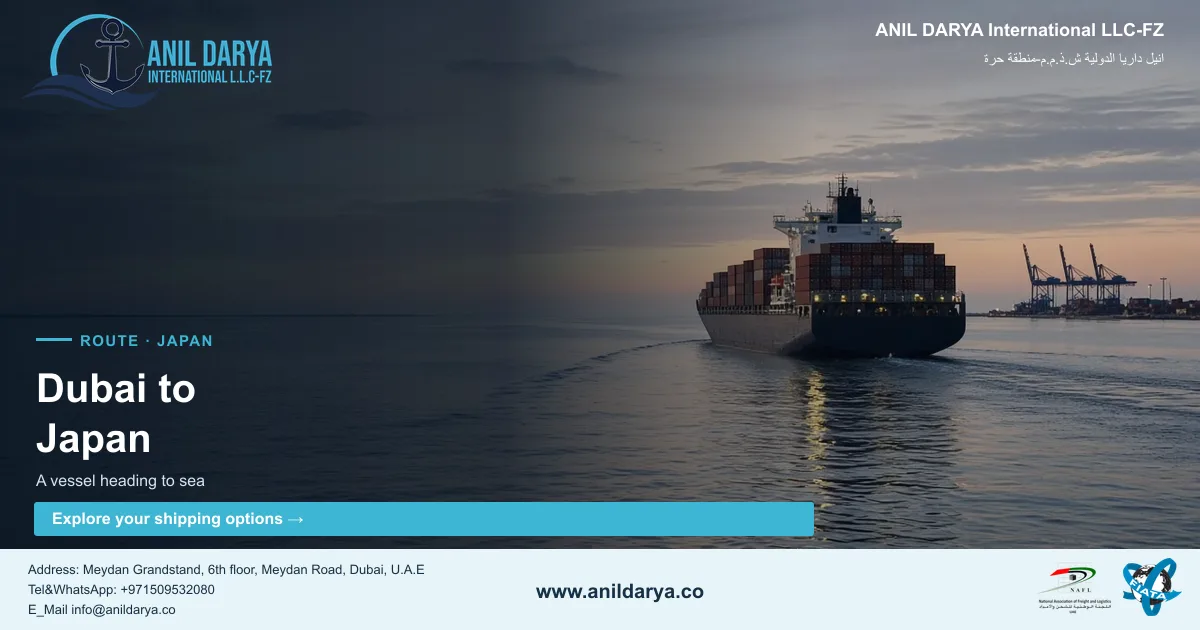
Shipping from Dubai to Japan usually means a container from Jebel Ali to Yokohama, Tokyo, Nagoya, Osaka or Kobe, with air cargo to Narita, Haneda or Kansai for urgent goods. In Japan, the importer or its customs broker lodges the import declaration, pays customs duty and consumption tax, and gets an import permit before the cargo leaves the bonded area. This guide covers the modes, the Japanese ports, the paperwork Japan Customs asks for, the taxes, and the order in which to do things.
Shipping from Dubai to Japan at a glance
| Item | Detail |
|---|---|
| Main UAE load port | Jebel Ali (Dubai); some services load at other UAE ports |
| Main Japanese container ports | Yokohama, Tokyo, Nagoya, Osaka and Kobe |
| Main air cargo gateways | Narita, Haneda (Tokyo) and Kansai (Osaka) |
| Modes on this lane | FCL, LCL, breakbulk and project cargo, dangerous goods, air cargo |
| Customs authority | Japan Customs (regional customs houses at each port) |
| Electronic system | NACCS, Japan's single system for port, customs and import/export procedures |
| Advance cargo data | Carriers and NVOCCs file container data through NACCS at least 24 hours before the vessel leaves the load port |
| Import declaration form | Customs Form C-5020, usually filed by a customs broker for the importer |
| Customs value | Transaction value plus freight and insurance to the Japanese port |
| Consumption tax on imports | 10% standard, 8% reduced (food and drink other than alcohol) |
| Consumption tax base | Customs value plus customs duty plus any excise tax |
| Low-value relief | No duty or consumption tax when the customs value is 10,000 yen or less per declaration (some goods excluded) |
| Small commercial imports | Simplified tariff rates when the customs value is 200,000 yen or less |
| UAE-Japan trade agreement | CEPA negotiations concluded in 2026; we found no confirmation that it is in force |
How cargo moves from Dubai to Japan
Almost all commercial cargo on this lane goes by sea in containers. Breakbulk and project cargo go on general cargo or heavy-lift ships. Air is for samples, spare parts and high-value goods.
We handle the UAE side: booking, trucking to the port, the export declaration with Dubai Customs and the shipping documents. In Japan, the importer or its customs broker clears the goods and arranges delivery. We do not have an office in Japan, so we work with your consignee's broker or a clearing agent they choose.
Ports and gateways on both ends
| Gateway | Side | Best for |
|---|---|---|
| Jebel Ali Port | UAE | Containers, breakbulk, project cargo and DG; the widest choice of services |
| Port of Yokohama | Japan | Greater Tokyo and the Kanto region; deep-water container berths |
| Port of Tokyo | Japan | Greater Tokyo consignees; terminals at Oi, Aomi and Shinagawa |
| Port of Nagoya | Japan | Central Japan, car makers and parts suppliers |
| Ports of Osaka and Kobe | Japan | The Kansai region, including Osaka and Kyoto |
| Narita, Haneda, Kansai airports | Japan | Air cargo, samples, urgent spare parts |
Pick the port closest to the consignee. Inland trucking can cost more than the difference in sea freight. DP World describes Yokohama as Japan's principal container port for inbound trade, and Nagoya as the third-largest container port and a gateway for car parts. If your buyer is in Kansai, Osaka or Kobe usually makes more sense.
Which Japanese port should you pick?
| Consignee location | Port to price first | Why |
|---|---|---|
| Tokyo, Kanagawa, Saitama, Chiba | Yokohama or Tokyo | Shortest truck leg into the Kanto region |
| Aichi, Gifu, Mie, Shizuoka | Nagoya | Serves central Japan's industrial belt |
| Osaka, Kyoto, Hyogo, Nara | Osaka or Kobe | Main gateways for the Kansai region |
| Kyushu | Hakata or Kitakyushu | Avoids a long truck or domestic feeder leg |
| Hokkaido or Tohoku | Ask us to compare | Often a transshipment or domestic feeder from a main port |
Sea freight from Dubai to Japan: FCL or LCL?
Most general cargo on this lane moves in containers. Choose by volume and by how much handling the goods can take.
- FCL (full container load). You book a whole 20ft or 40ft box. It suits stock orders, building materials, food in bulk packs and anything you want sealed from the loading point to the consignee.
- LCL (less than container load). Your cargo shares a box with other shippers and is unpacked at a container freight station in Japan. It suits small orders, but it adds handling, and the release depends on the consolidator's paperwork as well as yours.
Use strong export packing, clear marks on every carton and a packing list that matches the marks exactly. With LCL, a damaged or wrongly marked carton can hold your part of the box at the warehouse.
A simple rule: once your cargo fills a good part of a 20ft box, price FCL as well. Our guide on when FCL beats LCL on cost shows how to compare the two. See our sea freight service from Dubai for the container types we book.
How long does sea freight from Dubai to Japan take?
It depends on the carrier, the load port and whether the service is direct or transshipped. Online route tools disagree a lot on this lane. The same tool can show very different times for Jebel Ali and for other UAE ports to the same Japanese port, so we do not quote one figure here. Ask for the routing and the transit time of the actual service when you book, then add time for customs in Japan.
[AMIR-FACT: our real port-to-port transit Jebel Ali to Yokohama and to Kobe or Nagoya (FCL and LCL), direct or via which transshipment hub, and the carriers or services we actually book to Japan]
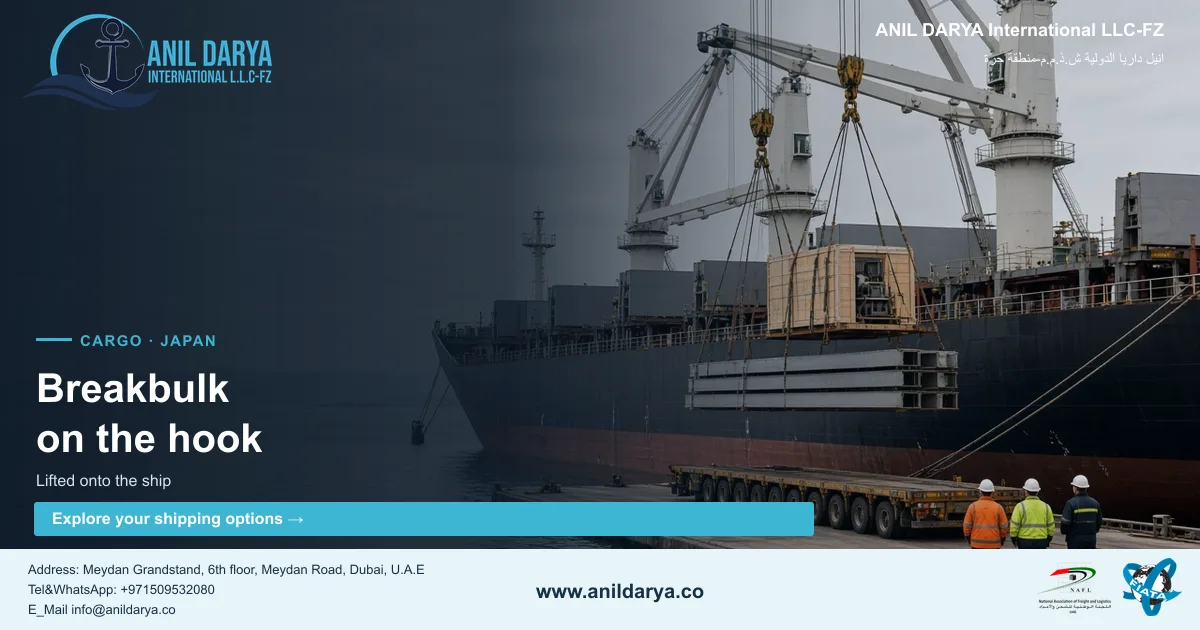
Breakbulk, project and out-of-gauge cargo to Japan
Machinery, steel structures, generators and plant equipment often do not fit a standard box. You have three main options.
| Cargo | How it usually moves | What to plan first |
|---|---|---|
| Steel bars, sections, pipes | Breakbulk on a general cargo ship, or flat racks | Weight per piece, lashing, discharge berth |
| Machinery slightly over container size | Flat rack or open top on a container service | Exact dimensions, lifting points, carrier acceptance |
| Heavy-lift and project pieces | Breakbulk or heavy-lift vessel | Lift plan, sailing date, road route in Japan |
| Vehicles and construction plant | Ro-Ro, flat rack or container | Japanese vehicle rules, inspection, documents |
A decision rule: if a piece fits a 40ft flat rack by size and weight, a container service gives you more sailings. If it does not, you need breakbulk or heavy-lift tonnage, and the sailing date drives the whole plan. Ask the consignee's trucker in Japan which road permits the piece needs before you fix the cargo dimensions. Read our guide to flat racks, open tops and breakbulk, or see our break bulk and project cargo service.
Dangerous goods from Dubai to Japan
You can ship IMDG dangerous goods to Japan, but two sets of rules apply: the shipping rules for the voyage, and Japanese laws on what may be imported and by whom.
On the shipping side, you need:
- A correct UN number, proper shipping name, class and packing group for every product.
- A Safety Data Sheet (SDS) and a signed Dangerous Goods Declaration.
- UN-approved packaging, labels on the packages and placards on the container.
- Carrier acceptance before you confirm the sailing. Not every service takes every class.
On the Japanese side, Japan Customs lists laws outside customs law that control certain imports. Several hit DG shippers directly.
| Japanese law | What it covers | Ministry or agency |
|---|---|---|
| High Pressure Gas Safety Act | High-pressure gas, including many cylinders and some aerosols | METI |
| Poisonous and Deleterious Substance Control Act | Poisonous and deleterious substances | MHLW |
| Explosives Control Act | Explosives and articles such as fuses | METI |
| Chemical Substances Control Act | Chemical substances | METI |
| Industrial Safety and Health Act | Harmful substances such as asbestos | MHLW |
If your product falls under one of these, the importer must hold the approval before the declaration. Our dangerous goods shipping team checks the classification and the carrier acceptance before you commit to a sailing.
Air cargo from Dubai to Japan
Air suits samples, spare parts, electronics, medicines and anything with a deadline. Fluent Cargo's route data lists direct passenger flights from Dubai International to Tokyo Haneda and to Kansai, and a direct freighter route from Al Maktoum International to Narita. DP World calls Narita Japan's primary air freight gateway for time-sensitive and high-value cargo.
The customs rules are the same by air and by sea. Licences, food checks and taxes do not change with the mode. Ask us for air cargo from Dubai when time matters more than freight cost.
Japan Customs import procedure: NACCS and who files
Japan Customs says the import declaration is made, in principle, by the person importing the goods. In practice a customs broker usually files it for the importer. The process starts with the declaration and ends with an import permit, issued after any examination and after duty and tax are paid.
The declaration is normally lodged after the goods enter a bonded (Hozei) area. Japan Customs says more than 90 percent of import procedures are computerised. They run through NACCS, which links customs, port authorities and other agencies, and handles sea cargo from arrival through import declaration, permit and delivery.
Two rules help you plan the Japanese side:
- Pre-arrival examination. The importer can submit the declaration documents once the bill of lading is issued, before the ship arrives. Customs examines them in advance and tells the importer whether the cargo will get a physical inspection, a document check or a simplified check.
- Selling on DDP terms. If you, as a seller outside Japan, act as the importer, you must appoint a Customs Procedure Agent in Japan. Unless that agent holds a customs brokerage licence, a licensed customs broker must do the clearance.
Advance filing before the ship leaves Dubai
Since March 2014, Japan's Advance Filing Rules require shipping companies and NVOCCs to send container cargo information to Japan Customs through NACCS. The deadline is, in principle, 24 hours before the vessel leaves the port of loading. Japan Customs then runs a risk check and can send notices back to the filer, including a do-not-load notice. Filing late, not at all or with false data carries a penalty under Japanese law.
What this means for you: give us a precise cargo description and the full consignee details at booking. A description such as "general cargo" or "spare parts" is the kind of thing that triggers questions.
Documents for an import into Japan
Japan Customs lists these documents with the import declaration (Customs Form C-5020). This is how they map to who provides them on this lane.
| Document | Who provides it | Notes |
|---|---|---|
| Commercial invoice | Seller in the UAE | Clear description, unit prices, Incoterm and currency |
| Bill of lading or air waybill | Carrier, through us | Consignee should be the Japanese importer |
| Packing list | Seller | Weights, carton count and marks must match the invoice |
| Freight and insurance documents | Seller or us | Needed to work out the customs value |
| Certificate of origin | Chamber or authority in the UAE | Needed for WTO or preferential rates |
| Licences or certificates under other laws | Importer and the relevant agency | Food notification, chemical or gas approvals, pharmaceutical licences |
| Valuation declaration | Importer, through its broker | Shows how the customs value was calculated |
| UAE export declaration | Exporter, filed with Dubai Customs | We file it before the cargo leaves the UAE |

Food, plants and other controlled goods
Japan Customs lists 30 laws outside customs law that it checks at import. The ones UAE exporters meet most often are below.
- Food Sanitation Law. Covers all food and drink, food additives, tableware, food containers and wrapping, and toys. Run by MHLW's Office of Import Food Safety.
- Plant Protection Act. Covers plants and pests, and used agricultural machinery. Run by MAFF.
- Pharmaceuticals and medical devices law. Covers medicines, cosmetics and medical devices. Run by MHLW and MAFF.
- Livestock disease law. Covers animals and meat products such as sausage and ham. Run by MAFF.
- Foreign Exchange and Foreign Trade Act. Covers quota items and other controlled goods. Run by METI.
Dates, spices and packaged food from the UAE all fall under the Food Sanitation Law. The importer files the food import notification, so make sure your buyer has it in hand before the box sails.
Import duty and consumption tax in Japan
Japan charges customs duty on the dutiable value of the goods, mostly as a percentage. On top comes consumption tax, and for some goods an excise tax.
How the customs value is worked out
Japan follows the WTO valuation agreement. The customs value is normally the transaction value: the price paid, plus transport costs up to arrival at the Japanese port, insurance and some other costs. In effect, freight and insurance from Dubai are part of the value. The importer files a valuation declaration with the import declaration showing how the value was calculated.
Which duty rate applies?
| Rate type | When it applies |
|---|---|
| General rate | The basic rate in the Customs Tariff Law |
| Temporary rate | Replaces the general rate for a set period |
| WTO rate | Rate bound at the WTO for member countries |
| GSP preferential rate | Goods from designated developing countries |
| EPA rate | Goods originating in a country with an economic partnership agreement in force |
Japan publishes its full tariff schedule (Statistical Code for Import) online. The latest edition we checked took effect on 31 October 2026. Find your HS code there before you quote a landed cost.
The UAE and Japan concluded negotiations on an economic partnership agreement (CEPA) in 2026. We found no confirmation that it is in force. Until it is, do not assume preferential rates for UAE-origin goods.
Consumption tax on imported goods
Japan Customs charges consumption tax at 10% (standard) or 8% (reduced) on nearly all imported goods. The National Tax Agency says the reduced rate covers food and drink other than alcohol and dining out, plus some newspapers. The 10% is made of 7.8% national and 2.2% local tax.
The tax base is the customs value plus customs duty plus any excise tax. Excise taxes apply to liquor, tobacco, petroleum and LPG. A worked example, using round numbers: goods with a customs value of 1,000,000 yen and 50,000 yen of duty give a tax base of 1,050,000 yen. At 10%, the consumption tax is 105,000 yen.
Low-value and small shipments
| Customs value per declaration | Treatment |
|---|---|
| 10,000 yen or less | No customs duty or consumption tax. Other excise taxes still apply. Some goods are excluded, such as leather bags, gloves, knitted clothing, ski boots and leather shoes. |
| 200,000 yen or less (commercial) | Simplified tariff rates can apply. Consumption tax is still charged. |
| Above 200,000 yen | Normal tariff rates for the HS code |
Splitting one invoice into several declarations does not get around the 10,000 yen limit.
Restricted and prohibited goods
Japan Customs lists nine groups of goods that may not be imported at all:
- Narcotics, cannabis, stimulants and psychotropic substances.
- Handguns, their ammunition and parts.
- Explosives.
- Precursors for chemical weapons.
- Germs that could be used for bioterrorism.
- Counterfeit currency, bank notes, securities and forged credit cards.
- Obscene or harmful publications and images.
- Child pornography.
- Goods that infringe intellectual property rights.
The last group matters most for traders: copy brands and fake branded goods are seized.
What decides the cost of shipping from Dubai to Japan
We do not publish rates, because they change with every booking. These are the factors that move your landed cost.
| Cost factor | What drives it |
|---|---|
| Ocean or air freight | Container size, weight, carrier, season, direct or transshipped service |
| UAE origin charges | Trucking to Jebel Ali, terminal handling, export declaration, documents |
| Japanese destination charges | Terminal handling, delivery order, broker fees, CFS charges for LCL |
| Duty and consumption tax | HS code, customs value including freight and insurance, rate type |
| Inland delivery in Japan | Distance from the port, truck size, any special permits |
| Delays | Missing permits or wrong data leading to storage, demurrage and detention |
| Insurance | Cargo value and type |
Agree the Incoterm first, because it decides who pays which of these. Our guide to Incoterms 2020 for sea freight explains the split. Free days and the daily rates after them are set by each carrier; our article on demurrage and detention shows how they add up.
How to ship from Dubai to Japan: step by step
- Send us the cargo details. Commodity, HS code, weight, volume or dimensions, packing, the Japanese consignee's city and the Incoterm.
- Check Japanese controls. The buyer confirms whether the goods fall under the Food Sanitation Law, plant rules, chemical or gas laws, or other controls, and starts any notification early.
- Choose the port and mode. We price the Japanese port nearest the consignee, and air if the timing needs it.
- Book space. For DG, reefer or out-of-gauge cargo we get carrier acceptance first.
- Give a precise description. The carrier uses it for the advance filing to Japan Customs before the ship leaves.
- Prepare documents. Invoice, packing list, certificate of origin and any certificates. We check that names, weights, marks and HS codes match.
- Export from the UAE. We truck the cargo or container to Jebel Ali, file the export declaration with Dubai Customs and load before the cut-off.
- Release the bill of lading. We send the draft, you approve it, and the original or a sea waybill goes to the buyer.
- Clear in Japan. The buyer's customs broker files the import declaration, pays duty and consumption tax, and gets the import permit.
- Deliver and return the empty. The consignee collects the cargo and returns the container within free time.
Checklist before you ship to Japan
- HS code checked against Japan's current tariff schedule.
- Japanese importer confirmed, with a customs broker ready to file.
- Food notification, plant, chemical or other approvals in progress before sailing.
- Precise cargo description given to the carrier for the advance filing.
- Invoice, packing list and bill of lading show the same consignee, weights and carton count.
- Freight and insurance costs available to the broker for the customs value.
- For DG: SDS, DG declaration, packaging, labels and carrier acceptance.
- Free days agreed with the carrier and cargo insurance arranged.
Common mistakes on this lane
- Vague cargo descriptions. Advance filing happens before loading, so a weak description can stop the box in Dubai.
- Late food notifications. Food without the notification sits in the port while storage charges run.
- Assuming a trade deal applies. Until the UAE-Japan CEPA is in force, plan on standard rates.
- Forgetting freight in the value. Consumption tax is charged on a base that includes freight, insurance and duty, not on the invoice price alone.
- Poor carton marks on LCL. Mismatched marks slow the unpacking and the release.
- Treating batteries, aerosols or paints as general cargo. They are dangerous goods and need declaring.
[AMIR-FACT: one real shipment we moved from Dubai to Japan (cargo type, Japanese port, mode and what we handled), or confirm we have none yet]
Frequently asked questions
Which port in Japan should I ship to from Dubai?
Ship to the main port nearest your consignee. Yokohama or Tokyo suit the Tokyo area, Nagoya suits central Japan, and Osaka or Kobe suit the Kansai region.
How long does shipping from Dubai to Japan take?
It depends on the carrier, the load port and whether the service is direct or transshipped. Published online estimates disagree, so ask for the transit time of the actual service when you book and add time for Japanese customs.
What documents does Japan Customs need?
Japan Customs asks for the invoice, the bill of lading or air waybill, and where needed a certificate of origin, packing list, freight and insurance documents, and licences under other laws. The importer also files a valuation declaration.
What is NACCS?
NACCS is Japan's electronic system for customs and port procedures. Import and export declarations and the carriers' advance cargo filings run through it.
How much consumption tax is charged on imports into Japan?
Consumption tax is 10%, or 8% for food and drink other than alcohol. It is charged on the customs value plus customs duty plus any excise tax.
Is there a duty-free threshold for imports into Japan?
Yes. If the customs value of a declaration is 10,000 yen or less, no customs duty or consumption tax is charged, though some goods such as leather bags, gloves and knitted clothing are excluded.
Is there a free trade agreement between the UAE and Japan?
The UAE and Japan concluded CEPA negotiations in 2026. We found no confirmation that the agreement is in force, so plan on standard Japanese duty rates for now.
Can I ship dangerous goods from Dubai to Japan?
Yes, if the goods are classified, packed and declared under the IMDG Code and the carrier accepts them. Some products, such as high-pressure gas or poisonous substances, also need approvals under Japanese law.
Who clears the goods in Japan?
The importer files the import declaration, usually through a licensed customs broker. A seller abroad acting as importer must appoint a Customs Procedure Agent in Japan and use a licensed broker unless the agent holds a licence.
Get a quote for shipping from Dubai to Japan
Send us your cargo details and the consignee's city, and we will come back with a routing and a price. Use our freight rate inquiry form, or contact our team to talk through a breakbulk, DG or air shipment first. You can also read more about our Dubai freight forwarding team.
Sources
- Japan Customs: Import procedures (declaration, documents, permit, computerisation)
- Japan Customs: Advance Filing Rules on maritime container cargo
- Japan Customs: Outline of tariff and duty rates (rate types, consumption tax, simplified tariff)
- Japan Customs: Details of the customs valuation system
- Japan Customs: Customs Answer 1006 (10,000 yen exemption)
- Japan Customs: Customs Answer 1801 (other laws checked at import)
- Japan Customs: Prohibited goods
- Japan Customs: Japan's Tariff Schedule (Statistical Code for Import)
- Japan Customs: Customs Answer 1108 (pre-arrival examination)
- Japan Customs: Customs Answer 9601 (Customs Procedure Agent for non-residents)
- NACCS Center: About NACCS
- National Tax Agency: Consumption tax rates
- Gulf Business: UAE concludes CEPA negotiations with Japan (2026)
- DP World: Shipping routes to Japan (ports and airports)
- Fluent Cargo: UAE to Japan air routes
- Wikipedia: Port of Tokyo (container terminals)
- Dubai Customs: Submit Customs Declaration
Reviewed: 10 November 2026