
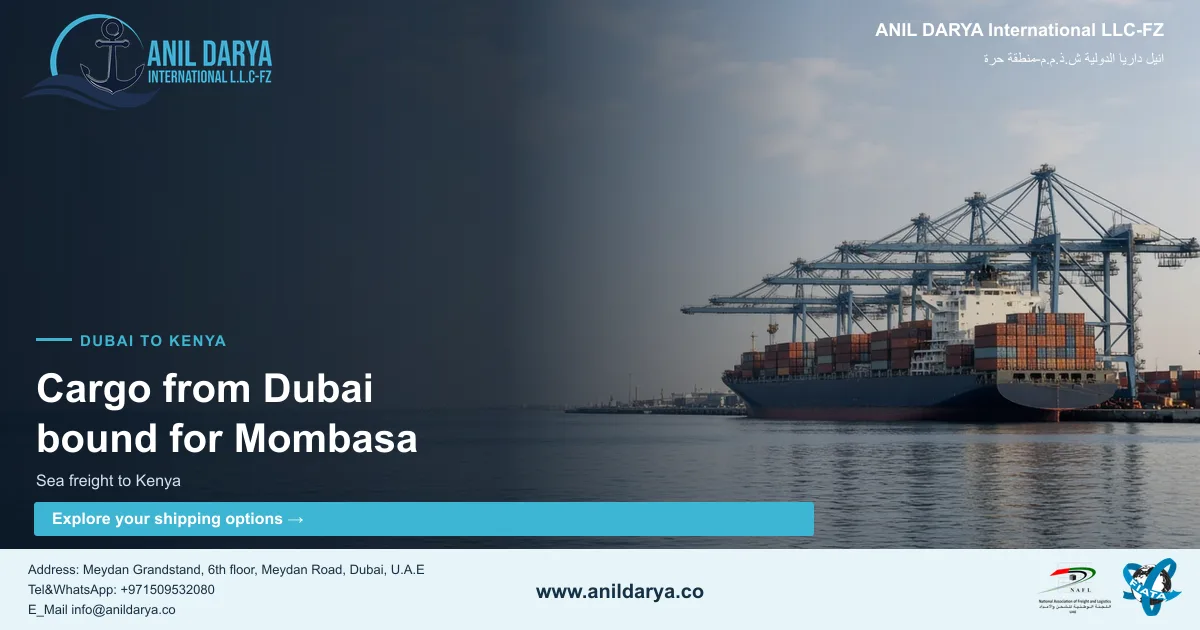
Shipping from Dubai to Kenya almost always means sea freight from Jebel Ali to the Port of Mombasa, with air cargo for urgent goods and breakbulk or bulk for steel, machinery and project cargo. On the Kenyan side three bodies decide how fast you clear: the Kenya Revenue Authority (KRA) for customs, the Kenya Bureau of Standards (KEBS) for the PVoC certificate of conformity, and the Kenya Ports Authority (KPA) for the port. This guide covers each mode, the documents Kenya asks for, the duties, and the order in which to do things.
Shipping from Dubai to Kenya at a glance
| Item | Detail |
|---|---|
| Main UAE load port | Jebel Ali (Dubai) |
| Main Kenyan sea port | Port of Mombasa, run by the Kenya Ports Authority |
| Berths at Mombasa | 22, split between conventional cargo and container terminals |
| Container capacity at Mombasa | Two container terminals, 2.3 million TEU a year in total |
| Containers handled at Mombasa | 2.11 million TEU in 2025, up from 2.00 million TEU in 2024 |
| Inland links | Standard Gauge Railway to the inland container depots at Nairobi and Naivasha |
| Modes on this lane | FCL, LCL, breakbulk and project cargo, dry and liquid bulk, dangerous goods, air cargo |
| Customs authority | Kenya Revenue Authority, entries lodged by a licensed clearing agent in iCMS |
| Standards check before export | KEBS PVoC certificate of conformity for regulated products, issued in the UAE |
| Import duty | EAC Common External Tariff: 0%, 10%, 25% or 35%, higher for sensitive items |
| Import VAT | 16% |
| Other charges on customs value | Import Declaration Fee and Railway Development Levy |
| Certificate of origin | Required on imports since 1 July 2025, fully enforced from 1 October 2025 |
| Marine cargo insurance | Must be bought from an insurer licensed in Kenya |
How cargo moves from Dubai to Kenya
Cargo leaves the UAE through Jebel Ali, sails down the East African coast and discharges at Mombasa. Domestic containers are cleared at a container freight station (CFS) near the port, or move by rail under customs control to an inland depot and are cleared there.
The Kenya Ports Authority says Mombasa connects directly to over 80 ports and is served by over 40 major shipping lines. Its hinterland reaches Uganda, Rwanda, Burundi, eastern DR Congo, northern Tanzania and South Sudan, so much of what lands at Mombasa is transit cargo for those markets.
A practical rule: decide where the goods will be cleared before you book. Nairobi consignees often clear at the Nairobi inland depot. For clearance in Mombasa, KPA stopped clearing domestic containers inside the port from 10 December 2025, so nominate a CFS when you book in Jebel Ali.
Ports and gateways on both ends
| Gateway | Side | Best for |
|---|---|---|
| Jebel Ali Port | UAE | Containers, breakbulk, project cargo and DG; most sailings to East Africa |
| Port of Mombasa | Kenya | All sea cargo for Kenya and the transit markets inland |
| Inland Container Depot Nairobi | Kenya | Containers for Nairobi consignees, moved from Mombasa by rail on a through bill of lading |
| Inland Container Depot Naivasha | Kenya | Transit cargo for the northern corridor and the Rift Valley |
| Jomo Kenyatta International Airport, Nairobi | Kenya | Air cargo, samples, spare parts, urgent stock |
| Moi International Airport, Mombasa | Kenya | Air cargo for coastal consignees |
Sea freight from Dubai to Kenya: FCL or LCL?
Most general cargo on this lane moves in containers. Choose by volume and by how much handling your goods can take.
- FCL (full container load). You book a whole 20ft or 40ft box. It suits stock orders, building materials, tyres, food and anything you want sealed from the factory to the consignee.
- LCL (less than container load). Your cargo shares a box with other shippers and is unpacked at a container freight station in Kenya. It suits small orders, but it adds handling and the release depends on the consolidator's paperwork too.
Two points matter more on the Kenya lane than on most. First, PVoC inspection happens in the UAE before the container is sealed, so plan stuffing around the inspector's visit. Second, with LCL every shipper's goods in the box need their own documents in order, and one problem consignment can slow the whole unpacking. Our guide on when FCL beats LCL on cost helps you pick.
KPA lists container berths 16 to 22 at Mombasa, with an allowable draft of 12.5 m at berths 16 to 18 and 14.5 m at berths 21 and 22.
Published transit times and sailings
Transit time depends on the carrier and the service rotation. Some services call Jebel Ali and go straight to Mombasa. Others stop at ports in India or elsewhere first, which adds days. Online schedule tools give very different figures for the same port pair, so we do not quote a single number here. Ask for the transit and the routing of the actual service when you book.
[AMIR-FACT: Our real port-to-port transit Jebel Ali to Mombasa (days) and the carriers or services we actually book on this lane]
Breakbulk, bulk and project cargo to Kenya
Bulk and breakbulk matter on this lane. Steel, machinery, vehicles, transformers and construction equipment go to Kenya in volume, and Mombasa is built for them.
KPA says berths 1 and 2 handle steel, container and Ro-Ro ships, while berths 5, 11 and 12 serve conventional and container ships with their own gear. Mombasa also has dedicated facilities for bulk grain, soda ash, clinker, titanium and petroleum products, including the Kipevu Oil Terminal and the Shimanzi Oil Terminal. Bulk grain is discharged either by conveyor to silos outside the port or by grabs into bagging plants alongside the ship.
| Cargo | How it usually moves | What to plan first |
|---|---|---|
| Steel coils, bars and sections | Breakbulk on a general cargo ship, or flat racks | Weight per piece, lashing, discharge berth |
| Machinery and heavy equipment | Flat rack or open top, or breakbulk if too big | Dimensions, lifting points, road permit in Kenya |
| Vehicles and plant | Ro-Ro, or containers for smaller units | Vehicle age rule, inspection, documents |
| Grain, fertiliser, clinker | Dry bulk vessel | Discharge method, receiving facility, surveys |
| Edible oil, chemicals, fuels | Liquid bulk or ISO tanks | Terminal acceptance, DG rules if hazardous |
| Project cargo for energy or construction sites | Heavy-lift or breakbulk tonnage | Lift plan, sailing date, inland route survey |
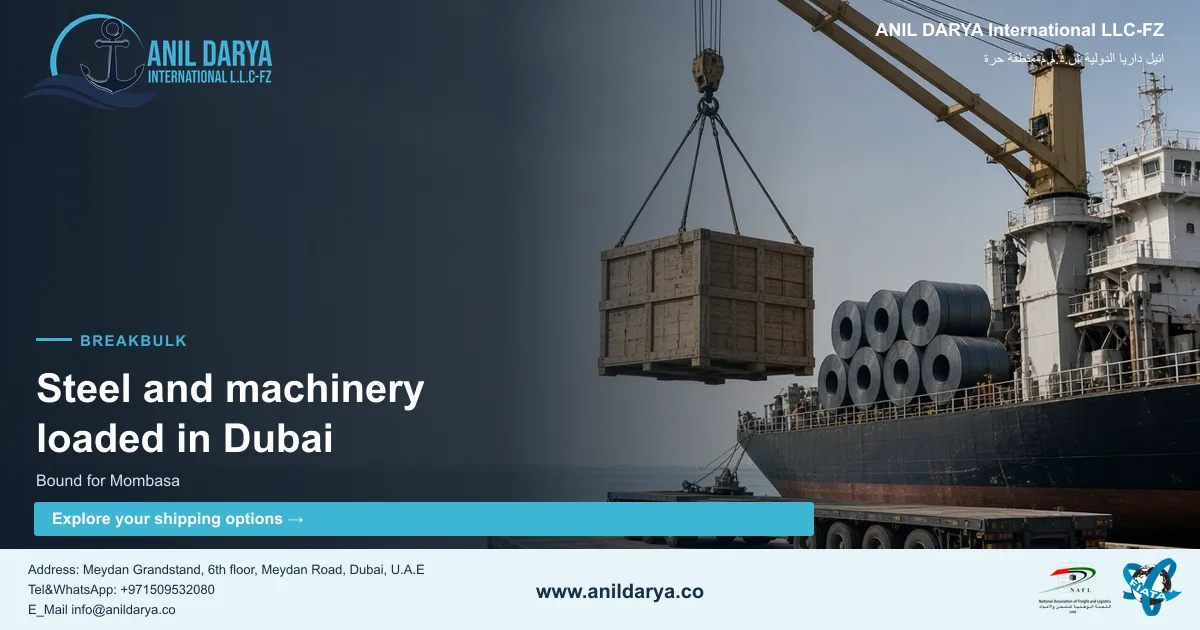
A decision rule for big pieces: if the item fits a 40ft flat rack by size and weight, a container service gives you more sailings. If it does not, you need breakbulk or heavy-lift tonnage and the sailing date drives the plan. For full shiploads, our article on bulk shipping from Dubai to Africa walks through charter and parcel options. See also our break bulk and project cargo service and our dry and liquid bulk shipping page.
Dangerous goods from Dubai to Kenya
You can ship IMDG dangerous goods to Mombasa, and KPA says it handles dangerous cargo under international maritime rules and its own safety procedures. The work sits mostly on the UAE side, before the box is loaded.
- Correct UN number, proper shipping name, class and packing group for every product.
- A Safety Data Sheet (SDS) and a signed Dangerous Goods Declaration.
- UN-approved packaging, labels on packages and placards on the container.
- Carrier acceptance before you confirm the sailing. Not every service takes every class.
- Any Kenyan import permit the product needs, for example for regulated chemicals.
Chemicals often fall under KEBS standards too, so check PVoC with the DG paperwork. Our dangerous goods shipping team checks classification and carrier acceptance before you commit.
Air cargo from Dubai to Nairobi and Mombasa
Air suits samples, spare parts, electronics, medicines and anything with a deadline. Cargo for Nairobi lands at Jomo Kenyatta International Airport, and cargo for the coast can go to Moi International Airport in Mombasa. The same Kenyan rules apply by air, including PVoC and the certificate of origin. Ask us for air cargo from Dubai when time matters more than freight cost.
KEBS PVoC: the certificate you get in the UAE
Pre-Export Verification of Conformity (PVoC) is the KEBS programme that checks products against Kenyan standards before they leave the exporting country. For regulated goods shipped from Dubai, the inspection and the certificate of conformity (CoC) happen in the UAE, not in Mombasa.
KEBS renewed its PVoC contracts for 2026 to 2029. SGS says its contract runs for three years from 9 February 2026 and covers a zone that includes the United Arab Emirates. Intertek also announced its appointment in February 2026, with a Gulf and UAE zone. The PVoC partner is assigned by the country of supply, not by where you file the request.
PVoC routes and published fees (SGS)
| Route | Fee, % of FOB value | Minimum | Maximum |
|---|---|---|---|
| A | 0.6% | USD 300 | USD 3,500 |
| B | 0.55% | USD 300 | USD 3,500 |
| C | 0.5% | USD 300 | USD 3,500 |
SGS says these fees cover document checks, physical inspection, sampling and container sealing where needed. Laboratory testing, manufacturer licensing, registration, bulk sampling and re-inspection are charged separately. KEBS also asks traders to test products in an ISO/IEC 17025 accredited laboratory before export, and businesses must supply a Free Sales Certificate. Route A is the per-shipment route. Routes B and C are for registered products and licensed manufacturers, which cuts work for regular exporters.
Shipments from some other regions (Africa, Central Europe, Canada and the USA) are inspected at destination by KEBS at 0.6% of CIF value. Goods from the UAE are in a PVoC zone, so plan the CoC before loading.
How we fit PVoC into a Dubai export:
- Check whether the HS code is regulated before the buyer pays the deposit.
- Send the request for certification to the PVoC partner with the pro forma invoice, packing list and test reports.
- Book the inspection for the day of stuffing, so the inspector sees the goods before the seal goes on.
- Add the CoC to the shipping set and send it to the Kenyan clearing agent with the other documents.
[AMIR-FACT: Typical lead time we see from PVoC request to CoC issue for UAE exports, and which PVoC partner we usually work with]
Kenya customs: documents and process
Kenyan customs entries are lodged by a licensed clearing agent in KRA's Integrated Customs Management System (iCMS). Trade documents and permits from other agencies run through the National Electronic Single Window System, operated by the Kenya Trade Network Agency (KenTrade). You need a Kenyan importer with a KRA PIN. A foreign company with no Kenyan entity usually sells to a Kenyan buyer who imports in its own name.
Documents for an import into Kenya
| Document | Who provides it | Notes |
|---|---|---|
| Commercial invoice and pro forma invoice | Seller in the UAE | True transaction value, clear description, HS code |
| Packing list | Seller | Weights, package count and marks must match the invoice and bill of lading |
| Bill of lading or air waybill | Carrier, through us | Consignee should be the Kenyan importer named on the entry |
| Import Declaration Form (IDF) | Kenyan importer, through its clearing agent | Filed with KRA; carries the Import Declaration Fee |
| Certificate of conformity (CoC) | KEBS PVoC partner in the UAE | For regulated products; issued before shipment |
| Import Standardisation Mark | KEBS | Where the product needs it |
| Certificate of origin | Competent authority in the exporting country | Mandatory on imports into Kenya since 2025 |
| UAE export declaration | Exporter, filed with Dubai Customs | Kenyan importers must keep this from 1 September 2026 |
| Marine cargo insurance certificate | Insurer licensed in Kenya | Bought digitally and submitted to iCMS |
| Sector permits | Kenyan agency for the product | For example medicines, plants, telecom equipment, chemicals |
The certificate of origin rule from 2025
KRA says that from 1 July 2025 consignments imported into Kenya must come with a certificate of origin issued by a competent authority in the country of export, under section 44A of the Tax Procedures Act as amended by the Finance Act 2025. The transition ended on 30 September 2025, and full compliance applied from 1 October 2025. Exempt categories include used goods such as used vehicles, personal effects, certain courier parcels, samples of no commercial value and some temporary imports. For goods shipped from Dubai, get the certificate of origin at the same time as the invoice, not after sailing.
Export documents and local insurance
Two newer rules affect what you send from Dubai. Under the Finance Act 2026, from 1 September 2026 importers must obtain and keep an export declaration or equivalent from the country of export for at least five years. We file the UAE export declaration and send a copy with the shipping documents.
Kenya also requires imports to be insured with an insurer licensed in Kenya. An Insurance Regulatory Authority notice of 22 May 2026 made digital enforcement effective from 1 July 2026, with the certificate submitted to iCMS before clearance. If you sell CIF, your own insurance does not replace the buyer's Kenyan policy, so agree this in the contract. Our guide to Incoterms 2020 for sea freight explains who pays for what.
Kenya import duty, VAT and levies
Kenya applies the East African Community Common External Tariff. The EAC sets four bands, plus higher rates for sensitive products.
| Band | Applies to |
|---|---|
| 0% | Raw materials and capital goods |
| 10% | Intermediate goods not available in the region |
| 25% | Intermediate goods available in the region |
| 35% | Finished products available in the region |
| Above 35% | Sensitive products listed in Schedule 2 of the CET |
On top of duty, imports pay VAT at 16%, and excise duty applies to some goods such as vehicles, alcohol and certain foods. Kenya also charges an Import Declaration Fee and a Railway Development Levy, both worked out on the customs value. The published rates for these two have changed several times through finance acts, and KRA pages show different figures, so ask your clearing agent for the rate on the day of entry.
A decision rule: check the HS code and the CET band before you fix the sale price. On finished goods the duty band moves the landed cost far more than the freight does.
Restricted and prohibited goods
The EAC Customs Management Act lists prohibited and restricted imports in its Second Schedule, which KRA publishes. Prohibited goods include counterfeit goods of all kinds, false money, narcotic drugs under international control, hazardous wastes, soaps and cosmetics containing mercury, used tyres for light commercial vehicles and passenger cars, and a list of banned agricultural and industrial chemicals. Restricted goods need a permit and include items such as unwrought precious metals and stones, ivory and other wildlife products, arms and ammunition, and ozone-depleting substances.
Used vehicles have their own rule. KRA states that motor vehicles over 8 years old are not allowed into Kenya under the KS 1515 standard. Check the year of first registration before you buy a car in Dubai for export to Kenya.
What drives the cost of shipping from Dubai to Kenya?
We do not publish fixed rates, because they change with the market and the cargo. These are the lines that make up a quote.
| Cost line | What moves it |
|---|---|
| Ocean or air freight | Container type, weight, volume, carrier, season, transit choice |
| UAE origin charges | Trucking to Jebel Ali, terminal handling, export declaration, documentation |
| Special cargo | DG surcharges, flat rack or breakbulk premiums, lashing and surveys |
| PVoC | Route, FOB value, testing needs |
| Kenyan port and line charges | Terminal handling, delivery order, storage after free days |
| Duties and taxes | HS code, CET band, excise, VAT, IDF and RDL on customs value |
| Inland delivery | Rail to Nairobi or Naivasha depot, or road haulage, and the final truck |
| Insurance | Cargo value and the Kenyan insurer's premium |
How to ship from Dubai to Kenya, step by step
This is how we run a typical sea shipment from Dubai to Mombasa. We handle the UAE side and work with the consignee's clearing agent in Kenya.
- Share the cargo details. Commodity, HS code, weight, volume or dimensions, value, Incoterm, and the delivery point in Kenya.
- Confirm the Kenyan rules. The buyer's clearing agent confirms the CET band, permits and whether PVoC applies.
- Choose the mode and routing. FCL, LCL, breakbulk, bulk, DG or air. We compare services from Jebel Ali and confirm transit and free days.
- Start PVoC and origin paperwork. Request certification, book testing if needed, and apply for the certificate of origin.
- Kenyan buyer files the IDF and buys insurance. Both happen before the goods sail, with a Kenyan-licensed insurer.
- Book space and arrange stuffing. We truck the empty, the PVoC inspector attends, then we seal and gate in before the cut-off.
- File the UAE export declaration. We file export or re-export with Dubai Customs and keep a copy for the buyer.
- Release the bill of lading. We check the draft against the invoice and IDF and send the full document set to Kenya.
- Clearance and delivery in Kenya. The clearing agent lodges the entry in iCMS, pays duty and taxes, collects the release, and arranges rail or road to the consignee.
[AMIR-FACT: One real Dubai to Kenya shipment we handled: cargo type, mode, port pair and what we did, cleared for publication]
Checklist before you ship to Kenya
- HS code and CET band confirmed for every item.
- Kenyan importer has a KRA PIN and a licensed clearing agent.
- PVoC checked, and the CoC issued before the container is sealed.
- Certificate of origin issued in the UAE.
- IDF filed by the buyer's agent before sailing.
- Marine insurance placed with an insurer licensed in Kenya.
- Invoice, packing list, IDF and bill of lading show the same values, weights and consignee.
- Sector permits in hand for medicines, plants, chemicals or telecom equipment.
- Clearance point chosen: a nominated CFS at Mombasa, or the Nairobi or Naivasha depot.
- For DG: SDS, DG declaration, packaging, labels and carrier acceptance.
- For breakbulk or project cargo: drawings, weights, lifting points and the inland route.
- For used vehicles: year of first registration within the 8-year limit.
Common mistakes on the Kenya lane
- Sealing the container before PVoC. The inspector cannot inspect a sealed box, and the certificate cannot be issued after the fact.
- No certificate of origin. Since October 2025 this is a hard requirement, not a formality.
- Relying on the seller's CIF insurance. Kenya wants cover from a locally licensed insurer.
- Vague descriptions. "General goods" does not support an HS code and invites a valuation or classification query.
- Different consignee names. The importer on the entry, the bill of lading and the IDF should be the same party.
- Late IDF. Filing after arrival means the questions get answered while storage runs.
Frequently asked questions
How do I ship goods from Dubai to Kenya?
Most cargo goes by sea from Jebel Ali to the Port of Mombasa, either as a full container, a shared LCL container, or breakbulk for large items. Urgent goods go by air to Nairobi or Mombasa. The Kenyan buyer clears the goods through a licensed clearing agent with KRA.
Which port in Kenya receives cargo from Dubai?
The Port of Mombasa, run by the Kenya Ports Authority, receives almost all sea cargo from Dubai. It has 22 berths and two container terminals with 2.3 million TEU of annual capacity, and it links by rail to inland depots at Nairobi and Naivasha.
What is PVoC and do I need it for goods from Dubai?
PVoC is the KEBS Pre-Export Verification of Conformity programme. If your product is regulated, a KEBS partner in the UAE inspects it before export and issues a certificate of conformity. The UAE is in a PVoC zone, so plan the inspection before the container is sealed.
What documents do I need to ship from Dubai to Kenya?
You need a commercial invoice, packing list, bill of lading or air waybill, certificate of origin and, for regulated goods, a certificate of conformity. The Kenyan importer adds the Import Declaration Form, a Kenyan marine insurance certificate and any sector permits.
How much is import duty in Kenya?
Kenya uses the EAC Common External Tariff with bands of 0%, 10%, 25% and 35%, and higher rates for sensitive products. VAT is 16%, and an Import Declaration Fee and Railway Development Levy are charged on the customs value.
Can I ship a used car from Dubai to Kenya?
Yes, if it meets the age rule. KRA states that vehicles over 8 years old are not allowed into Kenya under the KS 1515 standard, so check the year of first registration before you buy.
Is a certificate of origin required for Kenya?
Yes. KRA requires a certificate of origin from a competent authority in the exporting country on imports into Kenya, effective 1 July 2025 and fully enforced from 1 October 2025. Some categories, such as used goods and personal effects, are exempt.
Can I ship dangerous goods from Dubai to Kenya?
Yes. Mombasa handles dangerous cargo under international maritime rules. You need correct classification, an SDS, a DG declaration, UN packaging and carrier acceptance, plus any Kenyan permit the product requires.
Can goods for Uganda or Rwanda go through Mombasa?
Yes. Mombasa serves a hinterland that includes Uganda, Rwanda, Burundi, eastern DR Congo and South Sudan. Transit cargo moves under customs control, and the Naivasha inland depot was set up partly for these markets.
Get a quote for shipping from Dubai to Kenya
Send us the cargo, the delivery point in Kenya and your Incoterm, and we will come back with a routing and a price. Use our freight rate inquiry form, or contact our team to talk through a breakbulk, bulk or DG shipment first. You can also read more about our Dubai freight forwarding team and our sea freight service.
Sources
- Kenya Ports Authority: Port of Mombasa (berths, container capacity, specialised berths)
- Kenya Ports Authority: Ports and terminals (shipping lines, connectivity, ICDs)
- Kenya Ports Authority: Inland Container Depots (Nairobi, Naivasha)
- Kenya Ports Authority: Marine information (berth list and allowable drafts)
- Kenya Ports Authority: FAQ (dangerous goods, clearance documents)
- Khusoko: Port of Mombasa 2025 volumes, KPA figures (January 2026)
- Maersk: Mombasa domestic cargo clearance moved to CFS (KPA notice of 4 December 2025)
- KRA: How to import
- KRA: Importation (clearing agents and iCMS)
- KRA: Customs FAQ (VAT 16%, vehicle age limit)
- KRA public notice: Mandatory certificate of origin on imports (September 2025)
- KRA: Finance Act 2026, what it means for you
- KRA: Prohibited and restricted goods under the EACCMA 2004
- East African Community: Customs union and the four-band CET
- KenTrade: National Electronic Single Window System
- SGS: Kenya renews PVoC mandate, 2026 to 2029 zones
- SGS: Kenyan PVoC contract 2026 to 2029, routes and fees
- Intertek: Appointed for Kenya PVoC (February 2026)
- Clyde and Co: Digital enforcement of local marine cargo insurance in Kenya (June 2026)
Reviewed: 10 November 2026