
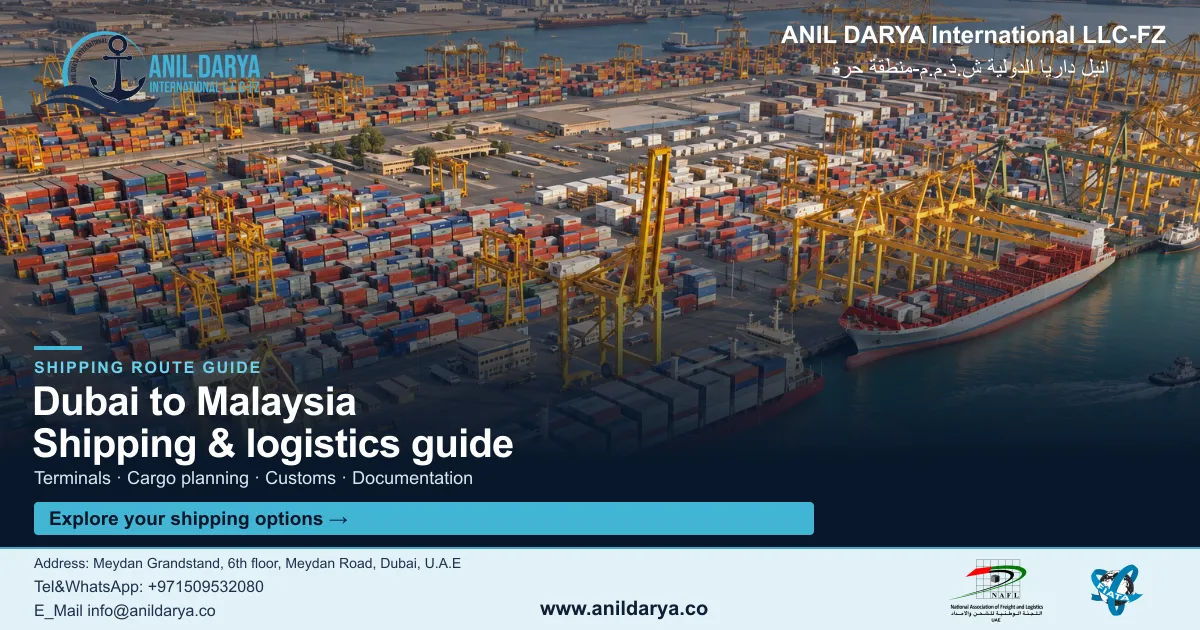
Shipping from Dubai to Malaysia usually means a container from Jebel Ali to Port Klang, with Penang and the Johor ports as the other options and air cargo to Kuala Lumpur for urgent goods. In Malaysia, the importer or its customs agent declares the goods on Customs Form No. 1 (K1), pays any duty and sales tax, and gets the cargo released by the Royal Malaysian Customs Department. This guide covers the ports, the modes, the Malaysian customs steps, the taxes and the order in which to do things.
Shipping from Dubai to Malaysia at a glance
| Item | Detail |
|---|---|
| Main UAE load port | Jebel Ali (Dubai); Khalifa Port and Sharjah on some services |
| Main Malaysian gateway | Port Klang (Westports and Northport), 15.14 million TEU in 2025 |
| Other container ports | Port of Tanjung Pelepas (Johor), Penang Port (North Butterworth Container Terminal) |
| Main air cargo gateway | Kuala Lumpur International Airport (KUL) |
| Modes on this lane | FCL, LCL, breakbulk and project cargo, dangerous goods, air cargo |
| Customs authority | Royal Malaysian Customs Department (RMCD, also called JKDM) |
| Import declaration | Customs Form No. 1 (K1), filed electronically |
| Who files it | An appointed customs agent, an AEO company declaring for itself, or a registered direct user |
| Pre-arrival option | Sea manifest 24 hours or more before the ship arrives; K1 can be lodged before arrival |
| Taxes at import | Import duty by tariff code, excise duty on some goods, sales tax |
| Sales tax since 1 July 2025 | 5% or 10% on discretionary and non-essential goods; essential goods stay exempt |
| Prohibited and restricted goods | Customs (Prohibition of Imports) Order 2023, P.U. (A) 117/2023 |
| Record keeping | Import records kept in Malaysia for seven years |
How the Malaysia lane works: who does what
Most commercial cargo on this lane goes by sea in containers. Breakbulk and project cargo go on general cargo ships or on flat racks. Air is for samples, spare parts, electronics and anything with a deadline.
We handle the UAE side: booking space with the carrier, trucking to the port, the export declaration with Dubai Customs, and the shipping documents. In Malaysia, the importer or its customs agent clears the goods and arranges delivery. We do not have an office in Malaysia, so we work with your consignee's agent or a clearing agent they choose.
Ports and gateways on both ends
| Gateway | Side | What it is used for |
|---|---|---|
| Jebel Ali Port | UAE | Containers, breakbulk, project cargo and DG; the widest choice of services to Asia |
| Port Klang: Westports | Malaysia | The largest terminal at Port Klang, 11.33 million TEU in 2025; containers and conventional cargo |
| Port Klang: Northport | Malaysia | Containers, breakbulk, bulk and vehicles; 3.8 million TEU in 2025 |
| Port of Tanjung Pelepas | Malaysia | Johor; 14.03 million TEU in 2025 |
| Penang Port | Malaysia | Northern Peninsular Malaysia; container terminal at North Butterworth |
| Kuala Lumpur International Airport | Malaysia | Air cargo, samples, urgent spare parts |
The Ministry of Transport figures reported for 2025 show Port Klang at 15.14 million TEU, up 3.4%, and Tanjung Pelepas at 14.03 million TEU, up 14%. Big numbers at a port do not make it the right one for you. At Port Klang, 8.41 million TEU of the 2025 total was transshipment cargo that never entered Malaysia. For an import, the first question is where your consignee is.
Which Malaysian port should you pick?
| Consignee location | Port to price first | Why |
|---|---|---|
| Kuala Lumpur, Selangor, the Klang Valley | Port Klang | Shortest truck leg; main gateway for central Peninsular Malaysia |
| Penang, Kedah, Perak, Perlis | Penang Port | Serves the northern states and their factories |
| Johor | Tanjung Pelepas or Port Klang | Compare the services that actually discharge import boxes in Johor |
| Sabah or Sarawak | Ask us to compare | Check the full routing and the final discharge port before you book |
Pick the port nearest the consignee. Inland haulage in Malaysia can cost more than the difference in sea freight, and a box that lands at the wrong port has to move again before it is cleared.
Sea freight from Dubai to Malaysia: FCL or LCL?
Choose by volume and by how much handling your goods can take.
- FCL (full container load). You book a whole 20ft or 40ft box. It suits stock orders, building materials, food in bulk packs, and anything you want sealed from loading to delivery.
- LCL (less than container load). Your cargo shares a box and is unpacked at a container freight station in Malaysia. It suits small orders, but the release depends on the consolidator's paperwork as well as yours.
Mark every carton clearly and make the packing list match the marks. On LCL, one wrongly marked carton can hold your whole lot at the warehouse while the agent sorts it out.
A simple rule: once your cargo fills a good part of a 20ft box, price FCL as well. Our guide on when FCL beats LCL on cost shows how to compare the two, and our sea freight service from Dubai lists the container types we book.
How long does sea freight from Dubai to Malaysia take?
It depends on the carrier, the Malaysian port and whether the service is direct or transshipped. We did not find a carrier schedule page we could open for this lane, so we do not quote a figure here. Ask for the routing and the transit time of the actual sailing when you book, then add time for clearance in Malaysia.
[AMIR-FACT: our real port-to-port transit Jebel Ali to Port Klang, and to Penang or Tanjung Pelepas (FCL and LCL), direct or via which hub, and the carriers or services we actually book to Malaysia]
Breakbulk, steel and project cargo to Malaysia
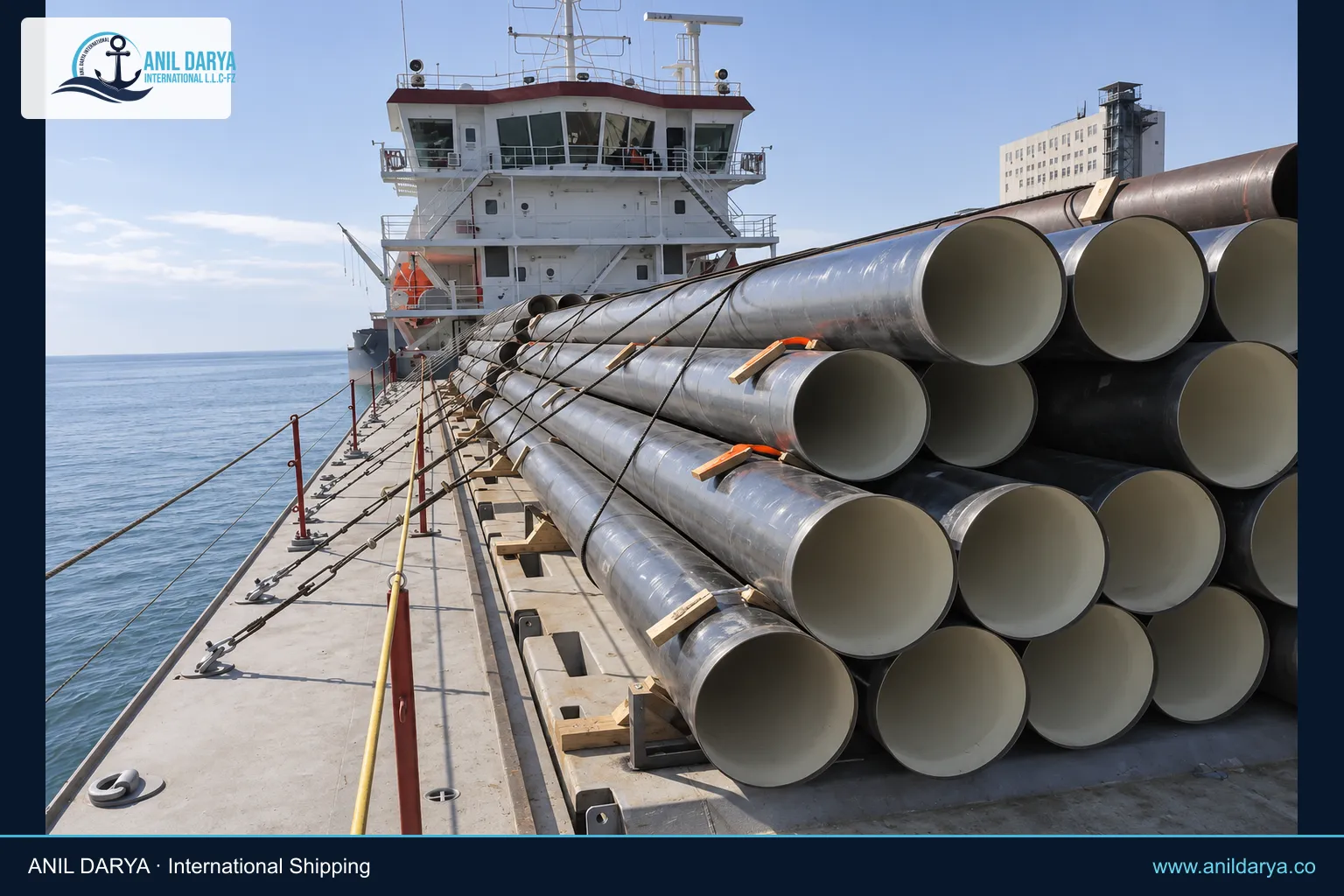
Steel, machinery, generators and plant equipment often do not fit a standard box. Port Klang handles conventional cargo at both Westports and Northport, so most heavy pieces for central Malaysia go there.
| Cargo | How it usually moves | What to check first |
|---|---|---|
| Steel bars, sections, coils, pipes | Breakbulk or flat racks | Weight per piece, lashing, and whether the product needs to meet a Malaysian standard |
| Machinery slightly over container size | Flat rack or open top on a container service | Exact dimensions, lifting points, carrier acceptance |
| Heavy-lift and project pieces | Breakbulk or heavy-lift vessel | Lift plan, sailing date, road route and permits in Malaysia |
| Vehicles and construction plant | Ro-Ro, flat rack or container | Import licence for motor vehicles under the 2023 order |
Steel needs extra care. Under the 2023 import order, some iron and steel products, such as semi-finished billets and slabs and some hot-rolled flat products, may not be imported unless they meet the Malaysian Standard or another approved standard. Several of these rules do not apply inside named free zones, which include West Port and South Point at Port Klang, Tanjung Pelepas and the Penang terminals. They apply when the goods move from the free zone into the main customs area.
A decision rule: if a piece fits a 40ft flat rack by size and weight, a container service gives you more sailings. If not, you need breakbulk or heavy-lift tonnage, and the sailing date drives the plan. Read our guide to flat racks, open tops and breakbulk, or see our break bulk and project cargo service.
Can you ship dangerous goods to Malaysia?
You can ship IMDG dangerous goods to Malaysia, but two sets of rules apply: the shipping rules for the voyage, and the Malaysian import rules for the product itself.
For the sea leg from Jebel Ali you need:
- A correct UN number, proper shipping name, class and packing group for every product.
- A Safety Data Sheet (SDS) and a signed Dangerous Goods Declaration.
- UN-approved packaging, labels on the packages and placards on the container.
- Carrier acceptance before you confirm the sailing. Not every service takes every class.
On the Malaysian side, the RMCD import guide tells importers to check whether the goods need a permit or approval from another government agency before they are imported. Chemicals, gases and some electrical goods often do. Substances listed in the First Schedule of the 2023 order, such as chlorofluorocarbons covered by the Montreal Protocol, may not be imported at all. Our dangerous goods shipping team checks the classification and the carrier acceptance before you commit to a sailing, and your consignee's agent confirms the Malaysian permit.
Air cargo to Malaysia: when it makes sense
Air suits samples, spare parts, electronics, medicines and urgent orders. Fluent Cargo's route data lists direct passenger flights from Dubai International to Kuala Lumpur International, with Emirates and Batik Air Malaysia among the airlines, so belly space is available on this pair. Freighter options it lists from Al Maktoum International go with one transfer.
Air freight is charged on the higher of actual and volumetric weight, so light, bulky cargo costs more than its weight suggests. The customs rules are the same as by sea, but the air manifest under Malaysia's pre-arrival rules is due 2 hours or more before the aircraft lands. Ask us for air cargo from Dubai when time matters more than freight cost.
Malaysian customs clearance: how the K1 process works
The RMCD short guide for importers sets out nine steps. Every import must be declared, and import duty, excise duty and sales tax are paid on goods that attract them. In practice the steps look like this.
| Step | What happens | Who does it |
|---|---|---|
| 1. Declarant | Decide who declares: an appointed customs agent, the importer itself under the AEO programme, or a direct user | Importer |
| 2. Classification | Find the correct tariff code under the customs duty, sales tax and excise duty orders | Importer or agent |
| 3. Controls | Check whether the goods are prohibited, restricted or need a permit from another agency; get the permit before importing | Importer |
| 4. Declaration | File the K1 electronically and submit any import permit | Agent |
| 5. Examination | Customs may physically examine any consignment | RMCD |
| 6. Payment | Pay duty and tax at the counter or online | Importer |
| 7. Approval | Goods approved once duty is paid and any permit is in hand | RMCD |
| 8. Release | Cargo released once all customs requirements are met | RMCD |
| 9. Records | Keep import records in Malaysia for seven years | Importer |
Who files the K1?
The importer is responsible. Most importers appoint a licensed customs agent, which RMCD lists through the myTRADELINK portal. Larger traders with Authorised Economic Operator status can declare for themselves. We do not file Malaysian declarations. We send the agent a full, matching set of documents before the vessel arrives.
Can the goods be cleared before the ship arrives?
Yes, under RMCD's Pre-Arrival Processing. For sea cargo the manifest must be submitted 24 hours or more before the vessel arrives, and the K1 is lodged before arrival. Duty and tax on goods that have been declared and approved can be paid before the cargo lands. Goods that do not need a physical check can get immediate release if any permits are submitted with the declaration. Goods picked for examination do not get immediate release. The duty rate is the one in force at clearance.
What this means for you: get the documents to the agent while the ship is still at sea. A clean, early K1 is the simplest way to cut port storage.
Documents for an import into Malaysia
| Document | Who provides it | Notes |
|---|---|---|
| Customs Form No. 1 (K1) | Malaysian agent | Filed electronically |
| Bill of lading or air waybill | Carrier, through us | Consignee should be the Malaysian importer |
| Commercial invoice | Seller in the UAE | Clear description, unit prices, Incoterm and currency |
| Packing list | Seller | Weights, carton count and marks must match the invoice |
| Certificate of origin | Issuing authority in the UAE | Where relevant, and needed for any preferential rate |
| Import permit or approval | Importer and the relevant agency | Needed before import for controlled goods |
| UAE export declaration | Exporter, filed with Dubai Customs | We file it before the cargo leaves the UAE |
Dubai Customs asks for an invoice, a packing list, a certificate of origin and any permit from a restricting authority for the export declaration. Prepare one set of documents that works at both ends, so the names, weights and descriptions match from Jebel Ali to Port Klang.

Import duty and sales tax in Malaysia
Malaysia sets import duty per tariff code, so there is no single rate for goods from Dubai. On top of duty, sales tax applies at import, and excise duty applies to some goods.
How to find the duty rate for your product
RMCD points importers to its HS Explorer tariff tool, to its technical services division for classification advice, and to the MITI free trade agreement portal for preferential rates. The tariff tool also shows whether a code is subject to an import prohibition. Ask your consignee's agent to confirm the code before you ship. A wrong code changes the duty, the sales tax and sometimes the permit you need.
Sales tax at import
The Ministry of Finance revised sales tax from 1 July 2025. Discretionary and non-essential goods now carry 5% or 10%. The rate for essential goods consumed by the public did not change, and the government says essential goods stay exempt. The rate for each tariff code is in the sales tax rate order, so check it with the HS Explorer or the agent.
| Charge | Rate | Where to check |
|---|---|---|
| Import duty | Set per tariff code, can be zero | Customs Duties Order, through HS Explorer |
| Sales tax, essential goods | Exempt or unchanged | Sales tax orders |
| Sales tax, non-essential goods | 5% or 10% | Sales Tax (Rates of Tax) Order for your code |
| Excise duty | Only on goods listed in the excise order | Excise Duties Order |
Is there a preferential rate for UAE goods?
When we checked Malaysia's MITI free trade agreement portal, its list of bilateral agreements did not include the UAE. Plan on the standard rate unless your agent confirms a preference that applies to your goods.
Where a preference does apply, RMCD asks for the K1, a proof of origin such as a certificate of origin or declaration of origin, and the invoice, bill of lading and packing list. The details on the proof of origin must match the K1 and the supporting documents. If the proof is not ready, the goods can be released on payment of the standard rate, and a bank guarantee can cover the difference while it is checked.
Restricted and prohibited goods in Malaysia
RMCD tells importers and agents to check every shipment against the Customs (Prohibition of Imports) Order 2023, P.U. (A) 117/2023, before importing. It came into operation on 15 April 2023 and replaced the 2017 order. If your goods are listed, every condition must be met.
| Schedule | What it means | Examples from the order |
|---|---|---|
| First | Absolute prohibition | Listed ozone-depleting substances such as CFCs |
| Second | Prohibited except under an import licence from the named ministry or agency | Motor vehicles; radar and radio apparatus licensed through SIRIM |
| Third | Prohibited except in the manner provided, such as a permit or inspection | Plants, animals and food regulated by agencies such as MAQIS, the Department of Veterinary Services and the Ministry of Health food safety division |
| Fourth | Prohibited unless the goods meet the Malaysian Standard or another approved standard | Some iron and steel products; some goods need a certificate of approval from the Energy Commission |
The licence or approval must be in hand before import, not after the ship arrives. Food, plants and animal products from the UAE fall under the Third Schedule agencies, so your buyer should start that paperwork when the order is placed.
What decides the cost of shipping from Dubai to Malaysia
Freight on the Jebel Ali to Port Klang lane moves with every booking, so we quote per shipment rather than publish a rate card. These are the factors that decide what a box costs you once it is cleared in Malaysia.
| Cost factor | What drives it |
|---|---|
| Ocean or air freight | Container size, weight, carrier, season, direct or transshipped service |
| UAE origin charges | Trucking to Jebel Ali, terminal handling, export declaration, documents |
| Malaysian destination charges | Terminal handling, delivery order, agent fees, CFS charges for LCL |
| Duty, excise and sales tax | Tariff code, origin, any preference claimed |
| Inland haulage in Malaysia | Distance from the port, truck type, permits for heavy pieces |
| Delays | Missing permits or wrong data leading to storage, demurrage and detention |
| Insurance | Cargo value and type |
Settle the Incoterm with your Malaysian buyer first: it decides whether you or the buyer pays the Port Klang terminal charges, the agent and the sales tax. Our guide to Incoterms 2020 for sea freight explains the split.
How to ship from Dubai to Malaysia: step by step
- Send us the cargo details. Commodity, HS code, weight, volume or dimensions, packing, the consignee's city in Malaysia and the Incoterm.
- Check Malaysian controls. The buyer's agent checks the tariff code and the 2023 import order, and the buyer applies for any permit or licence.
- Choose the port and mode. We price the Malaysian port nearest the consignee, and air if the timing needs it.
- Book space. For DG, reefer or out-of-gauge cargo we get carrier acceptance first.
- Prepare documents. Invoice, packing list, certificate of origin and any certificates. We check that names, weights, marks and codes match.
- Export from the UAE. We truck the cargo or container to Jebel Ali, file the export declaration with Dubai Customs and load before the cut-off.
- Release the bill of lading. We send the draft, you approve it, and the original or a sea waybill goes to the buyer.
- Pre-lodge in Malaysia. The agent files the K1 before the ship arrives, with any permit attached.
- Pay and clear. The importer pays duty and sales tax, and RMCD releases the cargo, unless it is picked for examination.
- Deliver and return the empty. The consignee collects the cargo and returns the container within free time.
Checklist before you ship to Malaysia
- Tariff code confirmed by the Malaysian agent.
- Goods checked against the 2023 import order; permit or licence in hand where needed.
- Steel and electrical goods checked for the Malaysian Standard or Energy Commission approval.
- Consignee details match on the invoice, packing list and bill of lading.
- Certificate of origin ready if a preference will be claimed.
- For DG: SDS, DG declaration, packaging, labels and carrier acceptance.
- Documents sent to the agent early enough for pre-arrival lodging.
- Free days agreed with the carrier and cargo insurance arranged.
Common mistakes on this lane
- Applying for the permit after sailing. RMCD expects permits before import, and the box waits at the port while storage runs.
- Choosing the busiest port, not the nearest one. A box for Penang that lands at Port Klang needs another move.
- Assuming a trade deal applies. Without a confirmed preference, plan on the standard duty rate.
- Guessing the tariff code. It decides the duty, the sales tax and any permit.
- Treating batteries, aerosols or paints as general cargo. They are dangerous goods and need declaring.
- Weak carton marks on LCL. Mismatched marks slow unpacking and release.
[AMIR-FACT: one real shipment we moved from Dubai to Malaysia (cargo type, Malaysian port, mode and what we handled), or confirm we have none yet]
Frequently asked questions
Which port in Malaysia should I ship to from Dubai?
Ship to the port nearest your consignee. Port Klang suits Kuala Lumpur and the Klang Valley, Penang suits the northern states, and for Johor compare Tanjung Pelepas with Port Klang.
How long does shipping from Dubai to Malaysia take?
It depends on the carrier, the port and whether the service is direct or transshipped. Ask for the transit time of the actual sailing when you book and add time for clearance in Malaysia.
Who clears the goods in Malaysia?
The importer, usually through a customs agent that files Customs Form No. 1 (K1) electronically. Companies with AEO status can declare for themselves.
What documents does Malaysian customs need?
The K1, the bill of lading or air waybill, the invoice and the packing list, plus a certificate of origin where relevant and any import permit the goods need.
How much sales tax is charged on imports into Malaysia?
Since 1 July 2025, discretionary and non-essential goods carry 5% or 10% sales tax, and essential goods stay exempt. The rate depends on the tariff code.
Is there a free trade agreement between the UAE and Malaysia?
Malaysia's MITI free trade agreement portal did not list a UAE agreement among its bilateral FTAs when we checked. Plan on standard duty rates unless your agent confirms a preference.
Can goods be cleared before the ship arrives in Malaysia?
Yes. Under Pre-Arrival Processing, the manifest goes in 24 hours or more before arrival and the K1 is lodged before the ship docks, so goods not picked for examination can be released quickly.
Which goods are prohibited from import into Malaysia?
The Customs (Prohibition of Imports) Order 2023 lists goods that are banned outright, goods that need a licence, goods that need a permit or inspection, and goods that must meet a Malaysian standard.
Can I ship dangerous goods from Dubai to Malaysia?
Yes, if they are classified, packed and declared under the IMDG Code and the carrier accepts them. Some chemicals and gases also need a Malaysian permit before import.
Get a quote for shipping from Dubai to Malaysia
Tell us what you are shipping and where in Malaysia it is going, and we will come back with a port, a routing and a price. Use our freight rate inquiry form, or contact our team to talk through a breakbulk, DG or air shipment first. You can also read more about our Dubai freight forwarding team.
Sources
- Royal Malaysian Customs Department: Short guide to import procedure (2023)
- Royal Malaysian Customs Department: Pre-Arrival Processing (PAP)
- Royal Malaysian Customs Department: Import procedure
- Royal Malaysian Customs Department: Rules of origin FAQ
- Royal Malaysian Customs Department: Prohibition of imports
- Customs (Prohibition of Imports) Order 2023, P.U. (A) 117/2023
- Ministry of Finance Malaysia: Sales tax revision effective 1 July 2025
- MITI: Malaysia's free trade agreements portal
- The Star, reporting the Ministry of Transport: Port Klang and PTP container records 2025
- Malay Mail: Port Klang hits record 15.14 million TEU in 2025
- Fluent Cargo: UAE to Malaysia air routes
- Dubai Customs: Submit customs declaration
Reviewed: 10 November 2026