
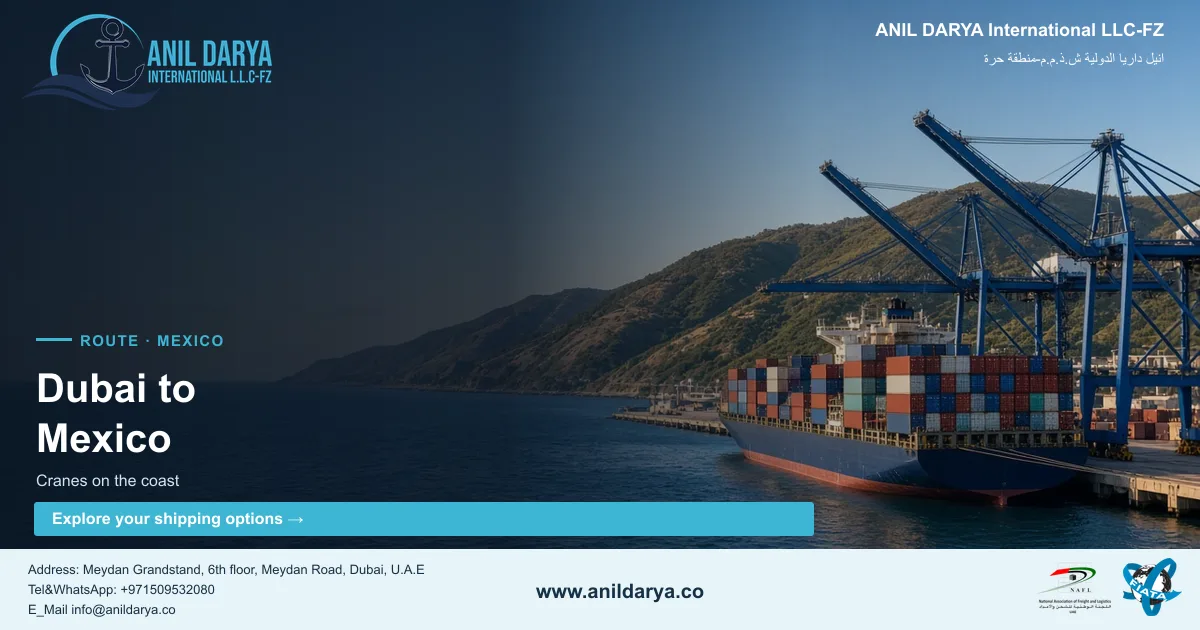
Shipping from Dubai to Mexico usually means a container from Jebel Ali or Khor Fakkan to Manzanillo on the Pacific coast, with air cargo for urgent goods. Before the cargo can be cleared, the Mexican importer must be registered in the SAT's Padron de Importadores and hire a licensed customs broker (agente aduanal), who files the pedimento and pays the import duty (IGI), the customs processing fee (DTA) and 16% IVA. This guide covers ports, modes, documents, duty, controlled goods and each step from Dubai to your consignee.
Shipping from Dubai to Mexico at a glance
| Item | Detail |
|---|---|
| Main UAE load ports | Jebel Ali (AEJEA) and Khor Fakkan (AEKLF) |
| Main Mexican container gateway | Manzanillo, Colima: 46% of Mexico's container traffic and 3,893,357 TEU in 2025 |
| Other Mexican sea ports | Lazaro Cardenas (Pacific), Veracruz and Altamira (Gulf of Mexico) |
| Published sea transit | About 41 to 62 days port to port with transshipment, depending on route (Fluent Cargo data) |
| Published air transit | About 22 hours Dubai to Mexico City |
| Customs authority | Agencia Nacional de Aduanas de Mexico (ANAM); importer registration is with the SAT |
| Importer requirements | Active RFC tax ID, Padron de Importadores, a customs broker or own legal representative |
| Import declaration | Pedimento, transmitted electronically by the broker |
| Import duty | IGI at the rate for the 8-digit tariff code (TIGIE) |
| Other charges at entry | DTA of 8 per thousand of customs value on a definitive import; IVA 16% |
| Trade agreement with the UAE | None. Mexico and the UAE have an investment agreement, not a trade agreement |
| 2026 tariff change | General duty rates raised on 1,463 tariff lines from 1 January 2026, to between 5% and 50% |
Which mode should you use from Dubai to Mexico?
Most cargo from Dubai to Mexico goes by sea. It is a long voyage with at least one transshipment, so air cargo is the only fast option. There is no road option on this lane.
| Your cargo | Best mode | Why |
|---|---|---|
| A full container or more of general goods | FCL by sea | Lowest cost per unit, box stays sealed to Mexico |
| A few pallets or cartons | LCL by sea | You pay for the space you use, but expect a longer total time |
| Machinery, steel, vehicles, oversized pieces | Flat rack, open top or breakbulk | Fits cargo that does not go in a standard box |
| Chemicals, batteries, aerosols, perfumes | DG container or DG air | Needs carrier acceptance and fast clearance on arrival |
| Samples, spare parts, urgent stock | Air cargo | About a day in the air instead of six weeks or more at sea |
A simple rule: if the goods must be in Mexico within a month, price air. Sea freight from Dubai to Mexico rarely beats six weeks port to port, before customs and inland delivery.
Sea freight from Dubai to Mexico: ports, FCL and LCL
Sea freight from Dubai to Mexico loads at Jebel Ali or Khor Fakkan. Our Jebel Ali port shipping guide covers the terminals, cut-offs and export steps on the UAE side. On the Mexican side, the port you choose should follow where the consignee is, because inland trucking or rail in Mexico can be long.
Which Mexican port should your cargo go to?
Manzanillo, in the state of Colima, is Mexico's main container entrance. The port authority says it handles 46% of the country's containers and 68% of those on the Pacific coast. It moved 3,893,357 TEU in 2025, and 3,483,498 TEU from January to October 2026, up 8.1% on the same months of 2025. Its hinterland is central Mexico and the Bajio region, which the port authority says produce more than 67% of national GDP.
| Port | Coast | Best for consignees in |
|---|---|---|
| Manzanillo | Pacific | Guadalajara, Mexico City, the Bajio (Leon, Queretaro, Aguascalientes), Monterrey |
| Lazaro Cardenas | Pacific | Michoacan and cargo railed to central Mexico |
| Veracruz | Gulf of Mexico | Veracruz state, Puebla and the east |
| Altamira | Gulf of Mexico | Tamaulipas and the industrial north-east |
Distances from Manzanillo, as published by the port authority, show why the port works for central Mexico.
| From Manzanillo to | By road | By rail |
|---|---|---|
| Guadalajara | 300 km | 355 km |
| Leon | 517 km | 661 km |
| Queretaro | 660 km | 703 km |
| Mexico City (Pantaco) | 791 km | 960 km |
| Monterrey | 1,086 km | 1,380 km |
FCL or LCL?
- FCL (full container load). You book a whole 20ft, 40ft or 40ft high cube. It suits larger volumes, heavy goods and anything you do not want handled with other cargo.
- LCL (less than container load). Your cargo shares a box. It is packed at a container freight station in the UAE and unpacked in Mexico, so release depends on the whole box being cleared. Each importer still needs its own pedimento and broker.
Our guide to FCL vs LCL costs shows where the break-even usually sits, and our sea freight service page explains what we book.
Sea freight transit times from Dubai to Mexico
There is no direct service on this lane in the schedule data we checked. Every option transships at least once. Fluent Cargo's route pages list these indications:
| Route | Published time | Transfers | Frequency |
|---|---|---|---|
| Khor Fakkan to Manzanillo | 41 days 8 hours | 1 | Every 1 to 2 weeks |
| Jebel Ali to Manzanillo | 54 days 21 hours | 2 | Every 2 to 4 weeks |
| Jebel Ali to Lazaro Cardenas | 58 days 4 hours | 2 | Every 2 to 4 weeks |
| Khor Fakkan to Veracruz | 61 days 23 hours | 1 | Every 1 to 2 weeks |
Competitor pages quote anything from 25 to 65 days for the same lane, so treat any single figure with care. Check the vessel schedule and estimated arrival on your booking before you give your buyer a date.
[AMIR-FACT: the carriers we actually book from Jebel Ali or Khor Fakkan to Manzanillo, the transshipment hub on each, and our real port-to-port days in 2026]
Breakbulk, project cargo and dangerous goods to Mexico
Breakbulk and project cargo
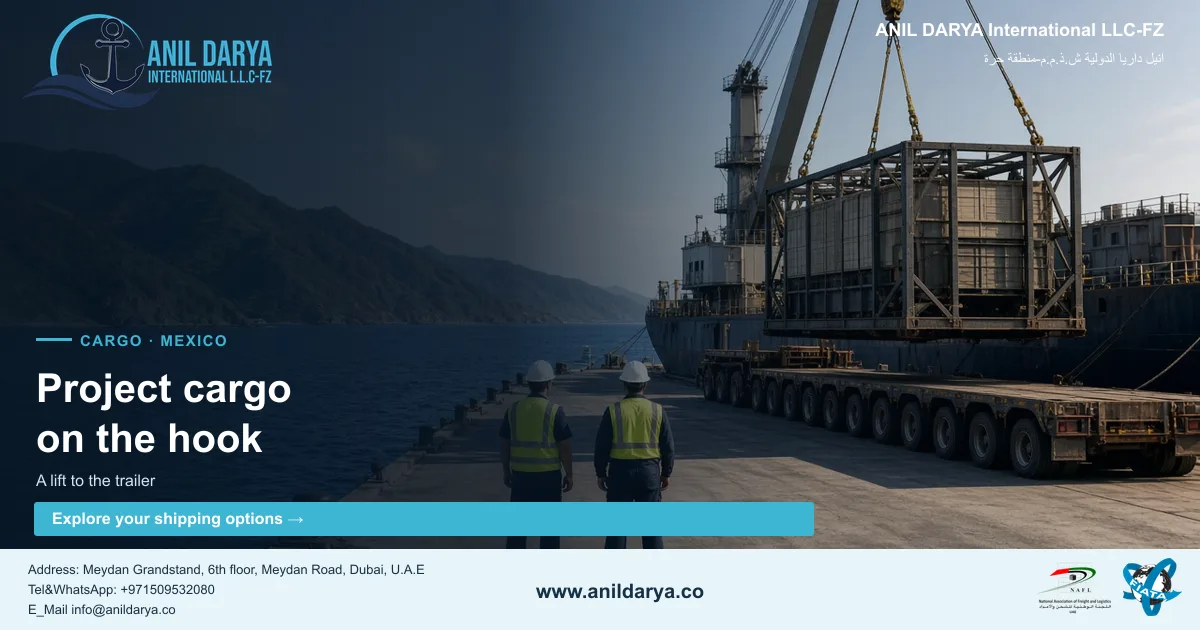
Machinery that fits a container but is too tall or wide goes on a flat rack or open top. Pieces too large for any container need breakbulk or heavy-lift tonnage. In Manzanillo, the port authority lists two multi-purpose terminals for general and containerised cargo, and a terminal that also handles project cargo with open areas and specialised equipment.
A decision rule: if a piece fits a 40ft flat rack by size and weight, a container service gives you more sailings. If it does not, the breakbulk sailing date drives the whole plan. We collect drawings, weights and lifting points, agree lashing with the carrier and plan the UAE road move to the quay. See our break bulk and project cargo service.
Dangerous goods
DG cargo to Mexico must be packed, marked and declared under the IMDG Code for sea or IATA rules for air. You need a UN number, proper shipping name, class and packing group, a safety data sheet, a signed DG declaration and UN-approved packaging.
Clearance speed matters more for DG than for other cargo. Under Mexico's Customs Law, explosive, flammable, contaminating, radioactive or corrosive goods left in customs storage are treated as abandoned after three days, or up to 45 days where the facility can keep them safely. Some chemicals also fall under the special importer register described below. Our dangerous goods shipping team gets carrier acceptance before you commit to a sailing and sends DG data to the consignee's broker early.
Air cargo from Dubai to Mexico
Air cargo suits samples, spare parts, electronics and urgent orders. Fluent Cargo lists departures from Dubai International (DXB) to Mexico City (MEX) every 1 to 2 days, at about 21 hours 56 minutes. It also lists an Emirates freighter from Al Maktoum (DWC) to Felipe Angeles International (NLU), north of Mexico City, 2 to 4 times a week, at about 21 hours 44 minutes.
Air freight is priced on chargeable weight, the higher of actual and volume weight. Mexican customs rules are the same as for sea: the importer needs the Padron registration and a broker, and pays duty, DTA and IVA. See our air cargo service for what we arrange from Dubai.
Mexican customs: who can import into Mexico?
ANAM runs Mexico's customs offices. The SAT, Mexico's tax authority, keeps the importer registers. ANAM lists five things an importer must do:
- Hold an active RFC (Mexican tax ID).
- Hire a customs broker (agente aduanal).
- Identify the tariff code (fraccion arancelaria) of the product.
- Register in the Padron de Importadores and, where needed, the register for specific sectors.
- Meet the tariff and non-tariff rules for the product.
This has a direct effect on your Incoterm. The importer of record must be a Mexican taxpayer with an RFC and e.firma, so a Dubai seller cannot simply clear goods in its own name. If you sell DDP, you need a Mexican entity or a partner that can act as importer. Our guide to Incoterms 2020 for sea freight explains the split of costs and risk.
How does an importer register in the Padron de Importadores?
The SAT's registration page says the filing is made online through the SAT portal with an e.firma or password, at any time before the first import. No documents are uploaded, but the applicant must meet these conditions:
- RFC active and e.firma valid.
- Up to date with tax obligations, with a positive compliance opinion.
- Fiscal address located in the RFC.
- Buzon Tributario (tax mailbox) validated.
- A customs broker, customs proxy or legal representative to carry out foreign trade operations.
The SAT says it gives the result within 10 days of receiving the request. Apply before the cargo sails. If the registration is rejected, the importer must fix the issues and file again, while the container waits at the port.
The register for specific sectors
Some goods need a second registration, the Padron de Importadores de Sectores Especificos. The SAT lists 16 sectors, including chemicals, precursor chemicals, firearms and explosives, pyrotechnics, cigarettes, footwear, textiles and apparel, ethyl alcohol, hydrocarbons, steel, steel products and automotive. The response time is up to 10 business days. Check your tariff code against this list before you ship clothing, shoes, steel or chemicals from Dubai.
The customs broker and the pedimento
The pedimento is Mexico's import declaration. The Customs Law requires it to be transmitted electronically, signed with an e.firma or digital seal. ANAM describes the agente aduanal as a person authorised by the Ministry of Finance, by patent, to clear goods on behalf of others. A company can clear without a broker only through its own accredited legal representative, which few importers do.
The Customs Law lists the data that must be sent with the pedimento for an import:
- Value and sale data from the commercial invoice or equivalent document.
- Bill of lading, packing list or other transport document data.
- Proof of compliance with non-tariff rules, such as permits or Mexican standards (NOMs) for the tariff code.
- Origin documents where a preference, quota or origin rule applies.
- Serial numbers, part numbers, brand and model for goods that can be identified one by one.
The importer must also give the broker a signed value declaration and keep an electronic file of each pedimento. Mexico's customs rules were amended again in 2026, including new rules for customs agencies, so let the broker confirm the current document list. You can find a broker through the CAAAREM or CLAA broker associations, which ANAM names.
How customs clearance works on arrival
- The carrier's agent transmits the cargo manifest and the container is discharged into the terminal.
- The broker classifies the goods, checks permits and validates the pedimento.
- The duty, DTA and IVA are paid.
- The goods are presented and the automated selection system decides if there is an inspection. If not, the goods are released straight away.
- If an inspection is selected, customs checks the documents and goods against the pedimento, then releases them if there are no irregularities.
Imports left in customs storage are treated as abandoned after two months under the Customs Law. Once ANAM notifies the owner, there are 15 days to collect the goods. Long before that, terminal storage and carrier detention build up, as our note on demurrage and detention explains.

Import duty and taxes when shipping from Dubai to Mexico
IGI: the general import duty
The IGI is charged at the rate set in Mexico's tariff (TIGIE) for the goods' tariff code. ANAM explains that it can be ad valorem (a percentage of customs value), specific (an amount per unit) or mixed. The base for ad valorem duty is the customs value, which is normally the transaction value: the price paid for the goods, adjusted under the Customs Law.
From 1 January 2026, a decree published in the Diario Oficial on 29 December 2025 changed the duty on 1,463 tariff lines. The new rates run from 5% to 50%, with most lines at 25% or 35%. Many are in textiles and clothing, plastics, paper, leather goods, steel and other metal products. Goods that qualify for one of Mexico's trade agreements pay the preferential rate instead.
Do goods from the UAE get a lower duty rate?
No. Mexico's Ministry of Economy lists the UAE among its investment protection agreements, not its trade agreements. Goods of UAE origin pay the general rate. Goods made in another country and shipped through Dubai pay the rate for their real origin, so the certificate of origin and the pedimento must match.
DTA and IVA
| Charge | Rate | Base |
|---|---|---|
| IGI (import duty) | Set per tariff code: ad valorem, specific or mixed | Customs value |
| DTA (customs processing fee) | 8 per thousand (0.8%) on most definitive imports | Customs value |
| IVA (value added tax) | 16% | Customs value plus IGI plus the other import charges |
A worked order of calculation: customs value, then IGI on that value, then DTA, then 16% IVA on the value plus IGI and the other charges. Because IVA is charged on top of duty, a 35% duty line costs far more at the border than the duty rate alone suggests. Your broker uses the current rates on the day of clearance.
Restricted and controlled goods
Mexico enforces most controls through the tariff code. If a rule is published for a code, proof of compliance goes with the pedimento.
| Goods | What applies |
|---|---|
| Chemicals, precursors, hydrocarbons | Padron de Sectores Especificos plus product permits |
| Clothing, textiles and footwear | Padron de Sectores Especificos; many lines hit by the 2026 duty rates |
| Steel and steel products | Padron de Sectores Especificos |
| Food, plants, animal products | Health and phytosanitary requirements checked at the port |
| Firearms, explosives, pyrotechnics | Special register and permits |
| Goods covered by a Mexican standard (NOM) | Proof of NOM compliance with the pedimento |
| Dangerous goods | IMDG or IATA rules; three-day abandonment limit in customs storage |
Send us the tariff code, description and origin of each line before booking, and we pass them to the consignee's broker to check permits and NOMs while the cargo is still in Dubai.
What does shipping from Dubai to Mexico cost?
We do not publish a fixed price, because rates change every week. Your total is built from these parts.
| Cost element | What drives it |
|---|---|
| UAE origin charges | Trucking to Jebel Ali or Khor Fakkan, export declaration, terminal handling, documents |
| Ocean or air freight | Container size or chargeable weight, carrier, transshipment route, season, surcharges |
| Mexican port charges | Terminal handling, LCL unpacking, storage after free time |
| Customs broker | Broker fee, pedimento validation, inspections, permits |
| Duty and taxes | IGI rate for the tariff code, 0.8% DTA, 16% IVA |
| Inland delivery in Mexico | Truck or rail from the port to the consignee |
| Delay costs | Demurrage and detention if the box is not cleared and returned on time |
The biggest swing on this lane is usually duty, not freight. A product on a 35% line costs more to land than one on a 5% line, whatever the ocean rate. Check the code first, then compare freight.
How to ship cargo from Dubai to Mexico: step by step
- Agree the Incoterm with your buyer. If you sell DDP, confirm who will be the Mexican importer of record.
- Confirm the importer has an active RFC and is in the Padron de Importadores, plus the sector register if the code needs it.
- Have the importer's broker check the tariff code, IGI rate, NOMs and permits.
- Send us the cargo details: goods, tariff codes, weight, volume, packing and the Mexican delivery address.
- We compare routings to Manzanillo or another port, then book space with the carrier from Jebel Ali or Khor Fakkan.
- We check the commercial invoice, packing list and certificate of origin, and prepare the bill of lading data with full goods descriptions.
- We arrange trucking to the port and the UAE export declaration, then load and seal the container.
- We send the documents and arrival notice to the consignee's broker before the vessel arrives.
- The broker files the pedimento, the charges are paid and the cargo is released for delivery.
[AMIR-FACT: one real Dubai to Mexico shipment we handled (cargo, mode, Mexican port, total days door to port, any problem solved), cleared for publication]
Checklist before you ship to Mexico
- Importer's RFC active and Padron de Importadores registration confirmed.
- Sector register checked for chemicals, textiles, footwear, steel or automotive goods.
- Customs broker appointed and given the commercial documents.
- Tariff code checked for the 2026 IGI rate, NOMs and permits.
- Origin of each product confirmed, with a certificate of origin that matches.
- Commercial invoice with full descriptions, serial or part numbers where they exist.
- Wood packaging and pallets checked with the broker against plant health rules.
- DG documents ready and the broker told early, given the three-day storage limit.
- Discharge port chosen by where the consignee is, not only by freight price.
- Terminal free time known and clearance planned before it ends.
- Cargo insurance arranged if the Incoterm puts the risk on you.
Common mistakes on the Dubai to Mexico lane
| Mistake | What happens | How to avoid it |
|---|---|---|
| Importer not in the Padron at arrival | The pedimento cannot be filed and storage starts | Register before the cargo sails |
| Selling DDP with no Mexican importer | Nobody can legally clear the goods | Agree the importer of record first, or sell DAP |
| Using an old duty rate | Landed cost far above the quote | Check the code against the 2026 rates |
| Assuming UAE origin gives a preference | Duty higher than planned | Use the general rate; there is no Mexico-UAE trade agreement |
| Wrong origin on re-exported goods | Wrong duty, penalties | Declare the real country of manufacture |
| Vague invoice descriptions | Classification queries and inspection | Describe each item, with serial and part numbers |
| Missing NOM proof | Goods held until compliance is shown | Have the broker check NOMs before shipping |
If you are comparing service providers on this lane, our guide on how to choose a freight forwarder in Dubai lists the questions to ask.
Frequently asked questions
How long does shipping from Dubai to Mexico take?
By sea, published schedule data shows about 41 days from Khor Fakkan to Manzanillo and about 55 days from Jebel Ali to Manzanillo, both with transshipment. Add customs and inland delivery. By air, Dubai to Mexico City takes about 22 hours of flying.
Which Mexican port is best for cargo from Dubai?
For most consignees it is Manzanillo, which handles 46% of Mexico's containers and is 300 km by road from Guadalajara and 791 km from Mexico City. Gulf ports such as Veracruz and Altamira suit the east and north-east.
Do I need a customs broker to import into Mexico?
In practice, yes. ANAM lists hiring an agente aduanal as a requirement. A company can only clear without one through its own legal representative accredited with the SAT.
What is the importer register (Padron de Importadores)?
It is the SAT's register of importers. A person or company must be registered, with an active RFC, valid e.firma and up-to-date taxes, before it can import goods into Mexico. Some sectors need a second, specific registration.
What is a pedimento?
The pedimento is Mexico's customs declaration. The broker transmits it electronically with the goods' tariff code, value, origin and permits, and it is used to pay duty, DTA and IVA.
Is there import duty on goods from Dubai to Mexico?
Yes, for most goods. The IGI rate depends on the tariff code. The UAE has no trade agreement with Mexico, so UAE-origin goods pay the general rate, which rose on 1,463 tariff lines from 1 January 2026.
What is the IVA rate on imports into Mexico?
IVA is 16%. On imports it is charged on the customs value plus the import duty and the other import charges, such as the DTA.
Can I ship dangerous goods from Dubai to Mexico?
Yes, by sea under the IMDG Code or by air under IATA rules. Plan clearance before arrival, because hazardous goods left in customs storage are treated as abandoned after three days, or up to 45 days where suitable facilities exist.
Get a quote for shipping from Dubai to Mexico
Send us your cargo details, tariff codes, the Mexican delivery address and the Incoterm, and we will come back with a routing and a price. Use our freight rate inquiry form, or contact our team to talk through a breakbulk or DG shipment first. You can also read more about our Dubai freight forwarding team.
Sources
- ANAM: Frequently asked questions (requirements to import, broker associations, abandoned goods)
- ANAM: Glossary (agente aduanal, pedimento, IGI, DTA, IVA)
- ANAM: Customs regimes
- ANAM: Abandoned goods
- ANAM: Customs clearance procedure
- SAT: Registration in the Padron de Importadores
- SAT: Padron de Importadores de Sectores Especificos
- Ley Aduanera, articles 29, 35, 36, 36-A, 40, 43, 59 and 64 (Orden Juridico Nacional)
- Ley del Impuesto al Valor Agregado, articles 1 and 27 (Orden Juridico Nacional)
- Ley Federal de Derechos, article 49 (Orden Juridico Nacional)
- DOF 29 December 2025: decree amending tariff lines of the LIGIE
- DOF 2026: decree amending the Customs Law Regulation
- Secretaria de Economia: Countries with treaties and agreements signed with Mexico
- ASIPONA Manzanillo: Location and zone of influence
- ASIPONA Manzanillo: Distances
- ASIPONA Manzanillo: Terminals and facilities
- ASIPONA Manzanillo: Monthly port statistics, December 2025
- ASIPONA Manzanillo: Monthly port statistics, October 2026
- Fluent Cargo: Dubai to Manzanillo
- Fluent Cargo: Dubai to Mexico City
- Fluent Cargo: Dubai to Veracruz
Reviewed: 10 November 2026