
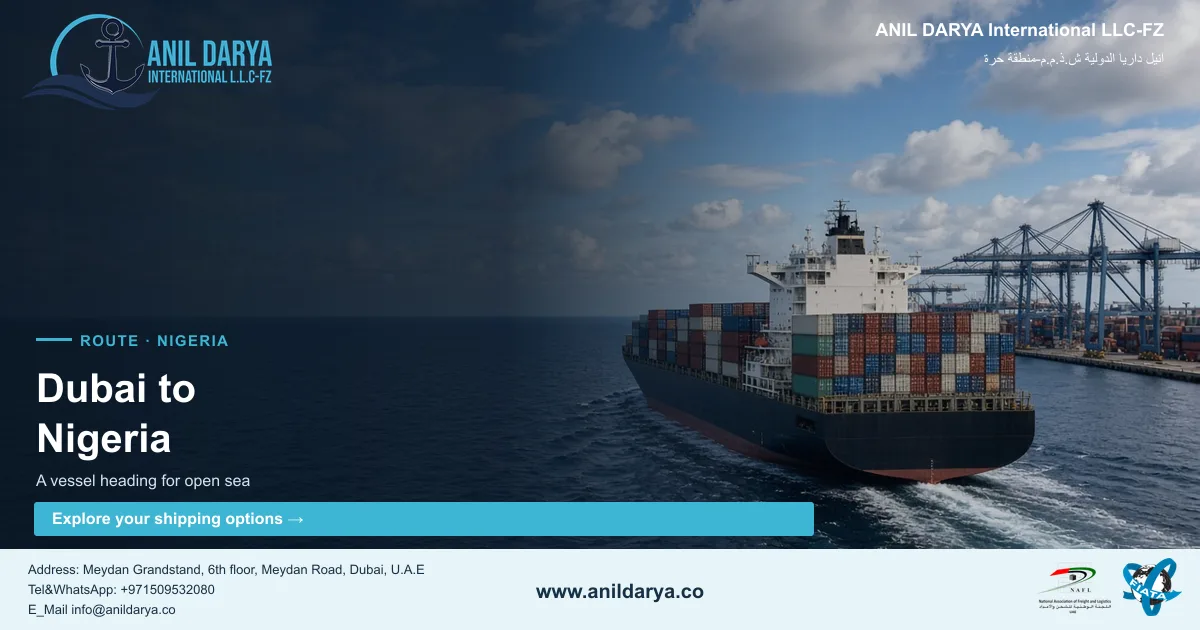
Shipping from Dubai to Nigeria works best when the Nigerian paperwork starts before the cargo moves. Your consignee needs an approved Form M, and regulated goods need SONCAP certificates, before the vessel sails from Jebel Ali. This guide covers the ports at both ends, sea and air options, Nigerian customs and duty, banned goods, and the steps we follow on this lane.
Shipping from Dubai to Nigeria at a glance
| Item | Detail |
|---|---|
| Main UAE load port | Jebel Ali (Dubai); Khalifa Port, Sharjah and Fujairah for some services |
| Main Nigerian ports | Lagos Port Complex (Apapa), Tin Can Island Port and Lekki Deep Sea Port in Lagos; Onne, Rivers (Port Harcourt), Calabar and Delta (Warri) in the east |
| Port landlord and regulator | Nigerian Ports Authority (NPA); terminals run by private operators |
| Customs authority | Nigeria Customs Service (NCS) |
| Customs clearance platform | B'Odogwu, the NCS system that replaced the older NICIS platform |
| Import approval | Form M, opened by the Nigerian importer through its bank on the Nigeria Single Window |
| Product conformity | SONCAP: Product Certificate before Form M, SONCAP Certificate per shipment |
| Food, drugs, cosmetics, chemicals | NAFDAC registration before import |
| Import duty | ECOWAS Common External Tariff, five bands from 0% to 35% |
| VAT | 7.5% standard rate |
| Air link | Dubai (DXB) to Lagos (LOS), about 5,900 km, flights every 1 to 2 days |
| Modes | FCL, LCL, Ro-Ro and vehicles, breakbulk and project cargo, dangerous goods, air cargo |
Which ports handle cargo from Dubai to Nigeria?
On the UAE side most Nigeria services load at Jebel Ali. If your cargo sits in Abu Dhabi or the northern emirates, a carrier calling at Khalifa Port or Sharjah may save trucking. Our Jebel Ali port shipping guide covers gate-in, terminals and UAE export clearance in detail.
On the Nigerian side the NPA acts as landlord and regulator, and private companies run the terminals under concessions signed in 2006. The NPA groups the ports into western ports (Lagos) and eastern ports.
| Port | Terminal operators (NPA list) | Cargo handled |
|---|---|---|
| Lagos Port Complex (Apapa) | APM Terminals (container terminal and Lilypond), ENL Consortium, Apapa Bulk Terminal, Greenview Development | Containers, breakbulk, general cargo, bulk |
| Tin Can Island Port, Lagos | TCI Container, Port and Cargo Handling Services, Five Star Logistics, Josepdam, Ports and Terminal Multiservices (PTML) | Containers, general cargo, bulk, vehicles (Ro-Ro) |
| Lekki Deep Sea Port, Lagos | Lekki Port LFTZ Enterprise | Containers, dry bulk, liquid bulk |
| Onne | Intels, Brawal, WACT | Containers, oil and gas cargo, general cargo |
| Rivers Port (Port Harcourt) | Port and Terminal Operators, BUA Ports and Terminal | Dry, liquid and break bulk |
| Calabar | Intels, Ecomarine, Addax Logistics | Containers, general cargo, liquid bulk |
| Delta Ports (Warri) | Intels, Julius Berger, Associated Marine Services, Green Leigh | General cargo, liquid bulk |
Lekki Deep Sea Port sits about 65 km east of Lagos. The NPA describes it as the deepest seaport in sub-Saharan Africa, and its operator says it has been fully operational since 1 April 2023, with 5 ship-to-shore cranes and 15 rubber-tyred gantry cranes.
The Nigerian port system handled 602,392 TEU of containers and 44,147 vehicles in the second quarter of 2026, according to the NPA. A simple rule: pick the port nearest your consignee that a regular service calls at.
Sea freight Dubai to Nigeria: FCL, LCL, Ro-Ro and breakbulk
Most cargo on this lane moves by sea. Volume and cargo type decide the mode.
| Mode | Best for | What to plan |
|---|---|---|
| FCL (20ft, 40ft, 40ft high cube) | Full loads of general goods, building materials, electronics, spare parts | One Form M can cover the shipment; seal and stuffing at origin |
| LCL (shared container) | Small volumes and mixed cartons | Each consignee still needs its own Form M and clearance; extra handling at the destination freight station |
| Ro-Ro | Cars, trucks, buses, wheeled machinery | Age limit on used vehicles, vehicle levy, Ro-Ro terminal at the discharge port |
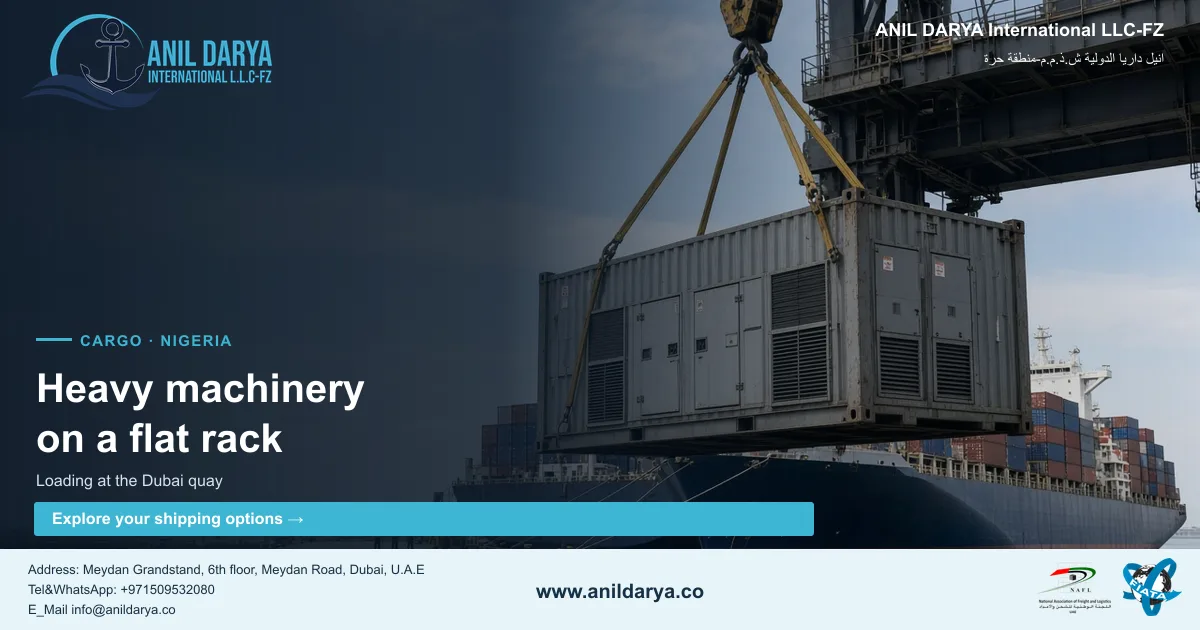
| Flat rack and open top | Machinery or steel too tall or wide for a standard box | Lashing, lifting points, out-of-gauge acceptance from the carrier |
| Breakbulk and project cargo | Pieces that fit no container: transformers, generators, plant | Vessel type, drawings and weights, lift plan, road permits in Nigeria |
| Dangerous goods | Chemicals, paints, batteries, aerosols | IMDG packing and labels, carrier acceptance, NAFDAC rules for chemicals |
FCL or LCL?
LCL looks cheap on the freight line, but on this lane every small shipment still carries the full Nigerian paperwork: Form M, PAAR and, for regulated goods, a SONCAP Certificate. If your volume is close to half a container, price FCL too. Our guide to FCL vs LCL costs shows how to compare the two on a total landed cost basis.
Vehicles and Ro-Ro
Nigeria's import prohibition list includes used motor vehicles more than 15 years past their year of manufacture. Used vehicles pay 20% duty plus a 15% National Automotive Council levy, and new vehicles pay 20% duty plus a 20% levy. From July 2026 a Green Tax Surcharge also applies to vehicles with engines of 2000cc and above. Check the vehicle's year and engine size before you buy it in Dubai.
Breakbulk and project cargo
Heavy machinery and project cargo usually move on general cargo or heavy-lift vessels, or on flat racks inside a container service. We collect drawings, weights and centre of gravity, then match the cargo to vessel type and discharge port. Our break bulk and project cargo service covers how we plan these moves, and our article on bulk shipping from Dubai to Africa covers bulk lots.
How long does shipping from Dubai to Nigeria take?
There is no single answer, because most Dubai to Nigeria container services are routed through a transshipment hub and published schedules change from month to month. Third-party schedule sites show very different sea transit figures for this lane, so we do not quote them here. The real time is the carrier's transit plus the days the consignee needs for Form M, PAAR and clearance.
[AMIR-FACT: our real door-to-port sea transit time from Jebel Ali to Apapa, Tin Can or Lekki, and the carriers we actually book on this lane]
For a realistic plan, count three blocks of time:
- Before sailing. Form M approval, SONCAP certificates and booking. This can take longer than the sea leg if it starts late.
- At sea. The carrier's transit time, including any transshipment.
- In Nigeria. Discharge, PAAR-based clearance, any examination, then delivery.
Cargo from Dubai to Nigeria by air
Air cargo suits urgent spare parts, samples, phones and other high-value, low-weight goods. Schedule data on Fluent Cargo lists Dubai International (DXB) to Murtala Muhammed International Airport in Lagos (LOS) at about 5,903 km, with flights every 1 to 2 days and about 8 hours 30 minutes flying time. It also lists freighter services from Sharjah and Abu Dhabi to Lagos.
Air shipments need the same Nigerian import approvals as sea cargo, so a fast flight does not help if the Form M is not ready. Lithium batteries, perfumes, aerosols and other dangerous goods must be declared under air DG rules. Our air cargo team in Dubai books space and checks DG acceptance before you hand over the cargo.
Nigerian import documents: Form M, SONCAP and PAAR
The Nigerian side runs on documents that the importer controls. The NPA's import guidelines say the importer must first have a company registered in Nigeria, a Tax Identification Number and an Authorised Dealer Bank. After that, the order of steps matters.
| Document | Who gets it | When | Why it matters |
|---|---|---|---|
| Product Certificate (PC1, PC2 or PC3) | Importer, through an accredited inspection firm | Before Form M | SON says it is needed to open Form M for regulated goods |
| Form M | Importer, through its bank on the Nigeria Single Window | Before shipment | The bank validates it and sends it to the NCS for acceptance |
| SONCAP Certificate (SC) | Issued by SON per shipment | After Form M is accepted, before arrival | A mandatory customs clearance document for regulated goods |
| NAFDAC registration | Nigerian company or local agent of the manufacturer | Before import | Required for food, drugs, cosmetics, chemicals and medical devices |
| PAAR (Pre-Arrival Assessment Report) | Importer applies on the Single Window; NCS issues it | After the SONCAP Certificate is activated | Clearance starts once PAAR is issued |
| Commercial invoice, packing list, bill of lading | Shipper and carrier | At shipment | The final invoice, bill of lading and packing list go to the inspection firm for the SONCAP Certificate |
| Insurance certificate | Importer | With Form M | Attached to Form M; imports must be insured with a Nigerian insurer |
How SONCAP works
SONCAP is the Standards Organisation of Nigeria's conformity programme. Testing and inspection happen in the exporting country, run by accredited inspection firms. SON sets out three Product Certificate routes: PC1 for unregistered products, valid for one shipment, and PC2 or PC3 for registered or licensed products, valid for one year. The firm issues a Certificate of Conformity, and SON then issues the SONCAP Certificate, which Customs needs to clear the goods.
SON lists goods outside SONCAP, including food products, medicines, medical items other than equipment and machines, raw-material chemicals for genuine manufacturers, and used products other than automobiles. Genuine manufacturers importing machinery or spare parts for their own production apply for a SONCAP import permit instead.
Why the Incoterm matters on this lane
Because Nigerian rules expect imports to be insured locally, many Nigerian buyers buy on FOB or CFR terms and arrange insurance in Nigeria. Agree the Incoterm, the insurance and who pays which charges before you quote. Our Incoterms 2020 guide for sea freight explains each term.
Nigeria customs clearance: B'Odogwu, inspection and release
The Nigeria Customs Service now processes declarations on B'Odogwu, its own clearance platform. It ran as a pilot at the PTML command from October 2024 and went live at the Apapa command in May 2025, replacing the NICIS system run by Webb Fontaine. Form M processing was added to the platform during the pilot.
Nigeria uses destination inspection, so goods are inspected on arrival rather than before shipment. Duties are paid in naira, and the NCS uses scanners at Apapa to cut down on manual examinations. The clearance flow on the Nigerian side looks like this:
- The shipping line submits the manifest to Customs, NPA and the terminal operator.
- The licensed customs agent files the declaration against the PAAR on B'Odogwu.
- Duty and other charges are paid through a bank linked to the platform.
- Customs may scan or physically examine the cargo.
- Customs releases the cargo, the shipping line issues the delivery order, and the terminal delivers.
We do not clear cargo in Nigeria. We prepare the UAE-side documents so the Nigerian clearing agent can file without corrections, and we share draft documents with that agent before sailing.
Import duty, VAT and levies in Nigeria
Nigeria applies the ECOWAS Common External Tariff to imports from outside ECOWAS, so goods from the UAE pay the CET rate for their HS code. Duties are mostly ad valorem, charged on the CIF value.
| CET band | Rate | Goods (ECOWAS description) |
|---|---|---|
| Band 0 | 0% | Essential social goods |
| Band 1 | 5% | Goods of primary necessity, raw goods and capital goods |
| Band 2 | 10% | Intermediate goods and inputs |
| Band 3 | 20% | Final consumption or finished goods |
| Band 4 | 35% | Specific goods for economic development |
On top of duty, keep these in your landed-cost sums:
- VAT at the standard rate of 7.5%.
- An import adjustment tax on some tariff lines. The 2026 fiscal policy measures include a revised Import Adjustment Tax list.
- The vehicle levy and Green Tax Surcharge for vehicles, described above.
- Excise duty on goods such as beverages, alcohol and tobacco.
The Nigeria Customs Service Act 2023 introduced a charge of not less than 4% of FOB value to replace the old 1% CISS and 7% cost of collection. The NCS suspended its implementation in February 2025 for consultation. Ask your Nigerian clearing agent which levies apply on the day of clearance, because these items change.
What goods are banned or restricted in Nigeria?
Nigeria has two kinds of lists. The absolute prohibition list covers goods that may never be imported. The trade prohibition list protects local industry and is revised from time to time. The 2026 fiscal policy measures from the NCS include a Revised Import Prohibition List (Trade), which took effect on 1 April 2026 for imports from outside ECOWAS, with a 90-day window for deals backed by a valid Form M signed before that date.
| List | Examples of goods covered |
|---|---|
| 2026 trade prohibition list: food and agriculture | Poultry and livestock products, pork and beef cuts, non-breeding eggs, refined vegetable oils, cane and beet sugar, cocoa products, processed tomato products |
| 2026 trade prohibition list: pharmaceuticals and fertiliser | Listed medicaments, waste pharmaceuticals, NPK fertilisers |
| 2026 trade prohibition list: construction and manufacturing inputs | Bagged cement, selected steel products, corrugated paper, cartons, large glass bottles |
| 2026 trade prohibition list: consumer goods | Soaps and detergents, sweetened beverages, ballpoint pens and parts |
| Absolute prohibition list | Counterfeit goods and coins, second-hand clothing, air pistols and disguised weapons, obscene material, nuclear and toxic waste, unfit food |
| Vehicles | Used vehicles more than 15 years past their year of manufacture |
| Restricted, not banned | Food, drugs, cosmetics, chemicals and medical devices need NAFDAC registration; regulated goods need SONCAP |
Check the HS code against the current NCS lists before your buyer opens the Form M. Banned goods that arrive can be seized.
Dangerous goods shipping from Dubai to Nigeria
Chemicals, paints, solvents, aerosols, batteries and gases are accepted on many services, but only when declared and packed to the IMDG Code. Each shipment needs:
- A UN number, proper shipping name, class and packing group for each product.
- A Safety Data Sheet and a signed dangerous goods declaration.
- UN-approved packaging, labels on packages and placards on the container.
- Carrier acceptance for the class, including any transshipment port rules.
- NAFDAC registration in Nigeria for regulated chemicals and cosmetics.
Our dangerous goods shipping team checks the SDS and the carrier's acceptance before you commit to a sailing.
What affects the cost of shipping from Dubai to Nigeria?
We do not publish rates, because they move with carrier pricing and cargo type. These are the items that make up your total:
| Cost item | Who usually pays | What drives it |
|---|---|---|
| UAE trucking, stuffing, export clearance | Shipper (FOB, CFR, CIF) | Pickup location, cargo handling, declaration type |
| Ocean or air freight | Depends on the Incoterm | Container type, weight, season, transshipment, DG or out-of-gauge surcharges |
| SONCAP and inspection fees | Usually the exporter for the SONCAP Certificate | Certificate route, testing, inspection |
| Nigerian duty, VAT, levies | Importer | HS code, CIF value, vehicle age and engine size |
| Terminal, shipping line and NPA charges | Importer | Port, container size, storage days |
| Demurrage and detention | Importer | Days beyond the line's free time |
| Clearing agent and haulage in Nigeria | Importer | Port, distance, road conditions |
Delays in Nigeria turn into storage and container charges quickly. Our article on demurrage and detention shows how those charges add up.
How to ship from Dubai to Nigeria step by step
This is the order we follow. We book space with carriers, prepare documents and arrange UAE trucking and export clearance. We work with your consignee's clearing agent in Nigeria.
- Share the cargo details. Commodity, HS code, weight, volume or dimensions, pickup address, consignee city and Incoterm.
- Check the Nigerian lists. Confirm the HS code is not on a prohibition list and whether SONCAP or NAFDAC applies.
- Consignee opens the Form M. With a Product Certificate if the goods are regulated, through its bank on the Single Window.
- Book space. We compare services to Apapa, Tin Can, Lekki or Onne and get carrier acceptance for DG or out-of-gauge cargo.
- Prepare and inspect. The inspection firm handles SONCAP checks, and we arrange stuffing, sealing and UAE export or re-export clearance.
- Issue documents. Final invoice, packing list and bill of lading with the Form M number, sent to the inspection firm and the consignee.
- PAAR and clearance. The consignee activates the SONCAP Certificate, gets the PAAR and clears the cargo on arrival.
- Delivery and empty return. The Nigerian agent delivers and returns the empty container within free time.
[AMIR-FACT: one real Dubai to Nigeria shipment we handled: cargo type, discharge port, mode and what we did to get it cleared without delay]
Checklist before you ship to Nigeria
- HS code confirmed and checked against the current NCS prohibition lists.
- Consignee has a Nigerian company registration, TIN and Authorised Dealer Bank.
- Form M approved, with the number ready for the invoice and bill of lading.
- Product Certificate and SONCAP route agreed for regulated goods.
- NAFDAC registration in place for food, drugs, cosmetics, chemicals or medical devices.
- Insurance arranged in line with Nigerian rules and the agreed Incoterm.
- Invoice, packing list and bill of lading show the same weights, packages and consignee.
- For vehicles: year of manufacture within the age limit and engine size known.
- For DG: SDS, DG declaration, UN packaging and carrier acceptance.
- Nigerian clearing agent named and draft documents shared before sailing.
Common mistakes on the Dubai to Nigeria lane
- Shipping before the Form M is approved. Without it the consignee cannot get a PAAR, and the cargo waits at the port.
- Missing the SONCAP Certificate. Regulated goods without it cannot be cleared.
- Ignoring the 2026 trade prohibition list. Goods ordered under old rules can be stopped.
- Different values on invoice and Form M. Customs will query any mismatch.
- Buying an old car in Dubai. A vehicle over the age limit cannot be imported.
- Undeclared DG in a general cargo box. This leads to rejection, fines or a stuck container.
- Late clearing agent. If the Nigerian agent sees the documents only after arrival, free time is gone before filing starts.
Frequently asked questions
Do I need a Form M to ship goods from Dubai to Nigeria?
Yes. The Nigerian importer opens a Form M through its Authorised Dealer Bank on the Nigeria Single Window before shipment. Without an accepted Form M the importer cannot get a PAAR, which clearance depends on.
What is SONCAP and who arranges it?
SONCAP is the Standards Organisation of Nigeria's conformity programme for regulated goods. The importer gets a Product Certificate before opening the Form M, and an accredited inspection firm in the export country handles checks so SON can issue the SONCAP Certificate for the shipment.
Which Nigerian port should I ship to?
For Lagos consignees, Apapa, Tin Can Island and Lekki Deep Sea Port all handle containers, and the carrier's service usually decides. For the east, Onne is the main container option. Choose the port nearest your consignee that a regular service calls at.
How much is import duty in Nigeria?
Nigeria uses the ECOWAS Common External Tariff, with five bands of 0%, 5%, 10%, 20% and 35% by HS code. VAT of 7.5% applies on top, and some goods also pay import adjustment tax, excise or a vehicle levy.
Can I ship a used car from Dubai to Nigeria?
Yes, if the vehicle is not more than 15 years past its year of manufacture. Used cars pay 20% duty plus a 15% National Automotive Council levy, and vehicles of 2000cc and above also face a Green Tax Surcharge from July 2026.
What goods are banned from import into Nigeria?
The absolute list includes counterfeit goods, second-hand clothing and some weapons. The 2026 trade list, in force from 1 April 2026, adds items such as frozen poultry, bagged cement, refined vegetable oils, soaps and detergents, and listed medicines from outside ECOWAS.
Can I ship dangerous goods from Dubai to Nigeria?
Yes, if they are classified, packed and labelled to the IMDG Code, declared with an SDS, and accepted by the carrier. Chemicals and cosmetics also need NAFDAC registration in Nigeria.
Which customs system does Nigeria use now?
The Nigeria Customs Service uses B'Odogwu, its own clearance platform. It started as a pilot in October 2024 and went live at the Apapa command in May 2025, replacing the older NICIS system.
Does Anil Darya clear cargo in Nigeria?
No. We handle the UAE side: booking, documents, trucking and export clearance in the UAE. We work with your consignee's licensed clearing agent in Nigeria and share drafts with them before sailing.
Get a quote for shipping from Dubai to Nigeria
Send us the commodity, HS code, weight, volume, pickup point and Nigerian port, and we will come back with a routing and a price. Use our freight rate inquiry form, or contact our team to talk through a vehicle, DG or project shipment first. You can also read about our Dubai freight forwarding team and our sea freight service.
Sources
- Nigerian Ports Authority: Terminals and operators by port
- Nigerian Ports Authority: Import and export guidelines (Form M, SONCAP, PAAR steps)
- Nigerian Ports Authority: Lekki Deep Sea Port
- Nigerian Ports Authority: Q2 2026 operational performance
- Lekki Port: Port facts and equipment
- Standards Organisation of Nigeria: SONCAP services
- Nigeria Customs Service: 2026 Fiscal Policy Measures and Tariff Amendments (July 2026)
- Federal Ministry of Information: NCS suspends 4% FOB charge (February 2025)
- US International Trade Administration: Nigeria prohibited and restricted imports
- US International Trade Administration: Nigeria import tariffs (vehicle duty and levy)
- US International Trade Administration: Nigeria customs regulations (insurance, naira payment, PAAR)
- US International Trade Administration: Nigeria import requirements (destination inspection)
- ECOWAS: Common External Tariff bands
- PwC Worldwide Tax Summaries: Nigeria other taxes (VAT 7.5%)
- SCP Law: Nigeria's 2026 import restrictions (categories, effective date)
- Legal 500: Registration of imported products with NAFDAC
- Nairametrics: Customs to expand B'Odogwu to Apapa and Tin Can (March 2025)
- Legit.ng: B'Odogwu goes live at Apapa (May 2025)
- Fluent Cargo: Dubai to Lagos air and sea schedules
Reviewed: 10 November 2026