
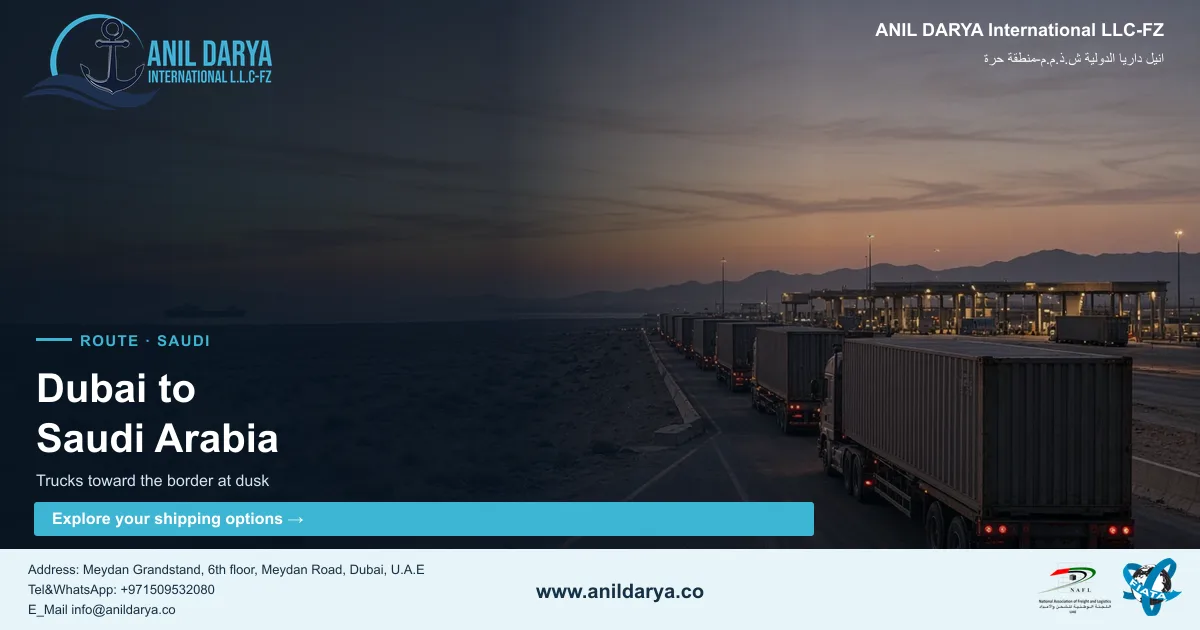
Shipping from Dubai to Saudi Arabia is done three ways: by truck across the Ghuwaifat-Batha land border, by container ship from Jebel Ali to Dammam or Jeddah, or by air. The right choice depends on where your consignee is, how much you ship and what the cargo is. Every option ends with a Saudi customs declaration on the Fasah platform, and many products also need a SABER shipment certificate before they arrive.
Dubai to Saudi Arabia shipping at a glance
| Item | Detail |
|---|---|
| Main UAE origin points | Jebel Ali Port (sea), Dubai airports (air), your site or warehouse (road) |
| Land border | Al Ghuwaifat (UAE side) and Al Batha (Saudi side), the only land port linking the two countries |
| Main Saudi seaports | King Abdulaziz Port, Dammam (east coast) and Jeddah Islamic Port (west coast) |
| Saudi customs authority | Zakat, Tax and Customs Authority (ZATCA) |
| Saudi ports authority | Saudi Ports Authority (Mawani) |
| Customs declaration system | Fasah, filed at least 48 hours before the shipment reaches the port of entry |
| Product conformity | SABER platform (run under SASO): product certificate (PCoC) and shipment certificate (SCoC) for regulated products |
| Core import documents | Commercial invoice, bill of lading, certificate of origin |
| Customs duty on non-GCC goods | GCC common external tariff, at least 5% for most goods, on CIF value |
| GCC-origin goods | Duty exemption if origin rules are met (valid certificate of origin, direct shipment, at least 40% local value added) |
| Import VAT | 15%, on the customs value plus duty and other charges |
| UAE border pre-arrival rule | Since 18 September 2023, trucks need an advance customs declaration and a truck crossing permit at Ghuwaifat |
Which way should you ship from Dubai to Saudi Arabia?
On this lane road, sea and air all make sense. The table shows where each one fits.
| Mode | Best for | Main Saudi entry point | What decides it |
|---|---|---|---|
| Road, full truck (FTL) | A full trailer of palletised or loose cargo for one consignee | Al Batha land port | Volume, door-to-door control, inland destination |
| Road, groupage (LTL) | A few pallets that share a truck | Al Batha land port | Small volume, flexible dates |
| Sea, FCL | Full 20ft or 40ft containers, heavy goods | Dammam or Jeddah | Weight, west coast delivery, carrier schedules |
| Sea, LCL | Part loads that can wait for consolidation | Dammam or Jeddah | Small volume, cost per cubic metre |
| Breakbulk and project cargo | Machinery, steel, oversized pieces | Dammam or Jeddah, or road on special trailers | Dimensions, weight, route permits |
| Dangerous goods | Chemicals, batteries, gases and other classed cargo | Depends on class and mode | Carrier acceptance, packaging, permits |
| Air | Urgent spares, samples, high-value goods | Riyadh, Jeddah or Dammam airports | Deadline, chargeable weight |
A simple rule: if your consignee is in Riyadh, Dammam, Al Khobar or Jubail and the cargo fits a truck, start with road. If the consignee is in Jeddah, Makkah or the west, compare a truck across the country with a container to Jeddah. If the goods must arrive in days, price air.
Road freight from Dubai to Saudi Arabia via the Ghuwaifat-Batha border
Trucks leave Dubai, drive west through Abu Dhabi emirate and cross at Al Ghuwaifat on the UAE side and Al Batha on the Saudi side. Saudipedia, the Saudi reference encyclopedia, describes Al Batha as a land port in Al Udayd Governorate in the Eastern Province and the only port connecting the Kingdom with the UAE. It is one of fourteen Saudi land border ports.
Saudipedia reports SAR 117 billion of imports from the UAE through Al Batha from 2019 to 2021. ZATCA handles customs there, alongside the passports and border guard directorates.
What the UAE side needs before the truck arrives
Abu Dhabi Customs made pre-arrival clearance mandatory at Ghuwaifat from 18 September 2023. In practice that means:
- The customs declaration is prepared in advance, with goods data and attachments.
- A truck crossing permit is issued before the truck reaches the border.
- For trucks leaving the UAE, the permit carries the customs declaration number, the Saudi clearance information from Fasah and the expected arrival date at the crossing.
So the Saudi side has to be ready before the truck leaves Dubai. If the Fasah declaration is not in place, the truck cannot get its UAE exit permit, and it waits.
FTL, LTL and special trailers
A full truckload gives you one consignee, one seal and one clearance. Groupage is cheaper for small volumes, but the truck usually clears as one load, so one shipper's missing paperwork can hold everyone. Ask how the groupage operator handles clearance before you commit high-value or time-critical goods.
Heavy machinery and oversized pieces move on flatbed, low-bed or extendable trailers. These need route checks and, above certain sizes, permits on both sides.
[AMIR-FACT: our typical door-to-door road transit days from Dubai to Riyadh, Dammam and Jeddah (FTL and LTL), and how often we load]
Sea freight from Dubai to Saudi Arabia: Jebel Ali to Dammam and Jeddah
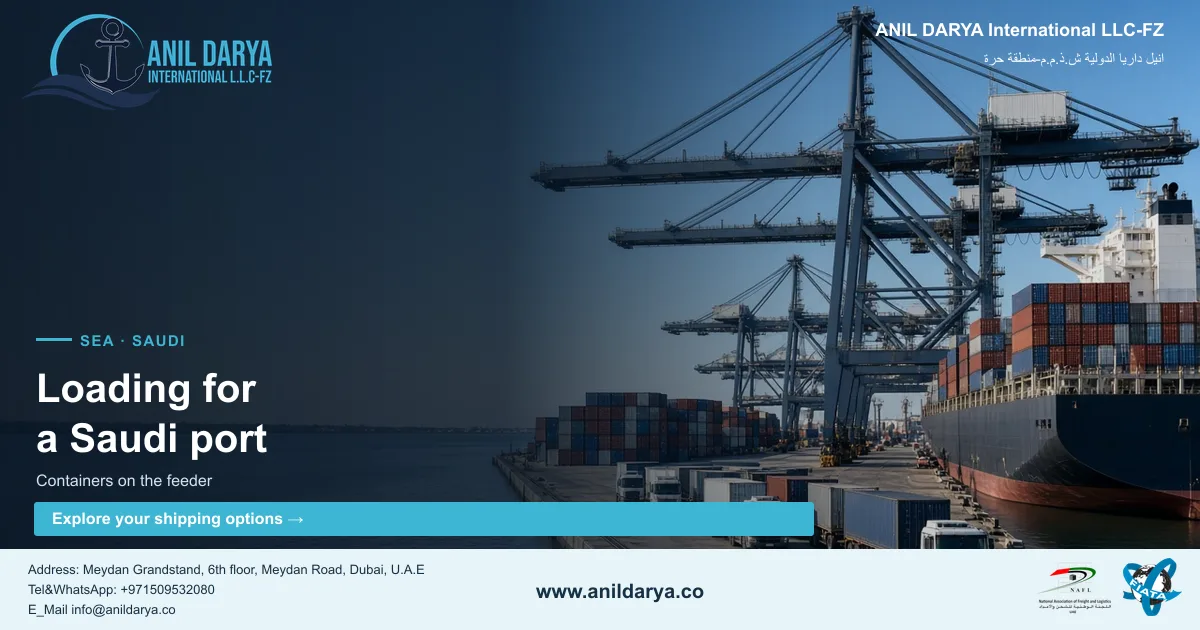
Sea freight on this lane almost always starts at Jebel Ali Port. On the Saudi side, the choice is between the east coast and the west coast.
| Saudi port | Coast | Key facts | Usually serves |
|---|---|---|---|
| King Abdulaziz Port, Dammam | East | 43 berths, three terminals, 105 million tonnes capacity, rail link to the Riyadh dry port | Eastern Province and central region including Riyadh |
| Jeddah Islamic Port | West | About 12 km², 62 berths, 11.2 km of quay, maximum draft 16 m | Jeddah, Makkah, Madinah and the western region |
Dammam is the short sea leg from Jebel Ali. Jeddah is a much longer sea voyage, so for west coast cargo you are comparing a long sea leg with a long truck drive across the country.
For Riyadh, Dammam has one extra option: Saudipedia notes the port is connected by railway to the dry port in Riyadh, so a container can continue inland by rail as well as by truck.
FCL or LCL?
FCL means you book a whole 20ft or 40ft container. It suits heavy cargo, goods that should not be mixed with others, and anything that would fill most of a box. LCL means your cargo shares a container and is consolidated in Dubai and unpacked at the Saudi end. LCL needs fewer cubic metres to make sense, but it adds handling and your release depends on the whole consolidation clearing. Our guide to FCL vs LCL costs shows where the break-even usually sits.
For a few pallets, compare LCL with road groupage, which delivers to the door in one move.
Published carrier transit times
We did not find a carrier schedule page that publishes a direct Jebel Ali to Dammam or Jebel Ali to Jeddah transit time we could cite. Feeder schedules change often, so we quote the current sailing and transit for your booking rather than a fixed number.
[AMIR-FACT: the carriers or feeder services we actually book from Jebel Ali to Dammam and Jeddah, with typical port-to-port days]
Our sea freight service from Dubai covers FCL and LCL bookings on both Saudi coasts.
Breakbulk, project cargo and dangerous goods to Saudi Arabia
Breakbulk and project cargo
Steel, machinery, generators and other large pieces can go three ways: on a flat rack or open top container, as conventional breakbulk on a general cargo ship, or by road on a special trailer. On this lane the road option is real, which is not true on most sea lanes. The decision depends on size and weight:
- Fits a 40ft flat rack and the consignee is in the east or centre: compare flat rack by sea to Dammam with a low-bed truck.
- Too wide or heavy for normal road limits: price sea freight to the port closest to site and plan a short permitted road move from there.
- Many pieces for one project: plan the full sequence, not each piece, so that cranes, trailers and clearance are booked once.
Read how we plan flat rack, open top and out-of-gauge cargo, or see our break bulk and project cargo service.
Dangerous goods
Dangerous goods can move by sea, road or air, but each mode has its own rules: the IMDG Code at sea, the carrier's and the road authorities' rules for trucks, and IATA rules by air. For every DG shipment we need:
- UN number, proper shipping name, class and packing group.
- A Safety Data Sheet for each product.
- A signed dangerous goods declaration.
- UN-approved packaging, labels and placards.
- Any Saudi permit the product needs, approved before the cargo leaves Dubai.
Some classes cannot go by groupage truck. Our dangerous goods shipping team confirms acceptance before you commit to a date.
Air cargo from Dubai to Saudi Arabia
Air freight from Dubai lands at the main Saudi airports in Riyadh, Jeddah and Dammam. It suits spare parts that stop a production line, documents, samples, electronics and anything where a day matters more than the freight cost. Price is based on chargeable weight, which is the higher of actual weight and volume weight, so light bulky cargo costs more by air than its weight suggests.
The same Saudi rules apply: a Fasah declaration, a SABER shipment certificate for regulated goods, and permits for restricted products. Air does not skip customs. See our air cargo service for what we book.
Saudi customs: Fasah, documents and SABER
ZATCA runs Saudi customs. Its import instructions set out three core documents and an online declaration on Fasah.
What documents do you need to ship to Saudi Arabia?
| Document | Who issues it | When it is needed |
|---|---|---|
| Commercial invoice | Seller | Always |
| Packing list | Seller | Always (needed for the UAE export declaration and for checks at the Saudi end) |
| Bill of lading, air waybill or road consignment note | Carrier | Always, by mode |
| Certificate of origin | Chamber of commerce or authority in the country of origin | ZATCA says it is not needed if the country of origin is clearly established; for a GCC duty exemption it is essential |
| SABER product certificate (PCoC) | Conformity body, issued in SABER | Regulated products under Saudi technical regulations |
| SABER shipment certificate (SCoC) | Issued in SABER per shipment | Each shipment of regulated products, before arrival |
| IECEE certificate | Certification body | Goods that require it |
| Permits from the competent authority | Relevant Saudi regulator | Restricted goods |
| UAE export, re-export or transit declaration | Filed with UAE customs | Always on the UAE side |
How Fasah filing works
The declaration is filed on Fasah, directly by the importer or through a customs broker. ZATCA's instructions say the documents and the customs declaration should be completed at least 48 hours before the shipment reaches the port of entry. Fasah also lets the importer track the shipment and receive notifications.
For road cargo this matters twice. The Saudi declaration must exist before the truck can get its UAE exit permit at Ghuwaifat. So the Saudi broker's work starts before the truck is loaded, not when it reaches the border.
SABER: product and shipment certificates
SABER is the online platform run under the Saudi Standards, Metrology and Quality Organization (SASO). Products covered by Saudi technical regulations are called regulated products. For these, you need two things:
- A Product Certificate of Conformity (PCoC) for each product, issued in SABER after a conformity body assesses it.
- A Shipment Certificate of Conformity (SCoC) for each shipment, valid only for that shipment. The conformity body checks that every regulated product in it has a valid PCoC.
SABER lists a fee of SAR 500 to register a product certificate and SAR 350 for a shipment certificate, both excluding VAT, and notes that shipment certificate validity was extended from 60 to 90 days. Conformity body charges come on top. Register products early. The PCoC is the slow part, and you cannot get the SCoC without it.
Customs duty and VAT when you ship from Dubai to Saudi Arabia
Two charges apply at Saudi customs: customs duty and import VAT. Excise tax also applies to some products, such as cigarettes, carbonated drinks and energy drinks.
Customs duty
Saudi Arabia applies the GCC common external tariff, which is at least 5% for most goods from outside the GCC, calculated on the CIF value. Some goods carry higher rates, and some staples, such as rice, coffee and tea, enter duty-free. Check the rate for your exact HS code in the ZATCA tariff.
Goods made in a GCC country can enter duty-free as national products, but only if they meet the Saudi rules of origin. Under Ministerial Decision 3852, in force since 2 July 2021, the main conditions are:
- A valid certificate of origin from the GCC country of manufacture.
- Direct shipment from that country to Saudi Arabia.
- At least 40% local value added, with a higher threshold if the factory's national workforce share is below 25%.
Two points matter for Dubai shippers. Goods made in a GCC free zone are unlikely to qualify as GCC origin. Goods made in China, India or Europe and re-exported from Dubai are not UAE origin, so expect Saudi duty on them and ask the Saudi broker how it will be calculated before you sell DDP.
Import VAT at 15%
ZATCA charges 15% VAT on all goods imported into the Kingdom, whatever their tariff rate, and even when they are exempt from customs duty. Only a short list of cases is exempt from import VAT, such as diplomatic and military imports and returned goods. The VAT base is the customs value plus customs duty and any other fees or taxes.
Goods from other GCC states, including the UAE, are treated as imports for VAT under the current transitional rules, and the importer pays VAT to ZATCA at clearance. A VAT-registered importer can apply to account for import VAT through its VAT return instead. ZATCA's conditions include a monthly tax period, importing at least once a month, and a clean filing record for the past 12 months.
| Your goods | Customs duty in Saudi Arabia | Import VAT |
|---|---|---|
| Made in the UAE, meets Saudi origin rules, shipped direct | Exempt as a GCC national product | 15% |
| Made in a UAE free zone | Likely dutiable (treated as foreign) | 15% |
| Made outside the GCC, re-exported from Dubai | GCC tariff rate for the HS code, at least 5% for most goods | 15% |
| Duty-free tariff lines (for example rice, coffee, tea) | 0% | 15% |
Restricted and prohibited items
ZATCA's import rules say restricted goods need permits from the competent authorities, and that goods prohibited internationally or locally cannot be imported. Counterfeit, adulterated or substandard goods are also refused. In practice, plan for these categories:
- Prohibited: narcotics, weapons and ammunition without approval, counterfeit goods and currency, and goods banned under Saudi law.
- Restricted, permit needed: food, medicines, cosmetics and medical devices, chemicals, telecom and wireless equipment, drones, and anything under a SASO technical regulation.
- Special rules: used vehicles, which ZATCA handles under its own vehicle import controls.
Not sure? Send us the HS code and a product description before booking. It is cheaper to find out in Dubai than at Al Batha.
What does shipping from Dubai to Saudi Arabia cost?
We do not publish fixed rates for this lane, because the price depends on details only your shipment has. These are the factors that move it:
| Cost factor | Road | Sea | Air |
|---|---|---|---|
| Basis of charge | Per truck (FTL) or per pallet or cubic metre (LTL) | Per container (FCL) or per cubic metre (LCL) | Per chargeable kilogram |
| Destination city | Distance from the border | Port plus inland delivery | Airport plus delivery |
| Cargo type | Standard, reefer, flatbed, low-bed | Dry, reefer, flat rack, open top | General, DG, perishable |
| Border and port costs | Clearance on both sides, waiting time | Terminal handling at both ports, delivery order | Airport handling |
| Saudi charges | Customs duty, 15% VAT, SABER fees, broker fee, any permit fees | ||
| Delays | Truck waiting days | Demurrage and detention after free time | Storage |
Your Incoterm decides who pays which line. If you sell DDP, the duty, VAT and Saudi broker fees are yours. See Incoterms 2020 for sea freight.
How to ship from Dubai to Saudi Arabia: step by step
This is how we run a typical shipment. We book transport, prepare the UAE side and work with your Saudi consignee or their clearing agent on the Saudi side.
- Send the cargo details. Commodity, HS code, weight, dimensions, pickup location in the UAE, delivery city in Saudi Arabia, and the Incoterm.
- Check the product rules. We check whether the goods are regulated under SABER or restricted, and what origin evidence you have.
- Choose the mode. We price road, sea or air, or more than one, and confirm the route.
- Start SABER early. The importer or supplier registers regulated products and requests the shipment certificate.
- Prepare documents. Invoice, packing list, certificate of origin and any permits, with matching names, weights and HS codes.
- Saudi declaration on Fasah. The consignee's broker files at least 48 hours before arrival and shares the reference.
- UAE declaration and permits. We file the export, re-export or transit declaration and, for road, get the truck crossing permit at Ghuwaifat.
- Load and move. Truck loading and sealing, container gate-in at Jebel Ali, or air cargo delivery to the airline.
- Saudi clearance. ZATCA assesses duty and VAT, inspects if selected, and releases the cargo.
- Delivery and closing. The cargo goes to the consignee's door, and for sea freight the empty container is returned within free time.
[AMIR-FACT: one real Dubai to Saudi Arabia shipment we handled (cargo, mode, route, how long it took, any problem solved)]
Checklist before you ship to Saudi Arabia
- HS code confirmed for every item.
- SABER status checked: regulated or not, PCoC in place, SCoC requested.
- Permits for restricted goods approved by the Saudi authority.
- Certificate of origin issued, and origin rules checked if you claim the GCC exemption.
- Invoice, packing list and transport document show the same weights, piece counts and consignee.
- Saudi consignee or broker ready to file on Fasah at least 48 hours ahead.
- For road: Fasah reference shared so the Ghuwaifat crossing permit can be issued.
- Incoterm agreed, and it is clear who pays Saudi duty, VAT and broker fees.
- For DG: SDS, DG declaration, packaging, labels and carrier acceptance.
- For project cargo: drawings, weights and a route plan.
- Cargo insurance arranged.
Common mistakes on the Dubai to Saudi lane
- Leaving SABER to the last day. Without a shipment certificate, regulated goods are held at the Saudi port or border.
- Loading the truck before the Fasah declaration exists. The UAE exit permit needs it, so the truck waits at Ghuwaifat.
- Assuming all goods from Dubai are duty-free. Only goods that meet GCC origin rules are, and re-exports usually are not.
- Forgetting VAT. Import VAT of 15% applies even to duty-exempt goods.
- Mismatched paperwork. A different weight on the invoice and the consignment note can hold the whole load.
- Putting high-value goods on groupage with unknown co-loaders. One problem shipment can delay the truck.
- Picking the port by habit. Jeddah cargo routed to Dammam, or the reverse, adds a long inland leg.
Frequently asked questions
What is the cheapest way to ship from Dubai to Saudi Arabia?
For most commercial cargo going to Riyadh or the Eastern Province, road freight is the cheapest door-to-door option, with groupage for small loads and a full truck for larger ones. For full containers to the west coast, sea freight to Jeddah can be cheaper. Ask for both prices.
Which border crossing do trucks use from the UAE to Saudi Arabia?
Trucks cross at Al Ghuwaifat on the UAE side and Al Batha on the Saudi side. Al Batha is the only land port connecting Saudi Arabia with the UAE.
Do I need a SABER certificate to ship to Saudi Arabia?
You need SABER certificates if your product is covered by a Saudi technical regulation. That means a product certificate (PCoC) for the product and a shipment certificate (SCoC) for each shipment, issued before the goods arrive.
Is there customs duty on goods shipped from Dubai to Saudi Arabia?
Goods made in the UAE that meet Saudi origin rules, including at least 40% local value added and direct shipment, are exempt. Goods made outside the GCC and re-exported from Dubai pay the GCC tariff rate, at least 5% for most goods on CIF value. Import VAT of 15% applies in both cases.
What is Fasah?
Fasah is ZATCA's online platform for customs declarations. The importer or a customs broker files the declaration and documents there, at least 48 hours before the shipment reaches the Saudi port of entry.
Which Saudi port should I use for sea freight from Jebel Ali?
Use King Abdulaziz Port in Dammam for the Eastern Province and Riyadh, since it is the short sea leg and has a rail link to the Riyadh dry port. Use Jeddah Islamic Port for Jeddah, Makkah, Madinah and the western region.
How long does customs clearance take in Saudi Arabia?
ZATCA does not publish a single clearance time. Clearance is fastest when the Fasah declaration, SABER certificate and permits are all ready before arrival, which is why the declaration should be filed at least 48 hours ahead.
Get a quote for shipping from Dubai to Saudi Arabia
Tell us what you are shipping, where it is and where it needs to go in Saudi Arabia, and we will price the options that fit. Use our freight rate inquiry form, or contact our team to talk through a project, DG or SABER question first. You can also read more about our Dubai freight forwarding team.
Sources
- ZATCA: Import instructions (documents, Fasah, 48-hour rule)
- ZATCA: Guideline on imports and exports under VAT provisions (15% VAT, VAT base, GCC imports, payment through VAT return)
- ZATCA: Importation rules (restricted and prohibited goods)
- SABER platform (SASO): certificate fees and shipment certificate validity
- Intertek: Overview of the SABER system (PCoC and SCoC)
- US International Trade Administration: Saudi Arabia import tariffs
- EY: Saudi Arabia clarifies GCC origin of goods (Ministerial Decision 3852)
- Abu Dhabi Customs: Pre-arrival customs clearance at Ghuwaifat
- Saudipedia: Al-Batha Port
- Saudipedia: King Abdulaziz Port in Dammam
- Wikipedia: Jeddah Islamic Port (area, berths, quay length, draft)
- Dubai Customs: Submit customs declaration
Reviewed: 10 November 2026