
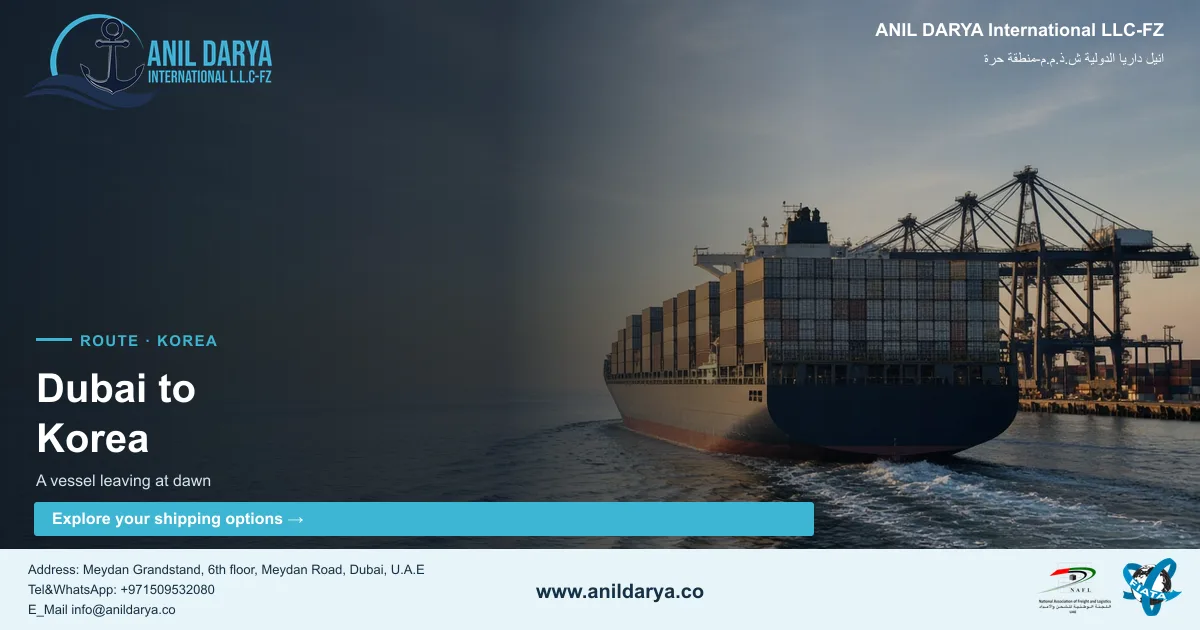
Shipping from Dubai to South Korea usually means a container from Jebel Ali to Busan, the country's main container port, or to Incheon near Seoul, with air cargo into Incheon International Airport for urgent goods. On arrival, a customs broker or the owner of the goods files the import declaration through the Korea Customs Service's UNI-PASS system, and the importer pays duty and 10% VAT. Since 1 May 2026 the UAE-Korea CEPA cuts or removes duty on most tariff lines for goods of UAE origin. This guide covers ports, modes, transit indications, documents, duty and tax, restricted goods and each step from Dubai to your consignee.
Shipping from Dubai to South Korea at a glance
| Item | Detail |
|---|---|
| Main UAE load port | Jebel Ali (AEJEA), with Khor Fakkan and Abu Dhabi as alternatives |
| Main Korean sea gateways | Busan (KRPUS) for most containers, Incheon (KRINC) for the Seoul area, plus Gwangyang and Pyeongtaek |
| Main air gateway | Incheon International Airport (ICN) |
| Modes | FCL, LCL, flat rack and breakbulk, dangerous goods, air cargo |
| Customs authority | Korea Customs Service (KCS) |
| Declaration system | UNI-PASS, filed by a customs broker or the owner of the goods |
| Duty basis | CIF value, rate set by HS code |
| Import VAT | 10% on customs value plus duty |
| Payment deadline | 15 days from acceptance of the duty payment declaration |
| Trade agreement | UAE-Korea CEPA, signed 29 May 2024, in force since 1 May 2026, covering about 91.2% of tariff lines |
| Declaration deadline after storage | 30 days from entry into a bonded area or designated storage place, with an extra duty of up to 2% of customs value if late |
Which mode should you use from Dubai to Korea?
Most cargo from Dubai to South Korea moves by sea in containers. Air cargo suits urgent, light or high-value goods. Road is not an option on this lane.
| Your cargo | Best mode | Why |
|---|---|---|
| A full container or more of general goods | FCL by sea | Lowest cost per unit, the box stays sealed to destination |
| A few pallets or cartons | LCL by sea | You pay only for the space you use |
| Machinery, steel, oversized pieces | Flat rack, open top or breakbulk | Fits cargo that does not go in a standard box |
| Chemicals, batteries, aerosols, perfumes | DG container or DG air | Needs carrier acceptance before booking |
| Samples, spare parts, urgent stock | Air cargo into Incheon | Days instead of weeks, higher cost per kilo |
Shipa Freight's guide puts the line between air and sea at about 100 kg. Below that the two often cost about the same, and above it sea is usually cheaper. A quick decision rule: if the goods must be in Korea within a week, price air. If not, start with sea and compare FCL and LCL once you know the volume.
Sea freight from Dubai to South Korea: FCL and LCL
Sea freight from Dubai to South Korea normally loads at Jebel Ali. DP World lists over 80 weekly services from the port. Our Jebel Ali port shipping guide covers the terminals, cut-offs and export steps there. Some aggregator data shows faster sailings from Khor Fakkan on the east coast, so it is worth asking for both load ports in your quote.
Which Korean port should your cargo go to?
Pick the port closest to the consignee, then check which carriers call there. Busan takes most deep-sea calls. A port with fewer direct services can mean a transhipment and a longer transit, even if the truck leg is shorter.
| Port | Code | Best for consignees in | Notes |
|---|---|---|---|
| Busan | KRPUS | Busan, Ulsan, Changwon, the south-east industrial belt, and much of the country by road or rail | Korea's largest container port, about 24.4 million TEU in 2024, connected to 500 ports in 100 countries |
| Incheon | KRINC | Seoul, Incheon and Gyeonggi province | Second-largest seaport; a direct SeaLead service linking Incheon and Jebel Ali was announced in 2023 |
| Gwangyang | Check on booking | South Jeolla, steel and petrochemical plants | Deep-water port about 125 km south-west of Busan |
| Pyeongtaek | KRPTK | South Gyeonggi and the Chungcheong area | Smaller container volumes, fewer deep-sea calls |
FCL or LCL?
Shipa Freight suggests FCL once your cargo fills at least half a 20ft container, and LCL for up to about six standard pallets. A 20ft box takes 10 or 11 standard pallets and a 40ft up to 21. LCL goes through a consolidation warehouse at both ends, so it adds handling and a few days. Our guide to FCL vs LCL costs shows how to work out the break-even point for your volume.
| Container | Use it for |
|---|---|
| 20ft dry | Heavy, dense cargo such as tiles, steel parts or bagged goods |
| 40ft dry or high cube | Lighter, bulky cargo such as furniture, appliances or cartons |
| Reefer | Chilled or frozen food, some chemicals and pharmaceuticals |
| Open top or flat rack | Tall, wide or heavy pieces lifted in from above or the side |
How long does sea freight from Dubai to South Korea take?
Published figures vary a lot, because they depend on the load port, the carrier and whether the service is direct. Treat the numbers below as indications, not promises.
| Source | Routing | Published port-to-port time |
|---|---|---|
| Shipa Freight (2021 guide) | Jebel Ali to Busan, FCL | About 24 days |
| Shipa Freight (2021 guide) | Jebel Ali to Incheon, FCL | About 27 days |
| Fluent Cargo schedule data | Khor Fakkan to Busan, quickest listed service | 20 days 7 hours, sailings every 1-2 weeks |
| Fluent Cargo schedule data | Jebel Ali to Incheon, listed services | 38 days 15 hours, with transfers |
Add a few days at each end for export clearance, gate-in, discharge and import clearance. LCL adds consolidation and unpacking time on top.
[AMIR-FACT: the carriers we actually book from Jebel Ali to Busan and Incheon, and our typical port-to-port days on each]
Breakbulk, project cargo and dangerous goods to Korea
Breakbulk and project cargo
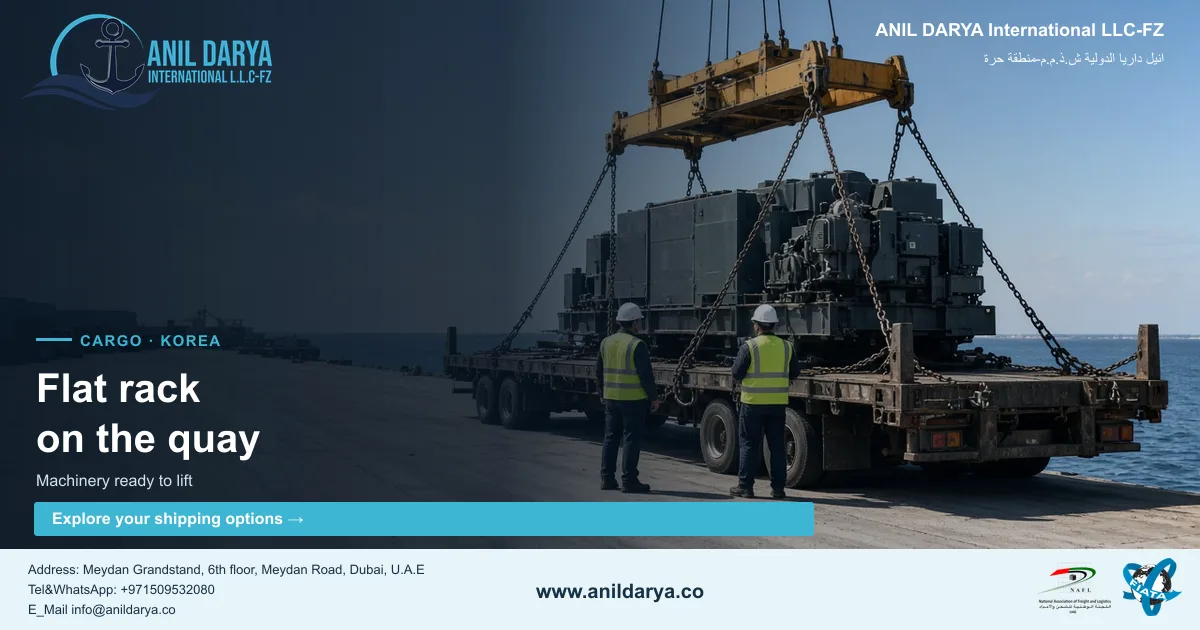
Machinery, steel structures and other oversized pieces move on flat racks or open tops when they fit a container frame, and as conventional breakbulk when they do not. Busan's New Port was designed with more than 17 m of water depth for large ships, and its overall port facilities include open storage yards and general cargo piers.
Plan project cargo in this order:
- Collect drawings, dimensions, weights and centre of gravity for each piece.
- Choose flat rack on a container service, or breakbulk or heavy-lift tonnage.
- Agree lifting, lashing and securing with the carrier.
- Confirm the Korean consignee's trucking, permits and receiving site.
- Prepare customs early so the cargo can leave the port quickly.
A simple rule: if a piece fits a 40ft flat rack by size and weight, a container service gives you more sailings. If not, the breakbulk sailing date drives the whole plan. See our break bulk and project cargo service.
Dangerous goods
Dangerous goods by sea follow the IMDG Code, and by air the IATA Dangerous Goods Regulations. Carriers accept DG by class and UN number, so acceptance comes before the booking is confirmed. You need:
- The UN number, proper shipping name, class and packing group.
- A Safety Data Sheet for each product.
- A signed Dangerous Goods Declaration.
- UN-approved packaging with the right marks, labels and placards.
- Any Korean approval the product needs before import, confirmed with the consignee.
Our dangerous goods shipping team checks the documents and carrier acceptance before you commit to a sailing.
Air cargo from Dubai to South Korea
Air cargo from Dubai to South Korea lands at Incheon International Airport (ICN), the country's largest airport. Fluent Cargo's schedule data lists direct flights from Dubai International (DXB) to Incheon, with Emirates flying the route once or twice a day. Shipa Freight puts typical air freight from Dubai to Seoul at 4 to 8 days.
Air suits samples, spare parts, electronics and urgent stock. Charges use chargeable weight, the higher of actual weight and volume weight, so light bulky cargo costs more than its scale weight suggests. For lithium batteries, perfumes and aerosols, check DG rules before you book. Our air cargo service from Dubai covers booking, DG checks and documents.
Korea Customs Service: how clearance works
All import procedures in Korea run through UNI-PASS, the online system of the Korea Customs Service. The declarant is a customs broker or the owner of the goods. The import declaration is normally prepared in Korean, so most foreign shippers rely on the consignee's licensed customs broker.
When is the import declaration filed?
In principle the importer declares after the goods arrive at the port. You can also declare before arrival, before entry into a bonded area, or after storage in a bonded area. Pre-arrival filing suits urgent cargo, and goods declared before arrival are treated as having arrived.
Watch the time limit. Under Article 241 of the Customs Act, goods placed in a bonded warehouse or designated storage place must be declared within 30 days. For goods listed by Presidential Decree, customs may add an extra duty of up to 2% of the customs value if you miss it.
Inspection and release
Customs selects goods for inspection using risk management and cargo data. Inspection checks the description, quantity, origin and trademark, and the owner of the goods pays the inspection cost. When the declaration is accepted, customs issues an electronic import declaration certificate and the goods can leave the bonded area. Under Article 226, customs also checks that goods meet any permit, approval or labelling requirement under other Korean laws.
What documents do you need to ship to South Korea?
KCS lists the import declaration plus an invoice, a packing list, the bill of lading, a certificate of origin and any inspection or quarantine certificate. The table shows how this changes by cargo type.
| Cargo type | Core documents | Usually also needed |
|---|---|---|
| General cargo (FCL or LCL) | Commercial invoice, packing list, bill of lading, certificate of origin | Country-of-origin marking on the goods at clearance |
| Goods claiming CEPA preference | Core set | Proof of UAE origin under the CEPA rules of origin |
| Food and agricultural goods | Core set | Quarantine or inspection certificates, Korean labels |
| Electrical and consumer products | Core set | KC certification where the product category requires it |
| Medical devices and pharmaceuticals | Core set | Registration with the Ministry of Food and Drug Safety (MFDS) and a licensed importer |
| Dangerous goods | Core set | DG declaration, Safety Data Sheet, any product approval |
The invoice should show total value, unit value, quantity, marks and a product description. Make sure it agrees with the packing list and bill of lading.
Labelling and country of origin
Commercial shipments entering Korea need country-of-origin labelling, and it must be on the goods at customs clearance. Korean-language labels for regulated products can be attached locally in the bonded area. Electrical and industrial products may need the KC Mark, issued under the Ministry of Trade, Industry and Resources, which replaced 13 separate mandatory marks.
Customs duty and VAT when you ship from Dubai to South Korea
How much duty do you pay, and what does the CEPA change?
Korea charges duty on the CIF value of the goods, using mainly the transaction value method. The rate depends on the HS code. Anti-dumping and other flexible duties take priority over other rates.
The UAE-Republic of Korea CEPA was signed on 29 May 2024 and entered into force on 1 May 2026. It covers about 91.2% of tariff lines, with duties phased out over up to 10 years under each side's schedule.
To get the CEPA rate, the goods must originate in the UAE. For manufactured goods, the UAE Ministry of Economy and Tourism says origin is met by a change in tariff classification or by local value content of at least 40% of the FOB price, with product-specific rules for some goods. Goods simply re-exported from Dubai do not qualify. Check your HS code on the ministry's CEPA market access dashboard before you price the deal.
Import VAT and other taxes
Korea charges a flat 10% VAT on imports, on the customs value plus duty. A special excise tax of 10-20% applies to certain luxury items and durable consumer goods. Duty and taxes are paid in Korean won.
| Step | How it is worked out |
|---|---|
| Customs value | CIF value: goods, insurance and freight to Korea |
| Duty | Customs value x the rate for your HS code (or the CEPA rate if the goods qualify) |
| VAT | (Customs value + duty) x 10% |
| Special excise tax | Only for listed luxury and durable goods |
| Payment | Within 15 days of acceptance of the duty payment declaration, or monthly for approved payers |
Low-value shipments
For express cargo, KCS uses three declaration types. Personal-use goods and samples up to USD 150 can go on a list declaration. Goods between USD 150 and USD 2,000 can use a simplified declaration, and anything above USD 2,000 needs a general import declaration. Commercial freight shipments normally use the general declaration.
Restricted and prohibited items
Korea's Customs Act bans the import of material that undermines constitutional order, public safety or public morals, goods that leak government secrets or serve intelligence work, and counterfeit currency or securities. Goods that infringe trademarks, copyright, patents, designs, plant varieties or geographical indications are also barred. The US government's guide lists guns, narcotics, pornography and counterfeit goods as prohibited.
| Category | What applies |
|---|---|
| Counterfeit or IP-infringing goods | Prohibited, seized at the border |
| Guns and narcotics | Prohibited, and firearms are among the goods customs checks for permits under Article 226 |
| Rice | The only commodity not freely importable |
| Medical devices and pharmaceuticals | MFDS registration and a licensed importer |
| Food, plants, animal products | Quarantine and food safety checks before release |
| Electrical and industrial products | KC certification where required |
If your goods fall in a regulated group, get the approval before the cargo sails. A missing permit is the most common reason a container sits in a bonded area.
What does shipping from Dubai to South Korea cost?
We do not publish fixed rates, because ocean and air prices change often. These are the factors that move your price:
- Volume and weight: CBM for LCL, container size for FCL, chargeable weight for air.
- Load port and Korean port: Jebel Ali or Khor Fakkan, Busan or Incheon.
- Direct or transhipment service, and the sailing date.
- Cargo type: DG, reefer and out-of-gauge cargo cost more to handle.
- Incoterm: who pays for trucking, export clearance, freight, insurance and Korean charges. Our Incoterms for sea freight guide explains the split.
- Korean charges: terminal handling, delivery order, broker fees, inland trucking, duty and VAT.
- Free time on the container at destination. Our article on demurrage and detention shows how the daily charges build up.
How to ship cargo from Dubai to South Korea: step by step
- Send us the cargo details. Commodity, HS code, weight, dimensions, pickup location in the UAE, the Korean delivery city and the Incoterm.
- Check the Korean side. Confirm with your buyer or their broker whether the goods need KC certification, MFDS registration, quarantine or Korean labels.
- Check CEPA origin. If the goods are made in the UAE, confirm they meet the rules of origin and arrange the certificate of origin.
- Get a quote and pick the routing. We compare carriers from Jebel Ali and other UAE ports to Busan or Incheon, direct and transhipment.
- Book space. For DG, reefer or out-of-gauge cargo we get carrier acceptance first.
- Pick up, pack and clear export. We arrange trucking, stuffing and the UAE export or re-export declaration.
- Gate-in and sail. The container reaches the terminal before cut-off, and we send you the draft bill of lading to check.
- Pre-file in Korea. The consignee's broker prepares the UNI-PASS declaration so clearance can start on arrival.
- Pay duty and VAT, and deliver. After acceptance the goods leave the bonded area and the consignee's trucker delivers to site.
We work with your consignee or the Korean customs broker they appoint. We do not clear goods in Korea ourselves.
[AMIR-FACT: one real Dubai to South Korea shipment we handled (cargo, mode, Korean port, total days door to port, any problem solved)]
Checklist before you ship to South Korea
- HS code confirmed with the Korean importer or broker.
- Invoice, packing list and bill of lading show the same weights, piece counts and consignee.
- Country-of-origin marking on the goods or packaging.
- Certificate of origin issued, and CEPA origin checked if you claim the preferential rate.
- KC, MFDS, quarantine or other approvals in hand before sailing.
- Korean consignee has a broker ready on UNI-PASS.
- For DG: SDS, DG declaration, packaging, labels and carrier acceptance.
- For project cargo: drawings, lifting points and a receiving plan in Korea.
- Free time at the Korean port agreed with the carrier.
- Cargo insurance arranged on the right Incoterm.
Common mistakes on the Dubai to Korea lane
- Claiming CEPA on goods that are not UAE origin. Re-exported goods from third countries pay the normal rate, and a wrong claim leads to a duty bill and possible penalties later.
- Missing origin marks. Korea requires country-of-origin labelling at clearance for commercial shipments.
- Late approvals. Applying for KC or MFDS approval after the vessel arrives runs up storage costs.
- Leaving cargo in the bonded area too long. After 30 days an extra duty of up to 2% of customs value can apply to some goods.
- Mismatched documents. A different weight on the invoice and the bill of lading can hold clearance.
- Treating DG like general cargo. Undeclared dangerous goods can be rejected, delayed or fined.
Frequently asked questions
How long does shipping from Dubai to South Korea take by sea?
Published indications range from about 20 days from Khor Fakkan to Busan up to 38 days or more on some Jebel Ali to Incheon services with transfers. Shipa Freight gives about 24 days to Busan and 27 days to Incheon for FCL from Jebel Ali. Add time for clearance at both ends.
Which Korean port is best for cargo from Dubai?
Busan handles most deep-sea services and suits most consignees. Incheon is closer to Seoul and Gyeonggi province, but compare its sailings and transit time against Busan plus a truck or rail leg.
What is the import VAT rate in South Korea?
Korea charges a flat 10% VAT on imports. It is calculated on the customs value plus any duty, and some luxury and durable goods also pay a special excise tax of 10-20%.
Does the UAE-Korea CEPA remove duty on goods from Dubai?
The CEPA entered into force on 1 May 2026 and covers about 91.2% of tariff lines, with some cuts phased in over up to 10 years. It applies only to goods that meet the UAE rules of origin, not to goods simply re-exported from Dubai.
What is UNI-PASS?
UNI-PASS is the Korea Customs Service's online system for electronic declarations, payments and customs information. Import declarations are filed through it, usually by a licensed customs broker.
What documents does Korean customs need?
KCS lists the import declaration with an invoice, packing list, bill of lading, certificate of origin and any inspection or quarantine certificate. Regulated goods also need their approvals, such as KC certification or MFDS registration.
How long can cargo stay in a Korean bonded area before declaration?
Goods stored in a bonded warehouse or designated storage place must be declared within 30 days. For some goods customs can add an extra duty of up to 2% of the customs value if the deadline is missed.
Can I ship dangerous goods from Dubai to South Korea?
Yes, if the cargo is classified, packed, labelled and declared under the IMDG Code for sea or IATA rules for air, and the carrier accepts it. Any Korean product approval must be in place before shipment.
Get a quote for shipping from Dubai to South Korea
Send us your cargo details and we will come back with a routing and a price for sea or air freight to Busan, Incheon or another Korean port. Use our freight rate inquiry form, or contact our team to talk through a DG, breakbulk or project shipment first. You can read more about our Dubai freight forwarding team and our sea freight service.
Sources
- Korea Customs Service: Export-import clearance (import declaration, documents, inspection, Article 226)
- Korea Customs Service: Tax payment reporting (15-day deadline, monthly payment)
- Korea Customs Service: Express cargo clearance (list, simplified and general declarations)
- Korea Legislation Research Institute: Customs Act, English translation (Articles 9, 226, 234, 235, 241)
- Invest Korea: Customs clearance procedures and UNI-PASS
- US International Trade Administration: Korea import tariffs (CIF basis, 10% VAT, special excise tax)
- US International Trade Administration: Korea import requirements and documentation
- US International Trade Administration: Korea labelling and marking requirements
- US International Trade Administration: Korea prohibited and restricted imports
- UAE Ministry of Economy and Tourism: UAE-Korea CEPA
- Busan Port Authority: Busan Port overview
- Busan Port Authority: Busan New Port development
- Wikipedia: Port of Busan (2024 throughput, UN/LOCODE)
- Enterprise: Incheon Port Authority announces SeaLead service to Jebel Ali (June 2023)
- Shipa Freight: UAE to Korea shipping guide (transit indications, ports, pallet guidance)
- Fluent Cargo: UAE to South Korea schedule data
- Fluent Cargo: Dubai to Seoul schedule data
- DP World: Jebel Ali Port
Reviewed: 10 November 2026