
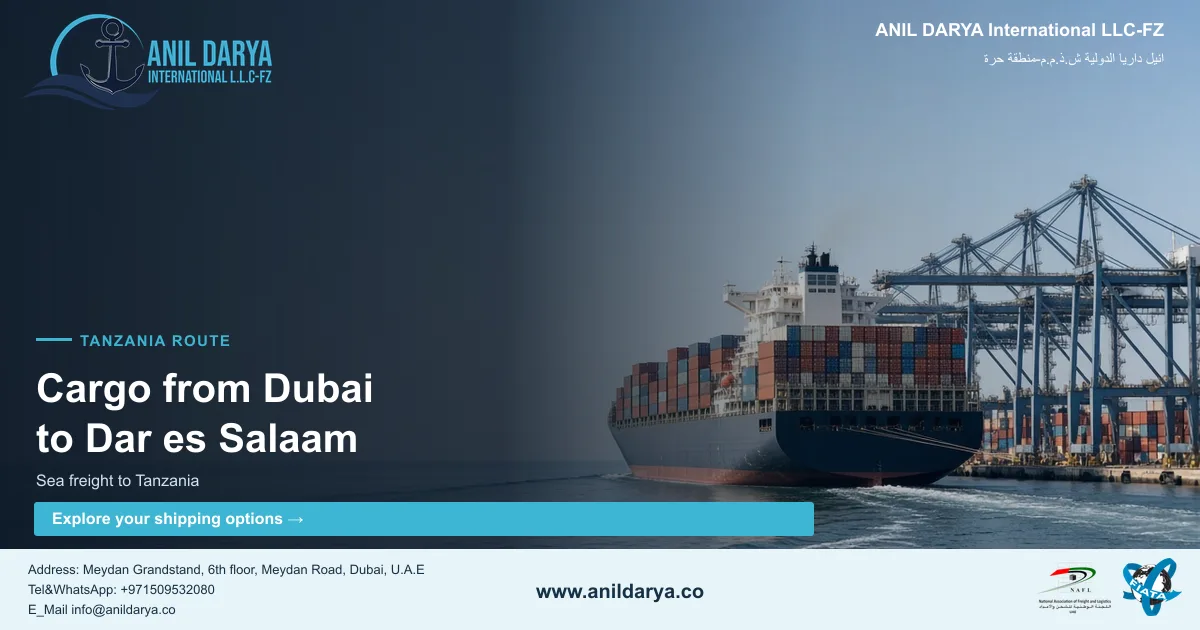
Shipping from Dubai to Tanzania usually means a container from Jebel Ali to the Port of Dar es Salaam, which handles about 95% of Tanzania's international trade. The cargo then clears through the Tanzania Revenue Authority (TRA) in its TANCIS system, and many products also need a Certificate of Conformity from the Tanzania Bureau of Standards (TBS) before they leave the UAE. This guide covers ports, modes, published transit times, documents, duties and the steps that keep your cargo moving.
Dubai to Tanzania shipping at a glance
| Item | Detail |
|---|---|
| Main UAE load ports | Jebel Ali (Dubai); Khorfakkan (Sharjah east coast) on at least one direct service |
| Main Tanzanian port | Dar es Salaam (UN/LOCODE TZDAR), run by the Tanzania Ports Authority (TPA) |
| Other Tanzanian sea ports | Tanga (north) and Mtwara (south, 578 km from Dar es Salaam) |
| Published carrier transit | Jebel Ali to Dar es Salaam 15 days (Emirates Shipping Line, weekly GIA service, July 2025). Khorfakkan to Dar es Salaam 9 days (GT Lines KTX, every 10 days, from August 2026) |
| Modes | FCL, LCL, reefer, flat rack and open top, breakbulk and project cargo, dry and liquid bulk, Ro-Ro vehicles, air cargo |
| Customs authority | Tanzania Revenue Authority, declarations in TANCIS through a licensed clearing and forwarding agent |
| Pre-shipment check | TBS Pre-shipment Verification of Conformity (PVoC) for regulated products |
| Import duty (EAC tariff) | 0%, 10%, 25% or 35% depending on the goods |
| VAT on imports | 18% (Mainland Tanzania) |
| Other import charges | Railway Development Levy 2% of CIF; Customs Processing Fee 0.6% of FOB |
| Free port storage (TPA) | Local import FCL: 5 days. Transit import FCL: 15 days |
| Landlocked markets served | Zambia, DR Congo, Burundi, Rwanda, Malawi, Uganda, Zimbabwe |
Which ports do you use when shipping from Dubai to Tanzania?
Load ports in the UAE: Jebel Ali or Khorfakkan
Most Dubai cargo for Tanzania loads at Jebel Ali. Emirates Shipping Line's Gulf India Africa Express (GIA) calls Jebel Ali at DP World Terminal 3 and then Mombasa and Dar es Salaam. Read our guide to Jebel Ali port shipping for terminals, gate slots and export rules.
Khorfakkan, on Sharjah's east coast, now has a direct shuttle to Dar es Salaam: GT Lines' Khorfakkan Tanzania Express (KTX). If your goods sit in Sharjah or the northern emirates, compare both ports. Our page on Sharjah port shipping covers the Sharjah side.
Tanzania side: Dar es Salaam, Tanga and Mtwara
Dar es Salaam is the main gateway. TPA gives it a rated capacity of 14.1 million tonnes of dry cargo and 6.0 million tonnes of bulk liquid, with about 2,600 m of quay. Two private operators now run most of the berths:
- DP World runs the multi-purpose Terminal 1 (berths 0 to 7) on a 30-year concession and started operations in April 2024.
- Adani Ports runs Container Terminal 2 (four berths, rated at 1 million TEU a year) through TICTS. It handled 0.82 million TEU in 2023, about 83% of Tanzania's container volume.
Tanga serves the north of the country and Mtwara the south. Both are managed by TPA, but most direct services from the UAE call Dar es Salaam, so cargo for Arusha or Mtwara often lands there and moves on by road.
Transit time and sailings on the Dubai to Dar es Salaam route
Transit depends on the service, not the distance. Two carrier-published schedules show the range:
| Service | Rotation | Frequency | Published transit to Dar es Salaam |
|---|---|---|---|
| Emirates Shipping Line GIA (advisory of 25 July 2025) | Nhava Sheva, Mundra, Jebel Ali, Mombasa, Dar es Salaam | Weekly, 5 ships of 2,800 TEU | 15 days from Jebel Ali |
| GT Lines KTX (announced 27 July 2026) | Khorfakkan, Dar es Salaam, Khorfakkan | Every 10 days, 2 ships of 700 to 1,100 TEU | 9 days from Khorfakkan |
A multi-port service like GIA stops in Mombasa first, which adds days. A shuttle goes direct but sails less often. Port-to-port days also exclude waiting for a berth, clearance and the inland leg. Carriers change rotations often, so we confirm the live schedule on every booking.
[AMIR-FACT: our real port-to-port and door-to-door transit time Jebel Ali to Dar es Salaam on recent bookings, and which carriers we actually book on this lane]
Shipping modes from Dubai to Tanzania
| Mode | Best for | What to plan |
|---|---|---|
| FCL (20ft, 40ft, 40ft high cube) | Building materials, machinery, FMCG, spare parts | Container type, weight limits, PVoC certificate before loading |
| LCL | Small volumes, mixed retail goods | Release depends on the consolidator's paperwork in Dar es Salaam |
| Reefer | Chilled and frozen food | Set temperature, food permits, cold storage handling surcharge at the port |
| Flat rack and open top | Over-height or over-width machinery | Lashing plan, out-of-gauge handling surcharge at the port |
| Breakbulk and project cargo | Steel, transformers, plant, heavy lifts | Vessel with gear or a port crane, road permits for the inland move |
| Dry and liquid bulk | Grain, fertiliser, clinker, fuels | Charter or parcel space, receiving facility, discharge rate |
| Ro-Ro and vehicles in containers | Cars, trucks, buses, machinery on wheels | Vehicle age rules, excise duty, PVoC for used vehicles |
| Air cargo | Urgent parts, samples, documents | Delivered to Julius Nyerere International (Dar es Salaam) or Kilimanjaro International |
FCL or LCL?
FCL gives you a sealed box, one consignee and the fastest release. LCL suits a few cubic metres, but your cargo waits for the whole shared container to be stripped and every co-loader's papers to clear. If you are close to the line, ask us to price both. Our FCL vs LCL cost guide shows how to find the break-even point.
Breakbulk, project and bulk cargo
Tanzania imports a lot of heavy cargo for construction, mining and energy. DP World lists berths 1 to 4 at Dar es Salaam for breakbulk and dry bulk vessels at 14.5 m draft, a general cargo yard for 150,000 tonnes, and a 30,000 tonne grain silo with bagging. Liquid bulk uses the Kurasini Oil Jetty and the single buoy mooring.
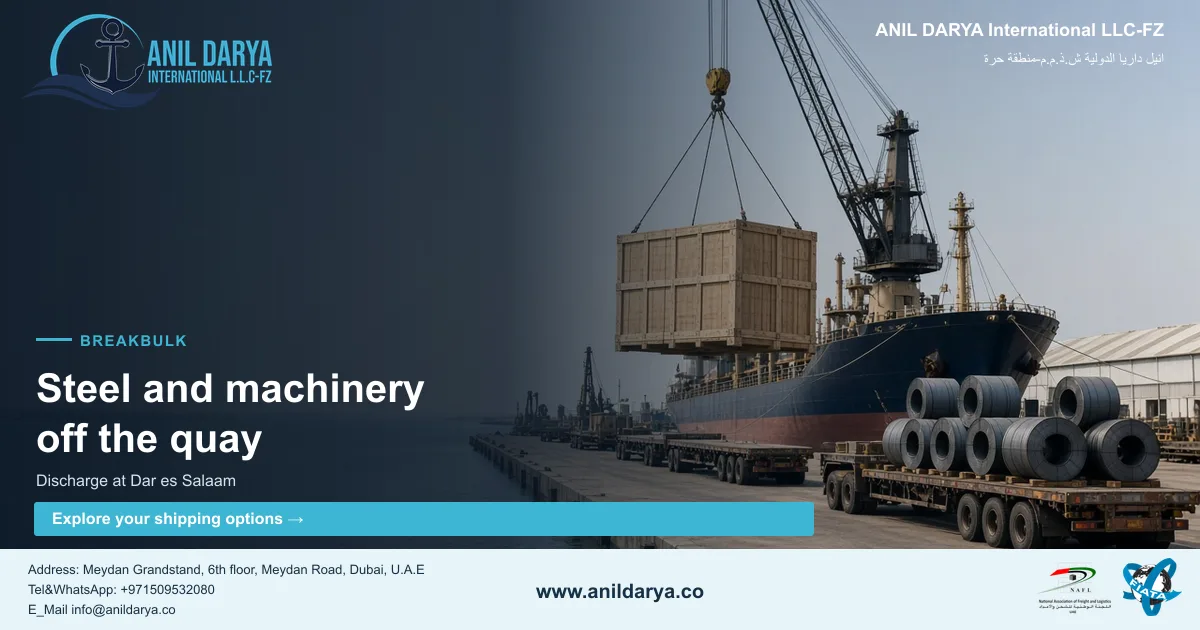
A simple rule: if the piece fits a 40ft flat rack by size and weight, a container service gives you more sailings. If not, you need breakbulk or heavy-lift tonnage. For grain, fertiliser or clinker, a bulk parcel or charter is usually the only sensible option, and our dry and liquid bulk cargo service books that tonnage. We cover this trade in more detail in our guide to bulk shipping from Dubai to Africa, and our break bulk and project cargo service handles lift plans, lashing and vessel choice.
TPA charges a 30% surcharge on handling out-of-gauge cargo. Budget for it when you compare a flat rack with a breakbulk booking.
Dangerous goods
TPA requires ship's agents to declare dangerous goods by class, not trade name, on every clearance document. After discharge, the port's Fire and Safety Unit guards DG cargo. Under the January 2026 tariff, a daily surcharge starts after 24 hours: USD 24 per TEU for containers and USD 1.20 per harbour tonne for conventional cargo. DG cargo also pays a 10% surcharge on handling. In practice, that means DG imports should be cleared for direct delivery the moment the ship berths.
Some chemicals also fall under TASAC rules (see below). Our dangerous goods shipping team checks carrier acceptance, the DG declaration and the SDS before you commit to a sailing.
Tanzania customs: TRA, TANCIS and the documents you need
Imports into Tanzania are cleared under the East African Community Customs Management Act 2004. TRA says the importer must appoint a licensed clearing and forwarding agent, who lodges the declaration online in TANCIS, the Tanzania Customs Integrated System, with the supporting documents. TRA urges agents to lodge at least 7 days before the vessel arrives. TANCIS automatically rejects incomplete declarations, or declarations with poor goods descriptions, through its query system.
Documents for a Tanzania import
| Document | Who provides it | Notes |
|---|---|---|
| Final commercial invoice | Seller in the UAE | Full goods description, HS code, value, Incoterm |
| Packing list | Seller | Weights and package counts must match the bill of lading |
| Bill of lading or air waybill | Carrier, via us | Consignee name must match the Tanzanian importer |
| Agent's authorisation letter | Importer | Lets the clearing agent file in TANCIS |
| TBS Certificate of Conformity | PVoC agent in the UAE | For PVoC-regulated goods, issued before shipment |
| Import permits | Importer, from TMDA, TBS, TASAC and others | Medicines, food, chemicals and other controlled goods |
| Exemption documents | Importer | Only if a duty exemption applies |
| Certificate of origin | Seller, from the issuing authority in the UAE | Also listed by Dubai Customs for the UAE export declaration |
On the UAE side, Dubai Customs lists the invoice, packing list, certificate of origin and any permit from a restricting authority for an export declaration. We file the export or transit declaration and check that the names, weights and HS codes match across every document.
TBS pre-shipment verification of conformity (PVoC)
PVoC is a check that certain imported products meet Tanzanian standards before they leave the exporting country. TBS runs it under section 4(1)(s) of the Standards Act No. 2 of 2009, through authorised third-party agencies. Consignments covered by PVoC need a Certificate of Conformity (CoC) before shipment. TBS says goods that arrive without one are rejected or fined.
Intertek, one of the TBS-appointed agents, describes three routes and the penalty:
| Route | Who it suits | Steps |
|---|---|---|
| Route A | Occasional exporters | Product testing, shipment inspection, CoC |
| Route B | Frequent exporters | Product registration, inspection, random testing, CoC |
| Route C | Frequent, high-volume manufacturers | Product licence, licence review, random testing, CoC |
Per Intertek, goods shipped without a CoC face a penalty of 15% of CIF value plus destination inspection, and non-compliant goods may be re-exported or destroyed at the exporter's cost. Check whether your HS code is regulated before you book, because the inspection has to happen before the container is sealed.
Import duty, VAT and other taxes in Tanzania
Tanzania applies the East African Community Common External Tariff to goods from outside the EAC, including the UAE. TRA's 2025/2026 summary sets these bands:
| Goods | Import duty |
|---|---|
| Raw materials, pharmaceuticals, capital goods, agricultural implements | 0% |
| Semi-finished goods | 10% |
| Final consumer goods or finished commercial goods | 25% |
| Fully finished goods or special items | 35% |
Some sensitive items pay more than these bands to protect local industry. On top of duty, expect:
- VAT at 18% on taxable imports into Mainland Tanzania.
- Railway Development Levy of 2% of CIF on goods entered for home consumption.
- Customs Processing Fee of 0.6% of FOB value.
- Excise duty on listed goods. Used passenger vehicles carrying fewer than 10 people pay 15% excise at 8 to 10 years old and 30% when over 10 years old.
Goods produced in EAC member states can enter at zero duty if they meet the rules of origin. Goods made in the UAE do not qualify for this.
Prohibited and restricted goods
TRA lists narcotic drugs, tear gas substances, seditious or obscene material and used tyres for light commercial vehicles and passenger cars as prohibited. Live animals, plants, firearms, ammunition and ivory are restricted and need a permit from the relevant authority.
Under the Tanzania Shipping Agencies (Clearing and Forwarding of Exclusive Items) Regulations, GN No. 184 of 2025, the state agency TASAC alone clears certain items into Mainland Tanzania: arms and ammunition, mineral concentrates, chemicals used by mining companies, government trophies and live animals under the Wildlife Conservation Act. If one bill of lading mixes these with other goods, TASAC clears the whole consignment and charges fees on all of it. Keep these items on a separate bill of lading.
Transit cargo to Zambia, Malawi, Rwanda, Uganda and the DRC
TPA lists Zambia, DR Congo, Burundi, Rwanda, Malawi, Uganda and Zimbabwe among the landlocked countries served through Dar es Salaam. The rules depend on the final country:
| Destination | Customs regime | Free storage at Dar es Salaam (FCL import) |
|---|---|---|
| Tanzania mainland | Import for home consumption in TANCIS | 5 days |
| Rwanda, Burundi, Uganda | EAC Single Customs Territory: one declaration, lodged in the destination country | 15 days (transit) |
| Zambia, Malawi, DR Congo, Zimbabwe | Transit declaration in Tanzania, then import clearance in the destination country | 15 days (transit) |
Under the Single Customs Territory, TRA says goods for Rwanda, Burundi and Uganda are no longer cleared as transit in Tanzania. They are declared once in the destination country, and the goods then move under the Electronic Cargo Tracking System or a regional bond guarantee. For the southern and western corridors, the UN Logistics Cluster describes road links via the A7 and B12 to Mbeya, Tunduma (Zambia) and Malawi, and rail on TAZARA towards Zambia and the TRC central line towards Kigoma and Mwanza.
For transit cargo, the bill of lading and invoice must show the final destination and consignee from the start. Changing a box from local to transit after arrival costs time and extra port charges.
[AMIR-FACT: whether we have shipped transit cargo via Dar es Salaam to Zambia, Malawi, Rwanda, Uganda or the DRC, and which corridor and destination clearing setup we used]
What affects the cost of shipping from Dubai to Tanzania?
We do not publish rates because they change with every sailing. These are the items that move your total landed cost:
- Ocean freight and surcharges for the container type and season.
- UAE origin charges: trucking to Jebel Ali or Khorfakkan, export declaration, terminal handling.
- PVoC inspection and testing fees paid to the TBS agent.
- Destination terminal handling and shipping line local charges in Dar es Salaam.
- TPA storage after the free period, plus surcharges for DG, out-of-gauge and cold storage cargo.
- Duty, VAT, Railway Development Levy and Customs Processing Fee.
- Clearing agent fees, inland trucking or rail, and transit bond costs.
- Container demurrage and detention from the shipping line.
The biggest avoidable costs are late PVoC certificates and port storage. Under TPA's tariff, import cargo with no documents accepted within 21 days of the vessel breaking bulk can be moved to a customs warehouse, and entered goods left in the port for more than 90 days can be sold.
How to ship from Dubai to Tanzania: step by step
This is how we handle a shipment from the UAE to Dar es Salaam. We book space, prepare documents and handle the UAE side. The consignee's licensed clearing agent clears the goods in Tanzania.
- Send us the cargo details. Commodity, HS code, weight, volume or dimensions, pickup address, final destination in Tanzania or beyond, and the Incoterm.
- Check PVoC and permits. Confirm whether the HS code is PVoC-regulated and which permits the importer needs from TMDA, TBS or other bodies.
- Choose the port and service. We compare Jebel Ali and Khorfakkan sailings, transit and cut-offs.
- Book the PVoC inspection. The TBS agent inspects, tests if needed and issues the CoC before the container is sealed.
- Collect and stuff. We arrange the empty container, trucking and stuffing, or lifting and lashing for breakbulk.
- File the UAE export declaration. We file with Dubai Customs and send the cargo to the terminal before the cut-off.
- Issue and share documents. We release the bill of lading and send the invoice, packing list, CoC and certificate of origin to the consignee's clearing agent.
- Pre-lodge in TANCIS. The clearing agent lodges the declaration at least 7 days before arrival.
- Pay taxes and collect. Duty, VAT and levies are paid, the line releases the delivery order and the cargo leaves the port within free time.
Our sea freight service covers FCL, LCL and special equipment. For urgent consignments we also arrange air cargo from Dubai.
[AMIR-FACT: one real shipment we handled from the UAE to Tanzania (cargo, mode, port, what went right or wrong), with client approval to mention it]
Checklist for cargo from Dubai to Tanzania
- HS code confirmed and PVoC status checked.
- CoC issued before loading, if the goods are regulated.
- Tanzanian importer has appointed a licensed clearing and forwarding agent.
- Invoice, packing list and bill of lading match on weights, counts and consignee.
- Import permits applied for before the vessel sails.
- TASAC exclusive items kept on a separate bill of lading.
- Final destination (local or transit) shown on the documents from the start.
- DG: UN number, class, SDS, DG declaration and carrier acceptance in hand.
- Breakbulk: drawings, weights, lifting points and an inland route plan.
- Cargo insurance in place before the goods leave the warehouse.
Common mistakes on this route
- Shipping regulated goods without a CoC. The penalty and destination inspection cost far more than the inspection at origin.
- Late TANCIS lodgement. Every day the declaration is late eats into the 5 free days for local cargo.
- Vague goods descriptions. TANCIS rejects them automatically, and the declaration has to be resubmitted.
- Mixing TASAC items with general cargo. TASAC then clears the whole consignment.
- Declaring transit cargo as local, or the reverse. The free period and the procedure both change.
- Treating DG like general cargo. The daily DG surcharge starts 24 hours after discharge.
- Old used cars. Higher excise applies from 8 years of age, and 30% above 10 years.
Frequently asked questions
How long does shipping from Dubai to Tanzania take?
Carrier schedules show 15 days from Jebel Ali to Dar es Salaam on Emirates Shipping Line's weekly GIA service, and 9 days from Khorfakkan on GT Lines' direct KTX service. Add time for berthing, customs clearance and inland delivery.
Which port in Tanzania do ships from Dubai use?
Almost all direct services from the UAE call Dar es Salaam, the port that handles about 95% of Tanzania's international trade. Tanga and Mtwara are smaller TPA ports in the north and south.
Do I need a TBS Certificate of Conformity to ship to Tanzania?
You need one if your products are covered by the TBS PVoC programme. The certificate must be issued by an authorised PVoC agent before shipment. Goods arriving without one can be rejected or fined.
What is the import duty in Tanzania?
Under the EAC Common External Tariff, duty is 0%, 10%, 25% or 35% depending on whether the goods are raw materials, semi-finished, finished or special items. VAT of 18%, a 2% Railway Development Levy and a 0.6% Customs Processing Fee also apply.
Who clears my goods at Dar es Salaam?
A licensed Tanzanian clearing and forwarding agent appointed by the importer. The agent lodges the declaration in TANCIS, ideally at least 7 days before the vessel arrives.
Can I ship cargo to Zambia or Malawi through Dar es Salaam?
Yes. TPA serves Zambia, Malawi, DR Congo and other landlocked neighbours. The cargo moves through Tanzania under transit procedures and gets 15 days of free port storage for FCL containers, then clears as an import in the destination country.
Can I ship breakbulk or bulk cargo from Dubai to Tanzania?
Yes. Dar es Salaam has berths for breakbulk and dry bulk at 14.5 m draft, a grain silo and liquid bulk facilities. Heavy pieces move on flat racks or breakbulk vessels, and bulk moves as a parcel or charter.
Can I ship a used car from Dubai to Tanzania?
Yes, by Ro-Ro or in a container. Used passenger vehicles pay higher excise at 8 to 10 years old (15%) and over 10 years old (30%), on top of duty and VAT.
Get a quote for shipping from Dubai to Tanzania
Send us your cargo details through our freight rate inquiry form and we will come back with port options, sailings and a price. If you have breakbulk, bulk or DG cargo, contact our team to talk it through first. You can read more about our Dubai freight forwarding team.
Sources
- Tanzania Ports Authority: Dar es Salaam Port (capacity, quay, drafts, trade share, landlocked countries)
- Tanzania Ports Authority: Tariff Book Sea Ports, January 2026 (free storage, DG and OOG surcharges, overstayed cargo)
- Tanzania Revenue Authority: Import procedures (TANCIS, documents, 7 days)
- Tanzania Revenue Authority: Taxes and duties at a glance 2025/2026 (duty bands, RDL, CPF, excise, prohibited goods)
- Tanzania Revenue Authority: Value Added Tax (18% on imports)
- Tanzania Revenue Authority: Single Customs Territory
- Tanzania Bureau of Standards: Pre-shipment Verification of Conformity
- Intertek: Exports to Tanzania PVoC (routes, penalty)
- Clyde & Co: TASAC exclusive items regulations, GN No. 184 of 2025
- Emirates Shipping Line: GIA service advisory, 25 July 2025
- GT Lines: KTX Khorfakkan Tanzania Express announcement, 27 July 2026
- DP World: Dar es Salaam terminal infrastructure
- DP World: Record efficiency at Dar es Salaam port (July 2026)
- Adani Ports press release: Container Terminal 2 concession (31 May 2024)
- Logistics Cluster: Tanzania port assessment (hinterland links, Mtwara)
- Dubai Customs: Submit customs declaration
Reviewed: 10 November 2026