
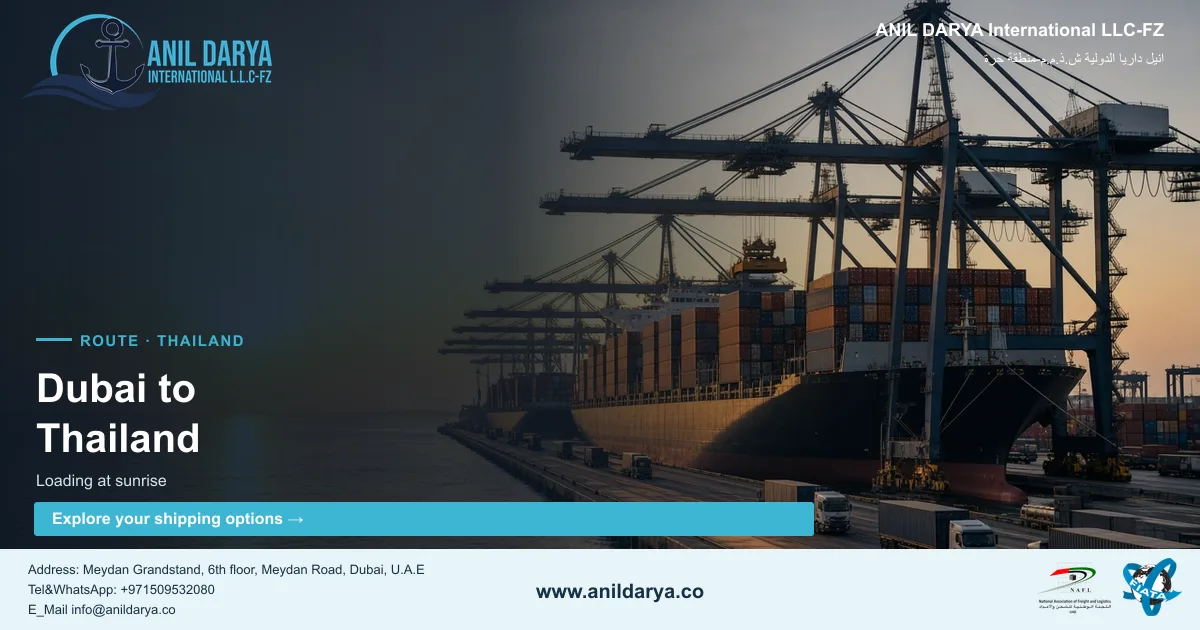
Shipping from Dubai to Thailand usually means sea freight from a UAE port to Laem Chabang, Thailand's main deep-water port, or to Bangkok Port for some services, with air cargo to Suvarnabhumi Airport for urgent goods. On arrival, the Thai Customs Department clears the cargo through an electronic goods declaration, collects import duty by HS code and 7% VAT, and releases the goods once both are paid. This guide covers each mode, the ports, the documents, the taxes and the order in which to do things.
Shipping from Dubai to Thailand at a glance
| Item | Detail |
|---|---|
| Main UAE load port | Jebel Ali (Dubai), with Khalifa Port, Sharjah and Khor Fakkan used by some services |
| Main Thai sea port | Laem Chabang Port, Chonburi province, about 130 km south of Bangkok |
| Port authority | Port Authority of Thailand (PAT), with private terminal operators on concession |
| Other Thai gateways | Bangkok Port (Khlong Toei), Lat Krabang inland container depot |
| Port codes | Laem Chabang THLCH, Bangkok THBKK |
| Main cargo airport | Suvarnabhumi Airport (BKK), Bangkok |
| Air distance Dubai to Bangkok | About 4,909 km, direct flights |
| Customs authority | Thai Customs Department, under the Customs Act B.E. 2560 (2017) |
| Import duty | Rate set by HS code in the Thai customs tariff, on a customs value that includes freight and insurance |
| Import VAT | 7%, collected by Customs at import, on CIF value plus duty plus any excise |
| UAE and Thailand trade deal | CEPA negotiations concluded in October 2026; not yet signed or in force |
| Modes | FCL, LCL, breakbulk and project cargo, dangerous goods, air cargo |
How cargo moves from Dubai to Thailand
Almost all commercial cargo on this lane goes by sea. You load a container or breakbulk cargo at a UAE port, the carrier discharges it in Thailand, and the consignee clears it with Thai Customs. Air cargo is the fast option for samples, spare parts and high-value goods. There is no road option on this lane.
The UAE side is short. We truck the cargo from your warehouse, free zone unit or supplier to the load port, file the UAE export or re-export declaration and hand the cargo to the carrier. Most services load at Jebel Ali. See our Jebel Ali Port shipping guide for terminals, gate rules and port cut-offs.
Ports and gateways in Thailand
| Gateway | What it is | When it fits |
|---|---|---|
| Laem Chabang Port | Thailand's largest port, deep-water, run by PAT with private terminals. Operating since 1991 | Most FCL from the UAE, large vessels, breakbulk and Ro-Ro, cargo for the Eastern Economic Corridor |
| Bangkok Port (Khlong Toei) | PAT's river port in Bangkok city | Cargo for central Bangkok, where a service calls there |
| Lat Krabang ICD | Inland container depot in eastern Bangkok, rail-linked to Laem Chabang | Containers cleared and delivered close to Bangkok, export consolidation |
| Suvarnabhumi Airport (BKK) | Bangkok's main international airport | Air cargo to anywhere in Thailand |
Distances help you plan the inland leg. The Lat Krabang ICD is about 110 km from Laem Chabang, 30 km from Bangkok Port and 10 km from Suvarnabhumi Airport. Laem Chabang sits about 130 km south of Bangkok and within 2 km of the main highway to the capital, and the State Railway of Thailand links the port to Lat Krabang. Thai Customs has offices at both Laem Chabang and Lat Krabang, so containers can be cleared at either point.
Container terminals at Laem Chabang
Laem Chabang has two working basins and a third under development by PAT. Your carrier's service decides the terminal, so check it on the arrival notice.
| Basin | Terminals | Depth alongside |
|---|---|---|
| Basin 1 (from 1991) | Container terminals A2, A3 and B1 to B5, plus A0 multipurpose and coastal, A1 passenger, A4 general cargo, A5 car terminal | 14 m |
| Basin 2 (from 1998) | Container terminals C1 to C3 and D1 to D3, plus C0 general cargo | 16 m |
| Phase 3 (planned) | U-shaped basin 800 m wide and 2,000 m long, planned capacity 8 million TEU | 18 m |
Sea freight from Dubai to Thailand: FCL or LCL?
Pick the mode by volume and by how the cargo is packed.
| Your cargo | Best fit | Why |
|---|---|---|
| Enough to fill most of a 20ft or 40ft | FCL | One seal from origin to consignee, fewer handling points, cleared at the port or the ICD |
| A few pallets or cartons | LCL | You pay for the space you use; the box is unpacked at a container freight station in Thailand |
| Chilled or frozen food | Reefer FCL | Terminals at Laem Chabang have reefer plug zones; food also needs Thai FDA clearance |
| Machinery or steel too big for a box | Flat rack or breakbulk | Depends on size, weight and the sailing available |
LCL release depends on the consolidator's paperwork as well as yours, because the shared box is unpacked first. Terminal CFS rules also limit what LCL can carry. At one Laem Chabang terminal, CFS cargo must be cased or palletised, movable by forklift and no heavier than 4.5 tonnes per piece, and dangerous goods are not accepted as CFS cargo. If your cargo does not fit those rules, book FCL. Our guide to FCL vs LCL costs shows where the break-even usually falls. For booking and space, see our sea freight service.
How long does sea freight from Dubai to Thailand take?
Transit depends on the carrier, the load port, the discharge port and whether the service is direct or transships. The schedule aggregator Fluent Cargo lists its quickest ocean option from the UAE to Laem Chabang, from Khor Fakkan, at about 21 days port to port. Forwarder pages on this lane quote much wider ranges, so treat any single figure as a guide only and check the vessel schedule on your booking.
[AMIR-FACT: our real port-to-port transit Jebel Ali to Laem Chabang for FCL and LCL, and the carriers or services we actually book on this lane]
Add time on both ends. On the UAE side, allow for trucking, stuffing and the carrier's cut-off. On the Thai side, allow for the consignee's declaration, any permit checks and delivery from Laem Chabang or the ICD.
Breakbulk, project and out-of-gauge cargo to Thailand
Laem Chabang has general cargo, multipurpose and Ro-Ro terminals alongside the container berths, so machinery, steel and vehicles can move as conventional cargo. Out-of-gauge pieces that fit a 40ft flat rack or open top can travel on container services, which usually means more sailings.
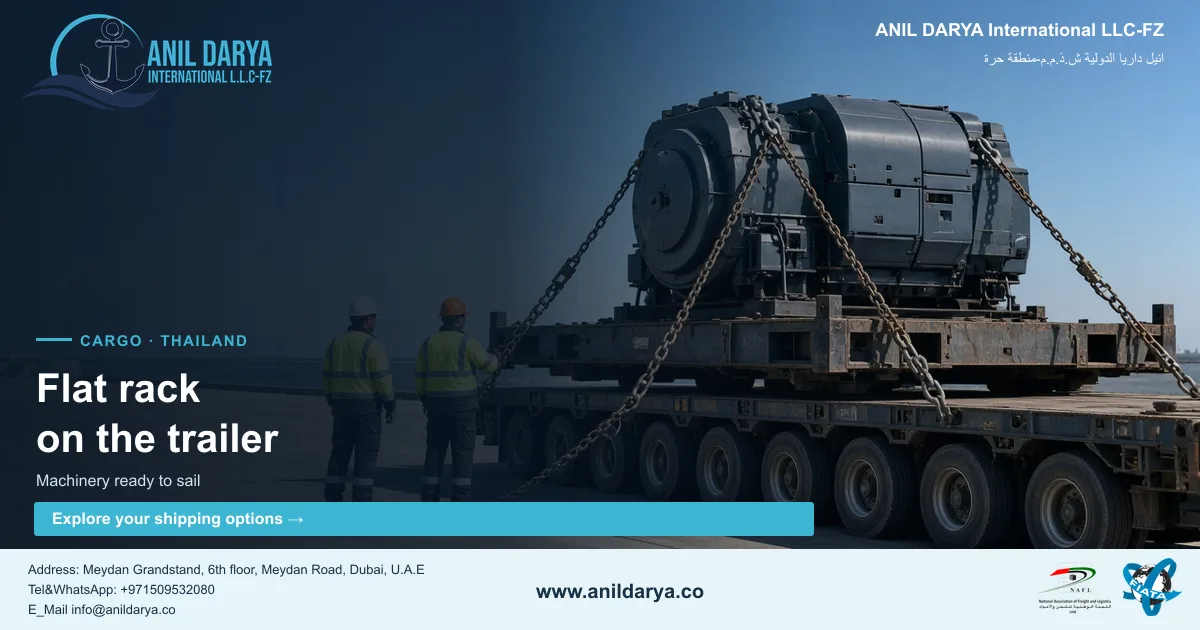
For project cargo we plan in this order:
- Collect drawings, dimensions, weights and lifting points for each piece.
- Choose flat rack, open top or conventional breakbulk tonnage.
- Agree lashing and securing with the carrier, and the discharge method with the consignee's agent in Thailand.
- Check whether the consignee needs a permit for used machinery or a road permit for the oversized move from the port.
- Line up the Thai declaration before arrival, so the cargo leaves the quay without storage days.
See our break bulk and project cargo service for what we handle on the UAE side.
Dangerous goods from Dubai to Thailand
Chemicals, lithium batteries, paints, aerosols and other DG can move on this lane by sea under the IMDG Code, or by air under IATA rules, if the carrier accepts the booking. Terminals at Laem Chabang handle DG as direct delivery: one terminal's published procedure says DG moves directly from ship to truck chassis on import and from chassis to ship on export, with no yard storage. That means the consignee must have the declaration, any permits and the truck ready when the vessel berths.
What you need for a DG booking:
- UN number, proper shipping name, class and packing group for each product.
- A Safety Data Sheet in English.
- A signed Dangerous Goods Declaration.
- UN-approved packaging, marks, labels and container placards.
- Carrier acceptance before you commit to a sailing.
- Any Thai licence or approval the consignee needs to import the substance.
Our dangerous goods shipping team checks the paperwork and gets carrier acceptance before cargo leaves your site.
Air cargo from Dubai to Thailand
Dubai and Bangkok are linked by direct passenger flights, about 4,909 km apart, and passenger aircraft carry cargo in the belly. Emirates SkyCargo also added a weekly freighter to Suvarnabhumi in October 2025, which gives main-deck space for larger pieces. Air suits urgent spares, samples, pharmaceuticals and high-value goods. Thai Customs procedure is the same as for sea cargo, with the air waybill in place of the bill of lading. Our air cargo service books space and handles DG by air.
Thai Customs: the import declaration and e-Customs
Thailand's Customs Act B.E. 2560 (2017) sets the rules. Customs procedures carried out as electronic data have the same legal standing as paper, and in practice import declarations are lodged electronically in the Thai Customs e-Customs system by the importer or a licensed customs broker.
The key points from the Act:
- A sea import is complete when the vessel enters the port of discharge.
- Before goods leave customs custody, the importer must lodge a goods declaration and pay the full duty or lodge a guarantee.
- The declaration must show at least the type of goods, quantity, weight and quality, customs value, and the country of departure and destination.
- You can ask the Director-General for an advance ruling on customs value, origin or tariff classification before you ship.
- You can appeal a duty assessment within 30 days of receiving it.
Documents for an import into Thailand
| Document | Who issues it | Notes |
|---|---|---|
| Commercial invoice | Seller | Value, Incoterm, HS code, currency; must match the declaration |
| Packing list | Seller | Weights, piece count, marks |
| Bill of lading or air waybill | Carrier or forwarder | Consignee name must match the Thai importer |
| Freight and insurance figures | Forwarder, insurer | Needed because customs value includes them |
| Certificate of origin | Chamber or authority at origin | Useful as proof of origin; no UAE-Thailand preference applies yet |
| Import licence or permit | Thai agency for the product | For restricted goods, presented during customs formalities |
| SDS and DG declaration | Shipper | Dangerous goods only |
| Delivery order | Carrier's agent in Thailand | Issued once local charges are paid |
What happens if cargo is not cleared?
The Act sets out what happens to goods left in customs custody. Imported goods become un-cleared goods if they stay more than 30 days without a declaration, duty payment or guarantee, and the transporter does not act within 15 days of a written notice from Customs. Goods that were declared but not paid for and not removed within 30 days of notice are treated the same way. Customs can then sell them at auction, destroy them or order them re-exported. Your consignee should be ready to file before the vessel arrives.
Import duty and VAT in Thailand
Thailand charges two main taxes on most imports: customs duty and VAT. Some goods, such as alcohol and tobacco, also carry excise, which the Excise Department controls.
| Tax | Rate | Base | Collected by |
|---|---|---|---|
| Customs duty | By HS code in the Thai customs tariff | Customs value, which includes insurance, freight and loading costs up to the customs house | Thai Customs |
| Excise tax | By product, where it applies | Set by excise law | Customs at import, for the Excise Department |
| VAT | 7% | CIF price + import duty + excise (if any) + other taxes and fees (if any) | Customs Department at import |
VAT is due on imports whether or not the importer is VAT-registered. The 7% rate is a reduced rate made up of 6.3% plus local tax. Thailand's cabinet approved extending it from 1 October 2026 to 30 September 2027, so check the rate again for arrivals after that date.
Because VAT is charged on top of duty, a higher duty rate also raises the VAT bill. Price both taxes together when you compare suppliers.
Thai Customs publishes a tariff database and the AHTN tariff text on its tariff service pages. Classify the goods before you price the deal, because the HS code drives duty, permits and the inspection risk.
Is there a free trade agreement between the UAE and Thailand?
Not yet. The UAE and Thailand concluded negotiations on an economic partnership agreement (CEPA) on 8 October 2026. Both governments still have to complete legal and technical steps before it is signed, and no entry-into-force date has been announced. Until it is in force, goods from the UAE pay Thailand's general duty rates. Non-oil trade between the two countries reached USD 12.3 billion in 2025, according to the UAE Ministry of Foreign Trade, so watch for the CEPA start date if you ship regularly.
Restricted and prohibited goods in Thailand
Thai Customs separates goods into prohibited goods, which cannot be imported at all, and restricted goods, which need a permit from another agency. The permit must be shown during customs formalities.
Examples of prohibited goods include narcotics, pornographic material, counterfeit trademark and IPR-infringing goods, fake notes or coins, and reserved or CITES-listed wildlife.
| Restricted goods | Permit from |
|---|---|
| Buddha images, artifacts, antiques | Fine Arts Department |
| Guns, ammunition, explosives | Department of Provincial Administration, Ministry of Interior |
| Plants and plant parts | Department of Agriculture |
| Live animals and carcasses | Department of Livestock Development |
| Food, medicine, cosmetics, food supplements | Food and Drug Administration (Thai FDA) |
| Vehicle parts | Ministry of Industry |
| Cigarettes, tobacco, alcoholic drinks | Excise Department |
| Radio and telecommunications equipment | NBTC |
A simple rule: if your product is on this list, the consignee applies for the permit before you ship. A permit applied for after arrival means storage days at the port.
Household goods and personal effects to Thailand
Many people moving from Dubai to Thailand send their belongings by sea. Thai Customs allows used household effects in reasonable quantities free of duty and tax for people changing residence to Thailand, if they owned and used the goods abroad. The main conditions:
- The goods must arrive no earlier than one month before and no later than six months after the owner arrives, unless Customs extends the limit.
- Only one unit of each electrical appliance, such as a TV, fridge or air conditioner, is duty-free. A family moving together gets two of each. Extra units pay normal duty and tax.
- Non-residents need proof of a long stay, such as a one-year non-immigrant visa, an Immigration Department letter or a work permit of at least one year.
- Thai nationals returning home need proof they lived abroad for at least one year.
Documents include a draft import declaration, passport, the bill of lading or air waybill, an invoice and packing list if any, any permit for restricted goods, and an application for duty exemption. The application goes to the duty exemption unit at the Bangkok Port Customs Office or the port of entry. Cars, guns and food are not covered by the personal effects allowance.
What affects the cost of cargo from Dubai to Thailand?
We do not publish fixed rates, because they change with the market. These are the factors that move the price:
| Cost factor | What drives it |
|---|---|
| Ocean or air freight | Carrier, season, container type, direct or transshipped service |
| UAE origin charges | Trucking distance, stuffing, export declaration, terminal handling |
| Thai destination charges | Terminal handling, delivery order, CFS fees for LCL, ICD transfer |
| Duty and VAT | HS code, customs value including freight and insurance |
| Special cargo | DG surcharges, reefer, out-of-gauge lashing and equipment |
| Delay costs | Demurrage and detention after free time, storage for un-cleared cargo |
Your Incoterm decides who pays each line. Under FOB the Thai buyer pays the freight; under CIF the UAE seller does, and under DAP or DDP the seller also pays some or all destination costs. See Incoterms 2020 for sea freight before you agree terms, and read how demurrage and detention work to keep delay costs down.
How to ship from Dubai to Thailand, step by step
- Send us the cargo details: commodity, HS code, weight, volume or dimensions, pickup address, Thai delivery address and Incoterm.
- Check Thai rules. The consignee confirms the HS code, the duty rate and whether a permit is needed from an agency such as Thai FDA or NBTC.
- Get a quote and choose the routing: FCL or LCL, Laem Chabang, Bangkok Port or the Lat Krabang ICD.
- Book space. For DG, reefer or out-of-gauge cargo we get carrier acceptance first.
- Prepare documents. We check that invoice, packing list and bill of lading show the same names, weights and HS codes.
- Collect and export. We truck the cargo, stuff the container if needed, file the UAE export or re-export declaration and gate in before the cut-off.
- Send documents to the consignee or its customs broker in Thailand, who lodges the declaration in e-Customs, ideally before the vessel berths.
- Pay and release. The consignee pays duty and VAT and the carrier's local charges, collects the delivery order and arranges delivery.
[AMIR-FACT: one real Dubai to Thailand shipment we handled: cargo type, mode, ports, what we did and total days from booking to delivery, cleared for publication]
We work with your consignee or its Thai customs broker on the destination side. We do not have our own office in Thailand.
Checklist before you ship to Thailand
- HS code agreed with the consignee and the Thai duty rate checked.
- Permit applied for if the goods are restricted.
- Invoice, packing list and bill of lading match on names, weights and piece counts.
- Freight and insurance amounts known, since they form part of the customs value.
- Consignee or its broker ready to file in e-Customs before arrival.
- Discharge point agreed: Laem Chabang, Bangkok Port or Lat Krabang ICD.
- For LCL: cargo palletised or cased, within the CFS weight limit.
- For DG: SDS, DG declaration, packaging, labels, carrier acceptance and a direct-delivery plan.
- For household goods: arrival window and exemption documents ready.
- Free time agreed with the carrier and cargo insurance arranged.
Common mistakes on the Dubai to Thailand lane
- Valuing goods without freight and insurance. Thai customs value includes them, so the duty is higher than a FOB-based estimate.
- Shipping restricted goods without a permit. Food, cosmetics, telecom devices and vehicle parts need an agency permit before clearance.
- Assuming the CEPA applies. It is not in force yet, so no preferential rate is available.
- Booking DG as LCL. Terminal CFS rules do not accept DG, and DG needs direct delivery from the ship.
- Sending household goods outside the time window. Effects that arrive too early or too late can lose the exemption.
- Leaving cargo unclaimed. After the deadlines in the Customs Act, goods can be auctioned, destroyed or sent back.
- Wrong consignee details. A bill of lading that does not match the Thai importer's registered name delays the declaration.
Frequently asked questions
How do I ship goods from Dubai to Thailand?
Most cargo goes by sea from Jebel Ali to Laem Chabang, as FCL or LCL, with air cargo to Suvarnabhumi for urgent goods. The Thai consignee or its customs broker files an electronic import declaration and pays duty and 7% VAT before release.
Which port in Thailand receives cargo from Dubai?
Laem Chabang, Thailand's largest port, in Chonburi about 130 km south of Bangkok. Some services also call at Bangkok Port, and containers can be moved by rail or truck to the Lat Krabang inland container depot for clearance near Bangkok.
How long does shipping from Dubai to Thailand take?
It depends on the carrier and whether the service is direct or transshipped. A schedule aggregator lists about 21 days port to port as its quickest UAE to Laem Chabang option, but you should check the vessel schedule on each booking.
What documents do I need to ship from Dubai to Thailand?
A commercial invoice, packing list, bill of lading or air waybill, freight and insurance figures, and any Thai permit for restricted goods. A certificate of origin is useful as proof of origin, and DG cargo also needs an SDS and a DG declaration.
How much is import VAT in Thailand?
Import VAT is 7%, collected by Thai Customs at import. It is charged on the CIF value plus import duty plus any excise and other fees, and the 7% rate has been extended to 30 September 2027.
Do goods from the UAE get lower duty in Thailand?
Not yet. The UAE and Thailand concluded CEPA negotiations in October 2026, but the agreement has not been signed or brought into force, so UAE goods pay Thailand's general tariff rates for now.
What goods cannot be imported into Thailand?
Prohibited goods include narcotics, pornography, counterfeit and IPR-infringing goods, fake currency and CITES-listed wildlife. Many other goods, such as food, medicine, cosmetics, telecom equipment and vehicle parts, need a permit from the relevant Thai agency.
Can I ship household goods from Dubai to Thailand duty-free?
Yes, if you are changing residence to Thailand and have owned and used the goods abroad. They must arrive between one month before and six months after you do, and only one unit of each electrical appliance is exempt, or two for a family.
Can I ship dangerous goods from Dubai to Thailand?
Yes, by sea under the IMDG Code or by air under IATA rules, once the carrier accepts the booking. Terminals at Laem Chabang deliver DG directly from the ship, so the consignee must be ready to clear and collect on arrival.
Get a quote for shipping from Dubai to Thailand
Send us your cargo details and we will come back with a routing and a price to Laem Chabang, Bangkok or the Lat Krabang ICD. Use our freight rate inquiry form, or contact our team to talk through a breakbulk, DG or household shipment first. You can also read more about our Dubai freight forwarding team.
Sources
- Thai Customs Department: Customs Act B.E. 2560 (2017), unofficial English translation (sections 11, 16-18, 37, 50-52, 107-108)
- Thai Customs Department: Restricted and prohibited items (updated 27 February 2025)
- Thai Customs Department: Household items import clearance
- Thai Customs Department: Customs tariff service (tariff database, AHTN text)
- Revenue Department of Thailand: Value added tax (rate, import tax base, collection by Customs)
- Nation Thailand: Cabinet approves one-year extension of 7% VAT until September 2027
- Khaleej Times: UAE, Thailand complete CEPA talks (8 October 2026)
- Hutchison Ports Thailand: Laem Chabang Port (location, basins, depth, Phase 3)
- Hutchison Ports Thailand: Connectivity (road, rail, airport distance)
- ESCO: Lat Krabang ICD (distances, rail, customs offices)
- ESCO: Terminal procedures at Laem Chabang (CFS limits, DG direct delivery)
- Dubai Media Office: Emirates SkyCargo adds Bangkok to its freighter network (October 2025)
- Fluent Cargo: UAE to Thailand (quickest ocean option, port codes)
- Fluent Cargo: Dubai to Bangkok (air distance, Bangkok port code)
Reviewed: 10 November 2026