
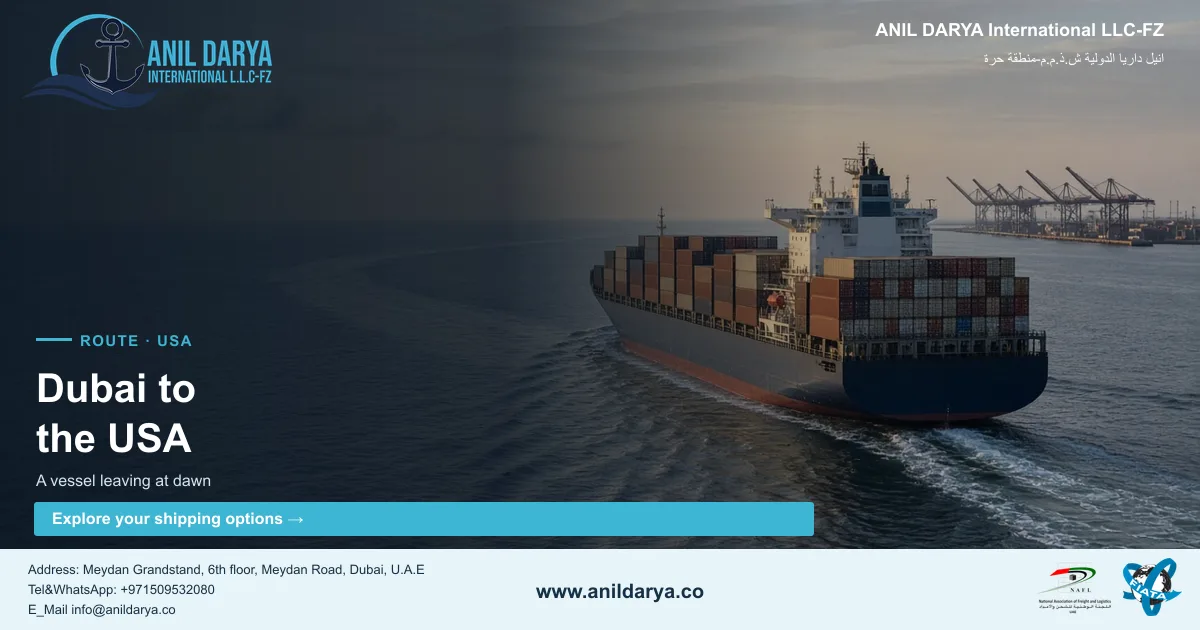
Shipping from Dubai to USA usually means a container from Jebel Ali to a US East Coast, Gulf Coast or West Coast port, or air cargo for urgent goods. The US side is strict on paperwork: for ocean cargo an Importer Security Filing (ISF 10+2) must reach US Customs and Border Protection (CBP) before the container is loaded in Dubai, and the US importer needs a customs bond and a correct HTS code to clear the goods.
Dubai to USA shipping at a glance
| Item | Detail |
|---|---|
| Main UAE sea gateway | Jebel Ali Port, Dubai |
| US customs authority | U.S. Customs and Border Protection (CBP) |
| Ocean security filing | ISF 10+2: most importer data due no later than 24 hours before loading at the foreign port |
| Entry deadline | Entry documents within 15 calendar days of arrival |
| Entry summary (CBP Form 7501) | Filed with estimated duties within 10 working days |
| Informal entry limit | Shipments up to $2,500 in value, with exceptions |
| Customs bond | Needed at entry; single transaction or continuous |
| Duty rate | Set by the 10-digit HTS code; check the current HTS for your product |
| Merchandise processing fee (MPF) | 0.3464% of value, minimum $34.58, maximum $670.86 from 1 October 2026 |
| Harbor maintenance fee (HMF) | 0.125% of value on cargo unloaded at designated ports |
| Low-value shipments | Duty-free de minimis suspended for all countries since 29 August 2025 |
| Modes we arrange | FCL, LCL, flat rack and breakbulk, dangerous goods, air cargo |
Which way should you ship from Dubai to the USA?
There is no road option on this lane, so you choose between sea and air. Use this table as a first filter.
| Your cargo | Best fit | Why |
|---|---|---|
| A full container of goods, raw materials or machinery | FCL to the US port nearest your consignee | Lowest cost per tonne, one ISF and one container to track |
| A few pallets or cartons | LCL | You pay for the space you use, but release depends on the consolidator |
| Machinery, steel structures, transformers | Flat rack, open top or breakbulk | Pieces too large or heavy for a standard box |
| Chemicals, batteries, paints, aerosols | DG container under the IMDG Code, or DG air cargo | Needs carrier acceptance and US hazmat rules at the terminal |
| Samples, spare parts, urgent stock | Air cargo | Days instead of weeks, and no ISF for air shipments |
Sea freight from Dubai to the USA: ports and transit
Most sea freight from Dubai to the USA loads at Jebel Ali Port in Dubai. Pick the US port by where your consignee is, not by the ocean rate alone.
Which US port should you choose?
| Consignee location | Ports to price | What to check |
|---|---|---|
| New York, New Jersey, Pennsylvania, New England | New York and New Jersey (Newark), Boston | Terminal free time and chassis availability |
| Southeast (Georgia, the Carolinas, Virginia) | Savannah, Charleston, Norfolk | Rail or truck leg to inland points |
| Texas, Oklahoma, Louisiana, central states | Houston | Bayport or Barbours Cut terminal on the arrival notice |
| California and the West | Los Angeles and Long Beach, Seattle | Longer ocean leg from the Gulf, compare against an East Coast port plus rail |
Houston is worth a close look for Texas and Gulf Coast consignees. Port Houston says it handles 97% of the Texas container market and 75% of US Gulf Coast container traffic. Its own trade-lane report estimates 227,960 import TEU from the India and Middle East region in 2025, 11.8% of its import containers.
Published transit indications
Transit on this lane depends on the US coast, whether the service calls direct or uses a transshipment hub, and the time your cargo waits for the next sailing. Published figures vary widely:
| Source | Mode | Indicated transit |
|---|---|---|
| Shipa Freight trade-lane guide | FCL, Jebel Ali to Newark | About 30 days |
| Shipa Freight trade-lane guide | LCL, Jebel Ali to Seattle | About 59 days |
| iContainers trade-lane guide | Ocean freight, UAE to US | 15 to 50 days |
| iContainers trade-lane guide | Air freight, UAE to US | 2 to 8 days |
Treat these as planning ranges. Add time for export clearance in Dubai and US entry at the other end.
[AMIR-FACT: our real port-to-port transit days from Jebel Ali to the US ports we use most (for example New York/New Jersey, Savannah, Houston), and the carriers or services we actually book on this lane]
FCL or LCL?
FCL gives you one container, one ISF and a direct release. LCL shares a container with other shippers, so your goods are unpacked at a US container freight station before release. On LCL each importer still needs its own ISF and entry, and a problem with another shipper's paperwork can delay the whole box.
Below about half a container, price LCL first; above that, price both. Our guide to FCL vs LCL costs shows the maths, and our sea freight service covers both.
[AMIR-FACT: whether we consolidate LCL to the USA ourselves or use a co-loader, which US gateways LCL goes to, and how often it departs from Dubai]
Breakbulk, project cargo and dangerous goods to the USA
Breakbulk and oversized pieces
Breakbulk to the USA still needs an ISF. CBP's ISF guidance says breakbulk shipments must file one, while true bulk cargo (free-flowing goods stowed loose in the hold) is exempt. If the carrier holds an exemption from the 24-hour manifest timing for breakbulk, the ISF for that cargo must be filed no later than 24 hours before arrival in the US.
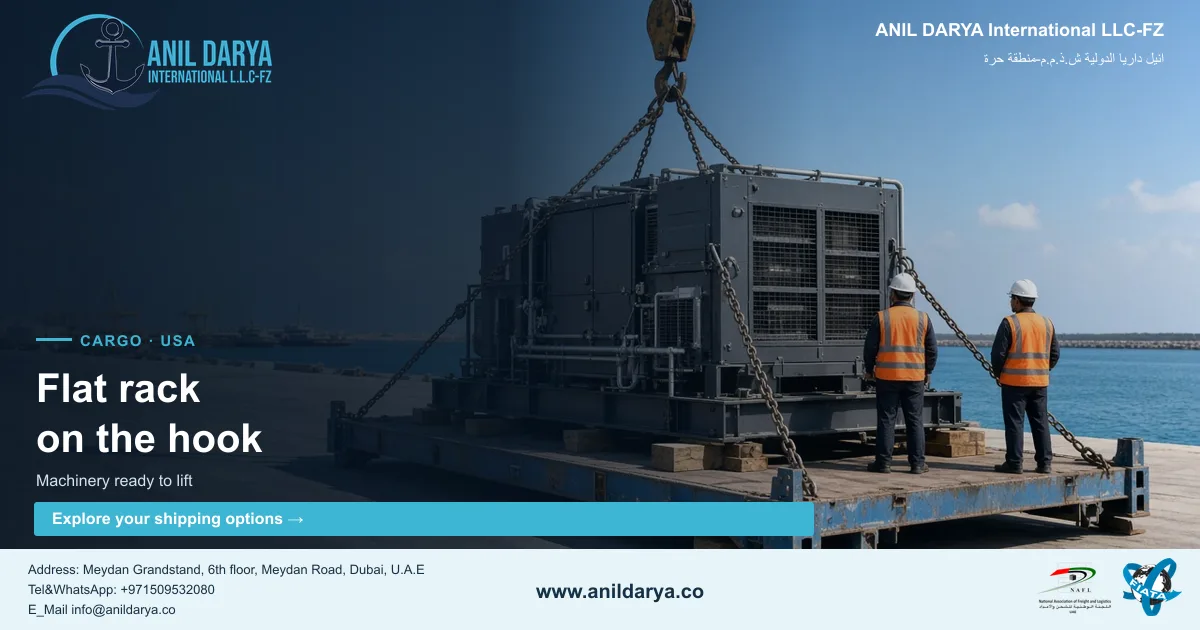
Pieces that fit a 40ft flat rack usually travel on a container service, which gives more sailings. Larger units need breakbulk or heavy-lift tonnage. Port Houston describes its multi-purpose terminals as the largest breakbulk, steel and project cargo complex in North America.
We plan lifting points, lashing and the sea leg from the UAE through our break bulk and project cargo team. Our article on flat rack, open top and out-of-gauge cargo helps you pick the equipment.
Dangerous goods
Sea DG moves under the IMDG Code. Once it lands, US terminal rules also apply. Port Houston's container terminal tariff, for example, requires hazardous cargo to meet both 49 CFR Parts 171 to 180 and the IMDG Code. Cargo arriving without the required documents is not received or offloaded. The same tariff says Class 1.1, 1.2 and 1.3 explosives and all fireworks are not handled at the Port of Houston at all.
What you need for any DG booking:
- UN number, proper shipping name, class and packing group for each product.
- A Safety Data Sheet (SDS) and a signed Dangerous Goods Declaration.
- UN-approved packaging, labels and container placards.
- Carrier acceptance and a check of the US terminal's rules.
Our dangerous goods shipping team checks classification, packing and carrier acceptance before booking.
Air cargo from Dubai to the USA
Air cargo suits samples, spare parts, electronics and anything where a week matters. The ISF rule does not apply: CBP says it covers only cargo arriving in the US by ocean vessel. The rest of US entry still applies, including the bond, the HTS code and any agency rules.
Food shipped by air needs FDA prior notice at least 4 hours before arrival, against 8 hours for food arriving by water. Our air cargo team books space from Dubai and prepares the air waybill.
US customs entry: how CBP clearance works
Importer of record and importer number
CBP asks for an importer number on the entry. That is the importer's IRS business registration number, or a social security number if there is no registered business. An importer can also ask for a CBP-assigned number on CBP Form 5106. A customs broker is not compulsory, since importers may make entry on their own, but the importer of record stays responsible for the entry and for all duties, taxes and fees either way.
What is ISF 10+2 and when is it due?
The Importer Security Filing is a set of 10 data elements from the importer plus 2 from the carrier (the vessel stow plan and container status messages). It applies to cargo arriving by vessel and has been in force since 26 January 2009.
| ISF element | Where it comes from | Deadline |
|---|---|---|
| Seller | Commercial invoice | 24 hours before loading at the foreign port |
| Buyer | Commercial invoice | 24 hours before loading |
| Importer of record number | US importer | 24 hours before loading |
| Consignee number(s) | US importer | 24 hours before loading |
| Manufacturer (or supplier) | Supplier records | 24 hours before loading |
| Ship to party | US importer | 24 hours before loading |
| Country of origin | Where the goods were made | 24 hours before loading |
| Commodity HTSUS number (at least 6 digits) | Classification | 24 hours before loading |
| Container stuffing location | Where the box was packed in the UAE | As early as possible, no later than 24 hours before arrival in a US port |
| Consolidator (stuffer) | Who packed the box | As early as possible, no later than 24 hours before arrival in a US port |
Manufacturer, country of origin and HTS number must be linked at line-item level. For goods made outside the UAE and re-exported through Dubai, the country of origin is where they were made, not Dubai.
Late or wrong filings are expensive. CBP's ISF FAQ lists liquidated damages of $5,000 per late ISF and $5,000 per inaccurate or incomplete ISF, up to $10,000 per ISF. The ISF must also be covered by a bond: a continuous import bond or a stand-alone ISF bond.
Customs bond: single transaction or continuous?
US rules say merchandise is not released from CBP custody at entry unless a bond is on file. The port director may waive this for goods worth $2,500 or less if duties are paid first, but not for every type of goods. CBP uses two main bond types:
| Bond | Covers | Suits |
|---|---|---|
| Single transaction bond | One entry | A one-off or occasional importer |
| Continuous bond | All entries for a year, renewing automatically | Regular importers; it also covers the ISF |
Make sure the bond is active before the ISF is filed.
Entry and entry summary timeline
- ISF filed before loading in Dubai.
- Vessel arrives. Entry documents must be filed within 15 calendar days of arrival.
- CBP reviews the entry and any agency data. Goods are released, held for exam, or held by another agency.
- The entry summary (CBP Form 7501) is filed and estimated duties deposited within 10 working days.
Ask the broker to file before arrival so the cargo can be released soon after it lands.
What documents do you need to ship from Dubai to the USA?
| Document | Who prepares it | Why it matters |
|---|---|---|
| Commercial invoice | Shipper | Value, seller, buyer, origin, HTS lines; basis of ISF and entry |
| Packing list | Shipper | Piece count, weights and marks must match the bill of lading |
| UAE export declaration | Us, through Dubai Customs | Invoice, packing list, certificate of origin and any permit |
| Bill of lading or air waybill | Carrier, from our instructions | Title and arrival data for CBP |
| ISF data sheet | Shipper and us, for the US filer | All 10 elements, including stuffing location and consolidator |
| Customs bond | US importer | Required at entry and for the ISF |
| Agency documents (FDA, USDA and others) | Shipper and importer | Prior notice, registrations, permits or certificates by product |
US import duty, fees and the HTS
How is the duty rate set?
The duty rate comes from the 10-digit code in the Harmonized Tariff Schedule of the United States (HTS), published by the US International Trade Commission. The importer of record is responsible for using the right code. If the classification is unclear, an importer can ask CBP for a binding ruling under Part 177 of the customs regulations before shipping.
US tariff measures change often, and extra duties may apply on top of the normal rate through Chapter 99 of the HTS. We do not quote duty rates on this page for that reason. Check the current HTS revision for your code, and the importer's broker should confirm the rate on the day the goods are entered.
Which fees apply on a US import?
| Charge | Basis | Notes |
|---|---|---|
| Customs duty | Rate for the HTS code, usually on value | Check the current HTS |
| Merchandise processing fee (MPF) | 0.3464% of value | Minimum $34.58, maximum $670.86 for fiscal year 2027, from 1 October 2026 |
| Harbor maintenance fee (HMF) | 0.125% of value | Ocean cargo unloaded at ports designated by the Army Corps of Engineers |
Is there still a duty-free limit for small shipments?
No. CBP suspended duty-free de minimis treatment for goods from all countries from 12:01 a.m. on 29 August 2025. Low-value commercial shipments now need a formal or informal entry and pay all duties, taxes and fees. Shipments worth up to $2,500 can still use informal entry, with some exceptions.
FDA, USDA and other agency rules
Some goods need a permit, licence or certificate from another US agency. CBP enforces these at the border.
FDA-regulated products
FDA's import programme covers human food and dietary supplements, food additives and food contact substances, drugs, vaccines and biologics, medical devices, radiation-emitting electronic products, cosmetics, animal food and veterinary products, and tobacco products. USDA covers some aspects of meat, poultry and egg products.
For food, FDA prior notice must be filed before arrival:
| Arrival by | Latest prior notice |
|---|---|
| Water | At least 8 hours before arrival at the port |
| Air | At least 4 hours before arrival |
| Earliest submission | 15 calendar days before arrival through FDA's PNSI system, or 30 days through ACE |
Wood packaging and origin marking
Pallets, crates and dunnage made of regulated wood must be treated and certified to ISPM 15, says USDA APHIS. A mark that is illegible or does not meet the standard makes the wood non-compliant, and the importer has to deal with it at the port.
Every article of foreign origin must be marked legibly with the English name of its country of origin, as permanently as the product allows, unless an exception applies. Unmarked goods face additional duties unless they are marked, exported or destroyed under CBP supervision.
Restricted items when shipping from Dubai to the USA
| Goods | Agency | What to plan |
|---|---|---|
| Food, beverages, supplements | FDA | Prior notice before arrival, plus FDA's product rules |
| Cosmetics, drugs, medical devices | FDA | Check FDA's product-specific import rules |
| Meat, poultry, egg products | USDA | Confirm eligibility before booking |
| Hazardous materials | DOT rules at the terminal, IMDG at sea | DG papers, carrier and terminal acceptance |
| Explosives Class 1.1 to 1.3 and fireworks via Houston | Port Houston tariff | Not handled at the Port of Houston; choose another route |
This is not a full list. The importer should check its product with its broker before the order is confirmed.
What does shipping from Dubai to the USA cost?
We do not publish freight rates because they change with every sailing. These are the parts of the bill and what moves them:
| Cost part | What drives it |
|---|---|
| UAE origin | Trucking to Jebel Ali, export declaration, terminal handling, any stuffing |
| Ocean or air freight | Container type or chargeable weight, season, carrier, direct or transshipment service |
| ISF and customs brokerage | Broker fees, bond premium |
| US duties and fees | HTS code, customs value, MPF and HMF |
| US terminal and storage | Free time at the terminal, demurrage after it |
| Inland delivery | Truck or rail from the port to the consignee |
Free time at US terminals is short. Port Houston's Bayport tariff effective 1 September 2026 gives loaded import containers 7 days free, or 10 if CBP or USDA examination is needed. Our article on demurrage and detention explains how the charges build up.
How to ship from Dubai to the USA: step by step
This is how we run a typical FCL export from Dubai to the USA, working with the US importer's broker.
- Confirm the US importer: importer number, bond and broker contact.
- Agree the HTS code with the importer and check agency rules.
- Choose the US port by consignee location, then compare services.
- Book space. For DG, reefer or out-of-gauge cargo we get carrier acceptance first.
- Send ISF data early, including stuffing location and consolidator, so the filer meets the 24-hour deadline.
- We arrange the empty, stuffing, the Dubai Customs export declaration and gate-in before cut-off.
- We check the draft bill of lading against the invoice and ISF.
- Pre-file the entry. The broker files entry and any FDA prior notice before arrival.
- After release, the container is collected inside free time and delivered.
[AMIR-FACT: one real Dubai to USA shipment we handled (cargo, US port, mode, door-to-door days, and any ISF or customs issue we solved)]
Checklist before you ship to the USA
- US importer of record confirmed, with importer number and broker.
- Customs bond active: continuous or single transaction, and covering the ISF.
- HTS code agreed for every line, with the current duty checked.
- Country of origin known for every item, especially re-exported goods.
- Wood packaging ISPM 15 treated and marked, or no wood used.
- FDA steps done for food, cosmetics, drugs or devices.
- ISF data sent to the US filer before the 24-hour deadline.
- Invoice, packing list and bill of lading show the same parties, weights and piece counts.
- Delivery planned inside terminal free time.
Common mistakes on the Dubai to USA lane
- Filing the ISF late. The deadline is before loading in Dubai, not before arrival in the US.
- Showing the UAE as origin for goods made elsewhere. Origin is where the goods were made.
- No bond in place. Without one the importer cannot file the ISF or release the goods.
- Guessing the HTS code. A wrong code means the wrong duty and a corrected entry later.
- Forgetting FDA prior notice. For food it must be filed before arrival, at least 8 hours ahead for sea cargo.
- Counting on de minimis for small commercial shipments. That route is suspended.
Frequently asked questions
How long does shipping from Dubai to the USA take?
Published indications range widely. iContainers gives 15 to 50 days for ocean freight from the UAE to the US and 2 to 8 days by air, and Shipa Freight shows about 30 days for FCL from Jebel Ali to Newark. Add time for export clearance, US entry and delivery.
What is ISF 10+2 and who files it?
ISF is a US security filing for ocean cargo: 10 data elements from the importer and 2 from the carrier. The US importer or its agent files it, and most elements are due no later than 24 hours before the cargo is loaded on the vessel in Dubai.
Is ISF required for air cargo from Dubai?
No. CBP says the ISF requirement applies only to cargo arriving in the US by ocean vessel. Air shipments still need a normal entry, a bond where required and any agency filings.
Do I need a customs bond to import from Dubai into the USA?
Yes, in most cases. US rules say goods are not released at entry without a bond on file, and the ISF must also be bonded. A single transaction bond covers one entry, and a continuous bond covers a year of entries.
How much import duty will I pay on goods from Dubai?
It depends on the HTS code and the goods' country of origin, and rates change often, so check the current Harmonized Tariff Schedule. MPF of 0.3464% (within set limits) and, for sea cargo, HMF of 0.125% also apply.
Can I ship food from Dubai to the USA?
Yes, if FDA rules are met. FDA prior notice must be filed at least 8 hours before arrival by sea or 4 hours before arrival by air, and other FDA requirements may apply to the product and its facility.
Get a quote for shipping from Dubai to the USA
Send us the cargo details, the US delivery address and the importer's broker contact, and we will come back with a routing and a price. Use our freight rate inquiry form, or contact our team to talk through ISF timing, a breakbulk move or a DG shipment. You can also read more about our Dubai freight forwarding team.
Sources
- CBP: Importer Security Filing 10+2 (last modified 28 July 2023)
- CBP: ISF frequently asked questions (November 2018): breakbulk, bonds, liquidated damages
- 19 CFR 149.2: ISF time of transmission
- 19 CFR 149.3: ISF data elements
- CBP: What is entry summary (last modified 6 January 2026)
- CBP: Tips for new importers and exporters (importer number, brokers, ISF, other agencies, rulings)
- 19 CFR 142.4: Bond required at time of entry
- 19 CFR 143.21: Informal entry limit
- Federal Register, CBP Dec. 26-14: Customs user fees for fiscal year 2027 (31 July 2026)
- 19 CFR 24.24: Harbor maintenance fee
- CBP CSMS 66065494: Suspension of duty-free de minimis treatment for all countries (28 August 2025)
- US International Trade Commission: Harmonized Tariff Schedule
- CBP: Marking of country of origin on US imports (last modified 15 May 2026)
- FDA: Importing FDA-regulated products (content current as of 26 October 2026)
- 21 CFR 1.279: FDA prior notice timing
- USDA APHIS: Wood packaging material (last modified 27 December 2025)
- Dubai Customs: Submit customs declaration
- Port Houston: Port statistics (Texas and Gulf Coast container share)
- Port Houston: Container volume by trade lane, 2025 (report generated 19 March 2026)
- Port Houston: Multi-purpose, breakbulk and project cargo
- Port Houston Tariff No. 15, Bayport Container Terminal (effective 1 September 2026)
- Shipa Freight: UAE to US trade lane (transit examples)
- iContainers: UAE to US trade lane (transit ranges)
Reviewed: 10 November 2026