
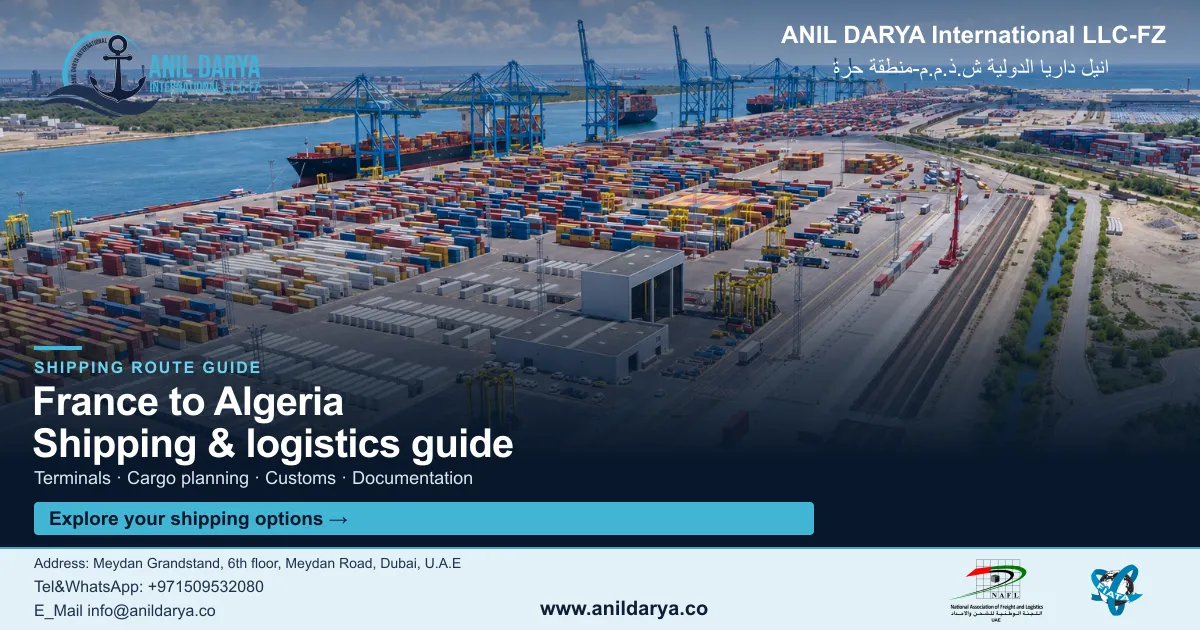
Shipping from France to Algeria is a short Mediterranean crossing: Marfret publishes a weekly direct sailing from Marseille to Algiers with 36 hours at sea, and other lines link French ports with Oran, Bejaia and Annaba. What decides whether your box clears fast is paper, not distance. French goods can enter Algeria at a reduced or zero duty under the EU-Algeria association agreement, but only with a valid EUR.1 or origin declaration and a direct transport route, and the Algerian buyer must domicile the purchase at its bank before you load. We book the ocean freight from Dubai, release the carrier's bill of lading to you and line up the French shipper, the Algerian buyer and its customs broker before the sailing.
Shipping from France to Algeria at a glance
| Item | Detail |
|---|---|
| Type of lane | Sea cross-trade, France to Algeria, booked and coordinated by Anil Darya from Dubai |
| Trade size | French goods exports to Algeria of EUR 4.8 billion in 2024, per France's Treasury (DG Tresor) |
| Main cargo | Industrial goods, transport equipment, machinery and electrical equipment, farm and food products |
| French load ports | Marseille and Fos (Marseille-Fos), Le Havre, Dunkirk; Marseille carries most Algeria sailings |
| Algerian discharge ports | Algiers, Oran, Bejaia, Annaba, Skikda, Djen Djen |
| Fastest published sailing | Marseille to Algiers, weekly on Fridays, 36 hours at sea (Marfret) |
| French export filing | Export declaration in DELTA IE since 4 November 2025, by the exporter or its customs representative |
| Trade agreement | EU-Algeria association agreement, in force since 1 September 2005 |
| Proof of origin | EUR.1 endorsed by French customs, or an invoice declaration by an approved exporter |
| Before loading | Algerian import programme and bank domiciliation by the buyer; transport document dated after the domiciliation |
| Algerian import tax | Duty by tariff code (cut or removed for EU-origin goods with proof), 19% VAT on most goods |
| Bill of lading | The shipping line's own B/L, released to you through us as agent for the line |
| Who clears in Algeria | The importer or its commissionnaire en douane, agreed before we confirm the booking |
How shipping from France to Algeria works as a cross-trade
The cargo is packed in France and cleared in Algeria; it touches the UAE only if you choose. Our Dubai desk holds the booking and checks the French papers against what the Algerian bank and customs will ask for.
| Party | What it does on a France to Algeria box |
|---|---|
| French exporter or its customs representative | Packs and stuffs the box, files the export declaration, gets the EUR.1 or writes the origin declaration, prints Arabic labels, delivers to the terminal |
| Anil Darya, Dubai | Books the space, compares sailings from Marseille, Fos and Le Havre, checks the domiciliation date against the loading date, releases the carrier's B/L |
| Shipping line | Carries the box and files the cargo manifest at the Algerian port |
| Algerian buyer | Holds a trade register entry for the goods, files its import programme, domiciles the purchase, pays duty and taxes |
| Buyer's commissionnaire en douane | Lodges the detailed declaration, claims the EU preference, attends inspections, takes delivery |
You receive the carrier's own bill of lading. We do not issue a house bill. Because Anil Darya acts as agent for many shipping lines, the line's B/L for, say, a 40ft box of dairy equipment from Marseille to Bejaia is issued and handed over through our Dubai office. In Algeria, the buyer's bank will read the date on that bill and compare it with the date it domiciled the import, so we hold the loading date until the buyer sends us its domiciliation date.
We do not clear cargo in Algeria. Duty and taxes at destination are paid by the consignee or its broker. Before we confirm a sailing, the buyer names its commissionnaire, tells us at which port that broker works, and confirms that its import programme and bank file cover these goods. Until we have all three answers, the booking stays provisional.
On FOB Marseille the buyer picks the line and controls the B/L date; on CFR or CIF the French seller books, so it needs the domiciliation date before gate-in. Our guide to Incoterms 2020 for sea freight shows where cost and risk pass.
French ports for Algerian cargo
For this lane the south coast wins. The Port of Marseille Fos says it serves Corsica, Sardinia, Algeria and Tunisia, and the direct Algeria sailings we found start there. Northern ports still matter for factories in the north and east of France.
| Port | What the port or operator publishes | Use it for |
|---|---|---|
| Marseille (eastern basins) | Departure port of Marfret's weekly Algeria Maghreb line; called by CMA CGM's TMX2 before Annaba | Fast direct sailings to Algiers and Annaba |
| Fos-sur-Mer (western basins) | Marseille-Fos handled 1.45 million TEU in 2025, with 16% of boxes moving by rail and 5% by river | Lyon, the Rhone valley and rail-fed cargo |
| Le Havre (HAROPA) | HAROPA PORT reported a record 3.2 million TEU in 2025 | Paris region and the north, usually with a Mediterranean connection |
| Dunkirk | The Flanders container terminal has 1,600 m of quay, two berths at 17.50 m and 700 reefer plugs | Northern factories and reefer cargo |
Marfret quotes about five days door to door from Paris or Antwerp to Algiers, so a box packed near Paris can go south to Marseille rather than sail from Le Havre.
Algerian discharge ports
Book the port closest to the buyer's warehouse and its broker.
| Port | Facts from the operator, port or carrier | Best for |
|---|---|---|
| Algiers | DP World Djazair runs two 300 m berths with depths up to 11 m on a 30-hectare terminal; Marfret's line links to the Algiers dry port | The capital and central Algeria |
| Oran | Regular LCL groupage from Marseille, per a French groupage operator | Western Algeria |
| Bejaia | Container terminal run by Bejaia Mediterranean Terminal, a joint venture set up in 2004 | Kabylie, food processing and building trade |
| Annaba | The port's line list shows CMA CGM's TMX2 calling Marseille and then Annaba | The east, Annaba and Constantine |
| Djen Djen (Jijel) | DP World lists 1,590 m of quay at 17 m and 36 reefer plugs | Larger ships, where your line calls |
Direct sailings and transit time
Direct ships are the norm here. The carrier and port pages we opened show these services.
| Service | Route as published | Source |
|---|---|---|
| Marfret, Algeria Maghreb line | Marseille to Algiers direct, weekly departures every Friday, 36 hours at sea, one 500 TEU ship | Marfret service page, opened 14 November 2026 |
| CMA CGM, TMX2 | Gemlik, Izmit, Istanbul (Ambarli east side), Aliaga, Salerno, Genoa, Marseille, Annaba | Annaba port regular lines page, opened 14 November 2026 |
| Groupage (LCL) from Marseille | Regular consolidations to Algiers and Oran; to Bejaia every 15 days on CMA CGM ships, about five days | Militzer & Munch Algeria page |
Marfret says boxes are discharged with the ship's own gear, so the broker can start at once. On the TMX2 loop, Marseille is the last call before Annaba, which keeps the sea leg short even though the loop starts in Turkey. Route aggregators list further France to Algeria services by MSC, CMA CGM and the Algerian line CNAN Med, but we did not open a carrier page that confirms their rotations, so we name the ship and voyage on each quote instead.
[AMIR-FACT: the carriers and services we actually book from Marseille, Fos and Le Havre to Algiers, Oran, Bejaia and Annaba in 2026, direct or transhipped, and the real port-to-port and door-to-door days we see, including berth waiting time in Algeria]
Sea freight from France to Algeria: FCL, LCL, reefer, project and DG
| Option | Typical French cargo | Check for Algeria |
|---|---|---|
| 20ft dry | Chemicals in drums, bagged ingredients, spare parts, steel fittings | Invoice value equal to the domiciled amount; EUR.1 lines match the invoice |
| 40ft dry or high cube | Machinery, electrical equipment, packaged food, cosmetics | Arabic labels and barcodes on retail packs; any ministry permit |
| 40ft reefer | Cheese and other dairy products, processed food | Veterinary or plant health certificate; reefer plugs at the Algerian terminal |
| Flat rack or open top | Production lines, industrial boilers, transport equipment parts | Line acceptance at the Algerian call; lashing survey in France |
| LCL groupage | Small industrial orders, ingredients, samples | Each consignee needs its own domiciliation and its own origin proof |
| Bulk | Agricultural commodities | Charter terms and the buyer's discharge port; plant health papers |
Our FCL vs LCL comparison helps decide when a full box is worth it, and our sea freight service handles the booking. Out-of-gauge pieces go to our breakbulk and project team, and full shiploads of commodities to our bulk cargo desk.
Dangerous goods
Paints, solvents, cleaning chemicals and aerosols travel under the IMDG Code 2024 edition, Amendment 42-24, mandatory from 1 January 2026. Turkey's Ministry of Trade 2026 report on the Algerian market adds that Algeria asks for an Energy Ministry authorisation for dangerous chemicals and pressure vessels. Our dangerous goods team secures the line's acceptance before anything else is fixed.
Used and refurbished machinery
Used goods are banned in general. The exception in the same report is used production machinery under 10 years old, with at least 10 years of service life left (12 for agriculture and pharmaceuticals) and a conformity assessment from the Algerian accreditation body ALGERAC or a body it recognises. Refurbished machines need the Ministry of Industry's permission.
What the French exporter files
French customs (DGDDI) runs export declarations in DELTA IE, used for exports since 4 November 2025. You can lodge the declaration when the goods are presented, or up to 30 days before, and never after they have left the EU. The exporter can file itself or use a customs representative, in direct or indirect representation. An EORI number starting FR plus the company's SIREN is free through the SOPRANO portal and active within 24 hours. We do not file in France; the exporter or its representative does.
Dual-use items need a licence from the SBDU, attached to the Directorate General for Enterprise, applied for in the Egide system.
Papers the Algerian side will ask for
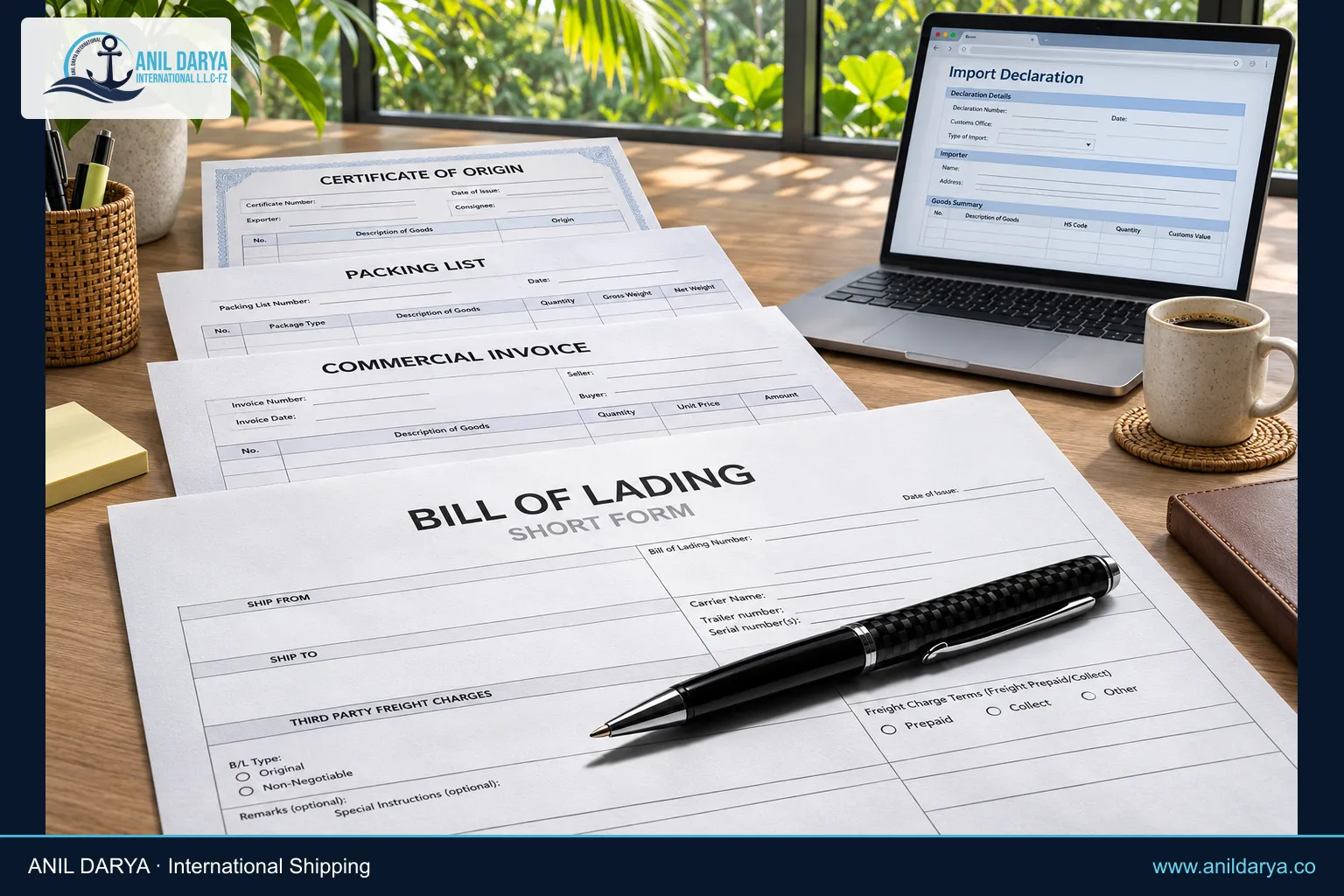
- A commercial invoice and packing list whose lines and values match the bank's domiciliation file.
- Proof of EU preferential origin: an EUR.1 or an origin declaration (see the next section).
- A free sale certificate. Turkey's 2026 market report states Algeria has required one for all imports since 1 January 2018. In France, the CCI Paris Ile-de-France lists free sale certificates for some pharmaceutical products; for other goods, ask the buyer's broker which issuing body Algerian customs accepts.
- A phytosanitary or veterinary certificate for plant and animal products.
Arabic labels and barcodes
According to the same Turkish report, retail packaging has had to show in Arabic the importer's name, the product features and the production and expiry dates since 1 January 2003. Since 29 March 2023, products for direct human consumption, food or not, also need a barcode with a GTIN registered for Algeria, with label details in Arabic and a second language. The Arabic text is not optional. Print the labels in France.
EU-Algeria association agreement: EUR.1 and origin declarations
This is where French goods differ from Chinese, Indian or Turkish goods on the Algerian market. The European Commission says the agreement, in force since September 2005, aimed at complete tariff dismantling by September 2020, a target met apart from a few tariffs Algeria still has to remove. Algeria's customs service (DGD) explains the schedule for EU-origin industrial goods: some were freed of duty from 1 September 2005, others were cut step by step. Farm, fish and processed farm goods get partial cuts, often inside tariff quotas.
Which proof of origin works?
The DGD lists two proofs under Protocol 6 of the agreement: an EUR.1 movement certificate issued by the customs of the exporting country, or an invoice declaration made by an approved exporter. In France, approved exporter (EA) status is requested once on form cerfa 13942 from a single customs office, per a douane.gouv.fr page updated 13 July 2026. The Commission's general PEM rules also allow any exporter to make an invoice declaration for consignments up to EUR 6,000. The DGD page names only the approved exporter, so ask the broker before relying on that threshold.
Which set of origin rules applies in 2026?
French customs explains that proofs issued under the revised Pan-Euro-Mediterranean (PEM) rules carry the words "REVISED RULES" in box 7 of the EUR.1 or at the end of an origin declaration. The Commission lists Algeria as a PEM contracting party, but none of the official pages we opened states which version of the rules applies to EU and Algeria trade today, and the DGD still describes Protocol 6. Do not choose the wording yourself. Ask French customs or the buyer's broker before the EUR.1 is filled in.
[AMIR-FACT: confirm with French customs or an Algerian broker, before we publish, which origin rules apply to EU to Algeria shipments in November 2026 (Protocol 6, the 2012 PEM Convention or the revised PEM rules), the wording required on the EUR.1, and whether Algeria accepts a non-approved exporter's invoice declaration up to EUR 6,000]
Direct transport, and why Dubai can cost you the preference
The DGD lists direct transport as a condition for the preference, next to the origin criteria, the proof and a ban on duty drawback. In Algeria the broker then declares the goods under code 1025 for direct release or 1026 when they leave a bonded warehouse. If French goods go to Jebel Ali, are stored, split or repacked there and then sent to Algeria, the direct transport rule may fail and the buyer may pay the full rate. Confirm with the broker before you plan any stop in Dubai.
What the Algerian buyer settles before you load
Registered importer and import programme
Customs wants a trade register entry whose activity covers the product and a tax number. Turkey's 2026 report adds that since July 2025 the Ministry of Foreign Trade has applied the forecast import programme (PPI) to all operators, that imports of goods and services need the ministry's authorisation, and that requests moved to a new portal in 2026. Ask the buyer for proof its programme covers your goods.
Bank domiciliation before shipment
Bank of Algeria note 01/DGC/2026 of 14 May 2026 requires every goods import to be domiciled at an approved bank before the foreign supplier ships. The bank checks that the transport document is dated after the domiciliation and refuses a file where the goods left first, except for justified cases that are expressly authorised. For you this means no gate-in at Marseille or Le Havre before the buyer sends that date.
The same Turkish report still mentions a deposit of 120% of the import value at least 30 days before loading. The Bank of Algeria note we read does not, so the buyer should confirm with its bank whether it applies to your goods.
Product permits
Goods that need an Algerian approval before import, per the same report, include:
- Cosmetics and hygiene products: Ministry of Health permission.
- Medical devices and medicines: health or pharmaceutical ministry approval.
- Food with sweeteners: prior permission from the Ministry of Foreign Trade.
- Telecom and radio equipment: ARPT approval and a label with the approval number.
Algerian customs clearance and the 21-day limit
The DGD says every import needs a detailed declaration, even with no duty to pay. The owner, a commissionnaire en douane or the carrier signs and lodges it at the competent office within 21 days of the registration of the document that authorised unloading. Past that window, the goods move to the deposit regime with penalties.
| Document | Why customs needs it |
|---|---|
| Trade register extract and tax number | Shows the importer may bring in this product |
| Commercial invoice, domiciled at an approved bank | Customs value and the link to the bank file |
| Carrier's bill of lading | Transport title; its date is checked against the domiciliation |
| EUR.1 or origin declaration | Needed to claim the EU preference under code 1025 or 1026 |
| Free sale certificate and any permit | Conformity and product approvals |
A registered declaration cannot be amended. The system routes it to the green channel for release after payment, the orange channel for a document check of code, value, origin and quantity, or the red channel, which adds a physical examination with the declarant present.
Duty, VAT and other charges on French goods
Algeria uses a 10-digit tariff code: the six HS digits plus four national ones. Turkey's 2026 market report summarises the general structure, which is the starting point before any EU preference is applied:
| Charge | General rule | With valid EU origin proof |
|---|---|---|
| Customs duty | 5%, 15% or 30% by product stage | Reduced or zero, per the agreement's schedules |
| Temporary additional safeguard duty (DAPS) | 30% to 120% on 992 tariff sub-lines | Ask the broker whether it applies to your code |
| VAT | 19% on most goods | Still due |
| Levy | 2% | Ask the broker |
| Withholding on goods for resale as imported | 2%, set at bank pre-domiciliation | Still due if it applies |
The DGD's own example taxes a good at 30% duty and then 19% VAT on value plus duty: DZD 5,470 of tax on a customs value of DZD 10,000. With zero duty under the agreement, the same good would still pay VAT. The broker should check the code in the DGD tariff database, or ask for a binding tariff ruling (RTC), before the price is agreed.
Banned and restricted goods in Algeria
The DGD publishes a list it calls non-exhaustive. Items French sellers ask about include:
- Used goods in general, used commercial spare parts, used or retreaded tyres and second-hand clothing.
- Used vehicles, apart from narrow exceptions.
- Counterfeit goods and goods with marks suggesting Algerian origin.
- Toy guns, fireworks, explosives, arms, drugs and ozone-depleting substances.
Turkey's report adds that imports under headings 87.01 to 87.05 (tractors, buses, cars, trucks and special vehicles) are suspended, with permits since 2023 for carmakers investing in Algerian production. That matters on a lane where transport equipment is a large export group: parts may move, finished vehicles usually cannot. Goods that need an authorisation are treated as prohibited if they arrive without it.
Typical cargo on this lane
France's Treasury puts bilateral goods trade at EUR 11.1 billion in 2024, with French exports to Algeria of EUR 4.8 billion, up 6.6% on the year. Turkey's 2026 Algeria country profile ranks France as Algeria's second-largest supplier in 2024, after China.
| French export group to Algeria, 2024 | Value |
|---|---|
| Industrial products | EUR 1.9 billion (39.8% of the total) |
| Transport equipment | EUR 1.1 billion (23.2%) |
| Mechanical, electrical and electronic equipment | EUR 1.1 billion |
| Agricultural products | EUR 322 million |
| Agri-food products | EUR 319 million |
One French groupage operator says food-industry goods such as processing equipment, flavourings, additives and packaging make up much of its LCL to Algeria.
Routing through Dubai: when it fits
Dubai is far off the line between Marseille and Algiers, and a two-day crossing does not need a hub. There are still a few cases where it helps:
- A Dubai trader buys from France and sells to Algeria while the box sails direct from Marseille.
- One Algerian buyer orders French and Asian goods together. The Asian part can be consolidated at Jebel Ali port, while the French part ships direct to keep its EU preference.
- Non-food stock without an EU preference claim is held in a free zone and released per Algerian order; our article on JAFZA re-export explains how.
Where cargo is landed, stored or re-exported in Dubai, we clear it through UAE customs for a fee with our Dubai freight forwarding team. The Algerian bank rule still applies to the onward leg, and so does the direct transport test for any EU preference.
[AMIR-FACT: whether we have routed any French cargo for Algerian buyers through Jebel Ali (trader invoicing, consolidation or Jafza stock), for which cargo, and what happened to the EU preference at Algerian customs]
What drives the cost of shipping from France to Algeria?
Rates change with each sailing, so we publish none. On FOB terms costs usually split like this.
| Cost part | What moves it | Usually paid by (FOB) |
|---|---|---|
| Pre-carriage in France | Truck or rail to Marseille, Fos or Le Havre; distance from the factory | Exporter |
| Export formalities | DELTA IE declaration, EUR.1, certificates, label printing | Exporter |
| Ocean freight | Equipment, load port, direct or transhipped, season, surcharges | Importer |
| Algerian port and line charges | Terminal handling, delivery order, reefer power, storage, container deposit, any congestion surcharge | Importer |
| Inspections | Orange or red channel, plant health or veterinary checks | Importer |
| Duty and taxes | Tariff code, EU preference, DAPS, VAT, levy | Consignee or its broker |
Free time and detention terms change often; check the date on the line's tariff and confirm before shipping. Our article on demurrage and detention explains how the clock runs.
Step by step: shipping from France to Algeria with Anil Darya
- Agree the product, tariff code and Incoterm with the buyer, then send us the cargo details, ready date and Algerian port.
- The buyer names its commissionnaire. We confirm the trade register and import programme cover the goods and that the broker works at that port. Only then do we confirm the booking.
- The buyer domiciles the purchase at its bank, obtains any permit and sends us the dates.
- The exporter settles the origin proof; we book a direct sailing and any reefer, out-of-gauge or DG acceptance.
- The exporter applies Arabic labels, files the DELTA IE declaration and gates in after the domiciliation date, before the cut-off.
- We check the draft B/L against the invoice, the EUR.1 and the domiciled amount, then release the carrier's B/L once freight is settled.
- The ship discharges. The broker lodges the declaration within 21 days, claims the preference, and the consignee or its broker pays duty and taxes.
[AMIR-FACT: one real France to Algeria cross-trade shipment we handled (cargo, French load port, Algerian port, carrier, how the EUR.1 and the domiciliation date were lined up, door-to-door days), cleared for publication]
Checklist before the box leaves France
- Buyer's trade register and import programme cover the goods.
- Purchase domiciled at an approved Algerian bank; the date sent to us.
- Origin proof chosen and its wording confirmed; EUR.1 data matches the invoice.
- Free sale certificate, health certificates and permits in hand.
- Arabic labels and registered barcodes on retail packs.
- No planned storage or repacking outside France and Algeria that breaks direct transport.
- Tariff code, preference and VAT checked by the commissionnaire.
- Broker named and clearance agreed before the booking is confirmed.
Mistakes that cost money on this lane
- Shipping before destination clearance is agreed. On a 36-hour crossing the box lands in Algiers long before a broker can be found, and the 21-day clock runs.
- Loading before the bank domiciliation, which gives the bank a B/L dated too early.
- Sending goods without an EUR.1 or valid origin declaration, so the buyer pays the general rate.
- Routing French goods through a hub where they are stored or split, and losing the preference under the direct transport rule.
- Shipping used machinery without checking age, service life and conformity.
Frequently asked questions
How long does shipping from France to Algeria take?
Marfret publishes 36 hours at sea from Marseille to Algiers on its weekly Friday sailing. Door to door, add trucking in France, any berth wait in Algeria and clearance, which together usually take longer than the voyage.
Which French port is best for Algeria?
Usually Marseille-Fos, which serves Algeria directly. Northern factories can use Le Havre or Dunkirk, but trucking or railing south to Marseille is often quicker.
Do French goods pay duty in Algeria?
Often less than other origins. The EU-Algeria association agreement removed or cut duty on most EU-origin goods, but only with an EUR.1 or a valid origin declaration and direct transport. VAT at 19% is still due on most goods.
Who issues the EUR.1 certificate in France?
French customs endorses the EUR.1 for the exporter. An approved exporter can instead write an origin declaration on the invoice, after applying once on form cerfa 13942.
When must the Algerian buyer domicile the import?
Before the French seller ships. Bank of Algeria note 01/DGC/2026 says the transport document must be dated after the domiciliation, so we wait for that date before the box is gated in.
Can I send French goods to Algeria through Dubai?
Storing or splitting them in Dubai may break the direct transport rule and cost the EU preference. A Dubai trader can still invoice the sale while the box sails direct.
Does Anil Darya clear the cargo in Algeria?
No. The buyer or its commissionnaire clears it, and duty and taxes at destination are paid by the consignee or its broker. We agree the plan with that broker before a French sailing is confirmed.
Get a quote for sea freight from France to Algeria
Send us the factory location, cargo and HS code, ready date, Algerian port, the broker's name and where the domiciliation stands, and we will reply with sailing options and a price. Use our freight rate inquiry form, or contact our team to plan a machinery or food programme first.
Sources
- Marfret: Algeria Maghreb line
- Annaba port: Regular lines
- Militzer & Munch: Algeria groupage from France
- Port of Marseille Fos: Key figures 2025
- HAROPA PORT: Record traffic 2025
- Port of Dunkirk: Sea access and terminals
- French customs: Lodging a customs declaration (DELTA)
- French customs: EORI number
- French customs: Approved exporter status (updated 13 July 2026)
- French customs: FAQ on the revised PEM Convention
- Directorate General for Enterprise: Exporting dual-use goods
- CCI Paris Ile-de-France: International formalities
- DG Tresor: France and Algeria bilateral economic relations
- European Commission: EU-Algeria Association Agreement
- European Commission: Pan-Euro-Mediterranean Convention
- European Commission: PEM cumulation and the PEM Convention
- Algerian Customs: EU-Algeria association agreement
- Algerian Customs: Preferential agreements
- Algerian Customs: Detailed declaration and documents
- Algerian Customs: Control channels
- Algerian Customs: Estimating duties and taxes
- Algerian Customs: Banned and suspended goods
- Bank of Algeria: Note 01/DGC/2026 (14 May 2026)
- Turkish Ministry of Trade: Algeria market information 2026
- Turkish Ministry of Trade: Algeria country profile 2026 (copy hosted by the Ankara Chamber of Industry)
- DP World Djazair: Algiers terminal
- DP World Djen Djen: Terminal data
- Bejaia Mediterranean Terminal: Partnership
- IMO: IMDG Code 2024 edition
Reviewed: 14 November 2026