
Shipping from Germany to Egypt is a two-week sea run from the North Sea to the Nile Delta: ONE's Levant Express publishes 15 days from Bremerhaven to Alexandria and 16 days to Damietta. Three things decide how smoothly it goes. The Egyptian buyer must hold an ACID from Nafeza before the box is loaded in Germany, the German exporter files the export declaration in ATLAS, and the goods need an EUR.1 or origin declaration marked "REVISED RULES" to get the EU-Egypt Association Agreement rate. We book the ocean freight from Dubai, release the carrier's bill of lading to you, and agree the plan with the German shipper and the Egyptian buyer's broker before we confirm the booking.
Germany to Egypt shipping at a glance
| Item | Detail |
|---|---|
| Type of lane | Cross-trade by sea, Germany to Egypt, booked and coordinated by Anil Darya from Dubai |
| German load ports | Bremerhaven, Hamburg, Wilhelmshaven (JadeWeserPort); Rotterdam and Antwerp for factories in the west |
| Egyptian discharge ports | Alexandria (with Dekheila), Damietta and Port Said East on the Mediterranean; Sokhna on the Gulf of Suez |
| Published sea days | ONE Levant Express (LEX): Bremerhaven to Alexandria 15, Bremerhaven to Damietta 16 |
| German export filing | Electronic export declaration in ATLAS-Ausfuhr by the exporter or its agent; EORI number required |
| Egypt pre-shipment rule | ACI: the importer requests the ACID on Nafeza; the German exporter files its documents on CargoX under that number |
| Trade agreement | EU-Egypt Association Agreement, in force since 2004; free trade area for industrial goods |
| Proof of origin | EUR.1, or an origin declaration on the invoice, marked "REVISED RULES" |
| Egypt import VAT | 14% standard; 5% on machinery for production lines |
| Bill of lading | The shipping line's own B/L, released to you through us as agent for the line |
| Destination clearance | The consignee's licensed customs broker in Egypt, agreed before we confirm the booking |
How shipping from Germany to Egypt works as a cross-trade
The box leaves a German or Benelux quay and is cleared in Egypt, without entering the UAE unless you ask for a Dubai routing.
| Party | Its job on a Germany to Egypt shipment |
|---|---|
| German exporter or its forwarder at origin | Packs and stuffs the box, files the ATLAS export declaration, gets the EUR.1 endorsed or writes the origin declaration, uploads the ACI documents on CargoX |
| Anil Darya, Dubai | Books the space, checks the ACID before the box gates in, follows the vessel, releases the carrier's B/L |
| Shipping line | Accepts the box only with a valid ACID, carries it, lodges the manifest with Egyptian Customs |
| Egyptian importer | Requests the ACID, approves the exporter's data on Nafeza, pays duty and VAT |
| Importer's broker in Egypt | Files the declaration with the EUR.1, attends inspection and takes the release |
The B/L on this lane belongs to the carrier. Because Anil Darya acts as agent for many shipping lines, the line's bill for, say, a 40ft box of packaging machinery from Bremerhaven to Alexandria is released to you from our Dubai office. Before release we compare the draft with the German invoice: consignee name, Egyptian tax number, ACID, weights and package count must all agree.
We do not sell customs clearance in Egypt. Duty and taxes at destination are paid by the consignee or its broker. So before a Bremerhaven or Hamburg booking goes firm, the Egyptian buyer names its broker, tells us whether that broker works at Alexandria, Damietta or Port Said, and confirms that the ACID request is lodged. If any of the three is missing, the booking waits.
The Incoterm fixes who pays which leg. Under FCA or FOB Bremerhaven, the German seller handles export clearance and the Egyptian buyer pays the ocean freight. Under CFR or CIF Alexandria, the seller books the ship, while Egyptian terminal charges, duty and VAT stay with the buyer. Our Incoterms 2020 guide for sea freight shows where risk and cost pass on each term.
Which German port to load at for Egypt
Pick the port with the Egypt sailing, not the nearest one. Both direct loops we found call Bremerhaven, so a box from Hamburg or Bavaria often goes there by truck or rail.
| Port | Facts from the port operator | Role on the Egypt lane |
|---|---|---|
| Bremerhaven | 14 large-ship berths on a 4,930 m quay, 14 to 16.5 m of water, 5.21 million TEU in 2025 | Calls on ONE LEX (Eurogate terminal, Friday to Saturday) and Maersk's SLA loop; the most direct German option |
| Hamburg | Germany's largest port: 8.3 million TEU and 114.6 million tonnes in 2025 | Biggest choice of sailings overall; for Egypt, ask whether the loop calls Egypt directly or connects at a hub |
| Wilhelmshaven (JadeWeserPort) | 18 m of water at any tide, 1,725 m quay, about 1.47 million TEU in 2025 | Used when a carrier's loop or feeder calls there; check the Egypt connection per booking |
| Rotterdam and Antwerp | Also on the LEX rotation | Suit plants in North Rhine-Westphalia or the south-west; Antwerp is the last LEX call before Egypt |
Loading in Rotterdam or Antwerp does not move the export filing out of Germany. The declaration is still lodged at the German export customs office where the goods are packed, and the Dutch or Belgian port acts as the customs office of exit.
Which Egyptian port to arrive at
Choose by the buyer's warehouse and by where its broker has staff on the ground.
| Egyptian port | Terminal or fact we found | Usually suits |
|---|---|---|
| Alexandria and Dekheila | LEX calls AICT at the old port; the port authority lists 55 berths at Alexandria and up to 18 m draft at Dekheila | Alexandria, the western Delta, 6th of October City and many Cairo importers |
| Damietta | LEX calls the Damietta Container Terminal; a second terminal, DACT, opened on 14 February 2026 | Damietta furniture makers, Mansoura and the eastern Delta |
| Port Said East | Maersk's SLA loop calls there; the SCCT terminal has 7 million TEU capacity | The canal cities, the eastern Delta and 10th of Ramadan |
| Sokhna | DP World terminal on the Gulf of Suez | Suez and east Cairo; not on the North Europe loops we found |
The ACID, manifest and broker are tied to one port, so fix it on the purchase order.
Direct loops and transhipment
Two carrier loops on the pages we opened run straight from North Europe into Egyptian ports, with no change of ship:
- ONE's Levant Express (LEX), in the 2026 Intra Europe brochure: Tilbury, Rotterdam, Bremerhaven, Antwerp, then Alexandria and Damietta, then back to Tilbury, on fixed weekdays.
- Maersk's Baltic Sea - SLA service, announced on 2 June 2026 as a weekly loop: Gdansk, Bremerhaven, Genoa (Vado Ligure), Port Said East, Alexandria, Tangier, then Gdansk.
Other lines link Hamburg or Wilhelmshaven to Egypt through a Mediterranean hub, which adds sailings but also a connection that can be missed. Either way the B/L runs from the German load port to the Egyptian port, and each quote names the vessel and any change of ship.
How long does sea freight from Germany to Egypt take?
ONE publishes these southbound days for LEX. We checked them against the port rotation: the ship leaves Bremerhaven on Saturday and reaches Alexandria on a Sunday 15 days later, Damietta the next day.
| Load port (LEX) | Days to Alexandria | Days to Damietta |
|---|---|---|
| Tilbury | 20 | 21 |
| Rotterdam | 17 | 18 |
| Bremerhaven | 15 | 16 |
| Antwerp | 13 | 14 |
Maersk's SLA notice gives the rotation but no port-to-port days, so we print none for it. Aggregator sites quote 11 to 13 days for Germany to Egypt; those are vessel-tracking estimates, not carrier schedules. Plan on the carrier figure, then add a few days for stuffing and the ATLAS filing in Germany and for clearance in Egypt.
[AMIR-FACT: the carriers we actually book from Bremerhaven, Hamburg and Wilhelmshaven to Alexandria, Damietta and Port Said in 2026, direct or via which hub, with the real port-to-port days and sailing frequency we see]
Sea freight from Germany to Egypt: FCL, LCL and special cargo
| Option | Typical German cargo for Egypt | Point to check |
|---|---|---|
| FCL 20ft | Chemicals in drums, machine parts, steel components, paper rolls | Heavy cargo hits the weight limit before the box is full |
| FCL 40ft / high cube | Packaging and printing machinery, appliances, auto parts, medicines on pallets | Weights and piece counts must match across invoice, packing list and Nafeza |
| LCL | Spare parts, lab equipment, small reorders | Every consignee in a shared box needs its own ACID and its own EUR.1 |
| Reefer | Temperature-controlled medicines, some food ingredients | Set point in the booking; product approval in Egypt before loading |
| Flat rack / open top | Presses, generators, transformers, construction machines | Drawings, weights and lifting points per piece |
| Breakbulk | Plant modules, heavy turbines, large tanks | An ACID is still needed; plan the Egyptian berth early |
An Egyptian distributor buying from three German suppliers can have them delivered to one origin warehouse and shipped as a single FCL. That means one booking and one ACID instead of three. Our FCL vs LCL comparison shows where the break-even usually sits, and our sea freight service books the box.
Machinery and project cargo
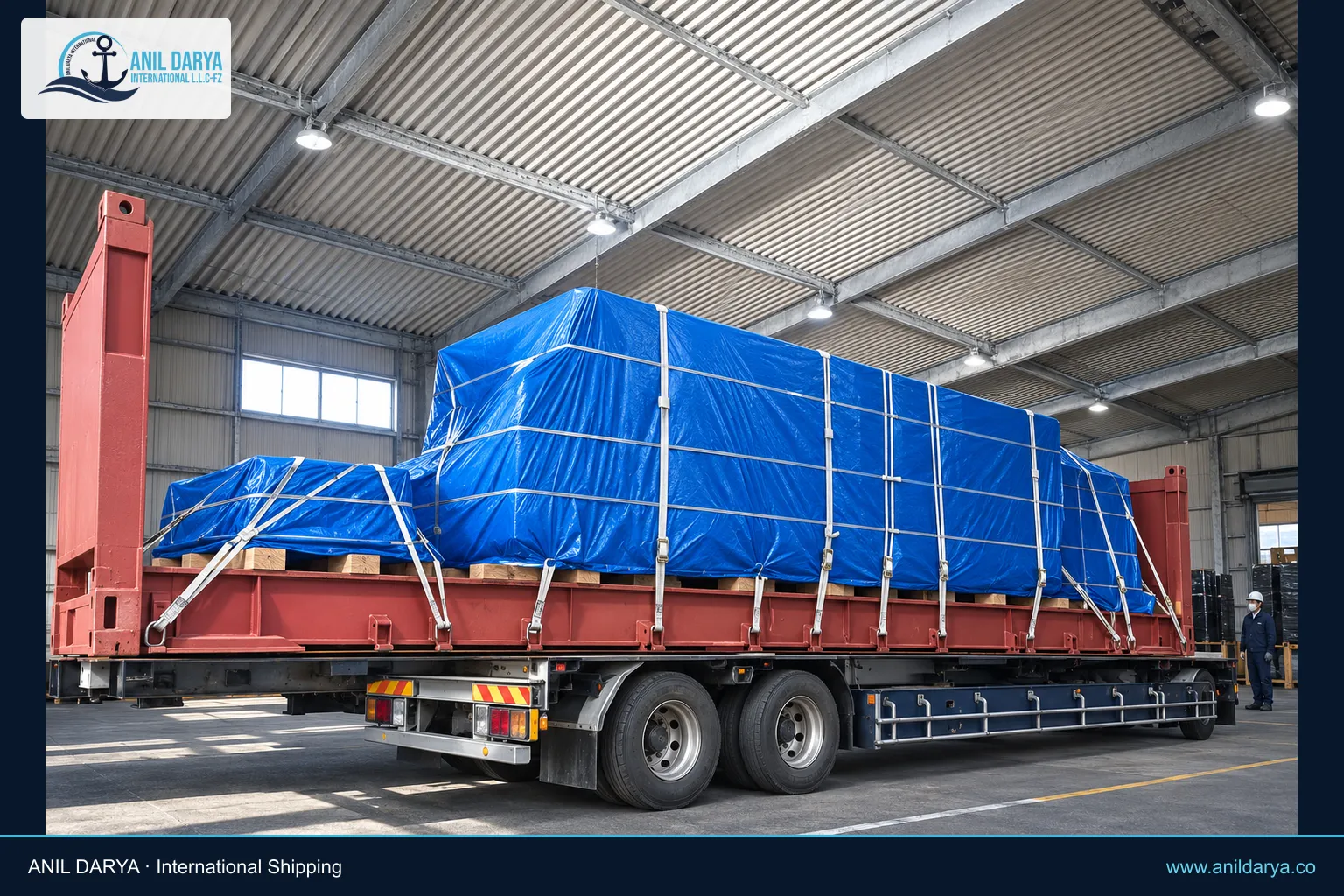
Pieces that fit a 40ft flat rack can sail on LEX or SLA and keep the weekly frequency. Heavier units need breakbulk tonnage, and the vessel date then drives the whole plan. Our break bulk and project cargo team handles the carrier side.
Dangerous goods: chemicals, coatings and batteries
Industrial chemicals, paints, adhesives and lithium batteries in equipment move under the IMDG Code 2024 edition (Amendment 42-24), mandatory since 1 January 2026. The German shipper supplies the UN number, class, packing group, safety data sheet and a signed DG declaration, and the line must accept the booking before stuffing. Egypt bans several pesticides and chemicals outright, so check the product list with the broker first. Our dangerous goods team gets carrier acceptance before we confirm.
What the German exporter files before the ship sails
The export side belongs to the German seller or its origin agent. We coordinate times and cut-offs with them; we do not file in Germany.
- EORI number. Every business exporting from the EU needs one.
- Export declaration in ATLAS-Ausfuhr, lodged electronically at the export customs office where the goods are packed or loaded.
- Exit. The office of exit at the seaport confirms departure, and the exporter then receives the exit notice (Ausgangsvermerk), its proof of export for VAT.
- Export controls. Dual-use items, such as many machine tools, sensors and chemicals, need a BAFA licence before they leave.
What the EU-Egypt trade agreement means for duty
The European Commission states that the EU-Egypt Association Agreement has been in force since 2004 and created a free trade area by removing tariffs on industrial products. Agricultural, processed agricultural and fisheries products got a separate agreement from 1 June 2010. For most German manufactured goods, this means Egyptian duty can fall to zero, but only with valid proof that the goods are of EU origin under the agreement's rules.
| Proof of origin | When it is used | Who issues it |
|---|---|---|
| EUR.1 movement certificate | Any value; the ACID goes in field 8 | The exporter fills it in; German customs endorses it |
| Origin declaration on the invoice | Consignments up to 6,000 euros by any exporter; above that only by an approved exporter | The exporter, on the invoice or another commercial document |
| IHK certificate of origin | Non-preferential origin, when the buyer or the goods need it; the ACID goes in field 5 | The local chamber (IHK); gives no duty preference |
Two rules catch German exporters. First, the revised Pan-Euro-Mediterranean origin rules have applied between the EU and Egypt since 11 March 2025, and the European Commission recommends that every proof of origin for Egypt carry the words "REVISED RULES". Spanish customs and German chambers report that Egyptian customs rejected proofs without it, and that replacement proofs with the remark can be issued afterwards. Second, IHK Cologne notes that a preference proof is valid for 10 months from issue, and that EU origin alone is not enough: each product must meet its origin rule, backed by supplier declarations for traded goods.
The gain is real: IHK Cologne gives certain motor vehicles a 135% Egyptian duty, but 0% with proven EU preferential origin. VAT is still due. If a shipment mixes originating and other goods, issue separate invoices.
Egypt import customs for German goods: ACI, ACID and Nafeza
Advance Cargo Information has been mandatory for sea freight into Egypt since 1 October 2021. Both the Egyptian importer and the German exporter must be registered. The shipping lines' guide published by Misr Technology Services sets the ACI request at least 48 hours before loading, gives Customs up to 48 hours to issue the ACID, and asks lines to send the manifest 48 hours before berthing.
| Step | Who | What happens |
|---|---|---|
| 1 | Egyptian importer or broker | Registers the shipment on Nafeza |
| 2 | Egyptian Customs | Issues the 19-digit ACID and notifies the importer and the German exporter |
| 3 | German exporter | Uploads invoice (PDF and Excel template), packing list, certificate of origin and B/L copy on CargoX under the ACID |
| 4 | Importer | Approves the exporter's data on Nafeza |
| 5 | Shipping line | Checks the ACID and loads at Bremerhaven, Hamburg or the Benelux port |
| 6 | Shipping line | Lodges the manifest through Nafeza before berthing |
| 7 | Broker | Presents the EUR.1, arranges payment of duty and VAT by the consignee, takes release |
On CargoX only fully verified exporters can file; a foreign forwarder can register but the German exporter submits. A sent filing cannot be recalled, so a correction goes as a new filing under the same ACID, and the filing fee is charged once per ACID plus a small fee per document. Cargo shipped without a valid ACID can be refused and sent back at the shipper's cost.
Documents Egypt expects from a German supplier
| Document | Issued by | What Egypt checks |
|---|---|---|
| Commercial invoice | German exporter | ACID, exporter ID and importer ID; origin as "Federal Republic of Germany"; HS code, brand, weights, maker's name and address, Incoterm |
| EUR.1 or origin declaration | Exporter; EUR.1 endorsed by German customs | "REVISED RULES" remark; EU origin under the agreement |
| Packing list | German exporter | Same packages and weights as the invoice and Nafeza |
| Bill of lading | Shipping line, released through us | Carries the ACID; a copy goes into the CargoX file |
| Health, phytosanitary or analysis certificate | German authority or lab | For food, plant goods and some chemicals |
| GOEIC registration proof | Factory or brand owner | For products on the Decree 43 list |
With 15 days at sea, couriered originals normally beat the ship to Alexandria; under a letter of credit, still send them the day the B/L is issued.

Duty, VAT and GOEIC rules on German cargo
Without a valid preference, PwC reports Egyptian customs duty of 0% to 60% of the CIF value, rising to 135% on some cars, luxury goods and alcohol. VAT is 14% on CIF value plus duty and other taxes; machinery for production lines pays 5%, and qualifying industrial machinery can have VAT suspended under Law 3 of 2022. IHK Cologne adds that some product groups pay a schedule tax on top of, or instead of, the standard VAT rate.
| German cargo | Duty with valid EUR.1 | VAT | Watch for |
|---|---|---|---|
| Industrial machinery and spare parts | Industrial goods: preference | 5% if for a production line, else 14% | End-use proof; dual-use licence in Germany |
| Cars and vehicle parts | 0% for cars with proven EU origin (IHK Cologne) | 14% or schedule tax | Origin proof for each vehicle; used-goods limits |
| Chemicals and coatings | Industrial goods: preference | 14% | Egyptian bans on some pesticides and chemicals; DG papers |
| Medicines | Check the tariff line with the broker | As the broker confirms | Health ministry approval before loading |
| Household appliances, lighting, cosmetics | Industrial goods: preference | 14% | GOEIC registration under Decree 43 |
Decree 43 of 2016 means factories, brand owners and distribution centres exporting listed products to Egypt must first register with GOEIC. The list covers household appliances, lighting, cosmetics, toys, tableware, furniture, textiles and packaged foods, among others, and AHK Egypt handles these registrations for German companies. The Egyptian buyer must also be on the importers register, whose rules Decree 271 of 2026 replaced from 22 July 2026.
Restricted and prohibited goods in Egypt
IHK Cologne lists goods Egypt does not admit, including two-stroke motorcycles, all asbestos products such as brake linings, certain incandescent lamps, many pesticides and chemicals, poultry parts and offal, and goods bearing symbols that offend religious beliefs. Used goods, such as second-hand machinery, enter only under set conditions, and medicines, food and telecom equipment need regulator approval. Ask the broker before production.
What cargo moves on this lane?
The European Commission reports EU exports to Egypt of about 20 billion euros in 2025, led by machinery and transport equipment (39%) and chemical products (17%). German boxes follow that pattern: production machinery, vehicles and parts, chemicals and medicines, so this lane uses more flat racks, DG bookings and reefers than a consumer-goods route.
The Dubai option: when Jebel Ali fits
Dubai is not on the way from Bremerhaven to Alexandria. A Dubai routing pays off only in these cases:
- Mixed sourcing: German goods combined in Dubai with Asian or Gulf goods into one container for Egypt.
- Free zone stock: German spare parts held in Dubai and called off in small lots for Egyptian and other regional buyers. Our article on JAFZA re-export explains the free zone route.
- A Dubai-based trader that buys in Germany and sells in Egypt and wants the goods to pass through Jebel Ali port.
The Dubai to Egypt leg needs its own ACID, and storing, splitting or repacking the goods in Dubai may cost the EU preference, so confirm with the Egyptian broker before you choose it. Where the cargo enters or leaves the UAE, customs clearance in Dubai is a service we provide for a fee through our Dubai freight forwarding team.
[AMIR-FACT: whether we route German cargo for Egypt through Jebel Ali today (consolidation or JAFZA stock), on which carriers, how often, and the real extra days compared with a direct Bremerhaven sailing]
What affects the cost of shipping from Germany to Egypt?
We price each sailing on the day, so no rates here. These are the parts of the bill.
| Cost part | What moves it | Usually paid by |
|---|---|---|
| Origin haulage | Distance from the factory to Bremerhaven, truck or rail, Hamburg-to-Bremerhaven repositioning | Exporter under FCA factory, buyer under EXW |
| Export and documents | ATLAS filing, EUR.1 endorsement, IHK certificate, CargoX fee per ACID | Exporter, unless agreed otherwise |
| Ocean freight | Box type, direct loop or transhipment, season, surcharges | Buyer on FOB, seller on CFR/CIF |
| Special cargo | Flat rack, breakbulk, DG and reefer premiums | As above |
| Egyptian port charges | Terminal handling, delivery order, LCL unpacking, storage | Importer |
| Duty and taxes | Preference proof, HS code, CIF value, 14% or 5% VAT | Consignee or its broker |
| Delay charges | Missing ACID, EUR.1 without "REVISED RULES", no GOEIC registration, inspection | Whoever caused the delay, by contract |
The most expensive avoidable error on this lane is a rejected proof of origin. A box of German machinery that arrives without a valid EUR.1 pays the full Egyptian rate or sits on the quay while a new one is issued. Our article on demurrage and detention shows how quickly those daily charges grow.
How to arrange shipping from Germany to Egypt, step by step
- Agree the Incoterm, the Egyptian port and the delivery city, and write them on the contract and invoice.
- Send us the product, HS code, weight, volume, pickup town in Germany, ready date and any DG, reefer or out-of-gauge detail.
- Name the Egyptian broker. We confirm with the broker that the importer is registered, the products are clear on GOEIC and the broker covers the chosen port. Only then do we confirm the booking.
- Get the ACID. The importer applies on Nafeza at least 48 hours before loading and shares the number with the seller and with us.
- Book the space. We compare LEX, SLA and transhipment options and get DG, reefer or flat rack acceptance first.
- Prepare documents in Germany. The seller puts the ACID and both Nafeza IDs on every paper and issues the EUR.1 or origin declaration with "REVISED RULES".
- File the ATLAS export declaration and the CargoX documents, then deliver the box before the terminal cut-off.
- Release the bill of lading. We check the draft against the invoice and ACID and release the carrier's B/L once freight is settled.
- Clearance in Egypt. The consignee's broker presents the EUR.1, the consignee pays duty and VAT, and the broker takes delivery.
[AMIR-FACT: one real Germany to Egypt cross-trade shipment we handled (cargo, German load port, Egyptian port, carrier, how the ACID, EUR.1 and broker were lined up, door-to-door days), cleared for publication]
Checklist before the box leaves Germany
- Incoterm, discharge port and delivery city agreed in writing.
- Egyptian importer on the importers register, with a valid ACID for this shipment.
- Consignee's broker named and working at the discharge port.
- Products checked against the Decree 43 list, with GOEIC registration where needed.
- Exporter verified on CargoX; ACID, exporter ID and importer ID on every document.
- EUR.1 or origin declaration marked "REVISED RULES", issued less than 10 months before import.
- EORI in place, ATLAS declaration filed, dual-use status checked with BAFA.
- For DG: SDS, DG declaration and line acceptance. For flat racks: drawings and lifting points.
- Cargo insurance arranged and Egyptian free time checked.
Common mistakes on this lane
- Shipping before destination clearance is agreed. A box that reaches Alexandria with no broker in place sits on the quay and builds storage.
- Delivering the box to the terminal before the ACID exists. The line will not load it.
- Leaving "REVISED RULES" off the EUR.1 or invoice declaration, and losing the preference at the border.
- Writing an invoice declaration above 6,000 euros without approved exporter status.
- Assuming the CE mark replaces GOEIC registration for appliances, lighting or cosmetics.
- Sending used machinery without checking Egypt's conditions for used goods.
- Chemicals or batteries booked as general cargo instead of DG.
Frequently asked questions
How long does shipping from Germany to Egypt take by sea?
ONE's Levant Express publishes 15 days from Bremerhaven to Alexandria and 16 days to Damietta, port to port. Add time for export filing and Egyptian clearance; transhipped sailings take longer.
Which German port is best for cargo to Egypt?
Bremerhaven, because both direct loops we found, ONE's LEX and Maersk's SLA service, call there. Hamburg and Wilhelmshaven work when the carrier connects them to Egypt, and western German plants can load at Rotterdam or Antwerp on LEX.
Do German goods pay customs duty in Egypt?
Industrial goods of EU origin can enter at zero duty under the EU-Egypt Association Agreement, in force since 2004. The goods must meet the origin rules and travel with an EUR.1 or origin declaration marked "REVISED RULES". Without valid proof, the normal Egyptian rate of up to 60% or more applies.
What does "REVISED RULES" on the EUR.1 mean?
It shows the proof was issued under the revised Pan-Euro-Mediterranean origin rules, which apply between the EU and Egypt from 11 March 2025. The European Commission recommends the remark for every proof of origin sent to Egypt, and proofs without it have been rejected.
Is VAT charged on German goods in Egypt?
Yes. The trade agreement covers customs duty, not VAT. Egyptian import VAT is 14%, or 5% on machinery for production lines, and the consignee or its broker pays it.
Who requests the ACID for a shipment from Germany?
The Egyptian importer or its broker, on Nafeza, at least 48 hours before loading. The German exporter must be registered and verified on CargoX and uploads its documents there under that ACID.
Does Anil Darya clear the cargo in Egypt?
No. We book the ocean freight, coordinate the German shipper and release the carrier's bill of lading. The consignee's licensed broker clears the goods in Egypt, and we agree that arrangement with you before confirming the booking.
Can German cargo for Egypt go through Dubai?
Yes, to combine German and Asian goods or hold stock in a Dubai free zone. The Dubai to Egypt leg needs a new ACID, and the broker should confirm the EU preference still applies.
Get a quote for shipping from Germany to Egypt
Send us the pickup town in Germany, the cargo and HS code, the ready date, the Egyptian port and the name of the buyer's broker, and we will reply with sailing options and a price. Use our freight rate inquiry form, or contact our team to plan a machinery, DG or project shipment first.
Sources
- Ocean Network Express: 2026 Intra Europe trade services (LEX rotation, terminals and transit times)
- Maersk: Strengthening connectivity between North Europe, Italy and Egypt (SLA service, 2 June 2026)
- European Commission: EU trade relations with Egypt (Association Agreement, 2025 trade)
- European Commission: Pan-Euro-Mediterranean cumulation and the PEM Convention
- Spanish Tax Agency (customs): Application of the PEM Convention rules with Egypt, "REVISED RULES"
- IHK Koeln: Import requirements in Egypt (ACI, invoice, EUR.1, duties, prohibited goods)
- IHK Magdeburg: Egypt, proofs of preferential origin
- German customs (Zoll): IT procedure ATLAS-Ausfuhr
- German customs (Zoll): Dual-use items
- Your Europe: Customs procedures on exports (EORI, office of export and exit)
- bremenports: Bremerhaven containers
- Port of Hamburg: Throughput figures for 2025
- IHK Oldenburg: JadeWeserPort in Wilhelmshaven
- Alexandria Port Authority: Alexandria port details
- Alexandria Port Authority: Dekheila port details
- Baird Maritime: Damietta Alliance Container Terminals starts commercial operations
- APM Terminals: About SCCT, East Port Said
- DP World: Sokhna port
- Misr Technology Services via SCZONE: ACI shipping lines and agents guide v1.5
- CargoX: Advance Cargo Information Egypt
- US International Trade Administration: Egypt import requirements and documentation
- PwC Worldwide Tax Summaries: Egypt, other taxes
- AHK Egypt: Registration of manufacturers with GOEIC (Decree 43 of 2016)
- Baker McKenzie: Egypt importers register, Decree 271 of 2026
- IMO: IMDG Code 2024 edition (Amendment 42-24)
Reviewed: 11 November 2026