
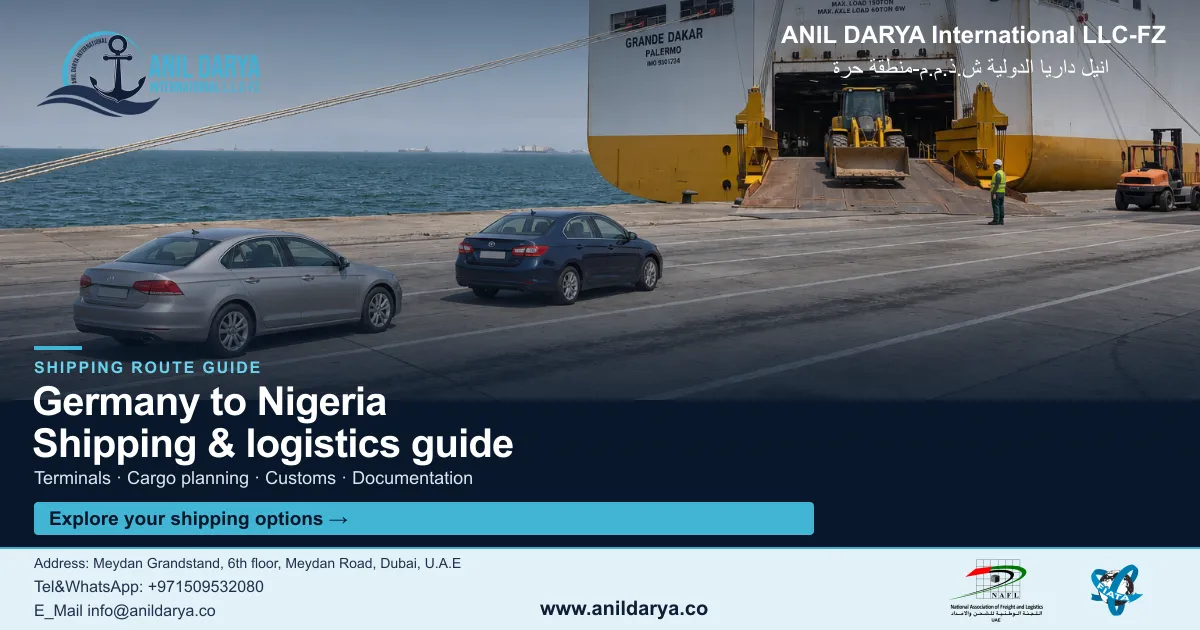
Shipping from Germany to Nigeria means loading at Hamburg, Bremerhaven or Wilhelmshaven and discharging at the Lagos terminals or at Onne. Cars, trucks and machines often travel on con-ro ships that take both rolling units and containers, while factory goods go in boxes. The German seller files the export in ATLAS, and the Nigerian buyer needs an approved Form M, SONCAP or NAFDAC papers where they apply, and a licensed customs agent in Lagos. Anil Darya books the sea freight from Dubai and keeps both sides working to one plan.
Germany to Nigeria shipping at a glance
| Point | What applies |
|---|---|
| Cargo types | FCL and LCL containers; Ro-Ro and con-ro for vehicles and wheeled machines; breakbulk and heavy lift for plant |
| German load ports | Hamburg for con-ro, containers and project cargo; Bremerhaven for containers and car carriers; Wilhelmshaven for deep-draught container ships |
| Nigerian discharge ports | Tin Can Island and Apapa in Lagos, Lekki Deep Sea Port, Onne in Rivers State |
| Published same-ship loops | Grimaldi's weekly Central Express loop from Hamburg calls Lagos; a BOCS breakbulk service from Hamburg calls Lagos every 14 days |
| German export filing | Electronic export declaration in ATLAS-Ausfuhr, by the exporter or its customs agent |
| Nigerian approval before loading | Form M, opened by the importer's bank on the Nigeria Single Window |
| Conformity | SONCAP for regulated goods, NAFDAC for food, drugs and cosmetics, VehCAP for used vehicles from 2026 |
| Duty and VAT | ECOWAS Common External Tariff bands of 0% to 35%, then 7.5% VAT; vehicles pay a levy as well |
| Trade preference | None: no EU agreement with Nigeria is in force |
| Bill of lading | The line's own B/L, released to you through us as agent for the line |
| Nigerian clearance | The consignee's licensed agent, agreed before we confirm space |
How a German-Nigerian cross-trade runs from Dubai
The cargo sails straight from the German quay to Nigeria. Dubai holds the booking, the carrier paperwork and the tracking, not the goods.
| Job | Done by |
|---|---|
| Choosing the line, sailing and equipment; holding con-ro or container space | Anil Darya, with the shipping line |
| Collection from the plant or dealer in Bavaria, Baden-Wurttemberg or the Ruhr; truck or rail to the port; VGM | The German shipper or its haulier, working to our cut-offs |
| EORI, ATLAS export declaration, any BAFA licence | The German exporter or its customs agent |
| Form M, SONCAP or NAFDAC, marine insurance with a Nigerian insurer | The Nigerian importer and its bank |
| PAAR, entry on B'Odogwu, duty and VAT, release from the terminal | The consignee's licensed customs agent |
The B/L you receive is the shipping line's own document, not a house bill. Because we act as agent for many lines, the carrier issues its B/L from Hamburg or Bremerhaven to the Nigerian port and we release it to you from Dubai once the draft is checked. For a used car, that check covers the chassis number letter by letter, since the Lagos bank compares it with the Form M.
Fix the sales term early. The Form M needs cover from an insurer registered in Nigeria, so a CIF Lagos offer with a German policy causes trouble, and many buyers take FOB Hamburg instead. Our Incoterms 2020 guide for sea freight shows where costs and risk change hands.
German ports for Nigerian cargo
Most German goods for Nigeria leave from the two big North Sea gateways. The right one depends on the line, not on where the factory is.
| Port | What the port publishes | Good fit for |
|---|---|---|
| Hamburg | 8.3 million TEU and 114.6 million tonnes in 2025; four container terminals; seven multipurpose terminals lifting single units of just over 400 tonnes | Con-ro sailings to Lagos, breakbulk, heavy machinery, containers |
| Bremerhaven | 5.21 million TEU in 2025 on 14 berths and 4,930 m of quay, 14 to 16.5 m deep; 1.25 million vehicles in 2025 over 18 car-carrier berths, with about 70,000 parking spaces, half of them covered | Containers, new and used vehicles, high and heavy units |
| Wilhelmshaven (JadeWeserPort) | Germany's deep-water container port, with 18 m of water | Containers on large ships that call there |
Nigerian ports and terminals for German goods
The Nigerian Ports Authority owns the ports and leases each terminal to a private operator. The terminal on your B/L sets free time, handling charges and the exit gate.
| Port | Operators listed by the NPA | Typical German cargo |
|---|---|---|
| Tin Can Island, Lagos | TCI Container, PTML (Ro-Ro and vehicles), Port and Cargo Handling Services, Five Star Logistics, Josepdam | Used cars, trucks and buses, mixed containers |
| Lagos Port Complex, Apapa | APM Terminals (containers), ENL Consortium (general cargo, breakbulk), bulk terminals | Containers of machinery, parts and consumer goods |
| Lekki Deep Sea Port | Lekki Freeport Terminal | Containers on lines that call there |
| Onne, Rivers State | Intels, WACT, Brawal | Oil and gas equipment, pipe, process plant |
Grimaldi, which runs the con-ro service from Hamburg, also operates PTML at Tin Can Island, described by Grimaldi as the largest multipurpose Ro-Ro terminal in West Africa. The NPA puts Lekki about 65 km east of Lagos and calls it the deepest seaport in sub-Saharan Africa. Goods for the Onne Oil and Gas Free Zone pay duty only when they leave the zone for the Nigerian market.
Sea freight from Germany to Nigeria: services we could verify
The Port of Hamburg publishes a liner directory, and two of its entries call Lagos on the same ship:
| Service | What the Hamburg port page lists |
|---|---|
| Grimaldi Central Express loop | Weekly, 42-day round voyage, containers, breakbulk and Ro-Ro, Vopak Dupeg terminal. Rotation: Hamburg, Tilbury, Antwerp, Casablanca, Santa Cruz de Tenerife, Freetown, Cotonou, Lagos, Tema, Takoradi, Abidjan, Amsterdam, Hamburg. Last Hamburg calls shown: Grande Luanda 16 October, Grande Gabon 4 November and Grande Guinea 8 November 2026 |
| BOCS West Africa breakbulk | Every 14 days, 70-day round voyage, heavy lift, out-of-gauge and breakbulk. Rotation: Hamburg, Dakar, Abidjan, Tema, Takoradi, Lome, Lagos, then on to Central Africa and back via France and Nordenham. Last Hamburg call shown for BOCS Bremen: 23 October 2026 |
Not every Grimaldi loop out of Hamburg suits Nigeria: the directory's Southern Express Loop 2 runs to Dakar, Lome, Luanda and Douala with no Nigerian call. Route listings also show container options from Hamburg to Tin Can with one or more transhipments.
We print no transit time: the directory gives round-voyage length, not port-to-port days, and route-site day counts are not from a carrier schedule we could check. Each quote carries the line's own dates.
[AMIR-FACT: the lines we actually book from Hamburg, Bremerhaven and Wilhelmshaven to Tin Can, Apapa, Lekki and Onne in 2026 (con-ro, container and breakbulk), which are same-ship and which tranship and where, and our real port-to-port days]
Used cars from Germany to Nigeria: Ro-Ro or container
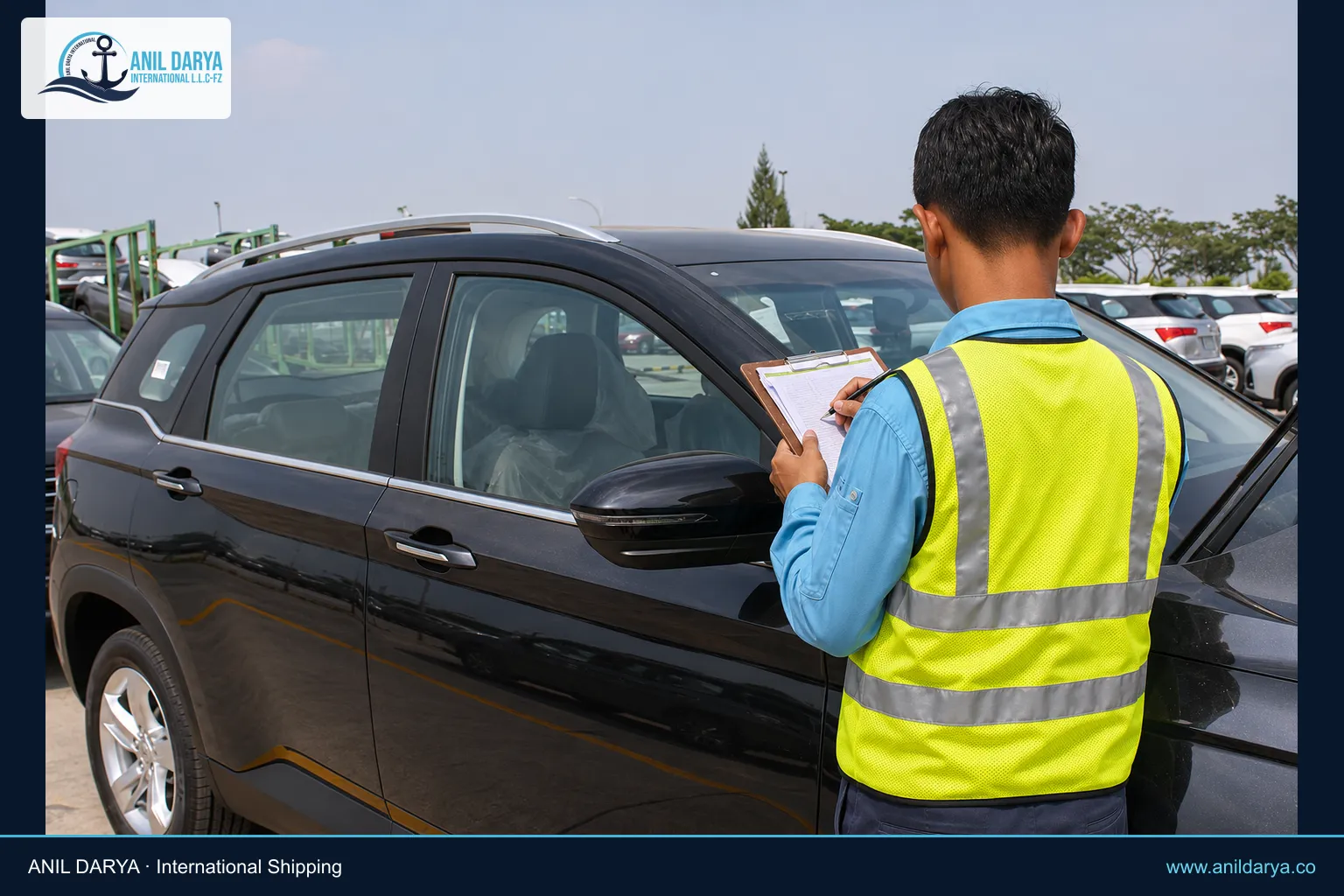
German used cars are popular in Lagos, and they have one built-in advantage: they are left-hand drive, which suits Nigeria's right-hand traffic. Choose the method by the car's condition and by how many units the buyer takes.
| Question | Ro-Ro or con-ro | Container |
|---|---|---|
| Does the car run? | It must drive on and off, or the line must agree a tow | Fine for non-runners, accident cars and classics |
| Can I pack goods inside? | Lines often refuse loose cargo in the cabin; ask first | Possible if declared, and every item must sit on the Form M |
| Several cars for one buyer? | Each unit is booked and charged by its size | Several cars can be racked into a 40ft high cube |
| Where does it land? | The vehicle terminal at Tin Can, such as PTML | The container terminal named on the B/L |
German rules for exporting a vehicle
- German Customs says a formal export procedure must always be carried out for a motor vehicle. The declaration goes electronically to the customs office of export through ATLAS-Ausfuhr.
- For the export to count for VAT purposes, the chassis number must appear in the description of goods on the declaration.
- Export number plates matter only when the car is driven out of the EU on its own wheels. A car shipped from Hamburg or Bremerhaven moves on the export declaration, and the dealer keeps the exit confirmation as proof for its VAT-free sale.
Nigerian rules for an imported car
- Age. The US International Trade Administration summary of Nigeria's prohibition list, last published 6 June 2023, lists used vehicles over 15 years from the year of manufacture as prohibited. Nigeria Customs revised its trade prohibition list under the 2026 Fiscal Policy Measures of 29 July 2026, and recent press reports give other figures, so treat 15 years as a ceiling to confirm, not a target.
- Duty and levy. The same agency's tariff summary of 5 September 2025 gives 20% duty plus a 15% National Automotive Council levy on used vehicles, and 20% plus 20% on new ones, before 7.5% VAT.
- Green tax. The 2026 measures add a Green Tax Surcharge on vehicles with engines of 2000cc and above, which covers many German saloons and SUVs.
- VehCAP. The National Automotive Design and Development Council says the Vehicle Conformity Assessment Programme, run with SON and NESREA, was launched on 31 March 2026 to assess imported used vehicles before they reach the Nigerian market.
- Tyres. Used and retreaded tyres are prohibited, except used truck tyres of 11.00 x 20 and above for retreading, so do not load spare tyres in the boot.
[AMIR-FACT: the current used-vehicle age limit on the Nigeria Customs 2026 prohibition list, today's duty and NAC levy rates for cars, and how VehCAP inspection works for a car leaving Hamburg or Bremerhaven (which body inspects, and whether it must come before the Form M), with the date checked]
Container shipping Germany to Nigeria: FCL, LCL and reefer
Each import needs its own Form M, PAAR and entry, so fewer, fuller boxes cost less per unit.
| Equipment | German goods it suits | Nigerian point to watch |
|---|---|---|
| 20ft FCL | Machine parts, drummed chemicals, bagged malt or ingredients | Truck weight rules out of the Lagos terminals |
| 40ft and 40ft high cube FCL | Spare parts, household appliances, furniture, two or three cars | Packing list must match the Form M line by line |
| LCL groupage from Hamburg or Bremen | Samples, small spare-part orders, trial lots | Each buyer in the box still needs its own Form M |
| Reefer | Dairy, food ingredients, pharmaceuticals | NAFDAC approval first; frozen poultry, pork and beef are banned |
Our FCL vs LCL guide shows when a full box pays off, and our sea freight team checks reefer acceptance with the line.
Machinery, project cargo and dangerous goods
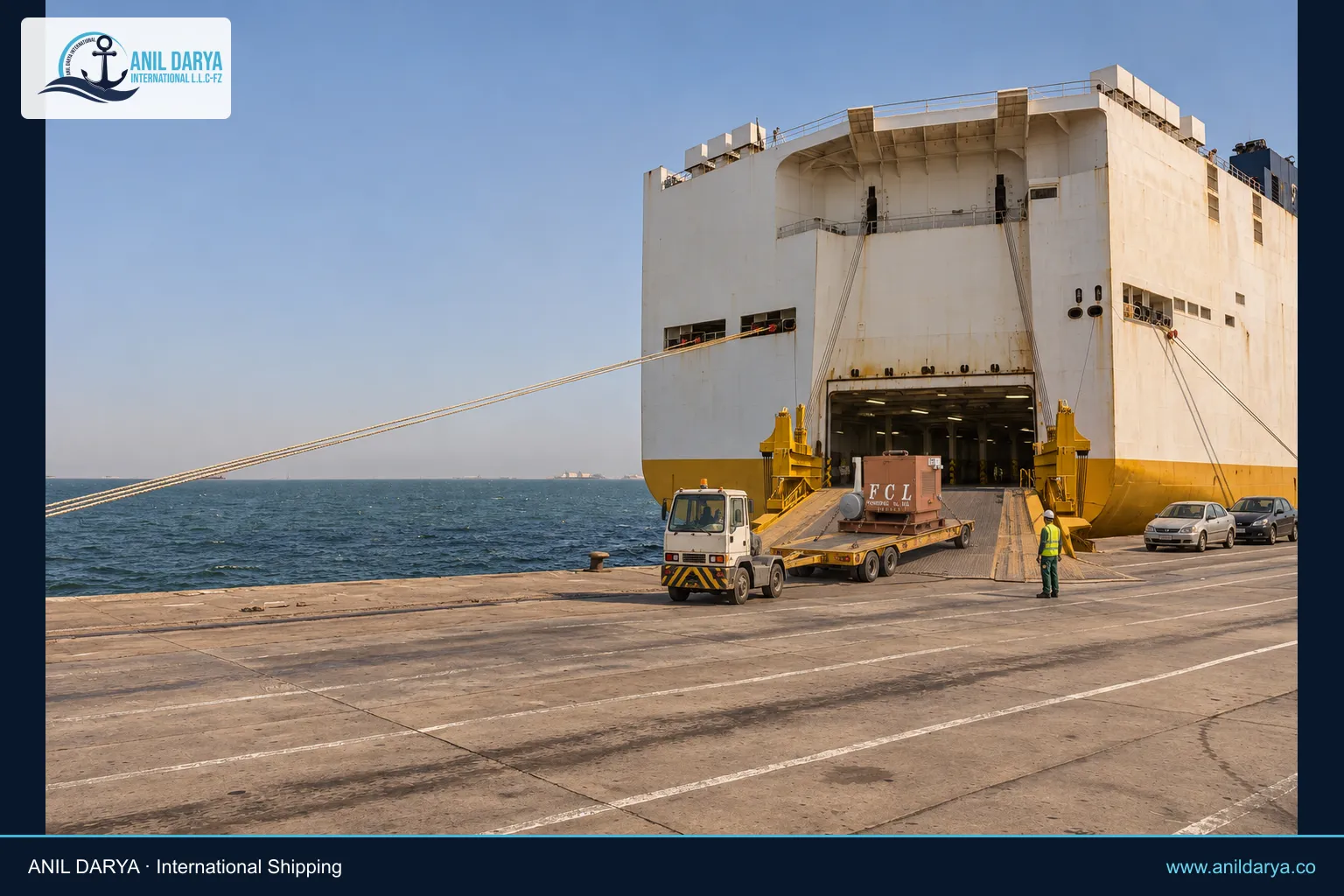
German turbines, transformers, generator sets and process lines go to Nigerian power, oil and gas and factory projects; the Federal Foreign Office names energy as a focus of German-Nigerian business. Flat rack and open top units stay on container ships, wheeled units can roll onto a con-ro ship, and the largest pieces need the breakbulk service or a charter. Our guide to flat rack, open top and out-of-gauge cargo sets out the limits, and our break bulk team needs drawings, weights, the centre of gravity and lifting points before it approaches a line.
Chemicals, paints, lithium batteries and gas cylinders travel as dangerous goods. The IMDG Code 2024 edition (Amendment 42-24) has been mandatory since 1 January 2026. The German shipper supplies the UN number, class, packing group, Safety Data Sheet and signed DG declaration. Each port on the loop must accept the class, which matters on a rotation with six calls before Lagos, so our dangerous goods desk checks the whole route before space is held.
The German export side: EORI, ATLAS and licences
The German seller or its customs agent files the export. We supply the booking number, vessel, cut-offs and draft B/L, and we do not lodge anything with German Customs.
- EORI number. Every EU exporter needs one, and it does not expire.
- ATLAS-Ausfuhr. German Customs states that taking part in the electronic export procedure is compulsory across the EU. Goods are released at the customs office of export and stay under supervision until the office of exit confirms they have left the EU. The office of export then sends the exit notice, the Ausgangsvermerk, which the seller keeps as VAT proof.
- Export licences. Dual-use items, which include some machine tools, chemicals and electronics, need an authorisation from BAFA under Regulation (EU) 2021/821.
- Certificate of origin. The local IHK issues one. Its Dusseldorf country overview of August 2025 has no Nigeria entry, so ask the Lagos agent if one is needed.
Ask the seller to print the Form M number on the invoice so all papers match.
Form M: the Lagos approval before loading in Hamburg
The NPA import guidelines set the order. The importer needs a registered Nigerian company, a Tax Identification Number and an Authorised Dealer Bank. Then:
- where the goods are regulated, it obtains a SONCAP Product Certificate, which the bank needs to open the Form M;
- its bank opens the Form M on the Nigeria Single Window with the German proforma invoice, the Nigerian insurance certificate and the Product Certificate;
- the bank validates it and Nigeria Customs accepts it;
- the approved number goes to the German seller for the invoice and to us for the B/L.
We do not release space for loading until the Form M is approved. Without it the agent cannot raise a PAAR, and the car or container waits in Lagos while storage builds.
SONCAP, NAFDAC and VehCAP for German goods
SONCAP is the Standards Organisation of Nigeria's conformity programme. A PC1 Product Certificate covers one shipment of an unregistered product, and PC2 or PC3 certificates cover registered or licensed products for a year. After loading, SON issues the SONCAP Certificate that the customs agent files.
- Since 27 March 2026, SON handles import permits and SONCAP requests only on the National Single Window, and certificates from the accredited firms are activated there for the Form M, PAAR and clearance.
- SON lists accredited firms such as Cotecna, Intertek and TUV Austria, none tied to a territory. SON announced Bureau Veritas's voluntary withdrawal from the scheme on 5 August 2026.
- SONCAP does not cover food, drugs, medical items other than equipment, raw-material chemicals for genuine manufacturers, or used products other than cars.
- NAFDAC registers food, drugs, cosmetics and many chemicals. The holder must be a Nigerian company or the maker's local agent, which matters for German pharmaceutical and food brands.
[AMIR-FACT: which SONCAP accredited firms our German shippers use since the Bureau Veritas withdrawal, and the usual days from inspection request to Product Certificate for German machinery and spare parts]
Nigerian customs clearance on B'Odogwu
We do not clear goods in Nigeria. Before we confirm the booking, the consignee's licensed agent must have seen the draft invoice, packing list and B/L and accepted the job. Nigeria Customs runs import entries on B'Odogwu, where the PAAR is raised from the registered Form M.
| Document | From | What the Lagos agent checks |
|---|---|---|
| Commercial invoice and packing list | German seller | Form M number, HS codes, values, net and gross weights |
| Carrier bill of lading | Shipping line, released through us | Consignee and notify party, Form M number, discharge terminal, chassis numbers |
| SONCAP Certificate or NAFDAC permit | SON, or the importer for NAFDAC | Covers these goods on this shipment |
| Nigerian insurance certificate | Insurer registered in Nigeria | Matches the Form M |
| Vehicle papers and sale invoice | German dealer | Year of manufacture, chassis number, engine size for the green tax |
| Certificate of origin, if asked | The seller's IHK | German origin, no preference claimed |
Duty and VAT on German goods in Nigeria
Germany gets no tariff preference in Nigeria. The European Commission says the EU-West Africa Economic Partnership Agreement has not entered into force, and only Ghana and Cote d'Ivoire apply interim EPAs. Nigeria has none, so German goods pay the full ECOWAS Common External Tariff, mostly on the CIF value. ECOWAS and AfCFTA preferences need African origin, which German goods cannot meet.
| Band or charge | Rate | German goods often in it |
|---|---|---|
| Band 0 | 0% | Essential social goods |
| Band 1 | 5% | Raw materials, capital goods, much industrial machinery |
| Band 2 | 10% | Intermediate goods, some chemicals and parts |
| Band 3 | 20% | Finished consumer goods, appliances |
| Band 4 | 35% | Goods protected for economic development |
| Vehicles | 20% duty plus NAC levy (15% used, 20% new, per the 2025 summary) | Cars, vans, SUVs |
| VAT | 7.5% | Charged after duty and levies |
The 2026 Fiscal Policy Measures also revise the Import Adjustment Tax list. The 4% FOB charge from the Customs Service Act 2023 has been suspended since February 2025. Duty and taxes at destination are paid by the consignee or its broker, so ask the agent for an estimate on the exact HS code before the Form M is opened. Since no preference is at stake, holding or splitting German goods in Dubai cannot cost a tariff benefit in Nigeria.
Banned and restricted goods to check first
Beyond the car age limit, tyres and the meat ban, the US International Trade Administration summary of 6 June 2023 and the 2026 changes include:
- Second-hand clothing, which is absolutely prohibited, so German textile collectors cannot use this lane.
- Refined vegetable oils and fats, and soaps and detergents in retail packs.
- From 1 April 2026, a revised trade prohibition list of 17 categories of goods from outside ECOWAS, with a 90-day window for deals backed by a valid Form M.
Does routing via Dubai help shipping from Germany to Nigeria?
For a plain German order, no: Dubai is far off the line from Hamburg to the Gulf of Guinea. It helps only in narrow cases.
| Option | How it works | What to watch |
|---|---|---|
| Direct from Germany | Car, box or heavy piece sails from Hamburg or Bremerhaven to the Nigerian port on the line's B/L | The normal choice for almost all cargo |
| Jafza stock and re-export | German spares kept in the Jebel Ali Free Zone and sent to Nigeria with Gulf or Asian goods | Dubai Chambers issues certificates of origin for re-exports; Form M and SONCAP still apply |
Where goods land, wait or are re-exported in Dubai, we clear them through UAE customs for a fee. Our Jebel Ali port guide and our note on re-exporting through Jafza explain the steps.
[AMIR-FACT: whether any of our Nigerian buyers combine German goods with Gulf or Asian stock through Jafza or Jebel Ali, for which cargo, and how many days it adds against a direct Hamburg sailing]
Typical cargo on this lane
The Federal Foreign Office, in its page of 2 October 2026, calls Nigeria Germany's second most important trading partner in sub-Saharan Africa, and German business has had a chamber of commerce in Nigeria since 1983.
| Cargo | Usual way to ship | Papers to plan |
|---|---|---|
| Used cars, vans and SUVs | Con-ro or car carrier; 40ft high cube for several units | ATLAS with chassis number, age check, VehCAP, levy and green tax |
| Trucks, buses, tractors, construction machines | Con-ro or flat rack | Sale invoice, dimensions, SONCAP |
| Generators, transformers, turbines, pumps | Flat rack, breakbulk, often to Onne | SONCAP, BAFA check, OGFZA papers if kept in the zone |
| Chemicals, paints, plastics | FCL, ISO tank, DG containers | DG declaration, SDS, NAFDAC for regulated chemicals |
| Malt, food ingredients, pharmaceuticals | Dry FCL or reefer | NAFDAC registration held in Nigeria |
How shipping from Germany to Nigeria works, step by step
The first four steps happen before anything moves.
- Send us the goods, HS codes, weights and sizes (or chassis numbers, model years and engine sizes for cars), the German pickup point, the Nigerian port and the Incoterm.
- The buyer's Lagos agent checks the HS codes and vehicle ages against the prohibition lists and says whether SONCAP, NAFDAC or VehCAP applies.
- The importer gets its Product Certificate or NAFDAC approval, buys Nigerian insurance and opens the Form M.
- Once the agent confirms it will clear the shipment, we confirm con-ro, container or breakbulk space to Tin Can, Apapa, Lekki or Onne.
- The German shipper delivers to the terminal in Hamburg or Bremerhaven, and its customs agent files the ATLAS declaration.
- The accredited firm inspects where SONCAP applies, and the seller puts the Form M number on the invoice.
- The line issues its B/L with the Form M number and chassis numbers, and we release it to you from Dubai.
- During the voyage, the importer collects the SONCAP Certificate and the agent raises the PAAR on B'Odogwu.
- On arrival the agent files the entry, the consignee pays duty, levies and VAT, and the terminal releases the cargo.
[AMIR-FACT: one real Germany to Nigeria cross-trade shipment we booked (cars, machinery or containers, German load port, Nigerian terminal, line, days at sea, and what we sorted out with the German seller and the Lagos agent), cleared for publication]
What sets the cost of shipping from Germany to Nigeria?
Every quote is priced on the day. The Nigerian Shippers' Council publishes quarterly indicative freight rates for its Europe route as a guide that shippers then negotiate with the lines.
| Cost part | What moves it | Usually paid by |
|---|---|---|
| German trucking, rail and terminal charges | Distance from the plant or dealer, customs agent fee | Seller on FOB, buyer on EXW |
| Ocean freight | Car size or box type, service, season, surcharges | Set by the Incoterm |
| Nigerian terminal and line charges | Terminal, box size, vehicle size | Consignee |
| Duty, levies and VAT | HS code, CIF value, engine size, exchange rate on the day | Consignee or its broker |
| Storage, demurrage and detention | Late Form M, missing SONCAP, slow clearance | Whoever caused the delay |
Our article on demurrage and detention explains how daily charges grow at a terminal, and our Dubai freight forwarding team will go through any quote line by line.
Checklist before the cargo leaves Hamburg or Bremerhaven
- HS codes, and for cars the year of manufacture and engine size, checked against Nigeria's 2026 lists.
- Form M approved, with its number on the invoice and the draft B/L.
- SONCAP inspection booked or Product Certificate issued; NAFDAC or VehCAP route agreed.
- Marine insurance from a Nigerian insurer that matches the Form M.
- ATLAS declaration filed with chassis numbers; BAFA and DG papers checked.
- Service confirmed as one that actually calls Lagos or Onne.
- Lagos customs agent named and clearance accepted before booking.
Mistakes that hold German cargo in Lagos
- Shipping before destination clearance is agreed. Without a Nigerian agent, the car or box sits at the terminal and storage runs.
- Loading in Hamburg without an approved Form M, which blocks the PAAR.
- Buying a car that is too old, or packing used tyres or old clothes inside it.
- Handing a car to a West Africa sailing that does not call Nigeria.
Frequently asked questions
How long does sea freight from Germany to Nigeria take?
It depends on the service and where Lagos or Onne falls in its rotation. Grimaldi's Hamburg loop calls six ports before Lagos, while container options may tranship. We give the line's own dates for each sailing rather than a general figure.
Is there a direct ship from Hamburg to Lagos?
Yes. The Port of Hamburg lists Grimaldi's weekly Central Express loop and a BOCS breakbulk service every 14 days, both calling Lagos without a change of ship. Rotations change, so check the current one before you book.
Can I ship a used car from Germany to Nigeria?
Yes, if it meets Nigeria's age limit, which a 2023 US summary of the prohibition list put at 15 years from manufacture. Confirm the 2026 list with your Lagos agent. German cars are left-hand drive, which suits Nigeria, and they pay duty, the NAC levy, 7.5% VAT and possibly the green tax.
Do I need a Form M to ship from Germany to Nigeria?
Yes. Every commercial import needs one, opened by the buyer's bank on the Nigeria Single Window. Get it approved before the goods load in Germany, then print its number on the invoice and the B/L.
Does the EU have a trade agreement with Nigeria?
No agreement is in force. The EU-West Africa Economic Partnership Agreement has not entered into force and Nigeria has no interim deal, so German goods pay the full ECOWAS tariff plus 7.5% VAT.
Does Anil Darya clear customs in Nigeria?
No. The consignee's licensed agent files the entry on B'Odogwu, and duty and taxes at destination are paid by the consignee or its broker. We agree the plan with that agent before the booking is confirmed.
Ask for a quote for cars, machinery or containers
Send the goods or vehicle details, the German pickup point, the Nigerian port and the ready date, and we will come back with a routing and a price. Use our freight rate inquiry form, or contact our team to plan a con-ro, heavy lift or DG shipment first.
Sources
- Port of Hamburg: Grimaldi Central Express loop (vessel calls to November 2026)
- Port of Hamburg: West Africa breakbulk service (BOCS)
- Port of Hamburg: Southern Express Loop 2
- Port of Hamburg: Throughput figures 2025
- Port of Hamburg: Terminals
- bremenports: Container handling in Bremerhaven
- bremenports: Automobile handling in Bremerhaven
- IHK Oldenburg: Seaport Wilhelmshaven, JadeWeserPort
- Grimaldi Agencies UK: The PTML terminal at Tin Can Island (16 October 2023)
- Fluent Cargo: Hamburg to Lagos route listing (routing types only)
- German Customs (Zoll): IT procedure ATLAS-Ausfuhr
- German Customs (Zoll): Export of motor vehicles
- German Customs (Zoll): Dual-use items
- Your Europe: Customs procedures on exports (EORI)
- IHK Dusseldorf: Certification of customs documents by country (August 2025)
- Federal Foreign Office: Germany and Nigeria, bilateral relations (2 October 2026)
- European Commission: EU trade relations with West Africa
- Nigerian Ports Authority: Terminals and operators
- Nigerian Ports Authority: Import and export guidelines
- Nigerian Ports Authority: Lekki Deep Sea Port
- Oil and Gas Free Zones Authority: Incentives
- Nigeria Customs Service: 2026 Fiscal Policy Measures (29 July 2026)
- Standards Organisation of Nigeria: SONCAP services and accredited firms
- SON: SONCAP and import permits move to the National Single Window (27 March 2026)
- SON: Bureau Veritas voluntary withdrawal from SONCAP (5 August 2026)
- NADDC: Vehicle Conformity Assessment Programme (16 October 2026)
- Federal Ministry of Information: Form M and PAAR on B'Odogwu
- Federal Ministry of Information: 4% FOB charge suspended
- Legal 500: Registration of imported products with NAFDAC
- US International Trade Administration: Nigeria prohibited and restricted imports (6 June 2023)
- US International Trade Administration: Nigeria import tariffs (5 September 2025)
- SCP Law: Nigeria's 2026 import restrictions
- ECOWAS: Common External Tariff bands
- PwC Worldwide Tax Summaries: Nigeria other taxes (reviewed 29 May 2026)
- Nigerian Shippers' Council: Indicative freight rates to Nigeria (source named only)
- IMO: IMDG Code 2024 edition
- Dubai Chambers: Certificate of origin for re-exported goods
Reviewed: 14 November 2026