
Shipping from India to Bahrain is a short sea lane with one twist: containers from Nhava Sheva, Mundra and other Indian ports all end at Khalifa Bin Salman Port, but most of them change ship on the way, at Jebel Ali, Hamad or another Gulf hub. Indian goods have no trade agreement discount in Bahrain, so they pay the GCC tariff, usually 5%, plus 10% VAT. We book the ocean freight from Dubai and line up the Indian shipper and the Bahrain consignee's customs broker before the box is loaded.
India to Bahrain shipping at a glance
| Item | Detail |
|---|---|
| Lane type | Cross-trade: India to Bahrain, booked and run by Anil Darya from Dubai |
| Usual Indian load ports | Nhava Sheva (JNPA) and Mundra; Hazira, Cochin, Chennai and others with a hub connection |
| Bahrain discharge port | Khalifa Bin Salman Port (KBSP) at Hidd, run by APM Terminals Bahrain |
| Typical routing | India to a Gulf hub (Jebel Ali or Hamad on the carrier sheets we opened), then a feeder to KBSP |
| Indian export filing | Shipping bill on ICEGATE, filed by the exporter or its customs broker |
| Trade agreement | None in force between India and Bahrain; India-GCC FTA talks were launched in February 2026 |
| Bahrain import filing | OFOQ system, Customs Affairs, Ministry of Interior, through a licensed clearing agent |
| Duty in Bahrain | 5% on most goods; 125% alcohol, 100% tobacco; some goods exempt |
| VAT in Bahrain | 10% standard rate since 1 January 2022 |
| Bill of lading | The shipping line's own B/L, released to you through us as the line's agent |
How shipping from India to Bahrain works as a cross-trade booking
The cargo leaves an Indian port, may change vessel at a Gulf hub, and is cleared only in Bahrain. Our part is the ocean leg and the coordination around it.
| Job | Done by | Notes for this lane |
|---|---|---|
| Factory pickup, stuffing, haulage or rail to the port | Indian shipper or its origin agent | Many inland factories reach Nhava Sheva or Mundra by rail from an ICD |
| Shipping bill and let export order | Exporter or its Indian customs broker | Filed on ICEGATE before the gate cut-off |
| Space with the shipping line | Anil Darya, from Dubai | We pick the routing and the hub, and send cut-offs to the shipper |
| Bill of lading | The shipping line | Released to you through our office, original or telex release |
| Hub and feeder follow-up | Anil Darya | We watch the connection at the hub and the feeder ETA to KBSP |
| OFOQ declaration, duty, VAT, approvals | The consignee's broker in Bahrain | Agreed with us before we confirm the booking |
Because we are agent for many shipping lines, the B/L in your hands is the carrier's document with the Indian exporter as shipper and the Bahrain buyer as consignee. We do not put our own house bill on top of it. We also have no office, yard or agent in India or in Bahrain; we work with the shipper's people at origin and the consignee's broker at destination.
Agree the Incoterm before anything else. A Bahrain buyer usually does best on FOB Nhava Sheva or FOB Mundra: the Indian seller handles export clearance and port charges, and the buyer controls the freight through us. On CFR or CIF KBSP the Indian seller picks the line, and the Bahrain side only sees the routing once the B/L arrives. Our sea freight Incoterms guide sets out who pays which charge under each term.
Which Indian port should the cargo load at?
Start from the factory, not the freight rate. Most Bahrain-bound boxes load on the west coast, because that is where the India to Gulf services start.
| Load port | Hinterland | Gulf links seen on carrier sheets |
|---|---|---|
| Nhava Sheva (JNPA), Navi Mumbai | Maharashtra, Madhya Pradesh, rail cargo from central and north India | Jebel Ali (ONE IGS), Sohar and Hamad (Milaha MIX), Dammam (Milaha MIX 2) |
| Mundra, Gujarat | Gujarat, Rajasthan, Punjab, Haryana and Delhi NCR by rail | Same services as Nhava Sheva |
| Hazira, Gujarat | Surat textiles, diamonds and jewellery, chemicals, engineering | Jebel Ali (ONE IGS) |
| Cochin, Chennai, Tuticorin, Kattupalli | Kerala, Tamil Nadu, Karnataka, Andhra Pradesh | No Bahrain routing on the sheets we opened; we check the hub connection per booking |
JNPA describes itself as running five container terminals and handling about half of the container volume of India's major ports. Mundra has several container terminals and a rail link deep into the north-west, so a Punjab or Rajasthan exporter often reaches Mundra faster than Nhava Sheva.
Khalifa Bin Salman Port: where the containers land
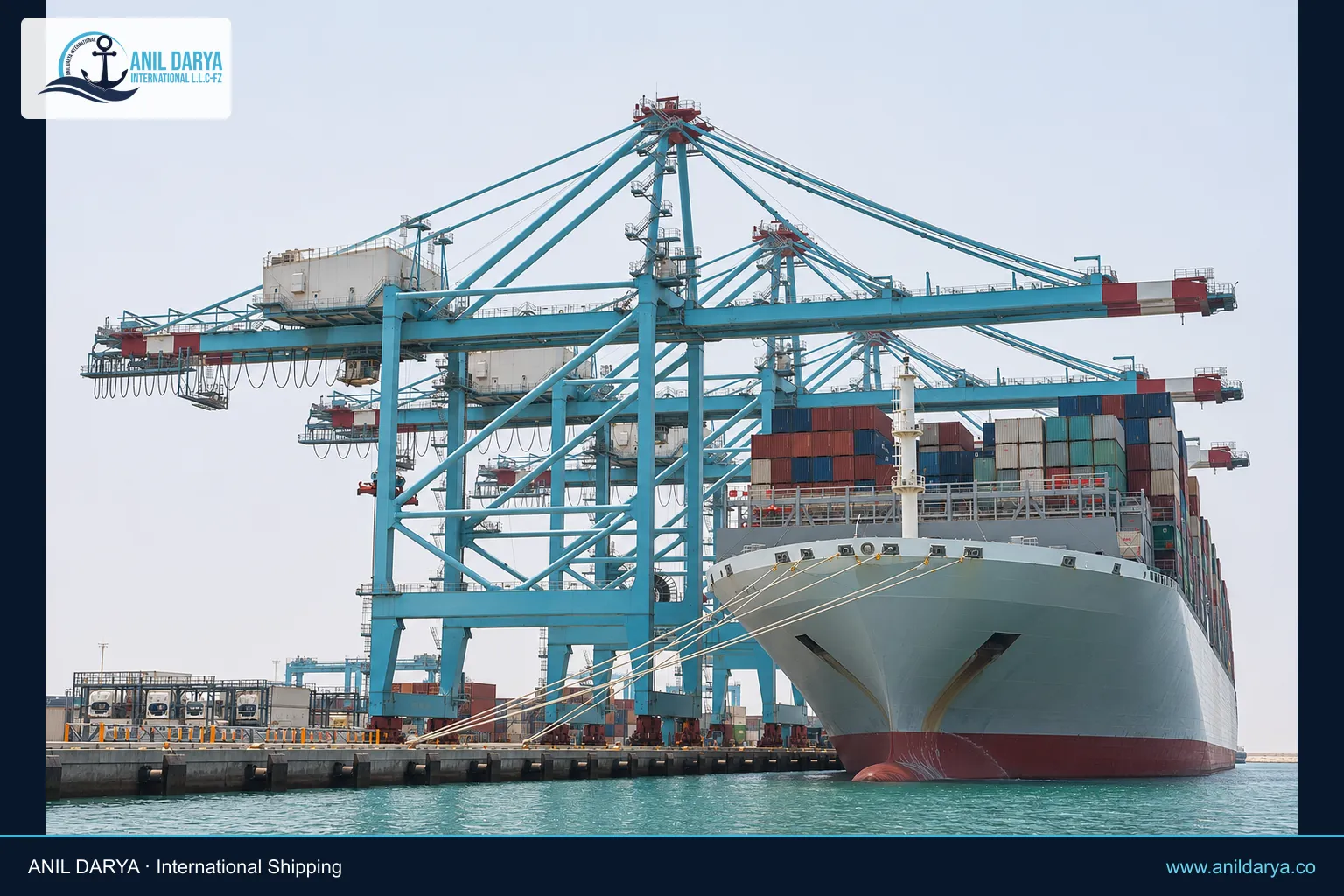
Some forwarder pages still list Mina Salman, Sitra or Muharraq as container ports. Book your containers to KBSP. APM Terminals Bahrain calls it the only general commercial port facility in the country and has operated it under an exclusive concession since 2009. The operator lists an 1,800 m quay, 15 m maximum depth alongside, four post-Panamax ship-to-shore cranes and 840 reefer plugs. The Ministry of Transportation and Telecommunications adds general cargo and Ro-Ro to the port's services.
A few terminal rules shape your delivery plan:
- Gates open 04:00 to 22:00 Saturday to Thursday, and 08:00 to 16:00 on Friday.
- LCL documents for collection must reach the terminal by 15:30 on the day before the booked slot.
- Every empty container goes through the customs scanner on its way back.
- Loads more than 5 m high need a traffic escort when they leave the port.
Direct ship or hub? Routings via Jebel Ali, Hamad and Dammam
We did not find a carrier sheet showing a current direct call from an Indian port at KBSP. The services we opened carry Bahrain cargo through a hub, with the last leg on a feeder. On a through bill of lading to Bahrain the line runs that connection itself; you see one B/L and one arrival notice.
| Published service | What the carrier shows | How Bahrain is reached |
|---|---|---|
| ONE India-Gulf Service (IGS) | Jebel Ali, Sohar, Mundra, Hazira, Nhava Sheva, Jebel Ali; first vessel due at Jebel Ali in June 2025 | Onward from Jebel Ali on a feeder |
| Emirates Shipping Line JBX | Weekly Jebel Ali, Bahrain, Jebel Ali shuttle launched February 2024, promoted for links to the Indian Subcontinent via Jebel Ali | Feeder leg from Jebel Ali to Bahrain |
| Milaha India Gulf Express (MIX), April 2026 sheet | Weekly Mundra and Nhava Sheva to Sohar; Bahrain listed among the Upper Gulf ports served via Hamad | Transhipment via Hamad in Qatar |
| Milaha India-Upper Gulf (MIX 2), February 2026 sheet | Weekly Nhava Sheva, Mundra, Dammam, Umm Qasr; westbound 6 days Nhava Sheva to Dammam, 4 days Mundra to Dammam | Dammam, then by road over the King Fahd Causeway (see below) |
Treat this table as a map, not a timetable. Rotations change often, and we could not read the Bahrain transit days on the Milaha MIX sheet with confidence, so we leave them out. Every quote we send names the first vessel, the hub and the feeder.
The Dammam and causeway option
Dammam has direct India sailings on the Milaha MIX 2 sheet, and Bahrain is joined to Saudi Arabia's Eastern Province by the King Fahd Causeway. A box landed in Dammam can travel by truck to Bahrain in transit through Saudi Arabia. The Saudi side needs a transit declaration on the Fasah platform, filed by a customs broker, and the Bahrain broker then clears the goods at the causeway, not at KBSP.
[AMIR-FACT: the carriers Anil Darya actually books from Nhava Sheva and Mundra to KBSP, which hub each uses (Jebel Ali, Hamad or other), our real port-to-port days, and whether we ever use the Dammam plus causeway route for Indian cargo]
How long does shipping from India to Bahrain take?
Competitor pages quote 7 to 25 days without naming a service. The real answer depends on the hub connection, which can add more days than the main sailing.
| Stage | What decides the time |
|---|---|
| Cargo ready and moved to the port | Factory lead time, rail slot from the ICD, truck to the terminal |
| Indian export clearance | Shipping bill, assessment, any examination, let export order |
| Sailing to the hub | Weekly sailing day; a few days from the west coast to the Gulf hubs on the sheets we opened |
| Hub wait and feeder | How often the feeder sails to KBSP and whether the box makes the first connection |
| Bahrain clearance | OFOQ filing before arrival, food or conformity approvals, duty and VAT payment |
| Delivery | Gate slot at KBSP, truck availability, unloading at site |
Plan around the vessel cut-off at the Indian port and keep spare days for the transhipment.
FCL, LCL, reefer and project cargo
Full containers
A 20ft box suits rice, sugar, tiles, steel pipe and other heavy cargo that reaches the weight limit before the box is full. A 40ft or 40ft high cube suits furniture, textiles, garments and household goods. Ask about free days at KBSP when you compare quotes; our article on demurrage and detention charges explains how a late clearance turns into a bill.
LCL
For a pallet or two, LCL avoids paying for an empty box but adds handling at a freight station at both ends and often an extra hub move. A Bahrain retailer buying from several Indian suppliers in one region can ask them to deliver to one consolidator near Nhava Sheva or Mundra, so one FCL sails instead of several small lots. Our FCL or LCL comparison shows where the switch usually makes sense.
Reefer
Chilled and frozen food from India, such as boneless buffalo meat, fruit, vegetables and seafood, moves in reefers with the set point on the booking. The cold chain has to hold through the hub as well, so confirm that the feeder to KBSP accepts reefers on that sailing. KBSP has 840 reefer plugs, and Bahrain's food inspection, covered below, happens before release.
Breakbulk and project cargo
Steel structures, pressure vessels, transformers and plant from Indian fabricators often travel as breakbulk or on flat racks. Every leg of the routing must accept the piece, including the feeder, so send drawings, weights and lifting points before the supplier crates anything. Our break bulk and project cargo team plans the stowage and checks the escort needed for tall loads leaving KBSP.
Dangerous goods on the India to Gulf routings
Indian chemicals, paints, dyes, pharma intermediates, adhesives and lithium battery products are often dangerous goods. Sea DG follows the IMDG Code, and the 2024 edition (Amendment 42-24) has been mandatory since 1 January 2026. The Indian shipper supplies the UN number, class, packing group, safety data sheet and DG declaration.
A transhipped DG box needs acceptance three times: at the Indian load port, at the hub and at KBSP. APM Terminals Bahrain asks for government approvals to reach its planning team 72 hours before the vessel arrives, and for the MSDS and manifest 72 hours ahead as well. Class 1 and Class 7 need government approval, listed classes pay a 100% handling surcharge, and hazardous boxes are charged BHD 88 a day in storage with no free days. Our dangerous goods desk checks carrier acceptance for each leg before we confirm space.
The export side in India: IEC, shipping bill and certificate of origin
Export formalities belong to the Indian shipper or its origin agent; we do not file Indian customs entries.
- IEC. The exporter needs an Importer-Exporter Code from the DGFT, a 10-character number that matches the firm's PAN.
- Shipping bill. Section 50 of the Customs Act, 1962 requires the exporter to file a shipping bill, which is done electronically on ICEGATE, directly or through a licensed customs broker.
- Let export order. Under section 51, customs permits clearance and loading once the goods are assessed. No order, no loading.
- Certificate of origin. Since 1 January 2025, non-preferential certificates of origin from India must be issued electronically on the DGFT eCoO 2.0 platform by an authorised chamber or agency. Bahrain asks for a certificate of origin where required, and the broker will want one that matches the invoice.
- Product certificates. Food may need a health certificate, and meat a halal slaughter certificate from an approved Islamic centre, both from the Indian side.
Ask the shipper for the invoice, packing list, shipping bill number and certificate of origin before the cut-off. We check the B/L draft against them and against the consignee details the Bahrain broker will file.
Duty in Bahrain: why there is no trade agreement discount
India has trade agreements with two GCC members, the UAE and Oman, but neither covers Bahrain. India and the GCC signed a joint statement in New Delhi on 24 February 2026 that launched negotiations for an India-GCC free trade agreement, with the first round planned for the second half of 2026. That is a start of talks, not a tariff cut. Until an agreement is signed and in force, Indian goods entering Bahrain pay the GCC common external tariff.
| Shipment | Duty in Bahrain | What the broker checks |
|---|---|---|
| Indian goods shipped to KBSP | 5% on most goods | HS code, customs value, certificate of origin |
| Goods on the exempt list | No duty | The tariff line for each item |
| Alcohol or tobacco | 125% or 100% | Special approvals before ordering |
| Goods cleared and duty paid in another GCC state first | May enter free of further duty | Certificates from the first point of entry |
| Goods held in a Dubai free zone and re-exported | 5% in Bahrain, as for a direct shipment | Origin and value on the re-export documents |
VAT is a separate charge. Bahrain's standard rate has been 10% since 1 January 2022, administered by the National Bureau for Revenue, with some goods zero-rated or exempt. Duty and taxes at destination are paid by the consignee or its broker, not through our freight invoice.
Bahrain import customs: OFOQ, documents and approvals
Customs Affairs at the Ministry of Interior runs imports through the OFOQ system. The clearing agent raises the declaration, attaches the bill of lading and invoices, plus a certificate of origin or other papers where required, and pays online. The official service page shows BD 3 for a declaration lodged before the goods arrive and BD 5 for the statement fee, plus the taxes due. The US trade guide for Bahrain advises using a registered, licensed clearing agent.
Documents from the Indian side
| Document | From | What to check |
|---|---|---|
| Commercial invoice | Indian seller | Consignee in Bahrain, HS codes, unit prices, currency, Incoterm |
| Packing list | Indian seller | Packages, gross and net weight; HS codes and UN numbers where relevant |
| Certificate of origin | Chamber or agency via eCoO 2.0 | Same goods, quantities and consignee as the invoice |
| Bill of lading | Shipping line, released through Anil Darya | Port of discharge KBSP, consignee and notify party as the broker files them |
| Health and halal certificates | Indian authority or approved centre | For food and meat |
| Proof of conformity | Manufacturer or test lab | For goods regulated by MOIC |
The GCC unified customs guide allows customs to ask for an Arabic translation of documents, so ask the broker early whether your file needs one.
Food from India: the health inspection permit
Rice, spices, ghee, frozen meat, snacks and fresh produce all go through the Ministry of Health before release. The importer or its representative files the imported food inspection form with the packing list, the delivery order or bill of lading and the required health certificate. Inspection fees run from BD 8 to BD 10 depending on weight, the published processing time is one working day, and goods that do not meet the standards are seized.
Regulated products and MOIC conformity
Electrical goods, many building products and other items regulated by the Testing and Metrology Directorate of the Ministry of Industry and Commerce need proof of conformity at clearance. The clearing agent raises an application in OFOQ, sends the invoices, packing list and conformity proof, and the port controller decides in OFOQ, within one working day for online requests.
Restricted and prohibited goods for Bahrain
Several prohibited items turn up in Indian export catalogues:
- Cultured pearls are prohibited, which matters for jewellery exporters.
- Used or refurbished tyres.
- Asbestos and products that contain it.
- Toy guns that fire projectiles, and radio or remote controlled model aircraft.
- Raw ivory, ivory products and rhinoceros horn.
- Printed material and images that conflict with public morals, and narcotics including CBD oil.
Restricted goods enter with approval. Medicines must come directly from a manufacturer with a research department, be registered in at least two other GCC states including Saudi Arabia, and be imported by a pharmacy or drug store licensed by MOIC after Ministry of Health approval. Beef and poultry need a health certificate and a halal slaughter certificate from an approved Islamic centre in the country of origin. Tobacco is released through the Ministry of Health on OFOQ.
Typical cargo on the India to Bahrain lane
An Indian export guide ranks these among India's biggest shipments to Bahrain by value: gold and precious metal jewellery, milled rice, butter and ghee, passenger cars, petroleum coke, steel tubes and boneless bovine meat. Around that core, Bahrain buyers also order:
- Spices, tea, pulses, flour and packaged food for supermarkets and restaurants.
- Steel pipe, sections, cable and fittings for construction and industry.
- Textiles, garments, home linen and furniture.
- Pharmaceuticals and chemicals, many under DG rules or ministry approval.
- Machinery, pumps and spare parts.
Where Dubai fits on this lane
Most of this cargo should go on a through B/L from India to KBSP. Dubai adds something in three situations:
- Transhipment at Jebel Ali. Services such as ONE IGS bring Indian cargo to Jebel Ali, and the JBX shuttle links Jebel Ali to Bahrain every week. Our Jebel Ali port guide explains the terminals.
- Consolidation. A Bahrain importer can combine Indian goods with stock bought in the UAE or from other countries and send one load on to Bahrain.
- Free zone stock. A distributor can keep Indian goods in Jebel Ali Free Zone and re-export smaller lots to Bahrain as orders come. Our article on re-exporting through JAFZA covers how that works.
When goods are landed in Dubai for consolidation or free zone storage, we handle the Dubai customs clearance for a fee. Dubai Customs uses one declaration service with separate regimes for import, export, transit and transfer, and the right regime depends on whether the goods enter the UAE market. On a plain through B/L to Bahrain, the hub move is the shipping line's operation.
[AMIR-FACT: whether Anil Darya has consolidated or held Indian goods in Dubai or JAFZA for a Bahrain buyer, which goods, and how the onward leg to KBSP was moved]
Step by step: arranging shipping from India to Bahrain
- Fix the Incoterm with the Indian seller, ideally FOB at a west coast port.
- Send us the commodity, HS code, weight, volume or dimensions, factory location, ready date and whether anything is DG, reefer or out of gauge.
- Clear the Bahrain side first. Before we confirm the booking, the consignee's customs broker must agree to handle the OFOQ declaration and list what it needs. We coordinate this with the broker directly.
- Start approvals. Food inspection, MOIC conformity, medicine or meat certificates must be in progress before the box sails.
- Choose the routing. We compare the hub options, feeder frequency and rate and show them on the quote.
- Book the space with the line. For DG, reefer and project cargo we get acceptance for every leg first.
- The shipper stuffs the container, files the shipping bill on ICEGATE, gets the let export order and the certificate of origin.
- We check the B/L draft against the invoice, packing list and the broker's consignee details, then the line issues the B/L.
- We follow the box through the hub and send the feeder arrival notice to the consignee and broker.
- The B/L is released through us, the broker files OFOQ, the consignee or its broker pays duty and VAT, and the delivery order is collected.
- The container is delivered and the empty returned through the KBSP scanner within free time.
Our Dubai freight forwarding team runs steps 2 to 10 from one desk.

What affects the cost of shipping from India to Bahrain?
We price each shipment on the day, because rates move with season, space and fuel.
| Cost part | What moves it |
|---|---|
| Origin charges in India | Rail or truck from the factory, terminal handling, documentation, LCL consolidation |
| Ocean freight | Load port, hub, carrier, container type, season |
| Hub and feeder | Whether the feeder to KBSP is in the through rate or billed apart |
| Special cargo | DG surcharges, reefer, flat rack or breakbulk premiums, lashing |
| Bahrain port and clearance | Terminal and delivery order charges, OFOQ fees, food inspection fee, broker fee |
| Duty and VAT | HS code, customs value, exemptions; no India preference |
| Delays | Storage, demurrage and detention after free time; no free storage for DG at KBSP |
Compare quotes on the same load port, hub and end point. Our sea freight service page lists the equipment we book.
Checklist before the container leaves India
- Incoterm written into the purchase order.
- Bahrain clearing agent appointed and confirmed for this shipment.
- HS code, duty rate and VAT treatment checked by the broker.
- Food permit, MOIC conformity or other approvals under way.
- Electronic certificate of origin issued and matching the invoice.
- Invoice, packing list and B/L draft agree on consignee, weights and package count.
- No cultured pearls, used tyres or other prohibited items in a mixed order.
- DG: SDS, DG declaration, carrier acceptance on every leg, KBSP 72-hour notice.
- Hub, feeder and free days at KBSP known, and cargo insurance arranged.
Mistakes that cost time on this lane
- Shipping before destination clearance is agreed. A box that reaches KBSP with no broker ready piles up storage and container charges while one is found.
- Pricing as if a trade agreement applied. Indian goods pay the GCC tariff in Bahrain; the UAE and Oman agreements do not stretch to it.
- Food without its health certificate. The Ministry of Health inspection holds the release until it is produced.
- Quotes that stop at the hub. The feeder leg to Bahrain is part of the transit and the price.
- DG cargo declared as general. A lithium battery or chemical found at the hub can be stopped there.
- EXW terms with no Indian exporter of record able to file the shipping bill.
[AMIR-FACT: one real cross-trade shipment Anil Darya booked from India to Bahrain (cargo, Indian load port, carrier and hub, days taken, how the Bahrain broker cleared it), cleared for publication]
Frequently asked questions
Which port in Bahrain receives containers from India?
Khalifa Bin Salman Port at Hidd. Its operator, APM Terminals Bahrain, describes it as the only general commercial port facility in the country, so containers from Indian ports are booked there.
Is there a direct ship from India to Bahrain?
The carrier sheets we opened show Bahrain reached through a hub: Jebel Ali on services such as ONE IGS with a feeder like the Emirates Shipping Line JBX shuttle, or Hamad on Milaha's MIX. On a through B/L the carrier runs the connection.
How long does sea freight from India to Bahrain take?
It depends on the hub and the feeder connection. The India to Gulf sailing takes only days, but the wait for the feeder to KBSP can match it. We confirm the transit on each booking and track the box through the hub.
What duty do Indian goods pay in Bahrain?
Most goods pay 5% under the GCC common external tariff, with 125% on alcohol and 100% on tobacco, and some goods are exempt. VAT at 10% applies on top. There is no India-Bahrain trade agreement in force.
Does the India-UAE CEPA help on shipments to Bahrain?
No. The India-UAE and India-Oman agreements apply only to those countries. India and the GCC launched talks on a wider agreement in February 2026, but nothing is in force for Bahrain yet.
Who clears the cargo in Bahrain?
The consignee's licensed clearing agent files the OFOQ declaration and arranges payment of duty and VAT. Anil Darya does not sell clearance in Bahrain, but we agree the clearance with the broker before we confirm the booking.
Who issues the bill of lading?
The shipping line issues its own B/L. Anil Darya acts as agent for many shipping lines, so the carrier's B/L is issued and released to you through us.
Can I ship rice, ghee or frozen meat from India to Bahrain?
Yes. Food needs a Ministry of Health inspection permit with a health certificate, and beef or buffalo meat also needs a halal slaughter certificate from an approved Islamic centre in India. Frozen goods travel in reefers.
Get a quote for shipping from India to Bahrain
Tell us the factory location in India, the cargo, the ready date and the name of your Bahrain clearing agent, and we will come back with a routing, hub, transit and rate. Use our freight rate inquiry form, or contact our team to plan a food, DG or project shipment first.
Sources
- ONE: India-Gulf Service (IGS) advisory
- Emirates Shipping Line: JBX service launch advisory
- Milaha: India Gulf Express (MIX), April 2026
- Milaha: India-Upper Gulf Service (MIX 2), February 2026
- APM Terminals Bahrain: Our terminal
- APM Terminals Bahrain: General information
- Bahrain Ministry of Transportation and Telecommunications: KBSP
- Bahrain.bh: Pay the customs declaration (OFOQ)
- Bahrain.bh: Clearance of MOIC regulated products
- Bahrain.bh: Permit for imported food products
- Bahrain.bh: Release of tobacco shipments
- Bahrain.bh: VAT in Bahrain
- US ITA: Bahrain import tariffs
- US ITA: Bahrain import requirements
- US ITA: Bahrain prohibited and restricted imports
- GCC Unified Guide for Customs Procedures
- ZATCA: Transit transport declaration
- GCC Secretariat: launch of GCC-India FTA negotiations, 24 February 2026
- CBIC: Customs Act, 1962
- ICEGATE: FAQ
- DGFT: Foreign Trade Policy 2023, chapter 2
- Calcutta Chamber: electronic certificates of origin (eCoO 2.0)
- JNPA: Port overview
- Adani Ports: Mundra
- XIMPEX: Exporting to Bahrain
- IMO: IMDG Code 2024 edition
- Dubai Customs: Submit customs declaration
Reviewed: 11 November 2026