
Shipping from India to Djibouti is mostly a container trade: bagged rice and sugar, engineering goods, machinery, medicines and vehicles loaded at Nhava Sheva or Mundra and discharged at the Doraleh container terminal, with much of it moving on to Ethiopia by rail or road. Every container needs an ECTN number on the bill of lading before it sails, unless it is declared in transit to Ethiopia. We book the sea leg with the shipping line from Dubai and line up the Indian exporter, the carrier and the consignee's Djiboutian broker before the box is stuffed.
India to Djibouti shipping at a glance
| Item | What applies on this lane |
|---|---|
| Lane type | Cross-trade: Indian origin, Djiboutian or Ethiopian destination, booked and coordinated by Anil Darya from Dubai |
| Main Indian load ports | Nhava Sheva (JNPA, Navi Mumbai) and Mundra (Gujarat); Pipavav, Hazira, Kandla, Chennai, Tuticorin and Cochin depending on the service |
| Container terminal in Djibouti | SGTD at Doraleh: 1.8 million TEU capacity, 1,050 m quay, 18 to 20 m alongside, rail station of 800 m with 3 lines |
| Vehicles, bulk and breakbulk | Doraleh Multipurpose Port (DMP): 6 berths, 1,200 m of quay, 15.3 m depth, ships up to 100,000 DWT, Ro-Ro and direct rail link |
| Indian export filing | Shipping bill filed electronically through ICEGATE by the exporter or its customs broker |
| ECTN | Needed for containers loaded on or after 15 June 2023, free zone cargo included; Ethiopia transit cargo exempt if the bill of lading says so |
| Djibouti import taxes | TIC in five bands (0, 8, 10, 20 and 23%), VAT at 10%, excise on some goods |
| Free storage in port (2018 tariff) | 3 days for local import boxes, 8 days for transit boxes, none for DG, out-of-gauge and flat rack containers |
| Bill of lading | The shipping line's own B/L, issued and handed to you through us as the line's agent |
| Djibouti clearance | The consignee's licensed Djiboutian clearing agent, confirmed before we accept the booking |
How a cross-trade booking on this lane works
The cargo goes from an Indian port to Doraleh and is never imported into the UAE, even though we book it from our Dubai desk. We handle the ocean leg and the coordination around it.
| Who | Their part | What we need from them |
|---|---|---|
| Indian exporter or its origin agent | Pickup, stuffing, the shipping bill on ICEGATE, gate-in at the Indian terminal | Ready date, cut-off plan, a copy of the final shipping bill |
| Anil Darya, Dubai | Carrier choice, space, equipment, DG or Ro-Ro acceptance, draft checks, release of the line's B/L | Commodity, HS code, weights, Incoterm, final destination |
| Consignee and its Djiboutian broker | Sydonia World declaration, TIC and VAT, delivery order, port charges, delivery or onward transit | A named broker who has seen the documents before the ship leaves India |
The bill of lading on this lane is the carrier's own document, not one of ours. Because we act as agent for many shipping lines, the line's B/L for the Indian load port to Djibouti is issued and released to the shipper through us once the vessel sails. Most Indian sellers quote FOB or CFR. Under FOB the Djiboutian buyer or its forwarder books the freight; under CFR the Indian seller books it. Our explainer on Incoterms 2020 in sea freight shows where cost and risk change hands.
A local box that lands at Doraleh with nobody ready to clear it pays storage from day four. So we only confirm space once the consignee has named its Djiboutian clearing agent and that agent has checked the HS codes and draft invoice.
Which ports to use for shipping from India to Djibouti
Pick the Indian port by where the goods are made and which services call there for Djibouti. In Djibouti, the cargo type decides the terminal.
Indian load ports
| Indian port | Usual catchment | Use for Djibouti |
|---|---|---|
| Nhava Sheva (JNPA) | Maharashtra, Madhya Pradesh, north Karnataka | Main container gateway for the lane; most west coast loops to the Red Sea start or call here |
| Mundra | Gujarat, Rajasthan, Punjab, Delhi region by rail | Containers, breakbulk and project cargo; convenient for rice, sugar and engineering goods from the north and west |
| Pipavav, Hazira, Kandla | Gujarat | Feeder and relay links, bulk and breakbulk; confirm the routing on each quote |
| Chennai, Tuticorin, Cochin | South India | Fewer direct Djibouti calls; cargo often relays at a hub or moves up the coast first |
Where the cargo lands in Djibouti
| Terminal | Indian cargo it usually takes | Port authority facts |
|---|---|---|
| SGTD, Doraleh | All standard containers: bagged rice and sugar, engineering goods, medicines, textiles, boxes railed to Ethiopia | 1.8 million TEU, 1,050 m quay, 18 to 20 m depth, 40 RTGs, rail station of 800 m with 3 lines |
| Doraleh Multipurpose Port (DMP) | Cars, motorcycles in bulk lots, trucks, steel, plant and project pieces | 6 berths, 1,200 m quay, 15.3 m depth, up to 100,000 DWT, bulk, breakbulk, containers and Ro-Ro |
| Port de Djibouti (historic port) | General cargo and some project lifts | General cargo operation positioned as a distribution point for Ethiopia |
Direct sailings, Jebel Ali calls and relays
Three kinds of service carry Indian cargo to Djibouti, and the choice changes the transit more than the distance does.
| Service type | Typical pattern | When it fits |
|---|---|---|
| Direct India to Red Sea loop | West coast India, then Djibouti, often with other Red Sea calls after it | Fastest when the sailing fits your ready date |
| Loop with a Jebel Ali call | Nhava Sheva, Jebel Ali, Djibouti on the same vessel | When the buyer also has cargo in Dubai, or the direct sailing is full |
| Relay at a hub | India, hub port, Djibouti on a second vessel | When your load port has no direct call that week; slower and less predictable |
One carrier page we could open shows the middle pattern. United Africa Feeder Line's Horn of Africa Express (HAX) lists Nhava Sheva, Jebel Ali and Djibouti in its rotation. In its launch notice of 14 August 2025, the maiden voyage was scheduled to reach Nhava Sheva on 1 September and Djibouti on 13 September 2025. That is one sailing's schedule, not a published transit time, and other carriers' service pages for this lane did not open for us. With every quote, ask for the vessel and voyage, the full rotation, any transhipment port and the estimated arrival at Doraleh.
[AMIR-FACT: the carriers we actually book from Nhava Sheva and Mundra to Djibouti, direct or via Jebel Ali or another hub, and the real port-to-port transit days we see for FCL]
Sea freight from India to Djibouti: containers, Ro-Ro and special cargo
India's main exports to Djibouti are heavy and bagged, so payload matters more than cubic space on many bookings. Choose the equipment first, then the carrier.
| Option | Indian cargo it suits | Watch on this lane |
|---|---|---|
| 20ft FCL | Bagged rice and sugar, steel, tiles, cement products, wire and cable | Payload limits on the Indian road and on the onward Ethiopian leg |
| 40ft and 40ft high cube FCL | Textiles, paper and plastic products, furniture, spare parts, mixed engineering goods | 3 free days for local cargo, so the broker must file before arrival |
| LCL | Trial orders, samples, small lots of medicines or parts | Fewer consolidation boxes run to Djibouti than to big hubs; one late lot can hold the shared box |
| Reefer | Fruit, vegetables, some medicines | Temperature on the booking, permits for food and medicines in Djibouti |
| Ro-Ro | Cars, pick-ups, trucks, tractors | Left-hand-drive only (see restricted goods); 3 or 8 free days by cargo status |
| Flat rack and open top | Machinery, transformers, steel structures | No free storage in port for out-of-gauge boxes, so delivery must be booked |
If the buyer orders from several Indian suppliers in one state, one FCL stuffed near the load port is often cheaper than several LCL lots, and gives the broker one declaration. Our article on when FCL beats LCL walks through the break-even, and the sea freight services page lists the equipment we book.
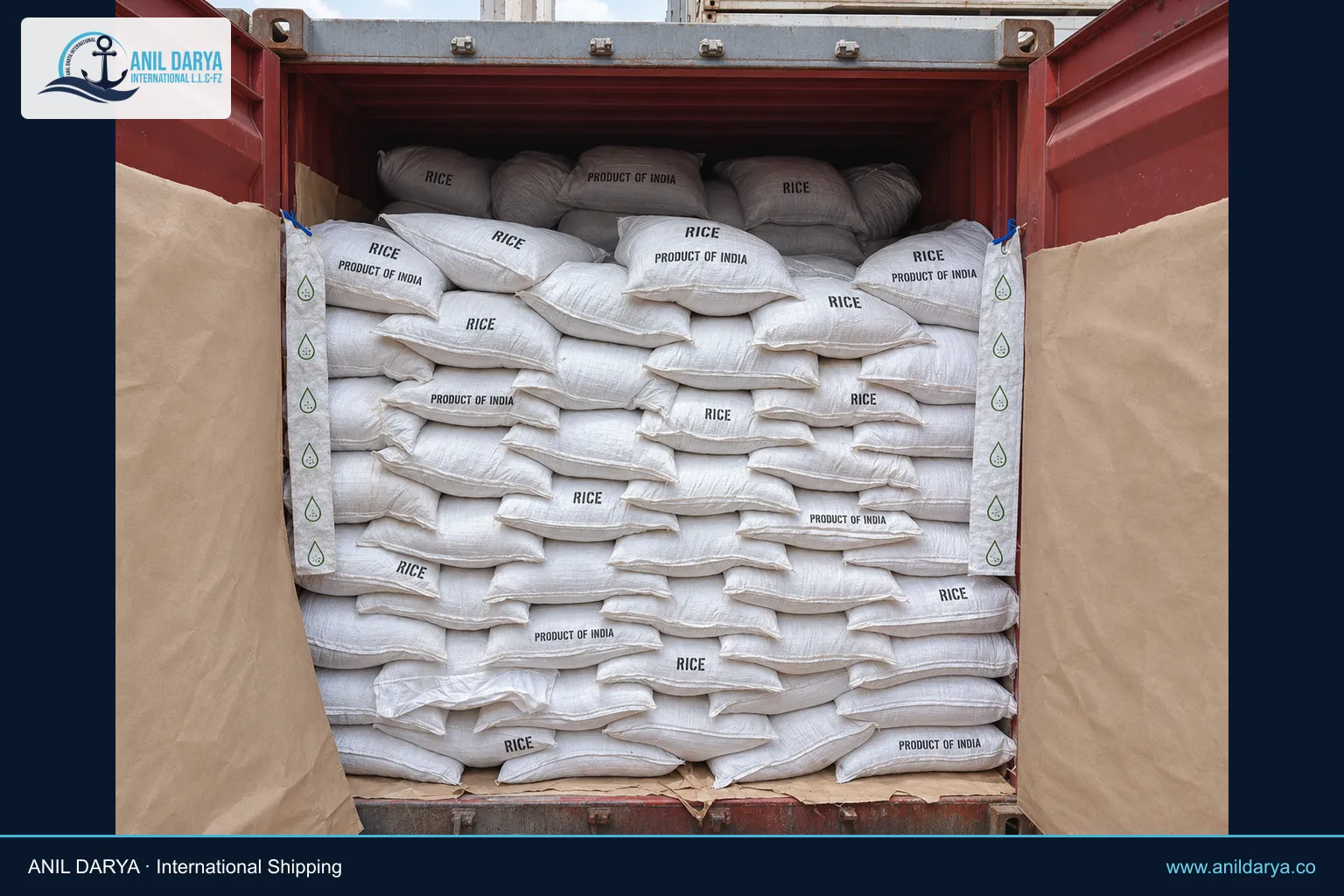
Rice, sugar and flour boxes
Bagged staples are a large part of this lane. The Djibouti port tariff book of 1 January 2018 gives full containers of rice, sugar and flour their own line for port dues, and it charges shore handling for local import boxes of these goods, delivered inside the port, at the transit rate. Ask the broker for the current tariff, and ask the supplier for a packing list by bag count and weight, since the declaration works from those numbers.
Machinery and project cargo
Pumps, generators, transformers and steel structures from India often go on to Ethiopia. A piece that fits a 40ft flat rack gets more sailings on a container service; larger pieces need breakbulk space into the Doraleh Multipurpose Port, and the vessel date sets the plan. We need drawings, weights and lifting points before we approach a line. Our break bulk and project cargo service covers that planning.
Dangerous goods
Insecticides, paints, solvents, some pharmaceutical inputs and lithium batteries leave India as dangerous goods. The IMDG Code 2024 edition (Amendment 42-24) became mandatory on 1 January 2026, so the Indian shipper's DG declaration and SDS must follow it. Djibouti adds its own port rules under the 2018 tariff:
- IMDG containers get no free storage at all.
- Class 1, 2.1, 2.3 and Class 3 with a flashpoint at or below 21°C go directly to inland transport.
- Class 7 is not accepted unless the competent authority instructs otherwise.
- Class 5.2, 6.2 and 8 boxes not cleared 15 days after discharge are sent back to the load port by the line.
- Undeclared IMDG boxes, or boxes arriving without hazard labels, are fined.
Our DG shipping desk checks the UN number, class, packing group and line acceptance for the Djibouti call before you choose a sailing.
The Indian export side
Indian Customs controls the export. Under section 50 of the Customs Act, 1962, the exporter files a shipping bill electronically, and under section 51 the proper officer then allows the goods to be cleared and loaded. The filing runs through ICEGATE, the customs portal. The exporter needs an Importer Exporter Code (IEC), which is the firm's 10-character PAN.
- The Indian seller, or its customs broker, files the shipping bill. A Djiboutian buyer cannot file it, so avoid EXW unless someone in India acts as exporter of record.
- Food staples such as rice and sugar sit in India's ITC(HS) export policy schedule, which DGFT changes by notification. The seller should check the line's current export policy before you sign the contract.
- Ask for the final shipping bill. Its value, description and HS code should match the commercial invoice the Djiboutian broker files, because Djibouti uses minimum reference values for food, appliances and clothing.
- Ask the broker whether your goods need a certificate of origin, and if so, have the Indian seller apply through its usual issuing agency before sailing.
The ECTN: filed in India before loading
CTN Djibouti, the authorised issuing agency, says the ECTN is required for shipments to Djibouti loaded on or after 15 June 2023. The requirement covers cargo bound for the Djibouti Free Zone and applies whatever the final destination, with one exception: goods in transit to Ethiopia are exempt when the bill of lading says so. The site describes the scope as containerised shipments in one place and all shipments in another, so check breakbulk and Ro-Ro lots with the agency before loading.
The Ethiopian Maritime Authority's 2023 notice said the shipper, exporter or forwarder obtains the ECTN at the port of loading using the B/L, commercial invoice and freight invoice, and the number goes on the B/L. So it must exist before the line issues the final B/L at Nhava Sheva or Mundra.
| Your cargo | ECTN | Settle before sailing from India |
|---|---|---|
| Container for a Djibouti importer | Required | Who files it (usually the Indian seller's side) and the number on the B/L |
| Container for a Djibouti Free Zone company | Required | As for local cargo |
| Container in transit to Ethiopia | Exempt if stated on the B/L | The exact transit wording, supplied by the Ethiopian buyer |
Name the ECTN filer in the sales contract; the Indian seller holds the papers, so its side usually files.
Import customs in Djibouti: declaration, documents and taxes
The Direction générale des douanes et droits indirects collects the TIC, excise and VAT on imports. The details below come from the WTO's trade policy review of Djibouti published in September 2022, the most complete official summary we could open. The broker should confirm each HS code.
Who files and on which system
In practice the importer uses a licensed clearing agent. DPFZA, the port and free zone authority, issues permits to forwarders and clearing agents only when they are Djiboutian nationals or companies wholly owned by Djiboutians. All import declarations are lodged in Sydonia World, in use since 2013; the 2021 version links customs with Ethiopian customs, the free zones and the port.
We do not clear goods in Djibouti and have no office there. We agree the arrival plan with the consignee's agent before confirming the booking and send the documents as soon as they are final.
Documents for an Indian shipment
The WTO review lists the declaration with the bill of lading, the invoice, the delivery order and the handling receipt, and notes that customs can ask for more. For a load from India, plan for this set:
| Document | From | Check before the ship sails |
|---|---|---|
| Commercial invoice | Indian seller | HS code, unit price, currency, Incoterm, full consignee name; signed and stamped |
| Packing list | Indian seller | Bags or packages, gross and net weight, marks, matching the B/L |
| Shipping bill copy | Indian seller or its broker | Same value and description as the invoice |
| Bill of lading | Shipping line, released through us | ECTN number or Ethiopia transit wording, correct notify party |
| Freight invoice | Carrier or forwarder | Needed for the ECTN application |
| ECTN | Usually the Indian seller's side | Validated before loading |
| Certificate of origin | Indian issuing agency | Only if the broker says your goods need one |
| Licences | Djiboutian ministries | Medicines, toxic substances, animal feed |
TIC, VAT and the duty basis
Djibouti has no formal customs tariff. The domestic consumption tax (TIC) does that job. It is charged ad valorem in five bands set by the 2022 finance law: 0%, 8%, 10%, 20% and 23%. The most frequent rate is 23%, and the simple average was 18.2% in 2022. VAT is charged at a standard 10% on the customs value plus any excise, and certain basic foods, farm inputs, medicines and books are exempt. Duty and taxes at destination are paid by the consignee or its broker.
| Indian goods group (WTO group averages, 2022) | Average TIC |
|---|---|
| Electrical machinery, such as cables and switchgear | 17.8% |
| Non-electrical machinery, such as pumps and engines | 17.6% |
| Transport equipment, such as cars and motorcycles | 17.7% |
| Metals and minerals, such as steel and wire | 21.1% |
| Chemicals, including many pharmaceutical and agro inputs | 21.3% |
| Textiles, such as yarn and fabric | 17.3% |
| Clothing | 9.9% (range 0 to 10%) |
For rice, sugar and other staples, ask the broker for the exact line: the review lists basic foods among VAT exemptions, but the TIC band depends on the product. Djibouti's valuation follows the WTO agreement, yet customs keeps indicative minimum values for some goods, including food, household appliances, electronics, building and furniture materials and clothing. A low invoice on those goods tends to be lifted at clearance. We found no pre-shipment inspection or conformity certificate scheme for Djibouti in the review; the ECTN is the pre-loading document to plan for.
Restricted goods that catch Indian cargo
Most of Djibouti's bans come from international conventions, and the country applies no import quotas. The WTO review names these specific rules, several of which bite on typical Indian loads:
- Right-hand-drive vehicles are banned. India's home-market cars, pick-ups and trucks are right-hand drive, so only left-hand-drive export versions can go.
- Non-biodegradable plastic bags are banned, which matters for packaging and for plastic product orders.
- Cooling appliances containing specified ozone-depleting substances, wild species and their skins and trophies are banned.
- Medicines need a Ministry of Health licence.
- Toxic or hazardous substances under treaties Djibouti has ratified need environment ministry authorisation.
- Animal feed needs Ministry of Agriculture authorisation.

Typical Indian cargo on this lane
India's Ministry of External Affairs, in its bilateral brief updated in March 2022, put Indian exports to Djibouti at USD 347.06 million in 2020-21 and said they consist mainly of:
- rice, fruit and vegetables, and other food items;
- engineering goods, machinery and metals;
- paper and plastic products;
- yarns and fabrics.
The same brief reported USD 619.03 million for April 2021 to January 2022. Much of this cargo is consumed in Ethiopia, which is why the transit rules below matter.
Cargo going on to Ethiopia
Many buyers who book India to Djibouti are Ethiopian. The box is discharged at Doraleh and moves inland. DPFZA says the Djibouti to Addis Ababa railway has run commercially since January 2018, takes about 12 hours against about three days by road, runs up to 4 or 5 trains a day into Ethiopia and serves both the SGTD container terminal and the DMP.
- Transit boxes get 8 free days against 3 for local cargo; book the train or truck early.
- The B/L must carry the Ethiopia transit wording for the ECTN exemption to apply.
- Ethiopian clearance, duty and haulage sit with the buyer and its Ethiopian agent; we make the B/L match what they need.
Where Dubai fits in shipping from India to Djibouti
For most Indian cargo the most direct sailing is best. Dubai helps in three cases.
| Option | When it helps | UAE side |
|---|---|---|
| Vessel call at Jebel Ali | The line's India to Djibouti loop calls Jebel Ali on the way, as the HAX rotation does | The box stays on board or on the carrier's through B/L and is not imported |
| Consolidation in Dubai | The Djibouti or Ethiopian buyer also buys from UAE suppliers and wants one shipment | Indian lots and UAE goods are combined in Dubai, then shipped on one B/L |
| Stock in Jebel Ali Free Zone | A trader wants Indian stock close to Djibouti and ships smaller lots on order | Goods enter the free zone and are re-exported as orders arrive |
The Dubai Customs customer guide says duty is suspended on goods in transit, goods admitted into free zones and goods imported for re-export, with a deposit or guarantee where customs asks for one. Its transit regime lets goods move from one foreign country to another through Dubai under customs control, within 30 days of clearing the transit declaration. For consolidation or free zone re-export, we handle Dubai customs clearance for a fee. Our Jebel Ali port guide and the article on JAFZA re-export of bulk and breakbulk explain the UAE side.
[AMIR-FACT: whether we route India to Djibouti cargo via Jebel Ali in practice (same-vessel call, Dubai consolidation or JAFZA re-export), on which services, and the extra days compared with a direct sailing]
How to ship from India to Djibouti: step by step
- Fix the final destination: Djibouti, the Djibouti Free Zone, or Ethiopia in transit. It decides the ECTN, the B/L wording and the free days.
- The consignee names its licensed Djiboutian clearing agent, plus an Ethiopian agent for transit cargo. We do not confirm the booking until this is in place.
- Send us the cargo details: commodity, HS code, bags or packages, weight, volume, supplier location in India, ready date, and any DG, Ro-Ro or out-of-gauge items.
- The broker checks the goods: TIC band, VAT, licences, minimum values, and bans such as right-hand-drive vehicles.
- We compare carriers and load ports and tell you whether the sailing is direct, calls Jebel Ali or relays at a hub.
- We book the space. For DG, reefer, Ro-Ro or flat rack cargo, the line's acceptance comes first.
- The seller or its origin agent picks up, stuffs and seals the box and files the shipping bill on ICEGATE before the gate cut-off.
- The ECTN is filed, or the Ethiopia transit wording agreed, before the final B/L is issued.
- We check invoice, packing list and draft B/L against each other, then release the carrier's B/L after sailing.
- The documents go to the Djiboutian broker early so the Sydonia World declaration is ready at berthing.
- The broker pays TIC, VAT and port charges, takes the delivery order and delivers; transit cargo leaves within its 8 free days.
[AMIR-FACT: one real cross-trade shipment we handled from India to Djibouti or on to Ethiopia (cargo, load port, carrier, how the ECTN and the consignee's broker were handled, transit achieved), cleared for publication]
What drives the cost of shipping from India to Djibouti?
We do not print rates, because they move with season, carrier and routing. These are the parts of the total.
| Cost part | What moves it |
|---|---|
| Origin in India | Factory to port trucking or rail, export filing, terminal handling, LCL consolidation |
| Ocean freight | Box type, weight, direct call or relay, season, surcharges |
| ECTN | A fee per shipment, and a hold if it is missing |
| Special cargo | DG surcharges, Ro-Ro charges by size, flat rack lashing |
| Djibouti port and terminal | Port dues and handling, which differ for local, transit and staple cargo |
| Storage and container detention | Days beyond 3 or 8 free days; from day one for DG and out-of-gauge |
| Duty and taxes | TIC band, 10% VAT, excise, minimum values |
| Onward to Ethiopia | Rail or truck, Ethiopian charges |
See our article on demurrage and detention.
Checklist before the container leaves India
- Final destination agreed: Djibouti, free zone or Ethiopia transit.
- Djiboutian clearing agent named and in touch with us.
- HS codes, TIC band and VAT checked by that agent.
- Indian export policy checked for rice, sugar or other controlled lines.
- Vehicles confirmed left-hand drive.
- Licences in hand for medicines, chemicals or feed.
- ECTN validated, or the Ethiopia transit wording agreed.
- Invoice signed and stamped; invoice, packing list, shipping bill and draft B/L match.
- For DG: SDS, IMDG declaration and the line's acceptance.
- For Ethiopia: train or truck booked inside the 8 free days.
Mistakes to avoid
- Shipping before destination clearance is agreed. Local boxes have 3 free days, and DG or flat racks pay storage from the first day.
- Loading without an ECTN number on the B/L. Fix it at Nhava Sheva or Mundra, not after arrival.
- Leaving out the Ethiopia transit wording, which loses the exemption.
- Sending right-hand-drive vehicles. They are banned in Djibouti.
- Under-valuing food, appliances or clothing. Minimum values apply.
- Assuming an Indian drug licence is enough. Djibouti's Ministry of Health issues its own.
Frequently asked questions
How long does shipping from India to Djibouti take?
It depends on the service; a direct loop beats a relay at a hub. One carrier's maiden HAX sailing was scheduled from Nhava Sheva on 1 September to Djibouti on 13 September 2025, via Jebel Ali. Ask for the rotation with each quote.
Which Indian port is best for cargo to Djibouti?
Nhava Sheva and Mundra have the most Djibouti connections. Use the one nearest the factory with a suitable sailing; South Indian ports more often relay through a hub.
Do I need an ECTN for a container from India to Djibouti?
Yes, for shipments loaded on or after 15 June 2023, including free zone cargo. Cargo in transit to Ethiopia is exempt if the bill of lading says so. The number must be on the final B/L.
What import taxes apply to Indian goods in Djibouti?
A domestic consumption tax (TIC) at 0%, 8%, 10%, 20% or 23% by HS code, plus 10% VAT and excise on some goods. Some basic foods and medicines are VAT exempt. The consignee or its broker pays.
Can I ship cars from India to Djibouti?
Yes, if they are left-hand drive. Djibouti bans right-hand-drive vehicles. Cars go Ro-Ro to the Doraleh Multipurpose Port or in containers, with 3 free days for local import and 8 for transit.
Who clears the cargo in Djibouti?
The consignee's licensed Djiboutian clearing agent, who files in Sydonia World. Agents need a DPFZA permit and must be Djiboutian-owned. We agree the plan with that agent before we confirm the booking.
Can Indian cargo go to Ethiopia through Djibouti?
Yes. The container lands at Doraleh and moves by rail or road. The B/L carries the transit wording, and the buyer's Ethiopian agent handles Ethiopian clearance.
Why route India to Djibouti cargo through Dubai?
Only when it adds something: a loop that calls Jebel Ali, combining Indian and UAE goods, or holding stock in Jebel Ali Free Zone and re-exporting smaller lots. Duty is suspended in Dubai on goods in transit or in a free zone.
Get a quote for shipping from India to Djibouti
Tell us the supplier's city in India, the cargo, the weight, the ready date and whether the goods stay in Djibouti or go on to Ethiopia. Use the freight rate inquiry form, or contact our team first if the load is DG, Ro-Ro or project cargo. You can also read about our Dubai freight forwarding team.
Sources
- CBIC: Customs Act, 1962, sections 50 and 51
- ICEGATE: shipping bill filing FAQ
- DGFT: Foreign Trade Policy 2023, chapter 2 (IEC, ITC(HS) export policy)
- Ministry of External Affairs, India: India-Djibouti bilateral brief (March 2022)
- United Africa Feeder Line: HAX Horn of Africa Express launch (14 August 2025)
- United Africa Feeder Line: HAX route page
- IMO: IMDG Code 2024 edition
- DPFZA: SGTD Doraleh container terminal
- DPFZA: Doraleh Multipurpose Port
- DPFZA: Djibouti to Addis Ababa railway
- DPFZA: forwarder and clearing agent permits
- Port de Djibouti: general cargo
- Djibouti Ports: Tariff Book, 1 January 2018
- CTN Djibouti: ECTN requirement
- Ethiopian Maritime Authority: Djibouti ECTN scheme (June 2023)
- WTO: Trade Policy Review of Djibouti, WT/TPR/S/430 (2022)
- WTO: Trade Policy Review of Djibouti, summary
- Dubai Customs: Customer Guide (duty suspension, transit regime)
Reviewed: 11 November 2026