
Shipping from India to Madagascar means a sea leg from a west or south Indian port to Toamasina, with at least one change of ship at a hub such as Port Louis, Reunion or Salalah, because no carrier page we opened shows a direct India to Toamasina call. Three papers decide how fast the box is released: the Indian shipping bill, the BSC cargo tracking note opened by the exporter, and the import declaration lodged by a licensed Malagasy customs broker. We book the ocean freight from Dubai, release the line's bill of lading and keep the Indian seller, the carrier and the consignee's broker working to the same dates.
Shipping from India to Madagascar at a glance
| Item | What applies on this lane |
|---|---|
| Usual Indian load ports | Nhava Sheva and Mundra in the west; Chennai, Kattupalli and Tuticorin in the south; Cochin for Kerala cargo |
| Port of discharge | Toamasina, where the MICTSL terminal handles over 90% of Madagascar's container throughput |
| Routing | Relay via a hub (Port Louis, Reunion or Salalah are the options seen on carrier pages); no direct call found |
| Trade size | Indian exports to Madagascar of USD 268.80 million in FY 2024-25, per the Embassy of India |
| Main Indian cargo | Rice, medicines, cotton textiles and yarn, machinery, vehicles, ceramic tiles, animal feed |
| Indian export filing | Shipping bill on ICEGATE by the exporter or its customs broker; IEC needed; APEDA RCAC for non-basmati rice |
| Cargo tracking note | BSC required for every cargo bound for Madagascar, opened by the exporter or its representative |
| Import clearance | Only through a licensed commissionnaire agréé en douane (CAD) chosen by the consignee |
| Duty and VAT | Duty on the CIF value from the national tariff; VAT 20% on CIF plus duty; no preference for Indian goods |
| Container limits | 32,000 kg gross per 20ft or 40ft; no 45ft boxes; OOG, IMO and breakbulk only at Toamasina (Maersk) |
Who does what on an India to Toamasina cross-trade booking
Four parties share the work, and clear ownership stops anyone finding out at discharge that nobody opened the BSC.
- The Indian seller or its origin agent packs and stuffs the container, trucks it to the port and files the shipping bill. For non-basmati rice, the seller also registers the contract with APEDA before loading.
- We book the space with the shipping line from Dubai, pass the cut-offs to the seller, check the draft bill of lading against the invoice and track the box through the relay hub.
- The bill of lading is the shipping line's own. We act as agent for many lines, so the carrier's B/L is issued and released to you through us. We do not issue a house bill of our own on this lane.
- The consignee's licensed broker in Madagascar lodges the import declaration, and the consignee or its broker pays duty and taxes there.
We do not sell customs clearance in Madagascar. Before we confirm a booking, the consignee names its broker, the broker confirms it has the papers it needs, and only then does the box load in India. Clearance in Dubai is a service we do sell, for a fee, if the cargo is routed through Dubai.
Indian load ports and the Malagasy port of discharge
Choosing the Indian port by supplier region
Pick the load port that sits closest to the factory and has the most relay options. Gujarat, Rajasthan, Punjab and north Indian suppliers usually load at Mundra or Pipavav. Maharashtra, Madhya Pradesh and Karnataka suppliers usually load at Nhava Sheva. Tamil Nadu and Andhra cargo goes from Chennai, Kattupalli or Tuticorin, and Kerala cargo from Cochin. Surat textile and chemical cargo can load at Hazira.
Toamasina and the MICTSL terminal
Toamasina, on the east coast, is the island's container gateway. Its terminal is run by Madagascar International Container Terminal Services Ltd (MICTSL), an ICTSI company that has held the concession since 2005. ICTSI says the terminal handles over 90% of the country's annual container throughput and that the concession now runs to 2040.
| MICTSL item | Figure |
|---|---|
| Terminal area | 34 hectares, with 29 hectares of yards in 4 yards |
| Container quay | 333 m long, 16 m deep |
| Reefer plugs | 176 |
| Cranes | 3 mobile harbour cranes, 10 RTG cranes |
| Expansion | New berth of 756 m at 16 m for ships up to 14,000 TEU (ICTSI, 2021 plan) |
The local press reported in September 2026 that a 333 m section of the new C4 quay entered service a few months earlier, with 10 hectares of extra storage.
Other Malagasy ports and Antananarivo
Mahajanga, Antsiranana, Toliara and Ehoala (Fort Dauphin) are much smaller ports. Maersk states it accepts no cargo at Madagascar's secondary ports, and that out-of-gauge, IMO and breakbulk cargo are accepted only to and from Toamasina. Most Indian cargo for the capital is trucked from Toamasina to Antananarivo. Maersk lists Toamasina, Antananarivo and Antsirabe as inland points served by truck only.
Sea freight from India to Madagascar: relay hubs and connecting services
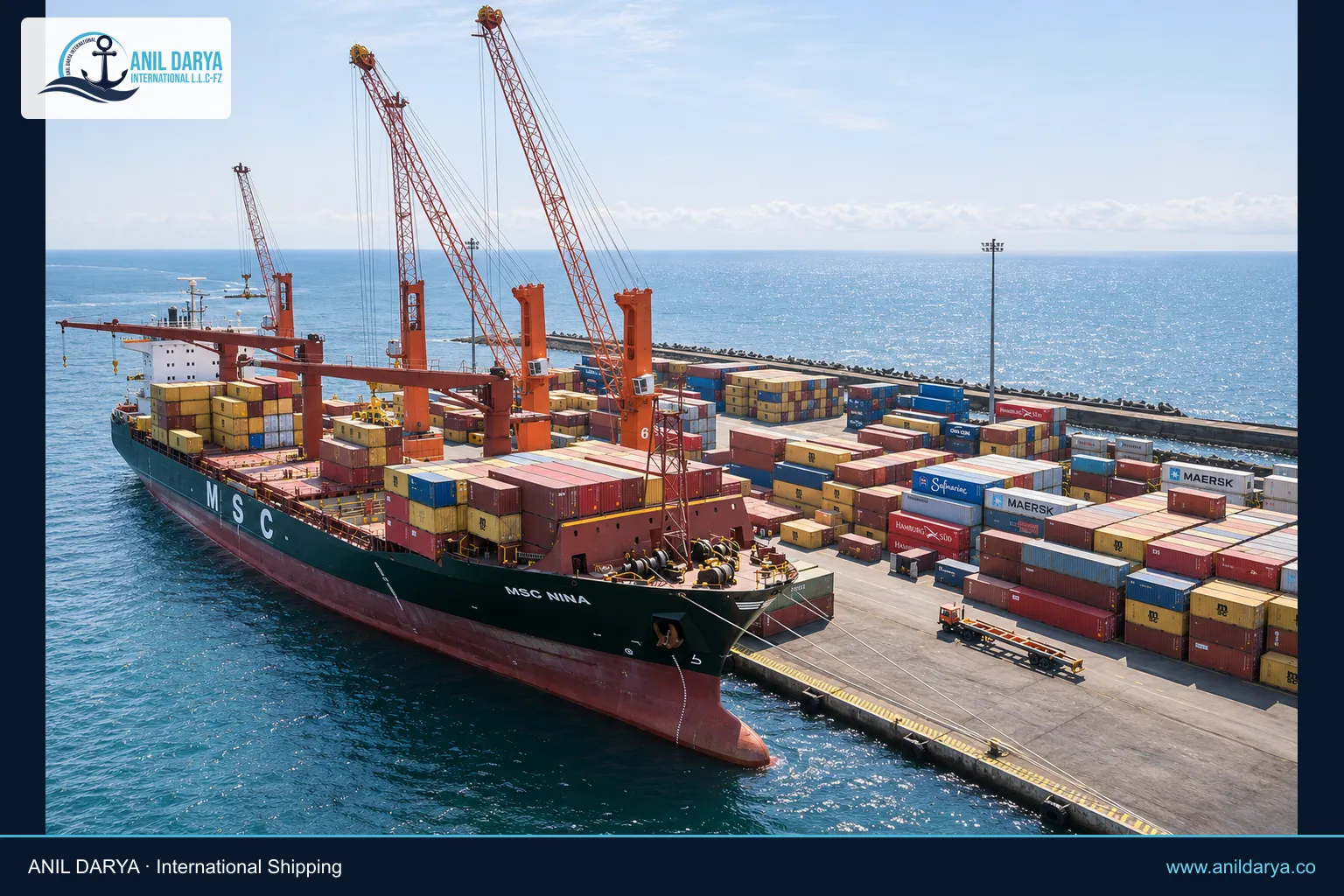
We found no carrier schedule page in 2026 showing a ship that loads in India and calls at Toamasina on the same voyage. Indian cargo therefore changes ship once, sometimes twice. The connections below are drawn from carrier and port pages we opened. Where we join two services ourselves, this is a possible connection, not a published routing.
| Hub | India side | Toamasina side | Status of the source |
|---|---|---|---|
| Port Louis (Mauritius) | MSC India to South Africa service: Mundra, Nhava Sheva, Hazira, Colombo, Port Louis, Durban | Regional feeders between Mauritius, Reunion and Madagascar | MSC loop reported May 2023; possible connection, confirm the current rotation |
| Pointe des Galets (Reunion) | CMA CGM's MIDAS linked Reunion with India and Africa | CMA CGM's MASCAREIGNES feeder linked Reunion, Mauritius and Madagascar weekly | CMA CGM hub page dated January 2016; confirm both services still run |
| Salalah (Oman) | Needs a separate India to Salalah leg; check current carrier schedules | Maersk's Madagascar route list shows the IOI service with Salalah | Possible connection we have inferred, not a published routing |
One more option is worth knowing. In September 2026 the Dubai-based line UAFL made its first call at Toamasina with the 622 TEU UAFL Express, arriving from Mutsamudu in the Comoros and sailing on to Nacala. The report names the Indian subcontinent as part of the line's network but lists no Indian port call, so treat it as a Dubai or regional link, not an India service.
Published transit days are not printed here. No carrier page we opened gives an India to Toamasina time, and competitor figures disagree with each other and name no source. Your total time is the Indian leg, the dwell at the hub and the feeder leg, and the dwell is the part that moves most.
[AMIR-FACT: carriers and relay hubs we actually book from Nhava Sheva, Mundra and Chennai to Toamasina in 2026, and real port-to-port days including hub dwell]
Can the cargo move through Dubai?
Dubai is not on the direct path from India to Madagascar, but it helps in three cases. First, when the consignee buys from Indian and Gulf suppliers and wants one container to Toamasina: we consolidate the cargo in Dubai and book one box onward. Second, when a trader keeps stock of Indian goods in the Jebel Ali Free Zone and sells to Madagascar in smaller lots. Third, when a carrier's Jebel Ali service gives a better Indian Ocean connection than the hubs above.
Goods held in Jafza and re-exported need a Dubai Customs declaration for the free zone movement, and we handle that clearance for a fee. A re-export certificate of origin from Dubai Chambers can be issued for goods leaving Dubai, but the origin of Indian goods stays Indian. Because Madagascar gives no tariff preference to Indian goods, a Dubai stop does not cost a duty preference on this lane. The BSC must still name the real exporter and match the final invoice, so agree with the consignee's broker who appears as exporter before the box leaves Dubai. Read our guide to JAFZA re-export and the Jebel Ali port guide for the Dubai side.
[AMIR-FACT: whether we have moved Indian goods for Madagascar through Jebel Ali (consolidation or Jafza stock), the carrier from Jebel Ali to Toamasina and the real extra days against a Port Louis relay]
FCL, LCL, bagged rice and project cargo
Container rules at Toamasina
Maersk's Madagascar pages set limits that apply to every Indian booking: a gross weight of 32,000 kg including tare for both 20ft and 40ft boxes, and no 45ft containers at all. Split bills of lading are not accepted, and customs does not allow manifest amendments after arrival. Maersk states that each amendment request can draw a fine, charged to the party asking for the correction. Get the B/L right before the ship sails.
Full container load suits a single Indian supplier filling a 20ft with rice, tiles or yarn, or a 40ft with garments and medicines. LCL works for small orders, but each house bill has to be declared to the line's local agent before arrival, and one house bill cannot be split into two at Toamasina. Our FCL vs LCL guide shows where the break-even usually sits.
Bagged rice in containers
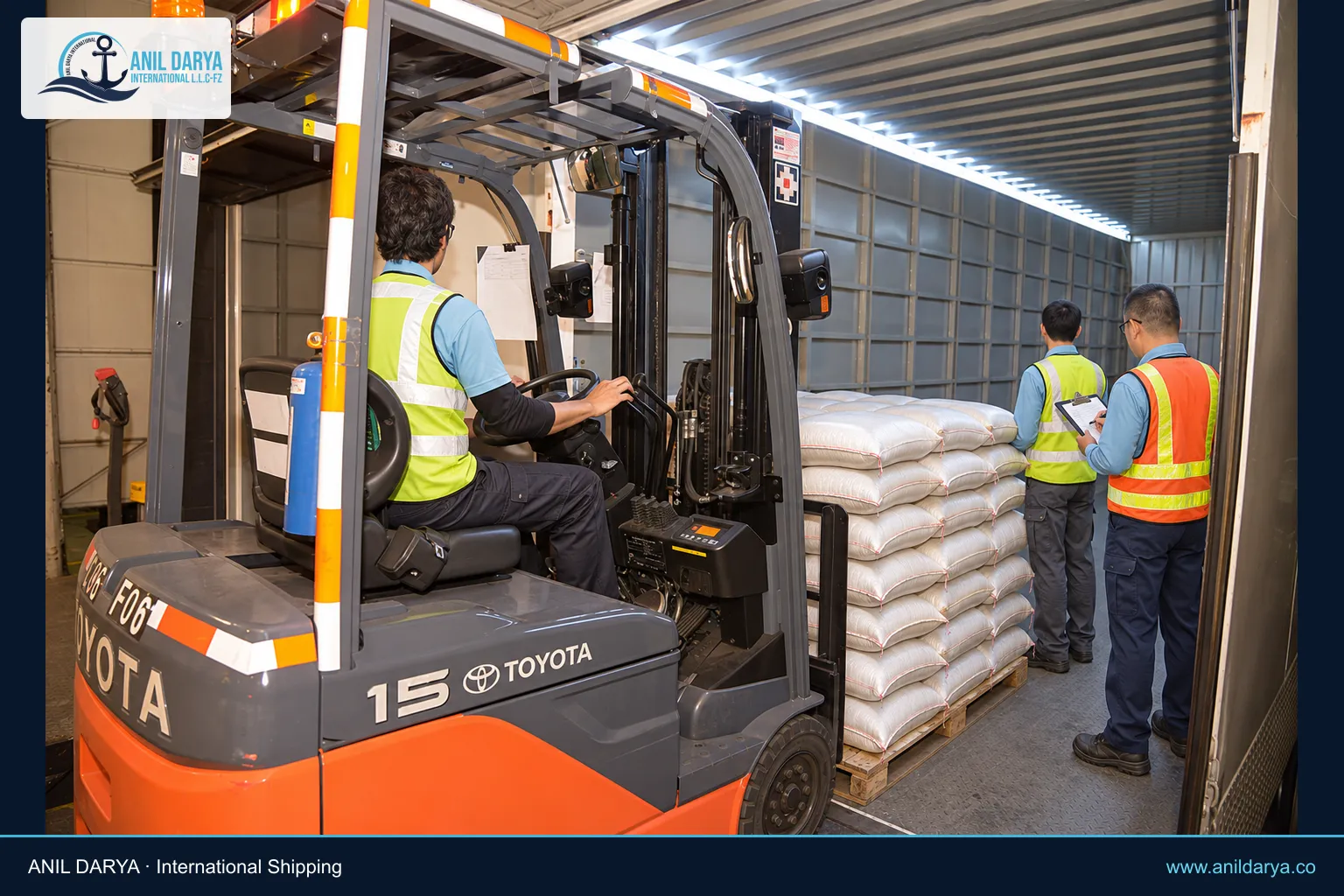
Rice is India's largest export to Madagascar. It usually moves in 50 kg or 25 kg bags in 20ft boxes, filled up to the 32,000 kg gross limit. Ask the mill for clean, dry, lined containers, and weigh each box at the mill gate so it is not refused at the terminal.
Machinery, vehicles and out-of-gauge cargo
Generators, pumps, tractors and road equipment from India go in flat racks or open tops, or as breakbulk. All three are accepted only at Toamasina, and breakbulk needs the line's prior approval. Plan the lift with our breakbulk team before the supplier fixes its delivery date. Check vehicle rules before you buy: Madagascar bans right-hand-drive vehicles and cut vehicles, and sets age limits for goods and passenger transport vehicles (see the restricted goods section).
Dangerous goods on this lane
Agro-chemicals, paints, solvents, adhesives and some pharmaceutical inputs from India are often dangerous goods. The 2024 edition of the IMDG Code (Amendment 42-24) became mandatory on 1 January 2026, so the shipper's DG declaration, packaging marks and labels must follow it. Maersk accepts IMO cargo only to and from Toamasina, and the relay carrier at the hub must accept the same class. Maersk also publishes a separate inland haulage charge for dangerous cargo moving from Toamasina to Antananarivo, which the consignee should budget for. Send us the safety data sheet and UN number before booking, and our dangerous goods desk checks acceptance on every leg.
The India export side: shipping bill, IEC and the rice RCAC
India's Customs Act requires the exporter to file a shipping bill (section 50), and customs lets the goods go once they are cleared for export (section 51). The exporter or its licensed customs broker files on ICEGATE, using a registered ICEGATE ID and a Class 3 digital signature. The exporter needs an Importer Exporter Code from DGFT, which is linked to its PAN. After sailing, the shipping line files the export general manifest.
Non-basmati rice has one extra step. Under DGFT notification 33/2025-26 of 24 September 2025, exports under ITC(HS) 10063011, 10063019, 10063091, 10063099 and 10064000 are allowed only after the contract is registered with APEDA. APEDA issues a Registration-cum-Allocation Certificate (RCAC) online, the exporter hands it to customs, and it is valid for shipment for 45 days from issue. A box rolled to a later vessel can fall outside that window, so send us the RCAC date with the booking request. Indian export policy on rice can change by notification, so check the current DGFT position before each contract.
Keep the shipping bill identical to the final invoice the Malagasy broker uses; the same invoice goes on the BSC.
The BSC: Madagascar's cargo tracking note
Who opens it and when
Madagascar customs states that every cargo bound for Madagascar must be covered by a BSC (Bordereau de Suivi des Cargaisons). The customs FAQ puts the job on the exporter or its representative. The BSC can be opened only when both exporter and importer are registered on the BSC site, the goods have been loaded and the final documents exist. Maersk's import page describes it as an electronic submission by the exporter or its forwarding agent before shipment. In practice: register both parties early, and open the BSC as soon as the carrier's B/L is issued in India.
Exemptions are narrow: postal and air parcels with a FOB value up to EUR 100, documents and samples, defence material, Central Bank banknotes, state gifts, diplomatic bags and disaster relief. A commercial container from India is never exempt.
Why a BSC gets rejected
The GasyNet technical centre checks each BSC for admissibility. Customs lists three rejection reasons: required documents missing or mandatory fields empty, information that does not match between documents, and an incomplete invoice. On Indian cargo, watch for a proforma uploaded instead of the final invoice, and B/L weights or consignee names that differ from the invoice.
[AMIR-FACT: how the BSC is opened on our India to Madagascar bookings (seller, origin agent or us), the documents we collect and the usual validation time]
Madagascar import clearance: licensed broker and documents
All clearance in Madagascar goes through a commissionnaire agréé en douane (CAD). The importer can choose any CAD licensed at the customs office concerned, and a company can clear its own goods only with approval from the minister in charge of customs. The broker lodges the declaration in the customs system, and customs checks and liquidates it before release.
Customs lists the documents usually requested: the final invoice, the transport document (B/L), the tax identification certificate (original and copy, for the first operation) and the packing list. The US Commercial Service adds the BSC, the bank payment record, the import declaration and a certificate of origin to the mandatory list. For Indian cargo, ask the seller for a non-preferential certificate of origin even though no preference applies.
Duty and VAT on goods shipped from India to Madagascar
Duty is charged on the CIF value in ariary, converted at the exchange rate on the day of the declaration. The customs FAQ gives the method: duty equals CIF times the rate in the tariff, and VAT equals CIF plus duty, times the VAT rate. The US Commercial Service reports duty rates from 5% to 20%, adjusted each year in the budget, with about 40% of imports at 20%, and VAT at 20%. The customs FAQ also lists an advance tax at import: 5% of CIF for importers without a tax number, and a 2% advance (ARS) for companies.
| Step | How it is worked out | Source |
|---|---|---|
| Customs value | CIF value in MGA at the rate on the declaration date | Douanes malagasy FAQ |
| Customs duty | CIF x tariff rate (5% to 20% band) | Douanes FAQ; trade.gov |
| VAT | (CIF + duty) x 20% | Douanes FAQ; trade.gov |
| Advance tax | 5% of CIF without a tax number; 2% ARS for companies | Douanes FAQ |
Customs publishes the 2026 tariff and an updated version after the 2026 amended finance law. Have the broker read the rate for your exact HS code from that tariff. Duty and taxes at destination are paid by the consignee or its broker.
Rice in 2026: higher duty and a safeguard investigation
Rice shippers should watch two changes. L'Express de Madagascar reported in July 2026 that imported rice now carries 20% customs duty and 5% VAT under the amended finance law; confirm the rate for your rice line in the current tariff. Separately, the WTO recorded that Madagascar started a safeguard investigation on 31 August 2026 into hulled, semi-milled or wholly milled, and broken rice, notified on 2 September 2026. No measure had been reported when we reviewed this page. A safeguard duty, if one follows, would add to the cost of Indian rice, so check the position before you sign a forward contract.
Does any trade agreement cut duty on Indian goods?
No. Madagascar customs lists its preferential arrangements as SADC, COMESA, the Indian Ocean Commission, the EU interim EPA, AGOA, generalised preference schemes, China and India. The India entry is the Indian GSP for least developed countries, a one-way preference for Malagasy goods entering India. It asks for a Form A certificate of origin in English and direct transport to India. It does nothing for Indian goods entering Madagascar.
The US Commercial Service names the EU interim EPA, SADC, the IOC and COMESA as the partners whose goods can enter duty-free, and India is not among them. The African Continental Free Trade Area covers trade between African states, not goods made in India. So Indian goods pay the normal tariff rate, whether they sail direct from India or via Dubai.
Re-invoicing Indian goods in Mauritius, South Africa or Dubai does not give them SADC or COMESA origin; origin follows where they were made.
Typical cargo on the India to Toamasina lane
The Embassy of India in Antananarivo reports Indian exports of USD 268.80 million in FY 2024-25 and USD 276.68 million in the first nine months of FY 2025-26, to December 2025. Madagascar sold USD 186.94 million to India in FY 2024-25, led by cloves.
| Cargo | HS line (example) | Shipping note |
|---|---|---|
| Milled rice | 1006.30 | Bagged in 20ft; APEDA RCAC in India; 2026 rice duty change at destination |
| Medicines, incl. antibiotics | 3004.90, 3004.20 | Prior authorisation in Madagascar; reefer only if the label requires it |
| Animal feed preparations | 2309.90 | Bagged FCL; keep dry |
| Denim and cotton yarn | 5209.42, 5205.24 | 40ft FCL or LCL; match roll counts to the packing list |
| Passenger cars | 8703.21 | Left-hand drive only; usually containerised |
| Ceramic paving and tiles | 6907.23 | Heavy; 20ft to stay under 32,000 kg gross |
The HS lines come from a commercial ranking of India's top export lines to Madagascar (Ximpex), not from an official statistics page, so treat the order as a guide.
Restricted and prohibited goods in Madagascar
The US Commercial Service lists as prohibited: radioactive waste, pornographic material, counterfeit and pirated goods, and goods with false origin labels. Prior authorisation is needed for firearms and explosives, pharmaceuticals, diamonds, gemstones and precious-metal jewellery, and vanilla. Lubricants need an import licence and tobacco leaf has special rules. Madagascar customs adds vehicle rules: right-hand-drive and cut vehicles are prohibited, goods vehicles must be under 15 years old and public transport vehicles under 10.
Medicines are the line to plan earliest. The Agence du Médicament de Madagascar handles registration and marketing authorisation, so the consignee should confirm that each Indian product is registered before the order is placed, not after the box lands.
Shipping from India to Madagascar step by step
- The consignee names its licensed broker in Madagascar, and the broker confirms the HS code, the rate in the 2026 tariff and the documents it needs.
- For medicines, the consignee confirms the product authorisation; for rice, the seller registers the contract with APEDA and gets the RCAC.
- You send us the cargo details, Incoterm, load port and ready date through the freight rate inquiry form.
- We check which relay hub has space and accepts the cargo class, and confirm the booking only after the broker has agreed to clear.
- The seller and the consignee both register on the BSC platform.
- The seller stuffs the container, trucks it in before the gate cut-off and files the shipping bill on ICEGATE.
- We check the draft B/L against the final invoice and packing list; once the vessel sails, the B/L is issued and the exporter opens the BSC.
- We track the box through the hub and pass the arrival notice to the broker.
- The broker lodges the declaration; the consignee or its broker pays duty, VAT and the advance tax; the box is released and trucked to the consignee.
What drives the cost of shipping from India to Madagascar?
We do not publish rates. These factors move your quote:
- The relay hub and dwell time: a second transhipment adds handling and days.
- The Indian load port: a port with frequent hub connections often costs less than a smaller port that feeds first.
- Box type and weight: heavy rice and tile boxes may need a 20ft where a 40ft would carry more volume.
- Cargo class: DG, reefer and out-of-gauge cargo pay surcharges on each leg and inland.
- Inland haulage to Antananarivo, including the separate dangerous cargo charge.
- Duty, VAT and advance tax at destination, paid by the consignee or its broker.
- Delays: manifest amendment fines, demurrage and detention when papers are late. Our demurrage and detention guide explains how free time runs out.
Checklist before the cargo leaves India
- Consignee's broker named and confirmed in writing
- HS code and 2026 tariff rate checked by the broker
- Exporter and importer registered on the BSC platform
- Final commercial invoice, not a proforma
- Packing list with gross weights that match the B/L
- Shipping bill filed; IEC on the documents
- APEDA RCAC for non-basmati rice, with shipment inside 45 days
- Non-preferential certificate of origin
- Medicine authorisation confirmed by the consignee
- DG declaration under IMDG 2024 for hazardous cargo
- Gross weight under 32,000 kg; no 45ft box
Mistakes that hold Indian cargo at Toamasina
| Mistake | What happens | How to avoid it |
|---|---|---|
| Shipping before the destination broker is agreed | The box lands with no one ready to clear it and storage starts | Name the broker and get its document list before we confirm the booking |
| No BSC, or one opened late | Customs will not clear the cargo | Register both parties early; open the BSC once the B/L is issued |
| Proforma attached to the BSC | BSC rejected for an incomplete invoice | Upload the final invoice only |
| Correcting the manifest after sailing | Fines per amendment request | Check the draft B/L line by line |
| Planning to split one B/L at Toamasina | Not accepted in Madagascar | Issue separate B/Ls in India |
| Rice RCAC expired before loading | Indian customs will not let the rice go | Book inside the 45-day window |
| Claiming SADC or COMESA origin for Indian goods | Refusal or penalties for false origin | Declare Indian origin |
Frequently asked questions
Is there a direct ship from India to Madagascar?
We found no carrier page in 2026 that shows a direct call from an Indian port at Toamasina. Indian cargo changes ship at a hub such as Port Louis, Reunion or Salalah. Ask us which relay has space for your sailing.
How long does shipping from India to Madagascar take?
It depends on the hub and the dwell there. No carrier page we opened publishes an India to Toamasina time, so we quote real days per booking.
What duty does Madagascar charge on goods from India?
Duty is charged on the CIF value at the rate in the national tariff, reported in a 5% to 20% band. VAT is 20% on CIF plus duty, and an advance tax is also taken at import. Indian goods get no preferential rate.
What is the BSC and who opens it?
The BSC is Madagascar's cargo tracking note, required for every cargo bound for Madagascar. The exporter or its representative opens it once the goods are loaded and the final invoice and B/L exist. Both parties must be registered first.
Does rice from India need special papers?
Yes, on the Indian side. Non-basmati rice can only be exported after the contract is registered with APEDA, and the RCAC is valid for shipment for 45 days. In Madagascar, check the 2026 rice duty and the status of the safeguard investigation.
Does Anil Darya clear customs in Madagascar?
No. Clearance in Madagascar is done by the consignee's licensed broker, which must be agreed before we confirm the booking. We clear cargo in Dubai, for a fee, when it moves through Dubai.
Who issues the bill of lading on an India to Madagascar booking?
Your B/L for Toamasina is the carrier's own document, not a house bill. Since we are agent for many lines, the line issues it and we release it to you once the Indian seller's terms are met.
Get a quote for shipping from India to Madagascar
Send the load port, cargo, weight and ready date through our freight rate inquiry, or reach the team on the contact page. Read about our sea freight service and our Dubai freight forwarding team.
[AMIR-FACT: one real India to Madagascar cross-trade shipment we handled, with cargo, ports, hub and days, cleared for publication by the client]
Sources
- Douanes malagasy: clearance, BSC, licensed broker, documents
- Douanes malagasy: FAQ (duty and VAT method, advance tax, BSC, vehicles, advance rulings)
- Douanes malagasy: customs tariff 2026
- Douanes malagasy: international agreements
- Douanes malagasy: Indian GSP for least developed countries
- US Commercial Service: Madagascar import tariffs (4 August 2025)
- US Commercial Service: Madagascar import requirements and documentation
- US Commercial Service: Madagascar prohibited and restricted imports (4 August 2025)
- WTO: Madagascar safeguard investigation on rice (3 September 2026)
- L'Express de Madagascar: tax on imported rice (July 2026)
- Embassy of India, Antananarivo: India-Madagascar trade
- MICTSL: terminal infrastructure and equipment
- ICTSI: Madagascar concession extended
- Newsmada: new line at Toamasina (17 September 2026)
- Maersk: Madagascar import rules
- Maersk: Madagascar export rules
- Maersk: Madagascar routes
- Maersk: inland services in Madagascar
- Maersk: dangerous cargo inland haulage to Antananarivo
- Maritime Gateway: MSC India to South Africa service (6 May 2023)
- CMA CGM: Reunion Indian Ocean hub (January 2016)
- APEDA: non-basmati rice contract registration and RCAC (25 September 2025)
- CBIC: Customs Act, 1962, sections 50 and 51
- ICEGATE: help and FAQ
- DGFT: Foreign Trade Policy 2023, chapter 2 (IEC)
- MSH IMPACT: Madagascar medicines regulation and the AMM
- IMO: IMDG Code 2024 edition
- Ximpex: India's top export lines to Madagascar
- Dubai Customs: customs declaration regimes
- Jafza: Jebel Ali Free Zone
- Dubai Chambers: certificates of origin
Reviewed: 14 November 2026