
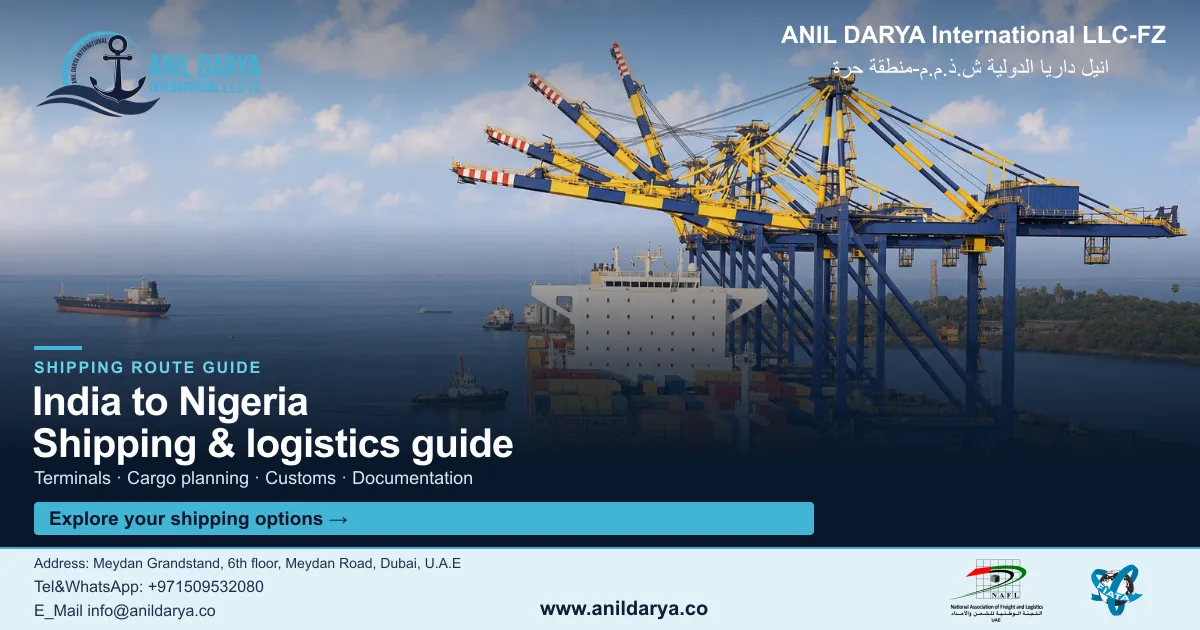
Shipping from India to Nigeria is a long container run: boxes load at Nhava Sheva or Mundra on the west coast and discharge at Apapa or Tin Can Island in Lagos, or at Onne near Port Harcourt. DP World's trade lane page lists 35 to 38 days port to port from Nhava Sheva to Lagos on a weekly direct service. Before any box sails, the Nigerian importer needs an approved Form M, regulated goods need SONCAP papers, and medicines need NAFDAC approval. We book the sea freight from Dubai and keep the Indian exporter and the Nigerian clearing agent on one timetable.
India to Nigeria shipping at a glance
| Item | Detail |
|---|---|
| Main Indian load ports | Nhava Sheva (JNPA, Navi Mumbai) and Mundra (Gujarat) |
| Main Nigerian discharge ports | Lagos Port Complex (Apapa) and Tin Can Island in Lagos; Lekki Deep Sea Port; Onne in Rivers State |
| Published transit indication | Nhava Sheva to Lagos 35 to 38 days, Mundra to Lagos 36 to 38 days, weekly direct (DP World India to Africa trade lane page) |
| Indian export filing | Shipping bill on ICEGATE, by the exporter or its customs broker |
| Nigerian pre-import approval | Form M, opened by the importer through its Authorised Dealer Bank before shipment |
| Product conformity | SONCAP for regulated goods; NAFDAC registration and pre-shipment checks for medicines and other NAFDAC goods |
| Nigerian customs system | B'Odogwu, the Nigeria Customs Service trade platform; PAAR created from the Form M |
| Duty and VAT | ECOWAS Common External Tariff bands of 0% to 35%, mostly on CIF value, plus 7.5% VAT |
| Bill of lading | The shipping line's own B/L, issued and released to you through us as agent for the line |
| Who clears in Nigeria | The consignee's licensed customs agent, confirmed before we accept the booking |
Who does what on this cross-trade booking
The container goes straight from an Indian terminal to a Nigerian one, so the UAE is not on the cargo's path unless you choose to route it there. Three parties share the work.
- Anil Darya books the sea freight with the shipping line, checks the draft papers against the Form M, and follows the box from the cargo ready date to discharge in Lagos or Onne.
- The Indian exporter, or its own origin agent, collects the goods, stuffs the container and files the Indian shipping bill. We give them the booking number, terminal and cut-off so the filing is on time.
- The Nigerian buyer's licensed customs agent creates the PAAR and files the import entry on B'Odogwu. Duty and taxes at destination are paid by the consignee or its broker.
The document of title is the carrier's bill of lading. We act as agent for many shipping lines, so the line's own B/L from Nhava Sheva or Mundra to Apapa is issued and handed over to you through our team in Dubai. Nigerian banks match that B/L to the Form M, so the Form M number, the consignee and the discharge terminal must be correct on the draft before the ship sails.
Most Nigerian buyers of Indian goods pay on FOB or CFR terms. Nigerian rules expect imports to be insured with an insurer registered in Nigeria, so CIF cover arranged by the Indian seller is a poor fit. Our Incoterms 2020 guide for sea freight shows where cost and risk move under each term.
Which Indian ports to load at
Regular West Africa loops load on India's west coast. Pick the port nearest the factory that a Nigeria loop calls at.
| Indian port | Usual catchment | Fit for Nigeria |
|---|---|---|
| Nhava Sheva (JNPA) | Maharashtra, Madhya Pradesh, Telangana, northern Karnataka | Main load port on the published Lagos services; JNPA runs five container terminals |
| Mundra | Gujarat, Rajasthan, Punjab and the Delhi region by rail | Usually the call before Nhava Sheva; handles containers, breakbulk and project cargo |
| Pipavav and Hazira | Saurashtra and the Surat textile belt | Some loops call here; others need a feeder or truck to Mundra or Nhava Sheva |
| Chennai, Kattupalli, Tuticorin, Cochin, Visakhapatnam | South and east India | Few direct West Africa calls; quotes from here often route via a hub, so ask |
Nigerian discharge ports: Apapa, Tin Can, Lekki or Onne
The Nigerian Ports Authority owns the ports and regulates them, while private operators run the terminals under concession. The terminal named on the B/L decides whose free time, gate rules and charges apply. The NPA reported 602,392 TEU handled across Nigerian ports in the second quarter of 2026.
| Port | Main container operator | Best for Indian cargo going to |
|---|---|---|
| Lagos Port Complex (Apapa) | APM Terminals Apapa | Lagos, Ogun, Oyo and the south-west; the Nigerian call on CMA CGM's MIDAS 1 loop |
| Tin Can Island, Lagos | Tincan Island Container Terminal and other operators | Lagos traders; also handles vehicles and general cargo |
| Lekki Deep Sea Port, Lagos | Lekki Freeport Terminal | The Lekki side of Lagos and the Lagos Free Zone, on loops that call there |
| Onne, Rivers State | West Africa Container Terminal | Port Harcourt, Aba, Onitsha, the south-south and south-east, oil and gas projects |
Lekki is the newest option. The NPA calls it the deepest seaport in sub-Saharan Africa, about 65 km east of Lagos, and its operator says it has been fully operational since 1 April 2023. Check that your India loop calls there before you name Lekki on a Form M.
Onne saves eastern buyers a long truck run from Lagos. Goods for the Onne Oil and Gas Free Zone pay duty only when they leave the zone for the Nigerian market.
Sea freight from India to Nigeria: services and transit days
Ships on this lane often start in the Gulf, load in India, then work along the West African coast. Where Lagos sits in that rotation changes the transit time a lot.
Two published references:
- DP World's India to Africa trade lane page lists Nhava Sheva to Lagos at 35 to 38 days and Mundra to Lagos at 36 to 38 days, both weekly and direct.
- CMA CGM's service update of May 2024 set its MIDAS 1 loop as Jebel Ali, Mundra, Nhava Sheva, Pointe Noire, Tema, Apapa, Cape Town, Coega and back to Jebel Ali, a 70-day round trip with 10 vessels of up to 5,700 TEU.
| Port pair | Published time | Frequency | Published by |
|---|---|---|---|
| Nhava Sheva to Lagos | 35 to 38 days | Weekly, direct | DP World trade lane page |
| Mundra to Lagos | 36 to 38 days | Weekly, direct | DP World trade lane page |
| Delhi to Lagos by air | 4 to 5 days | Daily | DP World trade lane page |
On MIDAS 1, Apapa comes after Pointe Noire and Tema, so Lagos cargo rides through two West African calls first. Ask for the rotation on every quote, and check whether Lagos is the first or the third West African call.
[AMIR-FACT: the shipping lines we actually book from Nhava Sheva and Mundra to Apapa, Tin Can and Onne, whether each sailing is same-vessel or transhipped (and where), and the real port-to-port days we see]
Container shipping India to Nigeria: FCL, LCL and reefer
Each Nigerian entry carries fixed paperwork: a Form M, a PAAR and, for regulated goods, a SONCAP certificate. That fixed cost pushes most buyers toward fewer, fuller containers.
| Option | Typical Indian goods | Point to watch for Nigeria |
|---|---|---|
| 20ft FCL | Steel pipes and fittings, cables, tiles, chemicals in drums | Check steel items against the 2026 trade prohibition list first |
| 40ft or 40ft high cube FCL | Motorcycles and tricycles in CKD or SKD packs, spare parts, textiles, packaged medicines | Packing list must match the Form M line by line |
| LCL | Samples, first orders, small pharma lots | Each consignee still needs its own Form M, PAAR and product papers |
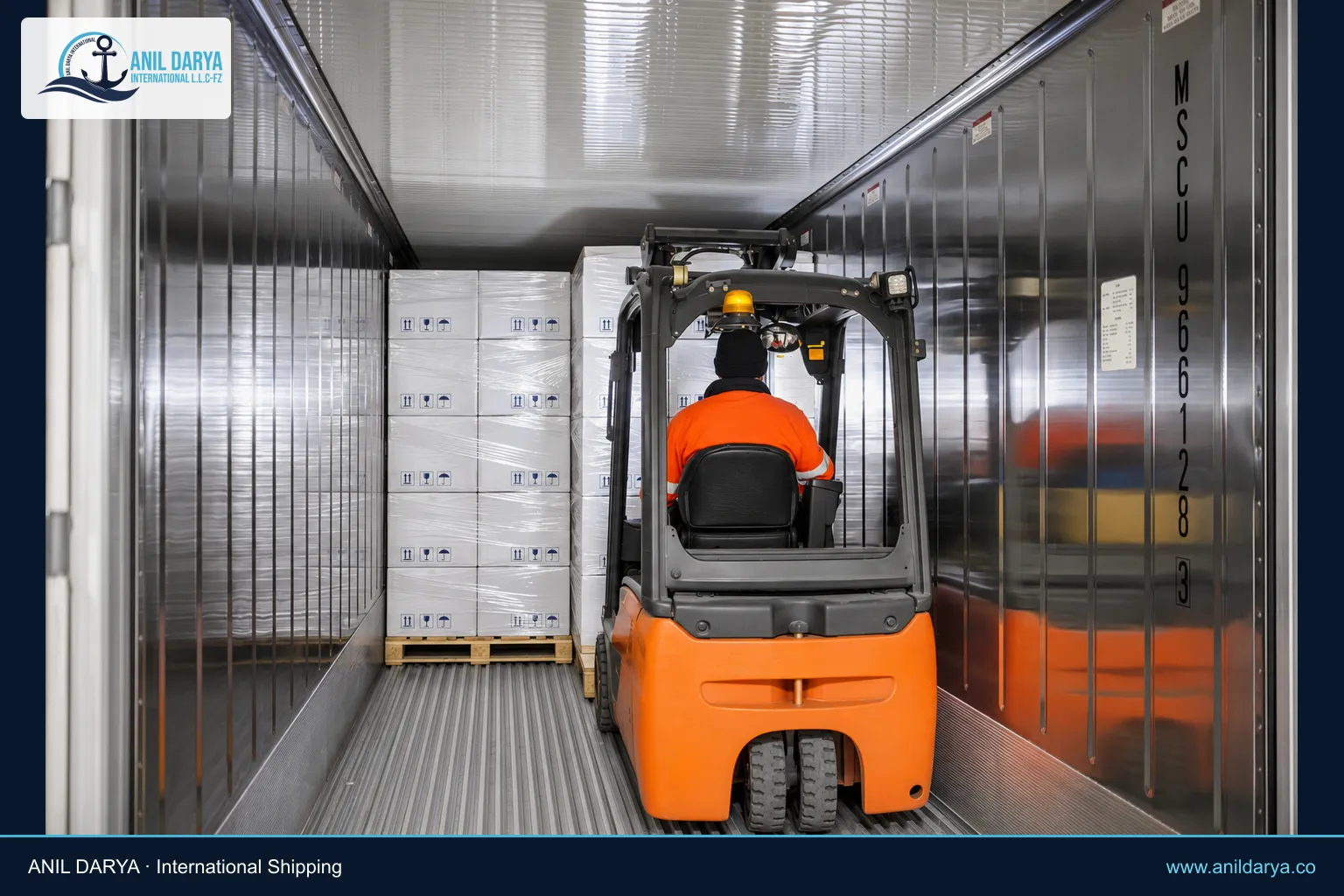
| Reefer | Temperature-controlled medicines and vaccines, some foods | Set point on the booking, power at the terminal, NAFDAC approval in place |
| Flat rack or open top | Transformers, gensets, crushers | Line acceptance and lashing plan before the Form M is closed |
With several suppliers in one state, consolidate at one warehouse near the port so one container and one set of entries cover the lot. Our FCL vs LCL guide explains where a full box starts to pay, and our sea freight service lists the equipment we book.
Dangerous goods and project cargo from India
Indian chemical, dye and paint makers sell steadily into West Africa, and many of their products are dangerous goods at sea. Since 1 January 2026 the IMDG Code 2024 edition, Amendment 42-24, is mandatory, so the Indian shipper's DG declaration and Safety Data Sheet must follow it.
Not every West Africa loop takes every class. Our dangerous goods shipping desk checks the UN number, class and packing group with the line before we confirm space.
Indian engineering firms ship transformers, switchgear, cable drums and plant equipment to Nigerian utilities and factories. Pieces that fit a 40ft flat rack can go on the container loops. Heavier units go breakbulk from Mundra, which handles project cargo. Send drawings, weights and lifting points early, and our break bulk and project cargo team will plan stowage with the carrier.
The export side in India
Under section 50 of the Customs Act, 1962, the exporter must file a shipping bill, and under section 51 the proper officer clears the goods for loading. The shipping bill is filed online through ICEGATE. The exporter needs an Importer Exporter Code (IEC), which is its 10-character PAN.
- The Indian exporter or its customs broker files the shipping bill. A Nigerian buyer cannot file it from Lagos.
- On EXW terms someone in India still has to act as exporter of record. FOB Nhava Sheva or FOB Mundra avoids that gap.
- Keep the value, HS code and description the same on the shipping bill, invoice, Form M and Nigerian entry.
- The Form M number must be printed on the Indian commercial invoice, so pass it to the exporter as soon as the bank validates it.
Form M: the approval you need before goods leave India
Nigeria controls commercial imports through the Form M, and the order of steps matters. The NPA's import guidelines say the importer first needs a company registered in Nigeria, a Tax Identification Number and an Authorised Dealer Bank. Then:
- For SONCAP-regulated goods, the importer gets a Product Certificate. SON says this is required to open the Form M.
- The importer opens the Form M through its bank on the Nigeria Single Window, attaching the proforma invoice from the Indian supplier, the insurance certificate and the Product Certificate.
- The bank validates the Form M and sends it to the Nigeria Customs Service.
- Once Customs accepts it, the Form M number goes to the Indian exporter for the invoice and to us for the bill of lading.
For a cross-trade booking, we hold the space until the Form M is approved. A box that leaves Nhava Sheva without it lands five weeks later with no route to a PAAR, and storage in Lagos starts to run.
SONCAP and NAFDAC for goods made in India
SONCAP is the Standards Organisation of Nigeria's conformity scheme. Regulated goods are checked in the country of supply before shipment, so for this lane the inspection takes place in India. SON offers three Product Certificate routes: PC1 for unregistered products, valid for one shipment, and PC2 or PC3 for registered or licensed products, valid for one year. After shipment, an accredited firm sends a Certificate of Conformity to SON, and SON issues the SONCAP Certificate, which is a mandatory customs clearance document.
SON's list of accredited firms includes Intertek, Cotecna, TUV Austria and others, and SON says no territory is assigned to any firm. An Indian factory can use any accredited firm that can inspect at its site. SON lists what is outside SONCAP:
- food, pharmaceutical drugs, and medical items other than equipment and machines;
- chemicals used as raw materials by genuine manufacturers;
- used products other than automobiles;
- machinery or spare parts imported by genuine manufacturers for their own production, which need a SONCAP import permit instead.
Medicines are the big India item that sits outside SONCAP and inside NAFDAC. A Nigerian company or the maker's local agent must hold the NAFDAC registration. NAFDAC also uses accredited Clean Report of Inspection and Analysis (CRIA) agents and laboratories in India and China to test products before they ship, alongside its own testing after arrival. Ask your Nigerian importer which CRIA agent covers the product, and book that inspection before the container is stuffed.
[AMIR-FACT: the usual lead time we see from SONCAP or NAFDAC CRIA inspection booking to certificate for India-origin cargo, and which inspection firms our Indian exporters use most]

Customs clearance in Nigeria on B'Odogwu
We do not clear goods in Nigeria. Before we confirm a booking from India, we check that the consignee has named a licensed customs agent and that the agent has seen the draft invoice and B/L.
The Nigeria Customs Service runs imports on B'Odogwu, rolled out command by command. The PAAR is created on B'Odogwu from the registered Form M, and the agent files the declaration against it. Nigeria inspects on arrival rather than before shipment, and Customs uses scanners to reduce physical checks. Duty is paid in naira, at the Central Bank of Nigeria rate that B'Odogwu applies automatically.
| Document | Comes from | What the Nigerian agent checks |
|---|---|---|
| Commercial invoice and packing list | Indian exporter | Form M number, HS code, values and weights match the shipping bill |
| Carrier bill of lading | Shipping line, released to you through us | Consignee, notify party, Form M number, discharge port and terminal |
| SONCAP Certificate | SON, after the accredited firm's Certificate of Conformity | Covers this shipment and these goods |
| NAFDAC registration and CRIA report | Importer and the CRIA agent | In place for medicines, cosmetics, chemicals and food |
| Insurance certificate | Insurer registered in Nigeria | Matches the Form M |
| PAAR | Nigeria Customs Service on B'Odogwu | Created before the entry is filed |
Import duty, VAT and levies on Indian goods
India is outside ECOWAS, so Indian goods pay the ECOWAS Common External Tariff rate for their HS code. Most duties are ad valorem on the CIF value at the Nigerian port.
| Charge | Rate or basis | Indian goods often in this band |
|---|---|---|
| CET band 0 | 0% | Essential social goods |
| CET band 1 | 5% | Raw materials and capital goods, such as many machines |
| CET band 2 | 10% | Intermediate goods and inputs |
| CET band 3 | 20% | Finished consumer goods |
| CET band 4 | 35% | Specific goods for economic development |
| VAT | 7.5% standard rate | Charged on top of duty |
| Import Adjustment Tax, excise, vehicle levy | By tariff line | Revised in the 2026 fiscal policy measures; relevant to motorcycles and vehicle parts |
The Nigeria Customs Service Act 2023 created a charge of at least 4% of FOB value to replace older levies, but Customs suspended it in February 2025 for consultation. Duty and taxes at destination are paid by the consignee or its broker, never by the Indian exporter or by us, so ask your agent for a duty estimate on the exact HS code before the Form M is opened.
Banned and restricted goods for Nigeria
Nigeria keeps an absolute import prohibition list and a separate trade prohibition list, and the trade list was revised in 2026. Check every HS code before your bank opens the Form M.
- From 1 April 2026 the revised trade list covers 17 categories of goods from outside ECOWAS. Items that touch Indian exports include selected steel products, corrugated paper and cartons, large glass bottles, ballpoint pens and parts, soaps and detergents, and listed medicines.
- A 90-day window applied to deals with a valid Form M issued before 1 April 2026. New orders follow the revised list.
- The absolute list covers counterfeit goods, second-hand clothing, some weapons and toxic waste, among other items.
- Used vehicles more than 15 years past their year of manufacture cannot be imported, and a Green Tax Surcharge on certain vehicles started on 1 July 2026.
The listed medicines matter most on this lane, so have your agent check each product on the Nigeria Customs Service website.
Routing via Dubai: stock, consolidation and transhipment
A direct loop suits most cargo. Dubai helps when part of the order already sits in the UAE or comes from other origins.
| Option | How it works | What to watch |
|---|---|---|
| Same loop, Dubai stock | MIDAS 1 calls Jebel Ali before Mundra and Nhava Sheva, so UAE stock and Indian cargo can sail on one vessel to Apapa | Separate B/Ls and Form M lines for each origin |
| Consolidation in Dubai | Indian goods and goods from other origins share one container to Lagos or Onne | SONCAP and NAFDAC still follow the real country of supply |
| Free zone stock and re-export | Stock held in Jafza and shipped to Nigeria as orders come in | Dubai Chambers issues certificates of origin for re-exported goods |
| Transhipment at Jebel Ali | Indian box connects at Jebel Ali to a West Africa sailing | Dubai Customs treats transit as its own regime, separate from import |
Where cargo is landed, consolidated or re-exported in Dubai, we handle the UAE customs clearance for a fee. Jafza sits next to Jebel Ali port. See our Jebel Ali port guide for the terminals and our article on re-exporting through Jafza for the free zone steps.
[AMIR-FACT: whether we route India to Nigeria cargo via Jebel Ali in practice (Dubai stock on the same loop, consolidation or transhipment), and the real extra days against a direct Nhava Sheva or Mundra sailing]
Typical cargo on this lane
The Consulate General of India in Lagos says Indian companies lead Nigeria's pharmaceutical, power and transmission sectors. That shows up in the cargo mix. Match each product to its papers before you book.
| Cargo | Usual equipment | Papers to plan |
|---|---|---|
| Generic medicines and APIs | 40ft dry or reefer, LCL for small lots | NAFDAC registration, CRIA inspection; outside SONCAP |
| Motorcycles, tricycles and spare parts | 40ft high cube, often CKD or SKD | SONCAP; check levies on vehicle tariff lines |
| Cables, transformers, switchgear | 20ft FCL, flat rack or breakbulk | SONCAP or an import permit for manufacturers; piece list for out-of-gauge |
| Steel pipes, fittings, building hardware | 20ft FCL | SONCAP; check against the 2026 trade list |
| Textiles, fabrics, garments | 40ft FCL or LCL | SONCAP where regulated; second-hand clothing is banned |
| Dyes, paints, agrochemicals | 20ft FCL, DG-approved where hazardous | IMDG papers, NAFDAC where the product falls under it |
How shipping from India to Nigeria works, step by step
Nothing sails until steps 1 to 4 are complete.
- Send us the product, HS code, weight, volume, the supplier's city in India, the Nigerian destination and the Incoterm.
- Your Nigerian agent checks the HS code against the prohibition lists and tells you whether SONCAP, NAFDAC or a permit applies.
- The importer gets the Product Certificate or NAFDAC approval, buys Nigerian cargo insurance and opens the Form M through its bank.
- We confirm the Nigerian customs agent has accepted the clearance, then confirm the booking with the line to Apapa, Tin Can or Onne.
- The Indian exporter books the SONCAP or CRIA inspection, stuffs the container and files the shipping bill on ICEGATE before cut-off.
- The line issues the carrier B/L with the Form M number, released to you through us, and the inspection firm sends its report.
- While the ship is at sea, the importer collects the SONCAP Certificate and the agent creates the PAAR on B'Odogwu.
- On arrival the agent files the entry, pays duty and VAT from the consignee's funds, clears the box and returns the empty within free time.
[AMIR-FACT: one real India to Nigeria cross-trade shipment we handled: cargo, load and discharge ports, carrier, what we coordinated with the Indian exporter and the Nigerian agent, and the outcome, cleared for publication]
What drives India to Nigeria shipping costs?
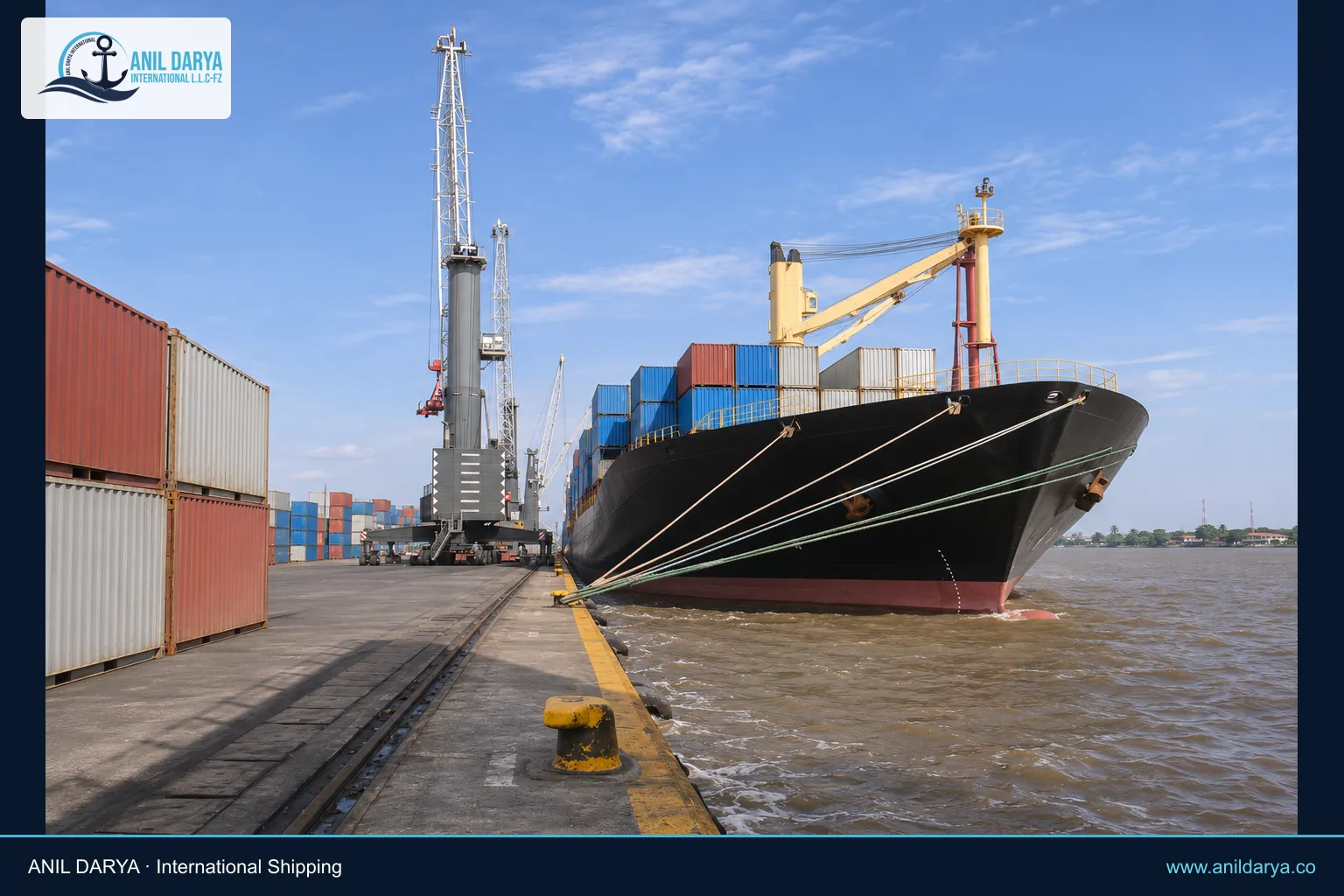
Prices change with every sailing, so we quote per shipment. These are the parts of the total.
| Cost part | What moves it | Usually paid by |
|---|---|---|
| Origin charges in India | Factory distance to port, rail or truck, shipping bill filing, terminal handling | Exporter under FOB |
| SONCAP or CRIA inspection | Product type, certificate route, testing needed | Exporter or buyer, as agreed |
| Ocean freight | Container type, season, carrier, direct or transhipped, surcharges | Buyer under FOB, seller under CFR |
| DG, reefer and out-of-gauge | DG surcharge, reefer power, flat rack or breakbulk premium | Whoever pays the freight |
| Nigerian terminal and line charges | Port, terminal, container size | Consignee |
| Duty, VAT and levies | HS code, CIF value, naira rate on the day | Consignee or its broker |
| Storage, demurrage and detention | Late Form M, missing SONCAP or NAFDAC papers, slow clearance | Whoever caused the delay, under your contract |
A missing certificate found on arrival can cost more in Lagos storage than any freight saving. Our article on demurrage and detention shows how those charges add up, and our Dubai freight forwarding team will walk you through any quote line by line.
Checklist before the container leaves India
- HS code agreed with your Nigerian agent and checked against the 2026 prohibition lists.
- Form M approved, with its number sent to the Indian exporter and to us.
- SONCAP Product Certificate in hand and the inspection booked, or NAFDAC registration and a CRIA inspection for medicines.
- Cargo insurance placed with a Nigerian insurer, matching the Form M.
- Nigerian customs agent named and the clearance accepted before we confirm the booking.
- Shipping bill filed on ICEGATE, with values matching the commercial invoice.
- Draft carrier B/L showing the right consignee, Form M number, discharge port and terminal.
- For DG: UN number, SDS, DG declaration to IMDG Amendment 42-24 and carrier approval.
Mistakes that hold Indian cargo in Lagos and Onne
- Shipping before destination clearance is agreed. With no Nigerian agent signed up, the box waits at Apapa while you look for one.
- Loading before the Form M is approved. No Form M means no PAAR, and no PAAR means no clearance.
- Treating medicines like general cargo. They need NAFDAC registration and a CRIA report, not SONCAP.
- Assuming the nearest port gives the fastest arrival. Check where Lagos sits in the rotation.
- Buying CIF with cover from an Indian insurer when Nigerian rules expect a local insurer.
- Different values on the shipping bill, invoice and Form M, which leads to a valuation query.
Frequently asked questions
How long does shipping from India to Nigeria take by sea?
DP World's trade lane page lists 35 to 38 days from Nhava Sheva to Lagos and 36 to 38 days from Mundra to Lagos, both on weekly direct services. Allow extra time for the Form M, inspection, export filing and clearance in Nigeria.
Which Indian port is best for cargo to Lagos?
Nhava Sheva or Mundra, because the regular West Africa loops load there. Cargo from south or east India usually moves by rail to one of them or sails on a transhipped service.
Do I need a Form M before goods leave India?
Yes, for commercial imports. The Nigerian importer opens it through an Authorised Dealer Bank on the Nigeria Single Window, Customs accepts it, and the Form M number then goes on the Indian invoice and on the bill of lading.
Do medicines from India need SONCAP?
No. SON lists pharmaceutical drugs outside SONCAP. Medicines need NAFDAC registration held by a Nigerian company or local agent, and NAFDAC uses accredited CRIA agents and laboratories in India to test products before shipment.
What duty and VAT do Indian goods pay in Nigeria?
Indian goods pay the ECOWAS Common External Tariff, with bands of 0%, 5%, 10%, 20% and 35%, mostly on CIF value, plus 7.5% VAT. Some lines also pay Import Adjustment Tax, excise or a vehicle levy, so check the HS code with your agent.
Can I ship dangerous goods from India to Nigeria?
Yes, under the IMDG Code. The Indian shipper needs a Safety Data Sheet and a DG declaration, the line must accept the class on that loop, and chemicals may also need NAFDAC registration in Nigeria.
Does Anil Darya clear customs in Nigeria?
No. The consignee's licensed customs agent clears the goods, and duty and taxes at destination are paid by the consignee or its broker. We agree the plan with that agent before we confirm the booking, and we clear customs in the UAE only if the cargo goes through Dubai.
Get a quote for shipping from India to Nigeria
Send the product, HS code, weight, volume, Indian city and Nigerian port for a routing and a price. Use our freight rate inquiry form, or contact our team to talk through a pharma, DG or project shipment first.
Sources
- DP World: India to Africa trade lane, transit times to Lagos
- CMA CGM via Hellenic Shipping News: MIDAS 1 and MIDAS 2 rotations (May 2024)
- Nigerian Ports Authority: Terminals and operators by port
- Nigerian Ports Authority: Import and export guidelines (Form M, SONCAP, PAAR)
- Nigerian Ports Authority: Lekki Deep Sea Port
- Nigerian Ports Authority: Q2 2026 cargo throughput
- Lekki Port: Port facts and operations
- Oil and Gas Free Zones Authority: Free zone incentives
- Standards Organisation of Nigeria: SONCAP services, certificate routes and accredited firms
- NAFDAC: Curbing substandard and falsified medicines (CRIA agents and laboratories in India and China)
- Legal 500: Registration of imported products with NAFDAC
- Federal Ministry of Information: Customs on Form M and PAAR on B'Odogwu
- Nairametrics: Customs says CBN sets the clearance exchange rate (February 2026)
- Federal Ministry of Information: Customs suspends the 4% FOB charge
- Nigeria Customs Service: 2026 Fiscal Policy Measures and Tariff Amendments
- SCP Law: Nigeria's 2026 import restrictions
- US International Trade Administration: Nigeria customs regulations
- US International Trade Administration: Nigeria import requirements
- US International Trade Administration: Nigeria prohibited and restricted imports
- ECOWAS: Common External Tariff bands
- PwC Worldwide Tax Summaries: Nigeria VAT
- Consulate General of India, Lagos: India-Nigeria trade and economic relations
- CBIC: Customs Act, 1962 (sections 50 and 51)
- ICEGATE: Electronic filing FAQ
- DGFT: Foreign Trade Policy 2023, chapter 2 (IEC)
- JNPA: Port overview
- Adani Ports: Mundra port
- IMO: IMDG Code 2024 edition (Amendment 42-24)
- Dubai Customs: Declaration regimes, including transit
- Dubai Chambers: Certificate of origin for exported and re-exported goods
- Jafza: About the Jebel Ali Free Zone
Reviewed: 11 November 2026