
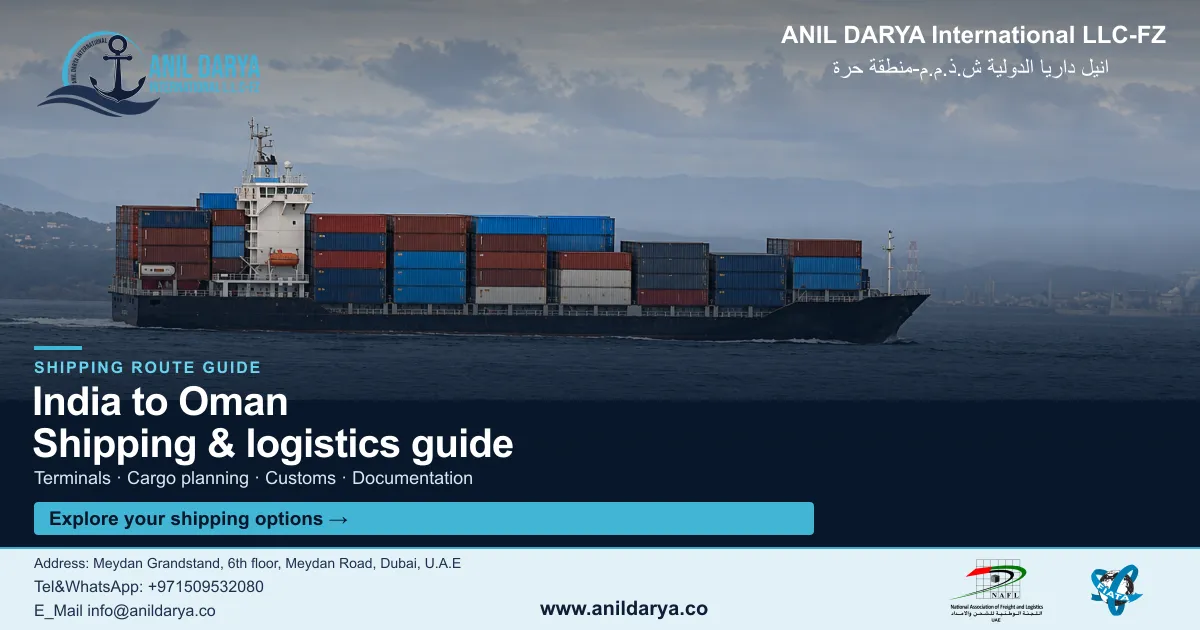
Shipping from India to Oman is one of the shortest deep-sea lanes in the region: containers usually load at Nhava Sheva, Mundra or Hazira and discharge at Sohar in the north or Salalah in the south. Since 1 June 2026 the India-Oman CEPA lets most Indian-origin goods enter Oman duty-free if the shipment carries a valid preferential certificate of origin. We book the ocean freight from Dubai and coordinate the shipper in India and the consignee's customs broker in Oman, so the cargo moves without surprises at either end.
India to Oman shipping at a glance
| Item | Detail |
|---|---|
| Lane type | Cross-trade: India to Oman, booked and coordinated by Anil Darya from Dubai |
| Main Indian load ports | Nhava Sheva (JNPA), Mundra, Hazira; Cochin on some services |
| Main Omani discharge ports | Sohar (OMSOH) for the north and Muscat; Salalah (OMSLL) for Dhofar; Duqm (OMDQM) by arrangement |
| Published direct services (examples) | Asyad Line IEX and FEX to Sohar, Asyad Line REX to Salalah, ONE IGS with Sohar in its rotation |
| Indian export filing | Shipping bill on ICEGATE under section 50 of the Customs Act, 1962, by the exporter or its customs broker |
| Exporter registration in India | Importer-Exporter Code (IEC) from the DGFT |
| Oman customs authority | Directorate General of Customs, Royal Oman Police |
| Oman declaration system | Bayan; fee OMR 15 per declaration for companies |
| Duty without CEPA | GCC common external tariff, 5% on most foreign goods |
| Duty with CEPA | Zero on 98.08% of Oman's tariff lines for originating Indian goods |
| CEPA proof | Electronic preferential certificate of origin on DGFT Trade Connect, "India Oman CEPA (Agency Issued)" |
| VAT in Oman | 5% standard rate, also charged on imported goods |
| Bill of lading | The shipping line's own B/L, issued and released to you through us as the line's agent |
| Destination clearance | By the consignee's customs broker in Oman, agreed before the cargo ships |
How shipping from India to Oman works as a cross-trade lane
A cross-trade shipment never enters the UAE as an import. The goods leave an Indian port and land in Oman, while we book the space from Dubai and keep the booking, documents and vessel dates aligned. Three parties do the work, and each needs to know its job before the booking is confirmed.
| Stage | Who does it | What it covers |
|---|---|---|
| Origin in India | The shipper or its origin agent | Factory pickup, container stuffing, the shipping bill on ICEGATE, the CEPA certificate of origin |
| Ocean freight | Anil Darya from Dubai, with the shipping line | Space booking, cut-offs, B/L instructions, release of the carrier's B/L, tracking |
| Destination in Oman | The consignee's customs broker | Bayan import declaration, duty and VAT payment, port release, delivery |
The bill of lading is the shipping line's own B/L. Anil Darya acts as agent for many shipping lines, so the carrier's B/L is issued and released to you through us. We do not issue a house B/L on this lane, and we do not have an office, yard or agent in India or Oman.
The Incoterm in your sales contract decides who pays for which leg. On FOB Nhava Sheva, the Indian seller clears export and the Omani buyer books the freight. On CFR or CIF Sohar, the seller books and pays the freight, and the buyer still pays Omani duty, VAT and local charges. Our guide to Incoterms 2020 for sea freight shows where cost and risk pass on each term.
Which load ports in India have services?
Most Oman-bound containers leave from the west coast, where the direct services start. Pick the port nearest the factory that has a service to your Omani port.
| Indian port | Region it serves | Oman links seen on carrier pages |
|---|---|---|
| Nhava Sheva (JNPA), Navi Mumbai | Maharashtra, Madhya Pradesh, much of north and central India by rail | Sohar (Asyad IEX and FEX, ONE IGS), Salalah (Asyad REX) |
| Mundra, Gujarat | Gujarat, Rajasthan, the north-west and NCR by rail | Sohar (Asyad IEX and FEX, ONE IGS), Salalah (Asyad REX) |
| Hazira, Gujarat | Surat and south Gujarat (textiles, chemicals, engineering) | Sohar (Asyad IEX, ONE IGS) |
| Cochin, Kerala | Kerala and parts of Tamil Nadu and Karnataka | Sohar on a fortnightly service reported by DP World Cochin in September 2026 |
| Chennai, Kattupalli, Tuticorin, Kandla | South-east India and Kutch | No direct Oman service found on the carrier pages we opened; ask us for the current routing |
Nhava Sheva has five terminals and handles around half of the container cargo of India's major ports. Mundra has four Adani container terminals plus DP World's, and a rail link into the north-west, so the rail leg often decides the port for cargo made around Delhi, Punjab or Rajasthan.
Which Omani port should your cargo arrive at?
Oman has three deep-sea ports for this trade, and they sit hundreds of kilometres apart. Choose by delivery address first, then by the services that call there.
| Omani port | Best for | Key facts |
|---|---|---|
| Sohar | Muscat, Al Batinah, Buraimi and most of northern Oman | Hutchison Ports Sohar container terminal: 2 million TEU a year, 18 m draft; C. Steinweg Oman for breakbulk, steel and project cargo on 4 berths with 16 m depth |
| Salalah | Dhofar and southern Oman | Container terminal capacity of 6 million TEU, more than 1,500 reefer plugs, a 13-berth general cargo terminal |
| Duqm | Al Wusta and the Special Economic Zone at Duqm | 18 m draft along a 2.2 km commercial quay; we found no direct Indian service on Asyad's service list, so routing is checked case by case |
Do not book sea freight to Muscat itself. Port Sultan Qaboos stopped taking commercial cargo vessels in 2014, and that activity moved to Sohar. A consignee in Muscat normally receives Indian containers through Sohar, followed by a truck.
Salalah applies monsoon controls from June to August, when waves can reach 4 m, so allow spare days for Dhofar cargo in summer.
Direct services vs transhipment on the India to Oman route
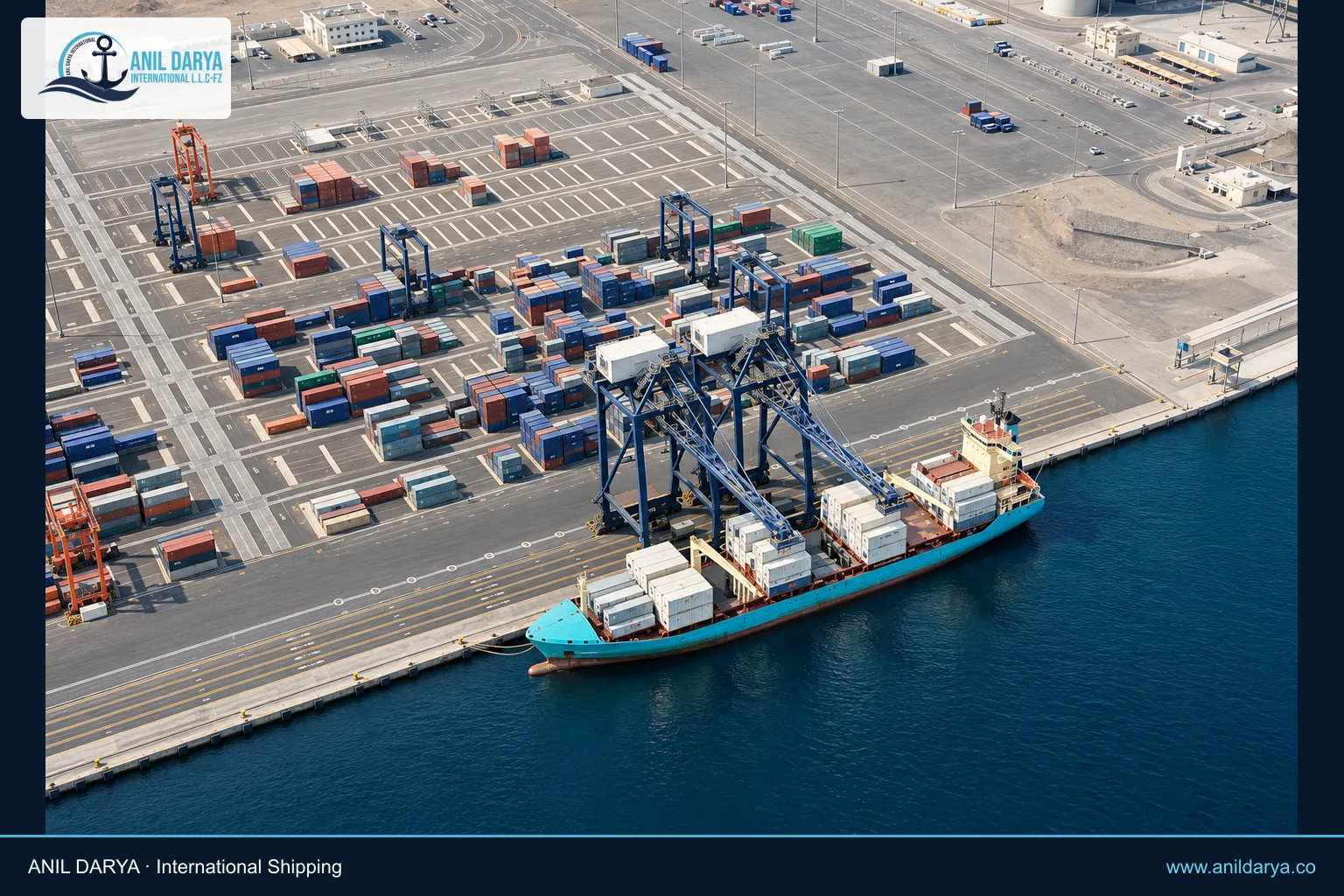
This lane has real direct sailings, which is the main reason it is quick. The table lists services we found on carrier and port operator pages. Rotations change, so treat them as examples and confirm the current one on the booking.
| Service | Published rotation (India and Oman calls) | Source |
|---|---|---|
| Asyad Line India Express (IEX) | Nhava Sheva, Hazira, Mundra, Sohar, Jebel Ali, Hamad, Dammam, Jebel Ali, Sohar, Nhava Sheva | Asyad direct lines page |
| Asyad Line Far East Express (FEX) | Includes Nhava Sheva and Mundra, then Jebel Ali and Sohar, before continuing to the Far East | Asyad direct lines page |
| Asyad Line Red Sea Express (REX) | Nhava Sheva, Mundra, Salalah, then on to Jeddah and Sokhna | Asyad direct lines page |
| ONE India-Gulf Service (IGS) | Jebel Ali, Sohar, Mundra, Hazira, Nhava Sheva, Jebel Ali (first vessel June 2025) | ONE customer advisory |
| MGR IFR service from Cochin | Cochin and Nhava Sheva with Fujairah and Sohar, every two weeks | DP World Cochin, reported September 2026 |
Read the rotation before you book. On ONE IGS, a box loaded at Nhava Sheva calls Jebel Ali before Sohar; on Asyad IEX, Sohar is the first call after Mundra. None of the carrier pages we opened publish transit days for this lane, so we quote none here.
[AMIR-FACT: the carriers we actually book from Nhava Sheva and Mundra to Sohar and Salalah, and our real port-to-port transit days on each]
Transhipment means the container is discharged at a hub and loaded onto a second vessel. On this lane it is mostly needed from east coast ports such as Chennai or Tuticorin, or for Duqm. Jebel Ali is one hub that can link these flows to Oman, because several India-Gulf services and several Oman services call there. Dubai Customs handles goods passing through on a transit declaration, which is separate from an import declaration, so transhipped cargo is not cleared into the UAE market. See our Jebel Ali port shipping guide for how the port works.
[AMIR-FACT: whether we route India to Oman cargo via Jebel Ali transhipment in practice, from which Indian ports, and how many extra days it adds]
FCL, LCL, breakbulk, DG and reefer cargo
FCL containers
Most commercial cargo on this lane moves as full 20ft or 40ft containers. FCL suits steel products, rice and other bagged food, building materials, chemicals in drums and textiles in volume. Check the free days at Sohar or Salalah before you sign, because the Omani broker needs time to file Bayan and get the box out. Our note on demurrage and detention explains what happens when free time runs out.
LCL and consolidation
For small volumes, LCL shares a container with other shippers. It costs less than a full box but adds handling at a container freight station at each end. If your buyer in Oman buys from several Indian suppliers, ask whether the goods can be grouped into one FCL at the Indian port. Our guide to choosing between FCL and LCL shows where the switch usually makes sense.
Breakbulk and project cargo
Heavy machinery, transformers, steel structures and plant for Oman's industrial zones often do not fit a container. At Sohar, C. Steinweg Oman handles project cargo, steel and Ro-Ro on berths with 16 m of water. Our break bulk and project cargo team plans the vessel, lifting and lashing from drawings and weights.
Dangerous goods
Chemicals, paints, solvents and lithium batteries move as dangerous goods under the IMDG Code, with a DG declaration and safety data sheet from the shipper. Oman adds its own steps. In March 2026 the Port of Salalah advised that vessel operators need prior approval from Oman's transport ministry before calling an Omani port with Class 1, 2.1, 3, 4.3, 5.1 or 5.2 goods on board. Chemicals also need an Environment Authority permit in Oman. Our dangerous goods shipping team checks the class, packaging and carrier acceptance before we confirm space.
Reefer cargo
Fruit, vegetables, chilled meat and frozen seafood from India need reefer containers and an unbroken cold chain. Salalah's container terminal has more than 1,500 reefer plugs. Meat and meat products for Oman need halal certificates, and fish and plant products need permits from Oman's agriculture and fisheries ministry.
The Indian export side: shipping bill, IEC and CEPA certificate
Export clearance happens in India and belongs to the shipper or its origin agent. We coordinate with them, but we do not file Indian customs entries.
- IEC. Every Indian exporter needs an Importer-Exporter Code from the DGFT. The IEC is a 10-character number, the same as the business PAN.
- Shipping bill. Section 50 of the Customs Act, 1962 requires the exporter to file a shipping bill, done electronically on ICEGATE. The exporter files it directly or through a licensed customs broker.
- Let export order. Under section 51, Indian customs permits clearance and loading once the goods have been assessed. Without it, the container does not load.
- CEPA certificate of origin. For duty-free entry into Oman, the exporter applies on the DGFT Trade Connect platform, chooses "India Oman CEPA (Agency Issued)", and an authorised agency issues an electronic certificate with a QR code and digital signature.
The DGFT's Public Notice 15/2026-27 lists the agencies allowed to issue the India-Oman certificate. They include the DGFT regional offices, the Export Inspection Council, APEDA, MPEDA, the Spices Board and several special economic zones.
Ask the shipper to send us the invoice, packing list, shipping bill number and CEPA certificate before cut-off, so the B/L draft matches them.
What the CEPA changes for your duty bill
The India-Oman CEPA came into force on 1 June 2026. India's rules of origin for it were notified as Customs Notification No. 48/2026 (N.T.), dated 29 May 2026. On the Omani side, Indian goods get zero duty on 98.08% of Oman's tariff lines, which covered 99.38% of India's export value, and the cuts applied from day one.
| Situation | Duty in Oman | What the broker needs |
|---|---|---|
| Indian-origin goods with a valid CEPA certificate | Zero on covered tariff lines | Electronic certificate from Trade Connect, invoice, B/L |
| Indian goods without a certificate, or failing the origin rule | GCC common external tariff, usually 5% | Invoice, certificate of origin, B/L |
| Goods on the GCC exemption schedule | Exempt regardless of the agreement | HS code check against the tariff |
| Non-Indian goods shipped from an Indian port | GCC tariff, usually 5% | Origin certificate of the real country of manufacture |
Origin is not automatic. Goods must be wholly obtained in India or meet a product-specific rule, and those rules use value-addition thresholds that range from 1.5% to 45% depending on the product. Check the rule for your HS code before you quote the buyer a duty-free price.
Import customs at the Omani end
All Omani import declarations are filed in Bayan, the system of the Directorate General of Customs at the Royal Oman Police. The consignee's broker signs in, creates the declaration, attaches the documents, submits and pays. The fee is OMR 15 per declaration for companies and OMR 5 for individuals.
Documents Oman Customs asks for
Oman Customs lists three documents for a Bayan declaration: commercial invoices, a certificate of the manufacturer's country of origin, and a declaration issued by the exporting country. For an Indian shipment, that export declaration is the Indian shipping bill.
| Document | Who provides it | Notes for this lane |
|---|---|---|
| Commercial invoice | Indian seller | HS codes and values must match the shipping bill |
| Packing list | Indian seller | Gross and net weights, number of packages, marks |
| Certificate of origin | Authorised Indian agency | Use the CEPA certificate to claim zero duty |
| Indian shipping bill | Exporter or its Indian customs broker | The "declaration issued by the exporting country" |
| Bill of lading | Shipping line, released through us | Consignee and notify party must match the Bayan filing |
| Import permit | Omani importer, from the competent authority | Only for permit-controlled goods |
| DG declaration and SDS | Indian shipper | For dangerous goods |
At the Port of Salalah, Bayan is linked electronically with the terminal system, and the port has asked that bill of lading details are submitted correctly from origin. A wrong consignee or container number on the B/L stops the Bayan declaration. This is one reason we check the B/L draft against the Omani broker's details before the carrier issues it.
Duty, VAT and advance rulings
Oman applies the GCC unified customs tariff, which sets 5% duty on most goods from outside the GCC, with a list of exempt goods. The India-Oman CEPA then takes most Indian-origin goods down to zero. VAT in Oman is 5% on most goods and services, and it also applies to goods imported into the country. Duty and taxes at destination are paid by the consignee or its broker.
For a new product, the Omani importer can ask Oman Customs through Bayan to confirm the value, HS code and origin before the goods ship. Customs may ask for a sample, catalogue or photos. This is useful when a CEPA claim depends on the exact tariff line.
We found no general pre-shipment inspection scheme for Oman on the official pages we checked; product permits do that job.
Restricted goods when shipping from India to Oman
Oman Customs does not allow internationally or locally prohibited goods, counterfeit goods, goods that infringe intellectual property, or goods that fail approved standards. Many common Indian exports need a permit before the Bayan declaration can be released.
| Typical Indian cargo | Omani permit or authority |
|---|---|
| Chemicals and cosmetics | Environment Authority (chemicals); Ministry of Commerce, Industry and Investment Promotion (chemical and cosmetic products) |
| Paints, toys, low-voltage electrical equipment | Ministry of Commerce, Industry and Investment Promotion, Standards and Metrology |
| Fish and fish products, plant products | Ministry of Agriculture, Fisheries Wealth and Water Resources |
| Pesticides, fertilisers and soil enhancers | Ministry of Agriculture, Department of Plant Protection |
| Controlled telecom goods | Telecom Regulatory Authority |
Pork products and alcohol are restricted, and meat needs a halal certificate. Human medicines need marketing authorisation in Oman. Under the CEPA, medicines approved by regulators such as the USFDA, EMA, UK MHRA or TGA can get fast-tracked approval within 90 days. The permit is the importer's job, and it must be in hand before loading, not after arrival.
Typical cargo on this lane
Oman buys a wide mix from India. In the 2025-26 financial year, the biggest groups were mineral fuels and oils, inorganic chemicals, articles of iron or steel, machinery and boilers, and ships and boats. Food is a large share of the containerised trade, and the first shipments under the CEPA in June 2026 were farm products and gems and jewellery.
- Rice, spices, fruit, vegetables and processed food, in dry and reefer containers.
- Steel pipes, sections and fabricated structures, often in FCL or as breakbulk to Sohar.
- Machinery, pumps and electrical equipment for industry and construction.
- Chemicals and pharmaceuticals, many of them under DG rules or product permits.
- Textiles, garments and home furnishings, often from Hazira or Nhava Sheva.
Where Dubai fits on this lane
Most India to Oman cargo should go direct. Dubai adds value in three cases.
- Transhipment at Jebel Ali, when there is no direct service from your Indian port or to your Omani port.
- Consolidation in Dubai, when an Omani buyer combines Indian goods with goods from other countries in one delivery.
- Stock in a Dubai free zone, when a distributor holds Indian goods in JAFZA and sends smaller lots to Oman and other GCC markets. Our article on re-exporting through JAFZA explains how this works.
Two cautions. First, the CEPA preference is built for goods shipped from India to Oman. If goods are stored, repacked or re-invoiced in Dubai, confirm with the Omani broker that Oman Customs will still accept the Indian certificate before you pick that route. Second, if goods are imported into the UAE market first, UAE duty is paid at that first GCC entry point. Customs clearance in Dubai is a service we provide, for a fee, when a shipment really does pass through the UAE.
[AMIR-FACT: whether we have consolidated or re-exported Indian goods to Oman through Dubai or JAFZA, and for which type of cargo]
How to ship from India to Oman: step by step
- Send us the details. Commodity, HS code, weights and dimensions, factory location in India, delivery address in Oman, ready date and the Incoterm.
- We confirm the Omani side first. Before we confirm the booking, we check that the consignee has a customs broker in Oman, that the broker can file Bayan for this cargo, and that any permit is in place.
- Check CEPA origin. The shipper confirms the product meets the origin rule and applies for the certificate on Trade Connect.
- Choose the ports and service. We match the Indian load port and the Omani discharge port to a current sailing.
- Book the space. We book with the shipping line from Dubai and send the booking confirmation and cut-offs to the shipper.
- Origin handling. The shipper or its origin agent collects the cargo, stuffs the container, files the shipping bill on ICEGATE and gets the let export order.
- Check the B/L draft. We match the draft against the invoice, packing list and the Omani broker's details, then the line issues its B/L and we release it to you.
- Pre-arrival filing. The Omani broker prepares the Bayan declaration with the invoice, certificate of origin and shipping bill.
- Clearance and delivery. The consignee or its broker pays duty and VAT, the port releases the container and the broker arranges delivery.
[AMIR-FACT: one real India to Oman cross-trade shipment we handled (cargo, Indian load port, Omani port, carrier and how clearance went), cleared for publication]

What affects the cost of shipping from India to Oman?
We do not publish fixed prices, because rates move with space, season and fuel. These factors change your quote.
- Load and discharge ports. Nhava Sheva or Mundra to Sohar is the shortest pairing; east coast ports and Duqm usually cost more.
- Direct or transhipped. A relay at a hub adds handling and time.
- Container type. Reefers, flat racks and open tops cost more than dry boxes.
- Cargo class. DG cargo needs carrier approval and Omani pre-approval for some classes.
- Inland legs in India and Oman.
- Local charges. Terminal and documentation charges at both ends.
- Duty and VAT. Zero duty with a valid CEPA certificate, about 5% without one, plus 5% VAT.
- Free time. Demurrage starts if the Omani clearance is late.
Ask for a quote that names the ports, the service, the free days and the Incoterm, so you can compare like with like. Our sea freight service page shows what we book on the line's side.
Checklist before the container sails
- Omani consignee has a customs broker, agreed before the booking is confirmed.
- HS code checked for every line, in India and in Oman.
- Omani permit in hand for chemicals, food, paints, toys, electrical goods or other controlled items.
- CEPA certificate of origin issued on Trade Connect, matching the invoice.
- IEC active and shipping bill filed on ICEGATE.
- Invoice, packing list, shipping bill and B/L draft show the same consignee, weights and packages.
- Discharge port matches the delivery area (Sohar for Muscat, Salalah for Dhofar).
- DG declaration, SDS and carrier acceptance ready for dangerous goods.
- Free days at the Omani port known, and the truck booked for delivery.
Mistakes to avoid on this lane
- Shipping before destination clearance is agreed. If no broker in Oman is ready to file Bayan, the container sits at Sohar or Salalah and charges grow every day.
- Booking to Muscat. Sea cargo for Muscat lands at Sohar.
- No CEPA certificate. The goods pay the normal 5% tariff even though they qualified for zero.
- Wrong B/L details. A mismatch with the Bayan filing holds the release, especially at Salalah.
- Permit applied for after arrival. Chemicals, food and standards-controlled goods wait at the port.
- Routing through Dubai without checking origin. Storage or re-invoicing there can put the CEPA claim at risk.
Frequently asked questions
How long does sea freight from India to Oman take?
The sailing is short, but the carrier pages we checked do not publish transit days for this lane. The real time depends on the rotation: a service that sails from Mundra straight to Sohar is quicker than one that calls Jebel Ali first. We confirm the current transit on each booking.
Which Omani port is best for cargo from India?
Sohar for Muscat and northern Oman, Salalah for Dhofar and the south. Duqm suits cargo for Al Wusta and the Duqm economic zone, but routing there is checked case by case.
Is there customs duty on Indian goods in Oman?
Since 1 June 2026, Indian-origin goods covered by the India-Oman CEPA enter Oman at zero duty with a valid preferential certificate of origin. Goods that do not qualify pay the GCC common external tariff, usually 5%. VAT of 5% applies to imports in both cases.
How do I get the India-Oman CEPA certificate of origin?
The Indian exporter applies on the DGFT Trade Connect platform, selects "India Oman CEPA (Agency Issued)", and an authorised agency such as a DGFT regional office or the Export Inspection Council issues an electronic certificate with a QR code.
Who clears the cargo through customs in Oman?
The consignee's customs broker files the Bayan declaration and pays duty and VAT. Anil Darya does not sell customs clearance in Oman, so we confirm the broker is ready before we confirm the booking.
Who issues the bill of lading on this lane?
The shipping line issues its own bill of lading. Anil Darya acts as agent for many shipping lines, so the carrier's B/L is issued and released to you through us. We do not issue a house B/L.
Can I ship dangerous goods from India to Oman?
Yes, with the right papers. You need the UN number, class, DG declaration, SDS and carrier acceptance. Vessels carrying Class 1, 2.1, 3, 4.3, 5.1 or 5.2 goods need prior approval from Oman's transport ministry, and chemicals need an Environment Authority permit.
Get a quote for shipping from India to Oman
Send us the cargo details, the Indian factory location and the delivery address in Oman, and we will come back with a port pair, a current service and a price. Use our freight rate inquiry form, or contact our team to plan a DG, reefer or project shipment first. You can also read about our Dubai freight forwarding team.
Sources
- Asyad: Direct lines (IEX, FEX and REX rotations)
- ONE: India-Gulf Service (IGS) customer advisory (June 2025)
- Oman Customs: Request to apply a customs declaration (Bayan, documents, fees)
- Oman Customs: Before imports (advance value, HS code and origin)
- Oman Customs: Customs exemptions
- Oman Customs: Permits by issuing authority
- Oman Customs: Import of goods (prohibited goods)
- UAE ICP: GCC customs union and common external tariff
- Oman Tax Authority: VAT FAQs (5% standard rate, imports)
- US International Trade Administration: Oman import requirements (halal, restricted goods)
- Gazette of India: DGFT Public Notice 15/2026-27, agencies issuing India-Oman CEPA certificates
- Gazette of India: DGFT Public Notice 16/2026-27, India-Oman CEPA added to HBP para 2.88
- Khaitan & Co: India-Oman CEPA update (June 2026)
- India Briefing: India-Oman CEPA goes live (trade data FY 2025-26)
- CBIC: Customs Act, 1962 (sections 50 and 51)
- DGFT: Foreign Trade Policy 2023, chapter 2 (IEC)
- JNPA: Port overview
- Adani Ports: Mundra port
- Asyad: Hutchison Ports Sohar
- C. Steinweg Oman: Sohar terminal
- Port of Salalah: Container terminal
- Port of Salalah: Marine services (monsoon)
- Port of Salalah: Customer advisory 05/26, DG pre-approvals (March 2026)
- Port of Salalah: Customer advisory 04/24, Bayan integration (May 2024)
- Dubai Customs: Submit customs declaration (import, export and transit regimes)
- Enterprise: DP World Cochin service to Sohar (September 2026)
- Oman Observer: Oman-India CEPA operational (1 June 2026)
- ICEGATE: FAQ
- Port of Salalah: General cargo terminal
- Port of Duqm: Terminals
- MarineLink: Sultan Qaboos Port stops cargo trade (2013)
Reviewed: 11 November 2026