
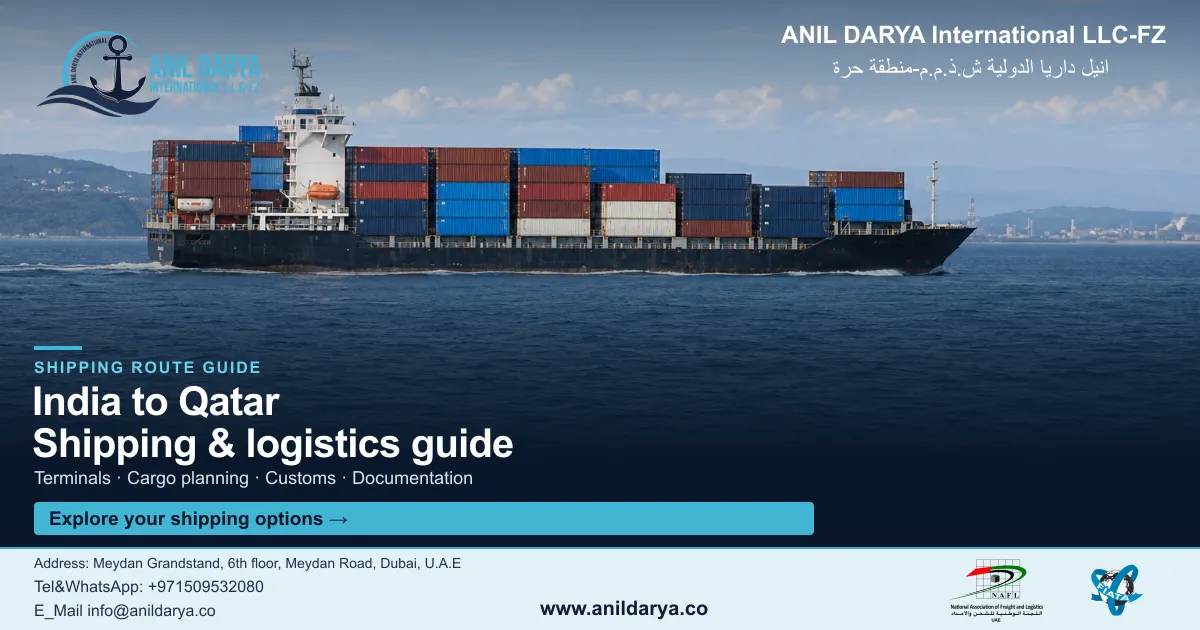
Shipping from India to Qatar is mostly a sea lane: containers load at a west coast port such as Nhava Sheva or Mundra and discharge at Hamad Port, south of Doha. The Indian shipper files the shipping bill on ICEGATE, and the Qatari consignee's customs broker clears the goods on Al Nadeeb, where most goods pay 5% duty on the CIF value. Anil Darya books the ocean freight from Dubai and coordinates both ends, so this guide explains the lane as we run it.
India to Qatar shipping at a glance
| Item | Detail |
|---|---|
| Main Indian load ports | Nhava Sheva (JNPA) and Mundra on the west coast; Chennai, Cochin, Tuticorin and Kolkata for south and east India suppliers |
| Main Qatar discharge port | Hamad Port, Umm Al-Houl, south of Doha (UN/LOCODE QAHMD) |
| Modes | FCL, LCL, reefer, flat rack and breakbulk, dangerous goods |
| Published carrier transit, Nhava Sheva to Hamad | 6 days on Milaha's weekly India Gulf Express (MIX), February 2026 release |
| Published carrier transit, Mundra to Hamad | 9 days on the same MIX release |
| India export filing | Shipping bill filed electronically on ICEGATE by the exporter or its customs broker; IEC needed |
| Qatar customs authority and system | General Authority of Customs, Al Nadeeb single window |
| Qatar duty | 5% of CIF for general goods; steel 20%; alcohol and tobacco 100%; basic foods such as rice exempt |
| VAT in Qatar | Not introduced (third-party guides checked 2026); excise applies to tobacco, energy drinks and sweetened drinks |
| Food shipments | Ministry of Public Health certificate of conformity programme for food and beverages since 25 January 2024 |
| Who clears in Qatar | The consignee or its customs broker, agreed before the cargo sails |
How shipping from India to Qatar works as a cross-trade
This is a cross-trade lane. The cargo never needs to touch the UAE: it sails from an Indian port to a Qatari port. We sit in Dubai and arrange the ocean leg between two countries where neither the shipper nor the consignee is our local customer by default. Three parties carry the work.
| Stage | Who does it | What it covers |
|---|---|---|
| Origin in India | The Indian shipper or its origin agent | Factory pickup, container stuffing, shipping bill on ICEGATE, Let Export Order, gate-in at the port |
| Ocean freight | Anil Darya, booked from Dubai with the shipping line | Rate, space, equipment, carrier acceptance for DG or special cargo, B/L release, tracking |
| Destination in Qatar | The consignee's customs broker | Al Nadeeb declaration, duty payment, permits, delivery order, inspection, delivery |
The bill of lading is the shipping line's own B/L. Anil Darya acts as agent for many shipping lines, so the carrier's B/L is issued and released to you through us. We do not issue a house bill on this lane. Destination clearance in Qatar is not a service we sell. The consignee's broker handles it, and we confirm that broker before we confirm the booking.
The Incoterm decides who pays which leg. On FOB Nhava Sheva, the Indian seller clears export and the Qatari buyer pays the sea freight. On CFR or CIF Hamad, the seller pays the freight and the buyer still pays duty and local charges in Qatar. Our Incoterms 2020 guide for sea freight shows where cost and risk pass under each term.
Choosing the load port in India
Pick the port nearest the factory. A truck or rail move across India to a distant port often costs more than the sea leg to Hamad.
| Indian port | Region it serves | Notes for the Qatar lane |
|---|---|---|
| Nhava Sheva (JNPA), Navi Mumbai | Maharashtra, Madhya Pradesh, north India via rail | Five container terminals and about half of India's major-port container cargo; Milaha's MIX calls at BMCT |
| Mundra, Gujarat | Gujarat, Rajasthan, Punjab, Delhi region | Four container terminals and rail links; Adani lists breakbulk, steel and project cargo; MIX calls at MICT |
| Kandla, Pipavav, Hazira (Gujarat) | Gujarat industrial belt | Alternatives to Mundra depending on the carrier |
| Chennai, Tuticorin, Cochin | Tamil Nadu, Kerala, Karnataka | Ask whether the service is direct or transhipped before you book |
| Kolkata, Visakhapatnam | East India | Longer routing; check transhipment points on every quote |
Hamad Port: the discharge end of the lane
Hamad Port is Qatar's container gateway. Mwani Qatar manages it, and operations moved there from the old Doha port in December 2016. Mwani lists two container terminals in operation with an optimum capacity of 5 million TEU a year, a general cargo terminal, a vehicle terminal and a free zone next to the port.
- LCL boxes are unpacked at the container freight station at Container Terminal 1, where cargo is weighed, examined and delivered.
- IMDG cargo is handled in a separate shed with a class-wise segregated DG warehouse.
- Steel plates, pipes, rails and project pieces go through the general cargo terminal, which has a 1,200 m berth.
- Container gates link to the customs single window, and trucks book slots through the port's appointment system.
Some feeder services from India may call other Qatari terminals, but for containers you should assume Hamad unless the carrier says otherwise.
Sea freight from India to Qatar: direct calls and transhipment
Most India to Qatar containers travel on a regional service that calls a few Gulf ports in a loop. Some sail direct to Hamad. Others discharge at a Gulf hub and reach Hamad on a feeder. The routing matters more than the headline transit, so ask for it on every quote.
Published carrier schedules we checked
| Service (release) | Rotation | Nhava Sheva to Hamad | Mundra to Hamad |
|---|---|---|---|
| Milaha India Gulf Express MIX (December 2024) | Mundra, Nhava Sheva, Sohar, Jebel Ali, Hamad; weekly, 2 vessels of 1,200 TEU | 6 days | 9 days |
| Milaha MIX (February 2026) | Same five ports, weekly; upper Gulf ports served through Hamad | 6 days | 9 days |
| Milaha MIX (April 2026) | Mundra and Nhava Sheva direct to Sohar; Hamad and Jebel Ali cargo moved on by truck through bonded corridors | 12 days | 14 days |
The three releases show how fast a published schedule can change on this lane. The vessel loop, the number of calls and even the last leg can move between releases. Treat any transit you read, including ours, as valid only for the sailing it was quoted on.
[AMIR-FACT: the carriers we actually book from Nhava Sheva and Mundra to Hamad, and the real port-to-port and door-to-door transit days we see on this lane]
Where transhipment happens
On the MIX service, Hamad itself is the hub: Milaha lists Dammam, Shuwaikh and Umm Qasr as transhipment ports reached through Hamad. Cargo for Qatar is discharged there directly. Other lines may tranship India to Qatar cargo at a Gulf hub, and Jebel Ali is a common one. Milaha's Intra Gulf Express shows a published feeder link from Jebel Ali to Hamad of 4 days via Sohar (January 2025 schedule). We check the hub and the feeder connection before we book.
FCL or LCL: which fits your cargo?
| Option | Best for | Watch out for |
|---|---|---|
| FCL 20ft | Rice, tiles, steel fittings, other dense cargo | Weight limits on Indian roads and on the carrier's box |
| FCL 40ft or 40ft high cube | Furniture, textiles, mixed retail stock from one supplier | Free time at Hamad and delivery booking |
| LCL | Small first orders, samples, mixed cartons | Release waits for the whole box to clear at the Hamad CFS |
| Reefer | Fresh fruit and vegetables, frozen meat, dairy, some pharma | Plug space on the vessel, MoPH food rules, shelf life on arrival |
| Flat rack or open top | Machinery, cable drums, tall equipment | Carrier acceptance and lashing; limited equipment at smaller Indian ports |
If you buy from several Indian suppliers, compare one consolidated FCL with several LCL lots. Our article on FCL vs LCL costs explains where the break-even usually sits, and our sea freight service covers container booking.
Dangerous goods, breakbulk and project cargo
India ships a lot of chemicals, paints, solvents and batteries to Gulf buyers. These move under the IMDG Code. The 2024 edition (Amendment 42-24) has been mandatory since 1 January 2026, so the Indian shipper's DG declaration and Safety Data Sheet must follow it.
- The shipper gives the UN number, proper shipping name, class and packing group.
- We request carrier acceptance before the booking is confirmed. Regional feeders and some Indian terminals have their own DG limits.
- Qatar prohibits explosives, ammunition, flammable goods and radioactive material, so some DG need a specific approval or cannot be imported at all.
- The consignee's broker checks whether a Qatari permit is needed before the box sails, not after it lands.
Our dangerous goods team checks the papers and carrier acceptance first.
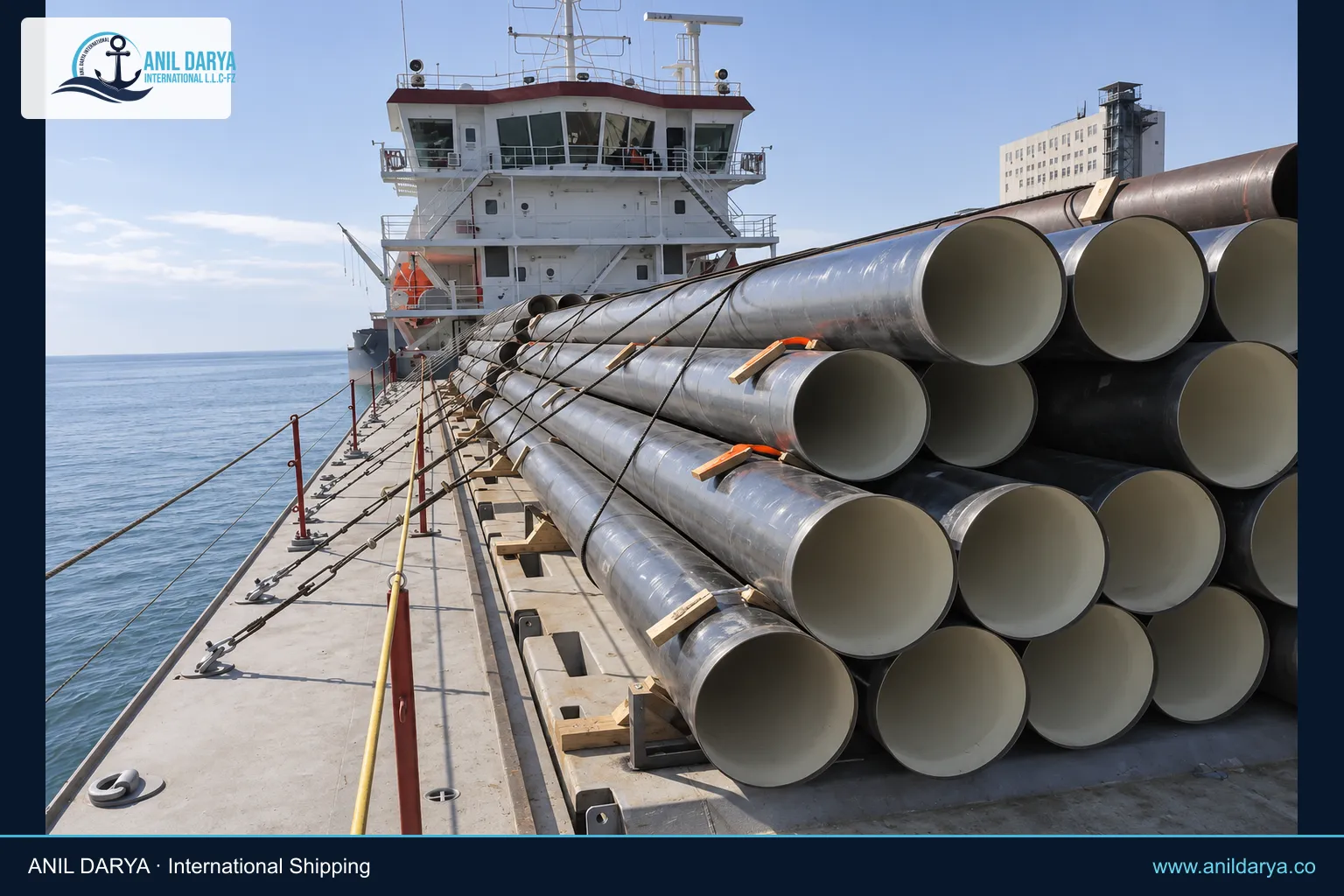
Project cargo on this lane is often steel pipe, structural steel, transformers and plant for Qatar's energy and construction work. Pieces that fit a 40ft flat rack can sail on a container service. Larger lifts need breakbulk tonnage into Hamad's general cargo terminal. For each piece we need drawings, weight, centre of gravity and lifting points, and the consignee's discharge and road plan in Qatar. Our break bulk and project cargo service explains how we plan the sea leg.
Typical cargo on this lane
Indian goods sold to Qatar range from food staples to heavy steel. An Indian export guide lists rice, jewellery, welded steel tubes and pipes, passenger cars, unglazed ceramic tiles, petroleum coke and benzene among India's largest export groups to Qatar. Each group brings its own paperwork.
| Cargo | Usual equipment | Qatar point to check |
|---|---|---|
| Rice, flour, pulses, spices | 20ft FCL, bagged | Rice, wheat and flour are duty-exempt basic foods; MoPH food rules and Arabic labels still apply |
| Fresh fruit and vegetables | 40ft reefer | Shelf life on arrival; some vegetables carry seasonal duty under the 2026 decree |
| Frozen meat and poultry | 40ft reefer | Health certificate and halal slaughter certificate; fresh or chilled chicken duty raised to 18% in 2026 |
| Steel pipes, bars, structures | Flat rack, breakbulk, 20ft FCL | Steel listed at 20% duty, not 5% |
| Ceramic and vitrified tiles, granite | 20ft FCL | Weight per box; origin marks on every crate |
| Textiles, garments, furniture | 40ft high cube | Made-in marks on each piece and carton |
| Chemicals, paints, batteries | FCL or LCL as DG | IMDG papers; permits for restricted chemicals |
| Jewellery and high-value goods | Usually air | Value checks at customs; cargo insurance |
India export side: shipping bill, IEC and Let Export Order
The Indian side is the shipper's job. Under section 50 of the Customs Act, 1962, the exporter files a shipping bill electronically, and under section 51 the proper officer issues an order permitting clearance and loading, the Let Export Order. Filing runs through ICEGATE, the Indian customs portal, which also generates the scroll used for IGST refunds on exports.
- The exporter needs an Importer-Exporter Code (IEC) from DGFT. It is mandatory for any export and matches the company's PAN.
- The shipping bill can be filed by the exporter or by its licensed customs broker in India.
- The commercial invoice, packing list and certificate of origin for Qatar should carry the same values, weights and HS codes as the shipping bill.
- Food, plant products and some chemicals may need an Indian health, phytosanitary or analysis certificate before loading.
We coordinate with the shipper or its origin agent on cut-offs, container release and the export documents. We do not file the Indian shipping bill. If the buyer is in Qatar and buys EXW, someone in India still has to act as exporter of record, so FOB or a named Indian agent is usually cleaner.
Note that the India-UAE CEPA covers goods entering the UAE only. Cargo for Qatar pays Qatar's normal tariff.
Qatar import customs and clearance
The General Authority of Customs (GAC) clears goods arriving in Qatar under Law No. 40 of 2002 and the GCC Common Customs Law. Declarations go through Al Nadeeb, the customs single window. The declarant submits and tracks the declaration there, it is routed to other agencies for approvals, a clearing agent can be authorised, and duty is paid online.
Who can import into Qatar
Every importer needs an import licence registered with the Ministry of Commerce and Industry. The US government's Qatar guide says licences go to Qatari nationals or to the Qatari partner in a company, and the rule also covers foreign-owned entities. In practice your Qatari buyer, or its customs broker, is the importer. Make sure the consignee on the B/L is the licensed importer.
Documents Qatar asks for
| Document | Prepared by | Rule to follow |
|---|---|---|
| Commercial invoice | Indian shipper | Official invoice showing the HS code for every line |
| Packing list | Indian shipper | Matches the invoice and the marks on cartons |
| Certificate of origin | Issuing body in India | Official COO with HS codes; India as origin, matching the goods |
| Bill of lading | Shipping line, released through us | Consignee is the licensed Qatari importer |
| Import licence and customs declaration | Consignee or its broker | Declaration filed on Al Nadeeb |
| Health, halal and conformity certificates | Indian shipper, as the goods require | Meat, poultry and food shipments |
Invest Qatar says documents must be attested, translated and verified before goods leave the customs area. Since 1 April 2011 Qatar has required an official invoice, an official certificate of origin and a packing list for sea and air shipments, and shipments without them are not cleared. Every piece and carton must carry a "Made in" or country of origin mark that matches the invoice and COO. Since January 2025, Qatar uses 12-digit HS codes for imports and exports, so ask the consignee's broker for the full Qatari code before the invoice is printed.
Goods are generally inspected at the customs station with the owner or a representative present. Goods that do not match the documents can attract extra duty and a fine.

Duty and taxes in Qatar
Qatar applies the GCC common external tariff. Duty and taxes at destination are paid by the consignee or its broker.
| Goods | Duty in Qatar |
|---|---|
| General cargo | 5% of the CIF invoice value |
| Records and musical instruments | 15% |
| Steel | 20% |
| Urea and ammonia | 30% |
| Alcohol, cigarettes and tobacco | 100% (tobacco: or QAR 1,000 per 10,000 cigarettes if higher) |
| Fresh or chilled chicken (Amiri Decree 45 of 2026) | Raised from 5% to 18% |
| Tomatoes, eggplants, zucchini in peak local season (same decree) | Raised from 0% to 15% |
| Basic foods such as rice, wheat, flour, fresh produce | Exempt |
Over 600 goods are exempt under the GCC Customs Union. Qatar has not introduced VAT, according to guides checked in 2026, so duty is usually the only import tax. Excise applies to tobacco, energy drinks and sweetened beverages, and since 17 September 2026 excise goods must be registered with the General Tax Authority before they are imported. For Indian steel pipe, the 20% rate makes a large difference to the landed cost, so confirm the HS code early.
Food conformity: the MoPH certificate of conformity
Qatar's Ministry of Public Health runs a certificate of conformity programme for shipments of food and beverages, in force since 25 January 2024. Under it, an approved inspection body checks the documents, inspects the goods, takes samples for testing in an ISO/IEC 17025 laboratory and issues a certificate of conformity for the shipment. The exporter supplies the invoice, ingredient list, batch certificate of analysis, label artwork, the product's MoPH registration number, and halal, health or origin certificates where they apply.
Labels must be in Arabic, or Arabic and English, and Arabic stickers are accepted. Production and expiry dates must be printed by the manufacturer, not added later on a sticker. Food must reach Qatar with at least half its shelf life left. For Indian rice, spices and snacks, plan the certificate and labels before production, not at the port.
Restricted and prohibited goods in Qatar
| Category | Status | What to do |
|---|---|---|
| Ammunition and explosives | Prohibited | Do not ship |
| Flammable goods, radioactive material | Prohibited or controlled | Check with the consignee's broker before any DG booking |
| Narcotic drugs | Prohibited | Not shippable |
| Counterfeit or IP-infringing goods | Prohibited | Not shippable |
| Meat and poultry | Restricted | Health certificate and halal slaughter certificate from India |
| Food and beverages | Restricted | MoPH certificate of conformity, Arabic labels, shelf life |
| Alcohol and tobacco | Restricted, 100% duty | Licensed importer and excise registration |
The Dubai option: Jebel Ali, consolidation and free zones
Most cargo should sail straight from India to Hamad. Routing through Dubai helps in three cases.
- Transhipment at Jebel Ali. If a carrier's India service discharges at Jebel Ali and a feeder carries the box on to Hamad, the cargo is moved under Dubai Customs' transit regime rather than imported into the UAE. Our Jebel Ali port guide covers the port.
- LCL consolidation in Dubai. A Qatari buyer with small lots from several Indian suppliers, plus goods from other origins, can gather them in Dubai and send one container to Hamad.
- Stock in a Dubai free zone. A trader can hold Indian goods in Jafza and re-export to Qatar and other Gulf buyers as orders come in. Our article on re-export through Jafza explains the set-up.
Goods held in a UAE free zone count as outside the GCC for customs, so Qatar charges duty when they arrive. Where the lane touches Dubai, customs clearance in Dubai is ours, for a fee.
[AMIR-FACT: whether we route India to Qatar cargo through Jebel Ali in practice, which carriers or feeders we use for that leg, and a real cross-trade shipment we handled from India to Qatar (cargo, load port, routing, transit, outcome)]
Shipping from India to Qatar step by step
- Agree the Incoterm. FOB Indian port or CFR Hamad are the usual terms on this lane.
- Send us the cargo details: commodity, HS code, weight, volume or piece sizes, supplier address in India, ready date, and whether anything is DG, reefer or out of gauge.
- Confirm the Qatar side first. The consignee names its customs broker, confirms its import licence and checks any permit, MoPH certificate or excise registration the goods need. We confirm this before we confirm the booking.
- Get a quote and routing. We compare carriers from the nearest Indian port and tell you whether the service calls Hamad direct or uses a hub.
- Book space with the shipping line. For DG, reefer or flat rack cargo, carrier acceptance comes before the booking is confirmed.
- Origin work in India. The shipper or its origin agent picks up the cargo, stuffs the container, files the shipping bill on ICEGATE and gets the Let Export Order before the cut-off.
- Check documents before sailing. We match the invoice, packing list, certificate of origin and draft B/L, and send them to the consignee's broker.
- Sailing and B/L release. The carrier's B/L is issued and released to you through us once the agreed terms are met.
- Pre-arrival filing. The broker lodges the Al Nadeeb declaration so it is ready when the vessel berths at Hamad.
- Clearance, delivery and empty return. The broker pays duty, collects the delivery order and delivers. The empty must be returned within free time.
What affects the cost of shipping from India to Qatar?
We do not publish rates, because they change with each sailing and carrier. These are the parts of the total and what moves them.
| Cost part | What moves it |
|---|---|
| Origin charges in India | Inland haulage to the port, CFS or factory stuffing, terminal handling, export filing by the shipper |
| Ocean freight | Load port, container type, season, direct call or hub routing, carrier surcharges |
| Special cargo | DG surcharges, reefer, flat rack or breakbulk premiums, lashing |
| Destination charges at Hamad | Terminal handling, delivery order, LCL unpacking, inspection |
| Qatar duty and excise | CIF value and the 12-digit HS code; steel and some foods pay more |
| Certificates | MoPH conformity, health, halal, attestation of documents |
| Delays | Demurrage and detention when free time runs out |
Our guide to demurrage and detention shows how free time turns into cost when clearance is late.
Checklist before the cargo leaves India
- Incoterm written in the contract.
- Consignee's Qatari customs broker named and in contact with us.
- Consignee holds a Qatar import licence and is the consignee on the B/L.
- 12-digit Qatari HS code on the invoice and certificate of origin.
- "Made in India" marked on every piece and carton.
- Invoice, packing list, COO and B/L agree on weights, counts and values.
- Shipping bill filed and Let Export Order issued before the cut-off.
- For food: MoPH certificate of conformity, Arabic labels, shelf life checked.
- For meat: health and halal slaughter certificates.
- For DG: SDS, DG declaration under IMDG 42-24, carrier acceptance.
- Duty rate checked, including steel at 20% and 2026 changes.
- Free time at Hamad agreed and cargo insurance arranged.
Common mistakes on this lane
- Shipping before destination clearance is agreed. A box that reaches Hamad with no broker and no licensed importer sits in the port and runs up charges.
- Missing HS codes on the invoice or COO. Qatar will not accept the shipment for clearance.
- No origin marks, or marks that do not match the documents.
- Pricing steel pipe at 5% duty instead of 20%.
- Food sent without the MoPH certificate, Arabic labels or enough shelf life.
- Assuming the India-UAE CEPA lowers duty in Qatar. It does not.
- Undeclared DG such as batteries or paints booked as general cargo.
- Choosing a service by headline transit without checking whether it calls Hamad direct.
Frequently asked questions
How long does sea freight from India to Qatar take?
It depends on the service. Milaha's February 2026 MIX schedule shows 6 days from Nhava Sheva and 9 days from Mundra to Hamad, while its April 2026 release shows 12 and 14 days with a truck leg from Sohar. Add time for export filing, clearance and delivery.
Which port in Qatar receives containers from India?
Hamad Port, south of Doha (UN/LOCODE QAHMD). It took over Qatar's container operations from the old Doha port in December 2016.
What is the import duty on Indian goods in Qatar?
Most goods pay 5% of the CIF value. Steel pays 20%, urea and ammonia 30%, and alcohol and tobacco 100%. Basic foods such as rice, wheat and flour are exempt.
Does the India-UAE CEPA reduce duty in Qatar?
No. The CEPA applies only to goods entering the UAE. Indian goods shipped to Qatar pay Qatar's normal GCC tariff.
Who clears the cargo in Qatar?
The consignee's customs broker, on Al Nadeeb, under the consignee's import licence. Anil Darya does not sell clearance in Qatar, and we confirm the broker before we confirm the booking.
Who issues the bill of lading?
The shipping line issues its own bill of lading. Anil Darya acts as agent for many shipping lines, so the carrier's B/L is issued and released to you through us.
What documents do I need for shipping from India to Qatar?
An official invoice and certificate of origin with HS codes, a packing list, the bill of lading and any certificates the goods need. In India the shipper files a shipping bill on ICEGATE. In Qatar the broker files on Al Nadeeb.
Can I ship Indian food products to Qatar?
Yes, with the MoPH certificate of conformity for the shipment, Arabic or Arabic and English labels, printed production and expiry dates, and at least half the shelf life left on arrival. Meat also needs health and halal slaughter certificates.
Can cargo from India to Qatar go through Dubai?
Yes. It can be transhipped at Jebel Ali, consolidated with other lots in Dubai, or held in a Dubai free zone and re-exported. Free zone goods pay Qatar duty on arrival.
Get a quote for shipping from India to Qatar
Send us the supplier location in India, the delivery point in Qatar, the cargo details and the name of the consignee's broker. We will come back with carriers, routing and price. Use our freight rate inquiry form, or contact our team to talk through DG, reefer or project cargo first. To see how we work from Dubai, visit our Dubai freight forwarding team.
Sources
- Milaha: India Gulf Express (MIX) schedule, February 2026 release
- Milaha: India Gulf Express (MIX) schedule, April 2026 release
- Milaha: India Gulf Express (MIX) schedule, updated December 2024
- Milaha: Intra Gulf Express (MIG) schedule, January 2025
- Mwani Qatar: Hamad Port
- QTerminals: Hamad Port terminals presentation (September 2020)
- Jawaharlal Nehru Port Authority: overview
- Adani Ports: Mundra port
- CBIC: Customs Act, 1962 (sections 50 and 51)
- ICEGATE: Frequently asked questions
- DGFT: Foreign Trade Policy 2023, chapter 2 (IEC)
- UAE Ministry of Economy and Tourism: India-UAE CEPA
- Invest Qatar: Customs laws, duty rates, documents, exemptions and Al Nadeeb
- US International Trade Administration: Qatar import requirements and documentation
- US International Trade Administration: Qatar labelling and marking requirements
- US International Trade Administration: Qatar moves to 12-digit HS codes
- EY Tax News: Qatar excise framework and tariff increases (2026)
- SGS: Qatar MoPH certificate of conformity for food and beverages (datasheet, February 2024)
- Goods Across Borders: GCC customs union explainer
- XIMPEX: Export guide to Qatar for Indian exporters
- IMO: IMDG Code 2024 edition (Amendment 42-24)
- Dubai Customs: Submit customs declaration (import, export and transit regimes)
Reviewed: 11 November 2026