
Shipping from India to Senegal means a container that loads at Mundra, Nhava Sheva or a Chennai-area terminal and is discharged at Dakar, Senegal's only container terminal, usually after one change of ship at a hub. Two papers decide whether it moves on time: for rice, the exporter's APEDA contract registration in India, and at the other end, the importer's BESC cargo tracking note from COSEC. We book the ocean freight from Dubai, release the shipping line's bill of lading to you and line up the Indian exporter and your broker in Dakar before the box sails.
Shipping from India to Senegal at a glance
| Topic | What applies on this lane |
|---|---|
| Trade size | India's exports to Senegal: US$1,001.10 million in 2024-25 (Ministry of External Affairs, April 2026) |
| Main Indian cargo | Rice (mostly broken rice), cotton fabrics and textiles, medicines, plastics, machinery, motorcycles, tiles |
| Indian load ports | Mundra, Nhava Sheva (JNPA), Pipavav, Hazira, Chennai, Kattupalli and Ennore |
| Discharge port | Dakar, DP World terminal: 900,000 TEU capacity, 710 m quay, 12.5 m average depth |
| Usual routing | Indian port to a hub, then a service that calls Dakar (no direct India to Dakar loop found on carrier pages) |
| Indian export filing | Shipping bill on ICEGATE by the exporter or its customs broker; IEC required |
| Rice exports | Contract registered with APEDA; the RCAC certificate is valid for shipment for 45 days |
| Senegal tracking note | BESC from COSEC, compulsory, validated before the ship arrives |
| Senegal customs | GAINDE 2000 and the ORBUS Infinity single window, filed by a licensed transitaire |
| Trade preference | None found: Indian goods pay the full ECOWAS external tariff |
| Duty and VAT | CET 0% to 35% of CIF, plus 1% RS, 1% PCS, 0.5% ECOWAS levy, 18% VAT unless exempt |
Who does what on an India to Dakar cross-trade booking
Unless you choose a Dubai routing, the cargo never touches the UAE. Our Dubai desk runs the booking, and each party has a fixed job.
- The Indian seller or its customs broker stuffs the box, files the shipping bill and, for rice, gets the APEDA certificate first.
- We reserve space with the line, send the seller its cut-offs and check the draft bill of lading against what COSEC and the Dakar broker need.
- The buyer's transitaire in Dakar files in GAINDE, pays duty and taxes with the importer's funds and collects the box.
The bill of lading on this lane is the carrier's own document, not one of ours. Because Anil Darya acts as agent for many shipping lines, the line's B/L for your rice or fabric is issued and released to you through our office. That carrier B/L is what the line's agency in Dakar asks for at release, and it is also the first attachment COSEC asks for on the BESC.
Agree the Incoterm first. Under FOB, the Indian exporter clears the goods for export and you choose the ship; under CFR the seller picks the carrier and the hub. Our article on Incoterms 2020 for sea freight sets out where cost and risk pass.
Indian load ports for Dakar cargo
Pick the port that has the best connection to Dakar that week, not only the one nearest the mill or factory. Ask for the hub on each option, because the second vessel sets the arrival date.
| Region of the seller | Usual port | Typical Senegal cargo |
|---|---|---|
| Gujarat, Punjab, Haryana, Rajasthan, Delhi NCR | Mundra, Pipavav, Hazira | Rice from northern mills, cotton fabrics, plastics, tiles from Morbi |
| Maharashtra, Madhya Pradesh, Karnataka north | Nhava Sheva (JNPA) | Medicines, machinery, motorcycles, chemicals |
| Tamil Nadu, Andhra Pradesh south | Chennai, Kattupalli, Ennore | Rice from southern mills, textiles, auto parts |
Dakar and the coming Ndayane port
DP World operates the container terminal at the Port Autonome de Dakar and calls it Senegal's only container terminal. It lists 15 hectares, a 710 m quay, 12.5 m average depth at chart datum, 6 quay cranes, 560 reefer plugs and 900,000 TEU of annual capacity, with IMDG, out-of-gauge and reefer handling.
A deeper port is on the way. DP World is developing Ndayane, about 50 km south of Dakar, with the Government of Senegal and British International Investment. Phase 1 is planned with an 840 m quay, 18 m of water and 1.2 million TEU, expected by 2028. Today, every box goes to Dakar.
Sea freight from India to Senegal: hubs and connecting services
We found no carrier page showing a loop from India that calls Dakar directly. The India to West Africa services we read call Gulf of Guinea ports, so a Senegal booking normally has two vessels: India to a hub, then a service that calls Dakar.
| Service and source | Published rotation or connection | Use for Indian cargo |
|---|---|---|
| Maersk MEWA (launch notice, January 2024) | Tanjung Pelepas, Colombo, Nhava Sheva, Mundra, Colombo, Tema, Lome, Abidjan, Tanjung Pelepas | Maersk said cargo could move between Tema and Dakar on a new Dakar feeder. Check that both legs still run before you book. |
| Maersk WAF1 (notice of 19 October 2026) | Algeciras, Tangier, Dakar, Algeciras, from the third week of December 2026 | Maersk says WAF1 improves connectivity to Dakar for cargo from Asia Pacific and the Middle East |
| ONE MAX (from July 2026) | Algeciras, Tangier, Dakar, Tema, Lekki, Abidjan, back to Algeciras | Dakar leg from the two Mediterranean hubs |
| Maersk ME2 (notice of 19 October 2026) | Ennore and Colombo, then Algeciras and Tangier among its calls | Possible connection only: we joined ME2 and WAF1 ourselves at Algeciras or Tangier. Maersk does not publish this as an India to Dakar routing. |
Ask for both legs in writing with each quote: first vessel, hub, connecting vessel and free time at Dakar.
Forwarder and marketplace sites quote about 15 to 45 days and contradict each other. We found no carrier schedule with an India to Dakar day count we could check against the order of calls, so we print none.
[AMIR-FACT: the carriers and services we actually book from Mundra, Nhava Sheva and Chennai/Ennore to Dakar, the hub used on each (Tema, Algeciras, Tangier or other), and our real port-to-port transit days on this lane]
FCL, LCL, reefer and rice cargo options
| Option | Typical Indian cargo for Senegal | What to watch |
|---|---|---|
| 20ft dry | Bagged rice, tiles, steel items, chemicals in drums | Weight is the limit, not volume; check the line's payload rule for each leg |
| 40ft dry or high cube | Cotton fabrics, garments, plastics, motorcycles in kits, furniture | Maersk publishes 10 free days for dry boxes at Dakar |
| Reefer | Frozen boneless meat, some medicines and food | Only 3 free days for reefers at Dakar on Maersk's tariff, and a reefer plug at each hub |
| LCL | Samples, spare parts, first orders of medicines or textiles | Every shipper in the box needs clean papers; one late file holds the rest |
| Bagged cargo on a general cargo ship | Large rice lots | Vessel and berth planning instead of container cut-offs; see our break bulk service |
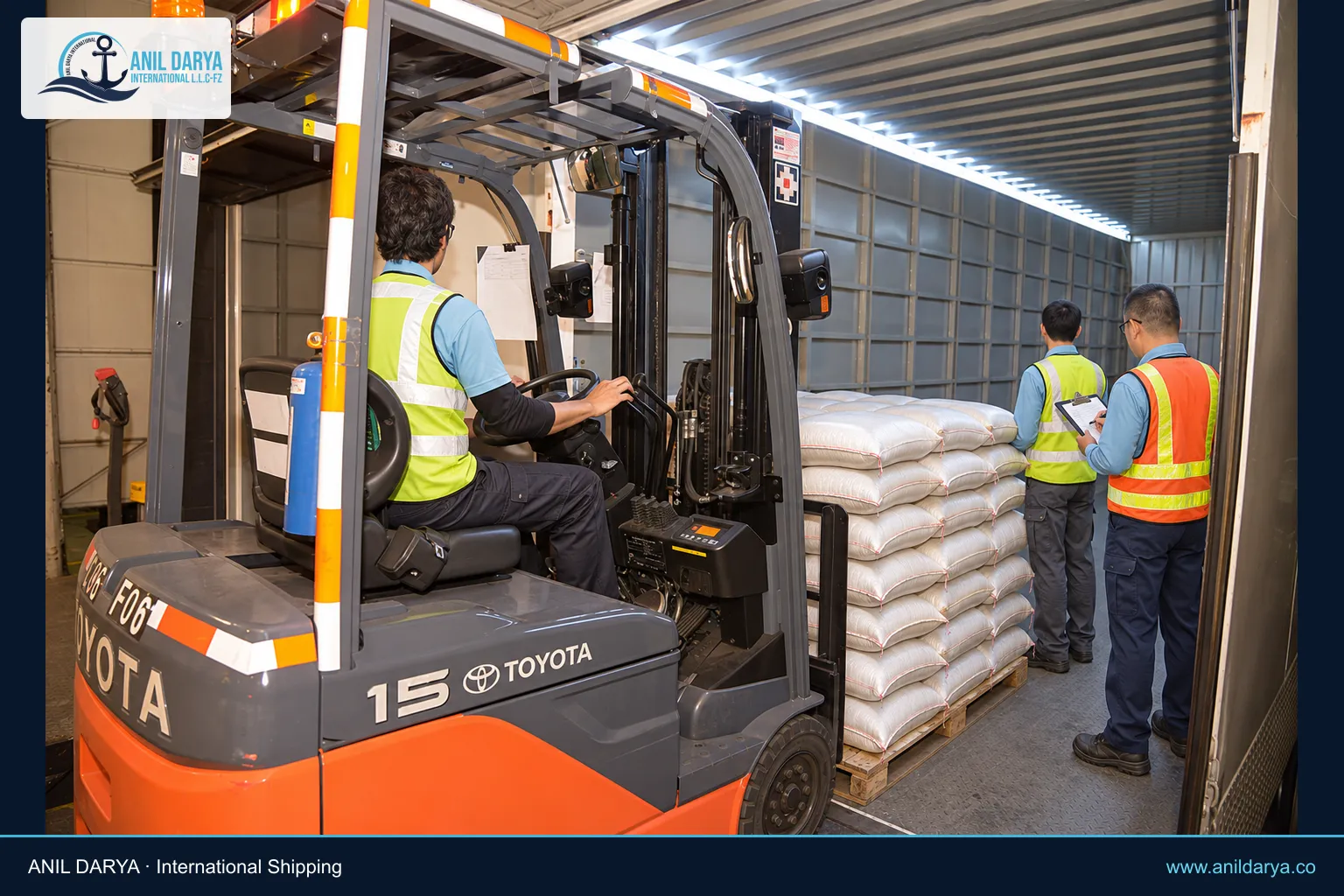
Rice can go in containers or as bagged cargo. Containers suit buyers who want the goods delivered to their own warehouse in lots that fit a box. Larger lots can also move as bags on a general cargo vessel, where the berth and the ship's date drive the plan. If you are unsure which fits, our FCL vs LCL guide covers the container side and our sea freight service covers equipment and booking.
Dangerous goods, machinery and project cargo
Motorcycles and gensets with fuel or batteries, lithium batteries for solar kits, paints, solvents and agrochemicals move under the IMDG Code, whose 2024 edition (Amendment 42-24) became mandatory on 1 January 2026. The seller's Safety Data Sheet and the dangerous goods declaration must follow that edition.
The class has to be accepted by every vessel and every hub on the routing. A DG approval on the India to Tema or India to Algeciras leg does not cover the Dakar leg on its own. Our dangerous goods team checks the UN number, class and packing group against each carrier before you confirm the order.
India also supplies power and transport projects in Senegal, such as the transmission lines and buses the Ministry of External Affairs lists under Indian credit lines. Transformers, cable drums and steel structures often fit a flat rack, and heavier pieces go as breakbulk. See our break bulk and project cargo service.
The India export side: shipping bill, ICEGATE and the rice RCAC
Under section 50 of India's Customs Act, the exporter files a shipping bill for the goods, and under section 51 customs allows the export once the goods are cleared. The exporter or its licensed customs broker files electronically on ICEGATE, which needs a registered ICEGATE ID and a Class 3 digital signature. The exporter also needs an Importer Exporter Code (IEC) from DGFT, which is tied to the company's PAN. Once the ship sails, the line files the export general manifest.
Rice needs one more step. By DGFT Notification 33/2025-26 of 24 September 2025, non-basmati rice under ITC (HS) codes 10063011, 10063019, 10063091, 10063099 and 10064000 may be exported only after the contract is registered with APEDA. Code 10064000 is broken rice, the type Senegal buys most from India. APEDA's trade notice of 25 September 2025 sets the procedure:
- The exporter applies online at APEDA with a scanned copy of the letter of credit, contract or proforma invoice, and pays a small processing fee per tonne.
- APEDA checks the papers and issues a Registration-cum-Allocation Certificate (RCAC) online.
- The exporter submits the RCAC to customs with the other export documents.
- The RCAC is valid for shipment for 45 days from issue, so the registered quantity should be the quantity planned for shipment within that time.
The 45-day window matters for booking: a rolled box can push loading past the RCAC validity. Send us the RCAC date and we plan the booking inside it. APEDA notes that policy conditions can change when the government announces them, so check the current DGFT position before each contract.
Keep the description, quantity and value on the shipping bill identical to the invoice your broker files in Dakar. A mismatch is a quick route to inspection.
Trade agreements: why Indian goods pay full duty in Senegal
We found no trade agreement that lowers Senegal's duty on Indian goods. The Ministry of External Affairs brief on India and Senegal (April 2026) lists no free trade or preferential agreement. Senegal is not on UNCTAD's list of participants in the Global System of Trade Preferences, so GSTP origin certificates, which India issues for other partners, give nothing here. ECOWAS and AfCFTA preferences apply to goods of African origin, not to goods made in India.
What this means for you:
- Price the goods with the full ECOWAS external tariff band for each HS code.
- Still ask the seller for a non-preferential certificate of origin. COSEC lists a certificate of origin among the documents for clearance in Senegal.
- Storing or splitting the goods in Dubai does not cost a preference on this lane, because there is none to lose. The origin stays Indian, and the papers must still show it.
The BESC: Senegal's cargo tracking note
COSEC, the Senegalese Shippers' Council, states that the Bordereau Electronique de Suivi de Cargaison (BESC) is compulsory for goods going to Senegal and must be in place before the cargo arrives. It is the importer's document, but it depends on papers from India.
- Account. The importer registers on the BESC platform with its NINEA tax number and RCCM trade register entry, plus its VAT exemption agreement if it has one. COSEC reviews the file and activates the account.
- Funds. The account must hold enough credit before a BESC can be submitted. A bank transfer can take more than three working days to credit; a deposit at the COSEC counter or a Visa payment on ORBUSPAY is faster.
- Filing. The BESC is created with the shipment data, the bill of lading, the commercial invoice and the freight invoice where it is separate.
- Validation. COSEC checks the file and either validates the BESC or sends a notice of what to correct.
The B/L only exists once the first vessel sails, so ask us for it and the freight invoice as soon as the box is loaded. Do not leave the BESC until the ship reaches Dakar.
[AMIR-FACT: on our India to Dakar bookings, who in practice creates the BESC (importer, its transitaire, or with our freight invoice) and how many days before arrival it is usually validated]

Senegal import customs: GAINDE, documents and release
Senegalese customs clears goods through GAINDE 2000, linked to the ORBUS Infinity single window. COSEC explains that an owner may declare goods worth 200,000 FCFA or less, but above that a licensed customs broker is generally required. We do not sell customs clearance in Senegal. Before we confirm the booking, your transitaire has to accept the file and know the arrival plan.
| Document | Comes from | Check before loading |
|---|---|---|
| Carrier bill of lading | Shipping line, released through us | Consignee is the NINEA holder; weights match the packing list |
| Commercial invoice | Indian seller | HS code and value per line, same figures as the shipping bill |
| Packing list | Indian seller | Bag or carton count and gross weight equal to the B/L |
| Certificate of origin | Indian seller, through its chamber or agency | Same goods and invoice number |
| Insurance | Buyer under FOB or CFR | Covers both vessels and the hub |
| BESC | Importer's COSEC account | Validated before arrival |
| DPI and AV | Importer, through ORBUS | For certain goods and value levels |
| Health or plant health permits | Importer | Food, meat, plant products, medicines |
The DPI is the prior import declaration and the AV the verification certificate. COSEC lists the DPI for certain goods and the AV where required. A 2020 French customs guide put the thresholds at 1,000,000 FCFA FOB (DPI) and 3,000,000 FCFA FOB (AV), with the AV linked to a check before shipment. Confirm the current rule with your broker before stuffing.
GAINDE numbers the declaration, calculates duty and taxes and assigns a green, yellow or red channel. After payment, customs issues the Bon à Enlever (BAE). The line releases the box on the original B/L, signed container guarantee forms and payment of its local charges, which Maersk invoices to the consignee from the day of arrival. COSEC notes that clearance can start before arrival, which protects your free days.
Import duty, levies and VAT on goods from India
Senegal applies the ECOWAS Common External Tariff, and India is a third country under it. Senegalese customs charges duty, the statistical fee and the community solidarity levy on the CIF value. Duty and taxes at destination are paid by the consignee or its broker, not by the Indian seller and not by us.
| Charge | Rate | Base and notes |
|---|---|---|
| Customs duty, categories 0 to 3 | 0%, 5%, 10%, 20% | CIF value, by HS code |
| Fifth CET band | 35% | CIF value, for a short list of tariff lines |
| Statistical fee (RS) | 1% | CIF value, third-country goods, even when duty is zero |
| Community solidarity levy (PCS) | 1% | CIF value |
| ECOWAS levy | 0.5% | CIF value, third-country goods |
| COSEC levy | 0.4% | Sea cargo |
| VAT | 18% | Single rate, unless the product is exempt |
Rice has its own published figure. Senegalese customs gives a cumulative rate of 12.7% for broken, whole, intermediate, husked and milled rice, and 7.7% for paddy rice for sowing. The customs page carries no date, so ask your broker to confirm the rate on the day of filing. For other Indian goods, get the full figure for each HS code before you agree a price: excise applies to some groups, and vehicles have their own cumulative rates on the customs site.
Restricted goods and product rules in Senegal
Most Indian goods clear on the standard file. Some need a permit, a standard or specific marking first.
| Indian goods | What applies in Senegal |
|---|---|
| Medicines | Import authorisation from the health authorities |
| Frozen meat and other animal products | Sanitary permit before shipment |
| Rice, other foods | Plant health or sanitary papers as required; marking rules for retail food |
| Phones, routers, radio equipment | Approval from the telecoms regulator (ARTP) |
| Reinforcing steel | Must meet the Senegalese standard |
| Used vehicles | Age limit and customs reference values |
The list comes from COSEC and the 2020 French customs guide; your broker should check each HS code against current rules.
Cargo for Mali through Dakar
Dakar is also a transit port for Mali, and Indian rice and goods for Bamako can land there. COSEC describes the transit regime: a transit declaration (acquit-à-caution), a bank guarantee and customs tracking to the exit office. Maersk's Senegal tariff gives 10 days of demurrage and 23 days of detention for dry boxes in transit to Bamako. Tell us at booking if the cargo is for Mali, so the B/L, the BESC and the transit papers name the right consignee and final destination.
Routing via Dubai: consolidation, free zone stock and transhipment
A direct booking from India is simpler for most cargo. Dubai helps when the buyer also sources from the Gulf or holds stock for several markets.
| Option | How it works | What to watch |
|---|---|---|
| Consolidation in Dubai | Indian goods join goods from other origins in one box for Dakar | Each line keeps its own origin on the invoice and certificate |
| Jafza stock and re-export | You hold Indian goods in the free zone and ship to Dakar as orders come in | Dubai Chambers issues certificates of origin for re-exports |
| Transhipment at Jebel Ali | The box arrives from India and connects to a sailing towards West Africa | Dubai Customs handles transit as its own declaration regime |
See our Jebel Ali port guide and our article on re-exporting through Jafza. When goods are landed, consolidated or re-exported in Dubai, we clear them through UAE customs for a fee.
[AMIR-FACT: whether we have routed India cargo for Senegal through Jebel Ali (transhipment, Dubai consolidation or Jafza re-export), the line used from Jebel Ali to Dakar and the real extra days compared with a sailing from Mundra or Nhava Sheva]
Typical cargo on the India to Dakar lane
The Ministry of External Affairs names cereals, cotton and textiles, pharmaceuticals, plastics and machinery as India's main exports to Senegal, and says almost 90% of the broken rice Senegal imports comes from India. Ximpex's list of top Indian export lines adds boneless bovine meat, motorcycles and unglazed ceramic paving.
| Cargo | Usual equipment | Points to plan |
|---|---|---|
| Broken and milled rice | 20ft dry, or bagged on a general cargo ship | APEDA RCAC inside its 45 days; cumulative 12.7% in Senegal |
| Cotton fabrics and garments | 40ft dry or LCL | Origin and marking on every bale or carton |
| Medicines | LCL, 20ft, reefer for cold-chain lines | Senegalese authorisation before shipment; temperature log |
| Frozen boneless meat | 40ft reefer | Sanitary permit; 3 reefer free days at Dakar on Maersk's tariff |
| Motorcycles and parts | 40ft high cube | Fuel and batteries declared under IMDG; CKD or CBU stated on the invoice |
| Ceramic tiles and paving | 20ft dry | Heavy per box; check payload on both legs |
| Machinery and power equipment | FCL, flat rack, breakbulk | Drawings and acceptance on the Dakar leg |
Step by step: shipping from India to Senegal with Anil Darya
- Send us the goods, HS code, weight, volume, the seller's city and the delivery point in Senegal or Mali.
- Name your transitaire in Dakar. We agree with them the documents, the BESC timing and who pays which terminal charges, and only then confirm the booking.
- Fix the Incoterm with the seller, and check that the NINEA, RCCM and a funded BESC account are ready.
- Have your broker check DPI, AV and any permit, so a check in India happens before stuffing.
- For rice, the seller registers the contract with APEDA and sends you the RCAC date.
- We book with the line, send the seller the booking, cut-offs and the draft B/L.
- The seller stuffs the box and files the shipping bill on ICEGATE.
- After loading, the line issues its B/L and we release it to you with the freight invoice.
- The BESC is validated, your broker files in GAINDE before arrival and the box leaves Dakar after the BAE.
[AMIR-FACT: one real India to Senegal cross-trade shipment we handled (cargo, Indian load port, hub, carrier, what we coordinated with the seller and the transitaire, and the outcome at Dakar), cleared for publication]
What drives the cost of shipping from India to Senegal?
We do not print freight figures, because they change with each sailing. These are the parts that make up your landed cost.
| Cost part | What moves it | Usually paid by |
|---|---|---|
| Indian origin charges | Trucking from the mill or factory, CFS handling, customs broker, terminal handling | Seller under FOB |
| Ocean freight | Box type, season, number of transfers, surcharges | Buyer under FOB |
| DG, reefer and out-of-gauge premiums | Class, temperature, lashing, flat rack or breakbulk | Buyer under FOB |
| BESC and COSEC levy | Platform charge and the 0.4% levy on sea cargo | Importer |
| Dakar local charges | Terminal handling, line documentation fee, container guarantee | Importer |
| Duty, levies and VAT | HS code, CIF value, excise | Importer or its broker |
| Demurrage and detention | Late BESC, missed hub connection, red channel | Whoever caused the delay, under your contract |
Free time at Dakar is short. See our article on demurrage and detention.
Checklist before the cargo leaves India
- Incoterm in the contract; insurance covers both vessels and the hub.
- HS code agreed with your broker; CET band, levies and VAT checked.
- Transitaire in Dakar named and the clearance plan agreed before booking.
- NINEA, RCCM and a funded BESC account in place.
- For rice: RCAC issued and the sailing inside its 45 days.
- DPI, AV and any permit checked; pre-shipment check booked if needed.
- For DG: UN number, SDS and acceptance on every leg, including Dakar.
- For Mali: final destination and transit consignee on the B/L from the start.
Mistakes that hold Indian cargo at Dakar
- Shipping before destination clearance is agreed. If no transitaire has accepted the job, the box sits at the terminal while free days run out.
- Letting the RCAC expire. A rolled booking or a slow hub connection can push loading past the 45 days.
- Leaving the BESC until the ship berths. It needs an active, funded account, the B/L and the freight invoice.
- Assuming a preference applies. There is none on this lane, so a quote built on a reduced duty is wrong.
- Planning only the first vessel. A DG class or a reefer accepted to the hub can be refused on the Dakar leg.
Frequently asked questions
Is there a direct ship from India to Dakar?
We found none on carrier pages. Cargo normally changes ship at a hub such as Tema, Algeciras or Tangier, from where feeders and services like Maersk's WAF1 and ONE's MAX call Dakar.
How long does shipping from India to Senegal take?
It depends on the load port, the hub and the connection. Online estimates disagree widely, so use the carrier schedule for your sailing and add time for the BESC and clearance in Dakar.
Does rice from India to Senegal need any special export paper?
Yes. Since DGFT Notification 33/2025-26, non-basmati rice, including broken rice, can be exported only after the contract is registered with APEDA. APEDA issues an RCAC that is valid for shipment for 45 days, and the exporter presents it to Indian customs.
What duty does Senegal charge on goods from India?
Duty follows the ECOWAS CET at 0% to 35% of CIF value. Add 1% statistical fee, 1% PCS, 0.5% ECOWAS levy, 0.4% COSEC levy on sea cargo and 18% VAT unless exempt. Senegalese customs gives a cumulative 12.7% for most rice.
Is there a trade agreement between India and Senegal that cuts duty?
We found none. Senegal is not a GSTP participant, the official India-Senegal brief lists no trade agreement, and ECOWAS and AfCFTA preferences cover African-origin goods only. Indian goods pay the full external tariff.
What is the BESC and when is it needed?
It is Senegal's electronic cargo tracking note, run by COSEC, compulsory for goods to Senegal and validated before arrival.
Does Anil Darya clear customs in Senegal?
No. A licensed transitaire chosen by the consignee clears the goods in Dakar, and duty and taxes at destination are paid by the consignee or its broker. We agree the plan with that broker before we confirm the booking.
Get a quote for shipping from India to Senegal
Send us the seller's city, the goods and HS code, the ready date and your transitaire in Dakar, and we will reply with a routing, hub, carrier and price. Use our freight rate inquiry form, or contact our team to plan rice, reefer, DG or Mali transit cargo first. You can also read more about our Dubai freight forwarding team.
Sources
- Ministry of External Affairs, India: Brief on India-Senegal relations (April 2026; trade, rice share, main exports)
- APEDA: Trade notice on registration of non-basmati rice export contracts and the RCAC (25 September 2025)
- CBIC: Customs Act, 1962, sections 50 and 51
- ICEGATE: Help and FAQ (shipping bill, digital signature, EGM)
- DGFT: Foreign Trade Policy 2023, chapter 2 (IEC)
- UNCTAD: About the GSTP (participants)
- COSEC: FAQ (BESC steps, clearance procedure, documents, broker rule, transit regime)
- Douanes sénégalaises: Table of duties and taxes (CIF base, RS, PCS, ECOWAS levy, 18% VAT)
- Douanes sénégalaises: Clearance of rice and other staple products (cumulative rates)
- Douanes sénégalaises: Cumulative tax rates for vehicles (COSEC levy)
- ECOWAS: Common External Tariff bands
- French customs: 10 questions on exporting to Senegal (2020; DPI and AV, permits, marking)
- GAINDE 2000: ORBUS single window
- DP World: Dakar terminal facts
- DP World: Senegal and the Port of Ndayane
- Maersk: Senegal import information (free time, Bamako transit, release)
- Maersk: MEWA service and Dakar feeder (January 2024)
- Maersk: Western Mediterranean to West Africa network, WAF1 (19 October 2026)
- Maersk: Network update ME2 and AE12 (19 October 2026)
- AJOT: ONE launches the MAX Mediterranean Africa service
- IMO: IMDG Code 2024 edition (Amendment 42-24)
- Ximpex: India's top export lines to Senegal
- Dubai Customs: Customs declaration regimes
- Dubai Chambers: Certificates of origin for re-exported goods
- Jafza: About the Jebel Ali Free Zone
Reviewed: 11 November 2026