
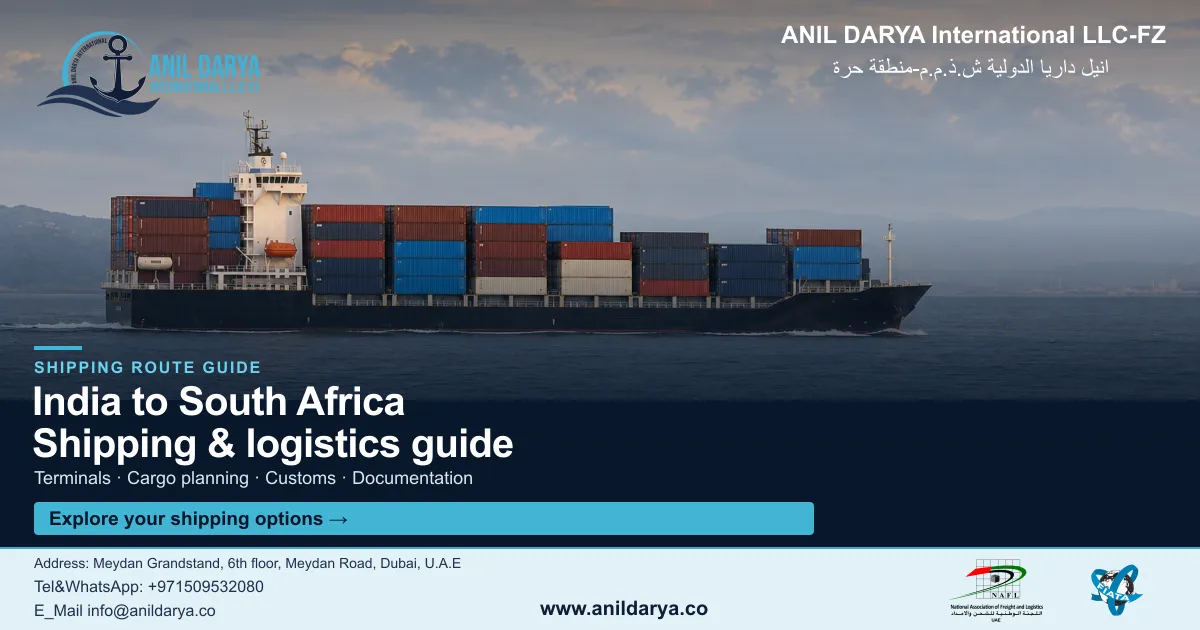
Shipping from India to South Africa is mostly a container move from Nhava Sheva or Mundra to Durban, on weekly loops that DP World lists at 14 to 19 days port to port. The Indian supplier files the shipping bill on ICEGATE, the South African importer must be registered with SARS, and goods covered by a compulsory specification need an NRCS letter of authority before they land. We book the ocean freight from Dubai and coordinate both ends, and this guide sets out the order in which each piece has to happen.
India to South Africa shipping at a glance
| Item | Detail |
|---|---|
| Lane type | Cross-trade: Indian origin, South African destination, booked and coordinated by Anil Darya from Dubai |
| Main Indian load ports | Nhava Sheva (JNPA) and Mundra on the west coast; Hazira and others on some loops |
| Main South African discharge ports | Durban for most containers; Cape Town and Ngqura (Coega) on fewer India loops |
| Published transit indications | Nhava Sheva to Durban 14 to 19 days, Mundra to Durban 15 to 17 days, weekly direct (DP World India to Africa trade lane page) |
| Indian export filing | Shipping bill on ICEGATE, by the exporter or its customs broker |
| South African importer | Must be registered with SARS customs; a foreign importer needs a registered agent in South Africa |
| Customs value basis | FOB price at the Indian port of export |
| Duty | Ordinary customs duty from Schedule 1 Part 1 of the Customs and Excise Act, by tariff heading |
| VAT on imports | 15% of the added tax value (customs value plus 10%, plus duty) |
| Conformity and permits | NRCS letter of authority for regulated products; ITAC permit for used goods and controlled goods; SAHPRA rules for medicines |
| Bill of lading | The shipping line's own B/L, issued and released to you through us as the line's agent |
How a cross-trade booking from India to South Africa works
The container goes from an Indian terminal to a South African one. It does not need to pass through the UAE. We run the booking from Dubai because our desk works with many lines on the India, Gulf and Africa trades, so one team can match the sailing, the Indian supplier's cargo date and the South African broker's needs.
Each party has its own job:
- Anil Darya books the sea freight with the shipping line and follows the shipment from the cargo ready date until the box is discharged in South Africa.
- The Indian supplier, or its own origin agent, collects the goods, stuffs the container and files the Indian export declaration. We line up cut-off dates and the document set with them.
- The South African buyer's customs broker lodges the import declaration with SARS. Duty and taxes at destination are paid by the consignee or its broker.
On the paperwork, you get the carrier's bill of lading, not a forwarder's document. We are agent for a range of shipping lines, and that is why the line's B/L for Nhava Sheva or Mundra to Durban is issued and handed to you through our Dubai team. Name the South African consignee and notify party exactly as the SARS importer registration shows them, because the broker will match the B/L to that record.
The Incoterm decides who books the freight: the buyer under FOB Nhava Sheva, the seller under CFR Durban. Our Incoterms 2020 guide for sea freight shows where risk and cost move under each term.
Indian load ports and South African discharge ports
Start with the factory location, then check which India to South Africa loops call at the nearest port. Most of them load on the west coast, so cargo from the south or east often moves by rail or road to Nhava Sheva or Mundra, or ships on a loop with a transhipment.
| Indian port | Usual catchment | Fit for South Africa |
|---|---|---|
| Nhava Sheva (JNPA, Navi Mumbai) | Maharashtra, Madhya Pradesh, northern Karnataka | Called by the main Durban loops; JNPA runs five container terminals |
| Mundra (Gujarat) | Gujarat, Rajasthan, north India by rail | Usually the call before Nhava Sheva; takes containers, breakbulk and project cargo |
| Hazira (Gujarat) | Surat region | On MSC's India to South Africa rotation as announced in 2023 |
| Chennai, Kattupalli, Tuticorin, Cochin | South India | Few direct South Africa calls; ask whether the quote routes via a hub |
On the South African side, the Transnet National Ports Authority lists Durban with 58 berths, Cape Town with 42 and Ngqura with a four-berth container terminal at 16 m depth. In 2025 Durban handled 2,732,190 TEU, Cape Town 843,599 TEU and Ngqura 747,847 TEU, so Durban takes the largest share by far.
| South African port | Why you would use it | Note for Indian cargo |
|---|---|---|
| Durban | Gauteng and KwaZulu-Natal buyers; container, car and breakbulk terminals | The usual call for India loops; rail to Gauteng on the 688 km container corridor |
| Cape Town | Western Cape buyers | Fewer India calls; some loops reach it only after West Africa ports |
| Ngqura (Coega) and Gqeberha | Eastern Cape, motor industry suppliers | Served on some loops or by feeder from Durban |
| Richards Bay | Bulk and breakbulk | For bulk or project cargo, not regular container service |
Gauteng buyers usually land at Durban and rail the box to an inland terminal such as City Deep. Agree with the broker whether the container clears at Durban or moves inland under bond, because that changes the B/L place of delivery and the trucking quote.
Direct loops, Gulf calls and transhipment
Rotations change often, so ask for the actual one on every quote. Announced loops include:
- CMA CGM's reshuffle of May 2024 set its MIDAS 2 service as Jebel Ali, Mundra, Nhava Sheva, Durban and back to Jebel Ali, a 49-day loop with seven vessels. Durban is its only South African call, and Port Elizabeth was offered weekly by feeder from Durban.
- The same announcement put MIDAS 1 on Jebel Ali, Mundra, Nhava Sheva, Pointe Noire, Tema, Apapa, Cape Town, Coega and back, a 70-day loop. Indian cargo for Cape Town on that loop reaches it after the West Africa calls.
- MSC, in May 2023, set its weekly India to South Africa service as Durban, Jebel Ali, Abu Dhabi, Dammam, Bahrain, Mundra, Nhava Sheva, Hazira, Colombo, Port Louis and Durban.
The fastest choice is a loop where Durban is the next call after India. Several loops also call Jebel Ali before India, which matters if you hold stock in Dubai.
| Service type | Typical pattern | Choose it when |
|---|---|---|
| Direct India to Durban loop | Mundra, Nhava Sheva, then Durban | All cargo is in India and the arrival date matters |
| Durban plus feeder | Main vessel to Durban, feeder to Gqeberha | The buyer is in the Eastern Cape |
| Transhipment at a hub | Indian port, hub, second vessel to South Africa | Your load port has no direct South Africa call |
Sea freight from India to South Africa: containers, ro-ro and special cargo
Most of this trade moves in dry containers. Choose the equipment before you ask for a rate.
| Option | Suits | Watch on this lane |
|---|---|---|
| FCL 20ft | Rice, tiles, steel products, chemicals in drums | South African road limit of 30 t gross for a 20ft box (Maersk South Africa import page) |
| FCL 40ft / high cube | Medicines, garments, footwear, auto parts, machinery | 31.5 t gross road limit; South Africa does not accept 45ft containers |
| LCL | First orders, samples, small lots | Each consignee still needs its own SARS registration and permits |
| Reefer | Temperature-controlled medicines and some foods | Set point on the booking, power at the terminal, SAHPRA or food rules |
| Ro-ro | New vehicles from Indian plants | Durban's ro-ro terminal has seven berths at 12.5 m draft; NRCS vehicle approval first |
| Flat rack / open top | Transformers, gensets, slightly out-of-gauge machines | Line acceptance and lashing plan before you book |
If you are unsure whether a full box pays off, our FCL vs LCL comparison sets out the break-even logic. For booking options and container types, see our sea freight service.
Dangerous goods
Dyes, intermediates, paints, agrochemicals and lithium batteries are a steady part of Indian exports to South Africa, and many of them are dangerous goods. The IMDG Code 2024 edition (Amendment 42-24) has applied since 1 January 2026, so the Indian shipper's DG declaration and Safety Data Sheet must follow it. In South Africa, the Merchant Shipping (Dangerous Goods) Regulations were amended in June 2026, and at Durban, Class 1 explosives need police permits and direct delivery. Our dangerous goods desk checks the UN number, class and packing group with the line before we confirm space, since not every loop accepts every class.
Breakbulk and project cargo
Indian suppliers ship power equipment, structures and plant machinery to South African mines, utilities and factories. Pieces that fit a 40ft flat rack can ride the container loops above. Bigger units need a breakbulk vessel, and the sailing date then drives the whole schedule. Transnet's multipurpose terminals at Durban, Richards Bay, Cape Town and other ports handle steel, abnormal and project cargo. Send us drawings, weights and lifting points early, and our break bulk and project cargo team will plan the stowage and lashing with the carrier.
How long does shipping from India to South Africa take?
The rotation sets the transit time. These figures come from a published trade lane page.
| Port pair | Published time | Frequency | Published by |
|---|---|---|---|
| Nhava Sheva to Durban | 14 to 19 days | Weekly, direct | DP World India to Africa trade lane page |
| Mundra to Durban | 15 to 17 days | Weekly, direct | DP World India to Africa trade lane page |
| Delhi to Durban by air | 4 to 5 days | Daily | DP World India to Africa trade lane page |
Door to door, add the factory pickup, the Indian export filing, the weekly cut-off, the SARS clearance and the inland leg to Gauteng. For urgent parts or samples, our air cargo service is the faster alternative.
[AMIR-FACT: the shipping lines we actually book from Nhava Sheva and Mundra to Durban (and to Cape Town or Ngqura if any), with the real port-to-port and door-to-door days we see]
The export side in India
Section 50 of the Customs Act, 1962 requires the exporter to file a shipping bill, and section 51 lets the proper officer clear the goods for loading. The shipping bill is filed electronically through ICEGATE. The exporter needs an Importer Exporter Code (IEC), which is its 10-character PAN.
- The Indian supplier or its customs broker files the shipping bill. A South African buyer cannot do it from abroad.
- Under EXW, someone in India still has to stand as exporter of record. FOB or CFR avoids that problem.
- Ask the supplier for the certificate of origin early. SARS checks the declaration against it, together with the invoice and B/L.
- Keep value, HS code and description identical on the shipping bill, invoice and South African declaration.
SARS customs: agree clearance in South Africa before the cargo sails
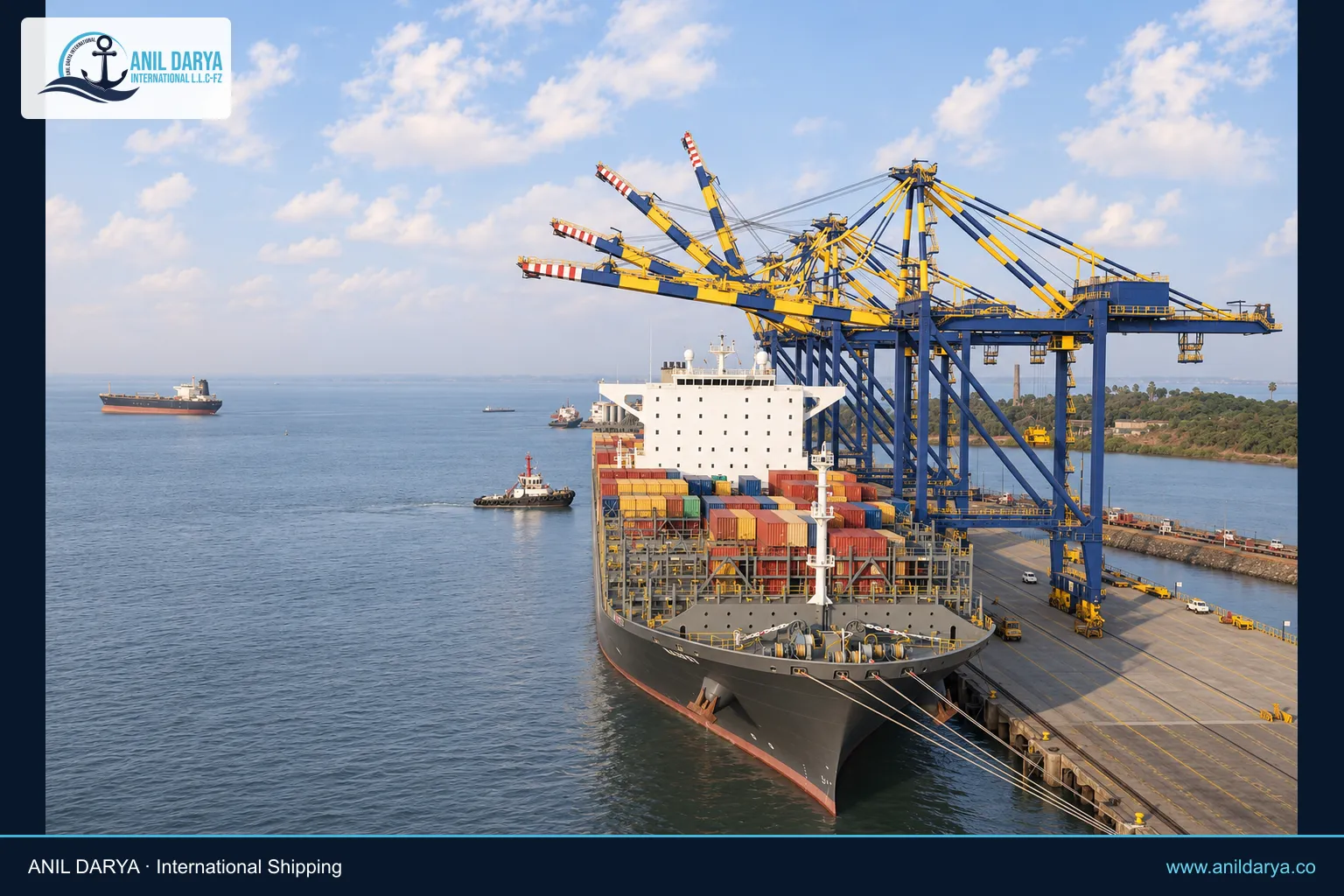
We do not sell customs clearance in South Africa. Before we confirm a booking from India, we check that the consignee has a broker lined up and an active SARS registration. A box that lands with no broker ready runs up terminal storage and line detention.
SARS sets the ground rules for the importer:
- Any person, local or foreign, who imports goods into South Africa must register as an importer, through the RLA function on SARS eFiling.
- A foreign importer must nominate a registered agent located in South Africa, and that agent takes full liability towards Customs. An Indian seller selling DDP would face this rule, which is one reason most sales on this lane are FOB or CFR.
- Customs checks the goods declaration against the invoice, the bill of lading, the certificate of origin and any permits.
- Permits must be produced at clearance. Other agencies can ask Customs to detain goods for their own checks.
Watch the clock after discharge. SARS allows seven days from landing to declare the goods, 14 days for loose or break bulk cargo, and 28 days for goods in a container depot. Goods not declared in time can be moved to the State Warehouse. At Durban Gateway Terminal (DCT Pier 2), the operator's procedures from 1 January 2026 treat uncleared import containers as overstay on the third day of free storage, so a late broker costs money fast.
South African duty and VAT: the FOB rule
South Africa values imports on the FOB price at the port of export, under SARS valuation policy SC-CR-A-03. For an Indian shipment that means the value at Nhava Sheva or Mundra; ocean freight and insurance to Durban are not part of the dutiable value. If the supplier sells ex works, SARS can ask for the costs of bringing the goods to the Indian port, so keep the trucking and handling invoices.
Ordinary customs duty is set by tariff heading in Schedule 1 Part 1 of the Customs and Excise Act, which SARS publishes and updates. SARS also lists additional ad valorem duty on some luxury goods, and anti-dumping or countervailing duty where one applies to a heading and origin. Plan on the general rate for the HS code unless the broker confirms in writing that a lower rate applies to Indian-origin goods.
VAT is 15% of the added tax value. That value is the customs value, plus 10% of the customs value, plus any non-rebated duty. The 10% uplift does not apply to goods originating in Botswana, Lesotho, Namibia or Eswatini, so it does apply to goods from India.
| Illustration (assumed 15% duty rate) | Amount |
|---|---|
| Customs value, FOB Nhava Sheva | R250,000 |
| Customs duty at an assumed 15% | R37,500 |
| 10% uplift on the customs value | R25,000 |
| Added tax value (250,000 + 25,000 + 37,500) | R312,500 |
| VAT at 15% | R46,875 |
The 15% rate above only shows the method. Ask the consignee's broker for a written estimate on the exact HS code before the order is placed.
NRCS, ITAC and SAHPRA: permits to sort out before loading
South Africa runs no pre-shipment certificate scheme of the kind some African countries use. The checks sit with its regulators, and most must be passed before the goods ship.
| Regulator | What it controls | What the importer needs |
|---|---|---|
| NRCS (National Regulator for Compulsory Specifications) | Products under compulsory specifications: electrical and electronic goods, automotive parts and vehicles, some chemicals, building materials, regulated foods | A letter of authority issued once the product meets the specification; NRCS accepts test reports from recognised local or foreign laboratories |
| ITAC (International Trade Administration Commission) | All used or second-hand goods; controlled goods such as new tyres, listed chemicals, fossil fuels, waste and scrap | An import permit, produced at clearance; ITAC states an average of three to five working days to process |
| SAHPRA (South African Health Products Regulatory Authority) | Medicines | Registered medicines may be imported only by a South African company licensed by SAHPRA; unregistered ones need Section 21 authorisation |
The NRCS letter catches many Indian goods, from cables and appliances to tyres and vehicles. The Indian maker can often supply the test reports. Get the letter before you load.
Typical cargo on this lane
The High Commission of India in Pretoria, citing India's Ministry of Commerce and Industry, puts Indian exports to South Africa at USD 7.46 billion in 2024-25, out of bilateral trade of about USD 18 billion. Its list of main Indian exports gives a good picture of the cargo on this lane.
| Cargo | Usual equipment | South African checks to plan for |
|---|---|---|
| Vehicles and components | Ro-ro for vehicles; 40ft for parts | NRCS approval for vehicles and regulated parts; ITAC for anything used |
| Pharmaceuticals | 40ft dry or reefer | SAHPRA licence of the importer and product registration |
| Engineering goods and machinery | 40ft, flat rack or breakbulk | NRCS for electrical items; ITAC permit if used |
| Dyes, intermediates and chemicals | 20ft, often DG | IMDG documents; ITAC for chemicals on the controlled list |
| Textiles and footwear | 40ft or high cube | South African labelling rules for clothing, textiles and footwear |
Restricted and prohibited goods in South Africa
SARS policy SC-CC-32 splits controlled goods into those absolutely prohibited and those restricted, which need an authority from the responsible department before import. Every declaration carries a prohibited and restricted status. Points that matter for Indian cargo:
- Clothing, textiles and footwear must meet the labelling rules. Non-compliant goods are detained and, if the fault cannot be fixed, re-exported off the African continent or destroyed at the importer's cost.
- ITAC's guidelines say no permits are issued for used vehicles imported for commercial or resale purposes.
Routing through Dubai: consolidation and re-export
Dubai helps only when the buyer also sources from the Gulf or holds stock there.
| Option | How it works | What to check |
|---|---|---|
| Load Dubai cargo on the same loop | On loops that call Jebel Ali before India, such as MIDAS 2 as announced in 2024, Dubai stock can sail to Durban on the vessel that carries the Indian boxes | The current rotation, and whether the timing suits both suppliers |
| Consolidate in a Dubai free zone | Indian and other goods are held in Jafza, combined and shipped to South Africa as one lot | UAE customs clearance, a Dubai certificate of origin, and SARS valuation on the right export price |
| Transhipment at Jebel Ali | Box discharged at Jebel Ali and reloaded to Durban | Only if the line offers it; Dubai Customs treats transit as its own declaration regime |
Customs clearance in Dubai is ours, for a fee. If the goods are consolidated or re-exported through Dubai, we handle the UAE declaration at Jebel Ali. Dubai Chambers issues certificates of origin for re-exported goods. Note that the goods then leave from the UAE, so the FOB value SARS uses is the value at Jebel Ali, and the origin stays wherever the goods were made. See our Jebel Ali port guide, our note on re-exporting through Jafza and bulk shipping from Dubai to Africa.
[AMIR-FACT: whether we route any India to South Africa cargo through Dubai in practice (Jebel Ali loading on the same loop, Jafza consolidation or transhipment), on which services and how often]
What drives the cost of shipping from India to South Africa?
Rates move with each sailing, so we do not publish them. These items set the landed cost:
| Cost item | Who usually pays | What moves it |
|---|---|---|
| Inland haulage in India | Supplier under FOB or CFR | Distance from factory to Mundra or Nhava Sheva, rail or road |
| Indian terminal and export charges | Supplier under FOB or CFR | Terminal handling, documentation, customs broker fee |
| Ocean freight | Whoever books under the Incoterm | Season, equipment type, direct loop or transhipment, DG or reefer surcharges |
| South African terminal handling | Consignee | Port, cargo type, any overstay at the terminal |
| Duty and VAT | Consignee or its broker | Tariff heading, FOB value, the 10% uplift for VAT |
| Permits and approvals | Importer or supplier | NRCS testing, ITAC permits, SAHPRA licensing |
| Inland delivery in South Africa | Consignee | Rail to City Deep or road to the buyer, weight limits |
| Demurrage and detention | Whoever causes the delay | Late broker, missing permit, slow empty return |
How to book this lane, step by step
- Confirm the HS code, the Incoterm and any NRCS, ITAC or SAHPRA requirement with the South African buyer and its broker.
- Check that the consignee is registered with SARS as an importer and that a broker is appointed. We confirm this before we take the booking.
- Send us the supplier's location, the cargo details, the ready date and the preferred South African port.
- We quote the routing and the carrier, then book space and send the booking to the Indian supplier or its agent.
- The supplier arranges pickup and stuffing, files the shipping bill on ICEGATE, and gets the certificate of origin.
- For DG cargo, the supplier sends the DG declaration and SDS, and we confirm acceptance with the line.
- The container gates in before the cut-off and sails. You receive the carrier's B/L through us.
- We share the vessel ETA and documents with the consignee's broker, who prepares the SARS declaration.
- The broker clears the goods within the SARS time limits, the consignee or its broker pays duty and VAT, and the container moves to the buyer.
Checklist before the cargo leaves India
- Consignee registered with SARS as an importer; name matches the B/L.
- South African broker appointed and given the documents.
- HS code agreed by supplier and broker.
- NRCS letter of authority in place for regulated products.
- ITAC permit for any used goods or controlled goods.
- SAHPRA licence and product registration for medicines.
- Commercial invoice showing the FOB value at the Indian port.
- Packing list, certificate of origin and a copy of the shipping bill.
- Clothing, textile and footwear labels checked against South African rules.
- DG declaration, SDS and IMDG marks for hazardous goods.
- B/L draft checked for consignee, notify party and place of delivery.
Common mistakes on this lane
- Shipping before destination clearance is agreed. With no broker ready, the box sits at Durban and storage starts after a short free period.
- Selling DDP from India without a registered agent in South Africa. SARS requires a foreign importer to nominate one.
- Declaring a CIF value. South Africa values imports on the FOB price at the Indian port.
- Loading electrical goods or auto parts without the NRCS letter of authority.
- Shipping used machinery without an ITAC permit.
- Labels on garments and footwear that do not meet the rules, which leads to detention or destruction.
- Missing the SARS deadline to declare, which can send the goods to the State Warehouse.
[AMIR-FACT: one real India to South Africa shipment we booked: cargo type, Indian load port, South African port, carrier type and what we coordinated, cleared for publication]
Frequently asked questions
How long does sea freight from India to South Africa take?
DP World lists Nhava Sheva to Durban at 14 to 19 days and Mundra to Durban at 15 to 17 days on weekly direct services. Transhipment takes longer.
Which South African port receives most cargo from India?
Durban. It is South Africa's largest container port and the usual call on India loops. Cape Town and Ngqura are served by fewer India services, sometimes by feeder from Durban.
What is the import duty on goods from India to South Africa?
Duty follows the tariff heading in Schedule 1 Part 1 of the Customs and Excise Act and is charged on the FOB value at the Indian port. VAT of 15% is then charged on the customs value plus 10%, plus duty. Ask the broker for a written estimate on your HS code.
Does the South African buyer need to register with SARS?
Yes. Any person importing into South Africa must register with SARS customs as an importer. A foreign importer must also nominate a registered agent in South Africa who accepts full liability.
Do Indian products need an NRCS letter of authority?
Products under a compulsory specification do, for example many electrical goods, vehicle parts, tyres and some chemicals. NRCS issues the letter once the product meets the specification, and it accepts test reports from recognised foreign laboratories.
Does Anil Darya clear the goods in South Africa?
No. The consignee's own customs broker clears the goods with SARS, and duty and taxes at destination are paid by the consignee or its broker. We make sure that broker is in place before we confirm the booking.
Who issues the bill of lading on this lane?
The shipping line. You receive the carrier's own B/L for the Indian load port to the South African port, issued and released to you through our Dubai team because we act as agent for many lines.
Can I combine goods from India and Dubai in one shipment?
Yes, through a loop that calls Jebel Ali before India or by consolidating in a Dubai free zone. We clear the UAE side for a fee.
Get a quote for shipping from India to South Africa
Send us the supplier's city, the cargo and HS code, the ready date, the South African port or inland delivery point and the name of your broker. Use our freight rate inquiry form, or contact our team first for DG, ro-ro or project cargo. You can also read more about our Dubai freight forwarding team.
Sources
- DP World: India to Africa trade lane, published transit times
- Hellenic Shipping News: CMA CGM reshuffles Africa, India and Middle East Gulf services, MIDAS 1 and MIDAS 2 (8 May 2024)
- Maritime Gateway: MSC upgrades India to Africa and South Africa services (May 2023)
- CBIC: Customs Act, 1962, sections 50 and 51
- ICEGATE: help and FAQ
- DGFT: Foreign Trade Policy 2023, chapter 2 (IEC)
- JNPA: port overview
- Adani Ports: Mundra port
- SARS: Imports (documents, declaration time limits, State Warehouse, permits)
- SARS: Importer registration and registered agents
- SARS: Duties and taxes for importers
- SARS FAQ: How is VAT calculated on imported goods?
- SARS: Schedules to the Customs and Excise Act (Schedule 1 Part 1)
- SARS SC-CR-A-03: Valuation of imports (FOB basis)
- SARS SC-CC-32: Prohibited and restricted goods
- ITAC: Import control
- ITAC: Guidelines for importing used or second-hand vehicles
- NRCS: Imports and exports, letters of authority
- SAHPRA: Process for importation of medicines (July 2022)
- Transnet National Ports Authority: Our ports
- Transnet National Ports Authority: Port statistics 2025
- Transnet Port Terminals: Durban terminals, including the ro-ro terminal
- Transnet Port Terminals: Break-bulk services
- Transnet Freight Rail: Container corridor, Durban to Gauteng
- Durban Gateway Terminal: Operating procedures from 1 January 2026
- Maersk: South Africa import information (road weight limits, DG at Durban)
- Acts Online: Merchant Shipping (Dangerous Goods) Regulations amended (June 2026)
- IMO: IMDG Code 2024 edition
- High Commission of India, Pretoria: India and South Africa relations, bilateral trade
- Dubai Chambers: certificate of origin for re-exported goods
- Dubai Customs: declaration regimes and documents
Reviewed: 11 November 2026