
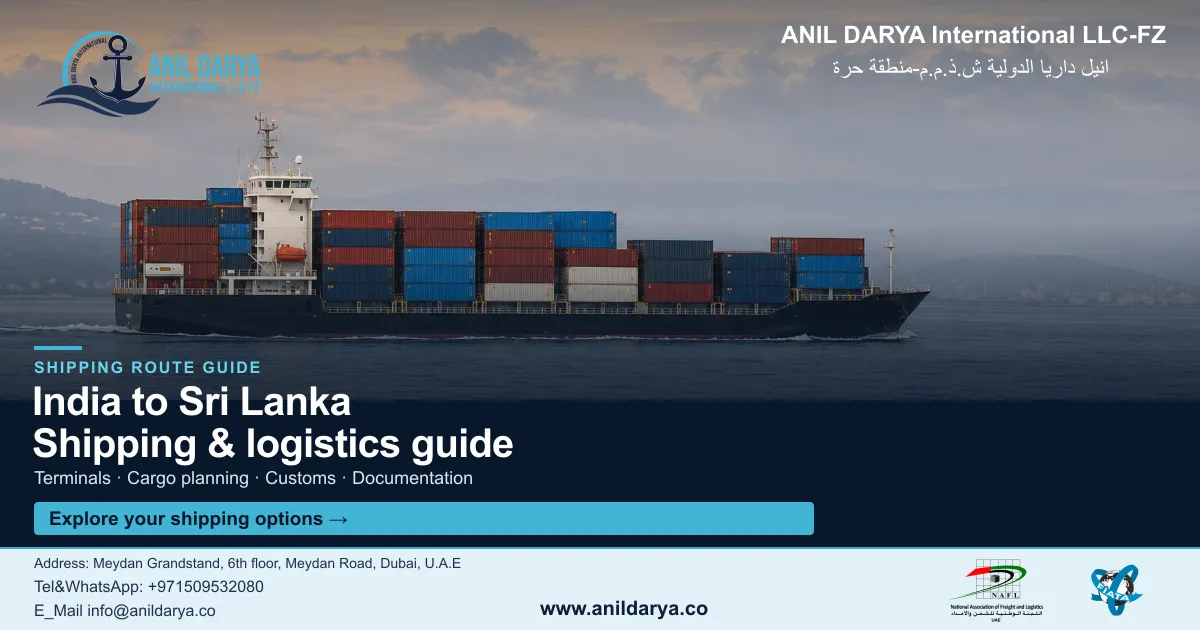
Shipping from India to Sri Lanka is one of the shortest container trades in Asia: a feeder from Tuticorin reaches Colombo in about a day, and a coastal loop from Mundra takes about a week. The Indian exporter files the shipping bill on ICEGATE, the Sri Lankan buyer's Customs House Agent lodges the CusDec after the ship arrives, and most Indian-made goods can enter free of customs duty under the India-Sri Lanka Free Trade Agreement if the right certificate of origin travels with them. We book the ocean freight from Dubai, release the carrier's bill of lading through us and keep exporter, line and agent working to one plan.
Shipping from India to Sri Lanka at a glance
| Item | Detail |
|---|---|
| Type of lane | Sea cross-trade, India to Sri Lanka, booked and coordinated by Anil Darya from Dubai |
| Main modes | FCL, LCL, flat rack and breakbulk, dangerous goods by sea, reefer for food |
| Indian load ports | Tuticorin and Cochin in the south; Mundra, Pipavav, Nhava Sheva and New Mangalore on the west coast; Kattupalli, Chennai, Visakhapatnam and Kolkata on the east coast |
| Sri Lankan port | Colombo for almost all containers; Hambantota for vehicles, bulk and project cargo |
| Published carrier days | 1 day from Tuticorin or Cochin, 7 days from Mundra (see the transit table below) |
| Indian export filing | Shipping bill on ICEGATE by the exporter or its customs broker |
| Sri Lankan import entry | CusDec in ASYCUDA World, lodged by a Customs House Agent after arrival and the delivery order |
| Trade agreement | ISFTA, in force since 1 March 2000: Indian goods duty free except 1,180 negative-list lines; SAFTA and APTA rates also exist |
| VAT and SSCL | 18% VAT and 2.5% SSCL on most lines, charged on top of duty and levies |
| Who clears in Sri Lanka | The consignee's Customs House Agent, agreed with us before the booking is confirmed |
Who does what on an India to Sri Lanka cross-trade
The box is stuffed in India and cleared in Sri Lanka; it never needs to touch the UAE. The Indian exporter or its broker stuffs the goods, files the shipping bill and gets the ISFTA certificate. We book the space, confirm the Colombo call and check the invoice, packing list and B/L wording. The buyer's Customs House Agent lodges the CusDec, claims the ISFTA rate and arranges delivery.
Your bill of lading is the shipping line's own document. Because we act as agent for many lines, the carrier's B/L for an India to Colombo box is issued and handed to you through our Dubai office once the freight is settled. Under a letter of credit, send us the bank's exact consignee and notify wording before the line drafts the bill.
We do not clear goods in Sri Lanka. Before we confirm a booking we ask the buyer to name its Customs House Agent and we check three things with that agent: that the importer is registered with Sri Lanka Customs, which licences or SLSI papers the product needs, and whether the ISFTA certificate is wanted. If any answer is open, the booking waits. On FOB the buyer pays the sea freight; on CFR Colombo the seller does. Our Incoterms 2020 guide for sea freight shows where risk passes on each term.
Which Indian port to ship from
Pick the load port by where the factory sits and which loop calls Colombo from there. On this short crossing the truck or rail leg inside India is often longer than the sea leg.
| Indian port | Usual hinterland | Point for Sri Lanka cargo |
|---|---|---|
| Tuticorin (V.O. Chidambaranar) | Tamil Nadu: Tirupur, Coimbatore, Madurai | Closest port to Colombo; several feeder loops, about a day at sea |
| Cochin | Kerala: spices, coir, rubber goods | Called by coastal loops one day before Colombo |
| Mundra and Pipavav | Gujarat, Rajasthan, north India by rail | Same-vessel coastal loops and Asia mainline loops that call Colombo |
| Nhava Sheva (JNPA) | Mumbai, Pune, Maharashtra | Asia loops call Nhava Sheva, then Mundra, then Colombo |
| Kattupalli and Chennai | Chennai belt, Bengaluru, auto and electronics plants | East coast coastal loop, 2 days to Colombo from Kattupalli |
Colombo or Hambantota: where Indian cargo lands
Colombo takes nearly every container that Indian exporters send to Sri Lankan buyers. It handled 8,291,178 TEU in 2025 on Sri Lanka Ports Authority figures, spread over five container terminals: JCT, ECT, SAGT, CICT and CWIT. The terminal changes with the loop. In ONE's 2025 brochure the coastal loop berths at SAGT, the North China India loop at JCT, and the Tuticorin shuttle loops at JCT or CICT.
Much of Colombo's traffic is transhipment, so the B/L for your box should show Colombo as both discharge port and place of delivery, with the Sri Lankan importer as consignee.
| Port | Published facts | Use it for |
|---|---|---|
| Colombo | 8,291,178 TEU in 2025; SLPA container freight station at Peliyagoda with a 19,500 m² LCL warehouse | FCL and LCL for the Western Province and most of the island |
| Hambantota | 428,036 TEU and 726,153 vehicles in 2025; 17 m alongside at the main berths | Vehicles by Ro-Ro, bulk, breakbulk and project cargo for the south |
How long does shipping from India to Sri Lanka take?
At sea, one to seven days depending on the Indian port. These are the figures we found on carrier pages we opened:
| From | To Colombo | Carrier and service | Source date |
|---|---|---|---|
| Tuticorin | 1 day | Maersk, BTL Tuticorin Feeder (33J) | Live page, November 2026 |
| Cochin | 1 day | ONE, India Coastal Express (ICE), eastbound | 2025 brochure |
| New Mangalore | 3 days | ONE, ICE, eastbound | 2025 brochure |
| Pipavav | 6 days | ONE, ICE, eastbound | 2025 brochure |
| Mundra | 7 days | ONE, ICE, eastbound | 2025 brochure |
| Kattupalli | 2 days | ONE, ICE, westbound | 2025 brochure |
| Visakhapatnam | 5 days | ONE, ICE, westbound | 2025 brochure |
Each ICE figure agrees with the berthing days on the same sheet: Mundra sails Thursday and Colombo berths the next Thursday. Mundra takes a week because the ship calls Pipavav, New Mangalore and Cochin first.
[AMIR-FACT: the carriers and services we actually book from India to Colombo (south India feeders and west coast loops), with the real port-to-port days and sailing frequency we see from Tuticorin, Cochin, Mundra and Nhava Sheva]
Feeders, coastal loops and mainline ships to Colombo
Three kinds of service carry Indian boxes to Colombo.
| Service type | Examples from carrier pages | Best for |
|---|---|---|
| South India shuttle feeders | Maersk BTL Tuticorin Feeder (33J); ONE Tuticorin Service with three loops in 2025; VOC Port's Tuticorin-Colombo shuttle launched June 2026 | Tamil Nadu cargo, short lead times, frequent sailings |
| Indian coastal loops via Colombo | ONE ICE: Mundra, Pipavav, New Mangalore, Cochin, Colombo, Kattupalli, Visakhapatnam and back; ONE CU3 from Kolkata | West and east coast factories wanting one ship to Colombo |
| Asia mainline loops | ONE NCI: Nhava Sheva, Mundra, then Colombo on its eastbound leg; ONE PS3: Nhava Sheva, Pipavav, Colombo | FCL from Mumbai and Gujarat when the loop has space for the short leg |
On all of these the box stays on one ship to Colombo, even when the ship calls other ports first. Transhipment is rarely needed here, because Colombo is itself the hub most Indian feeders serve.
Sea freight from India to Sri Lanka: FCL, LCL, reefer and special cargo
| Option | Typical Indian cargo for Sri Lanka | What to plan |
|---|---|---|
| 20ft FCL | Rice, cement, steel, tiles, chemicals in drums | Weight per box and road limits from the Colombo terminal |
| 40ft / 40ft high cube | Knitted fabric rolls, yarn, furniture, two-wheeler parts, packaged food | Free days at the terminal while the CusDec and checks run |
| LCL | Medicines, spare parts, samples, small retail lots | Unpacking at the Peliyagoda CFS; every shipper's papers in the box must be clean |
| Reefer | Fresh produce, frozen food, temperature-controlled medicines | Plant quarantine or food inspection approval ready before arrival |
| Flat rack / open top | Generators, transformers, machinery over standard size | Line approval, lashing plan and a road route to site |
If you buy from several suppliers in one Indian state, have them deliver to one warehouse near the port and ship a single FCL under one B/L. Your Colombo agent then lodges one CusDec instead of several. Our FCL vs LCL comparison explains where a full container starts to pay, and our sea freight service covers equipment and space.
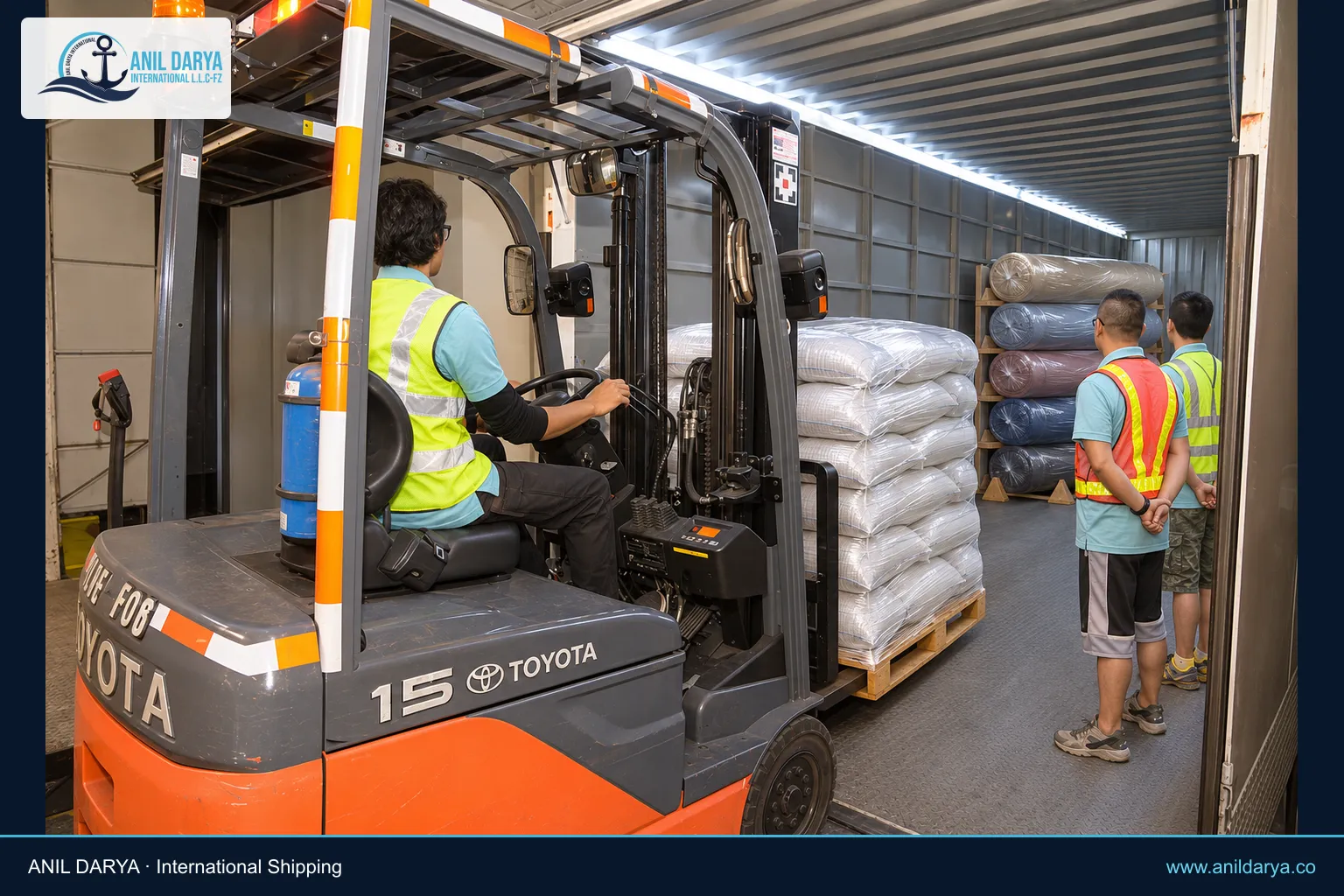
Dangerous goods
Paints, solvents, agrochemicals and lead-acid batteries are dangerous goods at sea. They move under the 2024 edition of the IMDG Code (Amendment 42-24), mandatory since 1 January 2026. Pesticides and toxic chemicals are also under licence control in Sri Lanka. Our dangerous goods team checks the UN number, class and packing group against the line before you commit.
Breakbulk and project cargo
Indian transformers, cranes, steel structures and plant for Sri Lankan power and road projects often do not fit a box. A piece that fits a flat rack can use a container loop; larger units need a multipurpose or heavy-lift ship, and Hambantota publishes bulk, breakbulk and project handling on its multipurpose berths. We need drawings, weights and lifting points first. See our break bulk and project cargo service.
What the Indian exporter files before sailing
The seller or its customs broker handles the export side; we file nothing in India.
- Importer Exporter Code (IEC): a 10-character code issued online by DGFT, the same as the company's PAN.
- Shipping bill: filed electronically on ICEGATE with a registered ICEGATE ID and a Class 3 digital signature. Customs then allows the goods for export and loading.
- Export general manifest (EGM): filed by the line after sailing. ICEGATE tells exporters to ask the line to file it if an IGST refund is stuck because the EGM is missing.
- ISFTA certificate of origin: applied for on DGFT's online platform, coo.dgft.gov.in, before shipment (see the next section).
The HS code, description and value on the shipping bill should match the invoice the Sri Lankan agent presents and the tariff item on the certificate of origin.
ISFTA: the duty-free route for Indian goods
The India-Sri Lanka Free Trade Agreement was signed on 28 December 1998 and entered into force on 1 March 2000. Sri Lanka's Export Development Board says both sides have completed their tariff cuts, and that Indian-origin goods now enter Sri Lanka duty free, except the 1,180 tariff lines on Sri Lanka's negative list. Sri Lanka Customs prints the ISFTA rate in a column marked IN on every line of its tariff guide, next to the general rate.
Three points decide whether your shipment gets that rate:
- The line must not be on the negative list. Check the IN column for the exact code.
- The goods must be of Indian origin under the ISFTA rules. Wholly Indian goods qualify. Goods with imported inputs qualify when non-originating materials are no more than 65% of the FOB value (so at least 35% value added), the product changes tariff heading at the four-digit level and the last manufacturing step happens in India. Sri Lankan inputs can count toward the total under the cumulation rule.
- The goods must be consigned directly from India to Sri Lanka, and the importer must claim the preference at import and produce the evidence.
Some steps never confer origin, whatever the HS code: repacking, sorting, labelling, simple mixing, simple assembly of parts, or cutting up. Light assembly of imported parts in India may fail the test.
The certificate the agent needs
The proof is the ISFTA certificate of origin, a combined declaration and certificate signed by the exporter and stamped by an authority designated by the Indian government. A DGFT trade notice of 13 October 2020 confirms that ISFTA certificates are applied for and issued on the coo.dgft.gov.in platform, which needs the exporter's IEC and a digital signature. Box 8 carries the origin criterion: "A" for wholly obtained goods, "B" with the percentage of non-originating content, or "C" for cumulation. Each article in the consignment must qualify on its own.
Two practical warnings. First, the agreement defines tariffs as basic customs duties, so ISFTA removes customs duty only; PAL, cess, excise, VAT and SSCL still apply. Second, India also belongs to SAFTA and APTA, and the tariff guide has SA and AP columns for those. Compare the columns, and match the certificate to the scheme the agent will claim; an APTA certificate does not support an ISFTA rate.
[AMIR-FACT: whether our Sri Lankan consignees actually claim ISFTA rates on India cargo, for which product groups, and any case where a certificate was rejected or queried at Colombo]
Sri Lanka Customs: CusDec, registration and documents
Sri Lanka Customs takes import declarations online through a Customs House Agent. The CusDec can only be lodged once the goods have arrived and the shipping agent has issued the delivery order. On a one-day crossing from Tuticorin, your agent needs the certificate and invoice almost as soon as the box is loaded.
The carrier reports the cargo first. Under Gazette Notification No. 1886/55 of 31 October 2014, the inward cargo report must reach Customs at least 72 hours before the ship arrives at its first Sri Lankan port.
The importer needs a Taxpayer Identification Number and Customs registration. Since 19 June 2026, under Imports and Exports (Control) Regulations No. 06 of 2026, banks check that registration before they send an advance payment for imports, so an unregistered Sri Lankan buyer cannot pay your deposit in India.
| Document | Who provides it | Check on an India shipment |
|---|---|---|
| Commercial invoice | Indian exporter | Same value, description and HS code as the shipping bill |
| Packing list | Indian exporter | Package count, marks and weights match the B/L |
| Carrier bill of lading | Shipping line, released through us | Colombo as port of discharge and delivery; importer as consignee |
| ISFTA certificate of origin | Exporter, certified by the Indian issuing agency | Tariff item, invoice number and origin criterion match the invoice |
| Delivery order | Shipping agent in Sri Lanka | Needed before the CusDec can be lodged |
| Licences and approvals | Importer and the agency concerned | Import Control Licence, SLSI, NMRA, food or plant quarantine as the line requires |
| CusDec | Consignee's Customs House Agent | Lodged in ASYCUDA World after arrival and the delivery order |
Duty is paid through Bank of Ceylon or People's Bank, at a branch or online, before release. Customs also charges Rs. 250 per declaration, Rs. 100 per container seal and Rs. 1,600 overtime on FCL.

Import duty, VAT and levies on Indian goods
Duty and taxes at destination are paid by the consignee or its agent. Even when ISFTA brings customs duty to zero, Sri Lanka Customs still works through a stack of levies set per HS code in the National Imports Tariff Guide.
| Charge | Base used by Sri Lanka Customs | Does ISFTA remove it? |
|---|---|---|
| Customs duty | CIF x rate (general or IN rate) | Yes, unless the line is on the negative list |
| EDB Cess | CIF x cess rate, or a unit rate | No |
| Ports and Airports Development Levy (PAL) | CIF x PAL rate | No |
| VAT | (CIF + 10% + duty + cess + PAL + excise + surcharge) x rate | No |
| SSCL | Same base as VAT x rate | No |
From 1 April 2026 the general duty bands moved to 0%, 10%, 20% and 30%. The 2026 tariff guide shows VAT at 18% and SSCL at 2.5% on most lines, and cess and PAL are due to be phased out by 2029. Because VAT is charged on a base that includes duty, an ISFTA zero rate also lowers the VAT bill, which makes the certificate worth more than the duty saving alone.
Some essential goods carry a Special Commodity Levy instead, which the tariff guide says replaces duty, VAT, cess, excise and PAL. On those lines the ISFTA rate has no effect, so ask your agent about SCL first.
SLSI, licences and restricted goods
Every tariff line carries an ICL/SLSI column. "L" means an Import Control Licence is needed, and "S" means the product is under the Sri Lanka Standards Institution's compulsory import inspection. ISFTA changes neither: an Indian product with zero duty can still wait at Colombo for an SLSI release.
SLSI runs the scheme under Gazette Notification No. 2064/34 of 29 March 2018. It accepts a consignment on a certificate of conformity from an accredited laboratory or from the national standards body of the exporting country, on registration of the factory with SLSI, on a national certification mark compatible with the Sri Lanka Standard, or on the maker's record of compliance. For a first order, confirm with the agent which route SLSI will accept for that model.
| Indian goods | Approval named by Sri Lanka Customs |
|---|---|
| Medicines and medical equipment | National Medicines Regulatory Authority (NMRA) and Import Control Licence |
| Rice, spices, packaged and fresh food | Imported Food Inspection Unit; plant quarantine for plants and fresh produce |
| Cosmetics | Cosmetics, Devices and Drugs Authority (CDDA) |
| Phones and radio equipment | Telecommunications Regulatory Commission and Import Control Licence |
| Outboard engines over 25 HP, motorcycle engines over 250cc | Ministry of Defence and Import Control Licence |
The US Commercial Service guide adds that used or reconditioned air conditioners and refrigerators are controlled, and that toxic chemicals and pesticides are under licence control. Vehicles and two-wheelers follow their own rules and valuation; confirm the current position with your agent before an Indian dealer ships any.
Typical Indian cargo on this lane
Medicines, rice, knitted cotton fabric, vehicle parts and pepper are among India's largest export lines to Sri Lanka, on DGCIS and UN Comtrade data.
| Cargo | Usual equipment | Papers to plan |
|---|---|---|
| Medicines | LCL or 20ft, reefer if temperature-controlled | NMRA registration and licence; ISFTA certificate |
| Rice | 20ft FCL in bags | Food inspection; check whether SCL applies |
| Knitted cotton fabric and yarn | 40ft high cube | HS code by fibre and knit; ISFTA origin; S mark on listed items |
| Two-wheeler and vehicle parts | 40ft or LCL | Part numbers on the invoice; ICL/SLSI column check |
Routing via Dubai: when it helps and when it costs the ISFTA rate
A direct sailing is usually faster; Dubai helps when the goods already sit in a UAE trade.
| Option | How it works | What to watch |
|---|---|---|
| Through Jebel Ali | India to Jebel Ali, then a sailing to Colombo (ONE's TIG loop, for one, calls Jebel Ali and then Colombo) | Dubai Customs treats transit as its own declaration type; ISFTA direct consignment must still be met |
| Consolidation in Dubai | Indian goods combined with other origins in one container | Each line keeps its own origin; mixed boxes need separate certificates |
| Free zone stock and re-export | Indian stock held in Jafza and shipped to Colombo per order | Storage, splitting or relabelling in Dubai may cost the ISFTA rate |
The ISFTA rules require goods to be consigned directly from India to Sri Lanka. If your goods are stored, split or repacked in Dubai, confirm with the Sri Lankan broker before shipping that Customs will still accept the Indian certificate. When cargo is cleared, consolidated or re-exported in Dubai, we handle UAE customs clearance for a fee. Our Jebel Ali port guide covers the terminals, and our article on re-exporting through Jafza explains the free zone steps.
[AMIR-FACT: whether we route any India to Sri Lanka cargo through Jebel Ali or Jafza in practice, on which carriers from Jebel Ali to Colombo, and the real extra days compared with a direct sailing]
Step by step: shipping from India to Sri Lanka with Anil Darya
- Send us the product, HS code, weight, volume, supplier city and ready date.
- Name the Customs House Agent in Sri Lanka and confirm the importer has a TIN and Customs registration. We agree the plan with the agent before confirming.
- Check the tariff line: general rate, IN rate, negative list, SCL, PAL, cess and the ICL/SLSI column. Start licences and SLSI papers now.
- Agree the Incoterm and ask the exporter to apply for the ISFTA certificate on coo.dgft.gov.in, with the right origin criterion.
- We book the space, confirm the Colombo call on that voyage and send the exporter the booking and cut-offs.
- The exporter stuffs the box, files the shipping bill on ICEGATE and gates in before the cut-off.
- We check consignee, notify party, description and Colombo discharge on the draft B/L.
- The ship sails, the carrier B/L is released to you through us, the certificate and invoice reach the agent, and the agent lodges the CusDec as soon as the delivery order is out.
[AMIR-FACT: one real India to Sri Lanka cross-trade shipment we handled (cargo, load port, carrier, Colombo terminal, what we coordinated and the outcome), cleared for publication]
What drives the cost of shipping from India to Sri Lanka?
We do not publish prices, because rates change with each sailing.
| Cost part | What moves it | Usually paid by |
|---|---|---|
| Inland haulage in India | Distance from factory to port, truck or rail | Exporter under FOB |
| Origin charges | Terminal handling, export filing, certificate of origin fees, CFS for LCL | Exporter under FOB |
| Ocean freight | Equipment, loop, season, feeder or mainline | Buyer under FOB, exporter under CFR |
| Colombo charges | Terminal handling, delivery order, LCL unpacking | Consignee |
| Duty, levies and VAT | General or IN rate, cess, PAL, excise, VAT, SSCL | Consignee or its agent |
| Storage and detention | Late certificate, held approval, slow duty payment | Whoever caused the delay, under the contract |
A missing ISFTA certificate brings back the general rate and a higher VAT; a held SLSI release adds storage and detention. Our article on demurrage and detention shows how those charges grow. Our Dubai freight forwarding team will go through any quote line by line.
Checklist before the container leaves India
- Importer registered with Sri Lanka Customs and holding a TIN.
- Customs House Agent named and the clearance plan agreed.
- HS code fixed for every line; IN column, negative list and SCL checked.
- ISFTA certificate applied for, with origin criterion and invoice number matching.
- ICL/SLSI column read; licence or SLSI paper in hand where needed.
- IEC active, shipping bill filed on ICEGATE, cut-off met.
- B/L shows Colombo as discharge and delivery, importer as consignee.
Mistakes that hold Indian cargo in Colombo
- Shipping before destination clearance is agreed. With no agent appointed, no CusDec is lodged and the box runs through its free days.
- Sending the certificate late. On a one-day crossing the box can arrive before the courier does; the agent needs the certificate to claim the IN rate.
- Assuming every Indian product is duty free. Lines on the negative list, goods under SCL and goods that fail the origin rule pay the general treatment.
- Using the wrong certificate form. A SAFTA or APTA certificate does not support the ISFTA rate.
- Ignoring the S and L marks. Zero duty does not release goods under SLSI or licence control.
Frequently asked questions
How many days does sea freight from India to Sri Lanka take?
At sea, 1 day from Tuticorin on Maersk's BTL feeder, and on ONE's 2025 coastal loop 1 day from Cochin and 7 from Mundra. Add inland trucking, the export cut-off and clearance in Colombo.
Are Indian goods duty free in Sri Lanka?
Most are, under the India-Sri Lanka Free Trade Agreement, except 1,180 tariff lines on Sri Lanka's negative list. The goods must meet the ISFTA origin rules and the importer must present an ISFTA certificate of origin. VAT, SSCL, PAL and cess are still charged.
Which port in Sri Lanka do ships from India arrive at?
Colombo, for almost every container. Hambantota on the south coast handles vehicles, bulk, breakbulk and project cargo.
What is the import VAT on Indian goods in Sri Lanka?
The 2026 tariff guide shows 18% VAT and 2.5% SSCL on most lines. Both are charged on CIF plus 10% plus duty and levies, so a zero ISFTA duty also lowers the VAT due.
Does Anil Darya clear customs in Sri Lanka?
No. The consignee's Customs House Agent clears the goods, and duty and taxes at destination are paid by the consignee or its agent. We agree the plan with that agent before your booking is confirmed and coordinate documents and arrival.
Can India to Sri Lanka cargo go through Dubai?
Yes, via Jebel Ali, Dubai consolidation or free zone re-export, and we clear UAE customs for a fee when needed. Storing or splitting goods in Dubai may break ISFTA direct consignment, so ask the Sri Lankan broker first.
Get a quote for shipping from India to Sri Lanka
Send us the supplier's city, the goods, the ready date and the delivery point in Sri Lanka, and name your Customs House Agent. We will come back with a load port, a loop, the carrier and a price. Use our freight rate inquiry form, or contact our team to plan a DG, reefer or project move first.
Sources
- Maersk: BTL Tuticorin Feeder
- Ocean Network Express: 2025 India service brochure
- Maritime Gateway: VOC Port inaugurates Tuticorin-Colombo shuttle feeder
- Sri Lanka Export Development Board: ISFTA market access profile
- Export Inspection Council of India: ISFTA text, Annex C rules of origin and certificate form
- DGFT Trade Notice No. 30/2020-2021: preferential certificates of origin on coo.dgft.gov.in, including ISFTA
- Sri Lanka Customs National Imports Tariff Guide 2025, preamble
- Sri Lanka Customs National Imports Tariff Guide 2026, Chapter 52
- Sri Lanka Customs: Computation of import levies
- Sri Lanka Customs: Import procedures
- Sri Lanka Customs: Cargo clearing process and items needing approvals
- Daily FT: duty bands from 1 April 2026 and para-tariff phase-out
- Sri Lanka Standards Institution: Import inspection
- US International Trade Administration: Sri Lanka prohibited and restricted imports
- D. L. and F. De Saram: Import payment rules, Regulations No. 06 of 2026
- Sri Lanka Ports Authority: Port of Colombo terminals
- Sri Lanka Ports Authority: General cargo services
- Baird Maritime: SLPA 2025 container volumes
- HIPG: Hambantota 2025 container and vehicle volumes
- HIPG: Hambantota port infrastructure
- HIPG: Bulk, project and breakbulk cargo
- ICEGATE
- DGFT: Foreign Trade Policy 2023, Chapter 2
- Ximpex: India's top export families to Sri Lanka
- IMO: IMDG Code 2024 edition
- Dubai Customs: Customs declaration types
- Jafza: About the Jebel Ali Free Zone
Reviewed: 11 November 2026