
Shipping from India to Turkey is a container trade that starts at Mundra or Nhava Sheva and ends at Mersin and Iskenderun in the south or at the Istanbul, Izmit and Aliaga terminals in the west and north-west. Two published services set the pace: a direct loop to Mersin in about two weeks, and a weekly loop to the Marmara ports in roughly three. We book the ocean freight from Dubai, release the carrier's bill of lading to you, and confirm the Turkish buyer's customs broker before the box is booked.
Shipping from India to Turkey at a glance
| Item | Detail |
|---|---|
| Type of lane | Cross-trade by sea between India and Turkey, booked and coordinated by Anil Darya from Dubai |
| Main Indian load ports | Mundra and Nhava Sheva; Hazira and Pipavav through Mundra; south and east coast cargo by feeder or rail |
| Main Turkish discharge ports | Mersin and Iskenderun (south); Ambarli in Istanbul, Izmit and Gemlik (Marmara); Aliaga near Izmir (Aegean) |
| Published transit examples | Mundra to Mersin 14 days (ESL IEX); Mundra to Istanbul Marport 18 days (Turkon TRI) |
| Typical Indian cargo | Mineral fuels, machinery, steel, man-made yarn and fibre, plastics, organic chemicals and dyes, cotton yarn |
| Indian export filing | Shipping bill on ICEGATE, by the exporter or its customs broker |
| Turkish import filing | Electronic customs declaration by the importer's broker; the importer needs a Turkish tax number |
| Tariff code | 12-digit GTIP; the first six digits are the HS code |
| Trade agreement | None in force between India and Turkey, so Indian goods pay the standard rate for their GTIP |
| Import VAT | 20% standard rate on CIF value plus duty and charges; lower rates for some farm goods |
| Bill of lading | The shipping line's own B/L, released to you through us as agent for the line |
| Turkish clearance | The consignee's licensed customs broker, agreed before we confirm the booking |
Who does what on this cross-trade booking
The cargo leaves India and is cleared in Turkey, without touching the UAE unless you choose a Dubai routing. Our Dubai desk books the vessel and keeps the four other parties on one set of facts.
| Party | Job on this lane |
|---|---|
| Indian exporter or its customs broker | Packs and stuffs the container, files the shipping bill on ICEGATE, gets the certificate of origin, delivers to the terminal before cut-off |
| Anil Darya, Dubai | Compares sailings, books the space, gets DG or out-of-gauge acceptance, follows the box and releases the carrier's B/L |
| Shipping line | Carries the container, issues the B/L, shares the cargo data needed for the summary declaration |
| Turkish importer | Holds the tax number, applies for any TAREKS or sector approval, pays duty and VAT |
| Importer's broker in Turkey | Files the declaration, attaches permits and certificates, deals with inspection and release at the port |
The B/L you receive is issued by the carrier, not by us. Because we act as agent for many shipping lines, the original or the express release reaches you from our Dubai office. Before it is final we check that the consignee name and the Turkish tax number on the draft match what the buyer's broker will put on the declaration in Mersin or Istanbul.
We do not clear cargo in Turkey, and we do not pay Turkish duty. Duty and taxes at destination are paid by the consignee or its broker. That is why a booking from Mundra or Nhava Sheva stays on hold until the buyer has named a broker, told us at which port that broker works, and confirmed that the product needs no permit the buyer has not yet applied for.
Your Incoterm decides who books. On FOB Nhava Sheva the Indian seller clears export and the Turkish buyer pays the ocean freight; on CIF Mersin the seller pays freight and insurance, and the buyer still pays Turkish port charges, duty and VAT. Our guide to Incoterms 2020 for sea freight shows where risk passes on each term.
Which Indian port to load at
Both published services we found load on India's west coast. A factory in the south or east usually feeds its box to Mundra or Nhava Sheva first.
| Indian port | Hinterland | Role on the Turkey lane |
|---|---|---|
| Mundra | Gujarat, Rajasthan, Punjab, Delhi region by rail | Four container terminals, 7.5 million TEU capacity; a load port on both the IEX and TRI services |
| Nhava Sheva (JNPA) | Mumbai, Pune, Nashik, central India | Five container terminals, about half of the containerised volume at India's major ports; TRI loads at BMCT, IEX connects via Mundra |
| Hazira | Surat and south Gujarat textiles and chemicals | ESL publishes connections to Mersin and Iskenderun via Mundra |
| Pipavav | Saurashtra | Same IEX connection via Mundra, two days slower than Hazira |
| Chennai, Cochin, Tuticorin, Kolkata | South and east India | No direct Turkey call found; plan a feeder or rail leg to the west coast |
Mundra's rail link is rated at 80 rakes a day, so north Indian steel, yarn and machinery usually reach it by train. Turkon's flyer also shows depots such as Dadri, Tughlakabad and Ludhiana linked to its Mundra call.
Which Turkish port to discharge at
Turkey handled 13,996,579 TEU in 2025, according to the Ministry of Transport. The right port is the one nearest the buyer's plant or warehouse, as long as a service from India calls there and the broker has staff on site.
| Port | Terminal on the India services | Facts from the operator or ministry | Usually suits |
|---|---|---|---|
| Mersin | Mersin International Port (MIP), on IEX and TRI | 8 container berths, up to 17.6 m depth, 3.6 million TEU design capacity; 1.97 million TEU in the Mersin area in 2025 | Adana, Gaziantep, Konya, Kayseri, Ankara by rail and road |
| Iskenderun | LimakPort, on IEX | Container berths 920 m at 15.5 m, 1 million TEU, 600 reefer plugs | Hatay, Kahramanmaras and south-east industry |
| Ambarli (Istanbul) | Marport, on TRI | Marport: 2.3 million TEU capacity, 16 m draft; the Ambarli area moved 3,428,048 TEU in 2025, the most in Turkey | Istanbul and Thrace |
| Izmit (Kocaeli) | DP World Evyap, on TRI | Yarimca terminal: 16 m draft, 1.25 million TEU; Kocaeli area 2.50 million TEU in 2025 | Kocaeli, Gebze and Sakarya plants |
| Gemlik | Gemport, by transhipment on TRI | 2 million TEU capacity | Bursa automotive and textile makers |
| Aliaga (Izmir) | TCE Ege, on TRI | Aliaga area 1.70 million TEU in 2025 | Izmir, Manisa and the Aegean |
A simple rule: south and central Anatolia go to Mersin or Iskenderun; Istanbul, Kocaeli and Bursa to the Marmara terminals; Izmir to Aliaga.
Direct services and transhipment on the India to Turkey lane
We opened two carrier documents that list direct India to Turkey calls. They take different paths and suit different ends of the country.
- Emirates Shipping Line (ESL) India East Mediterranean Express (IEX). The October 2024 launch advisory gives the rotation Mundra, Jeddah, Alexandria, Mersin, Iskenderun, Jeddah, Mundra, with four ships of 1,700 to 1,800 TEU on a 28-day round trip. ESL calls it the only service linking Mundra directly with Alexandria, Mersin and Iskenderun.
- Turkon Line Turkiye-Red Sea-India service (TRI). A trade news report from January 2025 gives the launch rotation Ambarli, Evyap (Izmit), Aliaga, Mersin, Aqaba, Jeddah, Nhava Sheva, Mundra, Jeddah, Aqaba, Alexandria, Ambarli, weekly. Turkon's flyer lists Nhava Sheva (BMCT) and Mundra (Adani) as load ports and Istanbul Marport, Izmit Evyap, Aliaga and Mersin as direct discharge ports, with Gemlik by transhipment.
On TRI the ship reaches the Marmara ports first and calls Mersin last, so Mersin is the slowest TRI port from India. IEX calls Mersin and Iskenderun early and has no Marmara call. Every quote from us names the service, the vessel and any transhipment.
How long does shipping from India to Turkey take by sea?
Port-to-port days published by the carriers in the documents we opened:
| Service | From | To | Published days | Note |
|---|---|---|---|---|
| ESL IEX | Mundra | Mersin | 14 | Direct |
| ESL IEX | Mundra | Iskenderun | 16 | Direct |
| ESL IEX | Nhava Sheva or Hazira | Mersin / Iskenderun | 16 / 18 | Transhipment at Mundra |
| ESL IEX | Pipavav | Mersin / Iskenderun | 18 / 20 | Transhipment at Mundra |
| Turkon TRI | Mundra | Istanbul (Marport) / Izmit (Evyap) | 18 / 20 | Direct |
| Turkon TRI | Mundra | Aliaga / Mersin | 21 / 24 | Direct |
| Turkon TRI | Mundra | Gemlik | 18 | Transhipment |
| Turkon TRI | Nhava Sheva | Istanbul (Marport) / Izmit (Evyap) | 20 / 22 | Direct |
| Turkon TRI | Nhava Sheva | Aliaga / Mersin | 23 / 26 | Direct |
| Turkon TRI | Nhava Sheva | Gemlik | 20 | Transhipment |
These are sailing days between ports, before export filing in India and clearance in Turkey. Both carriers say schedules are subject to change.
[AMIR-FACT: the carriers we actually book from Mundra and Nhava Sheva to Mersin, Iskenderun, Ambarli, Izmit and Aliaga, direct or transhipped, with the real port-to-port days and sailing frequency we see on this lane]
Sea freight from India to Turkey: FCL, LCL and special cargo
| Option | Typical Indian cargo for Turkey | Point to check before booking |
|---|---|---|
| FCL 20ft | Steel coils and sheets, organic chemicals in drums, dyes, granite | Heavy cargo reaches the weight limit before the box is full; declare VGM correctly |
| FCL 40ft / high cube | Polyester and nylon yarn, cotton yarn, fabrics, auto parts, plastics | Package count and weights must match on invoice, packing list and B/L |
| LCL | Spare parts, samples, small pharma or dye lots | The broker clears each consignment separately at the CFS; one missing paper can hold the unpacking |
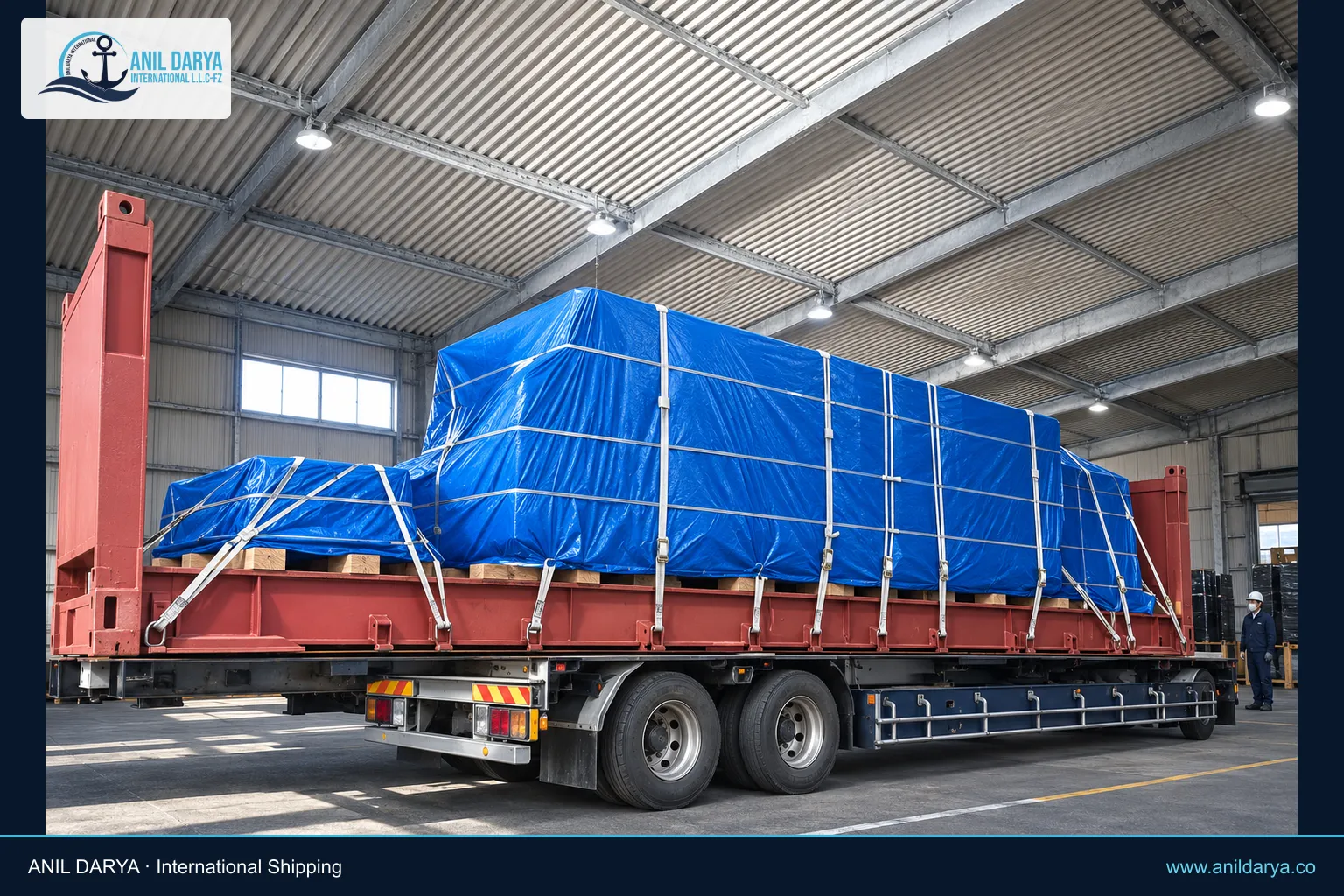
| Flat rack / open top | Pumps, transformers, steel structures slightly out of gauge | Dimensions, weights and lifting points per piece on the packing list |
| Breakbulk | Plant equipment, large fabrications | Discharge berth, crane capacity and road permits in Turkey |
If a Turkish importer buys from several Indian mills, one consolidated FCL is often cheaper than several LCL lots and means one set of clearance papers. Our article on FCL vs LCL explains where the break-even tends to sit, and our sea freight service handles container bookings on this lane.
Dangerous goods: dyes, solvents and pharma inputs
Much of what India sells Turkey in organic chemicals and dyes is classed as dangerous at sea. Since 1 January 2026 it moves under the IMDG Code 2024 edition, Amendment 42-24. The Indian shipper supplies the UN number, proper shipping name, class, packing group, a current safety data sheet and a signed DG declaration, and the line must accept the booking before stuffing. Check the Turkish terminal too: Marport's dangerous cargo guide says it does not handle Class 1, 6.2 or 7 in any way. Our dangerous goods team clears acceptance with the carrier before we hold space.
Breakbulk and project cargo
Turkish plants and energy projects buy Indian pumps, heat exchangers and steel structures. Pieces that fit a 40ft flat rack can ride a container service; larger units need breakbulk tonnage. Mundra lists oversized and overweight project cargo among its services. Our break bulk and project cargo service needs drawings, weights and lifting points before it can offer a vessel.
What the Indian exporter files before the ship sails
On FOB or CIF terms the export side is the seller's job, done by the seller or its customs broker in India. Three filings matter for a Turkey shipment.
- Importer Exporter Code. DGFT issues it online; it is a 10-character code equal to the company's PAN, and exports need one unless the exporter is exempt.
- Shipping bill. It is filed electronically on ICEGATE using a registered ICEGATE ID and a Class 3 digital signature certificate. Customs then allows the goods to be cleared and loaded.
- Certificate of origin. Non-preferential certificates have been issued on the eCoO 2.0 platform at trade.gov.in since 1 January 2025, by 125 agencies including 110 chambers of commerce.
After sailing, the line files the export general manifest. ICEGATE says that if an IGST refund stalls because the EGM is missing, the exporter must ask the line to file it.
One document Indian sellers are sometimes asked for is the A.TR. The European Commission describes it as proof of customs status for goods produced in, or released into free circulation in, the EU-Turkey customs union. Goods shipped straight from India are neither, so the A.TR does not apply on this lane. A certificate of origin showing India is what the Turkish broker needs.
Turkish import customs for goods from India
The Turkish Ministry of Trade's import guidance sets the frame. Any person or company with a Turkish tax number can import. A summary declaration is lodged for the goods before they arrive, and for sea cargo the goods must be given a customs-approved treatment within 45 days of that summary declaration. Release for free circulation is declared electronically, and the permits and conformity certificates the product needs are attached to that declaration.
| Step | Who | What happens |
|---|---|---|
| 1 | Turkish importer and broker | Confirm the 12-digit GTIP and any TAREKS, health or sector approval before the order ships |
| 2 | Carrier side | The summary declaration for the goods is lodged before the ship arrives |
| 3 | Terminal | Holds the container in temporary storage after discharge |
| 4 | Broker | Files the free circulation declaration with invoice, B/L, packing list, certificate of origin and permits |
| 5 | Customs and other agencies | Check documents; inspect or sample if the risk system or TAREKS selects the goods |
| 6 | Importer | Pays duty, any additional duty and VAT; customs releases the cargo |
Brokers file through the Ministry's BILGE system with a username and password from the Regional Directorate of Customs and Trade. If the GTIP is in doubt, the importer can apply for Binding Tariff Information, which is free and valid for 6 years.
Documents Turkey expects for Indian cargo
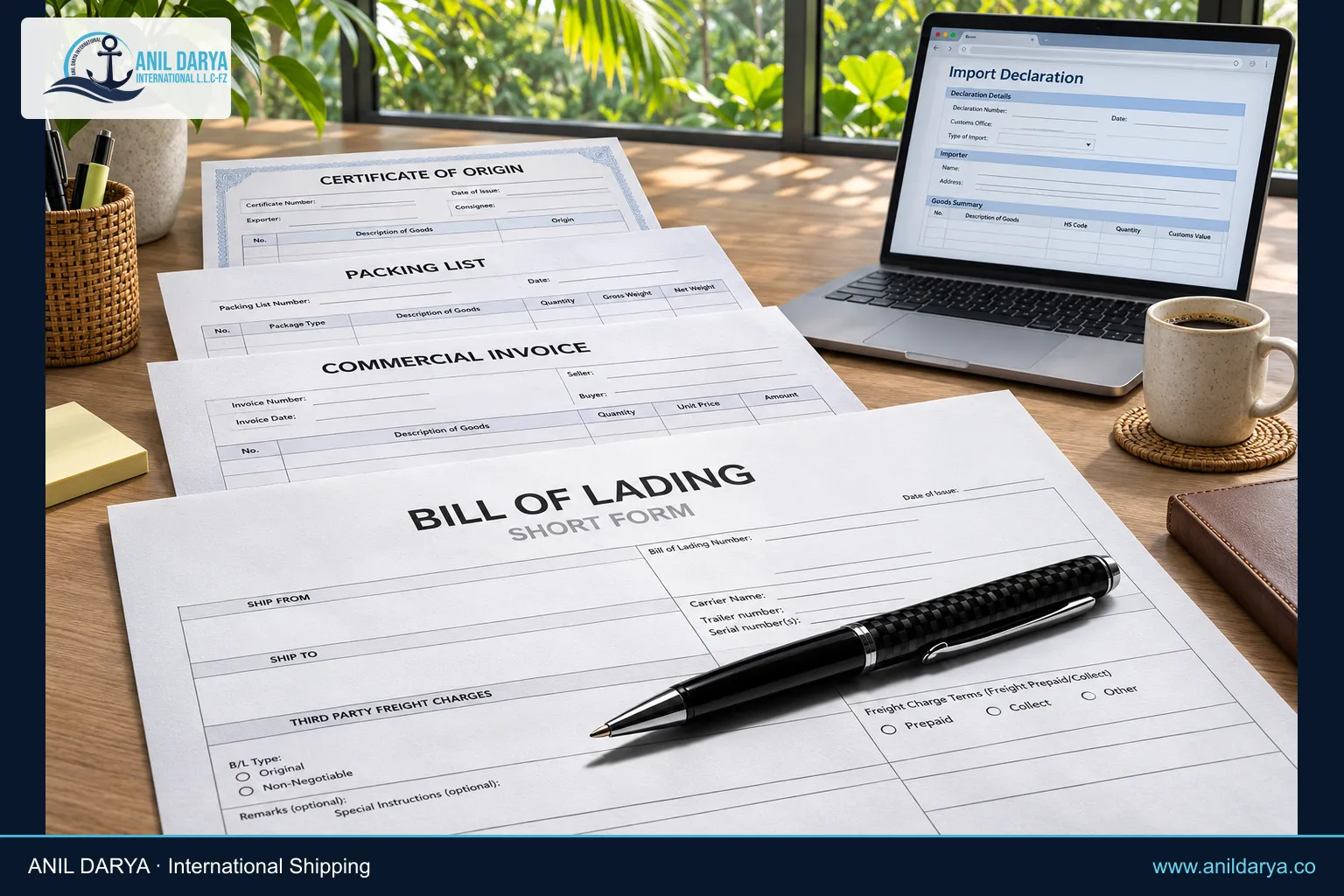
| Document | Issued by | What the broker checks |
|---|---|---|
| Commercial invoice | Indian exporter | Submitted in triplicate including the original; GTIP-level description, values and Incoterm |
| Packing list | Indian exporter | Same packages, weights and marks as the invoice and B/L |
| Bill of lading | Shipping line, released through us | Consignee and notify party as on the declaration |
| Certificate of origin | Chamber or agency via eCoO 2.0 | In English, no corrections; one copy goes to Turkish customs |
| TAREKS or conformity proof | Importer's application; CE evidence from the maker | For goods listed in the product safety communiques |
| Phytosanitary or veterinary certificate | Indian authority | For food and farm products, depending on the HS code |
| Safety data sheet | Manufacturer | For chemicals and DG |
Duty, additional duty and VAT on goods from India
Turkey's customs tariff is aligned with the EU Common Customs Tariff under the customs union, while Turkey sets its own rates for farm goods and some sensitive products. India is not on the Turkish Ministry of Trade's list of free trade agreements in force, so Indian goods get no agreement rate and pay the rate set for their GTIP and origin.
On top of the normal duty, Turkey applies additional customs duties to certain products from certain countries. The US International Trade Administration names India as one of the origins concerned. Whether a line attracts it depends on the GTIP, so the broker should price it into the landed cost before the buyer agrees the order.
VAT is charged on imports at 20% as the standard rate, with most agricultural products at 1% to 10%. The base is the CIF value plus duty and other charges. Special consumption tax applies on top for fuel, vehicles, alcohol, tobacco and some luxury goods.
| Indian cargo | Duty basis | VAT | Watch for |
|---|---|---|---|
| Machinery and mechanical appliances | GTIP rate; check additional duty | 20% standard | TAREKS for machinery under communique 2026/32; CE evidence |
| Steel and flat steel products | GTIP rate; check additional duty | 20% standard | Exact grade and dimensions on the invoice for classification |
| Man-made filament, fibre and cotton yarn | GTIP rate; check additional duty | 20% standard | Fibre content and count stated exactly |
| Organic chemicals and dyes | GTIP rate | 20% standard | SDS, DG paperwork, terminal class limits |
| Plastics | GTIP rate | 20% standard | Polymer type and form (granules, sheet, film) |
| Mineral fuels and oils | GTIP rate | As the broker confirms | Special consumption tax on fuel products |
Duty, any additional duty and VAT are paid by the consignee or its broker in Turkey.
TAREKS, conformity checks and restricted goods in Turkey
TAREKS is the Ministry of Trade's risk-based control system for product safety, running since 2010. The 2026 product safety and inspection communiques were published in the Official Gazette on 31 December 2025 and took effect at once. Every GTIP listed in their annexes now needs a TAREKS application, even where the goods end up outside inspection. For radio equipment, toys, construction materials and batteries, product photos taken in the bonded area must be uploaded. Machinery is covered by communique 2026/32.
So the Turkish buyer must start the TAREKS file early and may need CE evidence from the Indian factory. If goods are picked for physical inspection, a sampling report is signed at the port; refusing to sign rejects the application.
Other limits from official sources:
- Used, renovated or faulty goods need permission before import.
- Medicines, cosmetics and health products may need certificates from the Ministry of Health.
- Food and farm goods are controlled by the agriculture ministry and may need phytosanitary or veterinary certificates.
- Restricted goods such as firearms and hazardous materials need approvals beyond the tax number.
Ask the consignee's broker to confirm the GTIP and every approval before the Indian factory packs.
The Dubai option: Jebel Ali, consolidation and free zone stock
Most Indian cargo for Turkey should sail direct. Dubai helps in three cases.
- Combining Gulf and Indian goods. ESL's IEX brochure publishes 20 days from Jebel Ali to Mersin and 22 days to Iskenderun, so a buyer sourcing in both India and the UAE can join the same Mersin service. Our Jebel Ali port guide covers the terminal side.
- Consolidation. Several small Indian lots, plus UAE-sourced items, can be combined in Dubai into one FCL for a single Turkish buyer.
- Free zone stock. A distributor can hold Indian goods in a Dubai free zone and call off smaller lots for Turkey. Our article on JAFZA re-export explains how that works.
Watch the origin. Turkey and the UAE have a trade agreement in force, but its preference follows rules of origin, not the port of loading. Indian goods re-shipped from Dubai stay Indian, and a Dubai Chambers certificate for re-exported goods still names India as the country of manufacture. Where your cargo does pass through Dubai, customs clearance there is a service we provide for a fee through our Dubai freight forwarding team.
[AMIR-FACT: whether we route India to Turkey cargo through Jebel Ali (consolidation, free zone stock or transhipment), on which carriers, how often, and the real extra days compared with a direct Mundra sailing]
What drives the cost of shipping from India to Turkey?
We price each sailing on the day, so here are the parts of the bill, not rates.
| Cost part | What moves it | Usually paid by (FOB) |
|---|---|---|
| Origin charges in India | Truck or rail to Mundra or Nhava Sheva, stuffing, shipping bill, terminal handling | Exporter |
| Ocean freight | Service chosen, direct or transhipped, box type, season, surcharges | Importer |
| Special equipment | DG, ISO tank, flat rack, breakbulk | Importer |
| Turkish port charges | Terminal handling, delivery order, LCL unpacking, storage | Importer |
| Duty and taxes | GTIP rate, any additional duty, 20% VAT, special consumption tax where it applies | Consignee or its broker |
| Compliance | TAREKS application, inspection, sampling, sector certificates | Importer |
| Delay charges | Missing permit, wrong GTIP, inspection queue, demurrage and detention | Whoever caused the delay, by contract |
The cost that surprises buyers is storage while a TAREKS file or a certificate is still open. Our article on demurrage and detention shows how those daily charges build.
How to arrange shipping from India to Turkey, step by step
- Agree the Incoterm with the Indian seller. FOB Mundra or FOB Nhava Sheva keeps export clearance with the party that can file it.
- Send us the details: product, HS code, weight and volume, factory location, ready date, DG or out-of-gauge needs, and the Turkish port or city.
- Name the Turkish broker. We confirm with the broker which port it covers and whether the GTIP needs TAREKS or another approval. The booking is confirmed only after this.
- Choose the service. For Mersin and Iskenderun we compare the direct Mundra loop; for Istanbul, Izmit, Gemlik and Aliaga, the Marmara loop. We get DG or flat rack acceptance first.
- Prepare documents in India. The seller issues the invoice and packing list with matching data and gets the certificate of origin on eCoO 2.0.
- File the shipping bill on ICEGATE and gate in before the vessel cut-off.
- Release the bill of lading. We check the draft against the invoice and the buyer's details and release the carrier's B/L once freight is settled.
- Clearance in Turkey. The broker files the declaration on BILGE, the importer pays duty and VAT, and the cargo is released for delivery.
[AMIR-FACT: one real India to Turkey cross-trade shipment we handled (cargo, Indian load port, Turkish port, carrier, how the broker and any TAREKS file were lined up, door-to-door days), cleared for publication]
Checklist before the container leaves India
- Incoterm written in the contract and on the invoice.
- Turkish importer holds a tax number; broker named and working at the discharge port.
- 12-digit GTIP agreed with the broker, and Binding Tariff Information requested if it is unclear.
- TAREKS application or other permit started where the GTIP is listed.
- Additional duty checked for the GTIP and built into the landed cost.
- Certificate of origin issued on eCoO 2.0, in English, with no corrections.
- Invoice, packing list and B/L agree on weights, counts and descriptions.
- IEC active and the shipping bill filed on ICEGATE.
- For DG: SDS, DG declaration, carrier acceptance and terminal class check.
- Insurance arranged and terminal free time confirmed.
Mistakes that hold up cargo at Turkish ports
- Shipping before destination clearance is agreed. A box that reaches Mersin with no broker lined up builds storage from the first day.
- Choosing the wrong service. A Mersin buyer booked on the Marmara loop waits about ten days longer than on the direct Mundra service.
- Asking for an A.TR. It does not cover goods coming straight from India; the certificate of origin is the document needed.
- Ignoring additional duty. A quote built on the base rate alone can be well short of the real landed cost.
- Late TAREKS. The application is filed after arrival and the box waits in the port.
- Undeclared DG. Dyes or solvents booked as general cargo get rejected or fined, and some terminals refuse certain classes outright.
Frequently asked questions
How many days does sea freight from India to Turkey take?
ESL publishes 14 days from Mundra to Mersin and 16 to Iskenderun. Turkon publishes 18 days from Mundra to Istanbul Marport and 20 from Nhava Sheva. Add time for export filing in India and clearance in Turkey.
Is there a free trade agreement between India and Turkey?
No. India is not on the Turkish Ministry of Trade's list of agreements in force, so Indian goods pay the standard rate for their GTIP, plus any additional customs duty that applies to that line.
What VAT applies to Indian goods imported into Turkey?
The standard import VAT rate is 20%, charged on the CIF value plus duty and other charges. Most agricultural products are taxed at 1% to 10%. The consignee or its broker pays it.
Does an Indian exporter need an A.TR certificate for Turkey?
No. The A.TR proves free circulation status inside the EU-Turkey customs union. Goods shipped directly from India travel with an Indian certificate of origin instead.
What is TAREKS and does it affect Indian goods?
TAREKS is Turkey's risk-based product safety control system. If the goods' GTIP is listed in the 2026 communiques, the importer must apply on TAREKS whatever the origin, so Indian machinery and some consumer goods are affected.
Does Anil Darya clear the cargo in Turkey?
No. We book the ocean freight, coordinate the Indian shipper and release the carrier's bill of lading. The consignee's licensed broker clears the cargo in Turkey, and we agree that with you before confirming the booking.
Can Indian cargo for Turkey go through Dubai?
Yes, as an option. ESL publishes 20 days from Jebel Ali to Mersin, and goods can be consolidated or held in a Dubai free zone. The goods keep Indian origin, so no UAE agreement rate applies to them.
Get a quote for shipping from India to Turkey
Tell us the factory location, cargo and HS code, ready date, Turkish port or city and the name of the buyer's broker, and we will come back with sailing options and a price. Use our freight rate inquiry form, or contact our team to talk through a DG or project shipment first.
Sources
- Turkon Line: Turkiye-Red Sea-India Service (TRI) flyer, transit times
- Nowlun: Turkon Line launches weekly TRI service, January 2025
- Emirates Shipping Line: IEX service launch advisory and brochure
- Turkish Ministry of Trade: Import regime FAQ
- Turkish Ministry of Trade: Tariff FAQ (GTIP, Binding Tariff Information)
- Turkish Ministry of Trade: Digital customs FAQ (BILGE)
- Turkish Ministry of Trade: Free trade agreements in force
- US International Trade Administration: Turkiye import tariffs
- US International Trade Administration: Turkiye import requirements and documentation
- EY Tax News: Turkiye changes product safety and inspections (2026 communiques)
- European Commission Access2Markets: EU-Turkiye customs union and the A.TR
- Turkish Ministry of Transport: Maritime statistics bulletin 2025
- PSA: Mersin International Port fact sheet
- Marport: Terminal details
- Marport: Dangerous cargo handling guide
- TURKLIM: DP World Evyap terminals
- Gemport: Port facts
- LimakPort Iskenderun: Port technical features
- Adani Ports: Mundra port
- Jawaharlal Nehru Port Authority: Overview
- ICEGATE (CBIC): FAQ on shipping bills, digital signatures and EGM
- DGFT: Foreign Trade Policy 2023, Chapter 2 (IEC)
- India Briefing: eCoO 2.0 for certificates of origin
- Consulate General of India, Istanbul: India-Turkiye trade and main exports
- IMO: IMDG Code 2024 edition (Amendment 42-24)
- Dubai Legislation Portal: Dubai Chambers Resolution No. 7 of 2024 on certificates of origin
Reviewed: 11 November 2026