
Shipping from Indonesia to Egypt is a long container lane with a change of ship on almost every booking: boxes load at Tanjung Priok in Jakarta or Tanjung Perak in Surabaya, connect with a mainline vessel at a regional hub, and discharge at Sokhna, Port Said, Damietta or Alexandria. Palm oil and coffee lead the trade, and the Egyptian rule that decides the timing is the ACID, which the importer must obtain on Nafeza before the cargo is loaded in Indonesia. We book the ocean freight from Dubai, release the carrier's bill of lading to you, and line up the Indonesian shipper and the Egyptian buyer's broker before we confirm the space.
Indonesia to Egypt shipping at a glance
| Item | Detail |
|---|---|
| Type of lane | Cross-trade by sea, Indonesia to Egypt, booked and coordinated by Anil Darya from Dubai |
| Main Indonesian load ports | Tanjung Priok (Jakarta) and Tanjung Perak (Surabaya); also Semarang and Belawan (Medan) |
| Main Egyptian discharge ports | Sokhna on the Gulf of Suez; East Port Said, Damietta and Alexandria (with Dekheila) on the Mediterranean |
| Routing | Transhipment on nearly all container services, via a hub such as Tanjung Pelepas or Port Klang |
| Published transit | No carrier page we opened publishes an Indonesia to Egypt port pair; ask us for the current figure |
| Main Indonesian exports to Egypt | Palm oil and derivatives, coffee beans, vehicles, wood, iron, coconut products, textile yarn, tyres |
| Indonesian export filing | PEB lodged with Indonesian Customs (DJBC) by the exporter or its licensed broker (PPJK) |
| Egypt pre-shipment rule | Advance Cargo Information: an ACID from Nafeza before loading, documents uploaded by the exporter on CargoX |
| Egypt customs duty | By HS code, mostly 0% to 60% of CIF value, paid in Egyptian pounds |
| Egypt import VAT | 14% standard rate; 5% on machinery for production lines |
| Trade agreement | Both countries have ratified the D-8 Preferential Trade Agreement; Egypt's application of it must be confirmed per shipment |
| Bill of lading | The shipping line's own B/L, released to you through us as the line's agent |
| Destination clearance | The consignee's licensed customs broker in Egypt, agreed before we confirm the booking |
How shipping from Indonesia to Egypt works as a cross-trade
The cargo never touches the UAE unless you choose a Dubai routing. Our job in Dubai is to buy the space, keep five parties on the same booking data, and stop the box loading before the Egyptian side is ready.
| Party | What it does on an Indonesia to Egypt booking |
|---|---|
| Indonesian exporter or its PPJK | Stuffs the container, lodges the PEB with DJBC, obtains the certificate of origin, uploads the ACI documents on CargoX |
| Anil Darya, Dubai | Books the carrier, confirms the ACID and the three ACI data elements before gate-in, tracks the feeder and mainline legs, releases the carrier's B/L |
| Shipping line | Checks the ACID, carries the box via its hub, sends the cargo manifest to Egyptian Customs through Nafeza |
| Egyptian importer | Requests the ACID, approves the exporter's documents, holds the approvals for food or regulated goods, pays duty and VAT |
| Importer's broker in Egypt | Files the customs clearance at the discharge port and attends inspection and release |
You receive the shipping line's bill of lading, not a forwarder document. Because we act as agent for many lines, the carrier issues its B/L and we release it to you from Dubai. For a Surabaya coffee exporter selling to a Cairo roaster, that means the B/L shows the Egyptian buyer's legal name and 9-digit tax number exactly as the broker will declare them, and it carries the ACID.
We do not sell customs clearance in Egypt, and duty and taxes at destination are paid by the consignee or its broker. Before we confirm a Jakarta or Surabaya booking, the buyer names its broker and the port where it has staff, and confirms the ACID request is filed. Until then the booking waits.
On FOB Jakarta the buyer pays the ocean freight; on CFR Sokhna the seller does, and Egyptian port charges, duty and VAT stay with the buyer. Our guide to Incoterms 2020 for sea freight sets out where risk passes on each term.
Which Indonesian ports to load at
Most Egypt-bound containers start at Jakarta or Surabaya because those terminals have the most feeder departures to the regional hubs. Outer-island cargo usually comes to Java by domestic ship first.
| Port | Facts from the operator or port data | Typical Egypt-bound cargo |
|---|---|---|
| Tanjung Priok, Jakarta | 8.30 million TEU in 2025 (Pelindo Regional 2); terminals include JICT, NPCT1 and TPK Koja | Vehicles and parts, tyres, consumer goods, paper, packed palm products |
| Tanjung Perak, Surabaya | 4.49 million TEU in 2025; Terminal Petikemas Surabaya and the semi-automated Teluk Lamong terminal | Coffee, wood products, coconut products, East Java manufactures |
| Tanjung Emas, Semarang | 895,904 TEU in 2024 at TPK Semarang | Furniture, garments and textile yarn from Central Java |
| Belawan, Medan | Belawan New Container Terminal; draft of about 10 m limits ship size | Palm-based products, rubber and coffee from North Sumatra |
Which Egyptian port suits your cargo
Egypt has one container gateway on the Gulf of Suez and three on the Mediterranean. The right one depends on where the buyer's plant or warehouse sits and where its broker works.
| Port | Terminal facts | Usually suits |
|---|---|---|
| Sokhna | DP World Sokhna: Berth 1 of 750 m and Berth 2 of 1,350 m, 17 m alongside, 584 plus 320 reefer points | Eastern Cairo and the 10th of Ramadan industrial city |
| East Port Said | Suez Canal Container Terminal: 3,355 m quay, 17 m draft, 6,400 reefer plugs | Canal cities, the East Port Said industrial zone, mainline calls |
| Damietta | DCHC and Damietta Alliance Container Terminals (from 14 February 2026), 1,670 m quay at 18 m | Mansoura and the eastern Delta |
| Alexandria and Dekheila | The authority says the two ports carry about 60% of Egypt's export and import volume; Dekheila draft to 18 m | Alexandria, the western Delta and many Cairo importers |
For Cairo deliveries, price the trucking from Sokhna and from Alexandria before you pick the service. A broker with no team at the discharge port slows clearance.
Direct calls, hubs and transit time
We found no weekly container service that loads in Jakarta or Surabaya and sails straight to Egypt. The route tables on Fluent Cargo list every Jakarta to Alexandria and Surabaya to Port Said option as transhipment. The Indonesian leg is a feeder; the long leg is a mainline Asia to Mediterranean loop. Carrier pages we opened show two mainline loops that pick up near Indonesia and call Egypt:
- Maersk AE15, under the rotation announced on 10 August 2026 from Madison Maersk voyage 632W: Qingdao, Kwangyang, Ningbo, Tanjung Pelepas, Jeddah, Port Said, Damietta, Colombo, Singapore. Indonesian boxes join at Tanjung Pelepas from a Maersk feeder.
- Wan Hai FM1, as reported in September 2025, links Shanghai, Ningbo, Nansha and Shekou with Port Klang, Aqaba, Sokhna and Alexandria, among other ports. Indonesian cargo connects at Port Klang.
These are dated examples, not a timetable. Rotations change often, so each of our quotes names the feeder, the hub and the mainline vessel.
How long does shipping from Indonesia to Egypt take?
No carrier page we opened publishes a figure for this port pair, and aggregator pages disagree by weeks because they mix hubs and connections. The real time is the feeder leg, the wait at the hub and the mainline leg. Add time in Indonesia for the PEB and cut-off, and in Egypt for clearance.
[AMIR-FACT: the carriers and hubs we actually book from Tanjung Priok and Tanjung Perak to Sokhna, Port Said, Damietta and Alexandria, with the real port-to-port days and sailing frequency we see in 2026]
Sea freight from Indonesia to Egypt: palm oil, coffee and other cargo
Indonesia's embassy in Cairo reported non-oil exports to Egypt of USD 1.52 billion in 2024, up 16.36% on 2023, and named palm oil and its derivatives, coffee beans, cars, wood, iron, coconut products, textile yarn, vegetable oil, electronics and tyres as the main lines.
| Option | Indonesian cargo for Egypt | What to check |
|---|---|---|
| FCL 20ft | Green coffee in bags, tyres, iron and steel items, heavy coconut products | Weight limit before volume; one ACID per shipment |
| FCL 40ft / high cube | Furniture, plywood and wood products, textile yarn, auto parts | Fumigation and wood packaging rules; weights identical on every document |
| LCL | Spare parts, samples, spices, small consumer orders | Each consignee needs its own ACID; one missing file holds the whole unpacking |
| Flexitank or ISO tank | Refined palm oil, palm olein, coconut oil, non-hazardous oleochemicals | Carrier approval for flexitanks, tank cleaning certificate, food approvals in Egypt |
| Liquid bulk tanker | Crude and refined palm oil in ship-sized parcels | Charter or parcel space, shore tanks at the Egyptian port |
| Breakbulk / flat rack | Machinery, steel structures, oversized plant parts | Drawings, lifting points and an ACID, as for any container |
Several suppliers selling to one buyer can often share one container and one ACI file. Read FCL vs LCL for where the break-even usually sits, and see our sea freight service for container bookings.
Palm oil: tanker, flexitank or ISO tank
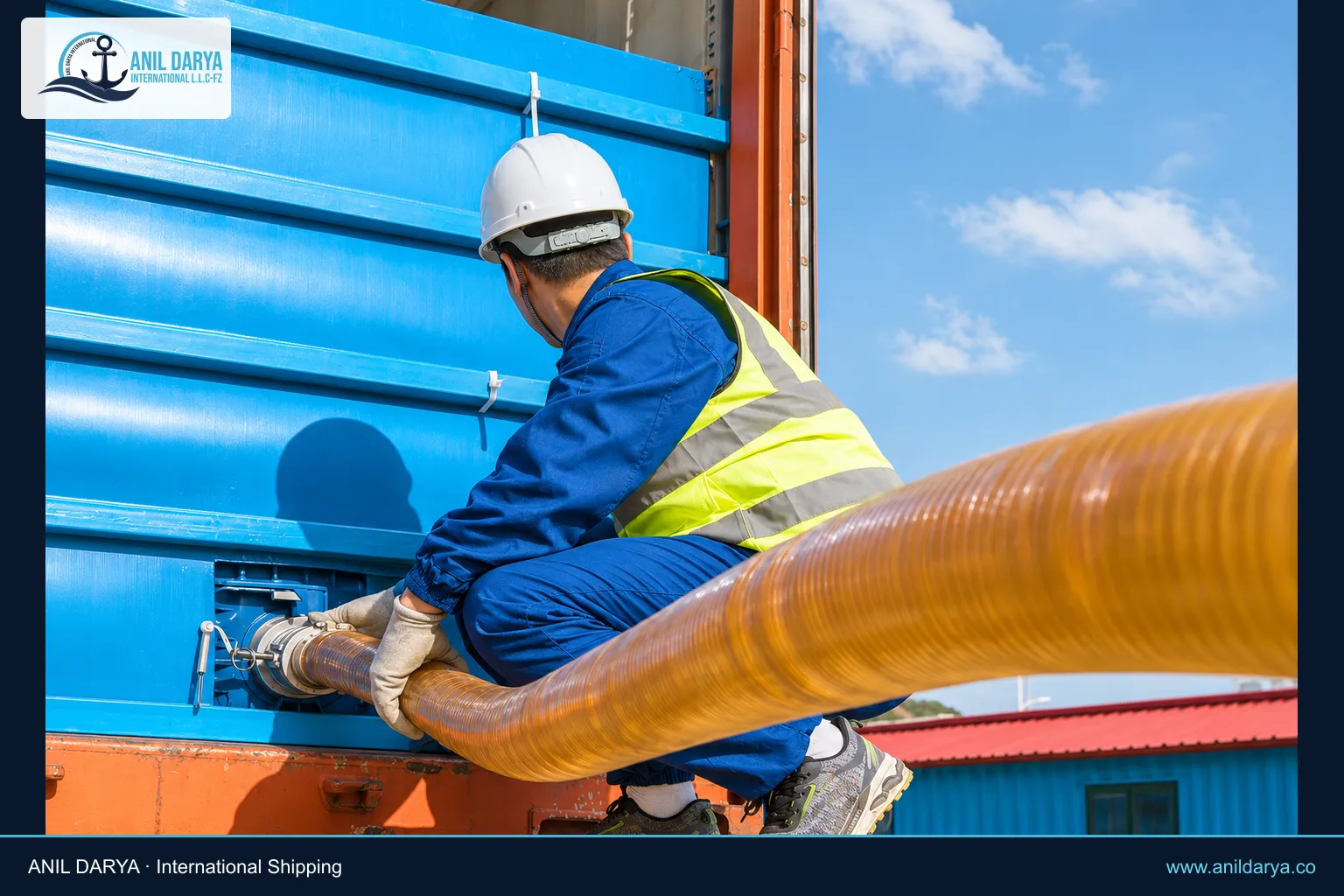
Ship-sized palm oil volumes move as liquid bulk through our bulk cargo service. Smaller lots go in a flexitank inside a 20ft container or in an ISO tank. Get the line to approve the flexitank make before you fix the sale, and send the broker the product specification early.
Indonesian export cost also moves each month. Indonesia charges an export duty and an export levy on crude palm oil and its products, calculated from a reference price the Ministry of Trade publishes monthly, at rates set by Finance Ministry regulations. The contract should say who carries a change.
Coffee beans and other dry food
Green coffee, Indonesia's second big export to Egypt, travels in dry containers in bags or bulk liners, and condensation on the long voyage is the main risk. Agree lining and desiccants with the exporter, and keep bag count and net weight identical on the phytosanitary certificate, invoice and packing list.
Dangerous goods and chemicals
Some oleochemicals, resins and paints are dangerous goods at sea, under the IMDG Code 2024 edition (Amendment 42-24, mandatory since 1 January 2026). The shipper supplies the UN number, class, safety data sheet and DG declaration, and the feeder and mainline carriers must both accept the booking. Our dangerous goods team gets that acceptance before we confirm a vessel.
Indonesian export side: PEB, DJBC and export levies
The Indonesian exporter, or a PPJK it authorises, handles the export formalities. DJBC lists CEISA 4.0 among its online customs service applications, and its export procedure page sets out the steps:
- Prepare the goods and supporting documents.
- Lodge the PEB (Pemberitahuan Ekspor Barang). Under PMK 155/PMK.04/2022 it goes in before the goods enter the customs area at the loading port; bulk cargo loaded outside that area may be lodged up to the ship's departure.
- Physical inspection, only if risk management selects it. DJBC names goods subject to export duty as one of the inspection cases, so palm oil shipments are more likely to be checked. Inspection can take place at the port or at the exporter's warehouse.
- Document examination by DJBC.
- Loading. The goods count as exported once the PEB has a registration number and they are on board.
| Error at export | Penalty on DJBC's page |
|---|---|
| Wrong type or quantity of goods declared | Administrative fine of 100% to 1,000% of the export levy underpaid |
| Export without a customs declaration | Criminal sanctions, including a fine of Rp50 million to Rp5 billion |
Restricted exports fall under PMK 141/PMK.04/2020 and export duty under PMK 106/PMK.04/2022. For Egypt, the ITA guide says the invoice and certificate of origin usually need legalisation by the Egyptian consulate in the country of origin. Ask the broker which level of legalisation it needs before the papers are printed.
Egypt import customs: ACI and Nafeza for goods from Indonesia
Egypt's Advance Cargo Information system was set up by Ministry of Finance Decree 38 of 2021 and became mandatory at seaports in October 2021, according to the ITA guide last published on 21 November 2025. Nafeza is the single window; Misr Technology Services runs it. The shipping-line guide sets the ACI request deadline at 48 hours before loading, and customs issues the 19-digit ACID within 48 hours of the request.
On a transhipped lane, "loading" means loading at Jakarta or Surabaya, not at the hub, so the buyer must request the ACID before the factory books its trucks.
| Step | Who | What happens |
|---|---|---|
| 1 | Egyptian importer or broker | Registers the shipment on Nafeza |
| 2 | Egyptian Customs | Issues the ACID and emails the importer and the Indonesian exporter |
| 3 | Indonesian exporter | Uploads the invoice, packing list, certificate of origin and B/L copy on CargoX under the ACID |
| 4 | Importer | Accepts the exporter's documents |
| 5 | Feeder line in Indonesia | Checks the ACID and loads the box |
| 6 | Mainline carrier | Sends the manifest through Nafeza at least 48 hours before berthing in Egypt |
| 7 | Importer and broker | Pay duty and VAT; inspection if selected; release |
The three data elements on every document are the ACID, the importer's 9-digit tax number and the exporter's ID (country code, ID type and number). Under Customs Law 207 of 2020, the ITA guide says, shipments arriving without an ACID are denied entry and returned at the shipper's cost.
On CargoX, only verified companies file, and a document sent in error cannot be recalled; it is corrected with a new envelope under the same ACID.
Documents Egypt expects for Indonesian cargo
| Document | Issued by | Points Egypt checks |
|---|---|---|
| Commercial invoice | Indonesian exporter | ACID, tax number, exporter ID; two copies plus original; consulate legalisation in most cases |
| Certificate of origin | Indonesian issuing office | Indonesia as origin; Form D-8 if the buyer claims the D-8 preference |
| Packing list | Indonesian exporter | Same packages, weights and description as the invoice and Nafeza |
| Bill of lading | Shipping line, released through us | Shows the ACID; copy in the ACI file |
| Phytosanitary certificate | Indonesian plant quarantine authority | For coffee, spices, wood and other plant products |
| Health certificate and analysis | Indonesian authority or laboratory | For palm oil and other foods, as the broker lists |
| Fumigation certificate | Licensed fumigator | Wood packaging and some plant products |

Duty, VAT and the D-8 agreement on Indonesian goods
Egyptian customs duty follows the HS code of each item. PwC's Egypt tax summary, last reviewed on 17 August 2026, gives average rates of 0% to 60% of CIF value, up to 135% on passenger cars, luxury goods and alcohol, 0% to 5% on most industrial machinery and 10% to 20% on trucks and heavy equipment. Duty is paid in Egyptian pounds.
VAT is 14% under Law 67 of 2016, charged on the CIF value plus duty and other taxes. Machinery for new production lines is taxed at 5%, excluding buses and passenger cars, and a schedule tax applies to some listed goods. The broker confirms the exact rate for each HS code before the ship sails.
| Indonesian cargo | Duty basis | VAT | Watch for |
|---|---|---|---|
| Palm oil and olein | By HS code | As the broker confirms | Food authority approval, tank or bulk certificates |
| Green coffee | By HS code | As the broker confirms | Phytosanitary certificate matching the import permit |
| Passenger cars | Up to 135% (PwC), set by engine size | 14% | Import rules for vehicles; confirm before the sale |
| Furniture, textile yarn | By HS code within 0% to 60% | 14% | Whether the product is on the Decree 43 list |
Does the D-8 trade agreement cut the duty?
Possibly, and this is the point most guides miss. Indonesia and Egypt are both members of the D-8 Preferential Trade Agreement. Indonesia applies it under Finance Ministry Regulation PMK 203/2021, in force since 1 January 2022, which asks importers for an original Form D-8 certificate of origin valid for six months. Egypt's House of Representatives approved accession on 15 June 2026, Presidential Decree 24 of 2026 approved it, and the D-8 Secretariat reported in October 2026 that Egypt had deposited its instrument of ratification.
What we could not confirm is whether Egyptian Customs already grants D-8 rates on goods from Indonesia, and on which tariff lines. Ask the broker before you choose between a Form D-8 and an ordinary certificate. If a preference applies, expect a direct consignment rule: storing or splitting the cargo in Dubai could cost the preference, so confirm with the broker before you plan a Jebel Ali stop.
[AMIR-FACT: whether Egyptian Customs is accepting Form D-8 certificates from Indonesia in 2026, for which products, and whether a Jebel Ali transhipment or Dubai storage keeps or loses the preference]
Food, GOEIC and other approvals in Egypt
These approvals most often hold Indonesian cargo:
- Ministerial Decree 43 of 2016 requires factories and brand owners exporting listed goods to register with GOEIC. The list includes furniture, textiles, clothing, cosmetics, toys and packaged foods.
- Food goes through Egypt's National Food Safety Authority, plant products through plant quarantine, and the importer needs the licences those bodies issue. The USDA's Cairo office report of 19 December 2025 says the phytosanitary certificate must reference the import permit, and that a mismatch between the permit and the shipping documents leads to rejection.
- The Egyptian buyer must be on GOEIC's importers register. Decree 271 of 2026, in force since 22 July 2026, replaced its rules.
Does routing through Dubai help on this lane?
Most Indonesian cargo for Egypt should go via a Malacca Strait hub and straight on to Egypt. Dubai helps in a few cases:
- Jebel Ali as a hub. DP World reported in December 2021 that Kaiso Line had opened a Jakarta service calling Jebel Ali and called the port its Middle East hub. Check whether that service still runs. Our Jebel Ali port guide covers the terminal.
- Consolidation. Indonesian and Gulf goods can be combined in Dubai into one container for Egypt.
- Free zone stock. An Egyptian distributor can hold Indonesian stock in a Dubai free zone and call off smaller lots. Our article on re-exporting from JAFZA explains how.
The leg from Dubai to Egypt needs its own ACID. Where the cargo is cleared in Dubai, the customs work is a paid service of our Dubai freight forwarding team.
[AMIR-FACT: whether we route Indonesian cargo for Egypt through Jebel Ali today (transhipment, consolidation or Jafza stock), on which carriers, and the real extra days compared with a Tanjung Pelepas or Port Klang connection]
What drives the cost of shipping from Indonesia to Egypt?
We price each sailing on the day, so this page gives the parts of the bill, not rates.
| Cost part | What moves it | Usually paid by (FOB) |
|---|---|---|
| Origin charges in Indonesia | Trucking to the terminal, stuffing, PEB filing, terminal handling | Exporter |
| Export duty and levy | Only for listed goods such as palm oil; reference price changes monthly | Exporter, unless the contract says otherwise |
| Documents | Certificate of origin, consulate legalisation, CargoX fee per ACID | Exporter |
| Ocean freight | Feeder plus mainline, hub, box type, season, surcharges | Importer |
| Egyptian port charges | Terminal handling, delivery order, LCL unpacking, storage | Importer |
| Duty and taxes | HS code, CIF value, VAT rate, any D-8 preference | Consignee or its broker |
| Delay charges | Missing ACID, approval or permit; inspection; demurrage and detention | Whoever caused it, by contract |
Storage while a permit is corrected is the cost buyers miss. Our article on demurrage and detention shows how those charges build.
How to ship from Indonesia to Egypt step by step
- Fix the Incoterm with the Indonesian seller. FOB Jakarta or FOB Surabaya keeps the PEB with the party that can file it.
- Send us the cargo details: product, HS code, weight and volume, factory or plantation location, ready date, tank, DG or out-of-gauge needs, and the Egyptian port or city.
- Name the Egyptian broker. We check with the broker that the importer is registered, that food, plant or GOEIC approvals are in place, and that the broker works at the chosen port. Only then do we confirm the booking.
- Get the ACID. The importer files on Nafeza at least 48 hours before loading in Indonesia and sends the number to the seller and to us.
- Book the space. We compare hubs and connections, and get flexitank, DG or out-of-gauge acceptance from every line on the route.
- Prepare the documents in Indonesia with the ACID, tax number and exporter ID, the right certificate of origin (Form D-8 only if the broker confirms it works), and consulate legalisation where needed.
- Upload the ACI documents on CargoX, lodge the PEB with DJBC and gate in before the cut-off.
- Release the bill of lading. We check the draft against the invoice and ACID and release the carrier's B/L once freight is settled.
- Clearance in Egypt. The consignee's broker pays duty and VAT, attends any inspection and takes delivery.
[AMIR-FACT: one real Indonesia to Egypt cross-trade shipment we handled (cargo, Indonesian load port, hub, Egyptian port, carrier, how the ACID and the broker were lined up, door-to-door days), cleared for publication]
Checklist before the container leaves Indonesia
- Incoterm written in the contract and on the invoice.
- Egyptian importer on the importers register and holding a valid ACID for this shipment.
- Consignee's broker named, agreed and working at the discharge port.
- Food, plant quarantine or GOEIC approvals confirmed for the HS code.
- ACID, importer tax number and exporter ID on every document.
- Certificate of origin chosen with the broker: Form D-8 or ordinary.
- PEB lodged, and the palm oil export duty and levy settled where they apply.
- Phytosanitary, health and fumigation certificates matching the permit.
- Flexitank or ISO tank approved by the carrier; DG accepted on every leg.
Common mistakes on this lane
- Shipping before destination clearance is agreed. A box that reaches Sokhna with no broker lined up sits on the quay and builds storage.
- Loading before the ACID exists. The feeder line in Jakarta or Surabaya will not load cargo for Egypt without a valid one.
- Mismatched figures. Bag counts or net weights that differ between the phytosanitary certificate, the invoice and Nafeza cause holds and rejection.
- Counting on the D-8 preference without checking. If Egyptian Customs does not grant it on your line, the duty is the normal rate.
- Unregistered factory. Furniture or garments on the Decree 43 list arrive and cannot be released.
Frequently asked questions
Is there a direct ship from Indonesia to Egypt?
Not on the services we found. Boxes from Jakarta or Surabaya are transhipped at a hub such as Tanjung Pelepas or Port Klang onto a loop that calls Egypt.
How long does sea freight from Indonesia to Egypt take?
It depends on the feeder, the hub and the connection. No carrier page we opened publishes a figure for this pair, so ask us for the days on the vessel you book.
Which Egyptian port is best for cargo from Indonesia?
Sokhna is usually the first Egyptian call for ships from Asia and suits eastern Cairo. Alexandria suits the western Delta, Damietta the eastern Delta, and East Port Said the canal zone.
Who gets the ACID for a shipment from Indonesia?
The Egyptian importer or its broker requests it on Nafeza. Customs issues it within 48 hours and emails both sides, and the Indonesian exporter then uploads the documents on CargoX.
Can palm oil go from Indonesia to Egypt in a container?
Yes. Smaller lots ship in a flexitank inside a 20ft container or in an ISO tank, after the carrier approves the equipment. Large volumes move as liquid bulk by tanker.
What duty and VAT apply to Indonesian goods in Egypt?
Duty follows the HS code, mostly 0% to 60% of CIF value, paid in Egyptian pounds. VAT is 14%, or 5% on production-line machinery. The consignee or its broker pays them.
Does the D-8 agreement lower duty on Indonesian goods?
Both countries have ratified it, Egypt in 2026. Whether Egyptian Customs grants the D-8 rate on your product must be confirmed with the broker before you choose Form D-8.
Does Anil Darya clear the cargo in Egypt?
No. We book the ocean freight, coordinate the Indonesian shipper and release the carrier's bill of lading. The consignee's licensed broker clears the cargo, and we agree that before confirming the booking.
Get a quote for shipping from Indonesia to Egypt
Tell us the product, the Indonesian port or factory, the ready date, the Egyptian port and the name of the buyer's broker, and we will come back with hub options and a price. Use our freight rate inquiry form, or contact our team to talk through a flexitank, DG or project shipment first.
Sources
- DJBC (Indonesian Customs): Export procedure, PEB, regulations and penalties
- Ministry of Finance Regulation PMK 155/PMK.04/2022 on export customs (PEB timing)
- RRI: Indonesia sets monthly export reference prices for CPO
- RRI: Indonesia's trade with Egypt hits record high in 2024 (embassy in Cairo)
- DDTCNews: PMK 203/2021, D-8 preferential tariff and Form D-8 (11 April 2022)
- APP: D-8 Secretariat on Egypt's ratification of the Preferential Trade Agreement (9 October 2026)
- Arab Finance: Decree 24 of 2026 approving Egypt's D-8 PTA accession
- The Shipping Gazette: Tanjung Priok 2025 throughput (Pelindo Regional 2)
- Lloyd's List: Tanjung Perak 2025 throughput
- Maersk: AE15 new rotation, 10 August 2026
- Al Riyadh Daily: Wan Hai FM1 ports of call (29 September 2025)
- Fluent Cargo: Jakarta to Alexandria services (routing type only)
- DP World: Sokhna infrastructure and facts
- APM Terminals: Suez Canal Container Terminal, East Port Said
- Alexandria Port Authority: Alexandria and Dekheila
- Baird Maritime: Damietta Alliance Container Terminals starts operations
- US International Trade Administration: Egypt import requirements and documentation (21 November 2025)
- US International Trade Administration: Egypt customs regulations
- Misr Technology Services via SCZONE: ACI Shipping Lines/Agents Guide v1.5
- CargoX: Advance Cargo Information Egypt
- PwC Worldwide Tax Summaries: Egypt, other taxes (reviewed 17 August 2026)
- AHK Egypt: Registration of manufacturers with GOEIC (Decree 43 of 2016)
- USDA FAS Cairo: Egypt FAIRS Country Report EG2025-0025 (19 December 2025)
- Baker McKenzie: Egypt importers register, Decree 271 of 2026
- DP World: Jebel Ali receives first Kaiso Line vessel from Jakarta (28 December 2021)
- IMO: IMDG Code 2024 edition (Amendment 42-24)
Reviewed: 11 November 2026