
Shipping from Italy to Egypt is a short Mediterranean crossing: Messina Line publishes 3 days from Naples to Alexandria and 5 days from Genoa, and DFDS runs a Ro-Ro ferry from Trieste to Damietta with a sailing time of about 68 hours. The sea leg is rarely the problem. The Egyptian buyer needs an ACID from Nafeza before the cargo is loaded, and the Italian seller must send an EUR.1 or origin declaration that says "REVISED RULES", or the buyer can lose the duty-free rate under the EU-Egypt Association Agreement. We book the ocean freight from Dubai, release the carrier's bill of lading to you, and agree the Egyptian broker before we confirm the booking.
Italy to Egypt shipping at a glance
| Item | Detail |
|---|---|
| Type of lane | Cross-trade by sea, Italy to Egypt, booked and coordinated by Anil Darya from Dubai |
| Main Italian load ports | Genoa and Vado Ligure, La Spezia, Naples and Salerno on the Tyrrhenian side; Trieste on the Adriatic for Ro-Ro |
| Main Egyptian discharge ports | Alexandria and Dekheila, Port Said East, Damietta |
| Published sea times | Naples to Alexandria 3 days and Genoa to Alexandria 5 days (Messina Line); Trieste to Damietta about 68 hours by Ro-Ro (DFDS) |
| Typical cargo | Machinery, refined oil products, chemicals, electrical equipment, metals and metal goods, paper, food |
| Italian export filing | Electronic export declaration in the EU Automated Export System, through ADM's AIDA system; EORI number needed |
| Trade agreement | EU-Egypt Association Agreement, in force since 2004; industrial goods duty-free with valid proof of origin |
| Proof of origin for Egypt | EUR.1 or origin declaration carrying the words "REVISED RULES" |
| Egypt pre-shipment rule | ACID requested on Nafeza at least 48 hours before loading |
| Egypt import VAT | 14% standard; 5% on machinery for production lines |
| Bill of lading | The shipping line's own B/L, released to you through us as agent for the line |
| Destination clearance | The consignee's licensed customs broker in Egypt, agreed before we confirm the booking |
How shipping from Italy to Egypt works as a cross-trade
The cargo moves from an Italian quay to an Egyptian one without touching the UAE, unless you choose a Dubai routing. Our Dubai desk holds the booking and keeps the Italian papers, the carrier's data and the Egyptian filing consistent.
| Party | Role on an Italy to Egypt shipment |
|---|---|
| Italian seller or its spedizioniere | Collects and stuffs the goods, lodges the export declaration, gets the EUR.1 endorsed or writes the origin declaration, uploads the ACI documents on CargoX |
| Anil Darya, Dubai | Books space with the line, checks the ACID before the box gates in, follows the sailing, releases the carrier's B/L |
| Shipping line or ferry operator | Will not load Egypt cargo without a valid ACID, carries the unit, sends the manifest to Egyptian Customs through Nafeza |
| Egyptian buyer | Requests the ACID, approves the seller's data on Nafeza, pays duty and VAT |
| Buyer's broker in Egypt | Lodges the import declaration with the proof of origin, attends inspection, takes release |
The bill of lading is always the carrier's document, never one of ours. Because Anil Darya is agent for many shipping lines, the line's B/L for, say, a 40ft of packaging machinery from Genoa to Alexandria is released to you from Dubai once freight is settled and we have matched the consignee, the Egyptian tax number and the ACID on the draft against the Italian invoice.
We do not clear goods in Egypt. Duty and taxes at destination are paid by the consignee or its broker. So before we confirm a Naples or Trieste booking, we want three answers from the Egyptian side: which broker will clear, at which port it has staff, and whether the ACID request has been filed. If those answers are missing, the booking waits.
On FOB Genoa the seller clears export and the buyer pays the freight; on CIF Alexandria the seller buys the freight, but Egyptian charges, duty and VAT stay with the buyer. Our Incoterms 2020 guide for sea freight shows where risk passes.
Which Italian port to load at
Choose the port by the sailing, not only by distance. A Lombardy plant can reach Genoa, La Spezia or Vado by truck or train, so the best weekly call decides.
| Italian port | What the port authority or terminal reports | Usual catchment and role on the Egypt lane |
|---|---|---|
| Genoa and Vado Ligure | Genoa handled 1,199,993 TEU in January to June 2026 | Piedmont, Lombardy, Liguria. Messina's Jolly line loads at Genoa; Maersk's SLA loads at Vado Ligure |
| La Spezia | 1,217,461 TEU in 2025 at its two container terminals, with 7,352 trains in the year | Emilia-Romagna and Tuscany, plus Lombardy by rail |
| Naples | 638,585 TEU in 2025, almost all of it hinterland cargo rather than transhipment | Campania and the south; 3 days to Alexandria on Messina's table |
| Salerno | 416,941 TEU in 2025, up 16.4% | Campania, Basilicata, Puglia by road |
| Trieste | Port authority lists 58 berths and depths up to 18 m | North-east Italy and Central Europe; DFDS Ro-Ro to Damietta from the Riva Traiana terminal |
A Veneto or Friuli producer can send containers to the Tyrrhenian ports or put a trailer on the Trieste ferry. For chilled food and urgent spares the ferry often wins: the trailer drives off in Damietta and goes to the buyer once cleared.
Which Egyptian port to arrive at
Match the discharge port to the buyer's warehouse and to the port where its broker works every day.
| Egyptian port | Facts from the port authority or carrier | Usually suits |
|---|---|---|
| Alexandria and Dekheila | The Alexandria Port Authority runs both; Alexandria has 55 berths, Dekheila 23 berths with depths up to 20 m. Messina and Maersk both call Alexandria | Alexandria, the western Delta, 6th of October City and most Cairo importers |
| Port Said East | Called by Maersk's SLA before Alexandria | The canal cities and the eastern Delta |
| Damietta | DFDS Ro-Ro from Trieste, using a dedicated terminal secured by its partner Pan Marine | Damietta furniture cluster, Mansoura, the eastern Delta; reefer trailers |
Direct sailings from Italy to Egypt
Italian cargo for Egypt mostly moves on direct Mediterranean loops, with no change of ship. These are the services we could confirm on the operators' own pages:
- Messina Line, Jolly and ESA lines. The line's published table runs Genoa, Naples, Alexandria, then on to Iskenderun, Jeddah, East Africa and India. Rows are the load port and columns the discharge port: Genoa to Naples 1 day, Naples to Alexandria 3 days, Genoa to Alexandria 5 days. The order of calls matches the figures.
- Maersk, Baltic Sea - SLA. Announced in June 2026 as a fixed weekly loop: Gdansk, Bremerhaven, Genoa (Vado Ligure), Port Said East, Alexandria, Tangier, Gdansk. Maersk gives no port-to-port days in the announcement, so we print none.
- DFDS, Trieste to Damietta Ro-Ro. Launched in November 2024 with a sailing time of about 68 hours. From 15 October 2026 a second ship, Ark Futura, gives two sailings a week: Trieste departures on Mondays and Thursdays, Damietta departures on Mondays and Fridays.
Rotations change, so every quote names the vessel and loop.
How long does sea freight from Italy to Egypt take?
| From | To | Published sea time | Operator and source |
|---|---|---|---|
| Naples | Alexandria | 3 days | Messina Line service table |
| Genoa | Alexandria | 5 days | Messina Line service table |
| Trieste | Damietta | About 68 hours (Ro-Ro) | DFDS launch announcement |
| Vado Ligure | Port Said East, then Alexandria | Not published; weekly | Maersk SLA announcement |
Marketplace sites quote anything from 4 to 14 days. Plan on the operator figure, then add export filing in Italy and clearance in Egypt.
[AMIR-FACT: the carriers we actually book from Genoa, Vado, La Spezia, Naples, Salerno and Trieste to Alexandria, Port Said and Damietta, with the real port-to-port days and sailing frequency we see in 2026]
Sea freight from Italy to Egypt: FCL, LCL, Ro-Ro and special cargo
| Option | Typical Italian cargo for Egypt | What to check |
|---|---|---|
| FCL 20ft | Chemicals in drums, ceramic and stone, metal parts, paper reels | Weight limit before volume; road limits at both ends |
| FCL 40ft / high cube | Packaging and food-processing machines, electrical panels, furniture, fabrics | Weights and package counts identical on invoice, packing list and Nafeza |
| LCL | Spare parts, samples, small lots of cosmetics or textiles | Each consignee in the shared box needs its own ACID |
| Reefer container | Dairy, cured meats, frozen food, pharmaceuticals | Set point, health certificate and ACID ready before stuffing |
| Ro-Ro trailer (Trieste) | Dairy and agricultural products, industrial goods, machinery on wheels | DFDS cut-off is 10.5 hours before departure for all cargo types |
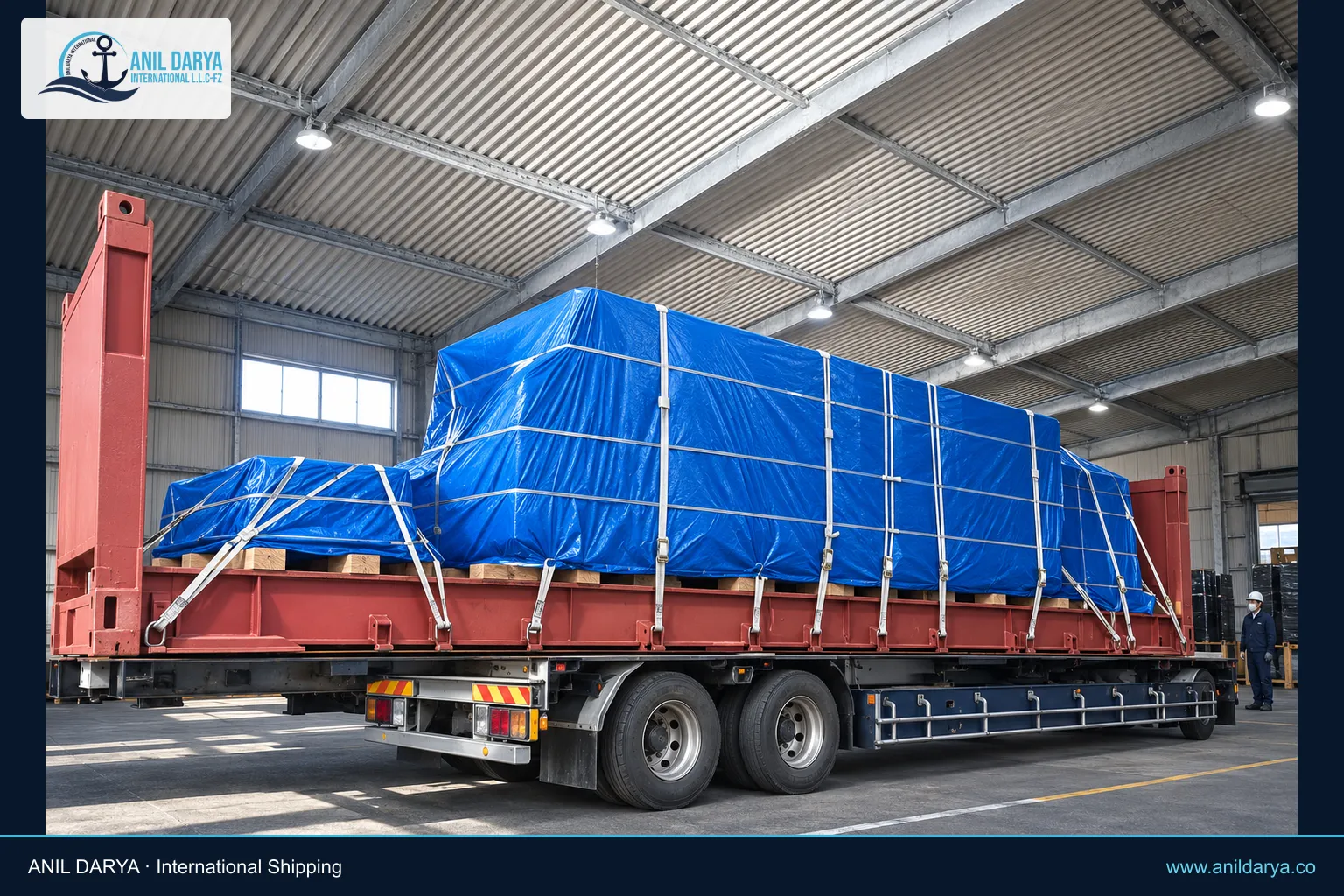
| Flat rack / breakbulk | Production lines, tanks, steel structures, generators | Dimensions, weight and lifting points per piece; an ACID is still required |
An Egyptian distributor buying from several Italian suppliers usually saves by consolidating into one FCL from Genoa or La Spezia, with one ACI filing. Our FCL vs LCL comparison shows where the break-even sits, and our sea freight service handles the booking.
Machinery and project cargo
Machinery is Italy's largest export to Egypt, and much of it does not fit a standard box. Packaging lines and presses often travel in parts on flat racks or as breakbulk. DFDS also takes abnormal loads at Trieste, including units wider than 2.6 m. Our break bulk team plans stowage and lifting first.
Dangerous goods: chemicals, paints and gases
Paints, resins, solvents and gas cylinders move under the IMDG Code 2024 edition, Amendment 42-24, mandatory since 1 January 2026. The Italian shipper provides the UN number, class, packing group, safety data sheet and DG declaration, and the line must accept the booking before stuffing. On the Trieste ferry, DFDS lists IMDG classes 2, 3, 4, 5.1, 6, 8 and 9, and does not carry classes 1 or 7 on its Mediterranean routes. Our dangerous goods team gets acceptance first.
What the Italian exporter files before the ship sails
Export formalities are the seller's job, usually through its customs agent.
- EORI. Any business lodging customs declarations in the EU needs an EORI number.
- Export declaration. EU rules require it to be lodged electronically in the Automated Export System at the customs office where the exporter is established. In Italy this runs through AIDA, the system of the Customs and Monopolies Agency (ADM). The office of exit, usually at the port, confirms the goods have left.
- Dual-use goods. Machine tools, valves, sensors and some chemicals can fall under EU Regulation 2021/821. In Italy the licensing authority is UAMA at the Ministry of Foreign Affairs.
The EU-Egypt Association Agreement: EUR.1 and the REVISED RULES wording
The European Commission says the EU-Egypt Association Agreement has been in force since 2004 and creates a free trade area by removing tariffs on industrial products. Cars were the last big item: the EU and Egypt recorded in November 2018 that Egypt would lift duties on EU-made cars from 1 January 2019. Farm, processed food and fish products follow a separate agreement in force since 1 June 2010, which gives concessions rather than full free trade.
The preference is not automatic. The goods must meet the origin rules of the Pan-Euro-Mediterranean (PEM) Convention, and the Egyptian broker must present valid proof of origin with the declaration. Without it, the buyer pays the normal Egyptian rate.
| Proof of origin | When it is used | Who issues it |
|---|---|---|
| EUR.1 movement certificate | Any consignment of EU-origin goods | Issued by the customs authority of the exporting country, in Italy ADM, on the exporter's application |
| Origin declaration on the invoice | Any value if the exporter is an approved exporter; otherwise only where the consignment is worth 6,000 euros or less | The Italian exporter |
| Ordinary certificate of origin | Proves non-preferential origin only; gives no Association Agreement rate | The Italian chamber of commerce |
The revised PEM rules have applied between the EU and Egypt since 11 March 2025. Egypt has not finished ratifying the revised Convention, so it applies them under temporary national measures. Spain's customs authority published the Commission's advice in April 2026: Egyptian customs require proofs of origin for EU exports to state that the revised rules apply, so exporters should write "REVISED RULES" on them. Certificates without the words have been rejected in Egypt, and a replacement can be issued retrospectively.
In practice: ask your Italian supplier to put "REVISED RULES" on the EUR.1 or the invoice declaration for every Egypt shipment, and have the broker confirm before the box sails. A proof of origin is valid for 10 months from issue. The agreement covers customs duty, not VAT.
Egypt import customs for Italian goods: ACI, ACID and Nafeza
The guide for shipping lines from Misr Technology Services sets the ACI request deadline at 48 hours before loading, gives Customs up to 48 hours to issue the ACID, and asks lines to file manifests at least 48 hours before berthing. On a 3-day Naples sailing or a 68-hour ferry, those windows overlap, so the ACID and correct documents must exist before the cargo reaches the terminal.
Every document carries three data elements: the 19-digit ACID, the buyer's 9-digit Egyptian tax number, and the exporter's identification (country code IT, ID type and number).
| Step | Who | What happens |
|---|---|---|
| 1 | Egyptian buyer or broker | Registers the shipment on Nafeza |
| 2 | Egyptian Customs | Issues the ACID within 48 hours and notifies the buyer and the Italian seller |
| 3 | Italian seller | Uploads invoice, packing list, proof of origin and B/L copy on CargoX under the ACID |
| 4 | Buyer | Approves the seller's data on Nafeza |
| 5 | Carrier | Checks the ACID and loads at Genoa, Naples, Trieste or another Italian port |
| 6 | Carrier | Files the manifest through Nafeza at least 48 hours before berthing |
| 7 | Buyer and broker | Present the EUR.1, pay duty and VAT, attend inspection if selected, take release |
Lines are told never to load Egypt cargo with an invalid ACID, and the US Commerce guide notes that shipments without one are re-exported at the shipper's cost. On CargoX only fully verified exporters can file, a sent filing cannot be recalled (a correction goes as a new filing under the same ACID), and fees are charged once per ACID plus a small amount per document.
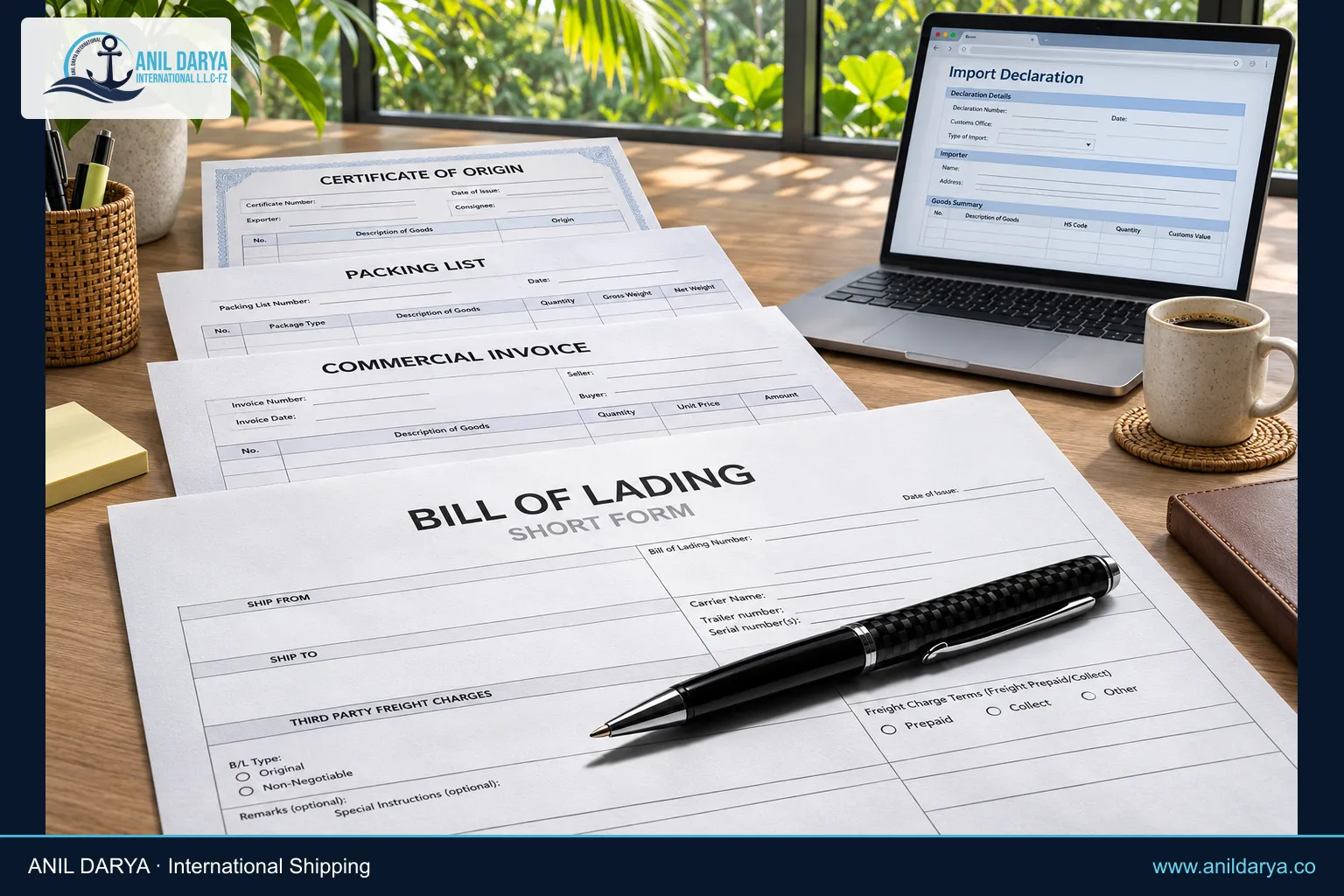
Documents Egypt expects for goods from Italy
| Document | Issued by | What Egypt checks |
|---|---|---|
| Commercial invoice | Italian seller | ACID, tax number, exporter ID, values, HS codes |
| EUR.1 or origin declaration | ADM endorses the EUR.1; the seller writes the declaration | EU origin and the "REVISED RULES" wording |
| Packing list | Italian seller | Same weights, packages and description as the invoice and Nafeza |
| Bill of lading | Shipping line, released through us | Shows the ACID; a copy goes into the ACI file |
| Health certificate | Italian veterinary or plant health authority | Dairy, meat, plants and other food |
| Safety data sheet | Manufacturer | Chemicals and DG |
| GOEIC registration proof | Factory or brand owner | Products on the Decree 43 list |
The US Commerce guide says the invoice and certificate of origin often need legalisation by the Egyptian consulate in the exporting country, so ask the broker early. On a 3 to 5 day crossing the ship can beat couriered originals; agree whether a surrendered B/L or sea waybill is acceptable.
Duty, VAT and GOEIC rules on Italian cargo
For goods outside the agreement, PwC reports Egyptian duty of 0% to 60% of CIF value, up to 135% on passenger cars, luxury goods and alcohol. Import VAT is 14% on CIF plus duty and other taxes; machinery for production lines pays 5%, and VAT on qualifying industrial machinery can be suspended under Law 3 of 2022.
| Italian cargo | Duty with valid proof of origin | VAT | Watch for |
|---|---|---|---|
| Production machinery | Industrial goods: duty-free under the agreement | 5% where it is for a production line | End-use proof, VAT suspension rules, dual-use check in Italy |
| Electrical equipment, household appliances | Industrial goods: duty-free | 14% | GOEIC registration for listed appliances |
| Chemicals, plastics, paper | Industrial goods: duty-free | 14% | SDS and DG papers; sector approvals |
| Furniture, textiles, cosmetics, tableware | Industrial goods: duty-free | 14% | All on the Decree 43 list |
| Cars | EU-made cars duty-free since 1 January 2019 | 14% plus other charges | Broker confirms the schedule tax and engine-size rules |
| Cheese, pasta, processed food | Only where the 2010 agriculture agreement grants a concession | As the broker confirms | Health certificates; Decree 43 for packaged foods |
Decree 43 of 2016 trips up many Italian exporters. Factories and brand owners selling listed goods to Egypt must register with GOEIC first; the list includes household appliances, furniture, textiles, clothing, footwear, tableware, cosmetics, toys, lighting and packaged foods. The buyer must also be on the GOEIC importers register, whose rules were replaced by Decree 271 of 2026 from 22 July 2026.
Restricted goods and approvals in Egypt
The official sources we opened give no single banned list, but extra papers apply to Decree 43 products, food and plant products (health certificates), medicines, medical devices, cosmetics and telecom equipment (regulator approval), and chemicals (SDS and IMDG papers). Send the broker the HS code and product sheet before production.
Typical cargo on this lane
Figures published by the Italian Foreign Ministry's infoMercatiEsteri portal, from ICE and ISTAT data, put Italian exports to Egypt at 2,798 million euros in 2024. Machinery and equipment led with 847 million, then refined oil products (532 million), chemicals (295 million), electrical equipment (195 million), metallurgy (154 million) and metal products (106 million). EU exports to Egypt reached 20 billion euros in 2025, 39% machinery and transport equipment, says the Commission.
When routing through Dubai makes sense
Dubai is off the direct route, so it helps only in a few cases:
- Mixed sourcing: Italian goods combined in Dubai with Gulf or Asian goods into one box for an Egyptian buyer.
- Free zone stock: Italian machinery or spares held in Dubai and called off in smaller lots for Egypt and other markets. Our article on JAFZA re-export explains how that works.
- UAE traders buying in Italy and selling to Egypt. See our Jebel Ali port guide.
The Dubai to Egypt leg needs its own ACID, and storing or splitting the cargo in Dubai may cost the EU preference unless the origin rules on non-alteration are met. Confirm with the Egyptian broker before you plan it. Where the cargo touches Dubai, customs clearance there is a service we provide for a fee through our Dubai freight forwarding team.
[AMIR-FACT: whether we route any Italian cargo for Egypt through Jebel Ali today (consolidation or JAFZA stock), on which carriers, how often, and the real extra days against a direct Genoa or Naples sailing]
What drives the cost of shipping from Italy to Egypt?
We price each sailing on the day, so there are no fixed rates here. Who usually pays on FOB terms:
| Cost part | What moves it | Usually paid by (FOB) |
|---|---|---|
| Origin charges in Italy | Trucking or rail to the port, stuffing, export declaration, terminal handling | Seller |
| Origin documents | EUR.1 issue, chamber or consular stamps, CargoX fees | Seller, unless agreed otherwise |
| Ocean or ferry freight | Container or trailer type, load port, season, surcharges | Buyer |
| Special cargo | Reefer, DG, flat rack, breakbulk or abnormal-load premiums | Buyer |
| Egyptian port charges | Terminal handling, delivery order, LCL unpacking, storage | Buyer |
| Duty and taxes | Valid proof of origin, HS code, CIF value, 14% or 5% VAT | Consignee or its broker |
| Delay charges | Missing ACID, rejected EUR.1, GOEIC registration, inspection | Whoever caused the delay, by contract |
The costliest avoidable mistake here is a proof of origin without "REVISED RULES": the box waits in storage for a replacement, or the buyer pays full duty. Our article on demurrage and detention shows how quickly those daily charges add up.
How to arrange shipping from Italy to Egypt, step by step
- Agree the Incoterm with the Italian seller and put it on the contract and invoice.
- Send us the product, HS code, weight, volume, factory location, ready date, any special handling and the Egyptian port.
- Name the Egyptian broker. We check with the broker that the buyer is on the importers register, the products are clear for GOEIC, and the broker works at the chosen port. Only then do we confirm the booking.
- Get the ACID. The buyer applies on Nafeza at least 48 hours before loading and shares the number with the seller and with us.
- Book the space. We compare Genoa, Vado, Naples and Trieste options and get DG, reefer or out-of-gauge acceptance first.
- Prepare the documents in Italy. The seller puts the ACID, tax number and its own ID on every document and gets the EUR.1 or origin declaration marked "REVISED RULES".
- Lodge the export declaration through AIDA and the ACI documents on CargoX, then deliver the box or trailer before the cut-off.
- Release the bill of lading. We check the draft against the invoice and ACID and release the carrier's B/L, or arrange a surrendered B/L if both sides agree, once freight is paid.
- Clearance in Egypt. The consignee's broker presents the proof of origin, pays duty and VAT, attends inspection if selected and takes delivery.
[AMIR-FACT: one real Italy to Egypt cross-trade shipment we handled (cargo, Italian load port, Egyptian port, carrier, how the ACID, EUR.1 and broker were lined up, door-to-door days), cleared for publication]
Checklist before the cargo leaves Italy
- Incoterm agreed and written on the contract and invoice.
- Egyptian buyer on the importers register and holding a valid ACID for this shipment.
- Consignee's broker named, agreed and working at the discharge port.
- Products checked against the Decree 43 list, with GOEIC registration where needed.
- Seller verified on CargoX; ACID, tax number and exporter ID on every document.
- EUR.1 or origin declaration carrying "REVISED RULES".
- EORI in place and the export declaration lodged; dual-use licence obtained if required.
- Reefer cargo: set point and health certificate. DG: SDS, DG declaration and carrier acceptance.
Common mistakes on this lane
- Shipping before destination clearance is agreed. A container that reaches Alexandria with no broker lined up sits on the quay and builds storage.
- Sending cargo to the terminal before the ACID exists. The line will not load it.
- An EUR.1 without "REVISED RULES". Egypt has rejected these, and the buyer can lose the duty-free rate on goods that should pay nothing.
- Unregistered factory. Appliances, furniture, cosmetics or packaged food on the Decree 43 list cannot be released without GOEIC registration.
- Originals arriving after the ship on a 3 to 5 day crossing.
- Paints or gas cylinders booked as general cargo instead of DG.
Frequently asked questions
How long does shipping from Italy to Egypt take by sea?
Messina Line publishes 3 days from Naples to Alexandria and 5 days from Genoa to Alexandria. DFDS gives about 68 hours from Trieste to Damietta by Ro-Ro. Add time for export filing in Italy and clearance in Egypt.
Which Italian port is best for cargo to Egypt?
It depends on the factory and the sailing. Genoa, Vado and La Spezia suit the north-west, Naples and Salerno the south, and Trieste suits trailers and reefer cargo from the north-east on the ferry to Damietta.
Do Italian goods pay customs duty in Egypt?
Industrial goods of EU origin are duty-free under the EU-Egypt Association Agreement when they travel with a valid EUR.1 or origin declaration. Food and farm products only get the concessions in the 2010 agriculture agreement. VAT of 14% still applies.
Why must the EUR.1 say "REVISED RULES" for Egypt?
Egypt applies the revised PEM origin rules under temporary national measures and requires EU proofs of origin to state it. Certificates without the words have been rejected; a replacement can be issued afterwards, but the cargo waits.
Who requests the ACID for a shipment from Italy?
The Egyptian buyer or its broker, on Nafeza, at least 48 hours before loading. The Italian seller then uploads its documents on CargoX under that number.
Is there a Ro-Ro or ferry service from Italy to Egypt?
Yes. DFDS runs a freight Ro-Ro between Trieste and Damietta, twice a week since 15 October 2026. It takes trailers, ISO and reefer containers, machinery and some DG classes.
Does Anil Darya clear the cargo in Egypt?
No. We book the freight, coordinate the Italian seller and release the carrier's bill of lading. The consignee's licensed broker clears the goods, and we agree that before confirming the booking.
Get a quote for shipping from Italy to Egypt
Send us the factory location, the cargo and HS code, the ready date, the Egyptian port and the name of the buyer's broker, and we will come back with sailing options and a price. Use our freight rate inquiry form, or contact our team to talk through a machinery, DG or reefer shipment first.
Sources
- Messina Line: Jolly Line and ESA Line service table
- Maersk: SLA service connecting North Europe, Italy and Egypt (June 2026)
- DFDS: New freight ferry service between Italy and Egypt
- DFDS: Second freight ferry on the Egypt-Italy route
- DFDS: Damietta-Trieste route, cargo types and cut-off
- European Commission: EU trade relations with Egypt
- EEAS: 6th meeting of the Egypt-EU Association Committee (cars from 1 January 2019)
- European Commission: PEM cumulation and the PEM Convention
- Access2Markets: Pan-Euro-Mediterranean Convention, proofs of origin
- Spanish Tax Agency customs: PEM revised rules and Egypt (April 2026)
- Genoa Chamber of Commerce: PEM origin update
- European Commission: What is exportation (AES)
- ADM: AIDA customs information system
- Assolombarda: UAMA dual-use licences
- Ports of Genoa: traffic Q2 2026
- AdSP Mar Ligure Orientale: La Spezia 2025 traffic
- AdSP Mar Tirreno Centrale: Naples 2025 traffic
- AdSP Mar Tirreno Centrale: Salerno 2025 traffic
- Port of Trieste: technical information
- Alexandria Port Authority: Alexandria port details
- Alexandria Port Authority: Dekheila port details
- Misr Technology Services via SCZONE: ACI guide for shipping lines
- CargoX: Advance Cargo Information Egypt
- US International Trade Administration: Egypt import requirements
- PwC Worldwide Tax Summaries: Egypt, other taxes
- AHK Egypt: GOEIC registration (Decree 43 of 2016)
- Baker McKenzie: Egypt importers register, Decree 271 of 2026
- infoMercatiEsteri (Italian Foreign Ministry): Italy-Egypt trade
- IMO: IMDG Code 2024 edition
Reviewed: 11 November 2026