
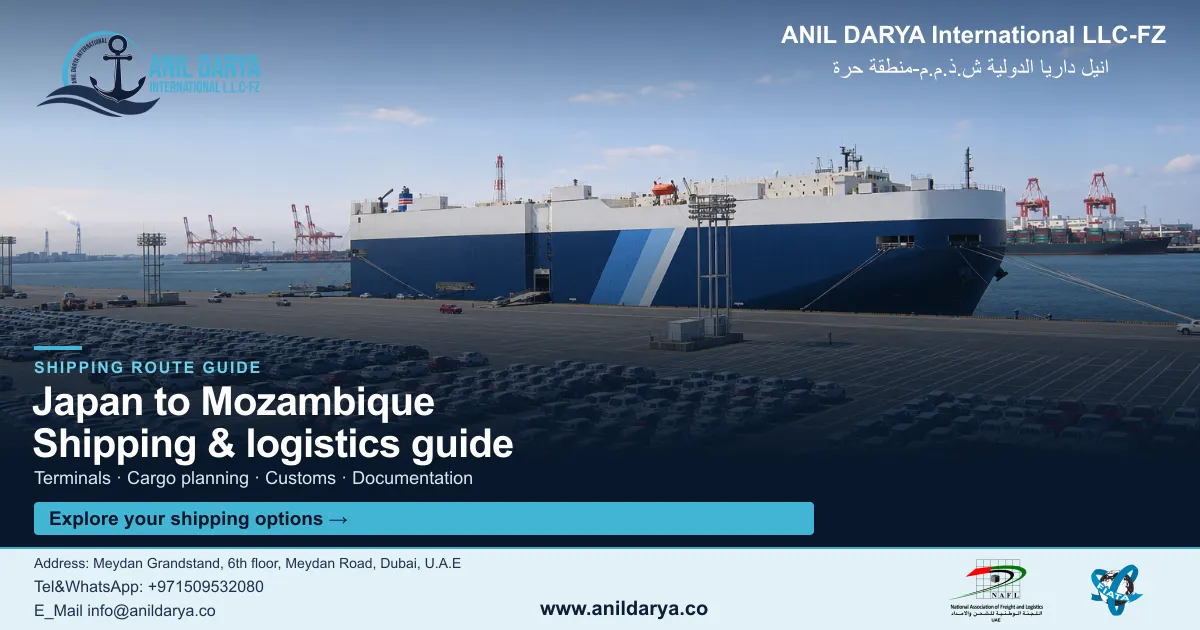
Shipping from Japan to Mozambique is mostly a vehicle trade: about 70% of what Mozambique bought from Japan in 2025 was cars, trucks and buses, and most of them land at Maputo. Vehicles go either on a Ro-Ro car carrier or inside a container, and other Japanese cargo (parts, electrical goods, fibres, steel) moves in containers changed at a hub. In Japan the seller deregisters each vehicle and files the export declaration. In Mozambique, Intertek checks regulated and used goods before shipment and a licensed broker clears them through the JUE single window. We book the ocean freight from Dubai and keep the seller, the line and the broker working to one plan.
Shipping from Japan to Mozambique at a glance
| Item | What applies on this lane |
|---|---|
| Main cargo | Used vehicles (USD 144.59 million of USD 207.46 million in 2025), then electrical goods, man-made staple fibres, iron and steel |
| Japanese load ports | Containers: Yokohama, Nagoya, Kobe, Osaka, Tokyo. Car carriers: Yokohama, Nagoya and other vehicle berths named by the line |
| Mozambican ports | Maputo (south, car terminal and container terminal), Beira (centre, transit corridor), Nacala (north, deep bay) |
| Ways to ship a vehicle | Ro-Ro car carrier, or inside a 20ft or 40ft container (alone or shared) |
| Typical container routing | Transhipment at a hub; ONE runs a Port Louis loop to Maputo, Beira and Nacala for Far East cargo |
| Japan export filing | Export declaration (form C-5010, filed online through NACCS) by the exporter or its customs broker |
| Used vehicle papers in Japan | Certificate of Registration Deletion, or Certificate of Notice of Planned Export, valid six months |
| Checks for Mozambique | CAP certificate of conformity by Intertek (used products always in scope) and Intertek used-vehicle pre-shipment inspection |
| Destination customs | Licensed broker mandatory, declaration through the JUE and SIGA customs system |
| Duty and tax | Duty 0% to 25% (consumer goods generally 20%), IVA 16% on imports |
| Trade agreement | None between Japan and Mozambique, so the standard tariff applies |
| Bill of lading | The shipping line's own B/L, released to you through us as agent for the line |
How shipping from Japan to Mozambique works as a cross-trade
A cross-trade booking has three parties in three countries. The seller in Japan loads the vehicle or container, the buyer's licensed broker clears it in Mozambique, and we sit in Dubai between them, booking the space and checking the papers before anything sails.
| Task | Who does it |
|---|---|
| Buying the vehicle, deregistering it in Japan, delivering it to the port | Seller in Japan |
| Japanese export declaration through NACCS | Seller or its Japanese customs broker |
| Booking Ro-Ro or container space, cut-off dates, B/L instructions | Anil Darya, from Dubai |
| Intertek inspection and CAP certificate before loading | Seller applies; buyer supplies the Mozambican UCR number |
| Import declaration, duty and IVA in Mozambique | Consignee's licensed customs broker; duty and taxes are paid by the consignee or its broker |
| Clearance in Dubai, only when cargo is consolidated or re-exported there | Anil Darya, for a fee |
The B/L on these bookings is the carrier's own document. We act as agent for many shipping lines, so the carrier issues it and it is released to you through us once freight is settled. We do not issue a house bill of lading on this lane. For used cars this matters: the chassis number, engine number, model and year on the B/L must match the deregistration certificate and the invoice letter for letter, because the Mozambican broker builds the declaration from those three papers.
Clearance in Mozambique is not a service we sell there. Before we confirm a booking, the buyer names a licensed broker at the discharge port and that broker confirms the tariff code, the CAP status and the documents they want.
Ro-Ro or container for vehicles?
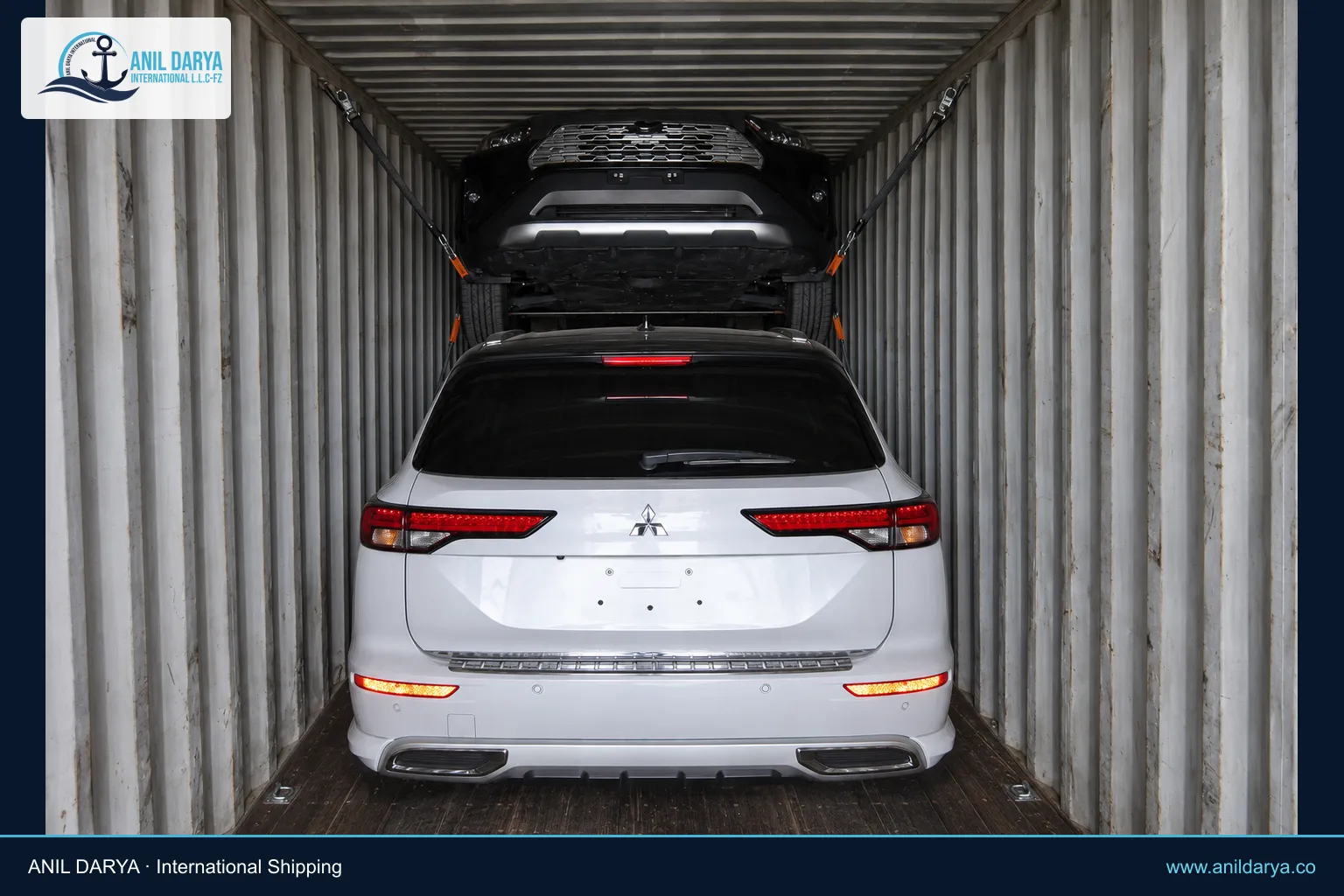
Most Japanese cars for Mozambique travel one of two ways. Ro-Ro means the car is driven onto a car carrier in Japan and driven off at Maputo. Containers mean the car is lashed inside a box, sometimes with three or four small cars or a car plus spare parts in a 40ft unit.
| Point | Ro-Ro car carrier | Container |
|---|---|---|
| Best for | Single cars, buses, trucks, tractors, wheeled machinery | Several small cars in one box, cars with parts, high-value vehicles |
| Port at destination | Mainly Maputo, at the Grindrod car terminal | Maputo, Beira or Nacala, wherever the container line calls |
| Running condition | Vehicle normally has to drive on and off; non-runners need the line's approval | Non-runners can be loaded by the seller's packing yard |
| Loose items inside | Usually restricted by the line | Spare parts and tyres can travel declared on the packing list |
| Sailings | Fewer fixed sailings, often monthly on a given trade | Weekly or fortnightly feeder links from hubs |
| Inspection at origin | Intertek inspects each vehicle before it is shipped | Same, plus witnessed loading and sealing for FCL under the CAP |
Höegh Autoliners runs an East Asia to Africa trade. Its trade-route page lists Yokohama, Hitachinaka, Sakaisenboku and Shimonoseki among the load ports, and it says the trade has four discharge ports but does not name them. Ask whether Maputo is on the rotation for the month you need before you promise a date to the buyer. Höegh's 2023 annual report describes the trade as monthly, carrying cargo from Japan, China and Singapore to South and East Africa.
[AMIR-FACT: the Ro-Ro and container carriers we actually book from Japan to Maputo, Beira and Nacala, the hub used for containers, and the real port-to-port and door-to-door days we see]
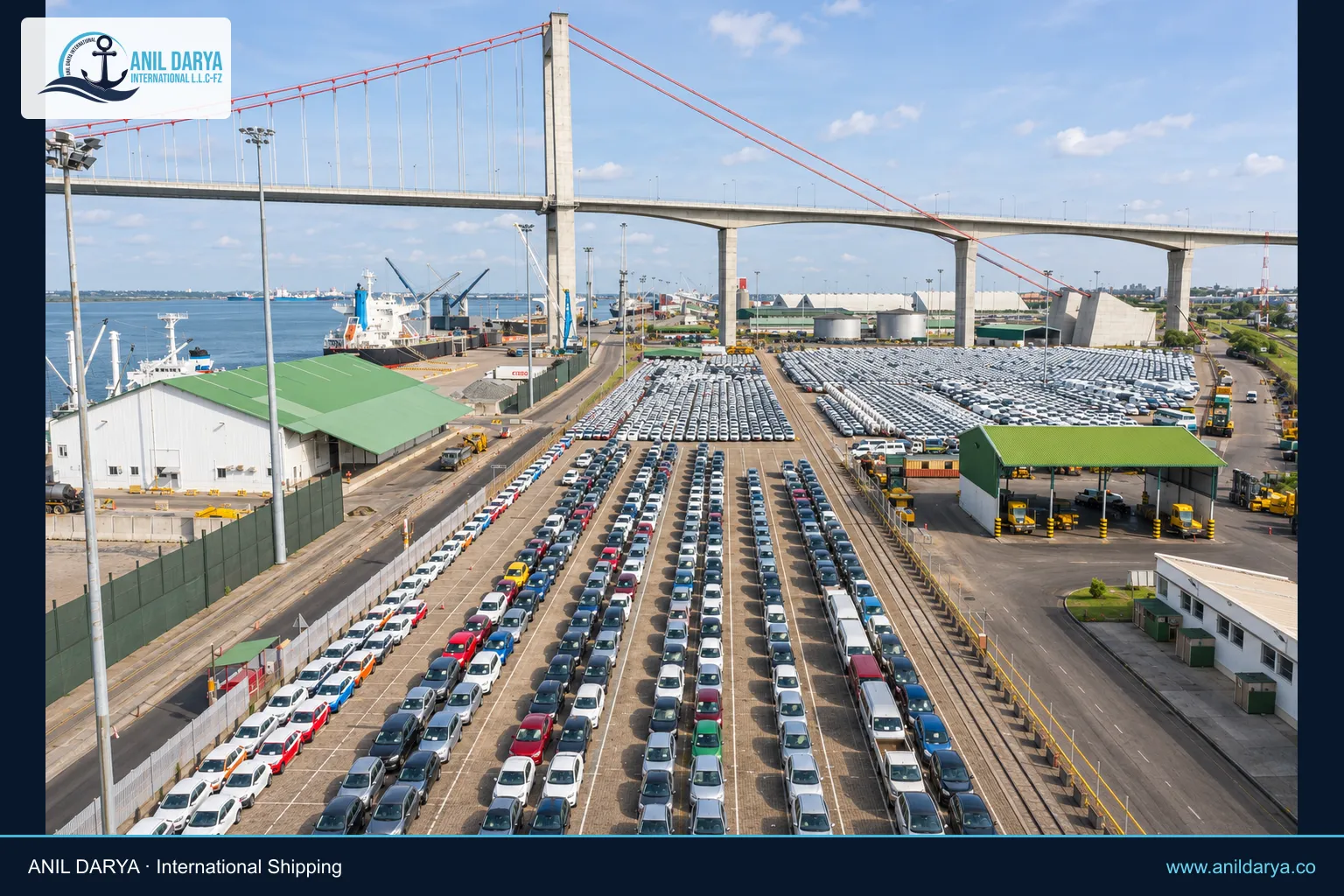
Maputo is the vehicle port. The Grindrod car terminal there works berth 5 (230 m) around the clock, with 4,158 parking bays, 28 inspection bays and 25 rail wagon sidings, and the port lists capacity of 115,000 cars a year. The terminal handles imports, exports and vehicle transhipment for other African ports.
Which Japanese port and which Mozambican port?
Load ports in Japan
DP World names Yokohama, Nagoya, Osaka and Kobe as Japan's principal outbound container ports and points to Nagoya for automotive and industrial exports. The load port for a used car often depends on the auction where it was bought.
| Japanese port | Region it draws from | Use on this lane |
|---|---|---|
| Yokohama | Tokyo and Kanto auctions | Containers and car carriers |
| Tokyo | Greater Tokyo | Containers |
| Nagoya | Chubu, the automotive belt | Containers, car carriers, new vehicles and parts |
| Kobe and Osaka | Kansai | Containers; car carrier calls nearby |
| Hakata and Shimonoseki | Kyushu and western Honshu | Containers; Shimonoseki is a Höegh load port |
Choosing between Maputo, Beira and Nacala
Choose the port by where the vehicle will be used, not by the cheapest ocean figure.
| Port | Best for | Notes from the operators |
|---|---|---|
| Maputo | Maputo city, Matola, the south, and cars bound for South Africa's interior | Car terminal (115,000 cars a year); DP World container terminal with 450 reefer points and an expansion from 255,000 to 530,000 TEU; MPDC reported 32.0 million tonnes in 2025 |
| Beira | Sofala, Manica, and transit cargo for Zimbabwe, Malawi and Zambia | Container terminal run by Cornelder de Moçambique; tide-bound approach, so ask for the berthing window |
| Nacala | Nampula, Cabo Delgado, Niassa and the Nacala rail corridor to Malawi | Natural deep-water port with no draft restriction, according to CFM |
Container services and hubs on this lane
We did not find a published container loop that sails straight from a Japanese port to a Mozambican one. Containers usually change ship at a hub. The hubs named below come from carrier notices we opened, not from aggregator tools.
| Service | Rotation | What it means for Japanese cargo |
|---|---|---|
| ONE MCL (from 18 September 2026) | Port Louis, Maputo, Beira, Nacala, Port Louis; every two weeks | ONE says it links Far East Asia with Mozambique through Port Louis; Japanese boxes would relay there from an Asian mainline |
| Evergreen MJI (DP World, 23 March 2026) | Maputo, Jebel Ali, Mundra, Nhava Sheva, Mombasa, Dar es Salaam, Beira, Maputo | A Jebel Ali relay: Japanese cargo reaching Jebel Ali on a Japan to Gulf service could connect here to Maputo or Beira |
No carrier page we opened publishes Japan to Mozambique transit days, so we do not print one. Aggregator figures are model estimates, not a line's schedule.
Routing through Dubai: when it helps
Dubai can earn its place on this lane in three cases. First, a container that relays at Jebel Ali onto a Mozambique loop such as MJI. Second, a buyer who collects Japanese parts and Gulf-sourced goods into one Dubai consolidation for Maputo. Third, a trader who holds stock of Japanese tyres, parts or machinery in Jafza and sells it to several African markets. See our Jebel Ali port guide and the Jafza re-export guide for how stock and documents move inside the free zone.
A relay at Jebel Ali and a Dubai consolidation are not the same thing. Dubai Customs lists transit as its own declaration type, separate from import. Customs clearance in Dubai is a service we provide, for a fee, when your cargo is unpacked, stored or re-exported there. Japanese goods stay Japanese in origin when they pass through Dubai. No trade agreement links Japan and Mozambique, so there is no preference to lose, but keep the Japanese invoices and origin papers with the file in case the broker asks for them.
[AMIR-FACT: whether we have routed Japanese cargo for Mozambique through Jebel Ali (relay or Dubai consolidation), with which carriers on each leg, and when it beat a Port Louis or Asian hub]
Sea freight from Japan to Mozambique: FCL, LCL and special cargo
Full containers and shared boxes
FCL makes sense for several cars, a car plus parts, or a full load of tyres or electrical goods. LCL suits a few pallets of parts or a single machine. Our FCL vs LCL guide sets out the break-even. Under the CAP, Intertek must witness the loading and sealing of every FCL shipment of regulated goods, so a Japanese packing yard cannot close the doors before the inspector has seen the cargo.
Trucks, buses, tractors and machinery
Heavy wheeled units suit a car carrier. Tracked excavators, cranes and anything that cannot drive on board go on a flat rack or as breakbulk on a car carrier that accepts high and heavy cargo. Read the flat rack and out-of-gauge guide and see our breakbulk service. Earthmoving machines fall in CAP Group III, so they need the Intertek certificate too.
Dangerous goods and vehicles in containers
Batteries, paints, aerosols, airbag modules and fuel left in a vehicle can all make a box dangerous goods. The IMDG Code 2024 edition (Amendment 42-24) is mandatory from 1 January 2026. Ask the line for its rules on fuel level and batteries before a car is lashed inside a container. At Maputo, IMO goods must be declared to the port with the safety data sheet and the IMO dangerous goods declaration. Our dangerous goods team checks class and packing before booking.
The Japan export side: who files and what a used car needs
Japan Customs requires the exporter, or a customs broker acting for it, to declare the nature, quantity and value of the goods. The goods must first be brought into a customs (Hozei) area or a specially permitted place. The declaration is form C-5010 with the invoice, and in practice it is lodged online through NACCS, the system that handles customs procedures for sea and air cargo in Japan. Customs will not release goods that need a permit under another law, for example a METI permit, until that permit is shown (Customs Law, Article 70).
Used vehicles need one more paper. Japan Customs' guidance on exporting used vehicles says a registered car must be deregistered in advance at a Ministry of Land, Infrastructure and Transport (MLIT) transport office, which issues a Certificate of Registration Deletion. A car already deregistered needs a Certificate of Notice of Planned Export. One of the two is shown to Customs when the export inspection is confirmed, and both are valid for six months from issue. The rule comes from the 2002 amendment to the Road Vehicle Law and applies to export declarations made from 1 July 2005.
| Japanese document | Issued by | Why the Mozambican side cares |
|---|---|---|
| Certificate of Registration Deletion (or Notice of Planned Export) | MLIT transport office | Ties the chassis number to the car; the broker checks it against the B/L and invoice |
| Export permit | Japan Customs | Shows the car left Japan legally; the B/L is issued against it |
| Commercial invoice | Seller | Basis for the customs value in Mozambique |
| Intertek inspection report or certificate | Intertek, before shipment | Needed for clearance in Mozambique |
Intertek checks before the vehicle sails
Two Intertek checks touch Japanese vehicles. Both happen in Japan before shipment.
The CAP certificate of conformity
The Conformity Assessment Programme is run by INNOQ, the national standards institute, with Intertek International Limited as the only certification body. Intertek's summary datasheet (issued 12 September 2024) says the CAP is fully in force under Decree 8/2022 and Ministerial Diplomas 98/2023, 23/2024 and 29/2024. Of its 19 product groups, two matter most here: Group III (automotive, earthmoving machines and related products) and Group XXII (used products).
| CAP rule | Effect on Japanese cargo |
|---|---|
| Shipments under USD 2,000 FOB are exempt, except used products | A cheap used car or a small lot of used parts still needs a certificate |
| Used product shipments can only use Routes A and D | Route A: physical inspection of every shipment in Japan. Route D: inspection at destination |
| Route A fee 0.50% of value (USD 250 to 2,750) | Paid by the party that asks for the certificate; testing extra |
| Route D fee 0.80% (USD 500 to 5,000) | The fallback when no certificate was issued before loading, with delays in clearance |
| Documents: request for certification, Mozambican UCR number, invoices, packing list, tariff codes, specifications | The buyer must get the UCR and tariff codes from its broker early |
In a communiqué dated 2 September 2024, INNOQ told importers that all products with mandatory control must be assessed by Intertek in the country of origin before shipment, and that the certificate must be shown to customs on entry. It also recommended that importers of used vehicles submit them to conformity assessment, unless they are covered by article 4 of Ministerial Diploma 98/2023. Missing certificates can lead to fines.
The used-vehicle pre-shipment inspection
Intertek's Mozambique PSI page says that, under Ministerial Diploma 244/2011, all used vehicles imported into Mozambique need a physical pre-shipment inspection at origin, with Intertek as the sole provider. The exporter pays USD 265 plus local tax per vehicle. A vehicle that arrives without it will not clear until it is inspected at destination, and the importer then pays the full inspection cost plus a fine equal to 10% of the CIF value Intertek sets for customs. The page carries no date; we read it on 11 November 2026.
[AMIR-FACT: confirm with a Maputo broker how the Diploma 244/2011 vehicle PSI and the CAP certificate work together for a used car in 2026 (one Intertek visit or two, which document customs asks for)]
We found no age limit for used vehicles on the official Mozambican and Intertek pages we opened, and no rule against right-hand drive. Mozambique drives on the left, like Japan. Ask the broker to confirm age, steering and vehicle taxes for your model before you pay the seller.
[AMIR-FACT: confirm with a Mozambican broker that no age limit or steering restriction applies to used cars from Japan in 2026, and which vehicle taxes apply beyond duty and IVA]
Mozambique import customs, duty and IVA
The broker and the JUE
Mozambique's Foreign Trade Portal states plainly that using a customs broker is mandatory. Declarations go through the Janela Única Electrónica (JUE), the trade single window run under the Directorate-General of Customs. It connects importers, shipping agents and terminal operators to SIGA, the customs management system, and offers a tariff code search and an import simulator that estimates duty. Importers also need a licence from the National Directorate of Trade.
Documents for a Japanese shipment
| Document | Who provides it | Notes |
|---|---|---|
| Carrier's bill of lading | Line, released through us | Chassis and engine numbers, model, year and engine size for each vehicle |
| Commercial invoice and packing list | Seller in Japan | Values must match the CAP file |
| Deregistration certificate | Seller in Japan | Keep the original; the broker confirms what registration needs |
| CAP certificate and PSI report | Intertek | Shown to customs on entry |
| Importer licence and tax number | Buyer | Broker confirms the format |
| Special permit | Buyer, where needed | Pharmaceuticals, firearms, munitions and explosives need one |
Duty and IVA on Japanese goods
The US Commerce Department's guide (last published 8 April 2026) gives import duty of 0% to 25%, with consumer goods generally at 20%, and 16% value-added tax on imports. It notes that other import taxes fall mainly on sugar and certain luxury items. Vehicle duty depends on the exact tariff line, so the broker should run the HS code through the JUE simulator before you agree a price. Japan has no economic partnership agreement with any African country, so Japanese goods pay the standard Mozambican rate. Duty and taxes at destination are paid by the consignee or its broker.
Vehicles in transit to neighbouring countries
Many Japanese cars landed at Beira or Nacala go on to Zimbabwe, Malawi or Zambia. Transit is governed by Ministerial Diploma 116/2013 of 8 August. Most transit goods need a guarantee that is returned when they leave Mozambique, and they must follow the declared route.
Typical cargo on this lane
UN Comtrade figures reported by Trading Economics put Mozambique's 2025 imports from Japan at USD 207.46 million.
| Product group (2025) | Value (USD million) | How it usually ships |
|---|---|---|
| Vehicles other than railway | 144.59 | Ro-Ro or containers, mainly to Maputo |
| Electrical and electronic equipment | 18.80 | FCL or LCL |
| Man-made staple fibres | 16.03 | FCL |
| Iron and steel | 8.68 | FCL, flat rack or breakbulk |
| Miscellaneous chemical products | 5.21 | FCL; check whether the goods are DG |
Restricted and controlled goods
Pharmaceuticals, firearms, munitions and explosives need special permits in Mozambique, and live animals need veterinary certificates. Regulated goods in any of the 19 CAP groups need the Intertek certificate before loading. On the Japanese side, goods covered by another law (strategic items under METI, narcotics and similar) need that permit before Customs will release them. Used engines, gearboxes and other used parts count as used products under the CAP, however small the invoice.
Shipping from Japan to Mozambique step by step
- Send us the cargo: vehicle make, model, year, chassis number and dimensions, or the packing list for general cargo, plus the Japanese pickup point and the Mozambican destination.
- The buyer appoints a licensed broker at Maputo, Beira or Nacala, who confirms the tariff code, the CAP route and the UCR number.
- We compare Ro-Ro and container options, the hubs and the cut-off dates, and confirm the booking only once the broker has agreed to clear.
- The seller deregisters each vehicle and keeps the certificate within its six-month validity.
- The seller books the Intertek inspection in Japan and supplies the CAP documents.
- For containers, Intertek witnesses loading and sealing; for Ro-Ro, the car is delivered to the vehicle berth by the line's cut-off.
- The seller or its customs broker files the export declaration through NACCS and gets the export permit.
- The line issues its B/L; we check every chassis number against the certificate and invoice before release.
- We track the sailing and any relay at the hub, and send the arrival notice to the broker.
- The broker lodges the declaration in the JUE, the consignee pays duty and IVA, and the vehicle leaves the terminal.
What affects the cost of shipping from Japan to Mozambique?
We do not publish rates because they change with every sailing. These are the items that move the total.
| Cost driver | Why it changes the price |
|---|---|
| Ro-Ro or container | Ro-Ro is priced by vehicle size; a container is shared across the cars inside |
| Vehicle size and weight | Car carriers charge by volume, so a minibus costs far more than a hatchback |
| Hub and number of relays | Each change of ship adds handling and time |
| Discharge port | Maputo, Beira and Nacala have different terminal charges and inland costs |
| Intertek fees | Per-vehicle PSI and CAP percentage; Route D is dearer |
| Duty and IVA | Set by the tariff line and the customs value of each vehicle |
| Storage, demurrage and detention | Builds up when papers or the broker are not ready; see demurrage and detention explained |
| Incoterm | FOB, CFR or CIF decides who pays which leg; see Incoterms 2020 for sea freight |
Checklist before the car leaves Japan
- Licensed broker at the discharge port confirmed in writing.
- UCR number and tariff codes sent to the seller for the Intertek application.
- Deregistration certificate issued and inside its six-month validity.
- Intertek inspection booked, and the PSI report or CAP certificate issued before loading.
- Chassis number, engine number, model and year identical on invoice, certificate and B/L draft.
- Ro-Ro rotation confirmed to call at Maputo, or container hub and feeder confirmed.
- Battery, fuel and loose-item rules agreed with the line.
- Incoterm and who pays freight, insurance and destination charges agreed.
Common mistakes to avoid
- Shipping before destination clearance is agreed. Without a broker who has checked the papers, a car can wait weeks in the terminal.
- Skipping the inspection in Japan to save the fee. Inspection at destination costs more and the PSI fine is 10% of CIF value.
- Assuming a cheap car is exempt from the CAP. The USD 2,000 threshold does not apply to used products.
- Letting the deregistration certificate expire while waiting for a Ro-Ro sailing.
- One wrong digit in a chassis number. Customs and Intertek treat it as a different vehicle.
Frequently asked questions
How long does shipping from Japan to Mozambique take?
It depends on whether the cargo goes on a Ro-Ro sailing or a container with a relay at a hub, and on how long it waits for the connection. No carrier page we opened publishes a Japan to Mozambique transit time, so ask us for the line's dates on your sailing rather than relying on a general range.
Is Ro-Ro or a container better for a used car?
Ro-Ro suits single cars and large wheeled units that drive on and off, mainly to Maputo. A container suits several small cars, a car with spare parts, or a destination such as Beira or Nacala that the car carrier does not call. Intertek must witness FCL loading and sealing under the CAP.
Does a used car from Japan need an inspection for Mozambique?
Yes. Intertek's PSI page says all used vehicles need a pre-shipment inspection at origin under Ministerial Diploma 244/2011, and INNOQ recommends conformity assessment for used vehicles. Arriving without it means inspection at Maputo and a fine of 10% of the CIF value.
Is there an age limit on cars imported into Mozambique?
The official Mozambican and Intertek pages we opened state no age limit and no ban on right-hand drive, and Mozambique drives on the left. Vehicle rules can change by decree, so have your broker confirm before you buy.
What paperwork does the Japanese seller need for the export?
The seller needs a Certificate of Registration Deletion, or a Certificate of Notice of Planned Export for a car already deregistered, valid for six months. It also needs the commercial invoice and an export declaration filed through NACCS. Japan Customs checks the certificate at the export inspection.
What duty and IVA apply in Mozambique?
Import duty ranges from 0% to 25%, consumer goods are generally at 20%, and IVA on imports is 16%. Japan has no trade agreement with Mozambique, so the standard rate applies. The broker can check the exact figure for your vehicle in the JUE import simulator.
Who clears the vehicle at Maputo, Beira or Nacala?
A licensed Mozambican customs broker appointed by the buyer, because using a broker is mandatory. We do not sell clearance in Mozambique, but we make sure the broker is agreed before we confirm the booking. Duty and taxes are paid by the consignee or its broker.
Can Japanese cargo for Mozambique go through Dubai?
Yes, where it helps. A container can relay at Jebel Ali onto a loop that calls Maputo and Beira, or parts can be consolidated or held in Jafza and re-exported. When cargo is cleared, stored or re-exported in Dubai, we handle the Dubai customs side for a fee.
Get a quote for shipping from Japan to Mozambique
Send the vehicle list or packing list, the Japanese pickup point and the Mozambican port through our freight rate inquiry form, or contact our team to talk it through. Our Dubai freight forwarding team will check the Ro-Ro and container options, the hub and the Intertek timing before we confirm space.
[AMIR-FACT: one real Japan to Mozambique cross-trade shipment we coordinated from Dubai (vehicles or cargo, Japanese port, Mozambican port, carrier and hub, inspection and broker timing, result), with client approval, or confirm we have none yet]
Sources
- Japan Customs: export procedures (form C-5010, Article 70)
- Japan Customs: customs procedures for exporting used vehicles (Customs Answer 5502)
- NACCS Inc.: about NACCS
- Japan Customs: economic partnership agreements in force
- DP World: shipping routes from Japan
- Höegh Autoliners: East Asia to Africa trade route
- Höegh Autoliners: Annual report 2023, business areas
- ONE: Southern Africa, new launch of MCL service (6 August 2026)
- DP World: Maputo welcomes Evergreen Line MJI service (23 March 2026)
- Port of Maputo: car terminal
- Port of Maputo (MPDC): record volumes in 2025
- Port of Maputo: port operating guidelines
- DP World: Maputo container terminal
- DP World: Maputo container terminal expansion
- CFM: Port of Beira
- Cornelder de Moçambique: Port of Beira presentation, 2025
- CFM: Port of Nacala
- Intertek: Mozambique CAP summary datasheet (issued 12 September 2024)
- INNOQ communiqué on the CAP and used vehicles (2 September 2024)
- Intertek: Mozambique CAP for exporters
- Intertek: Mozambique pre-shipment inspection of used vehicles (Ministerial Diploma 244/2011)
- Mozambique Foreign Trade Portal: commerce guides (broker, transit)
- Janela Única Electrónica (JUE) portal
- US International Trade Administration: Mozambique import tariffs (8 April 2026)
- US International Trade Administration: Mozambique import requirements (8 April 2026)
- Trading Economics (UN Comtrade): Mozambique imports from Japan
- IMO: IMDG Code 2024 edition
- Dubai Customs: declaration types
- Jafza: about the free zone
Reviewed: 11 November 2026