
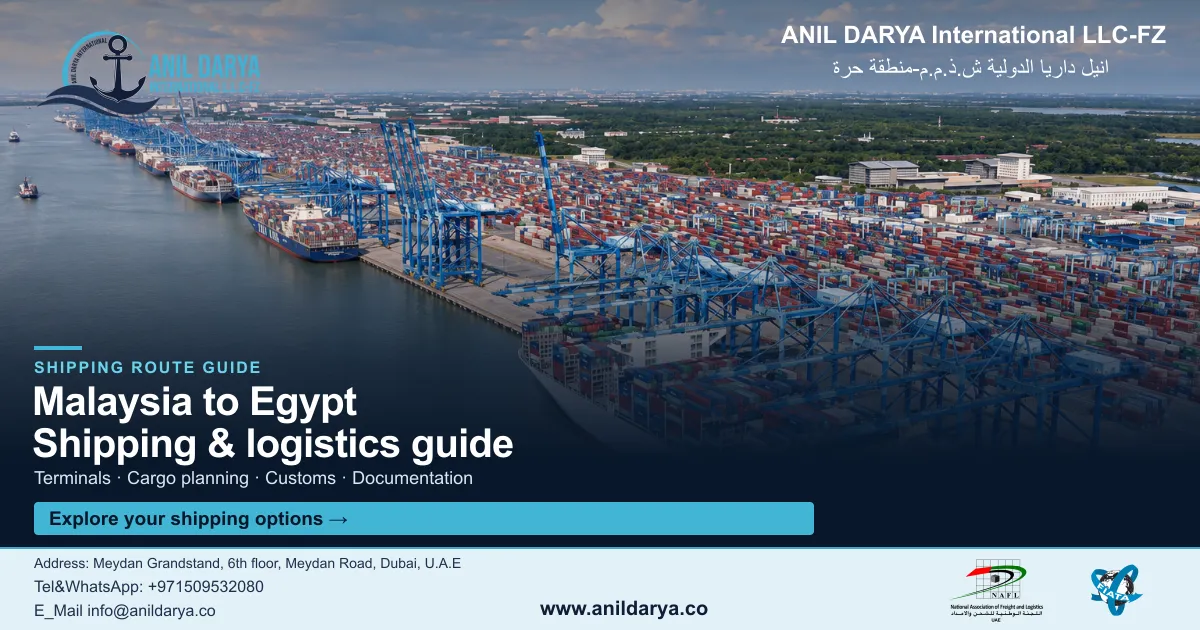
Shipping from Malaysia to Egypt is one of the better-served Asian lanes into Egypt: Port Klang and Tanjung Pelepas both sit on mainline loops that call Sokhna, Port Said, Damietta or Alexandria, so many boxes travel without a change of ship. Palm oil makes up about half the trade by value, and the Egyptian rule that sets the pace is the ACID, which the buyer must hold before the container is loaded in Malaysia. We book the sea freight from Dubai, release the carrier's bill of lading to you, and agree the Egyptian buyer's broker before we confirm any space.
Malaysia to Egypt shipping at a glance
| Item | Detail |
|---|---|
| Type of lane | Sea cross-trade, Malaysia to Egypt, booked and coordinated by Anil Darya from Dubai |
| Main Malaysian load ports | Port Klang (Westports, Northport) and Tanjung Pelepas; Penang, Johor Port and Kuantan for regional cargo |
| Main Egyptian discharge ports | Sokhna on the Gulf of Suez; East Port Said, Damietta and Alexandria on the Mediterranean |
| Direct options seen on carrier pages | Wan Hai FM1 (Port Klang, Sokhna, Alexandria); Maersk AE15 (Tanjung Pelepas, Port Said, Damietta) |
| Published transit example | Port Klang to Alexandria 21 days via Mundra, in an Emirates Shipping Line advisory of 8 October 2024 |
| Main Malaysian exports to Egypt | Palm oil and other fats, cocoa products, organic chemicals, rubber, machinery, vehicles and parts |
| Malaysian export filing | CUSDEC K2 (or K8) lodged with the Royal Malaysian Customs Department by the exporter or its forwarding agent |
| Egypt pre-shipment rule | Advance Cargo Information: a 19-digit ACID from Nafeza before loading in Malaysia |
| Egypt duty and VAT | Duty by HS code, mostly 0% to 60% of CIF value; VAT 14% (5% on production-line machinery) |
| Trade agreement | D-8 Preferential Trade Agreement in force for Malaysia since 1 October 2023; Egypt ratified in 2026 |
| Bill of lading | The shipping line's own B/L, issued and released to you through us as the line's agent |
| Egyptian clearance | The consignee's licensed customs broker, agreed before we confirm the booking |
How shipping from Malaysia to Egypt works as a cross-trade
The container normally never enters the UAE. From Dubai we buy the slot, keep both sides on the same data, and hold the gate-in until the Egyptian paperwork is ready.
| Party | Its job on a Malaysia to Egypt shipment |
|---|---|
| Malaysian exporter or its forwarding agent | Picks up and stuffs the cargo, lodges the K2, gets any permit and the certificate of origin, uploads the ACI file on CargoX |
| Anil Darya, Dubai | Compares direct and transhipped sailings, books the line, checks the ACID before cut-off, follows the box, releases the carrier's B/L |
| Shipping line | Refuses to load without a valid ACID, carries the box, sends its manifest to Egyptian Customs through Nafeza |
| Egyptian importer | Holds its importer registration, requests the ACID, approves the exporter's file, holds food or product approvals, pays duty and VAT |
| Importer's customs broker in Egypt | Files the clearance at the discharge port, attends inspection and takes release |
The document you receive is the carrier's bill of lading. Anil Darya is agent for many shipping lines, so the line issues its B/L and we hand it over from Dubai. On a Port Klang palm olein shipment for an Alexandria refiner, for example, we hold the draft until the consignee's name, its 9-digit Egyptian tax number and the ACID read exactly as they do on Nafeza.
Clearance in Egypt is not something we sell. Duty and taxes at destination are paid by the consignee or its broker. That is why the buyer names its broker, and the port where the broker has people, before we confirm a sailing out of Port Klang or Tanjung Pelepas. No named broker means no booking.
The Incoterm decides who buys the freight. On FOB Port Klang the Egyptian buyer pays the sea leg; on CFR Sokhna the Malaysian seller does, while Egyptian port charges, duty and VAT stay with the buyer either way. Our Incoterms 2020 guide for sea freight shows where risk changes hands.
Which Malaysian port should the cargo leave from?
Choose the port by where the cargo is made and which service you want. Klang Valley and central cargo goes to Port Klang; Johor cargo often suits Tanjung Pelepas because the AE15 loop loads there.
| Port | Facts from the operator or port data | Typical Egypt-bound cargo |
|---|---|---|
| Port Klang (Westports, Northport) | 15.14 million TEU in 2025, a record, per a Ministry of Transport statement | Packed palm products, chemicals, rubber goods, machinery, mixed consumer goods |
| Tanjung Pelepas, Johor | 14.03 million TEU in 2025; more than 90% of its traffic is transhipment | Johor manufactures, cargo for Port Said and Damietta on AE15 |
| Penang (North Butterworth) | Vegetable oil tanker pier with two berths of 8 m and 10 m depth, linked by pipeline to tank farms | Electronics and rubber products in boxes; palm oil in bulk parcels |
| Johor Port, Pasir Gudang | Liquid and dry bulk plus containers in southern Johor | Palm oil products, oleochemicals, breakbulk |
| Kuantan | East coast industrial port | Bulk and breakbulk; containers often trucked to Port Klang |
Cargo from Sabah or Sarawak usually reaches a Peninsular port on a feeder first, so ask for that leg on the quote.
Choosing the Egyptian port: Sokhna, Port Said, Damietta or Alexandria
Egypt has one big container gateway on the Gulf of Suez and three on the Mediterranean. Pick the port by the buyer's plant and the broker's team, then match the service to it.
| Egyptian port | Terminal facts | Usually suits |
|---|---|---|
| Sokhna | DP World Sokhna: berths of 750 m and 1,350 m, 17 m alongside, 584 plus 320 reefer points | Eastern Cairo, 10th of Ramadan City, the Sokhna industrial zone |
| East Port Said | Suez Canal Container Terminal: 3,355 m quay, 17 m draft, 6,400 reefer plugs | The canal cities and the East Port Said industrial zone |
| Damietta | Damietta Alliance Container Terminals operating since 14 February 2026, 1,670 m quay at 18 m | Mansoura and the eastern Nile Delta |
| Alexandria and Dekheila | About 60% of Egypt's import and export volume, per the port authority; Dekheila draft to 18 m | Alexandria, the western Delta, many Cairo food and oil refiners |
The port also picks the service: FM1 calls Sokhna and Alexandria, AE15 calls Port Said and Damietta.
Direct sailings, hubs and transit time
Unlike most Southeast Asian origins, Malaysia has loops that load at its own quays and call Egypt. Carrier and port notices we opened show:
- Wan Hai FM1. The Saudi Ports Authority announced it in September 2025 as linking four Chinese ports, Port Klang, Jeddah, Aqaba, Sokhna, Alexandria and two Turkish ports. Fluent Cargo's route tables list FM1 as the direct option from Port Klang to Sokhna and Alexandria.
- Maersk AE15, a Gemini service. Maersk's rotation of 10 August 2026 runs Qingdao, Kwangyang, Ningbo, Tanjung Pelepas, Jeddah, Port Said and Damietta, and its 9 September 2026 notice added Salalah on the eastbound leg. Johor cargo boards at Tanjung Pelepas.
- Emirates Shipping Line IEX. Its advisory of 8 October 2024 offers Port Klang to Alexandria by transhipment at Mundra, at 21 days.
Other options on aggregator tables connect at a hub. Rotations change, so every quote we send names the vessel, the loop and any hub.
How long does shipping from Malaysia to Egypt take?
The only carrier figure we found is ESL's 21 days from Port Klang to Alexandria via Mundra, dated October 2024. The FM1 and AE15 pages we opened give no Malaysia to Egypt day count, and aggregator figures differ by weeks. Add the K2 cut-off and Egyptian clearance on top.
[AMIR-FACT: the carriers and loops we actually book from Port Klang and Tanjung Pelepas to Sokhna, Port Said, Damietta and Alexandria in 2026, direct or via which hub, with real port-to-port days and sailing frequency]
Sea freight from Malaysia to Egypt: palm oil, cocoa, rubber and chemicals
UN Comtrade data, as published by Trading Economics, puts Malaysian exports to Egypt at USD 594.12 million in 2025. Animal and vegetable fats and oils came to USD 291.42 million of that, followed by cocoa preparations, organic chemicals, rubber and other chemical products. Malaysia's Prime Minister gave the 2025 export figure as RM2.55 billion in October 2026.
| Option | Malaysian cargo for Egypt | What to settle first |
|---|---|---|
| FCL 20ft | Cocoa butter and powder in bags, rubber, drummed chemicals, heavy machinery parts | Payload limit; one ACID covers the whole shipment |
| FCL 40ft / high cube | Rubber gloves, plastics, soaps, electrical goods, auto parts | Same weights on the K2, the invoice and Nafeza |
| LCL | Samples, spare parts, small first orders | Every consignee in the box needs its own ACID |
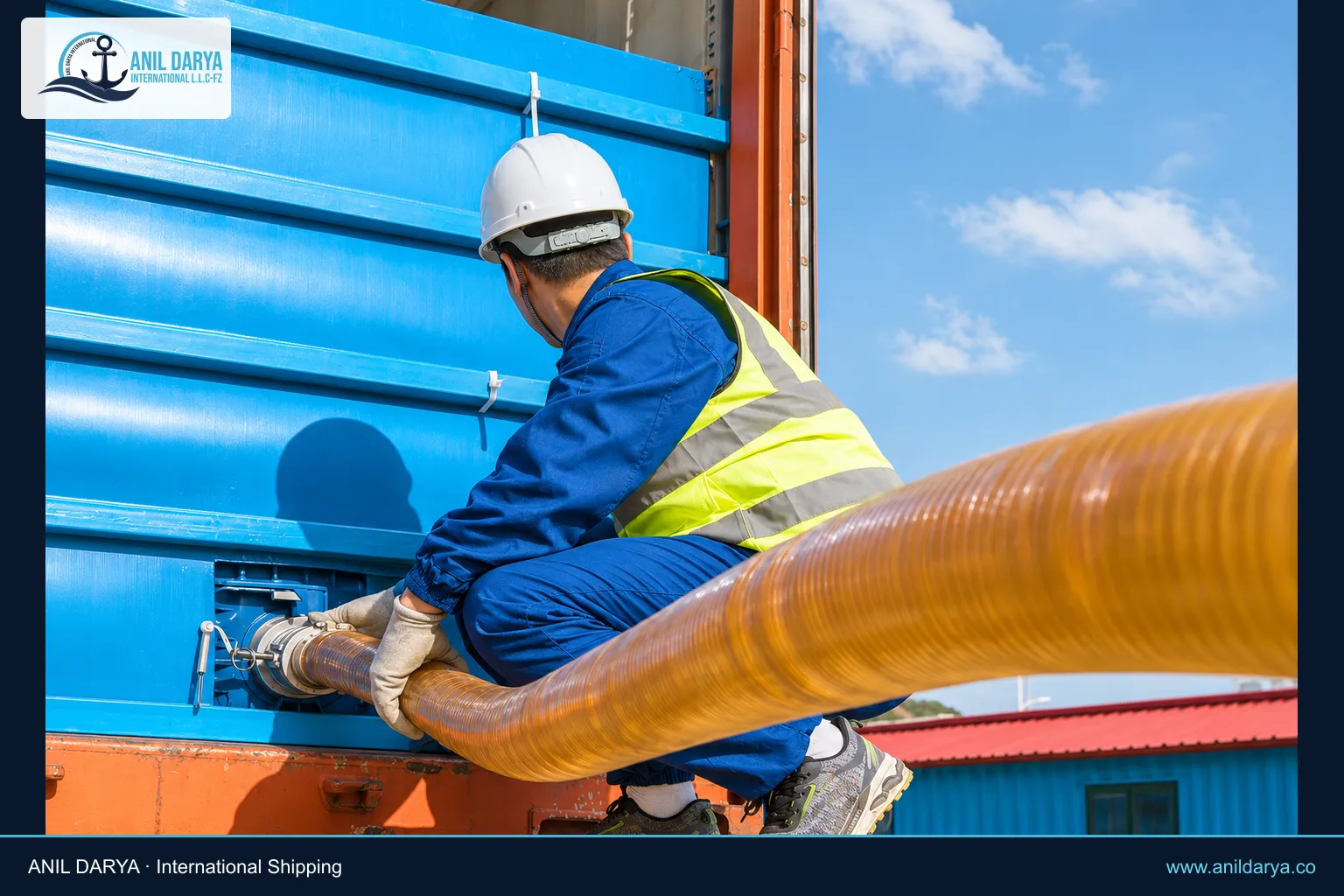
| Flexitank or ISO tank | Refined palm olein, palm stearin, non-hazardous oleochemicals | Line approval of the tank, cleaning certificate, Egyptian food approval |
| Liquid bulk tanker | Crude and refined palm oil in ship-sized parcels from Pasir Gudang, Penang or Port Klang | Charter or parcel space and shore tanks in Egypt |
| Flat rack / breakbulk | Plant equipment, steel structures, oversized machinery | Drawings, lashing plan and an ACID like any other cargo |
Past about half a container, compare a full box; see FCL vs LCL and our sea freight service.
Palm oil: tanker or tank container?
Large refiners in Egypt buy palm oil by the shipload, and that moves as liquid bulk through our bulk cargo service. Smaller buyers take a flexitank in a 20ft box or an ISO tank. Ask the line to approve the flexitank make before the contract is signed, not after.
Two Malaysian rules sit on the export side. The Malaysian Palm Oil Board licenses palm oil trading and lists the export permit (Customs permit AP) among its licensing services, and Malaysia charges an export duty on crude palm oil worked out from a reference price set each month. Write into the contract who carries a change in that duty between sale and loading.
Cocoa products and other food
Cocoa butter, cocoa powder and food preparations go in dry boxes but count as food in Egypt. The buyer needs National Food Safety Authority approval, and the health certificate, invoice and packing list must show the same net weights and lot numbers.
Dangerous goods and chemicals
Some organic chemicals, solvents and fatty alcohols from Malaysian plants are dangerous goods at sea under the IMDG Code 2024 edition, Amendment 42-24, mandatory since 1 January 2026. The shipper gives the UN number, class, packing group, safety data sheet and DG declaration, and on a transhipped routing both carriers must accept. Our dangerous goods team gets those acceptances before the vessel is confirmed.
Malaysian export side: K2, permits and palm oil rules
The Royal Malaysian Customs Department controls exports. The exporter or its forwarding agent lodges the CUSDEC K2 (K8 in some cases) online. On that form the declarant says whether the goods need a permit under the Strategic Trade Act 2010; if so, the permit number is entered and the customs system checks it. A wrong number gets the declaration rejected, and missing permits are an offence under section 9 of the Act.
| Item | Who issues it | When Egypt-bound cargo needs it |
|---|---|---|
| K2 export declaration | Filed by the exporter or its agent with Malaysian Customs | Every shipment, before the terminal cut-off |
| Strategic trade permit | MITI, the Atomic Energy Licensing Board, MCMC or the Pharmaceutical Services Division, applied for on myTRADELINK | Listed dual-use goods, some chemicals and electronics |
| MPOB licence and export permit | Malaysian Palm Oil Board | Palm oil and palm-based products |
| Non-preferential certificate of origin | MITI or a chamber of commerce it authorises | When the buyer does not claim a preference |
| D-8 certificate of origin | MITI, after a cost analysis approval | Only if the broker confirms Egypt grants the D-8 rate |
We do not lodge the K2. The shipper or its own origin agent does, and we line their cut-off up with the vessel. Egypt also expects the invoice and certificate of origin to be legalised by the Egyptian consulate in the origin country in most cases, the US Commerce guide says, so ask the broker early and leave time for it.
Egypt import customs: ACI and Nafeza for Malaysian cargo
Egypt made Advance Cargo Information compulsory for sea cargo in October 2021 under Ministry of Finance Decree 38 of 2021. Nafeza is the single window, run by Misr Technology Services. Its guide for shipping lines asks for the ACI request at least 48 hours before loading and gives Customs up to 48 hours to issue the ACID. Lines must not load cargo with an invalid ACID, and they lodge the manifest at least 48 hours before berthing.
Loading means Port Klang or Tanjung Pelepas, even if the box changes ship later at a hub.
| Step | Who | What happens |
|---|---|---|
| 1 | Egyptian importer or broker | Registers the shipment on Nafeza with the Malaysian exporter's details |
| 2 | Egyptian Customs | Issues the 19-digit ACID and notifies both buyer and seller |
| 3 | Malaysian exporter | Verifies on CargoX and uploads invoice, packing list, certificate of origin and B/L copy under the ACID |
| 4 | Importer | Accepts the exporter's documents on Nafeza |
| 5 | Line at the Malaysian port | Checks the ACID and loads |
| 6 | Carrier calling Egypt | Lodges the manifest 48 hours before berthing |
| 7 | Broker and importer | Pay duty and VAT, attend inspection, take release |
Three references must appear on every document: the ACID, the importer's 9-digit tax number and the exporter's ID (country code MY, ID type and number). Under Customs Law 207 of 2020, the US Commerce guide notes, cargo that arrives without an ACID is refused entry and sent back at the shipper's cost. A CargoX filing cannot be withdrawn; a mistake is fixed with a fresh filing under the same ACID.
Documents Egypt expects for Malaysian goods
| Document | Issued by | What the Egyptian broker checks |
|---|---|---|
| Commercial invoice | Malaysian exporter | ACID, tax number, exporter ID, HS codes, values; consulate legalisation if asked |
| Packing list | Malaysian exporter | Packages and weights identical to the invoice and Nafeza |
| Certificate of origin | MITI or an authorised chamber | Malaysia as origin; D-8 form only if the broker confirms it is honoured |
| Bill of lading | Shipping line, released through us | Consignee, notify party, ACID, discharge port |
| Health or analysis certificate | Malaysian authority or accredited laboratory | Palm oil, cocoa and other food, as the broker lists |

Duty, VAT and the D-8 agreement on Malaysian goods
Egypt charges duty by HS code. PwC's tax summary, reviewed 17 August 2026, gives a usual range of 0% to 60% of CIF value, up to 135% on passenger cars, luxury goods and alcohol, 0% to 5% on most industrial machinery, and 10% to 20% on trucks and heavy equipment. Duty is paid in Egyptian pounds.
VAT runs at 14% under Law 67 of 2016, on the CIF value plus duty and other charges. Machinery for production lines pays 5%, and a schedule tax applies to some listed goods. The broker confirms the rate per HS code before sailing.
| Malaysian cargo | Duty basis | Watch for |
|---|---|---|
| Palm oil, olein, stearin | HS code, crude or refined | Food approvals, tank certificates, analysis report |
| Cocoa butter and powder | HS code | Food safety approval; consumer packs may fall under GOEIC rules |
| Rubber gloves and goods | HS code within the normal range | Medical gloves may need health regulator approval |
| Production machinery | Mostly 0% to 5% | 5% VAT only for new production lines |
Does the D-8 agreement lower the duty?
Maybe, and few guides on this lane mention it. MITI announced that the D-8 Preferential Trade Agreement entered into force for Malaysia on 1 October 2023, after the Customs Duties Order 2023 was gazetted. At that time Egypt had not ratified. Egypt has since done so: the House approved accession on 15 June 2026, Presidential Decree 24 of 2026 approved it, and the D-8 Secretariat reported in October 2026 that Egypt had deposited its instrument.
MITI issues the Malaysian D-8 certificate of origin, valid six months, after a cost analysis that stays valid for two years. What we could not confirm is whether Egyptian Customs already applies D-8 rates on Malaysian goods and on which tariff lines. If it does, the agreement's origin rules may require the goods to travel straight to Egypt, so splitting or storing them in Dubai could lose the rate. Check both points with the broker before the exporter applies for the form.
Malaysia also applies TPS-OIC from 1 October 2023, but MITI's notice did not list Egypt as applying it. The US Commerce list of Egypt's agreements (November 2025) shows none with Malaysia or ASEAN.
[AMIR-FACT: whether Egyptian Customs is granting D-8 rates on Malaysian certificates in 2026, for which products, and whether a Jebel Ali transhipment or Dubai storage keeps or loses the preference]
Restricted goods and approvals in Egypt
IHK Cologne's Egypt import page lists goods Egypt does not admit, including two-stroke motorcycles, asbestos products such as brake linings, certain incandescent lamps, many pesticides and chemicals, poultry parts and offal, and goods bearing symbols that offend religious beliefs. Used goods face conditions. For Malaysian cargo, these approvals cause most holds:
- GOEIC registration under Ministerial Decree 43 of 2016 for factories and brand owners of listed goods, which include packaged foods, cosmetics, textiles and household goods.
- Food Safety Authority approval for palm oil, cocoa and food preparations. The USDA's Cairo report of 19 December 2025 says permits and shipping documents that do not match lead to rejection.
- The importers register: Decree 271 of 2026 replaced its rules from 22 July 2026.
Can Dubai help on this lane?
For most Malaysian cargo a direct loop is quickest. Dubai helps in three cases:
- A relay at Jebel Ali. ESL's GALEX rotation of February 2024 ran Port Klang to Jebel Ali, and ESL's GRC advisory of October 2024 lists Jebel Ali to Sokhna at 11 days. Joining the two is a possible connection we worked out from both pages, not a published through routing. Our Jebel Ali port guide covers the terminal.
- Consolidation. An Egyptian buyer with small lots from Malaysia and from Gulf suppliers can combine them in Dubai into one box.
- Free zone stock. A distributor can keep Malaysian goods in a Dubai free zone and send smaller lots to Egypt on demand; our article on re-exporting through JAFZA explains how.
If the cargo is unloaded in Dubai, the Dubai to Egypt leg needs its own ACID, and any Dubai customs clearance is a paid service of our Dubai freight forwarding team. Watch the D-8 point above before you choose this route.
[AMIR-FACT: whether we route Malaysian cargo for Egypt via Jebel Ali today (relay to Sokhna, consolidation or JAFZA stock), whether ESL GALEX and GRC still run, and the real extra days against a direct FM1 or AE15 sailing]
What drives the cost of shipping from Malaysia to Egypt?
We price each sailing on the day; these are the parts of the bill.
| Cost part | What moves it | Usually paid by (FOB) |
|---|---|---|
| Malaysian origin charges | Haulage to Port Klang or Tanjung Pelepas, stuffing, K2 filing, terminal handling | Exporter |
| Palm oil export duty | Monthly reference price for crude palm oil | Exporter, unless agreed otherwise |
| Ocean freight | Direct or transhipped loop, box type, tank equipment, season, surcharges | Importer |
| Egyptian port charges | Terminal handling, delivery order, LCL unpacking, storage | Importer |
| Duty and taxes | HS code, CIF value, VAT rate, any D-8 rate | Consignee or its broker |
| Delay charges | Missing ACID or approval, inspection, demurrage and detention | The party at fault, by contract |
Storage during a late food approval is the cost buyers miss; see demurrage and detention.
How to ship from Malaysia to Egypt step by step
- Agree the Incoterm and the Egyptian port with the Malaysian seller. FOB Port Klang or FOB Tanjung Pelepas keeps the K2 with the party that can file it.
- Send us the details: product, HS code, weight and volume, pickup point, ready date, tank, DG or out-of-gauge needs and the Egyptian city.
- Name the Egyptian broker. We confirm with the broker that the importer is registered, that food, GOEIC or regulator approvals are in place and that it works at the port. Only then do we confirm the booking.
- Get the ACID. The importer files on Nafeza at least 48 hours before loading and sends the number to the seller and to us.
- Choose the sailing. We compare FM1, AE15 and transhipped options and get tank, DG or out-of-gauge acceptance from each line involved.
- Prepare the papers in Malaysia with the ACID, tax number and exporter ID, the right certificate of origin and any consulate legalisation.
- Upload the ACI file on CargoX, lodge the K2 and deliver to the terminal before cut-off.
- Release the bill of lading. We match the draft to the invoice and ACID and release the line's B/L once freight is settled.
- Clear in Egypt. The consignee's broker pays duty and VAT, handles inspection and arranges delivery.
[AMIR-FACT: one real Malaysia to Egypt cross-trade shipment we handled (cargo, Malaysian port, carrier and loop, Egyptian port, how the ACID and broker were arranged, door-to-door days), cleared for publication]
Checklist before the box leaves Malaysia
- Incoterm and Egyptian discharge port written in the contract.
- Importer registered in Egypt and holding a valid ACID for this shipment.
- Broker named, agreed and staffed at the discharge port.
- Food Safety Authority, GOEIC or regulator approvals confirmed for the HS code.
- ACID, tax number and exporter ID on every document.
- Certificate of origin chosen with the broker: D-8 or ordinary.
- K2 lodged; MPOB permit and strategic trade permit where needed.
Mistakes to avoid on the Malaysia to Egypt lane
- Shipping before destination clearance is agreed. A box that reaches Alexandria with no broker in place sits on the quay and gathers storage.
- Gate-in without an ACID. The line at Port Klang will not load Egypt cargo without one.
- Numbers that disagree. Net weights or lot numbers that differ between the health certificate, the invoice and Nafeza lead to holds.
- Assuming the D-8 rate. Until the broker confirms Egypt grants it on your product, budget for the normal duty.
Frequently asked questions
Is there a direct ship from Malaysia to Egypt?
Yes, on some loops. Wan Hai's FM1 calls Port Klang, Sokhna and Alexandria, and Maersk's AE15 loads at Tanjung Pelepas and calls Port Said and Damietta. Other services tranship at a hub.
How many days does sea freight from Malaysia to Egypt take?
Emirates Shipping Line published 21 days from Port Klang to Alexandria via Mundra in October 2024. Direct loops publish no Malaysia to Egypt figure on the pages we opened, so ask us for the days on the vessel you book.
Which Egyptian port should I choose for Malaysian cargo?
Sokhna suits eastern Cairo, Alexandria the western Delta, Damietta the eastern Delta and East Port Said the canal zone.
Who requests the ACID for a Malaysian shipment?
The Egyptian importer or its broker, on Nafeza, at least 48 hours before loading in Malaysia. The Malaysian exporter then uploads its documents on CargoX under that ACID.
Can palm oil from Malaysia go to Egypt in containers?
Yes, in line-approved flexitanks or ISO tanks; large volumes go by tanker. Egyptian food approvals apply either way.
What duty does Egypt charge on Malaysian goods?
Duty follows the HS code, mostly 0% to 60% of CIF value, plus VAT at 14%, or 5% on production-line machinery. The consignee or its broker pays them in Egyptian pounds.
Does the D-8 agreement apply between Malaysia and Egypt?
Malaysia has applied it since October 2023 and Egypt ratified in 2026. Whether Egyptian Customs grants the D-8 rate on your product must be confirmed with the broker first.
Does Anil Darya clear customs in Egypt?
No. We book the sea freight, coordinate the Malaysian shipper and release the carrier's bill of lading. The consignee's licensed broker clears the cargo, and we agree that before booking.
Get a quote for your Malaysian cargo
Send us the product, the Malaysian port or factory, the ready date, the Egyptian port and the name of the buyer's broker, and we will reply with direct and hub options and a price. Use our freight rate inquiry form, or contact our team to plan a tank, DG or project shipment first.
Sources
- Royal Malaysian Customs Department: Export procedure (K2/K8, Strategic Trade Act permits)
- Royal Malaysian Customs Department: Rules of origin FAQ
- MITI: Implementation of the D-8 PTA for Malaysia (27 October 2023)
- MITI: Implementation of TPS-OIC for Malaysia (27 October 2023)
- Malaysian Palm Oil Board: Licensing Unit (export permit)
- InfoSAWIT: Malaysia's monthly CPO reference price and export duty (September 2026)
- The Star: Port Klang and PTP container records in 2025
- Penang Port: Vegetable oil tanker pier
- Trading Economics: Malaysia exports to Egypt 2025 (UN Comtrade)
- The Star: Malaysia and Egypt to expand trade ties (11 October 2026)
- Al Riyadh Daily: Mawani adds Wan Hai FM1 at Jeddah Islamic Port (September 2025)
- Maersk: AE15 new rotation (10 August 2026)
- Maersk: AE15 adding Salalah call (9 September 2026)
- Emirates Shipping Line: IEX and GRC service advisory (8 October 2024)
- Emirates Shipping Line: GALEX rotation via Port Klang and Jebel Ali (February 2024)
- Fluent Cargo: Malaysia to Egypt services (routing type only)
- DP World: Sokhna infrastructure facts
- APM Terminals: Suez Canal Container Terminal, East Port Said
- Baird Maritime: Damietta Alliance Container Terminals starts operations
- Alexandria Port Authority: Alexandria and Dekheila
- US International Trade Administration: Egypt import requirements and documentation (21 November 2025)
- US International Trade Administration: Egypt customs regulations
- US International Trade Administration: Egypt trade agreements (November 2025)
- Misr Technology Services via SCZONE: ACI Shipping Lines/Agents Guide v1.5
- CargoX: Advance Cargo Information Egypt
- PwC Worldwide Tax Summaries: Egypt, other taxes (reviewed 17 August 2026)
- APP: D-8 Secretariat on Egypt's ratification of the PTA (9 October 2026)
- Arab Finance: Decree 24 of 2026 approving Egypt's D-8 PTA accession
- IHK Koeln: Import requirements in Egypt (prohibited goods)
- AHK Egypt: Registration of manufacturers with GOEIC (Decree 43 of 2016)
- USDA FAS Cairo: Egypt FAIRS country report EG2025-0025 (19 December 2025)
- Baker McKenzie: Egypt importers register, Decree 271 of 2026
- IMO: IMDG Code 2024 edition (Amendment 42-24)
Reviewed: 11 November 2026