
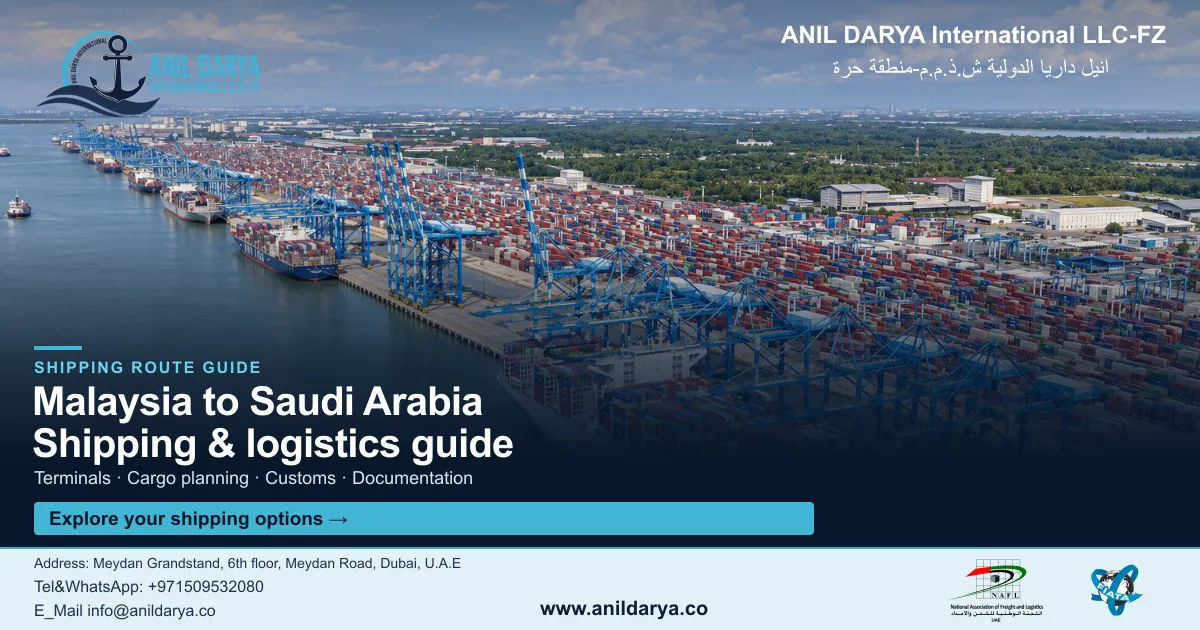
Shipping from Malaysia to Saudi Arabia usually means a container loaded at Port Klang or Tanjung Pelepas and discharged at Jeddah on the west coast or Dammam on the east coast. The Malaysian exporter files a K2 export declaration, and the Saudi consignee's customs broker clears the cargo on Fasah, with SABER certificates for regulated products, duty on the CIF value and 15% VAT. We book the ocean freight from Dubai and coordinate both ends, and this guide walks through ports, services, documents and the steps in order.
Malaysia to Saudi Arabia shipping at a glance
| Item | Detail |
|---|---|
| Main modes | Sea FCL, sea LCL, reefer, flexitank or ISO tank for liquids, breakbulk and project cargo, dangerous goods |
| Main Malaysian load ports | Port Klang (Westports, Northport), Tanjung Pelepas, Penang, Johor Port (Pasir Gudang), Kuantan |
| Main Saudi discharge ports | Jeddah Islamic Port and King Abdullah Port on the west coast; Dammam (King Abdulaziz Port) and Jubail on the east coast |
| Direct services seen in carrier notices | Tanjung Pelepas to Jeddah (Maersk AE15); Port Klang to Jeddah (Wan Hai, per Mawani); Port Klang to Jebel Ali and Dammam on one loop (ESL GALEX, 2024 notice) |
| Malaysian export filing | CUSDEC K2 (or K8) filed online with the Royal Malaysian Customs Department by the exporter or its forwarding agent |
| Saudi customs authority | Zakat, Tax and Customs Authority (ZATCA), declarations on Fasah at least 48 hours before arrival |
| Saudi product conformity | SABER: Product Certificate of Conformity plus a Shipment Certificate of Conformity per shipment for regulated goods |
| Saudi customs duty | GCC common external tariff, at least 5% of CIF on most goods; some staples duty-free; higher rates on some items |
| Saudi import VAT | 15%, charged on the customs value plus duty and other fees |
| Who clears in Saudi Arabia | The consignee or its licensed Saudi customs broker, agreed before the cargo ships |
| Bill of lading | The shipping line's own B/L, issued and released to you through Anil Darya as agent |
How a cross-trade booking from Malaysia to Saudi Arabia works
This is a cross-trade lane. The cargo moves from a Malaysian port to a Saudi port and never needs to enter the UAE, but the booking and coordination run from our Dubai office. That works because the decisions on this lane are carrier space, routing and paperwork, and those can be handled from Dubai with the shipping lines.
Three parties carry the job between them:
- Origin side. The Malaysian shipper, or its own origin agent, picks up the goods, stuffs or delivers the container and files the K2 export declaration. We coordinate dates, cut-offs and documents with them.
- Ocean leg. We book the space with the shipping line and follow the container from gate-in at the Malaysian terminal to discharge in Saudi Arabia.
- Destination side. The Saudi consignee's customs broker files the Fasah declaration, pays duty and VAT with the consignee's funds and arranges delivery. We do not sell customs clearance inside Saudi Arabia.
The bill of lading is the shipping line's own B/L. Anil Darya acts as agent for many shipping lines, so the carrier's B/L is issued and released to you through us. When we name a carrier service on this page, it is because the line published it, not because we represent that line.
Who pays for which leg depends on the Incoterm. Under FOB Port Klang, the Malaysian seller clears export and loads the goods, and the Saudi buyer pays the freight. Under CFR or CIF Jeddah, the seller pays the freight but the buyer still pays Saudi terminal charges, duty and VAT. Our Incoterms 2020 guide for sea freight shows where risk passes in each case.
Which Malaysian ports should you load at?
Pick the port nearest the factory or warehouse, then check that the port has a usable service to your Saudi coast. Trucking cargo the length of the peninsula to reach a better sailing can cost more than the freight difference.
| Malaysian port | What it suits on this lane | Note |
|---|---|---|
| Port Klang (Westports and Northport) | Most exporters in the Klang Valley and central Peninsular Malaysia; containers, breakbulk, liquid and dry bulk | Handled 15.14 million TEU in 2025, per a Ministry of Transport statement |
| Tanjung Pelepas | Johor-based exporters; big mainline services between Asia and the Middle East and Europe | Recorded 14.03 million TEU in 2025; mostly a transshipment port |
| Penang (North Butterworth Container Terminal) | Northern Peninsular exporters, many of them in electronics and rubber products | Ask whether your sailing is direct or connects at another port |
| Johor Port, Pasir Gudang | Palm oil products, chemicals, breakbulk and containers from southern Johor | Check whether your service loads here or at Tanjung Pelepas |
| Kuantan | East coast industry, bulk and breakbulk | Check container sailings early; trucking to Port Klang is the usual fallback |
Sabah and Sarawak ports such as Bintulu mainly run regional feeder services, so cargo from East Malaysia usually crosses to a Peninsular port or a regional hub first. Add that leg to the plan when you compare quotes.
Jeddah or Dammam: choosing the Saudi port
Saudi Arabia has two coasts and the right port depends on where the consignee is. Discharging on the wrong coast can mean a long road leg across the country.
| Saudi port | Coast | Best for |
|---|---|---|
| Jeddah Islamic Port | West (Red Sea coast) | Jeddah, Makkah, Madinah and the western region; RSGT's container terminal there has a stated capacity of 6.2 million TEU a year |
| King Abdullah Port, Rabigh | West | Western region cargo on services that call there instead of Jeddah |
| Dammam, King Abdulaziz Port | East | The Eastern Province and, by rail to the Riyadh dry port, the central region; 43 berths and three main terminals |
| Jubail | East | Industrial cargo for Jubail Industrial City and nearby plants |
A simple rule for Riyadh consignees: compare Jeddah plus a long truck leg against Dammam plus rail or a shorter truck leg to the capital. The answer changes with the sailing schedule, so ask for both routings on the same quote.
Direct services or transshipment on this lane
Malaysia sits on the main east-west container corridor, so this lane has more direct options than most cross-trades. Carrier notices we opened show three examples:
- Maersk's AE15, run with Hapag-Lloyd in the Gemini network, calls Tanjung Pelepas and then Jeddah on its westbound leg, according to Maersk advisories from August and September 2026.
- Wan Hai runs an Asia service that calls Port Klang and Jeddah. The Saudi Ports Authority (Mawani) announced it at Jeddah Islamic Port in July 2025.
- Emirates Shipping Line's GALEX, as announced in February 2024, called Port Klang, then Jebel Ali, then Dammam on the same loop.
Rotations change often, so treat these as examples, not a timetable. Many other sailings to Dammam or Jubail are transshipped at a hub in Asia or the Gulf. Ask on every quote whether the routing is direct or transshipped, and at which port, because each extra handling adds time and another chance of a missed connection.
[AMIR-FACT: the carriers we actually book from Port Klang and Tanjung Pelepas to Jeddah and to Dammam, direct or via which hub, and our real port-to-port transit days on each in 2026]
Where Dubai fits on this lane
Routing through Dubai is an option, not a default. It helps in three cases:
- Transshipment at Jebel Ali. Some Gulf services call Jebel Ali before Dammam, as the GALEX rotation above shows. Your container stays on the carrier's through bill of lading to the Saudi port. Our Jebel Ali port guide explains the terminals.
- Buyer's consolidation in Dubai. If a Saudi buyer collects small lots from Malaysia and from other Asian suppliers, the lots can be brought to Dubai, combined and sent on as one shipment.
- Stock in a Dubai free zone. A trader can hold Malaysian goods in a Jebel Ali Free Zone warehouse and re-export them to Saudi customers order by order. Our article on re-exporting through Jafza covers how that works.
When the cargo is cleared or re-exported in Dubai, Dubai customs clearance is our own service, for a fee. Dubai Customs asks a free zone company for a separate customs declaration when it sells goods into the UAE mainland, so keep re-export stock and mainland sales apart in your paperwork. One point many traders miss: goods re-exported from a free zone are unlikely to count as GCC origin in Saudi Arabia, so Saudi duty is still due on them.
[AMIR-FACT: whether we route Malaysia to Saudi Arabia cargo via Jebel Ali or consolidate it in Dubai in practice, and for which cargo types]
Sea freight from Malaysia to Saudi Arabia: FCL, LCL and special cargo
Most cargo on this lane goes in containers. Choose the box by weight, volume and how the cargo must be kept.
| Option | Typical Malaysian cargo | Watch out for |
|---|---|---|
| FCL 20ft | Copper wire and cathodes, rubber products, steel parts, packed palm-based products | Weight limits per box and per road leg in Saudi Arabia |
| FCL 40ft / 40ft high cube | Furniture, electrical goods, mixed stock from one supplier | Free time at Jeddah or Dammam and delivery planning |
| LCL | First orders, samples, small runs of spare parts | Consolidation cut-offs and fewer LCL sailings to some Saudi ports |
| Reefer | Frozen seafood, food preparations, some chemicals | Set temperature, plug monitoring, Saudi food approvals |
| Flexitank or ISO tank | Non-hazardous palm oil fractions and other edible oils, liquid chemicals | Carrier acceptance and the Saudi rules for the product |
| Flat rack, open top, breakbulk | Machinery, transformers, steel structures for Saudi projects | Drawings, lifting points and the Saudi road permit for the final leg |
For small volumes, LCL is simpler but takes longer, because the box waits for enough cargo and is split again at destination. Once you pass roughly half a container, compare a full box. Our article on FCL vs LCL costs walks through the break-even, and our sea freight service covers container types and booking.
Dangerous goods
Malaysian exports to Saudi Arabia include many products that are dangerous goods at sea: lithium batteries in electrical equipment, paints, adhesives, solvents, aerosols and industrial chemicals. Sea DG moves under the IMDG Code, and the 2024 edition with Amendment 42-24 has been mandatory since 1 January 2026. The shipper needs the UN number, class and packing group, a current Safety Data Sheet, a signed DG declaration and the carrier's acceptance before the box is stuffed. Our dangerous goods team checks the file and gets acceptance before we confirm the sailing.
Breakbulk and project cargo
Saudi industrial and infrastructure projects buy heavy equipment, and some Malaysian-made pieces do not fit a standard container. If a piece fits a 40ft flat rack by size and weight, a container service gives you more sailings. If it does not, a breakbulk or heavy-lift vessel decides the date, and the plan starts from drawings, weights and the centre of gravity. Our break bulk and project cargo service plans the sea leg, and the consignee's broker and haulier handle the Saudi side.
Malaysian export side: what the shipper must file
The Royal Malaysian Customs Department controls exports. The export declaration is CUSDEC K2 (or K8 in some cases), filed online by the exporter or its forwarding agent. On that screen the filer answers whether the goods need a permit under the Strategic Trade Act 2010. If they do, the permit number goes in and the customs system checks it, and an invalid number gets the declaration rejected.
- Strategic goods permits come from MITI, the Atomic Energy Licensing Board, the Malaysian Communications and Multimedia Commission or the Pharmaceutical Services Division, depending on the product.
- Permit applications are made online through myTRADELINK, after registration with Dagang Net.
- A certificate of origin for non-preferential trade is issued through MITI or a chamber of commerce that MITI authorises.
We do not file the K2. The shipper or its own origin agent does, and we match their cut-off to the vessel. Make sure the description, weight and value on the K2 agree with the invoice the Saudi broker will use. A mismatch between the two countries' records is a common reason for questions at Saudi customs.
Saudi import customs for goods from Malaysia
ZATCA runs Saudi customs. Its import instructions ask for a commercial invoice, a bill of lading and a certificate of origin, though the certificate is not needed where the origin is clearly established. Some products also need an IECEE certificate or product registration with the competent authority. The importer completes the Fasah procedures at least 48 hours before the ship reaches the port of entry, either directly or through a customs broker.
| Document | Who prepares it | What to check |
|---|---|---|
| Commercial invoice | Malaysian seller | Full goods description, HS code, unit price, total value, currency, Incoterm, Saudi consignee details |
| Packing list | Malaysian seller | Pieces, gross and net weight, volume, marks matching the cartons |
| Certificate of origin | MITI or an authorised Malaysian chamber | Goods and consignee match the invoice |
| Carrier's bill of lading | Shipping line, released through us | Consignee, notify party, weights and piece count match the packing list |
| SABER certificates | Consignee, through a conformity body | PCoC registered and SCoC issued before arrival for regulated goods |
| Product approvals | Consignee | IECEE certificate or product registration where the tariff requires one |
SABER for regulated products
SABER is the Saudi conformity platform supervised by the Saudi Standards, Metrology and Quality Organization (SASO). For regulated products, the importer registers a Product Certificate of Conformity (PCoC), then gets a Shipment Certificate of Conformity (SCoC) for each consignment. SABER lists a fee of SAR 500 to register a PCoC and SAR 350 for an SCoC, both before VAT. The SCoC is now valid for 90 days instead of 60. Malaysian electrical goods, cables, appliances and many building products fall under technical regulations, so start this well before the cargo is ready.
Customs duty and VAT
Saudi Arabia applies the GCC common external tariff. Most goods from outside the GCC pay at least 5%, charged on the CIF value. Rice, bulk animal feed, livestock, fresh red meat, coffee and tea enter duty-free, while some processed foods face higher rates up to 40%. Excise applies to cigarettes, energy drinks and carbonated drinks. Check the rate for your HS code in the Saudi tariff before you sign the contract.
Import VAT is 15%. ZATCA charges it on the customs value plus customs duty and other fees, and it applies even when the goods are duty-exempt. Duty and taxes at destination are paid by the consignee or its broker. Malaysian goods arriving in Saudi Arabia are not GCC origin, so GCC duty exemptions do not apply to them, and the same is true for Malaysian goods re-exported from a Dubai free zone.

What cargo moves on this lane?
According to DataSaudi, Saudi Arabia imported about SAR 6.1 billion of goods from Malaysia in 2025. The largest groups were electrical machinery and parts, animal or vegetable fats and oils, and copper and copper articles. In practice that means three kinds of booking on this lane:
- Electrical and electronic goods in 40ft boxes, often regulated under SABER and sometimes containing lithium batteries.
- Palm-based and other edible oils, either packed or in flexitanks and ISO tanks.
- Copper wire, cable and cathodes, which are heavy and usually fill a 20ft box by weight long before volume.
Furniture, rubber gloves and other rubber products, machinery and food preparations also move on the lane. Each of these has its own permit or conformity question on the Saudi side, so match the cargo type to the checks below before booking.
Restricted and prohibited goods in Saudi Arabia
ZATCA says restricted goods need permits from the competent authorities, and goods that are prohibited, counterfeit or adulterated may not be imported. The US Commercial Service's guide to Saudi imports lists the main groups:
| Status | Examples |
|---|---|
| Prohibited | Weapons, alcohol, narcotics, pork and pork products, pornographic material, distillery equipment, retreaded or used tyres, used clothing |
| Restricted, approval needed | Agricultural seeds, live animals, books and recorded media, chemicals and harmful materials, pharmaceuticals, wireless equipment, products containing alcohol such as perfume |
Food from Malaysia, including seafood, food preparations and edible oils, needs the approvals and certificates that the competent Saudi authority asks for, which can include health and halal documents. Ask the consignee's broker for the exact list for your product before the supplier packs it.
Shipping from Malaysia to Saudi Arabia step by step
- Agree the Incoterm and the Saudi discharge port with the buyer. FOB Port Klang or FOB Tanjung Pelepas keeps the export side with the seller.
- Send us the cargo details: commodity, HS code, weight and volume, pickup address, ready date, Saudi consignee city and any DG or temperature needs.
- Confirm destination clearance. The consignee names its Saudi customs broker, and we check with them that SABER certificates, permits and the Fasah filing will be ready. We confirm the booking only after this.
- We quote the routing, direct or transshipped, to Jeddah or Dammam, and book space with the shipping line from Dubai.
- The shipper or its origin agent arranges the empty container, stuffing or factory loading, and trucking to the Malaysian terminal.
- The shipper files the K2 export declaration, with any strategic trade permit, before the terminal cut-off.
- We check the invoice, packing list and certificate of origin against the draft bill of lading, and the line issues its B/L through us.
- The broker files the Fasah declaration at least 48 hours before arrival, with the SCoC where needed.
- The consignee or broker pays duty, VAT and local charges and collects the release.
- The consignee's haulier delivers and returns the empty within free time.
Our Dubai freight forwarding team stays on the file from booking to discharge and keeps the shipper and the broker on the same dates.
[AMIR-FACT: one real Malaysia to Saudi Arabia cross-trade shipment we handled (cargo, Malaysian load port, Saudi discharge port, carrier routing, transit and how clearance went), cleared for publication]
What decides the cost of shipping from Malaysia to Saudi Arabia?
We do not publish rates, because they change with each sailing. These are the parts of a quote and what moves each one.
| Cost part | What moves it |
|---|---|
| Malaysian origin charges | Pickup distance, terminal handling, export documentation, LCL consolidation |
| Ocean freight | Container type, direct or transshipped routing, Jeddah or Dammam, season, carrier surcharges |
| Special cargo | DG surcharges, reefer plugs, flexitank fitting, flat rack or breakbulk premiums |
| Saudi destination charges | Terminal handling, delivery order, inspection, storage if clearance is late |
| Conformity and permits | SABER certificates, testing, product registration |
| Duty and VAT | HS code, CIF value and the 15% VAT base |
| Inland delivery | Distance from the port, rail or truck, cargo weight |
| Delays | Demurrage and detention once free time runs out |
Compare quotes on the same scope: the same Incoterm, the same Saudi port and the same point where our job ends. For bulk liquids or dry bulk outside containers, see our bulk cargo service.
Checklist before the cargo leaves Malaysia
- Incoterm and Saudi discharge port written into the contract.
- HS code checked against the Saudi tariff, with the duty rate confirmed.
- Consignee's Saudi customs broker named and briefed.
- SABER PCoC registered and SCoC planned for regulated products.
- Saudi permits or registrations in hand for food, chemicals, medicines or wireless goods.
- K2 filer agreed and any Strategic Trade Act permit issued.
- Invoice, packing list, certificate of origin and draft B/L showing the same weights, pieces and consignee.
- For DG: UN number, SDS, DG declaration and carrier acceptance.
- For reefer: set temperature and the Saudi food certificates.
- Free time at the Saudi port agreed, and cargo insurance arranged.
Common mistakes when shipping from Malaysia to Saudi Arabia
- Shipping before destination clearance is agreed. With no broker ready to file on Fasah, the container sits at the port and storage builds.
- Missing SABER certificates. A regulated product without a valid SCoC is held until one is issued.
- The wrong coast. A Riyadh consignee who takes a Jeddah discharge without checking the road leg can lose the freight saving.
- Undeclared DG. Batteries or chemicals booked as general cargo can be refused by the line.
- Mismatched values. The K2 in Malaysia and the invoice in Saudi Arabia should tell the same story.
- Assuming GCC origin after Dubai. Re-exporting through a Dubai free zone does not remove Saudi duty on Malaysian goods.
- Ignoring transshipment. A cheap rate via a hub may add days and a missed connection.
Frequently asked questions
How long does shipping from Malaysia to Saudi Arabia take?
It depends on the service and the coast. Direct services from Tanjung Pelepas or Port Klang to Jeddah are the quickest, while many Dammam sailings are transshipped. Ask for the carrier's published schedule with each quote, and add time for export filing, Saudi clearance and delivery.
Which Saudi port should I use for cargo from Malaysia?
Use Jeddah or King Abdullah Port for the western region and Dammam or Jubail for the Eastern Province. For Riyadh, compare Jeddah plus trucking with Dammam plus rail or a shorter road leg.
What is the import duty on Malaysian goods in Saudi Arabia?
Most goods pay the GCC common external tariff of at least 5% of the CIF value. Some staples are duty-free and some foods pay more. Import VAT of 15% is added on top.
Do Malaysian products need SABER certificates?
Yes, if the product is covered by a Saudi technical regulation. The importer registers a Product Certificate of Conformity in SABER and gets a Shipment Certificate of Conformity for each consignment.
Who files the export declaration in Malaysia?
The exporter or its forwarding agent files the CUSDEC K2 online with the Royal Malaysian Customs Department, including any Strategic Trade Act permit number.
Do you clear customs in Saudi Arabia?
No. Saudi clearance is done by the consignee or its licensed customs broker. We agree the plan with that broker before we confirm the booking, so the Fasah filing is ready before arrival.
Who issues the bill of lading on a cross-trade shipment?
The shipping line issues its own bill of lading. We act as agent for many lines, so the carrier's B/L is issued and released to you through us.
Can I route Malaysian cargo through Dubai to Saudi Arabia?
Yes. Cargo can be transshipped at Jebel Ali, consolidated in Dubai, or held in a free zone and re-exported. Dubai customs clearance is our own service for a fee, and Saudi duty still applies to the Malaysian goods.
Get a quote for your Malaysian cargo
Send us the pickup location in Malaysia, the cargo details, the Saudi city and the ready date. We will come back with a routing to Jeddah or Dammam and a price. Use our freight rate inquiry form, or contact our team to talk through a DG, reefer or project shipment first.
Sources
- Royal Malaysian Customs Department: Export procedure (K2/K8, Strategic Trade Act permits)
- Royal Malaysian Customs Department: Rules of origin FAQ (certificates of origin)
- The Star: Port Klang and PTP container records in 2025 (Ministry of Transport statement)
- ZATCA: Import instructions (documents, Fasah 48 hours, broker)
- ZATCA: Import of goods (restricted and prohibited)
- ZATCA: Guideline on imports and exports under VAT
- SABER platform: PCoC and SCoC fees and validity
- US International Trade Administration: Saudi Arabia import tariffs
- US International Trade Administration: Saudi Arabia prohibited and restricted imports
- EY Tax News: Saudi Arabia clarifies GCC origin of goods
- DataSaudi: Saudi Arabia and Malaysia bilateral trade
- Red Sea Gateway Terminal: Jeddah terminal and services
- Saudipedia: King Abdulaziz Port, Dammam
- Maersk: AE15 service rotation (Tanjung Pelepas, Jeddah)
- TradeArabia: Mawani announces Wan Hai service linking Jeddah and Port Klang
- Emirates Shipping Line: GALEX rotation via Port Klang, Jebel Ali and Dammam (February 2024)
- Dubai Customs: FAQ (free zones, duty, clearing agents)
- Bintulu Port: list of shipping services (intra-Asia, regional feeder, coastal)
- IMO: IMDG Code 2024 edition (Amendment 42-24)
Reviewed: 11 November 2026