
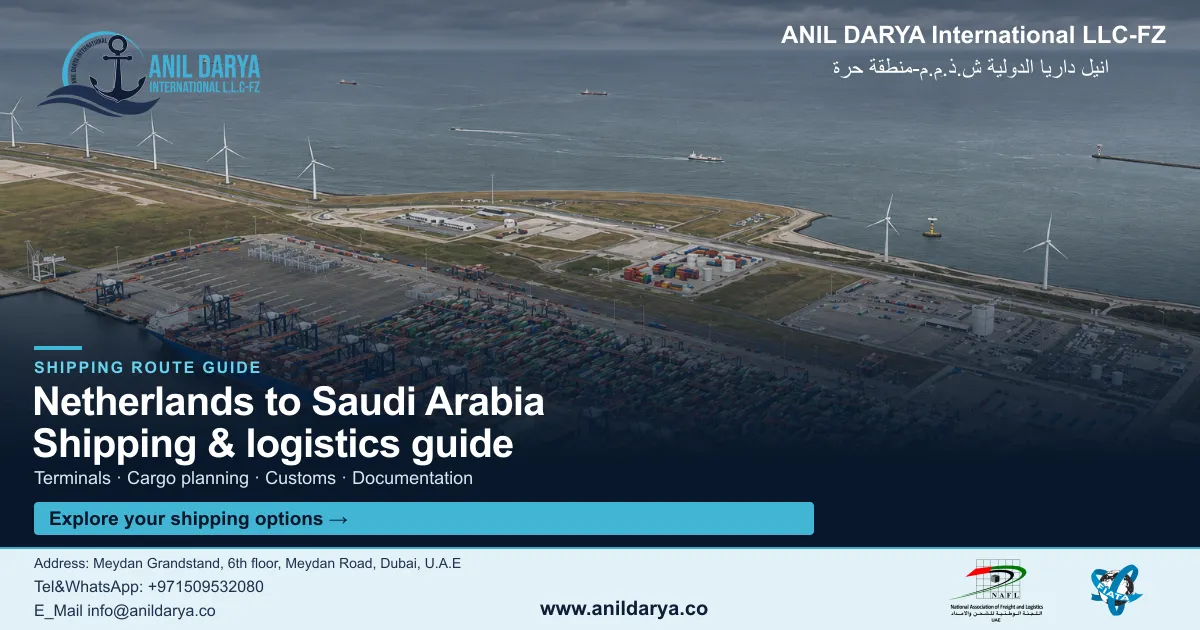
Shipping from Netherlands to Saudi Arabia almost always starts at Rotterdam, where Dutch cargo and boxes brought in by barge or rail board a deep-sea vessel for Jeddah or King Abdullah Port on the Red Sea, or for Dammam and Jubail on the Gulf coast. The Dutch exporter files its export declaration in the DMS customs system, and the Saudi consignee's broker clears the goods on Fasah with a SABER certificate, or SFDA approval for food, paying Saudi duty and 15% VAT. Anil Darya runs this lane from Dubai as a cross-trade: we book the ocean freight with the line and keep the Dutch shipper, the carrier and the Saudi broker working to one plan.
Netherlands to Saudi Arabia shipping at a glance
| Item | Detail |
|---|---|
| Usual mode | Sea freight: FCL, LCL, reefer for dairy, flat rack and breakbulk for machinery, tankers for fuels and oils |
| Dutch load port | Rotterdam for deep-sea containers; Amsterdam and Moerdijk cargo usually reaches Rotterdam by barge, truck or rail first |
| Saudi discharge ports | Red Sea: Jeddah Islamic Port, King Abdullah Port. Gulf: King Abdulaziz Port Dammam, Jubail |
| Routing | Some sailings call the Saudi port directly, others connect through a hub; the quote states which |
| Dutch export filing | Export declaration in DMS, lodged by the exporter or its forwarder or customs agent; EORI number required |
| Saudi import filing | Fasah declaration, at least 48 hours before the vessel reaches the port of entry |
| Conformity | SABER product and shipment certificates for regulated goods; SFDA rules and Ghad registration for food |
| Duty | Ad valorem on CIF value; GCC common external tariff of at least 5% on most goods, with higher lines in the Saudi tariff in force since 27 November 2025 |
| Import VAT | 15%, charged on customs value plus duty and other charges |
| Trade preference | None: there is no EU-GCC free trade agreement in force |
| Saudi clearance | Done by the consignee or its licensed Saudi broker, agreed before the cargo is booked |
Who does what on a Netherlands to Saudi Arabia cross-trade
The goods sail from a Dutch quay to a Saudi quay. Nothing has to pass through the UAE. Our part is the booking, the carrier paperwork and the coordination, all handled from our Dubai office.
| Task | Responsible party |
|---|---|
| Choosing the sailing, booking space and equipment with the line | Anil Darya |
| Collection in the Netherlands, stuffing, barge or truck to Rotterdam, DMS export declaration | The Dutch seller or its origin forwarder, working to the cut-offs we pass on |
| Bill of lading | The carrier's own B/L, issued and released to you through Anil Darya as agent for the line |
| SABER certificates or SFDA food approvals | The Saudi importer, with product data from the Dutch maker |
| Fasah declaration, duty, VAT, delivery order | The consignee or its Saudi customs broker |
| Keeping shipper, line and broker in step until release | Anil Darya |
Because many shipping lines appoint Anil Darya as their agent, a Rotterdam to Jeddah B/L for your cargo is the line's own document, and its issue and release are handled at our desk. You do not get a forwarder's house bill on this lane.
Who pays which leg depends on the Incoterm. A Dutch seller selling FCA Rotterdam or FOB Rotterdam clears export and hands over the cargo, and the Saudi buyer pays the sea freight. On CFR or CIF Dammam, the seller pays freight to Dammam, while Saudi duty, VAT and port costs remain with the buyer. A DDP sale is hard to deliver here, because the Dutch seller would need a Saudi importer of record. Our article on Incoterms 2020 in sea freight shows where cost and risk pass under each term.
Dutch ports: why most cargo sails from Rotterdam
Rotterdam is the port that deep-sea container lines to the Middle East use. In 2025 it handled 428.4 million tonnes of cargo and 14.2 million TEU, plus 25.6 million tonnes of Ro-Ro and 6.1 million tonnes of other breakbulk, according to the Port of Rotterdam Authority. Its container terminals sit on the Maasvlakte, at the mouth of the Nieuwe Waterweg.
| Dutch port | Role on this lane | What to plan |
|---|---|---|
| Rotterdam (Maasvlakte terminals) | Main load port for FCL and LCL to Jeddah, King Abdullah Port and Dammam; also a breakbulk and heavy-lift port | Terminal named on the booking, gate-in before the cut-off, Portbase pre-notification by the haulier |
| Amsterdam | Breakbulk, bulk and project cargo; few deep-sea container calls | Containers from the Amsterdam area usually travel to Rotterdam by barge or truck |
| Moerdijk | Inland port between Rotterdam and Antwerp with chemicals and logistics parks | Ocean ships for the Gulf do not call; boxes move to a deep-sea terminal by barge, rail or road |
| Antwerp-Bruges (Belgium) | An alternative load port across the border when its sailing fits better | An EU export declaration is still needed; check which customs office of exit applies |
Inland links shape the price. The Port of Rotterdam says barges link it every day with more than 100 European destinations, and rail reaches the German border in about three hours. For heavy loads from inland factories, a barge to the deep-sea terminal often costs less than a truck.
Saudi ports for cargo from the Netherlands
Pick the Saudi port by the consignee's city, not by the cheapest ocean rate. A box landed on the wrong coast must cross the country by truck.
| Port | Coast | Key facts | Suits consignees in |
|---|---|---|---|
| Jeddah Islamic Port | Red Sea | Red Sea Gateway Terminal: 6.2 million TEU container capacity on a 3,300 m quay, plus a 12-berth multipurpose terminal for containers, bulk and breakbulk | Jeddah, Makkah, Madinah, the western region |
| King Abdullah Port | Red Sea | Privately owned port at King Abdullah Economic City; 5.5 million TEU current container capacity, a Ro-Ro terminal and a bonded re-export zone | KAEC, Rabigh, distributors serving the west |
| King Abdulaziz Port, Dammam | Gulf | 43 berths, a container terminal and two general cargo terminals, and a rail line to the dry port in Riyadh | Dammam, Khobar, Riyadh, the Eastern Province |
| Jubail | Gulf | Commercial and industrial ports next to Jubail Industrial City | Petrochemical plants and industrial projects |
Dutch dairy and food for supermarket chains in Riyadh normally go through Dammam and on by rail or reefer truck. Machinery for a plant near Jeddah should land at Jeddah. Write the discharge port into the sales contract, because a change after loading is slow and charged.
Direct calls and transhipment from Rotterdam
Jeddah and King Abdullah Port lie on the main Europe to Asia container route, so some Rotterdam sailings call there directly. In May 2026 Mawani, the Saudi ports authority, announced CMA CGM's Ocean Rise Express as a new Jeddah Islamic Port service, with Rotterdam among the European ports on its port list. We confirm the current call on each booking.
Dammam and Jubail are less often called directly from North Europe. Boxes for the Gulf coast frequently connect at a hub and finish on a second ship. A direct call gives a firmer arrival date. A connection gives more sailing choices but adds a handover. In both cases the line's B/L covers the whole trip from Rotterdam to the Saudi port.
[AMIR-FACT: the shipping lines we actually book from Rotterdam to Jeddah, King Abdullah Port and Dammam in 2026, which call direct and which connect (and at which hub), and our real port-to-port days for FCL and LCL]
Sea freight from the Netherlands to Saudi Arabia by cargo type
Saudi trade data for 2025 puts machinery, fuels and oils, and dairy at the top of imports from the Netherlands. Each of those needs different equipment and paperwork.
Full containers and LCL
Machinery spares, packaging material, chemicals in drums and consumer goods usually move in 20ft or 40ft boxes. LCL works for samples and small orders, but every LCL lot clears Saudi customs on its own documents and its own SABER shipment certificate, so the paperwork is as heavy as for a full box. If you buy from several Dutch suppliers, ask the seller's forwarder to group the lots into one container in Rotterdam. Our FCL vs LCL guide helps with that choice, and our sea freight service lists the container types we book.
Saudi ports now require containerised imports to be palletised. The rule started on 8 May 2025 with a 12-month phase-in, and non-palletisable bulk, heavy machinery and oversized items can be exempted with approval. Ask the Dutch packer to load on pallets unless the broker confirms an exemption.
Dairy and other reefer cargo
Chilled dairy travels in reefers; milk powder usually travels dry. Before loading, the Saudi importer must have its establishment and products registered with the SFDA on the Ghad platform. Food that needs it must carry a halal certificate from a centre the Saudi Halal Center recognises. A reefer that arrives without these waits on power and storage.
Machinery, breakbulk and project cargo
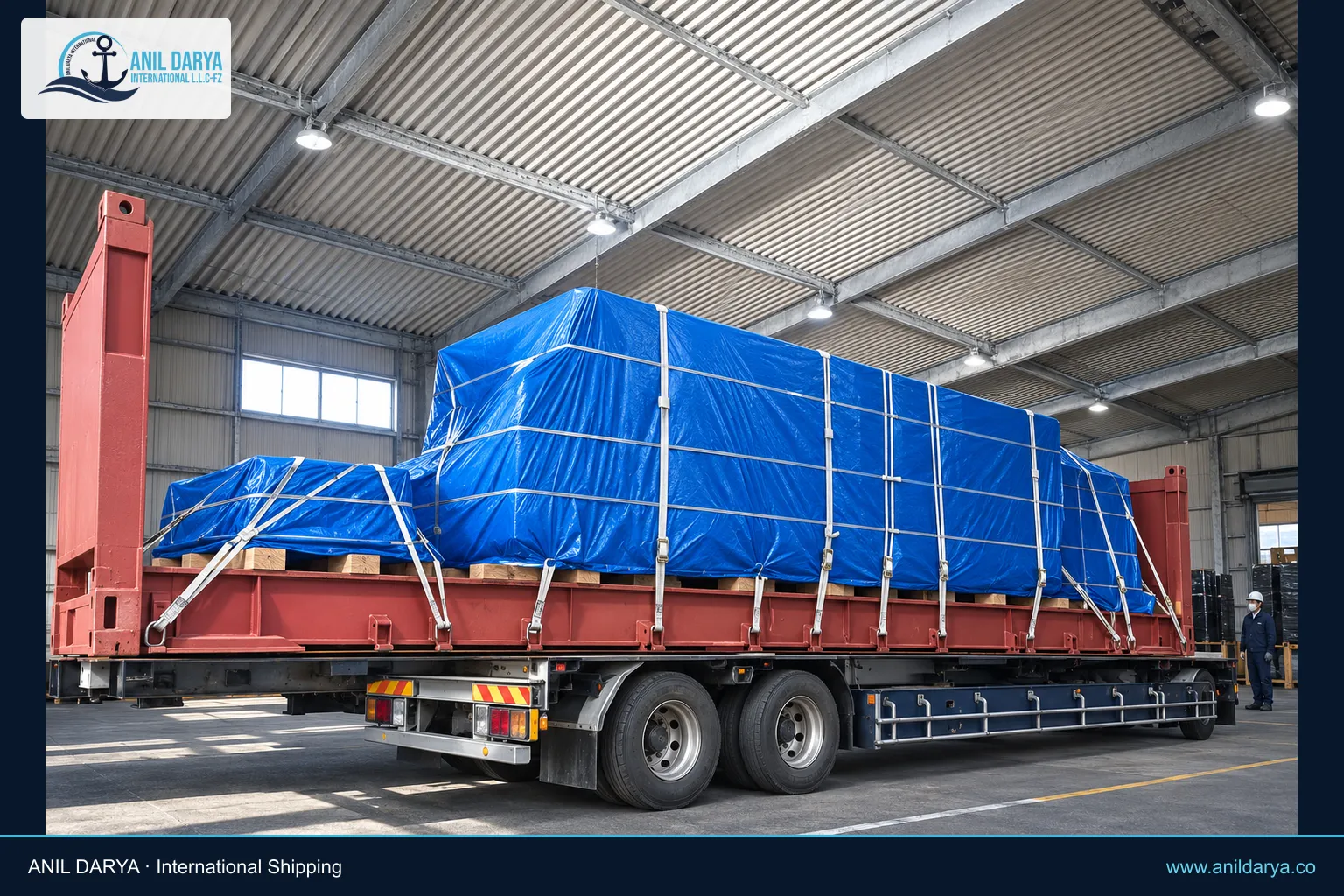
Dutch process equipment, dredging parts, greenhouse structures and plant modules often exceed container size. Rotterdam has a large breakbulk and heavy-lift sector, and Jeddah's multipurpose terminal takes breakbulk. Pieces that fit a flat rack or open top get more sailings; larger units need a breakbulk vessel.
- Collect drawings, weights, centre of gravity and lifting points per piece.
- Choose flat rack, open top or breakbulk, and get written acceptance from the line.
- Agree lashing and stowage with the line and the Rotterdam terminal.
- Keep one packing list that matches the invoice, the B/L and the SABER data.
- Agree discharge, storage and the inland road permit with the consignee's broker and haulier.
Our break bulk and project cargo desk plans the carrier side of oversized moves.
Fuels, oils and bulk liquids
Mineral fuels and oils were the second largest import group from the Netherlands in 2025. Most of that trade moves in tankers on charter terms, not in containers. If you need a parcel tanker or bulk vessel, speak to our bulk cargo team.
Dangerous goods
Paints, resins, cleaning chemicals, lubricants in drums and lithium batteries in equipment ship as dangerous goods under the IMDG Code. The 2024 edition has been mandatory since 1 January 2026. The Dutch shipper supplies the UN number, class, packing group, Safety Data Sheet and a signed DG declaration. In Rotterdam, DG cargo has to be reported through Portbase, and the Saudi importer may need a permit for chemicals. Our dangerous goods desk checks the file and gets the line's approval before the booking is confirmed.
Export from the Netherlands: what the Dutch shipper files
Export formalities in the Netherlands belong to the seller or its origin forwarder. We agree times with them, but we do not file in the Netherlands.
- EORI number. Dutch Customs makes it mandatory for the exporter and the declarant, except for private persons. It is requested through the Customs National Helpdesk.
- Export declaration. The goods are declared to Dutch Customs in DMS, which replaced the older AGS system and became mandatory from 1 July 2024. Business.gov.nl advises less experienced exporters to let a forwarder or transport company handle it.
- Exit from the EU. Under EU rules the declaration goes electronically through the Automated Export System to the export office. The customs office of exit, usually at the port, supervises departure and confirms exit to the export office.
- Zero-rate VAT proof. The Dutch invoice can show 0% VAT, but the seller must keep proof that the goods left the EU, such as the export declaration and freight documents.
- Strategic goods. Dual-use items need an export licence from the CDIU, the central import and export office of Dutch Customs, which decides on behalf of the Ministry of Foreign Affairs. It handles applications within eight weeks, so check controlled items before you accept the order.
Certificate of origin and document stamps
The Netherlands Chamber of Commerce (KVK) issues certificates of origin and handles legalisation of export documents. ZATCA says a certificate of origin can be skipped only when the origin is clearly established, so most Saudi brokers ask for one. Saudi buyers also often want the invoice and certificate legalised. Ask the broker which stamps it needs before the cargo leaves, because consular steps take time.
Saudi import customs for goods from the Netherlands
Saudi customs is run by the Zakat, Tax and Customs Authority (ZATCA). Every import is declared on the Fasah platform, by the importer itself or by a customs broker.
Documents the Saudi broker needs
| Document | Issued by | Points to check |
|---|---|---|
| Commercial invoice | Dutch seller | Full description, 12-digit Saudi tariff code if known, origin, Incoterm, net and gross weights |
| Bill of lading | Shipping line, released through us | Consignee and notify party match the importer on Fasah |
| Certificate of origin | KVK | Origin matches the invoice; legalised if the buyer asks |
| Packing list | Dutch seller | Pallet count, marks and weights match the cargo |
| SABER shipment certificate | Saudi importer, through SABER | Issued before the customs declaration |
| Health certificate, halal certificate | Competent Dutch authority or halal certifier | Food only, as SFDA requires for the product |
| Product registration or permit | Saudi importer | Medicines, cosmetics, chemicals and other controlled goods |
ZATCA wants the declaration and documents on Fasah at least 48 hours before the ship reaches the port of entry. With a Rotterdam departure, that means the broker should have final papers while the vessel is still at sea.
SABER for regulated products
SABER is the online conformity system of the Saudi Standards, Metrology and Quality Organization (SASO). The importer registers a product certificate for each regulated product and then requests a shipment certificate for each consignment. SABER lists SAR 500 to register a product certificate and SAR 350 to issue a shipment certificate, both before VAT. From 1 October 2025 the shipment certificate must be applied for before the customs declaration. The Dutch government's export agency RVO also notes that many products need testing, often by accredited firms in the Netherlands. A CE mark helps with test reports, but it is not a SABER certificate.
SFDA rules for Dutch food
Food is the SFDA's field. Its import conditions need the importer's establishment and products registered on Ghad, a licensed warehouse, an invoice showing quantities, expiry dates and batch numbers, a health certificate, and a halal certificate for products that need one. Meat, poultry and gelatine need a halal slaughter certificate from a centre accredited by the Saudi Halal Center. RVO adds that labels must show the country of origin.
Duty under the Saudi tariff
Saudi Arabia applies the GCC common external tariff of at least 5% to most goods from outside the GCC, charged on the CIF value. Rice, bulk animal feed, livestock, fresh red meat, coffee and tea enter duty free, and some food lines can reach 40% where local production is high. A new Saudi tariff came into force on 27 November 2025, and rates on some machinery, chemicals and steel now sit well above 5%. Since January 2025 the tariff uses 12-digit codes. Dutch goods get no preference, because the European Commission says EU-GCC free trade talks were suspended in 2008. Have the broker confirm the code and rate before you price the order.
Import VAT
Saudi import VAT is 15%. ZATCA sets the base as the customs value plus duty, excise and other charges, so the freight from Rotterdam and the duty both raise the VAT bill. An approved VAT-registered importer can account for import VAT in its VAT return instead of paying it at clearance.

Confirm the Saudi broker before the cargo leaves Rotterdam
We do not sell customs clearance in Saudi Arabia. The consignee or its own licensed broker clears the goods, so we settle who that is before we release the booking to the Dutch seller.
- The consignee gives us its legal name, importer details and the broker it uses.
- The broker confirms the job and sends its document list for this cargo.
- The importer confirms SABER or SFDA status for every line, plus any permits.
- We then release the booking and send the Rotterdam cut-offs to the seller's forwarder.
Skipping this costs money. A container that lands with no broker, no shipment certificate or no food registration builds up port storage and line demurrage once free days run out. See our article on demurrage and detention.
Goods that are restricted or banned in Saudi Arabia
ZATCA needs permits from the competent body for restricted goods and turns away goods that are banned, counterfeit or adulterated. Dutch exports that most often need extra approval are:
- Food and dairy products, through the SFDA.
- Medicines, medical devices and cosmetics.
- Chemicals, fertilisers and pesticides.
- Telecom and IT equipment.
- Seed potatoes and other products with their own product rules.
IHK Cologne's import guide for Saudi Arabia lists pork products, alcoholic drinks and foods containing alcohol, non-biodegradable plastic bags, used household appliances for resale and ozone-depleting substances among banned goods. Gelatine for food also needs a halal slaughter certificate under SFDA rules.
Using Dubai when shipping from the Netherlands to Saudi Arabia
Most Dutch cargo for the Kingdom should go straight to the Saudi port. Dubai is worth a look in three cases.
| Option | How it works | Who it suits |
|---|---|---|
| Connection at Jebel Ali | The line lands the box at Jebel Ali and loads it on a feeder to Dammam or Jubail; the B/L still runs Rotterdam to the Saudi port | Gulf-coast cargo when the best sailing connects there |
| Consolidation in Dubai | Dutch lots and goods from other origins meet in Dubai and go on to Saudi Arabia as one shipment | Buyers mixing European and Asian suppliers |
| Free zone stock | Goods sit in JAFZA and go to Saudi customers in smaller lots | Distributors selling across the GCC |
Our Jebel Ali port guide covers the hub, and our JAFZA re-export article covers the free zone. When goods enter or leave the UAE on one of these routes, Dubai customs clearance is a service we provide for a fee.
Duty works differently by route. Under the GCC customs union, duty is collected at the first point of entry and is not charged again in another member state when payment is proven. Goods kept in a free zone and re-exported have not paid UAE duty, so Saudi duty falls due on arrival. Saudi VAT applies in every case, because ZATCA treats goods from another GCC state as imports. Settle the treatment with the Saudi broker first.
[AMIR-FACT: whether we currently move any Netherlands to Saudi Arabia cargo through Jebel Ali (connection, Dubai consolidation or JAFZA stock), with which line or feeder, and how many days it adds against a direct sailing]
What decides the cost of shipping from the Netherlands to Saudi Arabia
Rates change with every sailing, so we do not publish them. This is what makes up the landed cost.
| Cost element | Usually paid by | What drives it |
|---|---|---|
| Collection, barge or truck to Rotterdam, terminal handling, DMS filing | Seller under FCA or FOB, buyer under EXW | Distance from the terminal, barge or road, filing fee |
| Ocean freight and surcharges | Depends on the Incoterm | Box size, reefer or special equipment, season, direct or connecting service, fuel factor |
| Packing | Seller | Pallets for the Saudi palletising rule, export crates, lashing |
| Documents | Seller, often recharged | KVK certificate of origin, legalisation, courier of originals |
| Conformity and food approvals | Saudi importer | SABER fees, testing, SFDA registration, halal certification |
| Saudi port and broker | Buyer | Terminal handling, delivery order, inspection, broker fee |
| Duty and VAT | Consignee or its broker | 12-digit tariff line, CIF value, 15% VAT on the duty-paid value |
| Delays | Party that caused them | Demurrage, detention, reefer power, storage |
Duty and taxes at destination are paid by the consignee or its broker.
How to ship from the Netherlands to Saudi Arabia, step by step
- Agree the Incoterm, the Saudi port and the delivery city with your trading partner.
- Send us the cargo details: commodity, HS code, weights, sizes, Dutch pickup address, ready date, and any DG, reefer or oversized items.
- Receive our routing and quote: line, Rotterdam terminal, direct or connecting, and any Dubai option.
- Confirm the Saudi broker, and have it confirm the documents, SABER or SFDA status and permits.
- Book the space. For DG, reefer and out-of-gauge cargo we get the line's approval first.
- The Dutch seller or its forwarder palletises, stuffs, moves the box to Rotterdam and files the DMS export declaration before the cut-off.
- The seller gets the KVK certificate of origin and any stamps; the importer gets the SABER shipment certificate or food approvals.
- We check the draft B/L against the invoice and packing list, then the line's B/L is issued and released through us.
- The Saudi broker files on Fasah at least 48 hours before arrival and arranges payment of duty and VAT by the consignee.
- The broker takes the delivery order, the cargo is released and delivered, and the empty box goes back within free time.
[AMIR-FACT: one real Netherlands to Saudi Arabia cross-trade shipment we booked from Dubai (cargo, Dutch load port, Saudi port, equipment, door-to-door days and the problem we solved), cleared for publication]
Our Dubai freight forwarding team runs these steps.
Checklist before the box leaves Rotterdam
- Incoterm, discharge port and delivery city fixed in the contract.
- Saudi consignee and broker confirmed, with the broker's document list.
- 12-digit tariff line and duty rate checked for each product.
- SABER product certificates in place and the shipment certificate requested.
- For food: Ghad registration, health certificate and halal certificate ready.
- Exporter's EORI number valid and the DMS declaration filed in time.
- Dual-use check done, with a CDIU licence if needed.
- KVK certificate of origin and any legalisation arranged.
- For DG: SDS, DG declaration and line approval. For oversized cargo: drawings and lifting points.
Mistakes to avoid on the Dutch-Saudi lane
- Shipping before destination clearance is agreed. Without a ready broker and importer, the box waits at the Saudi port while charges grow.
- Treating a CE mark as Saudi approval. SABER needs its own certificates.
- Sending dairy before the importer has SFDA registration and a halal certificate where needed.
- Floor-loading cartons. Saudi ports now expect palletised containers unless an exemption is approved.
- Pricing on an old 5% rate. The tariff that took effect on 27 November 2025 raised some machinery and chemical lines.
- Expecting an EU origin discount. No EU-GCC trade agreement is in force.
Frequently asked questions
Which ports are used when shipping from the Netherlands to Saudi Arabia?
Rotterdam is the usual load port, with Amsterdam and Moerdijk cargo fed to it by barge or truck. In Saudi Arabia the cargo lands at Jeddah or King Abdullah Port in the west, or at Dammam or Jubail in the east.
How long does sea freight from Rotterdam to Saudi Arabia take?
It depends on the line, the Saudi port and whether the box connects at a hub. Red Sea ports are usually reached sooner than Dammam or Jubail. Every quote we send states the line's current schedule for that sailing.
What duty does Saudi Arabia charge on Dutch goods?
Most goods pay at least 5% on the CIF value under the GCC common external tariff, but some machinery, chemical and steel lines are higher under the tariff in force since 27 November 2025. Dutch origin gives no reduction, as no EU-GCC trade agreement exists.
Is VAT charged on imports from the Netherlands?
Yes. Saudi Arabia charges 15% VAT on the customs value plus duty and other charges. Approved VAT-registered importers can account for it in their VAT return.
Can I ship Dutch cheese or milk powder to Saudi Arabia?
Yes, if the Saudi importer has its establishment and products registered with the SFDA on Ghad and the shipment has a health certificate and, where required, a halal certificate. Chilled products need a reefer set to the right temperature.
Who files the export declaration in the Netherlands?
The Dutch exporter or its forwarder or customs agent files it in DMS, using the exporter's EORI number. Anil Darya coordinates the cut-off times but does not file in the Netherlands.
Who issues the bill of lading when Anil Darya books the lane?
The shipping line issues its own B/L from Rotterdam to the Saudi port. We act as agent for many lines, so its issue and release go through our Dubai office.
Does Anil Darya handle Saudi customs clearance?
No. The consignee or its own Saudi broker clears the goods and pays duty and VAT. We confirm that arrangement before the booking is released and coordinate documents until the delivery order.
Get a quote for shipping from the Netherlands to Saudi Arabia
Tell us the Dutch pickup point, the Saudi delivery city, the cargo and the ready date, and your broker's name if you have one. Use our freight rate inquiry form, or contact our team to plan a reefer, DG or project shipment.
Sources
- ZATCA: Import instructions
- ZATCA: Importation rules
- ZATCA: Guideline on imports and exports under VAT provisions
- SABER platform (SASO): certificate fees
- SFDA: Conditions and requirements for food clearance
- US International Trade Administration: Saudi Arabia import tariffs
- US International Trade Administration: Saudi Arabia import requirements and documentation
- IHK Koeln: Import requirements in Saudi Arabia
- RVO: Export rules and product requirements for Saudi Arabia
- Business.gov.nl: Exporting goods outside the EU
- Dutch Customs: DMS
- Dutch Customs: EORI number requirements
- Government of the Netherlands: Export licences for strategic and dual-use goods
- European Commission: What is exportation
- European Commission: EU trade relations with the Gulf region
- Port of Rotterdam: 2025 throughput
- Port of Rotterdam: Inland shipping
- Port of Rotterdam: Rail transport
- Port of Rotterdam: Breakbulk
- Portbase: Dangerous goods notification
- Red Sea Gateway Terminal: Terminal and services, Jeddah Islamic Port
- King Abdullah Port: capacity, terminals and logistics zones
- Saudipedia: King Abdulaziz Port in Dammam
- Arab News: Mawani adds Ocean Rise Express service at Jeddah Islamic Port
- UAE ICP: Customs union for GCC states
- DataSaudi: Saudi imports from the Netherlands 2025
- IMO: IMDG Code 2024 edition
Reviewed: 11 November 2026