
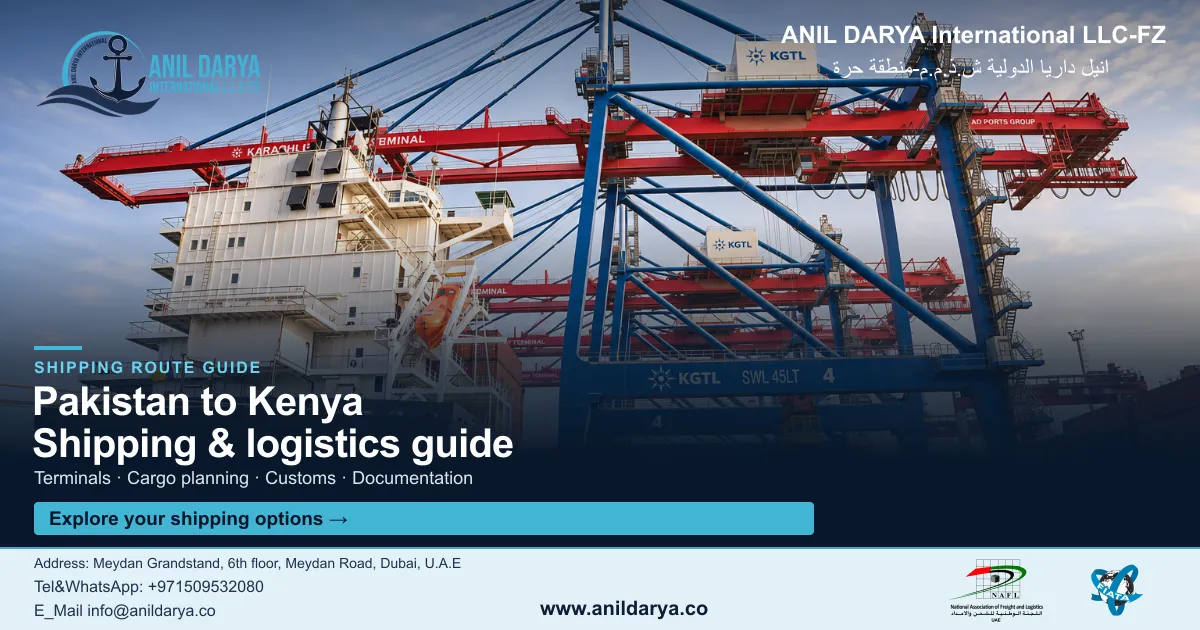
Shipping from Pakistan to Kenya is a sea lane: a container loads at Karachi or Port Qasim and discharges at the Port of Mombasa, either on a loop that sails across or through a hub such as Jebel Ali. The Pakistani shipper files the export Single Declaration on Pakistan Single Window, regulated goods need a KEBS certificate of conformity issued in Pakistan before loading, and the Kenyan consignee's clearing agent declares the cargo in KRA's iCMS. We book the ocean freight from Dubai and line up both ends before the box moves.
Pakistan to Kenya shipping at a glance
| Item | Detail |
|---|---|
| Lane type | Cross-trade: Pakistani origin, Kenyan destination, booked and coordinated by Anil Darya from Dubai |
| Pakistani load ports | Karachi (PKKHI) and Port Qasim (PKBQM) |
| Kenyan discharge port | Mombasa, run by Kenya Ports Authority, with rail on to the Nairobi inland container depot; Lamu for some services |
| Hub example from a carrier brochure | ONE: Karachi to Jebel Ali in 3 days (PGX), then Jebel Ali to Mombasa in 14 days (MIM), January 2025 brochure |
| Pakistani export filing | Export Single Declaration on Pakistan Single Window (PSW), by the trader or its licensed customs agent |
| Kenyan conformity scheme | KEBS PVoC: certificate of conformity from SGS or Intertek in the Pakistan zone, before shipment |
| Kenyan customs system | Integrated Customs Management System (iCMS), used by the consignee's clearing agent |
| Duty basis | EAC Common External Tariff: 0%, 10%, 25% and 35% bands, higher for sensitive goods such as rice |
| VAT on imports | 16% |
| Trade preference | No Pakistan to Kenya or Pakistan to EAC agreement listed by the WTO; plan on the full CET rate |
| Bill of lading | The shipping line's own B/L, issued and released to you through us as the line's agent |
How a Pakistan to Kenya cross-trade booking works
The goods do not need to stop in the UAE. We run the job from Dubai because we work with many lines on the Pakistan, Gulf and East Africa trades, so one desk keeps the Karachi shipper and the Mombasa clearing agent on the same plan.
Each party has a fixed job on this lane:
| Task | Who does it |
|---|---|
| Pickup from the mill or factory, stuffing, trucking to Karachi or Port Qasim | The Pakistani shipper or its origin agent |
| Export Single Declaration on PSW, bank financial instrument | The shipper or its licensed customs agent |
| PVoC request, inspection and certificate of conformity | The exporter or importer, with SGS or Intertek in Pakistan |
| Ocean freight to Mombasa and follow-up of the box | Anil Darya books it with the line from Dubai |
| Bill of lading | The carrier issues its own B/L; we release it to you as the line's agent |
| Kenyan marine insurance, iCMS entry, duty, VAT, levies and delivery | The consignee and its Kenyan clearing agent |
We do not issue a house bill on this lane. You receive the shipping line's B/L, released through us. That matters for Pakistani exports paid through a bank: Maersk's Pakistan export page says telex release is possible only under the carrier's master B/L with bank documents, not when a forwarder's house bill is involved. Agree early whether you need originals, telex release or a sea waybill, because the bank and the buyer must accept the same choice.
The Incoterm sets who pays what. On FOB Karachi the Kenyan buyer pays the sea freight. On CFR Mombasa the Pakistani seller pays it. CIF needs care here, because Kenya now requires local marine cargo insurance on every import (see the customs section), so a CIF policy bought in Pakistan does not replace the Kenyan cover. Our guide to Incoterms 2020 for sea freight shows where cost and risk pass under each term.
Which ports to use for shipping from Pakistan to Kenya
Both Pakistani gateways are in the Karachi area, about an hour's drive apart. Pick the one your carrier calls at and the one closest to where the box is stuffed.
| Port | What the official sources say | Fits best for |
|---|---|---|
| Karachi Port | Karachi Port Trust: three wharves, 34 berths, container terminals KICT, KGTL and SAPT, designed depth 13 to 16 m, 2.28 million TEU in FY 2023-24 | General containers; ONE's PGX loads at Karachi Gateway Terminal |
| Port Qasim | Port Qasim Authority: 49 km channel, ships up to 13 m draught, 18 berths; DP World's QICT designed for 1.4 million TEU a year; Marginal Wharf for machinery and project cargo | Reefers, heavy lifts, industrial cargo from the Bin Qasim area |
| Mombasa (Kenya) | Kenya Ports Authority: 22 berths; container berths 16-18 at 12.5 m allowable draft and 21-22 at 14.5 m; dangerous cargo handled under international rules | Almost all Kenyan imports from Pakistan |
| Lamu (Kenya) | Kenya Ports Authority: three operational berths of 400 m | Only when a carrier offers it; most Nairobi cargo still goes through Mombasa |
Inland Kenya changes how you book. KPA links Mombasa to the Nairobi inland container depot by the standard gauge railway, and a box on a through bill of lading to Nairobi ICD moves inland under customs control. For cargo cleared at the coast, KPA stopped clearing domestic containers inside the port from 10 December 2025 (KPA customer notice of 4 December 2025, as published by Maersk). The cargo owner must name a container freight station at the port of loading, so the CFS name belongs in your Karachi booking instructions. Boxes with no CFS named are allocated to one by the CFS association.
Lines also set yard rules in Pakistan: Maersk, for instance, takes reefers only at its Port Qasim yard and does not move DG by rail or truck to inland yards. Ask at booking.
Direct loops and the Jebel Ali connection
Lines add, change and drop Pakistan to East Africa calls often, so we print only rotations read on a carrier's own schedule or brochure. ONE's January 2025 Middle East brochure shows a two-ship routing through Dubai:
| Leg | Service and rotation | Published transit (westbound) |
|---|---|---|
| Karachi to Jebel Ali | PGX (Pakistan Gulf Express): Karachi KGTL, Jebel Ali T2, Hamad, Dammam | 3 days |
| Jebel Ali to Mombasa | MIM: Jebel Ali T3, Mundra, Nhava Sheva, Mombasa, Beira, Maputo | 14 days |
We checked both figures against the call days in the same brochure. PGX leaves Karachi on a Wednesday and arrives at Jebel Ali on a Saturday. MIM leaves Jebel Ali on a Wednesday and reaches Mombasa on the Wednesday two weeks later, after calling Mundra and Nhava Sheva. The legs are not a door-to-door time: the box also waits at Jebel Ali for the connection, moving from Terminal 2 to Terminal 3. Check the current schedule before you quote either number.
In December 2024, trade press reported SeaLead's DUKE service (Karachi, Jebel Ali, Mombasa, Karachi), first sailing 24 December 2024. We could not open a SeaLead schedule to confirm it still runs, so treat it as history until a current schedule shows it.
[AMIR-FACT: the shipping lines we actually book from Karachi and Port Qasim to Mombasa in 2026, whether each sails direct or connects at Jebel Ali or another hub, and the real port-to-port days we see]
Sea freight from Pakistan to Kenya: FCL, LCL and special cargo
Most of this trade moves as full containers. Bagged rice reaches a 20ft box's weight limit before it fills the space, and Maersk's Pakistan page says payload must stay within the CSC plate. Textiles, garments and sports goods are lighter and suit a 40ft or 40ft high cube. Our FCL vs LCL guide shows where one container beats several small lots.
LCL works for samples, spares and first orders. Each LCL consignee pays its own unpacking at the Kenyan CFS. Our sea freight team books both FCL and LCL.
Dangerous goods
Paints, solvents, some chemicals and lithium batteries in solar kits are dangerous goods. The shipper must give the UN number, class, packing group and a Safety Data Sheet, and the carrier must accept the booking before stuffing. KPA handles dangerous cargo under international rules, but each line decides what it accepts. Our dangerous goods desk checks the papers and gets the line's approval first.
Machinery, project cargo and reefers
Port Qasim's Marginal Wharf handles machinery and project cargo. For pieces too big for a flat rack, we need drawings, weights and lifting points to find space and agree discharge at Mombasa. See our break bulk and project cargo service. For reefers, ask which Pakistani yard takes them and whether the Mombasa CFS has plugs.
The export side in Pakistan: PSW Single Declaration
Pakistan files exports on Pakistan Single Window. PSW says the export Single Declaration is filed by a trader or customs agent registered on PSW. Before filing, the trader needs:
- registration on PSW;
- an active account with an authorised dealer bank, with the bank profile linked to the PSW business profile;
- a financial instrument for the payment mode: letter of credit, open account or collection, or advance payment.
After the goods are cleared, the bank settles the financial instrument. If the Kenyan buyer pays by letter of credit, the B/L consignee and notify party must match the credit exactly.
Maersk's export page says a change of destination after loading needs prior Pakistan Customs approval, so get the Kenyan port right before cut-off. Also send the buyer a copy of the cleared Single Declaration: Kenya now asks importers to keep the export declaration (see below).
KEBS PVoC: the certificate issued in Pakistan
Kenya checks product quality before shipment through the KEBS Pre-Export Verification of Conformity programme. Regulated goods must arrive with a certificate of conformity (CoC). Pakistan sits in a PVoC zone with India and Sri Lanka, and both main contractors cover it:
- Intertek, whose Kenya appointment notice of 11 February 2026 lists Pakistan in its Indian Subcontinent zone, and says shipments are certified in the zone of the country of supply, wherever the request is filed;
- SGS, whose Kenya trade datasheet (last modified 5 June 2026) lists India, Pakistan and Sri Lanka in its zone, under a mandate that started on 19 February 2026.
The SGS datasheet sets out what matters for Pakistani cargo:
- three routes: Route A, where each shipment is tested and inspected; Route B, registration for one year for steady low-risk goods; Route C, a three-year licence for audited manufacturers;
- used clothes and used footwear go through Route A, the container must be sealed, the baling facility must be accredited by the PVoC contractor, and KEBS must register the importer;
- the request needs the IDF and UCR data from Kenya, a seller's declaration of conformity, test reports, an inspection report and the invoice;
- a CoC cannot be amended once issued;
- a consignment arriving in Kenya without a CoC faces a penalty of 5% of CIF value plus test costs, and KEBS can inspect at destination.
So the order is fixed: the buyer's agent lodges the IDF in Kenya, the seller requests the CoC, the cargo is inspected, and then the box sails. Ask the PVoC agent early whether your HS code is regulated. Medicines, pesticides, plants and seeds also need permits under their own laws.
Kenya customs clearance: agree it before the cargo sails
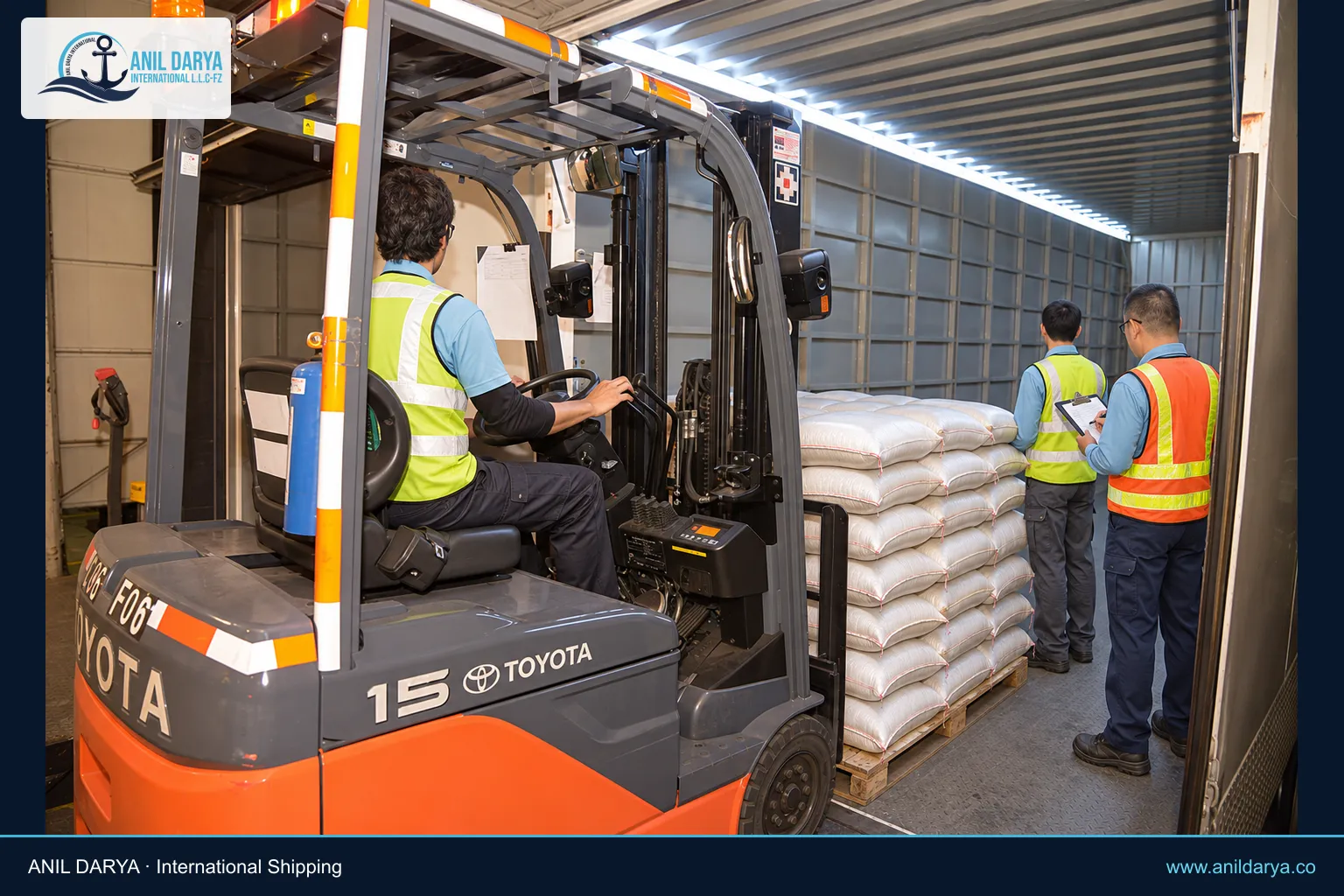
We do not clear goods in Kenya. KRA says importers must use a clearing agent, who lodges the documents in iCMS and clears the goods. So before we confirm a booking, we get the name of the consignee's agent and check it has what it needs. If nobody in Kenya is ready, we hold the booking rather than load the box.
KRA lists these documents for an import:
- Import Declaration Form (IDF);
- the customs entry;
- a certificate of conformity from the PVoC agent for regulated products;
- an import standards mark where it applies;
- the exporter's commercial invoice and pro forma invoice.
Three newer Kenyan rules touch this lane directly:
| Rule | Official source and date | What it means for Pakistani cargo |
|---|---|---|
| Certificate of origin on every import | KRA public notice, 23 September 2025: in force 1 July 2025, full compliance from 1 October 2025, under section 44A of the Tax Procedures Act | Send a certificate of origin from a competent authority in Pakistan with every shipment. KRA may accept an export declaration or a PVoC certificate in exceptional cases. |
| Export declaration kept by the importer | KRA, Finance Act 2026 summary: from 1 September 2026 | The Kenyan buyer must obtain and keep the export declaration from the country of export for at least five years. Send the cleared PSW Single Declaration with the documents. |
| Local marine cargo insurance | KRA public notice, 22 October 2026: enforced from 1 November 2026 | Every import needs a marine cargo policy from an insurer licensed by Kenya's IRA, sent through the Digital MCI system to iCMS before the entry. Non-compliant cargo is blocked. |
So a Pakistani seller offering CIF Mombasa still leaves the buyer to buy Kenyan cover, or the cargo will not clear. Settle this with the buyer and its broker before you sign.
[AMIR-FACT: how we confirm the Kenyan clearing agent and CFS nomination on Pakistan to Kenya bookings in practice, and what we ask the consignee to send before we release the booking]
Kenya import duty, VAT and levies
Kenya applies the East African Community Common External Tariff. The EAC sets bands of 0% for raw materials and capital goods, 10% for intermediate goods and 25% and 35% for finished goods, with higher rates for sensitive items. On top of duty, KRA charges VAT at 16%. The Import Declaration Fee and Railway Development Levy also apply to most imports. KRA's customs FAQ and later Kenyan laws state different rates for these two levies, so we do not print one here; your clearing agent quotes the rate in force on the day of entry. Excise duty applies to some products, and the Finance Act 2026 set excise of KES 40 per kilogram on specified imported sugar from 1 July 2026.
Rice, Pakistan's biggest export to Kenya, needs its own check. In the EAC Gazette of 30 June 2024, the CET rate for rice (heading 1006) was 75% or US$345 per tonne, whichever is higher. Kenya was allowed to apply 35% or US$200 per tonne, whichever is higher, for one year. That stay runs one year at a time, and Kenya has also used time-limited duty-free import windows for rice. Ask the broker for the rate in the current EAC Gazette and any open window before you price a contract.
[AMIR-FACT: the duty rate Kenya applies to Pakistani rice in November 2026 (EAC Gazette FY 2026/27 stay or any duty-free window), confirmed by a Kenyan clearing agent]
Other rates move each July. KPMG's summary of the EAC changes effective 1 July 2026 says Kenya raised duty on specified handbags from 25% to 35% and on selected furniture from 35% to 45%, so check the HS code rate for leather goods or furniture before pricing. Duty and taxes at destination are paid by the consignee or its broker.
On trade preferences, the WTO regional trade agreements database lists no agreement between Pakistan and Kenya, or between Pakistan and the EAC. Plan on the full CET rate. Goods made inside the EAC are treated differently, but that does not apply to Pakistani origin.
Typical cargo on this lane
A Pakistani press report of 21 April 2026, quoting the Ministry of Commerce's trade data portal, put Pakistan's exports to Kenya at US$319.9 million for July 2025 to March 2026, up from US$251.6 million a year earlier. Rice drove the growth. The same report names used clothing, pharmaceuticals, textiles, garments, sports goods and solar products among the other exports.
| Cargo | Usual box | What to check before booking |
|---|---|---|
| Rice in bags | 20ft dry, loaded to weight | Current rice duty or window, KEPHIS permit question, PVoC status, fumigation if the buyer asks |
| Used clothing in bales | 40ft or 40ft HC | PVoC Route A, accredited baling facility, sealed container, KEBS importer registration |
| Pharmaceuticals | 20ft dry or reefer if the product needs it | Kenyan Pharmacy and Poisons Board registration and permit, before shipment |
| Textiles, garments, sports goods | 40ft HC | PVoC CoC, labels, invoice detail by HS code |
| Solar panels and kits | 40ft HC | Lithium batteries as DG, PVoC CoC |
For rice and other plant products, ask KEPHIS early. KEPHIS says a plant import permit is needed before shipment from origin, applied for through its online system, so the buyer should check whether its product falls under that rule before the mill loads.
Restricted and prohibited goods in Kenya
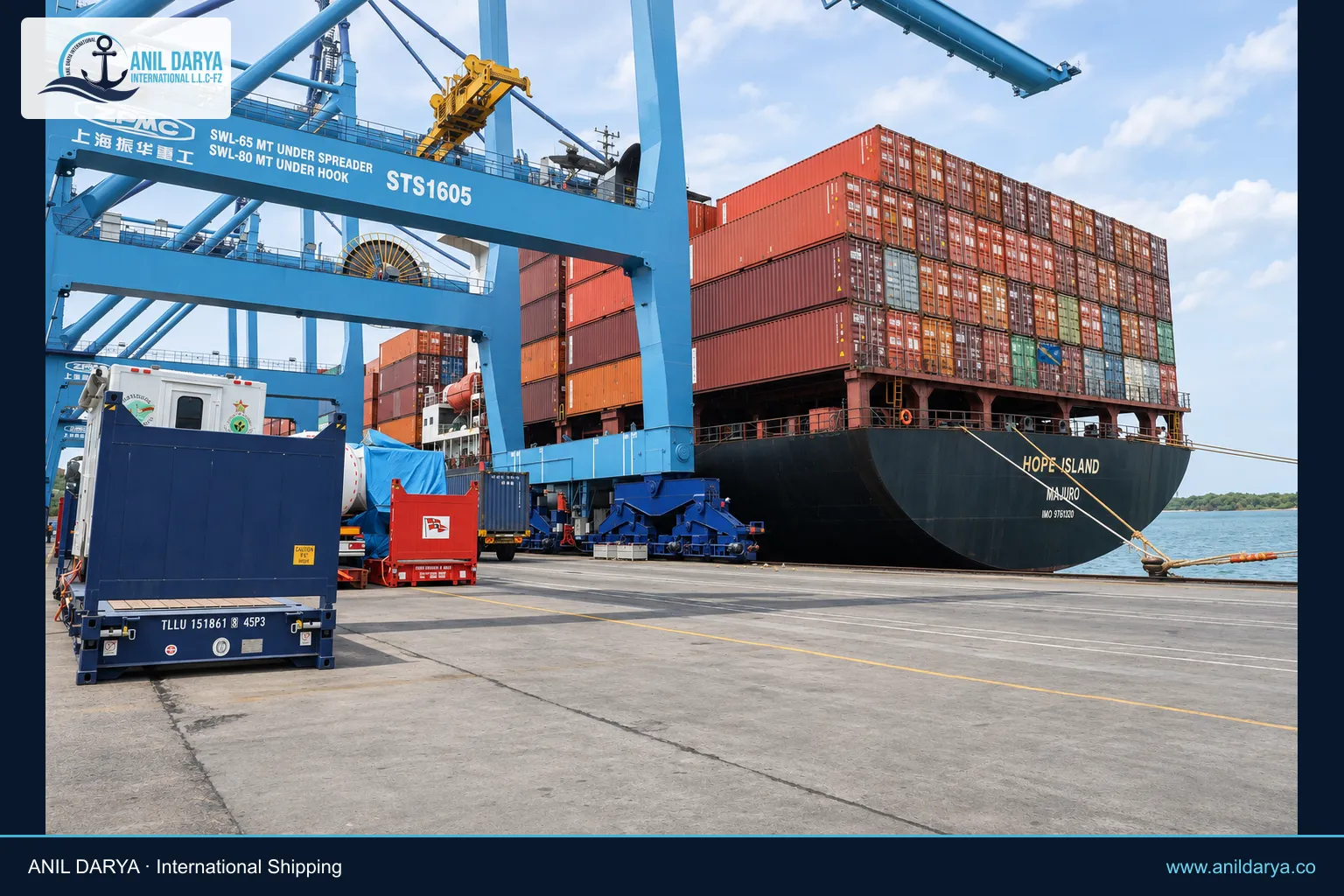
KRA publishes the prohibited and restricted lists under the Second Schedule of the EAC Customs Management Act. Part A lists prohibited goods, such as counterfeit goods and certain hazardous items. Part B lists restricted goods that need a permit or licence. For Pakistani cargo, the usual permit questions are:
- medicines and medical devices: Pharmacy and Poisons Board;
- plants, seeds and plant products: KEPHIS;
- pesticides and some chemicals: the Kenyan regulator for that product;
- used motor vehicles: KRA says vehicles over 8 years old are not allowed into Kenya.
Never let a box sail hoping a permit arrives while it is at sea. Storage, return or destruction costs fall on the cargo owner.
Routing through Dubai: transhipment, consolidation and re-export
The lane touches Dubai in three ways:
- Transhipment at Jebel Ali. On ONE's PGX and MIM, the box is discharged from one ship and loaded on the next at Jebel Ali port, under the carrier's bill of lading. Dubai Customs runs transit as its own declaration regime. Who files it, and whether anything is needed from you, depends on the line and the routing.
- Consolidation. If a Kenyan buyer purchases from suppliers in Pakistan and the Gulf, the goods can be gathered in Dubai and shipped as one container to Mombasa. That needs a Dubai Customs declaration, and Dubai customs clearance is a service we provide for a fee.
- Free zone stock. A trader can hold Pakistani stock in a Dubai free zone and re-export to Kenya in smaller lots. Our JAFZA re-export guide explains the process.
Watch the origin papers when goods stop in Dubai. Kenya wants a certificate of origin with every import, and the goods stay Pakistani in origin. Dubai Chambers issues certificates for re-exported goods and asks for the transit bill on transhipments. There is no preference to lose, but agree with the Kenyan broker which origin document it will present before you split a shipment in Dubai.
[AMIR-FACT: whether we route Pakistan to Kenya cargo through Jebel Ali in practice (transhipment, Dubai consolidation or free zone stock), how often, and what UAE customs filing we make for these boxes]
What drives the cost of the sea freight and landed price?
We do not publish rates, because they change with each sailing. These are the items that move your total:
- the ocean rate and surcharges for the routing chosen, direct or through a hub;
- Pakistani terminal handling, trucking from the mill or factory, and stuffing;
- PVoC inspection, testing and certificate fees, paid in Pakistan;
- Mombasa port charges, CFS handling, and the SGR leg if the box goes to Nairobi ICD;
- Kenyan duty, VAT, IDF and RDL, paid by the consignee or its broker;
- Kenyan marine cargo insurance, now required on every import;
- free time at Mombasa and the line's demurrage and detention after it, explained in our demurrage and detention guide.
How to arrange shipping from Pakistan to Kenya, step by step
- Agree the Incoterm, payment method and Kenyan insurance with the buyer.
- The buyer names its Kenyan clearing agent. We confirm the agent before we accept the booking.
- The clearing agent lodges the IDF in Kenya and passes the IDF and UCR to the Pakistani seller.
- The seller asks SGS or Intertek in Pakistan for a CoC if the goods are regulated, and books the inspection.
- The buyer secures any permit: PPB for medicines, KEPHIS for plant products, other bodies as needed.
- We book space with the line from Dubai and confirm the routing, the hub if any, and the cut-off.
- The buyer names the CFS in Mombasa, or the B/L runs through to Nairobi ICD; the name goes in the booking.
- The shipper stuffs the box, files the Single Declaration on PSW and delivers to Karachi or Port Qasim.
- We check the draft B/L against the invoice, packing list, CoC and letter of credit.
- The ship sails. The carrier's B/L is released to you through us, as original, telex release or waybill.
- The buyer arranges Kenyan marine insurance and the clearing agent files the entry in iCMS.
- The consignee pays duty, VAT and levies, and the cargo is released at the CFS or ICD.
[AMIR-FACT: one real Pakistan to Kenya cross-trade shipment we handled (cargo, load port, routing and carrier, how the Kenyan agent and PVoC were lined up, days from booking to delivery), cleared for publication]
Checklist before the box leaves Karachi
- Kenyan clearing agent named and confirmed
- IDF and UCR received from Kenya
- CoC issued, or written confirmation that the HS code is not regulated
- Permits in place for medicines, plant products or chemicals
- Certificate of origin from a competent Pakistani authority
- Export Single Declaration filed on PSW and a copy saved for the buyer
- Kenyan marine cargo insurance arranged by the buyer
- CFS named in the booking, or through B/L to Nairobi ICD
- B/L release method agreed with the bank and buyer
Common mistakes on the Pakistan to Kenya lane
- Loading before the Kenyan clearing agent agrees to take the cargo. The box arrives and sits, and storage builds every day.
- Shipping regulated goods without a CoC. The penalty is 5% of CIF value plus testing in Kenya.
- Selling CIF and assuming the Pakistani policy is enough. Kenya blocks cargo without IRA-licensed local cover.
- Pricing rice on last year's duty rate. The stay and any duty-free window change from year to year.
- Quoting a two-ship routing as if it were direct, without the hub wait.
Frequently asked questions
How long does sea freight from Pakistan to Kenya take?
It depends on the routing. ONE's January 2025 brochure lists 3 days from Karachi to Jebel Ali on PGX and 14 days from Jebel Ali to Mombasa on MIM, plus the wait for the connecting ship. Add time for PVoC inspection and clearance at both ends.
Which Kenyan port receives cargo from Pakistan?
Mombasa, run by Kenya Ports Authority, receives almost all of it. Cargo for Nairobi can go on by the standard gauge railway to the Nairobi inland container depot under a through bill of lading.
Do goods from Pakistan need a PVoC certificate for Kenya?
Regulated goods do. Pakistan is in a KEBS PVoC zone covered by SGS and Intertek, and the certificate must be issued in Pakistan before shipment. Without it, Kenya charges a penalty of 5% of CIF value plus testing costs.
What duty does Kenya charge on rice from Pakistan?
Rice is a sensitive item under the EAC tariff. The June 2024 EAC Gazette set the CET at 75% or US$345 per tonne and let Kenya apply 35% or US$200 per tonne for one year. The rate changes each year and Kenya has opened duty-free windows at times, so get the current rate from your broker.
Is there a trade agreement between Pakistan and Kenya?
The WTO regional trade agreements database lists none between Pakistan and Kenya or the EAC. Plan on the full CET rate. You still need a certificate of origin, because Kenya requires one on every import since 2025.
Does Anil Darya clear the goods in Kenya?
No. Kenyan clearance is done by the consignee's clearing agent in iCMS. We confirm that agent before we accept the booking, and we coordinate documents with them. Duty and taxes at destination are paid by the consignee or its broker.
Who issues the bill of lading on this lane?
The shipping line issues its own B/L. As agent for many lines, we release that B/L to you. We do not issue a house bill.
Can Pakistani cargo be combined with goods in Dubai for Kenya?
Yes. Goods from Pakistan and Gulf suppliers can be consolidated in Dubai and shipped as one container to Mombasa. Dubai customs clearance is a service we provide for a fee.
Get a quote for shipping from Pakistan to Kenya
Send us the cargo, HS code, weight, load port, Kenyan delivery point and your buyer's clearing agent through our freight rate inquiry form, or reach the team on the contact page. You can also read how our Dubai freight forwarding team works on cross-trade lanes.
Sources
- ONE: Middle East Service brochure, PGX and MIM rotations and transit tables (January 2025)
- Hellenic Shipping News: SeaLead launches DUKE service, Karachi, Jebel Ali, Mombasa (19 December 2024)
- Pakistan Single Window: Single Declaration for export
- Maersk: Pakistan export information (reefer yards, DG, change of destination, telex release, payload)
- Ministry of Maritime Affairs: Karachi Port Trust Year Book 2023-24
- Port Qasim Authority: introduction
- Port Qasim Authority: port operational complex
- DP World Karachi: Qasim International Container Terminal
- Kenya Ports Authority: Port of Mombasa
- Kenya Ports Authority: marine information (berth drafts)
- Kenya Ports Authority: Port of Lamu
- Kenya Ports Authority: inland container depots
- Kenya Ports Authority: FAQ (dangerous cargo)
- Maersk: KPA notice on CFS nomination for domestic containers at Mombasa (13 January 2026)
- KRA: how to import (documents)
- KRA: importation through a clearing agent on iCMS
- KRA: customs and border control FAQ (VAT 16%, vehicle age)
- KRA: mandatory certificate of origin on imports (23 September 2025)
- KRA: Finance Act 2026, what it means for you
- KRA: enforcement of marine cargo insurance (22 October 2026)
- KRA: prohibited and restricted goods under the EACCMA schedules
- EAC Gazette Vol. AT 1 No. 18 of 30 June 2024 (rice stay for Kenya), published by KRA
- East African Community: Customs Union and CET bands
- KPMG Kenya: EAC customs and duty changes for FY 2026/2027
- SGS: Kenya PVoC guidelines for the trade (last modified 5 June 2026)
- Intertek: appointed for Kenya PVoC, zones including Pakistan (11 February 2026)
- KEPHIS: plant import permits
- WTO: regional trade agreements in force for Pakistan
- The Standard (Pakistan): Pakistan's exports to Kenya, July 2025 to March 2026 (21 April 2026)
- Dubai Customs: declaration regimes including transit
- Dubai Chambers: certificate of origin for exports and re-exports
Reviewed: 11 November 2026