
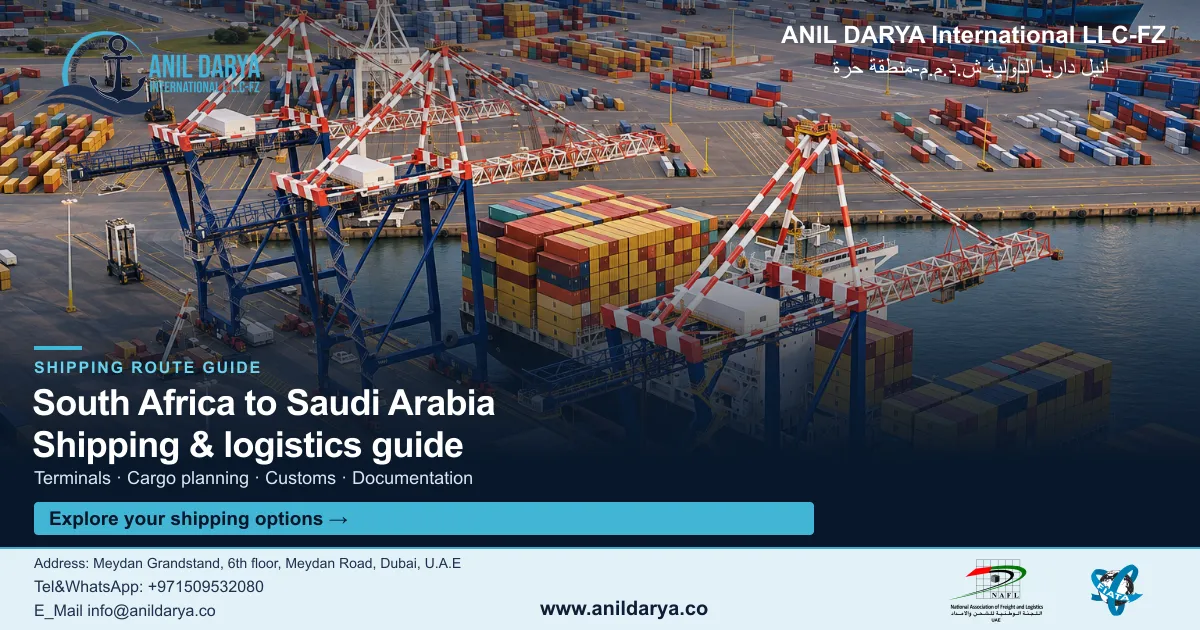
Shipping from South Africa to Saudi Arabia is mostly containers from Durban, Cape Town or Ngqura to Jeddah on the west coast or Dammam on the east coast, plus Ro-Ro for vehicles and reefers for citrus and lamb. The South African exporter must be registered with SARS and passes PPECB inspection for fresh produce, and the Saudi buyer's broker clears the goods on Fasah with SFDA or SABER approval where the product needs it. We book the ocean leg from Dubai and check that both ends are ready before the cargo sails.
South Africa to Saudi Arabia shipping at a glance
| Item | Detail |
|---|---|
| Main mode | Sea: reefer containers for citrus and meat, dry FCL and LCL, Ro-Ro for vehicles, breakbulk for steel and project pieces |
| South African load ports | Durban (ZADUR) for most containers and vehicles; Cape Town (ZACPT) for Western Cape fruit; Ngqura (Coega) for Eastern Cape cargo |
| Saudi discharge ports | Jeddah Islamic Port and King Abdullah Port in the west; Dammam (King Abdulaziz Port) and Jubail in the east |
| Saudi imports from South Africa | SAR 3.9 billion in 2025, up 14.7%; top lines precious stones and metals, fruit and nuts, vehicles (DataSaudi) |
| Export filing in South Africa | Exporter registered with SARS; goods declaration lodged by the exporter (as an EDI user) or a licensed clearing agent |
| Fresh produce at origin | PPECB inspection for quality, phytosanitary aspects and marking |
| Import filing in Saudi Arabia | Fasah declaration and documents at least 48 hours before the ship arrives (ZATCA, updated 26 August 2026) |
| Saudi duty and VAT | GCC common external tariff, at least 5% of CIF for most goods; fresh red meat and livestock duty-free; 15% import VAT |
| Trade agreement | None found that gives South African goods a lower Saudi rate |
| Bill of lading | The shipping line's own B/L, issued and released to you through us |
How shipping from South Africa to Saudi Arabia works when we book it from Dubai
This is a cross-trade lane. The cargo moves from a South African port to a Saudi port and normally never lands in the UAE. Four parties each own one piece of the job:
| Piece of the job | Who does it | What we do |
|---|---|---|
| Collection from the packhouse, factory or cold store, stuffing, PPECB inspection, SARS export declaration | The South African exporter or its clearing agent | We pass on the booking number, the stack dates at the terminal and the B/L instructions |
| Ocean freight to Jeddah, Dammam or another Saudi port | The shipping line | We book the space from Dubai and follow the container through every relay port |
| Bill of lading | The shipping line, on its own form | We act as agent for many shipping lines, so the line's B/L is issued and released to you through our office, as originals or a telex release |
| Fasah filing, SFDA or SABER release, duty, VAT and delivery in Saudi Arabia | The Saudi consignee's licensed customs broker | We confirm that this broker is appointed and has agreed the papers before we confirm the booking |
The last row matters most. We do not offer customs clearance in Saudi Arabia, so a reefer of oranges or a deck of new cars sits at the Saudi terminal until the buyer's broker files it. Duty and taxes at destination are paid by the consignee or its broker. That is why the broker's name is one of the first things we ask for.
The Incoterm decides who pays each leg. On FOB Durban the buyer pays the freight and every Saudi cost; on CFR or CIF Jeddah the exporter pays the freight, but Saudi port charges, duty and VAT stay with the buyer. Our Incoterms 2020 guide for sea freight sets out the split term by term.
Which South African port to load at
The right port depends on where the goods are made or packed. Transnet National Ports Authority (TNPA) figures for 2025 show how the three container ports compare:
| Port | Official facts | Typical Saudi-bound cargo |
|---|---|---|
| Durban | 2,732,190 TEU in 2025; 58 berths, 41 of them operational, including 3 automotive berths; the largest Ro-Ro terminal in the country, with 7 berths at 12.5 m draft; multipurpose terminals for steel, timber and project cargo | Vehicles, steel, machinery, chemicals, KwaZulu-Natal and Gauteng cargo, citrus from the northern growing areas |
| Cape Town | 843,599 TEU in 2025, of which 416,287 TEU were shipped out; 42 berths; a multipurpose terminal with temperature-controlled facilities for fresh produce | Western Cape citrus, grapes, deciduous fruit, wine and processed food |
| Ngqura (Coega) | 747,847 TEU in 2025; a 4-berth container terminal at 16 m depth | Eastern Cape citrus and automotive parts, and transhipment boxes |
Gauteng shippers can truck the container to Durban or rail it from an inland terminal such as City Deep along the 688 km container corridor. On the road, Maersk lists 30 t as the maximum gross weight for a 20ft box and 31.5 t for a 40ft in South Africa, and 45ft containers are not accepted.
Which Saudi port should South African cargo go to?
Pick the port nearest to the buyer's warehouse.
| Saudi port | Coast | What the operators say | Best for buyers in |
|---|---|---|---|
| Jeddah Islamic Port | West | The main west coast gateway; Red Sea Gateway Terminal alone handled about 39% of Saudi container volume in 2024 | Jeddah, Makkah, Madinah, the western and southern regions |
| King Abdullah Port | West | Privately owned port north of Jeddah with 18 m depth, built for ships above 23,500 TEU | The western region |
| Dammam (King Abdulaziz Port) | East | 43 berths with container and general cargo terminals and a rail link to the Riyadh dry port | Riyadh, Dammam, Al Khobar and the Eastern Province |
| Jubail Commercial Port | East | Serves the Jubail industrial area north of Dammam | Industrial and petrochemical buyers in Jubail |
Jeddah is the shorter sail from Durban, because ships run up the east coast of Africa into the Red Sea. A Riyadh buyer may still prefer Dammam for the rail link, so compare the full door cost, not only the sea leg.
Sailings, transhipment and transit times
We found no current carrier schedule that shows a ship loading in Durban and calling a Saudi port as its very next stop. Most South African boxes for Saudi Arabia change ship at least once. Here is what the published sources show:
- Messina Line's own service page lists Durban in a group of ports that connect to Jeddah, Mundra, Nhava Sheva and Mediterranean ports through its hub at Lamu in Kenya. The page shows port pairs, not the order of calls or the sailing days, so ask the line for the actual voyage.
- A route aggregator, Fluent Cargo, lists about 19 services between Durban and Jeddah from lines such as CMA CGM, Maersk, COSCO and ONE. All but one are shown as two linked services, which means a transhipment, and the relay ports are not named.
- In May 2023 MSC published a weekly India to South Africa service with the rotation Durban, Jebel Ali, Abu Dhabi, Ad Dammam, Bahrain, Mundra, Nhava Sheva, Hazira, Colombo, Port Louis and back to Durban. Treat that as history: it shows how a loop can carry Durban cargo to Dammam with Gulf calls on the way, but the current rotation must come from the line.
Aggregator transit estimates for this lane disagree with each other, so we do not repeat them. The real time depends on the relay port and the wait for the connection.
[AMIR-FACT: the carriers we actually book from Durban, Cape Town and Ngqura to Jeddah, King Abdullah Port and Dammam in 2026, the relay port on each, and our real port-to-port transit days]
Where Dubai fits between South Africa and Saudi Arabia
Most full containers should go straight through to the Saudi port on one bill of lading. Dubai earns a place in three cases:
| Option | How it works | When it makes sense |
|---|---|---|
| Relay at Jebel Ali | The line moves the box from its South Africa loop to a Gulf feeder at Jebel Ali under its own through B/L | When the line with the best space or reefer plugs connects to Dammam or Jubail through Jebel Ali |
| Consolidation in Dubai | Small lots of wine, dried fruit, processed food or parts from several South African suppliers land in Dubai and are packed into one container for Saudi Arabia | When a Saudi buyer orders mixed small lots that would each be costly as LCL |
| Stock in a Dubai free zone | Goods sit in Jafza and are called off in smaller loads to Saudi Arabia and other GCC buyers | When a distributor sells across the Gulf and wants stock close by |
Our Jebel Ali port guide explains the terminals, and the article on re-export through Jafza shows how goods leave a free zone. If the cargo is landed, repacked or re-exported in Dubai, we handle the Dubai customs clearance for a fee. Dubai Customs has separate declaration types for transit and transfer, chosen by what happens to the goods in Dubai.
Splitting or storing food in Dubai can change what the Saudi side accepts. SFDA asks for health certificates issued in the country of origin, and the certificate of origin must still prove South African origin. Ask the Saudi broker which papers it will accept for re-exported citrus or meat before you route through Dubai.
[AMIR-FACT: whether we route South Africa to Saudi Arabia cargo through Jebel Ali (relay, Dubai consolidation or Jafza stock), on which carriers, how often, and which Dubai customs declaration we file for these shipments]
Sea freight from South Africa to Saudi Arabia: equipment by cargo
| Equipment | Typical South African cargo | What to watch |
|---|---|---|
| 40ft reefer | Oranges, mandarins, lemons, grapefruit, table grapes, chilled or frozen lamb | Set point, ventilation and pre-cooling agreed in writing; PPECB and health papers before loading |
| 20ft dry | Steel products, granite, chemicals in drums, canned food | The box hits the weight limit before it is full; check South African road limits |
| 40ft dry or high cube | Wine, juices, dried fruit, auto parts, paper, consumer goods | Pallets are expected at Saudi ports |
| LCL | First orders, samples, small food or parts lots | Extra handling at both CFS warehouses and a slower release |
| Ro-Ro | New cars and light commercial vehicles, machinery on wheels | Saudi technical regulations apply; the importer checks SABER first |
| Flat rack, open top, breakbulk | Mining and plant equipment, steel structures, project pieces | Drawings and lifting points needed early; Durban's multipurpose terminals handle abnormal cargo |
Our article on FCL vs LCL shows where a full container starts to pay, and the sea freight service page lists the equipment we book.
Citrus and other fresh fruit
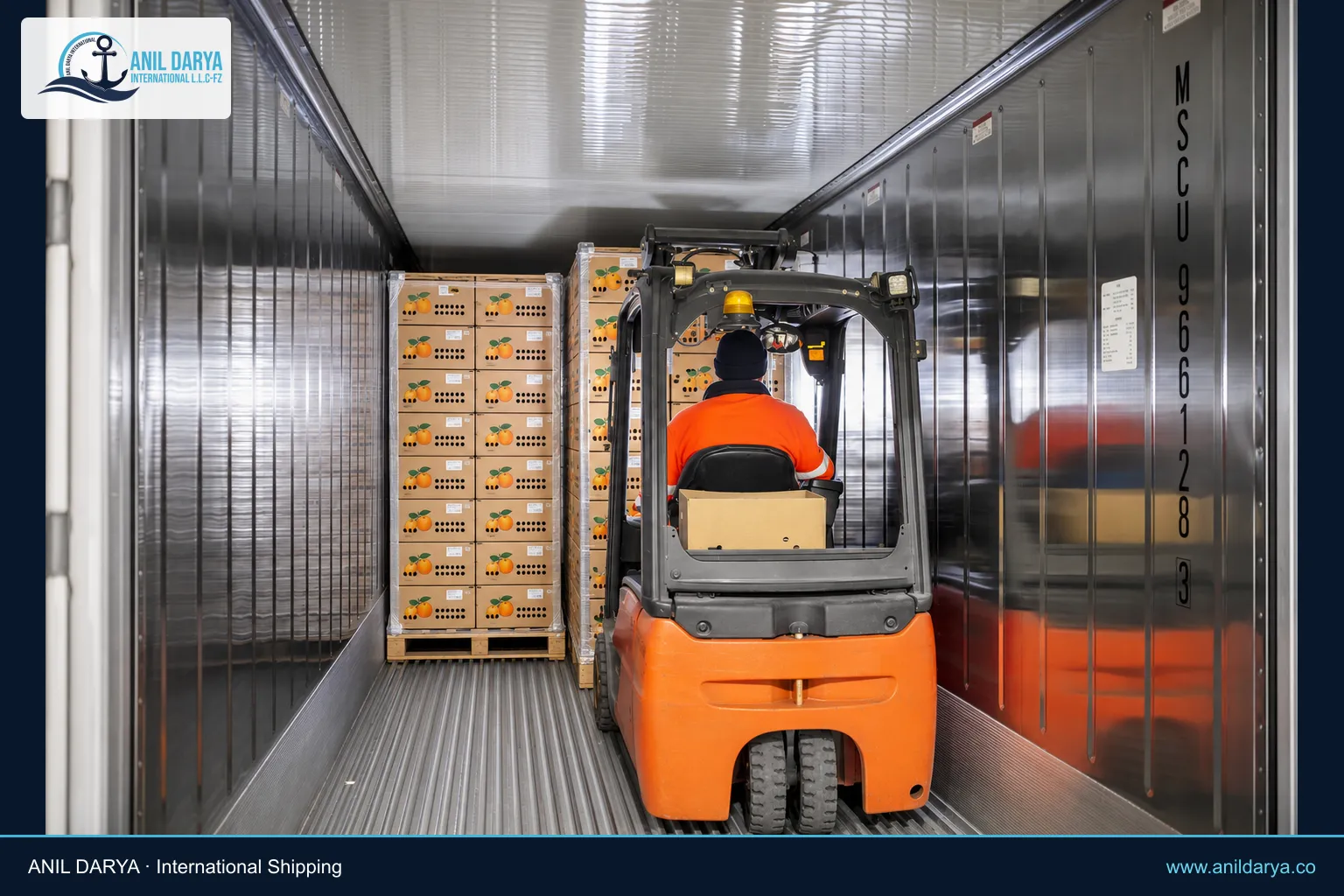
Fruit and nuts were Saudi Arabia's second-largest import line from South Africa in 2025, worth SAR 989.4 million on DataSaudi figures. Citrus leads. In 2023 one Saudi fresh produce importer told FreshPlaza that, in a normal season, 60 to 70% of its citrus came from South Africa. The season runs through the southern winter, so reefer space and plugs are in demand at Durban, Cape Town and Ngqura in the same weeks. Book early, and finish the PPECB inspection and phytosanitary certificate before the reefer gates in.
[AMIR-FACT: how far ahead we need to book reefer space from Durban and Cape Town to Jeddah and Dammam in the citrus season, and which carriers we use for these reefers]
Halal lamb and other meat
A 2026 AgriSA trade report, as covered by Farmer's Weekly, says Saudi Arabia's buying of South African agricultural goods grew in 2025 because of demand for halal lamb. Meat ships chilled or frozen in reefers. The slaughterhouse and cutting plant must be on SFDA's list of establishments approved to export to Saudi Arabia, and the shipment needs a South African health certificate and proof of halal slaughter that the Saudi side accepts. Fresh red meat enters Saudi Arabia duty-free, but 15% VAT still applies.
Vehicles on Ro-Ro or in containers
Vehicles and parts were the third-largest line, at SAR 360.9 million in 2025. New vehicles normally go Ro-Ro from Durban, which has the country's largest Ro-Ro terminal, or in containers when the numbers are small. Vehicles fall under Saudi technical regulations, so the Saudi importer must confirm the SABER certificates for the model and the 12-digit code before the cars are booked.
Dangerous goods
Chemicals, paints and lithium batteries ship under the IMDG Code with a Safety Data Sheet and Dangerous Goods Declaration, and every line in the routing must accept the class. Our dangerous goods team checks the relay port too.
Breakbulk and project cargo
Mining equipment and steel structures can load at Durban's multipurpose terminals. Send us drawings, weights and lifting points, and we look for a breakbulk ship and agree discharge in Saudi Arabia. See our break bulk and project cargo service.
Main goods on this lane
DataSaudi, the Saudi government statistics portal, puts imports from South Africa at SAR 3.9 billion in 2025, up 14.7% on the year before. The three main lines in 2025:
| Product group | 2025, SAR | Usual mode |
|---|---|---|
| Pearls, precious and semi-precious stones, precious metals | 1.4 billion | Air with secure handling, outside this sea guide |
| Edible fruit and nuts, citrus peel | 989.4 million | Reefer containers |
| Vehicles and parts | 360.9 million | Ro-Ro and containers |
The South African export side: SARS, ITAC and PPECB
Exporter registration and the declaration
SARS says anyone who ships goods out of South Africa, local or foreign, must register as an exporter. A foreign exporter must name a registered agent in South Africa on form DA 185 D, and that agent carries full liability for the foreign principal's customs dealings. Exporters who lodge their own declarations must also register as EDI users. Those who use a licensed clearing agent do not need to.
Transport documents must be shown when Customs asks, and goods that need an export permit must have it at clearance (SARS exports page, updated 19 August 2026).
ITAC export permits
The International Trade Administration Commission controls 177 of about 6,650 tariff lines. The ones that matter on this lane are ferrous and non-ferrous scrap, used motor vehicles, goods under the Montreal Protocol and Basel Convention, and some semi-precious stones. ITAC says most permits take about two working days, while scrap permits take 10 working days of circulation plus processing.
PPECB for perishables
The Perishable Products Export Control Board has inspected perishable exports since 1991 under a mandate from the agriculture department. It covers over 200 product types at more than 1,500 locations and checks quality, phytosanitary aspects and marking against minimum export standards and the buyer country's rules. For citrus and grapes to Saudi Arabia, the packhouse books PPECB before loading.
Pickup and the export declaration are the shipper's or its origin agent's job. We send them the booking and the cut-off times, and we check that the consignee on the SARS declaration matches the B/L.
Saudi import customs for South African cargo
Saudi customs is run by the Zakat, Tax and Customs Authority (ZATCA). Its import instructions, updated on 26 August 2026, say clearance on Fasah must be completed at least 48 hours before the shipment reaches the port of entry. The importer can file directly or through a customs broker.
Documents for Saudi clearance
| Document | Issued by | What to check |
|---|---|---|
| Commercial invoice | South African exporter | HS code, value and Incoterm; for food also batch numbers and expiry dates |
| Bill of lading | The line, released through us | Consignee, notify party and weights match the invoice |
| Certificate of origin | Authorised South African issuing body | ZATCA asks for it unless origin is clearly established; SFDA asks for it on food |
| Packing list | Exporter | Pallet count, cartons, gross and net weights |
| Phytosanitary certificate | South African plant health authority | Citrus, grapes and other fresh produce |
| Health and halal certificates | South African veterinary authority and a halal body accepted in Saudi Arabia | Meat and meat products |
| SABER shipment certificate | Saudi importer's SABER account | Vehicles, parts and other products under a Saudi technical regulation |
SFDA rules for South African food
SFDA's food clearance conditions, in the version published in April 2025, apply to every food container on this lane:
- The importer registers its establishment and each product on SFDA's Ghad platform and files the clearance request through Fasah.
- Labels on pre-packaged food must be in Arabic, under the GSO 9 labelling standard.
- Expiry dates follow GSO 150-1, and pesticide residues on fruit must stay within SFDA.FD 382.
- Meat must come from an establishment on SFDA's approved list.
SABER for regulated products
SABER is the Saudi product conformity platform. Products under a Saudi technical regulation need a product certificate and then a shipment certificate for each consignment. Vehicles, tyres, auto parts, electrical goods and some building products are the common South African examples. The buyer looks up the 12-digit code on SABER before the booking.
Palletisation
Saudi Arabia began requiring palletised containerised imports on 8 May 2025, with a 12-month phase-in. Bulk cargo that cannot be palletised, heavy machinery and oversized items may be exempt with approval. Citrus already ships on pallets. Floor-loaded cartons of canned food or bagged goods need checking first.

Saudi duty and VAT on South African goods
The US trade.gov guide to Saudi tariffs, last published on 11 May 2026, says Saudi Arabia applies the GCC common external tariff of at least 5%, charged on the CIF value. Rice, bulk animal feed, livestock, fresh red meat, coffee and tea enter duty-free. Some processed foods carry up to 40%. Since January 2025 the GCC states use a 12-digit tariff code based on HS 2022, so invoices should carry the new code.
Import VAT is 15%. ZATCA works it out on the customs value plus duty and other charges, and it applies to duty-free goods as well.
| South African cargo | Customs duty | Import VAT |
|---|---|---|
| Fresh chilled or frozen lamb (fresh red meat) | Duty-free | 15% |
| Citrus, grapes, other fresh fruit | Check the 12-digit code | 15% on value plus duty |
| Processed food, juices, canned fruit | At least 5%, some lines higher | 15% on value plus duty |
| Vehicles, parts, steel, machinery | Check the 12-digit code; at least 5% for most | 15% on value plus duty |
Duty and taxes at destination are paid by the consignee or its broker, on a CIF value that includes the real freight and insurance.
Is there a trade agreement between South Africa and Saudi Arabia?
We found no free trade agreement in force between South Africa, or the Southern African Customs Union, and Saudi Arabia or the GCC. The GCC agreements we found cover other partners. The African Continental Free Trade Area does not include Saudi Arabia. So South African goods pay the normal GCC rate, and the certificate of origin is for proof of origin and SFDA, not for a lower duty.
[AMIR-FACT: confirm with a Saudi broker in November 2026 that no preferential duty rate is accepted for South African origin goods]
Restricted goods at Saudi customs
ZATCA says restricted goods need permits from the competent authority, and goods banned locally or internationally may not enter. On this lane:
- Alcohol and pork products are prohibited, so South African wine cannot go to a Saudi consignee.
- All food: SFDA registration on Ghad, certificates and Arabic labels.
- Meat: an SFDA-approved plant, health certificate and halal proof.
- Plants and fresh produce: phytosanitary certificate.
- Vehicles and regulated goods: SABER certificates.
Step-by-step shipping from South Africa to Saudi Arabia
- Buyer and exporter agree the Incoterm and the Saudi port; the buyer names its broker and checks Ghad, SFDA and SABER needs.
- The exporter confirms its SARS registration and any ITAC permit.
- You send us the product, HS code, weight, volume, load port, ready date and whether it is reefer, DG, vehicle or out of gauge.
- We quote the line, the routing and relay port, and the free time at the Saudi port.
- We confirm with the consignee's broker that clearance is agreed and the papers are clear. Only then do we confirm the booking.
- The packhouse or factory palletises, labels in Arabic and books PPECB or the health inspection.
- The exporter or its clearing agent lodges the SARS declaration and delivers the box inside the stack dates.
- We check the B/L draft against the invoice, packing list and certificates.
- The line's B/L is issued and released through us.
- The broker files on Fasah at least 48 hours before arrival, SFDA or SABER releases the goods, and the duty and VAT are paid.
- The consignee collects the delivery order, takes the cargo and returns the empty within free time.
Our Dubai freight forwarding team runs steps 3 to 9.
What decides the cost of shipping from South Africa to Saudi Arabia?
We do not publish rates, because they change by sailing and season. These are the parts of the landed cost:
| Cost part | What moves it |
|---|---|
| South African origin | Trucking or rail to the port, terminal handling, clearing agent, PPECB inspection |
| Ocean freight | Reefer or dry, box size, relay port, citrus season demand, surcharges |
| Packing and labelling | Pallets, Arabic labels, reefer pre-cooling |
| Saudi port | Terminal handling, delivery order, LCL unpacking, inspection |
| Compliance | SFDA registration and testing, SABER certificates |
| Duty and VAT | 12-digit code and CIF value |
| Inland delivery | Truck or rail from Jeddah or Dammam to the buyer |
| Delay | Demurrage, detention and reefer plug-in after free time |
See our article on demurrage and detention for how free time runs out.
Checklist before the container leaves Durban or Cape Town
- Incoterm and Saudi port written into the contract.
- Saudi broker appointed and clearance agreed.
- Exporter registered with SARS; ITAC permit in hand if the goods need one.
- Importer and every food product registered on Ghad.
- PPECB inspection and phytosanitary certificate done for fruit.
- Meat plant on SFDA's approved list, health and halal certificates ready.
- Arabic labels on pre-packaged food; cargo on pallets.
- SABER certificates for vehicles or regulated goods.
- Free time at the Saudi port confirmed and cargo insurance arranged.
Common mistakes on this lane
- Shipping before destination clearance is agreed. With no Saudi broker lined up, the box waits at the port and the bill grows.
- Booking reefers late in the citrus season, then losing weeks waiting for space.
- Sending wine or other alcohol to a Saudi consignee. It is prohibited.
- Meat from a plant that is not on SFDA's approved list.
- Vehicles shipped before the SABER certificates are issued.
Frequently asked questions
How long does shipping from South Africa to Saudi Arabia take?
It depends on the line and the relay port. We found no current schedule with a direct Durban to Saudi call, so most cargo changes ship once. Add time for PPECB, the SARS declaration, SFDA release and the final truck.
Which Saudi port is best for cargo from Durban?
Jeddah or King Abdullah Port for buyers in the west, and Dammam for Riyadh and the Eastern Province because of the rail link to the Riyadh dry port.
Who clears the cargo in Saudi Arabia?
The consignee or its licensed broker files on Fasah at least 48 hours before arrival and pays duty and VAT. We do not sell clearance in Saudi Arabia, so we confirm the broker before we confirm the booking.
Do South African goods get a lower duty in Saudi Arabia?
No. We found no trade agreement between South Africa or SACU and Saudi Arabia, so the normal GCC tariff applies, at least 5% of CIF for most goods. Fresh red meat and livestock are duty-free for everyone.
Can I ship South African citrus to Saudi Arabia?
Yes, in a reefer, with a PPECB inspection and phytosanitary certificate, SFDA registration of the product, residues within SFDA limits and Arabic labels on retail packs.
Do you issue your own bill of lading?
No. You receive the shipping line's own B/L. We act as agent for many shipping lines, so that B/L is issued and released to you through us.
Can the cargo go through Dubai?
Yes. It can be relayed at Jebel Ali, consolidated in Dubai or held in Jafza. If it is cleared or re-exported in Dubai, we do the Dubai customs clearance for a fee. Check the origin and certificate rules with the Saudi broker first.
Get a quote for shipping from South Africa to Saudi Arabia
Send us the product, HS code, weight and volume, the load port, the ready date, the Saudi port and the name of the buyer's broker. We will come back with the line, the routing and a price. Use our freight rate inquiry form, or contact our team to plan a reefer, Ro-Ro or project shipment first.
[AMIR-FACT: one real South Africa to Saudi Arabia cross-trade shipment we handled (cargo, load port, Saudi port, line and relay port, how the Saudi broker and SFDA or SABER release went, days from booking to delivery), cleared for publication]
Sources
- DataSaudi: Saudi Arabia and South Africa bilateral trade (2025 and August 2026)
- SARS: registration of exporters (updated 22 November 2024)
- SARS: exports (updated 19 August 2026)
- ITAC: export control
- PPECB: product inspection services
- Transnet National Ports Authority: our ports
- Transnet National Ports Authority: 2025 container volumes by port
- Transnet Port Terminals: Durban container and Ro-Ro terminals
- Transnet Port Terminals: multipurpose terminals
- Transnet: Durban to Gauteng container corridor
- Maersk: South Africa local information, road weight limits
- Messina Line: line services
- Fluent Cargo: South Africa to Saudi Arabia route services
- Maritime Gateway: MSC India to South Africa service rotation (6 May 2023)
- ZATCA: import instructions, Fasah 48 hours (updated 26 August 2026)
- ZATCA: restricted and prohibited imports
- International Trade Administration: Saudi Arabia prohibited and restricted imports, alcohol and pork (published 11 May 2026)
- ZATCA: guideline on imports and exports under VAT
- SFDA: conditions and requirements for food clearance (April 2025)
- SABER: Saudi product conformity platform
- International Trade Administration: Saudi Arabia import tariffs (published 11 May 2026)
- International Trade Administration: Saudi Arabia import requirements and palletisation (published 11 May 2026)
- Saudipedia: King Abdulaziz Port in Dammam
- Red Sea Gateway Terminal: about us
- King Abdullah Port: official site
- Dubai Customs: customs declaration types
- FreshPlaza: South African citrus in Saudi Arabia, importer interview (8 September 2023)
- FreshPlaza and Farmer's Weekly: South African agricultural exports in 2025, AgriSA report (20 March 2026)
Reviewed: 11 November 2026