
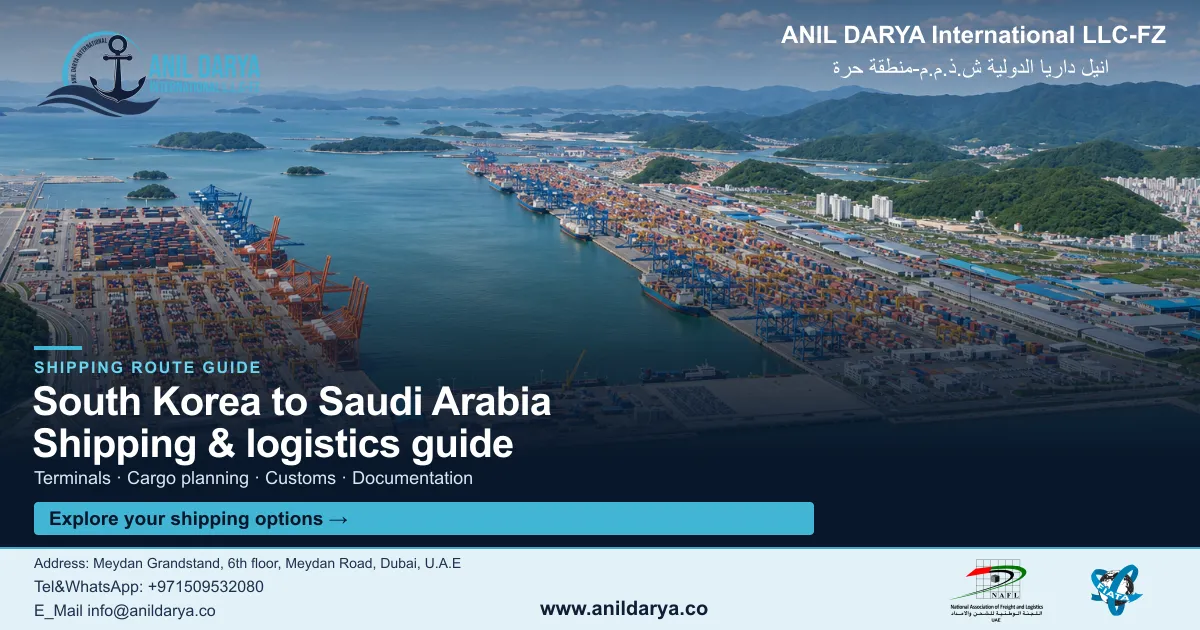
Shipping from South Korea to Saudi Arabia usually means a container loaded at Busan, Gwangyang or Ulsan and discharged at Jeddah on the Red Sea coast or Dammam on the Gulf coast. The Korean exporter declares the goods to Korea Customs Service, and the Saudi importer or its broker files the declaration on Fasah at least 48 hours before arrival. Regulated products also need a SABER shipment certificate. We book the ocean freight from Dubai and coordinate both ends, and this guide shows how the lane works.
South Korea to Saudi Arabia shipping at a glance
| Item | What applies on this lane |
|---|---|
| Main modes | Sea FCL and LCL, flat rack and breakbulk, dangerous goods, reefer for food |
| Korean load ports | Busan (KRPUS), Gwangyang, Ulsan, Incheon (KRINC), Pyeongtaek (KRPTK) |
| Saudi discharge ports | Jeddah Islamic Port (SAJED), King Abdulaziz Port Dammam (SADMM), King Abdullah Port, Jubail |
| Routing | Direct call on some loops, transhipment at a hub port on others; Jebel Ali is an option for Gulf cargo |
| Korean export authority | Korea Customs Service (KCS) |
| Korean loading deadline | Goods loaded within 30 days of the export declaration being accepted |
| Saudi customs authority | Zakat, Tax and Customs Authority (ZATCA), declarations on Fasah |
| Saudi declaration timing | Documents and declaration at least 48 hours before the ship arrives |
| Saudi duty | GCC common external tariff, at least 5% on most goods, charged on CIF value |
| Saudi VAT | 15% on imported goods |
| Product conformity | SABER platform (SASO): product certificate plus a certificate for each shipment of regulated goods |
| Who clears in Saudi Arabia | The consignee or its own customs broker, agreed before the cargo sails |
How does shipping from South Korea to Saudi Arabia work?
This is a cross-trade lane. The goods never enter the UAE as imports, yet the booking and the coordination run from our desk in Dubai. Three parties carry the load, and each one owns a different part of the chain.
- The Korean shipper, or its origin agent, packs the goods, trucks them to the terminal and files the Korean export declaration.
- The shipping line carries the container from the Korean port to the Saudi port. We book that space with the line and follow the box through to discharge.
- The Saudi consignee, through its own customs broker, files on Fasah, pays duty and VAT and takes delivery.
The bill of lading is the shipping line's own bill of lading. We act as agent for many shipping lines, so the carrier's B/L is issued and released to you through us. We do not issue a house bill on this lane.
Pick the Incoterm with this split in mind. FOB Busan suits a Saudi buyer who wants to control the freight: the Korean seller clears export and you, through us, pay the sea leg. CFR or CIF Jeddah suits a Korean seller who wants to quote a delivered port price; in that case the seller can book with us. Either way, duty and taxes at destination are paid by the consignee or its broker. Our Incoterms 2020 guide for sea freight shows where risk passes under each term.
Which Korean ports suit cargo for Saudi Arabia?
Start with the port nearest the factory. Trucking a container across Korea to reach a different terminal adds cost, and most long-haul services to the Gulf and the Red Sea call Busan anyway.
| Korean port | Typical cargo for Saudi buyers | Notes |
|---|---|---|
| Busan | Most containerised goods: electronics, auto parts, machinery, consumer goods | Korea's main container gateway; the port authority says it links 500 ports in 100 countries |
| Gwangyang | Steel coil and plate, petrochemicals, containers from the south-west | Near large steel and chemical plants in South Jeolla |
| Ulsan | Liquid chemicals, vehicles, heavy plant from local yards | Industrial port beside major shipbuilding and refining sites |
| Incheon | Cargo from the Seoul region, smaller lots | Fewer long-haul calls to the Gulf; often feeds through Busan |
| Pyeongtaek | Vehicles and cargo from Gyeonggi and Chungcheong | Vehicle and Ro-Ro focus; check container routing case by case |
Jeddah or Dammam: which Saudi port should receive your cargo?
Saudi Arabia has two coasts, and the right discharge port depends on where the consignee is. Picking the wrong coast can add a long truck journey across the country.
| Saudi port | Coast | Best for consignees in | What to know |
|---|---|---|---|
| Jeddah Islamic Port | Red Sea | Jeddah, Makkah, Madinah, the western region | Main Red Sea gateway for containers; many Asia-Europe loops call here |
| King Abdullah Port | Red Sea | King Abdullah Economic City, Rabigh, parts of the west | Alternative to Jeddah when the service calls there |
| King Abdulaziz Port, Dammam | Gulf | Dammam, Khobar, Riyadh, the Eastern Province | 43 berths, one container terminal and two general cargo terminals; rail link to the Riyadh dry port |
| Jubail | Gulf | Jubail industrial city and petrochemical plants | Suits project and chemical cargo for Jubail sites |
A simple rule: for Riyadh and the east, discharge at Dammam and move inland by truck or rail. For the western cities, discharge at Jeddah. Ask the consignee for the delivery address before you book, not after.
Direct services or transhipment on the Korea to Saudi lane
Some carrier loops leave Busan and call a Saudi port without changing ship. Others carry the box to a hub, where it moves to a second vessel for the last leg. Both work. The difference shows in transit time, in how many handlings the cargo gets and in how many places a delay can start.
Rotations change often, so treat any loop you read about as a starting point, not a promise. In August 2023, for example, the Saudi Ports Authority announced that HMM's weekly FIM service had added Jeddah Islamic Port, linking it with Busan and Gwangyang among 17 ports. Carriers have reshaped their Asia to Middle East networks since then, so we confirm the current rotation with the line on every booking.
| Routing | When it fits | What to check |
|---|---|---|
| Direct call, Korea to Jeddah or Dammam | Regular FCL volumes, time-sensitive stock | Weekly sailing day, port cut-off, free time at the Saudi port |
| Transhipment at an Asian or Gulf hub | Smaller Saudi ports, wider sailing choice, Jubail or King Abdullah Port | Connection time at the hub, which vessel carries the last leg |
| Via Jebel Ali, with a Dubai stop by choice | Buyers who consolidate, hold stock or split one shipment across GCC markets | Whether goods stay in transit or enter a free zone, onward booking to Saudi Arabia |
[AMIR-FACT: the carriers we actually book from Busan to Jeddah and Dammam, whether each service is direct or transhipped and where, and the real port-to-port transit days we see]
Sea freight from South Korea to Saudi Arabia: FCL, LCL and special equipment
Almost all cargo on this lane moves by sea. The first decision is whether you fill a container yourself.
| Option | Typical Korean cargo | Decision rule |
|---|---|---|
| FCL 20ft | Steel products, tyres, dense machinery parts | Heavy cargo that would exceed road or carrier weight limits in a 40ft |
| FCL 40ft or 40ft high cube | Home appliances, cosmetics, auto parts, consumer goods | Light or bulky cargo from one supplier |
| LCL | Samples, spare parts, first orders | When the cargo fills well under half a box; release depends on the shared container |
| Reefer | Food products, some pharmaceuticals | Set point agreed in writing; Saudi food approvals ready before loading |
| Flat rack or open top | Generators, transformers, machinery over container height | Fits the frame by size and weight; carrier acceptance before booking |
Saudi buyers often order from several Korean suppliers at once. If they ship from the same region, one consolidated FCL is usually cheaper and simpler to clear than several LCL lots, because the broker files one declaration and pays one set of port charges. Our article on FCL vs LCL costs explains where the break-even point tends to fall, and our sea freight service lists the equipment we book.
Transit time: what makes up the total
The sailing is only one part of the door-to-door time. Allow for each stage below and you will plan the order date correctly.
| Stage | What drives the time |
|---|---|
| Production and pickup in Korea | Factory lead time, packing, truck booking |
| Korean export clearance | Declaration accepted, any inspection, terminal cut-off |
| Ocean leg | Weekly sailing day, direct call or transhipment connection |
| Saudi clearance | Fasah filing before arrival, SABER certificate, inspection if selected |
| Inland delivery | Distance from the port, truck or rail, unloading at site |
Published schedules move from season to season. Ask for the routing and the expected arrival date on every quote, and compare quotes on the same port pair.
Breakbulk, project and dangerous goods cargo
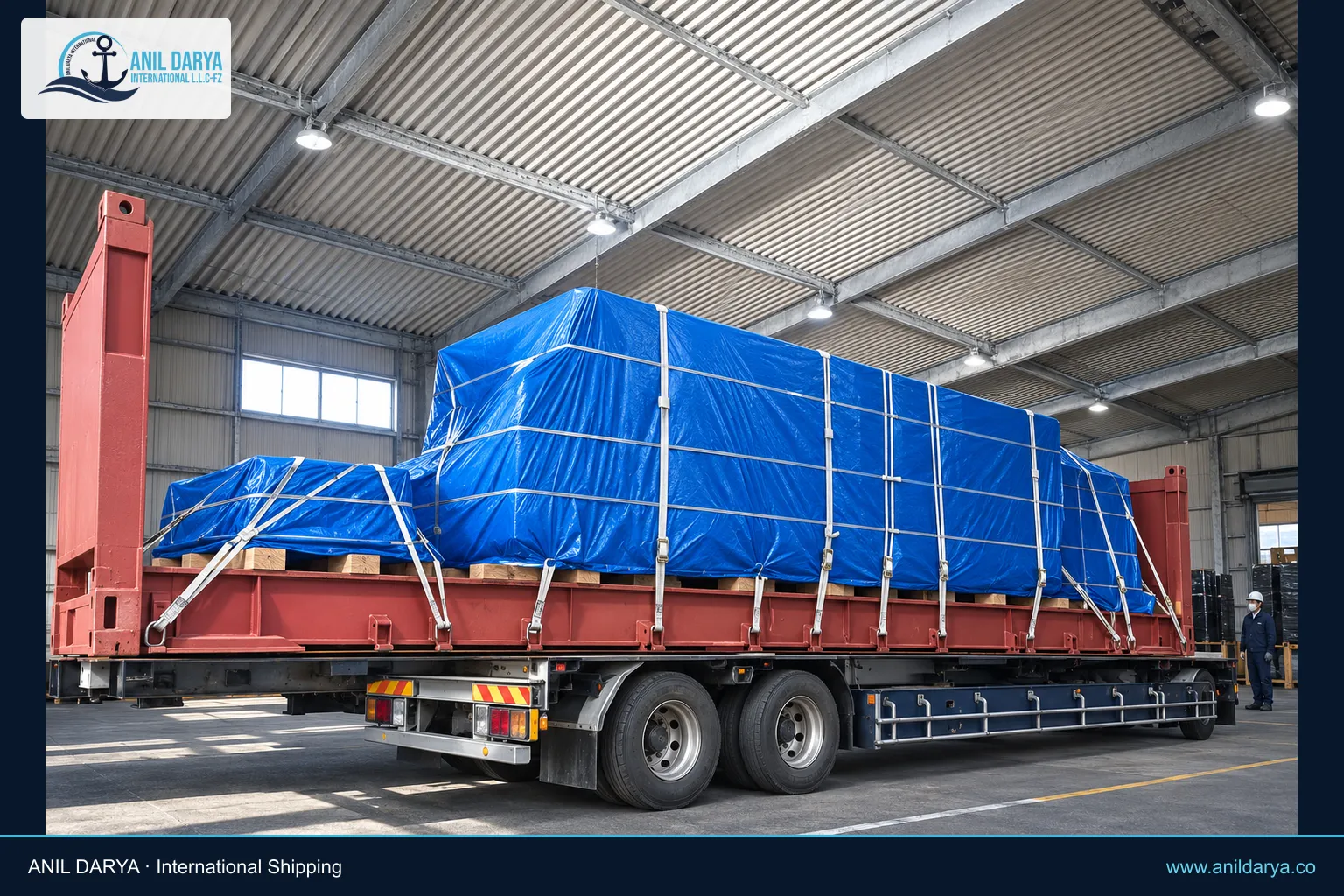
Korean yards and plant makers supply a lot of heavy equipment to Saudi industry: pressure vessels, transformers, compressors, steel structures and modules for petrochemical, power and water projects. Pieces that fit a 40ft flat rack can move on container ships, which sail more often. Larger pieces go as breakbulk on general cargo or heavy-lift vessels, often straight to Dammam or Jubail for eastern sites.
- Collect drawings, dimensions, weights and centre of gravity for every piece.
- Choose flat rack or breakbulk tonnage and agree load and discharge ports with the carrier.
- Agree lifting points, lashing and securing with the carrier and the Korean terminal.
- Prepare one master packing list that matches the invoice, the B/L and the Saudi declaration.
- Have the consignee's broker confirm discharge, inland permits and any escort on the Saudi side.
Our break bulk and project cargo service covers booking and stowage planning for this kind of cargo.
Dangerous goods are common on this lane too: lithium batteries in electronics, paints, adhesives, resins, solvents and aerosol cosmetics. At sea they move under the IMDG Code, and the 2024 edition (Amendment 42-24) has been mandatory since 1 January 2026. The Korean shipper must supply the UN number, class, packing group and a current Safety Data Sheet, and sign a DG declaration. We get carrier acceptance before you commit to a sailing; our dangerous goods team checks the papers first. The Saudi broker should also confirm whether the product needs an approval at destination.
Korean export customs: what the shipper must do
Korea Customs Service controls exports. The exporter must make an accurate declaration under the Customs Act and the Foreign Trade Act, and false information or export without a declaration can be punished as a false report, smuggling or price manipulation.
- The declaration goes to the head of the customs house that controls the place where the export goods are stored.
- Customs reviews it on documents or by inspection.
- Once the declaration is accepted, the goods must be loaded on the vessel within 30 days.
- Goods under export control, or under the Article 226 directive of the Customs Act, need approval from the competent body before export.
- Used cars and construction machinery need their Korean registration cancelled first, and are reported after they enter the bonded area.
The shipper or its origin agent handles all of this, along with pickup. We coordinate with them on the cut-off and the documents. If you buy EXW, you still need a Korean party to act as exporter, which is why FOB is easier for most Saudi buyers.
Saudi import customs for goods from South Korea
Customs clearance in Saudi Arabia is not a service we sell. It must be arranged with the consignee's own customs broker before the cargo ships, and we confirm that a broker is in place before we confirm the booking. This step protects you from a container that arrives with nobody ready to clear it.
Fasah declaration and documents
ZATCA asks importers to complete Fasah clearance by submitting the documents and the customs declaration at least 48 hours before the shipment arrives at the port of entry. The importer can file directly or through a customs broker.
| Document | Who provides it | What the broker checks |
|---|---|---|
| Commercial invoice | Korean seller | Description, HS code, value, currency, Incoterm, consignee matching the importer record |
| Bill of lading | Shipping line, released through us | Consignee and notify party, weights and piece count |
| Certificate of origin | Issuing body in Korea | Required unless origin is clearly established, says ZATCA |
| Packing list | Korean seller | Matches cartons, marks and weights |
| SABER certificates | Importer, through SABER | Product certificate and shipment certificate for regulated goods |
| IECEE certificate, product registration | Importer or seller | Only where the goods need them |
| Permits for restricted goods | Competent Saudi authority | Applied for before arrival |
SABER conformity for Korean products
SASO runs SABER, the online platform where regulated products are registered and certified. A product covered by a Saudi technical regulation needs a Product Certificate of Conformity (PCoC). Once a valid PCoC is confirmed, a Shipment Certificate of Conformity (SCoC) is issued for that consignment, and SABER states that the shipment certificate is now valid for 90 days. Electrical products have been in SABER since April 2019, and many other Korean product groups fall under a technical regulation too. Ask the broker to check every HS code against SABER before the factory finishes production.
Duty and VAT payable in Saudi Arabia
Saudi Arabia applies the GCC common external tariff, at least 5% on most goods from outside the GCC, charged ad valorem on the CIF value. Some processed foods carry higher rates, up to a general maximum of 40%. Excise tax applies to certain goods, such as cigarettes at 100% and carbonated drinks at 50%.
VAT on imports is 15%. ZATCA calculates it on the customs value plus customs duty and other charges, so the freight from Korea is inside the tax base. Check the rate for your exact HS code in the Saudi tariff with the broker, including whether any preferential rate applies to Korean-origin goods. Duty and taxes at destination are paid by the consignee or its broker.
| Cost item at destination | Basis | Paid by |
|---|---|---|
| Customs duty | Rate for the HS code on CIF value | Consignee or its broker |
| Import VAT 15% | Customs value plus duty and other charges | Consignee or its broker |
| Excise tax | Only for listed products | Consignee or its broker |
| Port and SABER fees | Per shipment | Consignee, as agreed with the broker |

Restricted goods at the Saudi end
ZATCA requires permits from the competent authorities for restricted goods. Goods prohibited internationally or locally cannot be imported, and neither can counterfeit or adulterated goods, goods that fail approved standards, or goods that infringe intellectual property. On this lane, these groups need the most care:
- Food, supplements and cosmetics, such as Korean snacks, sauces and skincare, which need approval from the competent authority.
- Medicines and medical devices.
- Chemicals, pesticides and some industrial gases.
- Wireless and telecom equipment.
- Used vehicles and machinery, where the broker should confirm the Saudi import conditions first.
- Branded goods without proof that the brand owner supplied them.
If a permit is needed, the consignee applies before the cargo leaves Korea. A permit chased after arrival means storage and container charges while the box waits.
Where Dubai fits on the South Korea to Saudi Arabia route
Most cargo on this lane should go straight from Korea to the Saudi port. Dubai helps in three cases.
- Transhipment at Jebel Ali. Some Gulf services can carry Korean cargo to Jebel Ali, where it changes ship for Dammam or Jubail. Dubai Customs lists transit as its own declaration type, separate from import, so cargo that only changes ships stays in transit and is not cleared for UAE import.
- Consolidation. A buyer with orders from Korea, China and other origins can gather them at Jebel Ali and send one load to Saudi Arabia.
- Stock in a free zone. Jafza, beside Jebel Ali port, calls itself the largest customs bonded zone in the Middle East. Some distributors hold Korean stock there and re-export smaller lots to Saudi Arabia and other GCC markets.
Where the cargo stops in Dubai, our customs clearance in Dubai is a paid service, and Dubai Chambers notes that transhipment goods need a Dubai Customs transit bill when a certificate of origin is issued for them. Read our Jebel Ali port guide and the article on re-exporting through Jafza before you choose this route.
[AMIR-FACT: whether we have routed Korean cargo for Saudi Arabia through Jebel Ali (transhipment or Jafza re-export), and with which carrier and feeder]
What affects the cost of shipping from South Korea to Saudi Arabia?
We do not publish prices, because each booking is priced on the day with the carrier. These are the parts of the total and what moves each one.
| Cost part | What moves it |
|---|---|
| Origin charges in Korea | Pickup distance, export clearance by the shipper's agent, terminal handling |
| Ocean freight | Container type, port pair, direct or transhipped, season, carrier surcharges |
| Special cargo | DG surcharges, flat rack or breakbulk premiums, lashing and survey |
| Saudi port charges | Terminal handling, delivery order, inspection handling |
| Conformity and permits | SABER certificates, product approvals, testing |
| Duty, VAT and excise | HS code and CIF value |
| Inland delivery | Distance from Jeddah or Dammam, truck or rail, unloading |
| Delays | Demurrage and detention once free time runs out |
The cheapest freight rate can be the dearest shipment if it lands at the wrong coast or waits for a missing certificate. Our guide to demurrage and detention shows how quickly waiting time adds up.
How to ship from South Korea to Saudi Arabia: step by step
- Agree the Incoterm and the Saudi discharge port with the buyer, based on the delivery address.
- Send us the cargo details: commodity, HS code, weights, dimensions, Korean pickup city, ready date and any DG.
- Name the consignee's customs broker in Saudi Arabia. We confirm with them that they will clear the cargo before we confirm the booking.
- The broker checks SABER, permits and the duty rate for each HS code.
- We quote the routing, carrier and sailing, and book the space with the shipping line. DG, reefer and out-of-gauge cargo get carrier acceptance first.
- The shipper or its origin agent collects the cargo and files the Korean export declaration before the terminal cut-off.
- We check the invoice, packing list and draft B/L against each other and against the broker's needs.
- The cargo sails, and the carrier's B/L is issued and released through us.
- The broker files on Fasah at least 48 hours before arrival, with the SABER shipment certificate.
- The consignee or its broker pays duty and VAT, takes delivery and returns the empty container within free time.
[AMIR-FACT: one real South Korea to Saudi Arabia shipment we coordinated from Dubai (cargo, Korean port, Saudi port, carrier, days door to door, any issue solved), or confirm we have none yet]
Checklist before the cargo leaves Korea
- Saudi customs broker named and confirmed in writing.
- Discharge port matched to the delivery address.
- HS codes confirmed and SABER requirements checked for each one.
- PCoC in place and SCoC requested for regulated products.
- Permits applied for if any goods are restricted.
- Invoice, packing list and B/L show the same weights, counts and consignee.
- Certificate of origin ordered from the Korean side.
- For DG: SDS, UN number, DG declaration and carrier acceptance.
- For project cargo: drawings, weights, lifting points and a Saudi inland plan.
- Free time at the Saudi port known, and cargo insurance arranged.
Mistakes to avoid on this lane
- Shipping before destination clearance is agreed. A container with no broker lined up sits at the port and runs up charges.
- Missing SABER certificates. Regulated goods without a valid shipment certificate stop at Saudi customs.
- Wrong coast. Riyadh cargo landed at Jeddah needs a long truck move.
- Late Fasah filing. The declaration is due 48 hours before arrival, not on arrival.
- Consignee name mismatches. The name on the invoice and B/L must match the Saudi importer record.
- Undeclared DG. Batteries or aerosols booked as general cargo can be rejected or fined.
- Assuming the Korean declaration is open-ended. Goods not loaded within 30 days of acceptance need a new step.
Frequently asked questions
How long does shipping from South Korea to Saudi Arabia take?
It depends on the port pair, the sailing day and whether the service is direct or transhipped. Add Korean pickup, export clearance, Saudi clearance and inland delivery to the ocean leg. We give the routing and expected arrival with each quote.
Which Saudi port should I use for cargo from Korea?
Use Dammam for Riyadh, Dammam, Khobar and the Eastern Province, and Jeddah for the western cities. Jubail suits industrial sites there, and King Abdullah Port suits consignees near King Abdullah Economic City.
Who files the export declaration in South Korea?
The exporter files it with the customs house that controls the place where the goods are stored. In practice the Korean shipper or its origin agent does this, and the goods must be loaded within 30 days of acceptance.
Do Korean products need SABER certificates in Saudi Arabia?
Regulated products do. They need a product certificate in SABER and a shipment certificate for each consignment. Electrical products are in scope, and many other groups are too, so check every HS code early.
What duty and VAT apply to goods from South Korea?
Customs duty follows the GCC common external tariff, at least 5% on most goods, on the CIF value. Import VAT is 15%, calculated on the customs value plus duty and other charges. The consignee or its broker pays them.
Do you clear customs in Saudi Arabia?
No. Saudi clearance is done by the consignee's own customs broker. We agree the arrangement with that broker before we confirm the booking, and we coordinate documents with them through the voyage.
Who issues the bill of lading on a Korea to Saudi Arabia shipment?
It is the carrier's own B/L, not a house bill. Because Anil Darya is agent for many shipping lines, the line's bill for your Busan, Gwangyang or Ulsan loading is issued and released to you through our Dubai office.
Can Korean cargo go to Saudi Arabia through Dubai?
Yes, when it helps. Cargo can be transhipped at Jebel Ali, consolidated with goods from other origins, or held in Jafza and re-exported in smaller lots. A direct service is usually simpler when the full order goes to one Saudi consignee.
Get a quote for shipping from South Korea to Saudi Arabia
Send us the Korean pickup point, cargo details, ready date and the name of the Saudi broker, and we will come back with a routing, carrier and price. Use our freight rate inquiry form, or contact our team to plan a DG or project shipment first. You can also read how our Dubai freight forwarding team works on cross-trade lanes.
Sources
- Korea Customs Service: export clearance procedure (declaration, 30-day loading, approvals, used cars)
- Busan Port Authority: Busan port connections
- ZATCA: import instructions (documents, Fasah 48 hours before arrival)
- ZATCA: restricted and prohibited imports
- ZATCA: guideline on imports and exports under VAT
- US International Trade Administration: Saudi Arabia import tariffs (GCC tariff, CIF basis, excise, VAT 15%)
- SABER: shipment certificate validity extended to 90 days
- Intertek: SASO SALEEM program and the SABER platform (PCoC and SCoC)
- Saudipedia: King Abdulaziz Port in Dammam
- Transport and Logistics ME: Mawani adds Jeddah to HMM's FIM service (August 2023)
- IMO: IMDG Code 2024 edition (Amendment 42-24)
- Dubai Customs: declaration types and documents
- Dubai Chambers: certificate of origin (transit bill for transhipment goods)
- Jafza: about the free zone
Reviewed: 11 November 2026