
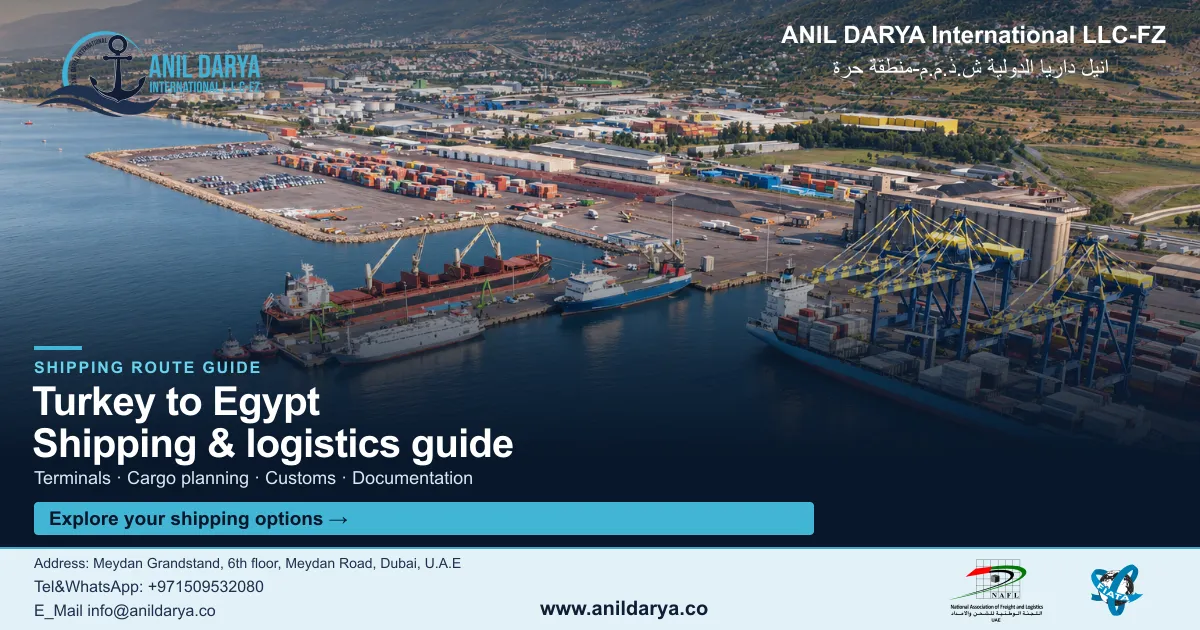
Shipping from Turkey to Egypt is one of the shortest container runs in the eastern Mediterranean: Turkon publishes 2 days from Iskenderun to Alexandria and 4 days from Mersin. Two things decide whether that speed helps you. The Egyptian buyer must hold an ACID from Nafeza before the box is loaded in Turkey, and the Turkish exporter must send an EUR.1 or EUR-MED certificate so the buyer gets the free trade agreement rate. We book the ocean freight from Dubai, release the carrier's bill of lading to you, and line up the Turkish shipper and the Egyptian buyer's broker before we confirm the booking.
Turkey to Egypt shipping at a glance
| Item | Detail |
|---|---|
| Type of lane | Cross-trade by sea, Turkey to Egypt, booked and coordinated by Anil Darya from Dubai |
| Main Turkish load ports | Iskenderun and Mersin in the south; Aliaga (Izmir) in the west; Ambarli (Istanbul), Gemlik and Izmit in the Marmara region |
| Main Egyptian discharge ports | Alexandria (including Dekheila) and Port Said; Damietta and Sokhna on other loops |
| Published sea days (Turkon TEL) | Iskenderun to Alexandria 2, Mersin to Alexandria 4, Mersin to Port Said 6, Istanbul (Marport) to Alexandria 9 |
| Typical cargo | Fuels and oil products, electrical machinery, iron and steel, cotton and textiles, chemicals, vehicles and tractors |
| Turkish export filing | Customs declaration to the Turkish customs office, through the BILGE system, by the exporter or its customs broker |
| Egypt pre-shipment rule | Advance Cargo Information: ACID request on Nafeza at least 48 hours before loading |
| Trade agreement | Turkey-Egypt FTA in force since 1 March 2007; Egypt's duties on Turkish industrial goods phased out by 1 January 2020 |
| Egypt import VAT | 14% standard; 5% on machinery for production lines |
| Bill of lading | The shipping line's own B/L, released to you through us as agent for the line |
| Destination clearance | The consignee's licensed customs broker in Egypt, agreed before we confirm the booking |
How shipping from Turkey to Egypt works as a cross-trade
The goods leave a Turkish terminal and are cleared at an Egyptian one, without touching the UAE unless you choose a Dubai routing. Our Dubai desk holds the booking and keeps the paper trail consistent on both sides.
| Party | What it does on a Turkey to Egypt shipment |
|---|---|
| Turkish exporter or its customs broker | Packs and loads the box, files the export declaration, gets the EUR.1 checked by its chamber and endorsed by customs, uploads the ACI documents on CargoX |
| Anil Darya, Dubai | Books the space, checks that the ACID is valid before the box gates in, tracks the sailing, releases the carrier's B/L |
| Shipping line | Refuses cargo for Egypt without a valid ACID, carries the box, lodges the manifest with Egyptian Customs through Nafeza |
| Egyptian importer | Requests the ACID, approves the exporter's data, pays duty and VAT |
| Importer's broker in Egypt | Presents the EUR.1 with the declaration, handles inspection and gets the release |
The B/L is the carrier's own document. Anil Darya is agent for many shipping lines, so the line's bill for a box of Gaziantep textiles going to Alexandria is released to you from our Dubai office, after we check that the consignee, Egyptian tax number and ACID on the draft match the Turkish invoice.
Clearance in Egypt is not something we sell. Duty and taxes at destination are paid by the consignee or its broker. Before we confirm a Mersin or Iskenderun booking, the Egyptian buyer tells us who its broker is, whether that broker works at Alexandria or Port Said, and whether the ACID request is in. Until then, the booking waits.
On FOB Mersin the Turkish seller clears export and the buyer pays the sea freight; on CFR or CIF Alexandria the seller books the ship, but Egyptian terminal charges, duty and VAT stay with the buyer. Our Incoterms 2020 guide for sea freight shows where cost and risk pass.
Which Turkish ports to ship from
The closer the load port is to Egypt, the shorter the sea leg. Turkon's TEL table makes the point clearly: the same Alexandria call is 2 days from Iskenderun and 12 days from Izmit, because the ship collects cargo along the Turkish coast first.
| Turkish port | Hinterland | Facts and role on the Egypt lane | Turkon TEL days to Alexandria / Port Said |
|---|---|---|---|
| Iskenderun (LimakPort) | Hatay, Gaziantep, Kahramanmaras, Adana | 1,000,000 TEU a year, 920 m container berth at 15.5 m, 600 reefer plugs, plus Ro-Ro and conventional cargo berths | 2 / 4 |
| Mersin (MIP) | Cukurova, Konya, Kayseri, Central and Southeast Anatolia | Designed capacity 3.6 million TEU, depth up to 17.6 m; about 1.97 million TEU handled in the Mersin port area in 2025 | 4 / 6 |
| Aliaga (TCEEGE) | Izmir, Manisa, Denizli, the Aegean | About 1.70 million TEU in the Aliaga area in 2025 | 7 / 9 |
| Ambarli, Istanbul (Marport) | Istanbul, Thrace, Western Marmara | Turkey's largest container area, about 3.43 million TEU in 2025 | 9 / 11 |
| Gemlik (Gemport) | Bursa automotive and textile belt | Marmara port for Bursa industry | 11 / 13 |
| Izmit (Evyap) | Kocaeli, Gebze, Sakarya | First call on the TEL loop, so the longest sea time | 12 / 14 |
A factory in Bursa or Kocaeli can load locally and accept 11 to 14 days at sea, or truck to Mersin and load 4 days from Alexandria. Price both; the trucking can save a week.
Which Egyptian port to arrive at
Pick the port by the buyer's warehouse and where its broker has staff.
| Egyptian port | Terminals named on the carrier pages we opened | Usually suits |
|---|---|---|
| Alexandria and Dekheila | ACHCO (Turkon TEL); Dekheila (ACCHCO), Abu Qir container terminal and the Tahya Misr multipurpose terminal (ONE) | Alexandria, the western Delta, 6th of October City and many Cairo importers |
| Port Said | PSCCHC (Turkon TEL); Port Said Container Terminal (ONE) | The canal cities, the eastern Delta, the 10th of Ramadan area |
| Damietta | Damietta Container Terminal (ONE) | Damietta furniture cluster, Mansoura and the eastern Delta |
| Sokhna | DP World Sokhna | Suez and eastern Cairo; rarely the first choice for cargo from Turkey |
For a Cairo buyer, Alexandria is usually the default: Turkon's table puts it 2 days closer than Port Said from every Turkish port.
Direct sailings and transhipment between Turkey and Egypt
Most cargo on this lane goes on a direct regional loop. The carrier pages and schedules we opened show two types:
- Turkon's Egypt and Lebanon Service (TEL) runs a regional loop through Izmit, Gemlik, Istanbul (Marport), Aliaga, Mersin and Iskenderun, then Alexandria and Port Said, with Beirut also on the loop. Turkon also lists transhipment connections from TEL to other markets.
- ONE's North Europe East Mediterranean Express (NEX), in its Intra Europe brochure from 2024, calls Alexandria, Port Said, Mersin, Iskenderun and Beirut and then Alexandria again, so Turkish cargo can stay on the same ship to Alexandria.
Turkon's TRI service to the Red Sea and India calls Alexandria only on its way back to Turkey, so it does not carry Turkish cargo to Egypt. Rotations change, so each quote names the vessel and says whether your box changes ship.
How long does sea freight from Turkey to Egypt take?
Turkon publishes these port-to-port days on its TEL page. The table reads from the Turkish load port (rows) to the Egyptian discharge port (columns).
| From | To Alexandria | To Port Said |
|---|---|---|
| Iskenderun (LimakPort) | 2 days | 4 days |
| Mersin (MIP) | 4 days | 6 days |
| Aliaga (TCEEGE) | 7 days | 9 days |
| Istanbul (Marport) | 9 days | 11 days |
| Gemlik (Gemport) | 11 days | 13 days |
| Izmit (Evyap) | 12 days | 14 days |
Aggregator sites quote a day or two from Mersin because they measure the hop between two calls. Plan on the carrier figure, then add export filing in Turkey and clearance in Egypt.
[AMIR-FACT: the carriers we actually book from Mersin, Iskenderun, Aliaga and the Istanbul terminals to Alexandria, Port Said and Damietta, with the real port-to-port days and sailing frequency we see]
Sea freight from Turkey to Egypt: FCL, LCL and special cargo
| Option | Typical Turkish cargo for Egypt | Point to check |
|---|---|---|
| FCL 20ft | Steel bars and profiles, chemicals in drums, tiles, flour and pasta | Steel and tiles hit the weight limit long before the box is full |
| FCL 40ft / high cube | Fabrics and yarn, garments, furniture, household appliances, auto parts | Piece counts and weights on the invoice, packing list and Nafeza entry must match |
| LCL | Spare parts, samples, small textile lots | Every consignee in the shared box needs its own ACID |
| Reefer | Fresh fruit, dairy, frozen food | Set point and health certificate ready before loading; a 2 to 4 day sailing leaves no slack |
| Flat rack / open top | Tractors, generators, steel structures | Dimensions, weight and lifting points per piece |
| Breakbulk | Project steel, plant machinery, large tanks | An ACID is still required; plan the discharge berth early |
When an Egyptian distributor buys from several Turkish mills, one consolidated FCL out of Mersin usually beats three LCL lots and needs one ACI filing instead of three. Our FCL vs LCL comparison shows where the break-even falls, and our sea freight service handles the booking.
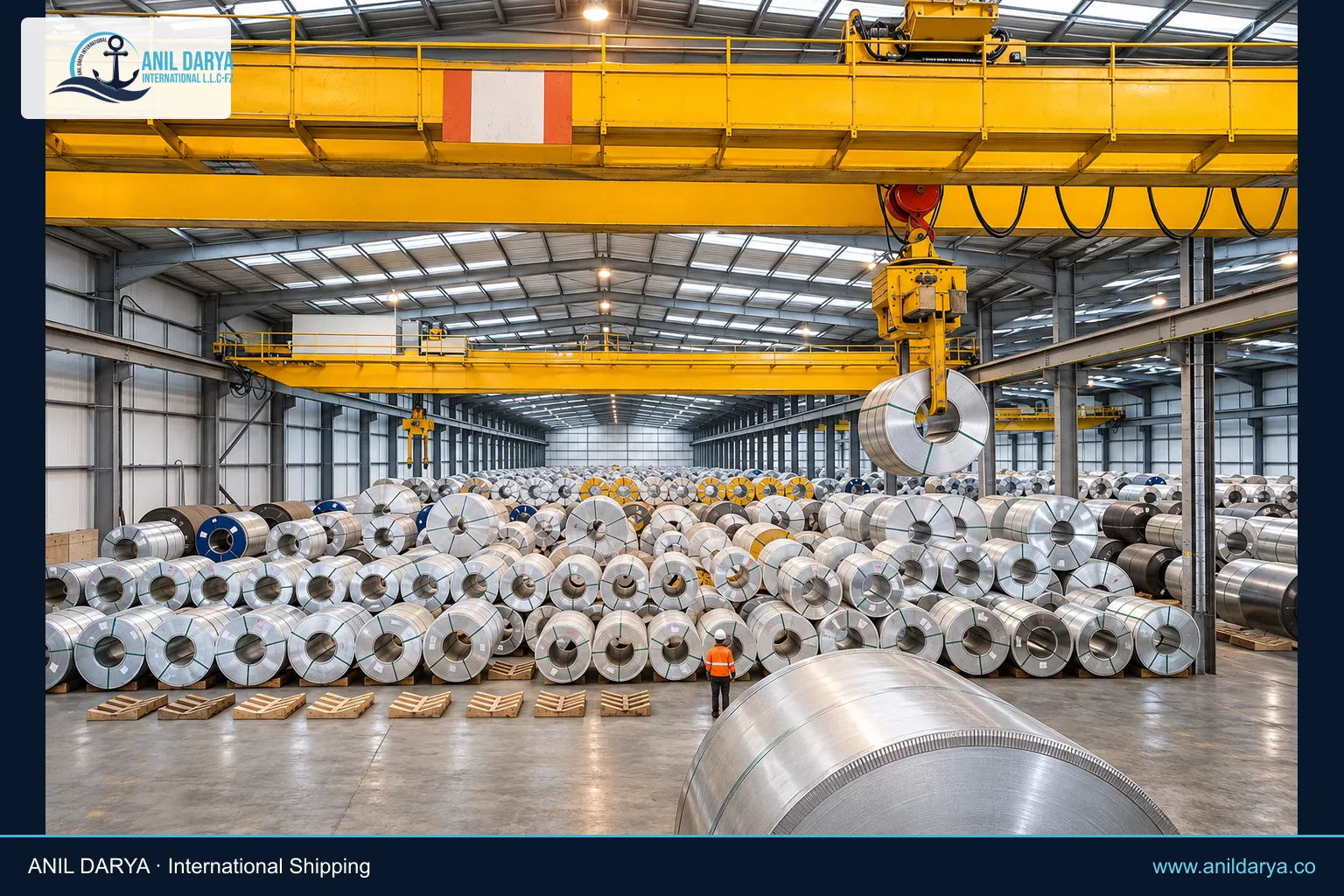
Steel and out-of-gauge cargo
Rebar and profiles go in 20ft boxes loaded to the weight limit; beams, coils and tractors may need flat racks or breakbulk. Our guide to flat rack, open top and out-of-gauge cargo covers the choice.
Dangerous goods: chemicals, paints and resins
Paints, solvents and resins move under the IMDG Code 2024 edition, Amendment 42-24, mandatory since 1 January 2026. The Turkish shipper supplies the UN number, class, packing group, safety data sheet and DG declaration, and the line accepts the booking before stuffing. Marport in Istanbul does not accept Class 1, 6.2 or 7, so those need another load port. Our dangerous goods team clears acceptance first.
What the Turkish exporter files before the ship sails
The exporter, or its customs broker, does this work under Ministry of Trade rules.
- The exporter needs a tax ID number and membership of the relevant exporters' association.
- The goods are declared to customs in BILGE, the ministry's system; access comes through the Customs and Trade Regional Directorate.
- The carrier lodges the exit summary declaration.
- Military, dual-use and nuclear items need permits, and the catch-all rule can catch unlisted goods.
Egypt adds the ACID on every document, the CargoX upload and, for the duty, the origin certificate.
The free trade agreement: EUR.1, EUR-MED and duty
The Turkey-Egypt FTA was signed in Cairo on 27 December 2005 and entered into force on 1 March 2007. Turkey's Ministry of Trade says Egypt phased out its duties on Turkish industrial goods, with the last cut on 1 January 2020. Farm products only get the concessions and quotas in Protocol II.
The preference is not automatic. The goods must meet the origin rules, and the broker presents proof of origin with the import declaration; without it, the normal Egyptian rate applies.
| Proof of origin | When it is used | Who issues it |
|---|---|---|
| EUR.1 movement certificate | Shipments under the revised Pan-Euro-Mediterranean origin rules, applied with Egypt from 26 February 2026 | The exporter fills it in, a chamber of commerce or industry checks it, Turkish customs endorses it |
| EUR-MED movement certificate | Shipments made under the old origin rules, which still run alongside the revised ones for Egypt | Same route, chamber check and customs endorsement |
| Invoice declaration | Low-value consignments under 6,000 euros by any exporter; above that only by an approved exporter | The exporter, on the invoice or another commercial document |
| Ordinary certificate of origin | Proves non-preferential origin; gives no FTA rate | The competent authority in Turkey |
For textiles and clothing (HS chapters 50 to 63), Turkish customs can charge a compensatory duty on non-originating inputs, and the treatment differs between EUR.1 and EUR-MED. The seller's broker should confirm this before the price is fixed. The FTA does not touch VAT, which is still due in Egypt.
Egypt import customs for Turkish goods: ACI, ACID and Nafeza
The Misr Technology Services guide for shipping lines sets the ACI request deadline at 48 hours before loading, gives Customs up to 48 hours to issue the ACID, and asks lines to lodge manifests at least 48 hours before berthing. On a 2-day sailing from Iskenderun these windows overlap, so the ACID and correct documents must exist before the box gates in.
Every document carries three data elements: the 19-digit ACID, the importer's 9-digit Egyptian tax number, and the exporter's identification (country code TR, ID type and number).
| Step | Who | What happens |
|---|---|---|
| 1 | Egyptian importer or broker | Enters the shipment on Nafeza |
| 2 | Egyptian Customs | Issues the ACID within 48 hours and emails the importer and the Turkish exporter |
| 3 | Turkish exporter | Uploads invoice, packing list, certificate of origin and B/L copy on CargoX under the ACID |
| 4 | Importer | Approves the exporter's data on Nafeza |
| 5 | Shipping line | Checks the ACID and loads at Mersin, Iskenderun or another Turkish port |
| 6 | Shipping line | Sends the manifest through Nafeza at least 48 hours before berthing |
| 7 | Importer and broker | Present the EUR.1, pay duty and VAT, attend inspection if selected, take release |
Carriers are told never to load cargo for Egypt with an invalid ACID, and the US Commerce guide says shipments without one are re-exported at the shipper's cost. On CargoX, only fully verified exporters can file, a sent filing cannot be recalled (corrections go as a new filing under the same ACID), and the fee is charged once per ACID plus a small fee per document.
Documents Egypt expects for goods from Turkey
| Document | Issued by | What Egypt checks |
|---|---|---|
| Commercial invoice | Turkish exporter | ACID, importer tax number and exporter ID; values and HS codes |
| EUR.1 or EUR-MED | Exporter, checked by the chamber, endorsed by Turkish customs | Turkish origin under the FTA, so the preferential rate applies |
| Packing list | Turkish exporter | Same weights, packages and description as the invoice and Nafeza |
| Bill of lading | Shipping line, released through us | Carries the ACID; a copy goes in the ACI file |
| Health or phytosanitary certificate | Turkish authority | For food, fruit and other plant or animal products |
| Safety data sheet | Manufacturer | For chemicals and DG |
| GOEIC registration proof | Factory or brand owner | For products on the Decree 43 list |
On a 2 to 4 day sailing the ship often beats couriered originals to Alexandria, more so under a letter of credit. Agree early whether a surrendered B/L or sea waybill is acceptable.

Duty, VAT and GOEIC rules on Turkish cargo
For goods outside the FTA, PwC reports Egyptian duty of 0% to 60% of CIF value, up to 135% on passenger cars, luxury goods and alcohol. VAT is 14% on CIF plus duty and other taxes; production-line machinery pays 5%, and VAT on qualifying industrial machinery can be suspended under Law 3 of 2022.
| Turkish cargo | Duty with valid EUR.1 or EUR-MED | VAT | Watch for |
|---|---|---|---|
| Steel rebar, profiles, sheet | Industrial goods: FTA preference | 14% | Reinforcing iron is on the GOEIC Decree 43 list |
| Household appliances, lighting | Industrial goods: FTA preference | 14% | GOEIC factory or brand registration |
| Fabrics, yarn, garments, carpets | Industrial goods: FTA preference | 14% | Decree 43 for clothing, textiles and carpets; Turkish compensatory duty on chapters 50 to 63 |
| Furniture | Industrial goods: FTA preference | 14% | Home and office furniture are on the Decree 43 list |
| Production machinery | Industrial goods: FTA preference | 5% where it is for a production line | End-use proof; VAT suspension rules |
| Food and farm products | Only where Protocol II grants a concession | As the broker confirms | Health certificates; Decree 43 for packaged foods |
Decree 43 of 2016 is the rule Turkish exporters most often miss. Factories, trademark owners and distribution centres exporting listed goods to Egypt must register with GOEIC first, and the list includes reinforcing iron, household appliances, furniture, textiles, clothing, carpets, footwear, tableware, cosmetics, toys, lighting and packaged foods. The buyer must also be on the GOEIC importers register, whose rules Decree 271 of 2026 replaced from 22 July 2026.
Restricted goods and approvals in Egypt
The official sources we opened give no single banned list, but extra papers apply to Decree 43 products, food and plant goods (health or phytosanitary certificates), medicines, medical devices, cosmetics and telecom equipment (sector regulator approval), and chemicals (SDS and IMDG papers). The US Commerce guide notes some goods also need factory registration and testing. Ask the broker to confirm the HS code, FTA eligibility and approvals before production.
Typical cargo on this lane
CAPMAS, Egypt's statistics agency, reported 3.6 billion dollars of imports from Turkey in 2025, led by mineral fuels and oil products, electrical machinery, iron and steel, cotton goods, and cars and tractors. TİM reported 4.2 billion dollars of Turkish exports to Egypt in 2024 from 5,700 companies, with chemicals, textiles, automotive, electronics and steel growing.
The Dubai option: when Jebel Ali fits
Dubai is not on the way from Turkey to Egypt, and a direct Mediterranean sailing is faster. It helps only in specific cases:
- Mixed sourcing: Turkish goods combined in Dubai with Gulf or Asian goods into one box for Egypt.
- Free zone stock: Turkish goods held in Dubai and called off in smaller lots. See our article on JAFZA re-export.
- UAE-based traders that want the goods to pass through Jebel Ali. Our Jebel Ali port guide covers the terminal.
The Dubai to Egypt leg needs its own ACID, and storage or repacking in Dubai may cost the FTA preference, so check with the broker first. Where the lane touches Dubai, customs clearance there is a service we provide for a fee through our Dubai freight forwarding team.
[AMIR-FACT: whether we route Turkish cargo for Egypt through Jebel Ali today (consolidation or JAFZA re-export), on which carriers, how often, and the real extra days compared with a direct Mersin or Iskenderun sailing]
What drives the cost of shipping from Turkey to Egypt?
We price each sailing on the day, so there are no fixed rates on this page. These are the parts of the bill and who usually pays them on FOB terms.
| Cost part | What moves it | Usually paid by (FOB) |
|---|---|---|
| Origin charges in Turkey | Trucking to the port, stuffing, export declaration, terminal handling | Exporter |
| Documents | Chamber check and customs endorsement of the EUR.1, CargoX fee per ACID | Exporter, unless agreed otherwise |
| Ocean freight | Box type, load port, direct or transhipped, season, surcharges | Importer |
| Special cargo | Reefer, DG, flat rack or breakbulk premiums | Importer |
| Egyptian port charges | Terminal handling, delivery order, LCL unpacking, storage | Importer |
| Duty and taxes | FTA eligibility, HS code, CIF value, 14% or 5% VAT | Consignee or its broker |
| Delay charges | Missing ACID, EUR.1 or GOEIC registration, inspection, late originals | Whoever caused the delay, by contract |
The biggest avoidable cost on this lane is a missing EUR.1. A box that arrives without valid proof of origin pays the full Egyptian duty, or sits in storage while the paper is chased. Our article on demurrage and detention shows how fast those daily charges build.
How to arrange shipping from Turkey to Egypt, step by step
- Agree the Incoterm with the Turkish seller and write it on the contract and invoice.
- Send us the product, HS code, weight, volume, factory city, ready date, special needs and Egyptian port.
- Name the Egyptian broker. We confirm with the broker that the importer is on the register, the products are clear on GOEIC, and the broker works at the chosen port. Only then do we confirm the booking.
- Get the ACID. The importer applies on Nafeza at least 48 hours before loading and shares the number with the seller and with us.
- Book the space. We compare load ports and loops and get DG, reefer or out-of-gauge acceptance first.
- Prepare the documents in Turkey. The seller puts the ACID, importer tax number and its own ID on every document and gets the EUR.1 or EUR-MED checked and endorsed.
- File the export declaration in BILGE and the ACI documents on CargoX, then gate in before the cut-off.
- Release the bill of lading. We check the draft against the invoice and ACID and release the carrier's B/L, or arrange a surrendered B/L if the parties agree, once freight is settled.
- Clearance in Egypt. The consignee's broker presents the EUR.1, pays duty and VAT, attends inspection if selected and takes delivery.
[AMIR-FACT: one real Turkey to Egypt cross-trade shipment we handled (cargo, Turkish load port, Egyptian port, carrier, how the ACID, EUR.1 and broker were lined up, door-to-door days), cleared for publication]
Checklist before the box leaves Turkey
- Incoterm agreed and written on the contract and invoice.
- Egyptian importer on the importers register and holding a valid ACID for this shipment.
- Consignee's broker named, agreed and working at the discharge port.
- Products checked against the Decree 43 list, with GOEIC registration in place where needed.
- Exporter verified on CargoX; ACID, tax number and exporter ID on every document.
- EUR.1 or EUR-MED checked by the chamber and endorsed by Turkish customs.
- Export declaration filed in BILGE; any strategic goods permit obtained.
- For reefer cargo: set point and health certificate. For DG: SDS, DG declaration and carrier acceptance.
- Insurance arranged and Egyptian free time checked.
Common mistakes on this lane
- Shipping before destination clearance is agreed. A box that reaches Alexandria with no broker in place sits on the quay and builds storage.
- Gating in before the ACID exists. The line will not load cargo for Egypt without a valid one.
- Forgetting the EUR.1. Without proof of origin the buyer loses the FTA rate on goods that should pay nothing or very little.
- Unregistered factory. Steel bar, appliances, furniture or garments on the Decree 43 list cannot be released without GOEIC registration.
- Mismatched data between the invoice, packing list and Nafeza entry.
- Originals arriving after the ship on a 2 to 4 day crossing.
- Paints or solvents booked as general cargo instead of DG.
- Wrong load port. Loading in Izmit for Alexandria adds about 8 days at sea compared with Mersin on the TEL table.
Frequently asked questions
How long does shipping from Turkey to Egypt take by sea?
Turkon publishes 2 days from Iskenderun to Alexandria, 4 days from Mersin to Alexandria and 6 days from Mersin to Port Said. From Istanbul (Marport) it is 9 days to Alexandria. Add time for export filing in Turkey and clearance in Egypt.
Which Turkish port is best for cargo to Egypt?
Iskenderun and Mersin, because they are the last Turkish calls before Egypt on the TEL loop and give the shortest sea time. Marmara factories can load at Ambarli, Gemlik or Izmit, or truck to Mersin to save days at sea.
Do Turkish goods pay customs duty in Egypt?
Under the Turkey-Egypt FTA, Egypt phased out its duties on Turkish industrial goods by 1 January 2020. The goods must meet the origin rules and travel with an EUR.1, EUR-MED or valid invoice declaration. Agricultural goods have only partial concessions.
Is VAT charged on Turkish goods in Egypt?
Yes. The FTA covers customs duty, not VAT. Egyptian import VAT is 14%, or 5% on machinery for production lines, and the consignee or its broker pays it.
Who requests the ACID for a shipment from Turkey?
The Egyptian importer or its broker, on Nafeza, at least 48 hours before loading. Customs issues the ACID within 48 hours, and the Turkish exporter then uploads its documents on CargoX under that number.
Does Anil Darya clear the cargo in Egypt?
No. We book the ocean freight, coordinate the Turkish shipper and release the carrier's bill of lading. The consignee's licensed broker clears the goods in Egypt, and we agree that with you before confirming the booking.
Is there a Ro-Ro service from Turkey to Egypt?
We found no operator schedule for a regular line in 2026, and a 2026 ferry guide says the scheduled Iskenderun Ro-Ro line stopped in 2014. Some forwarders still offer truck-on-ship moves, so ask for a named sailing; containers are the dependable option.
Can Turkish cargo for Egypt go through Dubai?
Yes, when it makes commercial sense, for example to combine Turkish and Gulf goods or to hold stock in a Dubai free zone. The Dubai to Egypt leg needs its own ACID, and the broker should confirm the FTA preference still applies.
Get a quote for shipping from Turkey to Egypt
Send us the factory city, the cargo and HS code, the ready date, the Egyptian port and the name of the buyer's broker, and we will reply with sailing options and a price. Use our freight rate inquiry form, or contact our team if you want to talk through a steel, DG or project shipment first.
Sources
- Turkon Line: Egypt and Lebanon Service (TEL), rotation and transit times
- Turkon Line: Türkiye, Red Sea and India Service (TRI)
- Ocean Network Express: Intra Europe service brochure (NEX rotation, Egyptian terminals)
- Republic of Türkiye Ministry of Trade: Free trade agreement with Egypt
- WTO RTA database: Egypt-Turkey free trade agreement text
- BAİB annex on the Ministry of Trade notice: revised PEM origin rules, EUR.1 and EUR-MED for Egypt
- Ministry of Trade: FAQ on origin, EUR.1, invoice declaration and certificates of origin
- Ministry of Trade: Export regime FAQ
- Ministry of Trade: Digital customs applications FAQ (BILGE)
- Ministry of Transport and Infrastructure: maritime statistics bulletin 2025
- LimakPort Iskenderun: port technical features
- PSA: Mersin International Port factsheet
- Marport: dangerous cargo handling rules
- DP World: Sokhna port
- Misr Technology Services via SCZONE: ACI Shipping Lines/Agents Guide v1.5
- CargoX: Advance Cargo Information Egypt
- US International Trade Administration: Egypt import requirements and documentation
- PwC Worldwide Tax Summaries: Egypt, other taxes
- AHK Egypt: Registration of manufacturers with GOEIC (Decree 43 of 2016)
- Baker McKenzie: Egypt importers register, Decree 271 of 2026
- Daily News Egypt: CAPMAS data on Egypt-Türkiye trade in 2025
- Turkish Exporters Assembly (TİM): Egypt trade delegation and 2024 export figures
- IMO: IMDG Code 2024 edition (Amendment 42-24)
- Feribot Seferleri: Is there a ferry from Turkey to Egypt? (2026)
Reviewed: 11 November 2026