
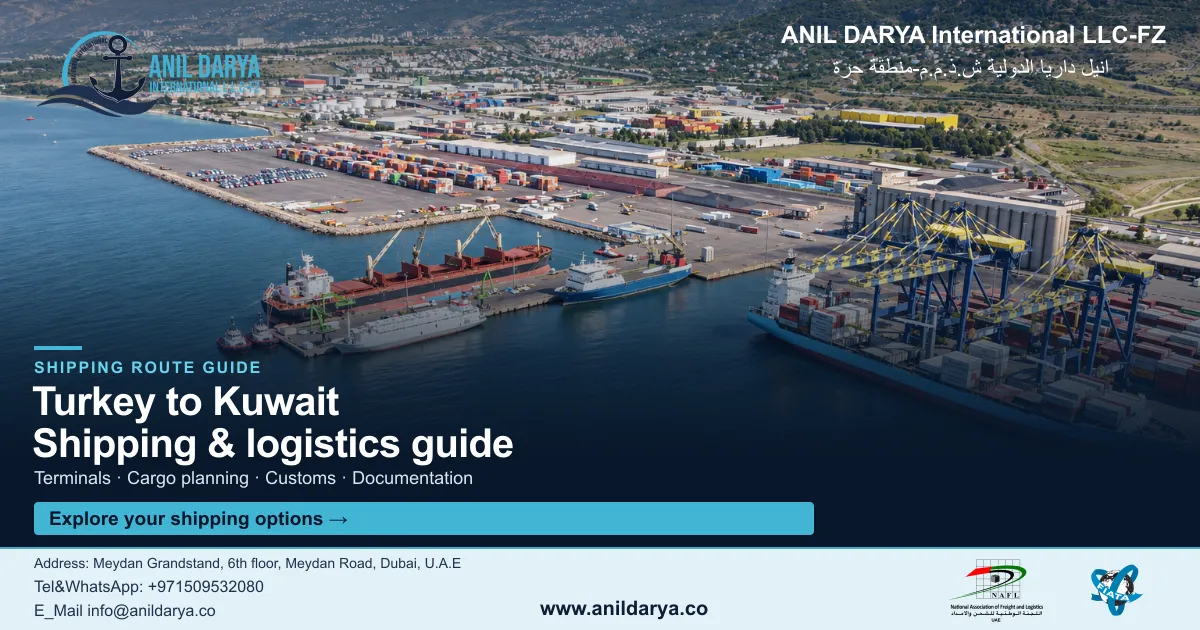
Shipping from Turkey to Kuwait is a relay trade: boxes load at Mersin, Iskenderun, the Istanbul terminals or Aliaga, sail to a Gulf hub such as Jebel Ali, and finish on a feeder to Shuwaikh or Shuaiba. None of the Turkish terminal lists we opened shows a ship calling Kuwait direct. There is no Turkey-Kuwait free trade agreement, so most Turkish goods pay Kuwait's 5% duty on CIF, and a licensed Kuwaiti broker clears them. Anil Darya books the ocean leg from Dubai and keeps the seller, the line and the broker on one plan.
Turkey to Kuwait shipping at a glance
| Point | What applies on this lane |
|---|---|
| Turkish load ports | Mersin (MIP), Iskenderun (LimakPort), Ambarli and Kumport in Istanbul, Izmit Bay, Aliaga near Izmir, Gemlik |
| Kuwait discharge ports | Shuwaikh (commercial, containers, vehicles) and Shuaiba (industrial, heavy and chemical cargo), both under Kuwait Ports Authority |
| Usual routing | Mainline to Jebel Ali, then a Gulf feeder to Kuwait |
| Published sea days we found | LimakPort list of 7 October 2025: Iskenderun to Jebel Ali 18 days (KAWA) or 22 days (Messina); the feeder leg comes on top |
| Turkish export filing | Customs declaration in BILGE, by the exporter or its Turkish customs broker |
| Proof of origin | Non-preferential certificate of origin approved by a Turkish chamber or exporters' association; Kuwait embassy stamp if the importer asks |
| Trade agreement | None in force with Kuwait or the GCC as a bloc |
| Kuwait duty | 5% of CIF for most goods, 100% on tobacco, 400+ exempt lines |
| VAT and excise in Kuwait | Neither in force (PwC summary reviewed 22 July 2026) |
| Bill of lading | The carrier's own B/L, issued and released to you through us as the line's agent |
| Who clears in Kuwait | A broker licensed by Kuwait customs, for an importer registered with the Ministry of Commerce and Industry |
Who does what on a cross-trade booked from Dubai
The cargo moves between Turkey and Kuwait; the booking and the document checks sit with our Dubai desk.
| Task | Handled by | Detail |
|---|---|---|
| Carrier, routing and space | Anil Darya, from Dubai | Choice of line and relay hub, equipment, DG or oversize acceptance, tracking to Kuwait |
| Collection and stuffing in Turkey | The Turkish seller or its origin agent | Truck to the terminal, loading, seal number, verified gross mass |
| Export customs in Turkey | The seller or its Turkish broker | BILGE declaration, certificate of origin, any export permit |
| Bill of lading | The shipping line | Its own B/L from the Turkish load port to Shuwaikh or Shuaiba; we act as agent for many lines, so it is released to you through us |
| Kuwait clearance and delivery | The importer and its licensed broker | Declaration, KUCAS and food approvals, duty, delivery order, trucking |
We have no office, yard or agent in Turkey or Kuwait. Kuwait wants the import licence holder named on the B/L, so that is the first field we check.
A Kuwaiti buyer that wants to pick the line buys FOB Mersin, and we book the sea leg for it. On CFR Shuwaikh the seller pays freight, but Kuwait terminal charges and duty stay with the buyer. Our guide to Incoterms 2020 for sea freight shows where each term moves cost and risk.
Which Turkish port suits Kuwait cargo?
Pick the terminal nearest the factory that has a Gulf sailing this month. A long truck run across Anatolia often costs more than the difference in ocean freight between two ports.
| Port | Facts from the operator | Turkish cargo for Kuwait that often starts here |
|---|---|---|
| Mersin International Port | 8 container berths and 13 multipurpose berths, 4,013 m of quay, 17.6 m maximum depth, 3.6 million TEU designed capacity; hinterland includes Adana, Gaziantep, Kayseri and Konya; direct link to the Mersin free zone (PSA profile, April 2026) | Machine-made carpets from Gaziantep, food, building products, furniture from Kayseri |
| Iskenderun (LimakPort) | 1,000,000 TEU a year, 920 m container berth, 15.5 m depth, 600 reefer plugs | Rebar, steel profiles and pipe from the Iskenderun gulf mills |
| Ambarli and Kumport (Istanbul) | Kumport handles project cargo with cranes up to 104 tonnes | Textiles, women's clothing, jewellery stock, appliances from the Marmara belt |
| Izmit Bay and Gemlik | Gateways for Kocaeli, Sakarya and Bursa industry | Vehicle parts, machinery, tyres |
| Aliaga (Izmir) | Aegean container gateway | Marble and natural stone, dried fruit, textiles from Denizli |
Shuwaikh or Shuaiba: where your Turkish cargo lands
Kuwait Ports Authority publishes 2024 figures for both ports. They show two very different jobs.
| KPA figure (2024) | Shuwaikh | Shuaiba |
|---|---|---|
| Role and location | Main commercial port, Shuwaikh industrial area next to Kuwait City | Main industrial port, Ahmadi Governorate in the south |
| Berths | 21 | 20 |
| Total area | 4.4 million m2 | 2.2 million m2, with a 318,000 m2 container yard |
| Containers | 613,093 TEU | 282,870 TEU |
| General cargo | 3,230,749 tonnes | 23,688,110 tonnes |
| Vehicles | 177,394 | 2,972 |
Furniture, clothing and carpets for Kuwait City retailers suit Shuwaikh. Steel, refinery plant and chemicals usually suit Shuaiba, near the industrial users in the south.
Sea freight from Turkey to Kuwait: the relay at a Gulf hub
We checked four editions of LimakPort Iskenderun's carrier list, from November 2023 to October 2025. None names a Kuwaiti port; the 2025 edition shows Gulf calls at Jebel Ali only. So the box changes ship.
| Leg | Published service we opened | What it shows |
|---|---|---|
| Turkey to Jebel Ali | KAWA East Mediterranean Sea Express, LimakPort list of 7 October 2025 | Rotation LimakPort, Sokhna, Jeddah, Jebel Ali; export days from Iskenderun: Sokhna 4, Jeddah 8, Jebel Ali 18 |
| Turkey to Jebel Ali | Messina service via Mundra, same list | Rotation LimakPort, Port Said, Aqaba, Jeddah, Djibouti, Mundra, Jebel Ali; export days to Jebel Ali 22 |
| Jebel Ali to Kuwait | Emirates Shipping Line Gulf Pakistan Shuttle (GPS), advisory of 11 February 2024 | Weekly rotation Jebel Ali, Karachi, Jebel Ali, Kuwait, Dammam, Jebel Ali; Shuwaikh Container Terminal is the Kuwait call; two ships of 1,350 to 1,450 TEU |
The export days rise in the same order as the port calls, so they read as days from Iskenderun. ESL's feeder day table does not line up clearly in the copy we opened, so we print no feeder days. LimakPort tells readers to confirm rotations with the carriers.
So the total is the mainline days to the hub, plus the wait for a feeder, plus the feeder voyage. Rate sites quoting 7 to 10 days match no rotation we found. Our quotes name the mainline vessel, the relay port and the feeder.
[AMIR-FACT: the carriers and services we actually book from Mersin, Iskenderun and the Istanbul terminals to Shuwaikh and Shuaiba in 2026, which hub each relays at (Jebel Ali or another), the feeder used for the last leg, and the real port-to-port days]
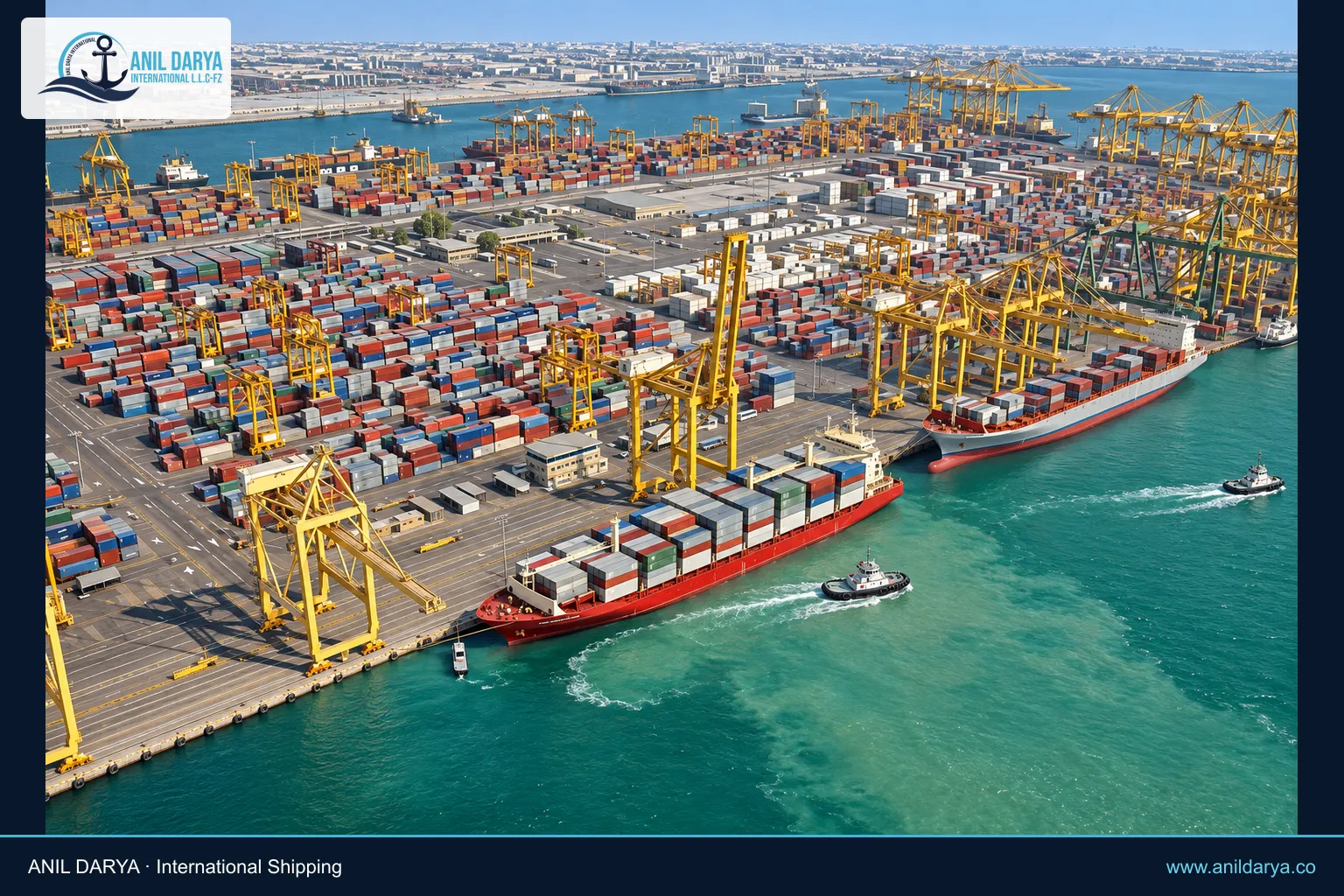
Container shipping from Turkey to Kuwait: FCL, LCL and special cargo
Most Turkish goods for Kuwait travel in full containers. Choose the box by what runs out first, weight or space.
| Equipment | Typical Turkish cargo for Kuwait | Rule of thumb |
|---|---|---|
| 20ft dry | Rebar, steel pipe, marble slabs in A-frames, ceramic tiles | Heavy cargo that reaches the weight limit before the box is full |
| 40ft high cube | Carpets, sofas and bedroom sets, clothing on hangers, household goods | Light, bulky cargo; carpets and upholstered furniture need the height |
| LCL | Samples, a first order of garments, spare parts | Ask which hub the consolidation goes through; the Kuwaiti side releases only when every lot's papers are clear |
| Reefer | Chilled dairy, some confectionery, fresh produce | Plugs must be booked on the mainline and the feeder; keep the set point on every document |
| Flat rack or open top | Generators, steel frames, tall machinery | Both ships and the relay terminal must accept the piece |
Kuwaiti buyers often order small lots, says Turkey's Ministry of Trade. Once a lot passes about half a box, price a 20ft too. Our article on FCL vs LCL shows the break-even, and the sea freight service page lists the equipment we book.
Breakbulk and project pieces
Transformers, crushers and steel structures that exceed a flat rack need breakbulk or multipurpose tonnage, and Shuaiba is the usual Kuwaiti discharge port for them. A relay means extra lifts, so get drawings, weights and lifting points from the factory before we approach any carrier. See our break bulk and project cargo service and the guide to flat rack, open top and out-of-gauge cargo.
Dangerous goods into Kuwait
Turkish paints, adhesives, aerosols, cleaning chemicals and batteries are dangerous goods at sea and must follow the IMDG Code 2024 edition, Amendment 42-24, mandatory since 1 January 2026. Kuwait adds its own conditions, which Emirates Shipping Line publishes for cargo it carries there:
- Classes 1, 2, 6 and 7 need approval from the Kuwaiti authorities before the box loads at origin. Without it, the box can stay on board at the cost of the load port account.
- At Shuaiba, DG containers are discharged on direct delivery only, in every season, and cannot be stored in the port. Shuwaikh has a summer restriction.
- The carrier's Kuwait agent needs an advance DG manifest: vessel, voyage, ETA, UN number, class, technical name, flash point, packages and weights.
On a relay, the hub and the feeder must accept the class too. Our dangerous goods desk checks the SDS and declaration against each line's rules before we request space.
Turkish export clearance before the box sails
The seller or its origin agent handles Turkish customs. We send cut-offs and check drafts, but we do not file in Turkey. The Ministry of Trade sets these rules:
- An exporter needs a Turkish tax ID number and membership of the relevant exporters' association.
- The goods are declared to the authorised customs office in BILGE, the customs computer system. Access is granted after an application to a Customs and Trade Regional Directorate.
- Military, dual-use and nuclear items need permission from the competent authority, and customs can ask for permission on unlisted goods when the end use is in doubt.
- Under Anti-Smuggling Law No. 5607, falsely declaring the type, quantity or value of exports to gain support counts as smuggling.
The certificate of origin for Kuwait is issued by the producer or exporter and approved by a Chamber of Commerce, Chamber of Industry or exporters' association. It names the factory, weights, the trade mark on the manifest, value, packing and transport mode. Some papers may also need a Kuwait embassy stamp, and the ministry notes Kuwaiti practice is not uniform, so ask the importer first. EXW leaves nobody in Turkey responsible for this; FOB or FCA works better.
Is there a trade agreement between Turkey and Kuwait?
No. Turkey's Ministry of Trade lists its free trade agreements in force, and Kuwait is not among them. Negotiations with the Gulf Cooperation Council as a group are listed as ongoing, with nothing concluded. Turkish goods therefore pay Kuwait's normal GCC tariff.
That has three practical results:
- The Turkish certificate of origin is non-preferential. It proves where the goods were made; it does not lower the rate. No EUR.1 or origin declaration is needed for Kuwait.
- Turkey does have agreements in force with the UAE and Qatar, but they are bilateral. They do not set Kuwait's duty, so do not plan a cheaper landed cost by routing through either country.
- GCC duty-free status needs 40% or more of the value added in a GCC state and a producer at least 51% owned by GCC citizens. Relabelling or repacking Turkish goods in Dubai does not make them GCC goods.
With no preference to protect, storing or splitting cargo in Dubai loses no duty saving. Keep the Turkish origin papers with every lot so the broker can declare the true origin.
Kuwait import customs and documents
Kuwait applies the GCC Common Customs Law. Only agents approved by Kuwait customs, or the end user, may take goods out, and the broker shows a letter of representation and a letter from the end user. Importers hold a yearly Ministry of Commerce and Industry licence, register with the Kuwait Chamber of Commerce and Industry, and may import only the goods named on the licence.
| Document | Copies | What the Kuwaiti broker checks on Turkish papers |
|---|---|---|
| Commercial invoice | Original and two copies | Full description, packing, metric net and gross weight, quantity, unit and total price, origin, port of destination, freight and the importer's full address |
| Certificate of origin | Original and two copies | Chamber or exporters' association approval; factory, trade mark and weights as above |
| Packing list | As requested | Contents, gross and net weight and value per package, matching the letter of credit; stamped by the exporter or forwarder |
| Bill of lading | Three originals | Carrier, consignee name and address, final port, freight details; import licence holder named |
| KUCAS reports, permits and certificates | Per product | Issued before shipment for regulated goods; food, halal, veterinary and plant papers |
Packages carry trade marks and numbers exactly as on the manifest. Every item needs a non-removable origin label matching the papers, with each country's percentage share if several made it. Kuwait has used 12-digit tariff codes since 1 January 2025, so print the broker's code next to the Turkish GTIP number.

Duty and tax on Turkish goods in Kuwait
Kuwait adopted the GCC single customs tariff on 1 April 2003. Most goods pay 5% of CIF, so the long freight and the relay sit in the duty base. More than 400 lines are exempt, mostly basic foods and medical products; the US guide counts 417 basic foodstuffs. Inputs for licensed industrial projects can be exempt under Public Authority for Industry incentives.
| Turkish goods | Kuwait duty |
|---|---|
| Carpets, furniture, clothing, steel, marble, appliances | 5% of CIF |
| Basic foods and medical items on the exemption list | 0% |
| Cigarettes and other tobacco products | 100% |
| Inputs for a licensed industrial project | Possible exemption through the Public Authority for Industry |
Kuwait has no VAT and no excise tax, according to PwC's summary reviewed on 22 July 2026. Duty and taxes at destination are paid by the consignee or its broker.
KUCAS, labels and product rules for Turkish goods
Under the Kuwait Conformity Assurance Scheme (KUCAS) of the Public Authority for Industry (PAI), a PAI-accredited body issues a Technical Evaluation Report and a Technical Inspection Report before a regulated product leaves Turkey. Applications go through PAI's TABEK portal. Turkey's Ministry of Trade names TUV Rheinland Middle East, Intertek, Bureau Veritas and SGS Gulf as the authorised bodies. Ceramics, paints, tyres and plastic pipe are on the list.
| Turkish product | Kuwait rule and date | Who acts |
|---|---|---|
| Reinforcing steel, Portland cement, white bricks, concrete bricks | Kuwait Quality Mark mandatory from 22 December 2025 (Ministerial Resolution No. 16 of 2025) | Turkish mill and Kuwaiti importer |
| Household detergents and cleaners | KWS GSO 151:2023 from 23 July 2024 and KWS GSO 2555:2022 from 1 January 2025, cleared through TABEK | Producer and importer |
| Washing machines, dryers, fridges and freezers, AC motors | Energy efficiency label from 1 March 2025, bought per serial number on TABEK at 250 fils each | Importer |
| Toys and low voltage appliances | G-Mark and a GCTS QR code on pack and label under the GSO technical regulations | Producer |
| Food | Arabic labels (multilingual accepted), production and expiry dates, certificate of no cyclamates; dairy free of harmful bacteria | Producer and importer |
| Meat, poultry and other animal products | Veterinary health certificate; halal certificate from a body Kuwait recognises, new for every batch number | Producer |
Shelf life catches Turkish food exporters most often. Kuwait's Public Authority for Food and Nutrition refuses food with a shelf life over one year if more than six months have passed since production, or eight months for seasonal products. For shelf lives under one year, no more than half the life, or three months if sooner, may have passed by import. Products with under two months of life are outside this rule. Book food on a sailing that respects these limits, counting the relay at the hub.
Restricted and prohibited goods in Kuwait
Kuwait bans pork, alcoholic drinks, gambling machines, pornographic material and narcotics, according to both Turkey's Ministry of Trade and the US International Trade Administration. The US guide adds used medical equipment and cars over ten years old. Firearms and explosives need special procedures. Health and cosmetic products go through the Ministry of Health's Drug and Food Control, which takes at least three months, so start before production.
Agree the Kuwaiti broker before the cargo sails
We do not sell customs clearance in Kuwait. The importer clears through its own licensed broker, and we confirm the booking only after that broker has agreed to take the job. The Ministry of Trade puts it plainly: documents must reach the importer before the goods reach customs, permits must be complete before import, and goods cannot be imported without them.
The broker confirms the 12-digit codes, the stamps it needs and any KUCAS or food approval; then we confirm space and send the seller its cut-off. A box that lands with no broker ready builds storage and line charges; see our guide to demurrage and detention.
Where Dubai fits on this lane
Jebel Ali is usually the relay port anyway, and Dubai can also be used on purpose.
| Option | How it works | Who it suits |
|---|---|---|
| Relay at Jebel Ali on a through B/L | The box changes ship at Jebel Ali and continues on the line's own bill of lading; Dubai Customs lists transit among its declaration types | Most FCL shipments |
| Consolidation in Dubai | Turkish lots join goods from Asia or Europe and leave for Kuwait as one load | Kuwaiti retailers with suppliers in several countries |
| Stock in a Dubai free zone | Turkish goods wait in JAFZA and move to Kuwait as orders come in; see our note on re-exporting through JAFZA | Distributors selling across the Gulf in small lots |
Free zone goods sit outside GCC customs territory, so Kuwait collects duty on arrival. If goods are duty-paid into mainland UAE first, GCC duty is collected at the first point of entry, and the Kuwaiti broker must accept the UAE proof. When cargo stops in Dubai, the UAE customs clearance is our work, for a fee.
[AMIR-FACT: whether we route Turkish cargo for Kuwait through Jebel Ali today (relay, Dubai consolidation or JAFZA stock), which feeder we use to Shuwaikh or Shuaiba, how many days the relay adds, and whether relayed cargo needs any UAE customs step]
What Turkish cargo moves to Kuwait?
Turkey's Ministry of Foreign Affairs lists woven carpets and flooring, iron and steel, motor vehicles and parts, machinery and textiles as the main exports to Kuwait; Turkish exports were USD 534 million in 2018, its latest figure. The Ministry of Trade's 2026 guide adds women's clothing, furniture, marble, jewellery and some foods as strong sellers.
| Cargo group | Usual equipment | Kuwait point to check |
|---|---|---|
| Carpets and flooring | 40ft high cube | Origin label sewn or fixed on each piece |
| Rebar and steel | 20ft, flat rack, breakbulk to Shuaiba | Kuwait Quality Mark since 22 December 2025 |
| Vehicle parts and machinery | 20ft or 40ft, flat rack for large units | PAI import licence for industrial machinery and spares; tyres under KUCAS |
| Food and confectionery | 20ft dry or reefer | Shelf-life limits, Arabic labels, halal papers for animal products |
How to ship from Turkey to Kuwait, step by step
- Send us the details: product, HS code, weight and volume, pickup city in Turkey, delivery point in Kuwait, Incoterm and ready date. Flag DG, reefer and oversize pieces.
- Check the product rules. Find out whether it falls under KUCAS, the Kuwait Quality Mark, energy labelling or food approval, and start the TER and TIR with an accredited body if it does.
- Agree destination clearance. The importer names its broker and confirms its licence covers the goods. We speak to the broker and do not confirm the booking until this is settled.
- We quote and book. You see the line, the relay hub, the feeder and the cut-off. For DG we get the Kuwaiti approval and both carriers' acceptance first.
- Origin work. The seller or its agent collects and stuffs the box, files the BILGE declaration and gets the certificate of origin approved.
- Check the drafts. We match the B/L draft to the invoice, packing list and licence holder's name and share the set with the broker.
- Sailing and relay. The line issues its B/L, released to you through us, and we follow the box to the hub and onto the feeder.
- Clearance and delivery. The broker files, the importer pays any duty, and the container is collected and returned within free time.
[AMIR-FACT: one real Turkey to Kuwait cross-trade shipment we booked (cargo, Turkish load port, carrier, relay port, Shuwaikh or Shuaiba, total days and one problem solved with the broker), cleared for publication]
What sets the cost of this lane
We do not publish rates, because they change with each sailing. These are the parts of the landed cost:
| Cost element | What changes it |
|---|---|
| Turkish origin charges | Truck distance to the port, terminal handling, export filing, chamber fees for the certificate of origin |
| Ocean freight | Load port, relay hub, container type, season, surcharges |
| Kuwait port and broker | Terminal handling, delivery order, inspection, broker fee, trucking |
| Duty | 5% of CIF, 0% on exempt lines, 100% on tobacco |
| Free time | Demurrage and detention if papers or approvals are late |
Checklist before the box leaves Turkey
- Kuwaiti broker named; import licence covers these goods; licence holder named on the B/L draft.
- 12-digit Kuwaiti tariff code agreed and printed on the invoice.
- Certificate of origin approved by a Turkish chamber or exporters' association, with any embassy stamp the importer wants.
- Origin label fixed on every item; trade marks on packages match the manifest.
- KUCAS TER and TIR, Quality Mark, energy labels or food papers in hand where they apply.
- Relay hub and feeder named on the quote; DG approvals for Kuwait received.
Mistakes that cost money on this lane
- Shipping before destination clearance is agreed. With no broker or licence ready, the box sits at Shuwaikh while storage runs.
- Expecting a direct ship. Plan for a relay and its extra days.
- Assuming a trade agreement. Turkish goods pay 5% in Kuwait; a EUR.1 does nothing there.
- Shipping rebar or cement without the Kuwait Quality Mark now required.
- Class 1, 2, 6 or 7 DG loaded without Kuwaiti approval.
Frequently asked questions
Is there a direct ship from Turkey to Kuwait?
We found none. LimakPort's carrier lists from 2023 to 2025 show no Kuwaiti call, and the 2025 list shows Gulf calls at Jebel Ali only. Cargo is relayed at a Gulf hub onto a feeder to Shuwaikh or Shuaiba.
How long does sea freight from Turkey to Kuwait take?
LimakPort's October 2025 list gives 18 or 22 days from Iskenderun to Jebel Ali, depending on the service. The feeder to Kuwait and the wait for it come on top. We quote total days from the live schedules for your port pair.
Which Kuwaiti port should I use for Turkish cargo?
Shuwaikh, next to Kuwait City, for consumer goods, furniture, carpets and vehicles. Shuaiba, in the south, for steel, heavy plant and chemicals. Both are run by Kuwait Ports Authority.
Do Turkish goods pay customs duty in Kuwait?
Yes. There is no Turkey-Kuwait free trade agreement, so most Turkish goods pay 5% of the CIF value. Exempt basic foods and medical items pay 0%, and tobacco pays 100%. The importer or its broker pays.
Does Kuwait charge VAT on imports from Turkey?
No. Kuwait has no VAT and no excise tax, according to PwC's summary reviewed in July 2026. Customs duty is the only border charge on most goods.
Who clears the cargo in Kuwait?
A broker approved by Kuwait customs, acting for an importer licensed by the Ministry of Commerce and Industry. We do not sell clearance in Kuwait, but we confirm the broker before we confirm the booking.
Can Turkish goods for Kuwait go through Dubai?
Yes, as a relay at Jebel Ali on a through B/L, through consolidation in Dubai, or from stock in a free zone. We handle the Dubai customs side for a fee. Kuwait still charges its duty unless GCC duty was already paid in the UAE.
Get a quote for shipping from Turkey to Kuwait
Send us the Turkish pickup city, the goods, the ready date and the name of your broker in Kuwait. We will reply with the line, the relay hub, the feeder to Shuwaikh or Shuaiba and a price. Use our freight rate inquiry form, or contact our team to plan a DG, reefer or project shipment first. You can also read more about our Dubai freight forwarding team.
Sources
- Republic of Türkiye Ministry of Trade: Kuwait market information 2026 (import documents, duty, KUCAS, labelling, shelf life)
- Republic of Türkiye Ministry of Trade: Free trade agreements (in force and under negotiation)
- Republic of Türkiye Ministry of Trade: Export regime FAQ
- Republic of Türkiye Ministry of Trade: Digital customs FAQ (BILGE)
- Republic of Türkiye Ministry of Foreign Affairs: Commercial and economic relations with Kuwait
- PSA: Mersin International Port profile (edition 2026.04)
- LimakPort Iskenderun: Container carriers and services (updated 7 October 2025)
- LimakPort Iskenderun: Container carriers and services (updated 15 November 2023)
- LimakPort Iskenderun: Port technical features
- Kumport: Project cargo and crane capacity
- Kuwait Ports Authority: Shuwaikh Port (2024 statistics)
- Kuwait Ports Authority: Shuaiba Port (2024 statistics)
- Emirates Shipping Line: GPS and JBX service launch advisory (11 February 2024)
- Emirates Shipping Line: Kuwait dangerous cargo rules
- US International Trade Administration: Kuwait import requirements and documentation (published 29 April 2026)
- US International Trade Administration: Kuwait import tariffs (published 29 April 2026)
- US International Trade Administration: Kuwait prohibited and restricted imports (published 29 April 2026)
- Public Authority for Industry, Kuwait: Imported products conformity services
- PwC Worldwide Tax Summaries: Kuwait other taxes (reviewed 22 July 2026)
- Middle East Briefing: Kuwait customs tariffs and the 12-digit tariff from 1 January 2025
- Goods Across Borders: GCC customs union explainer (free zones, first point of entry)
- IMO: IMDG Code 2024 edition (Amendment 42-24)
- Dubai Customs: Submit customs declaration (declaration types including transit)
Reviewed: 11 November 2026