
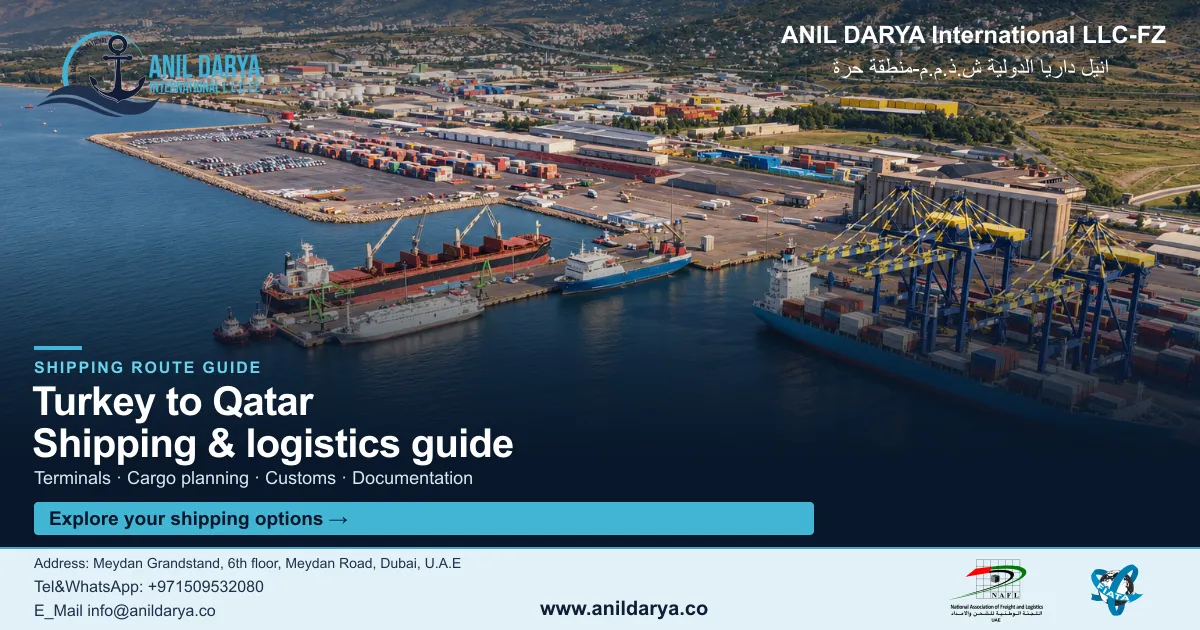
Shipping from Turkey to Qatar is a container trade that ends at one port: Hamad Port, south of Doha. Boxes load at Iskenderun, Mersin, the Istanbul and Izmit Bay terminals or Aliaga, and reach Hamad on a direct loop or after a relay at Jebel Ali. Since 1 August 2025, Turkish-origin goods on Qatar's concession lists can enter duty-free with a EUR.1 under the Türkiye-Qatar trade agreement; most other goods pay 5% of CIF. We book the ocean freight from Dubai and coordinate both ends.
Turkey to Qatar shipping at a glance
| Item | Detail |
|---|---|
| Mode covered here | Sea freight: FCL, LCL, reefer, flat rack, breakbulk and project cargo, dangerous goods |
| Turkish load ports | Iskenderun (LimakPort), Mersin, Ambarli and Kumport (Istanbul), Izmit Bay, Aliaga (Izmir), Gemlik |
| Qatar discharge port | Hamad Port, run by Mwani Qatar (UN/LOCODE QAHMD) |
| Published port-to-port example | LimakPort's November 2023 service list: Iskenderun to Hamad 14 days on the weekly GEM loop |
| Routings | A Gulf loop that calls Hamad, or a mainline call at Jebel Ali and a feeder to Hamad |
| Turkish export filing | Customs declaration in BILGE, by the exporter or its Turkish customs broker |
| Trade agreement | Türkiye-Qatar Trade and Economic Partnership Agreement (TEPA), in force since 1 August 2025 |
| Proof of origin for TEPA | Movement certificate EUR.1, or an origin declaration in the cases the protocol allows |
| Qatar customs system | Al Nadeeb single window, General Authority of Customs |
| Qatar duty | 0% for TEPA-listed Turkish goods with valid proof; otherwise 5% of CIF for most goods, 20% for steel |
| Bill of lading | The carrier's own B/L, issued and released to you through us as the line's agent |
| Who clears in Qatar | The consignee or its customs broker, confirmed before the box sails |
How shipping from Turkey to Qatar works when we book it from Dubai
The container goes from a Turkish quay to Hamad, sometimes via Jebel Ali, and we run the booking from Dubai. The work splits like this:
| Job | Done by | What it includes |
|---|---|---|
| Ocean booking | Anil Darya, from Dubai | Space with the line, equipment, DG or out-of-gauge acceptance, tracking to Hamad |
| Pickup and stuffing in Turkey | The Turkish seller or its origin agent | Truck to the terminal, loading, seal, verified gross mass |
| Export declaration in Turkey | The seller or its Turkish broker | BILGE filing, EUR.1 application if the buyer wants TEPA duty relief |
| Bill of lading | The shipping line | Its own B/L; we are agent for many lines, so it is issued and released to you through us |
| Qatar import clearance | The consignee or its broker | Al Nadeeb declaration, duty, permits, delivery order |
| Duty at destination | The consignee or its broker | Paid in Qatar, not by us |
Clearance in Qatar is not something we sell. What we do is refuse to confirm a Turkey to Hamad booking until the Qatari side is ready. That means we know who the broker is, the consignee's import licence is valid, and the broker has looked at the draft invoice and told us whether it wants a EUR.1.
Your Incoterm fixes who pays which leg. On FOB Iskenderun the seller clears export and loads, and you pay the freight to Hamad. On CFR Hamad the seller buys the freight, but the Qatari buyer still pays Hamad charges and any duty. Our Incoterms 2020 guide for sea freight shows where cost and risk pass for each term.
Which Turkish port should you load at?
Start from the factory, not the port: a long truck leg across Anatolia usually eats any freight saving. Then check which nearby terminal has a Gulf service this month.
| Port area | Typical supplier base | What to know for Qatar cargo |
|---|---|---|
| Iskenderun (LimakPort) | Hatay, Gaziantep, Kahramanmaras, steel plants on the gulf | Publishes its carrier list with export days; 1,000,000 TEU a year, 920 m container berth, 15.5 m depth, 600 reefer plugs |
| Mersin | Adana, Mersin, Konya, Kayseri | Large east Mediterranean gateway; called on the GEM loop alongside Iskenderun in LimakPort's 2023 listing |
| Ambarli and Kumport (Istanbul) | Istanbul, Thrace, the Marmara belt | Kumport handles project cargo with cranes up to 104 t |
| Izmit Bay (Kocaeli) | Gebze, Kocaeli, Sakarya, Duzce | Machinery and automotive parts; check whether the Gulf loop calls or a feeder links |
| Aliaga (Izmir) | Izmir, Manisa, Denizli | Aegean exporters of food, textiles and marble |
What to expect at Hamad Port
Every Turkish container for Qatar ends at Hamad. Mwani Qatar says operations started in December 2016 and the port was inaugurated on 5 September 2017. It covers 29 square kilometres. The two operating container terminals have an optimum capacity of 5 million TEU a year, rising to over 7.5 million TEU when the third is added. It also has general cargo, multi-use and vehicle terminals and a Centralised Customs Inspection Area that Mwani says can handle 5,600 containers a day. A free zone sits next to the port.
Direct Gulf loops or a relay at Jebel Ali?
Both patterns appear on this lane, and they change with each schedule revision. Two editions of LimakPort Iskenderun's carrier list show it:
| LimakPort list | Gulf service shown | Published export days from Iskenderun |
|---|---|---|
| Updated 15 November 2023 | MEGEM/GEM weekly direct loop: CMA CGM (MEGEM), COSCO and Hapag-Lloyd (GEM), OOCL (EM3) | Jebel Ali 11, Hamad 14 |
| Updated 7 October 2025 | No service calling Hamad; Gulf calls are at Jebel Ali, for example KAWA's East Mediterranean Sea Express and a Messina service via Mundra | Jebel Ali 18 (KAWA), Jebel Ali 22 (Messina) |
In the 2023 listing, the GEM loop called Mersin, Izmit, Ambarli and Aliaga as well as Iskenderun, then Jebel Ali, Hamad, Dammam and Jubail. The box stayed on the same ship from Turkey to Hamad. In the 2025 listing, a Qatar-bound box from Iskenderun would land at Jebel Ali and continue on a Gulf feeder. Milaha's Intra Gulf Express (MIG) is one weekly feeder that links Jebel Ali and Hamad, with two vessels of 1,015 TEU nominal and 90 reefer plugs each in its January 2025 profile.
LimakPort itself tells readers to check the carriers' own announcements for current rotations and days. So do we: every quote names the vessel route, whether it is direct to Hamad or relayed, and the relay port if there is one.
[AMIR-FACT: the carriers and services we actually book from Iskenderun, Mersin and the Istanbul terminals to Hamad today, whether they call Hamad direct or relay at Jebel Ali, and the real port-to-port days we see]
Container shipping from Turkey to Qatar: FCL, LCL and reefer
Most of the trade moves in full boxes. Choose the box by what fills it first: weight or volume.
| Option | Typical Turkish cargo for Qatar | Decision rule |
|---|---|---|
| 20ft dry | Rebar, steel profiles, marble, tiles, cement products | Dense cargo that hits the weight limit before the box is full |
| 40ft or 40ft high cube | Furniture, kitchen and bathroom units, textiles, household goods | Light, bulky cargo; furniture wants the extra height |
| LCL | Samples, a first order, spare parts | Ask whether a consolidation runs from your port to Hamad; a relayed LCL box is opened only at destination, but release waits for the whole box |
| Reefer | Dairy, chilled food, some confectionery | Book plugs on both the mainline and any feeder; keep the set point on every document |
| Flat rack or open top | Switchgear, generators, steel frames slightly over size | If it fits a flat rack, a container loop gives more sailings than breakbulk |
Once an LCL lot is more than about half a box, price a 20ft as well. Our article on FCL vs LCL walks through the break-even, and our sea freight service page lists the equipment we book.
Flat rack, breakbulk and project cargo
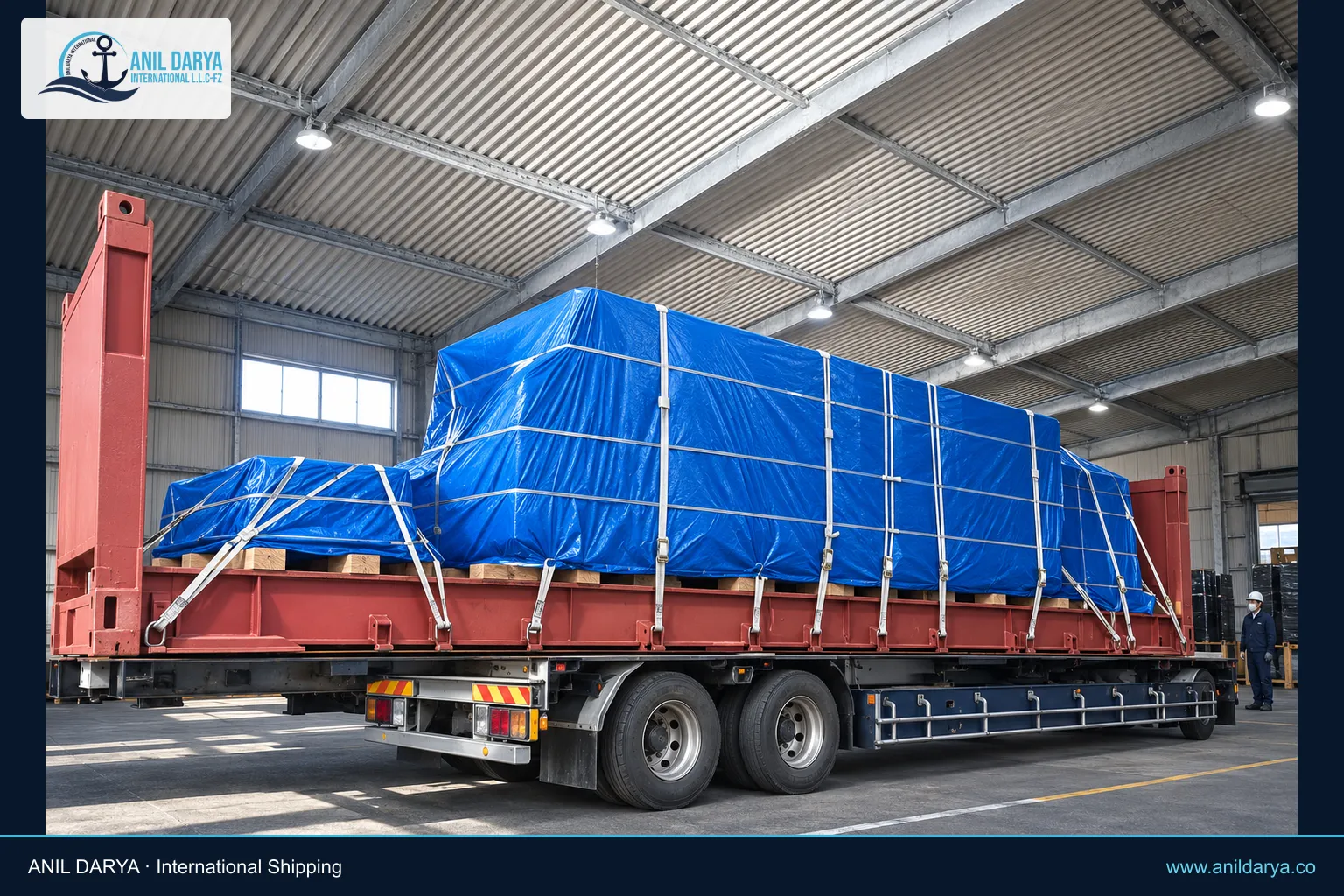
Qatar's building and utility projects buy Turkish switchgear, transformers, steel structures and plant. If a piece is over size but within flat rack limits, it can ride a container loop, though a relay at Jebel Ali means it is lifted twice more. If it is too big or too heavy, it needs breakbulk or heavy-lift tonnage, and Hamad's general cargo terminal receives it. Get drawings, weights and lifting points from the factory before we ask any carrier. See our break bulk and project cargo service and the flat rack and breakbulk guide.
Dangerous goods from Turkey
Paints, resins, adhesives, aerosols, lithium batteries and many cleaning chemicals are dangerous goods at sea. The IMDG Code 2024 edition, Amendment 42-24, has been mandatory since 1 January 2026, so the shipper's DG declaration and Safety Data Sheet must follow it. On the Qatar side, Invest Qatar's list of prohibited goods includes explosives, flammable goods and radioactive material, so some DG cannot be imported at all and others need an approval. We ask the Qatari broker to confirm the product is admissible before we request DG acceptance from the line. Our dangerous goods team checks the papers against the carrier's rules, including the relay vessel if there is one.
How long does sea freight from Turkey to Qatar take?
The only port-published figure we found is LimakPort's: 14 days from Iskenderun to Hamad on the direct GEM loop in its 2023 list. Rate sites quote from about a week to a month because they mix direct and relayed routings. Door to door, add these stages:
| Stage | What sets the time |
|---|---|
| Pickup and stuffing | Production date, truck booking, VGM, seal |
| Turkish export clearance | BILGE declaration accepted, EUR.1 issued, any inspection |
| Sea leg | Direct Gulf loop, or mainline to Jebel Ali plus connection time and the feeder to Hamad |
| Qatar clearance | Al Nadeeb declaration, permits, inspection at the CCIA if selected |
| Delivery | Truck from Hamad, return of the empty within free time |
Export clearance in Turkey
The Turkish side belongs to the seller or its origin agent. We agree the cut-off and the papers with them, but we do not file in Turkey. The Ministry of Trade sets the rules:
- An exporter needs a Turkish tax ID number and membership of the relevant exporters' association.
- Goods are declared to the authorised customs office. Declarations are filed in BILGE, the customs computer system, with access granted after an application to a Customs and Trade Regional Directorate.
- Military, dual-use and nuclear items need permission from the competent authority, and customs can ask for permission on unlisted goods when the end use is in doubt.
- Under Anti-Smuggling Law No. 5607, a false declaration of the type, quantity or value of exports to obtain support counts as smuggling.
If your buyer wants TEPA duty relief, the export step is also where the EUR.1 is born. Under the agreement's origin protocol, the EUR.1 is issued by the customs authorities of the exporting country on the exporter's written application and is made available once exportation has taken place or is ensured. Buying EXW leaves nobody in Turkey responsible for either task, which is why FOB or FCA works better here.
The Türkiye-Qatar trade agreement and your duty
Turkey's Ministry of Trade says the Trade and Economic Partnership Agreement was signed in Istanbul on 26 November 2018 and entered into force on 1 August 2025. For a shipper, the tariff schedules are what matter.
- Annex II, List B, is Qatar's schedule. Qatar abolishes customs duties on Turkish-origin goods listed there from the date the agreement entered into force. The list leans towards machinery, electrical goods, chemicals and fish.
- A second protocol, Annex VIII, adds a longer Qatari list in its appendix. It includes many lines in machinery, vehicles and parts, articles of steel, furniture, plastics, garments, carpets and bakery products.
- Goods not on either list pay Qatar's normal tariff, usually 5% of CIF.
The lists use the HS codes in force when the text was written. Since January 2025 Qatar classifies imports at 12 digits, so the broker must match your current code to the list before anyone promises zero duty.
Proof of origin under the TEPA
| Rule in the origin protocol | What it means for your shipment |
|---|---|
| Proof is a movement certificate EUR.1, or an origin declaration on the invoice | Ask the seller which one it will provide before the order is final |
| Any exporter may make an origin declaration for a consignment up to EUR 6,000; above that, only an approved exporter | Most container loads need a EUR.1 unless the seller is approved |
| EUR.1 forms are completed in English | Product descriptions must match the invoice line by line |
| Proof is valid for four months from issue in the exporting country | A box held for months in storage on the way can lose its preference |
| Direct consignment: storage and splitting are allowed only under customs supervision in the transit country | A relay at Jebel Ali on a through B/L fits; reworking or relabelling goods in Dubai does not |
Two more lines in the Annex VIII protocol are worth knowing. The parties will not require consular transactions on the import of originating goods under that protocol. And Turkish goods imported into Qatar get a GCC free-movement certificate only if the GCC customs duty has been levied in Qatar. If your buyer plans to send part of the cargo on to another GCC state, discuss that with the broker before it claims zero duty.
Qatar import customs for goods from Turkey
The General Authority of Customs clears all cargo at Hamad under Law No. 40 of 2002 and the GCC common customs law. Declarations go through Al Nadeeb, the web-based single window where the importer or its clearing agent files and follows the declaration, the system routes it to other agencies, and duty is paid online. Only a licensed importer can bring goods in: the US government's Qatar guide says importers need an import licence registered with the Ministry of Commerce and Industry. That is why clearance belongs to the consignee and its broker.
| Document | From | What the Qatari broker checks |
|---|---|---|
| Commercial invoice | Turkish seller | 12-digit HS code per line, price, Incoterm, consignee as on the B/L |
| Packing list | Turkish seller | Pieces, marks, net and gross weight matching the invoice |
| Certificate of origin or EUR.1 | Turkish issuing body or Turkish customs | Origin matches goods and invoice; EUR.1 still within four months if TEPA relief is claimed |
| Bill of lading | Shipping line, released through us | Consignee, notify party, load port in Turkey, discharge at Hamad |
| Import licence | Consignee | Registered with the Ministry of Commerce and Industry |
| Permits and certificates | Seller or consignee | Food, telecom, chemicals and other controlled goods |
Three Qatar rules catch Turkish shipments. Every piece and carton should show "Made in Turkey" or the country of origin, matching the invoice and certificate. Documents must be attested, translated and verified according to Invest Qatar, so ask the broker which stamps it needs. And goods that do not match their documents at inspection attract extra duty and a fine.
Duty, excise and tax on Turkish goods in Qatar
Qatar applies the GCC common external tariff. Turkish goods are non-GCC goods, so the TEPA lists decide whether they pay it. Duty and taxes at destination are paid by the consignee or its broker.
| Goods from Turkey | Qatar duty |
|---|---|
| On a TEPA concession list, with valid EUR.1 or origin declaration | 0% |
| Not listed, or no valid proof of origin | 5% of CIF for most goods |
| Steel, if not covered by the TEPA lists | 20% |
| Cigarettes and tobacco | 100%, or QAR 1,000 per 10,000 cigarettes if higher |
| Basic foods such as rice, wheat, flour, fresh fruit and vegetables | Exempt |
Excise tax applies to tobacco, energy drinks and sweetened drinks, and under decisions in force since 17 September 2026 excisable goods must be registered with the General Tax Authority before import. Qatar has not introduced VAT, according to a GCC customs guide checked in April 2026. For most Turkish goods, then, the real question is 0% or 5%, and the EUR.1 decides it.
Product rules and restricted goods in Qatar
We found no Qatari pre-shipment inspection scheme for general goods. Product rules apply instead:
| Cargo from Turkey | Rule | Who sorts it |
|---|---|---|
| Household electrical goods (low voltage) | Gulf Conformity Mark (G-Mark) under the GSO technical regulation | Seller, with a GSO notified body |
| Phones, routers, radio devices | Import authorisation from the Communications Regulatory Authority | Consignee |
| Dairy and other food | Ministry of Public Health certificate of conformity programme; Arabic or Arabic and English labels; at least half the shelf life left on arrival | Seller and consignee |
| Explosives, narcotics, goods that infringe trademarks | Prohibited | Do not ship |
| Flammable goods, radioactive material | Prohibited or controlled | Confirm with the broker first |
For dairy, printed dates must come from the manufacturer, not a sticker, and the conformity file should be ready before the reefer is booked.

Where Dubai fits on this lane
A direct call at Hamad is the clean option. Dubai comes in for three reasons, and each one affects your duty.
- Relay at Jebel Ali. The box moves on the carrier's through bill of lading and changes ship at Jebel Ali. Dubai Customs lists transit among its declaration types. The goods are not reworked, so the TEPA direct consignment rule can still be met.
- Stock held in a Dubai free zone. Our article on re-exporting through JAFZA explains the model. Free zone goods are outside the GCC customs territory, so Qatar charges duty on arrival. Whether a EUR.1 still works depends on storage under customs supervision and the four-month validity, so the Qatari broker must confirm it first.
- Goods cleared into the UAE first. Under the GCC customs union, duty is collected at the first point of entry. If Turkish goods paid GCC duty in Dubai and the broker proves it with the import declaration, Qatar does not charge it again.
When the cargo stops in Dubai for storage, consolidation or re-export, the UAE customs clearance is our work, for a fee. We file with Dubai Customs and send the Qatari broker a matching document set.
[AMIR-FACT: whether we route Turkish cargo for Qatar through Jebel Ali today (relay or JAFZA stock), which feeder we use to Hamad, and how many days it adds against a direct call]
What Turkish cargo moves to Qatar?
Turkey's Ministry of Foreign Affairs lists electrical and electronic equipment, furniture, construction components, petroleum and mineral oils, and milk and dairy products as the main export items to Qatar.
| Cargo group | Usual equipment | Qatar-side point |
|---|---|---|
| Electrical panels, cables, appliances | 40ft, flat rack for large panels | G-Mark for low voltage goods; check TEPA lists for chapter 85 |
| Furniture and fit-out | 40ft high cube | Origin marks on every piece; furniture lines appear in the Annex VIII list |
| Construction components and steel | 20ft, flat rack, breakbulk | 20% duty on steel unless a TEPA line covers it |
| Milk and dairy | Reefer | Food conformity, labels, shelf life |
How to ship from Turkey to Qatar, step by step
- Send us the details. Product, HS code, weight, volume or dimensions, Turkish pickup city, Qatar delivery point, Incoterm and ready date. Flag DG, reefer and oversized pieces.
- Check the HS code against the TEPA lists and start any G-Mark, CRA or food approvals.
- Agree destination clearance. The consignee names its broker and confirms its import licence and any permits. We contact the broker and do not confirm the booking until this is settled.
- We quote and book. You see the carrier, the routing (direct to Hamad or via Jebel Ali), and the cut-off. For DG, reefer and out-of-gauge cargo we get the line's acceptance first.
- Origin work. The seller or its origin agent collects the cargo, stuffs the box, files the BILGE declaration and applies for the EUR.1.
- Check the drafts. We match the B/L draft to the invoice and packing list and share them with the broker.
- Sailing. The line issues its B/L, released to you through us, and we track the box to Hamad, including any relay.
- Clearance and delivery. The broker files on Al Nadeeb, the consignee pays any duty, and the box is collected and returned within free time.
[AMIR-FACT: one real cross-trade shipment we handled from Turkey to Qatar (cargo, load port, routing and carrier, days to Hamad, how the broker cleared it, any TEPA claim), cleared for publication]
What drives the cost of this lane
We do not publish rates because they change with every sailing. These are the parts of the total:
| Cost element | What changes it |
|---|---|
| Origin charges in Turkey | Truck distance to the port, terminal handling, export filing and EUR.1 by the seller's broker |
| Ocean freight | Port pair, direct or relayed, container type, season, surcharges |
| Special cargo | DG surcharges, reefer plugs, flat rack and lashing, breakbulk premiums |
| Hamad charges | Terminal handling, delivery order, inspection, trucking, broker fee |
| Duty and excise | 0% or 5% under the TEPA, 20% on steel, excise on listed products |
| Free time | Demurrage and detention once free days run out; see our guide to demurrage and detention |
Checklist before the box leaves Turkey
- Incoterm agreed and written into the sales contract.
- Qatari broker named, import licence confirmed, draft documents shared.
- 12-digit Qatar HS code agreed and checked against the TEPA lists.
- EUR.1 or origin declaration arranged, with descriptions that match the invoice.
- "Made in Turkey" or country of origin on every carton and piece.
- G-Mark, CRA or food conformity papers in hand where they apply.
- Routing known: direct to Hamad or relayed at Jebel Ali, with the relay port on the quote.
- Free time at Hamad agreed and cargo insurance arranged.
Mistakes that cost money on this lane
- Shipping before destination clearance is agreed. With no broker or licence ready, the box waits at Hamad and storage runs.
- Forgetting the EUR.1. Without valid proof of origin, listed Turkish goods pay 5% like any other non-GCC goods.
- Assuming every product is covered. The TEPA works line by line; check the code first.
- Holding stock too long on the way. Proof of origin is valid for four months.
- Pricing steel at 5%. Unlisted steel pays 20%.
- Electrical goods or toys without a G-Mark, or food without its conformity file.
Frequently asked questions
Which port in Qatar receives containers from Turkey?
Hamad Port, south of Doha, run by Mwani Qatar. FCL, LCL, reefer, flat rack and breakbulk cargo from Turkey all discharge there, and customs inspection takes place in the port's Centralised Customs Inspection Area.
How long does sea freight from Turkey to Qatar take?
LimakPort's 2023 service list showed 14 days from Iskenderun to Hamad on a direct weekly loop. A relay at Jebel Ali takes longer. We quote days from the live carrier schedule for your port pair.
Is there a direct ship from Turkey to Qatar?
Direct Gulf loops that call Turkish ports and Hamad have run, for example the GEM loop in LimakPort's 2023 list. Its October 2025 list showed Gulf calls at Jebel Ali only, so check each quote for direct call or relay.
Do Turkish goods pay customs duty in Qatar?
Goods on Qatar's TEPA concession lists enter at 0% with a valid EUR.1 or origin declaration. Other goods pay the GCC tariff, 5% of CIF for most products and 20% for steel. The consignee or its broker pays.
What is a EUR.1 and who gets it?
A EUR.1 is the movement certificate that proves Turkish origin under the Türkiye-Qatar agreement. Turkish customs issue it on the exporter's application at export. It is valid for four months and must reach Qatar customs within that time.
Does Qatar charge VAT on imports from Turkey?
Qatar has not introduced VAT, according to a GCC customs guide checked in April 2026. Excise tax does apply to tobacco, energy drinks and sweetened drinks.
Who clears the cargo in Qatar?
The consignee, through its import licence and a customs broker on Al Nadeeb. We do not sell clearance in Qatar, but we agree the broker before we confirm the booking.
Can Turkish goods reach Qatar through Dubai?
Yes: on a through B/L with a relay at Jebel Ali, or from stock held in a Dubai free zone. We clear the Dubai side for a fee. Ask the Qatari broker first whether a EUR.1 will still be accepted.
Get a quote for shipping from Turkey to Qatar
Tell us the Turkish pickup city, the cargo, the ready date and your broker in Qatar. We will come back with the carrier, the routing to Hamad and a price. Use our freight rate inquiry form, or contact our team to talk through a DG, reefer or project shipment first. You can also read about our Dubai freight forwarding team.
Sources
- Republic of Türkiye Ministry of Trade: Türkiye-Qatar TEPA (signature, entry into force, scope)
- Republic of Türkiye Ministry of Trade: TEPA text and annexes (origin protocol, Annex II and Annex VIII lists)
- Republic of Türkiye Ministry of Trade: Export regime FAQ
- Republic of Türkiye Ministry of Trade: Digital customs FAQ (BILGE)
- Republic of Türkiye Ministry of Foreign Affairs: Commercial and economic relations with Qatar
- LimakPort Iskenderun: Container carriers and service details (updated 15 November 2023)
- LimakPort Iskenderun: Container carriers and service details (updated 7 October 2025)
- LimakPort Iskenderun: Port technical features
- Kumport: Project cargo and crane capacity
- Mwani Qatar: Hamad Port
- Milaha: Intra Gulf Express (MIG) service profile, January 2025
- Invest Qatar: Customs laws, duty rates, documents, prohibited goods and Al Nadeeb
- US International Trade Administration: Qatar import requirements and documentation
- US International Trade Administration: Qatar labelling and marking requirements
- US International Trade Administration: Qatar moves to 12-digit HS codes
- EY Tax News: Qatar excise framework update (September 2026)
- Goods Across Borders: GCC customs union explainer (verified April 2026)
- UAE ICP: Customs union for GCC states (duty at the first point of entry)
- QIMA: Gulf Conformity Mark (G-Mark)
- Gulf Times: CRA import authorisation for telecom equipment
- SGS: Qatar MoPH certificate of conformity for food and beverages (datasheet, February 2024)
- IMO: IMDG Code 2024 edition (Amendment 42-24)
- Dubai Customs: Submit customs declaration (declaration types including transit)
Reviewed: 11 November 2026