
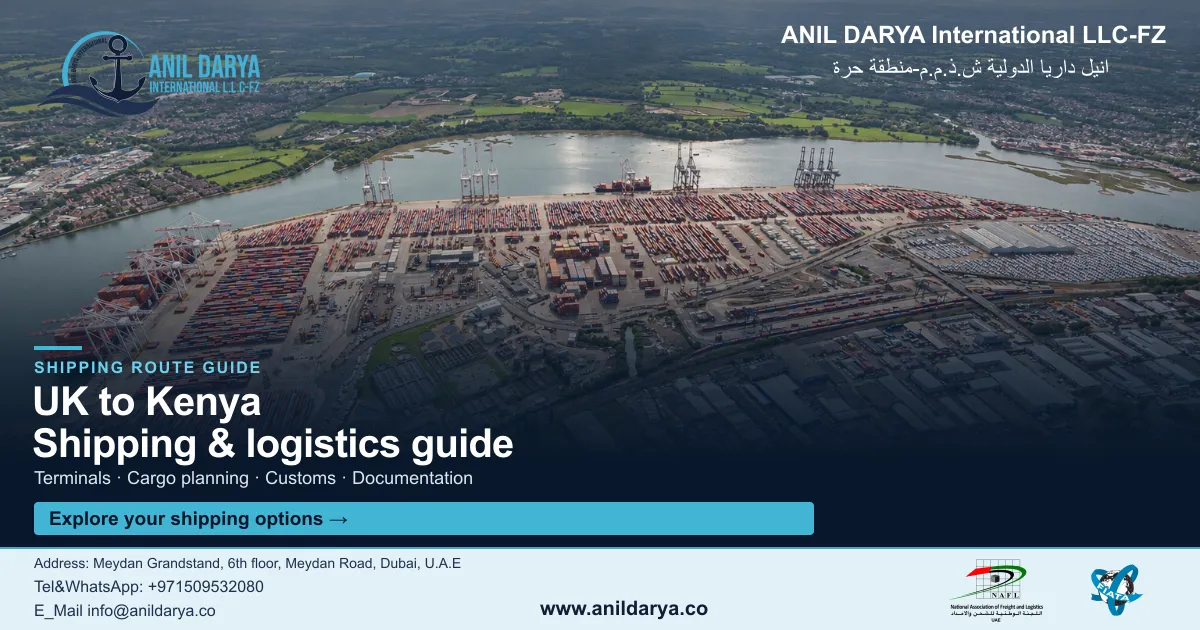
Shipping from UK to Kenya is a sea lane from Felixstowe, Southampton, London Gateway, Tilbury or Liverpool to the Port of Mombasa, usually with a change of ship at a hub on the way. The British exporter files the export on HMRC's Customs Declaration Service, regulated goods and every used car need a KEBS conformity check, and the Kenyan importer's clearing agent enters the cargo in KRA's iCMS. Anil Darya books the ocean leg as a cross-trade from Dubai and keeps the UK shipper, the line and the Kenyan broker working to one plan.
UK to Kenya shipping at a glance
| Item | Detail |
|---|---|
| Lane type | Cross-trade: British origin, Kenyan destination, booked from Dubai |
| UK load ports | Felixstowe, Southampton, London Gateway, Tilbury, Liverpool |
| Kenyan discharge port | Mombasa, with rail to the Nairobi inland container depot |
| Routing | Mostly a mainline ship plus a relay at a hub |
| UK export filing | CDS declaration, at least 24 hours before a container is loaded |
| Trade agreement | UK-Kenya EPA, in force since 22 March 2021; preference needs an EUR.1 or origin declaration |
| Kenyan conformity | KEBS certificate or destination inspection; QISJ checks for used vehicles |
| Kenyan customs | KRA iCMS, lodged by the consignee's clearing agent |
| Duty and VAT | EAC CET bands of 0%, 10%, 25% and 35%; VAT 16%; IDF and RDL on top |
| Bill of lading | The line's own B/L, released to you through us as agent for the line |
How shipping from the UK to Kenya works when we book it from Dubai
The container or car never has to pass through the UAE. It loads in Britain and discharges in Mombasa. Our part sits in Dubai: we pick the line and the sailing, hold the space, check the papers against the booking and follow the cargo until the Kenyan broker has it.
| Task | Who handles it |
|---|---|
| Carrier, space, equipment, sailing date | Anil Darya, directly with the shipping line |
| Collection, packing, haulage or drive-in to the terminal | The UK seller or its UK agent, to the cut-offs we send |
| CDS declaration, export licence, origin papers | The UK exporter or its customs agent |
| KEBS papers and QISJ vehicle inspection | The UK exporter, on the Kenyan buyer's instructions |
| Bill of lading | The line's own B/L, issued and handed over through us, since we act as agent for many lines |
| iCMS entry, duty, VAT, levies, delivery order | The Kenyan consignee or its clearing agent |
The Incoterm decides who pays the sea leg. On FCA or FOB the Kenyan buyer books the freight, often through us. On CFR Mombasa the UK seller pays it and the buyer takes over at the port. DDP rarely works here, because a foreign seller cannot easily act as importer in Kenya. Our guide to Incoterms 2020 for sea freight shows where cost and risk pass.
Which British port to load at
Start with where the goods sit, then compare the Mombasa sailings each port offers that month. The facts below come from the port operators.
| UK port | What the operator says | Good fit for Kenya cargo |
|---|---|---|
| Felixstowe | Two container terminals, 9 berths, 28 quay cranes; 54 trains a day to 15 inland terminals | East Anglia, and Midlands or northern boxes sent by rail |
| Southampton | DP World terminal with 5 container berths and 22 daily rail services | Southern England; the wider port also ships cars Ro-Ro |
| London Gateway | DP World terminal on the Thames with more than 3,000 reefer points | London, the South East and chilled cargo |
| Tilbury | Thames port for containers, Ro-Ro and general cargo | London-area cars and breakbulk, if the line loads there |
| Liverpool | Peel Ports' Liverpool2 and Royal Seaforth terminals | The North West, Wales and Scotland |
If the best East Africa connection that week loads at one terminal only, a longer truck or rail leg in Britain can still win.
Mombasa and the Nairobi depot
Almost every UK shipment to Kenya discharges at Mombasa, where KPA lists 22 berths split between conventional and container terminals. The Standard Gauge Railway links the port to the Nairobi inland container depot, and KPA says a box can travel there on a through bill of lading. Choose the clearance point before booking, since the B/L must name it.
One KPA rule changes how you book. Under its customer notice of 4 December 2025, quoted by Maersk, domestic containerised cargo stopped being cleared inside the Port of Mombasa from 10 December 2025. You name a container freight station (CFS) when the box is booked at the load port; boxes without one are allocated by the CFS association. Through-bill cargo for Nairobi is not affected. Send us the importer's chosen CFS with the booking request.
Lamu, on the north coast, is KPA's second sea port. Some route tools show UK cargo landing there after two transfers, but Mombasa remains the normal discharge point.
Sailings, relays and transit time from Britain to Mombasa
We found no direct weekly UK to Mombasa container loop on any carrier page we could open. UK cargo for Kenya usually goes on a Europe mainline service and is relayed at a hub to an East Africa vessel, all on one carrier B/L. The connection at the hub decides the arrival date more than the sea distance does.
Route tools and UK forwarders print transit figures that differ by weeks, and few say whether they count collection, the relay or clearance. We do not repeat them. Ask each quote for the hub and the number of transfers, and check the line's schedule for the exact sailing.
[AMIR-FACT: the shipping lines we actually book from Felixstowe, Southampton, London Gateway, Tilbury and Liverpool to Mombasa in 2026, the relay hub each one uses, and our real port-to-port days for FCL, LCL and Ro-Ro]
Sea freight from the UK to Kenya by type of cargo
British exports to Kenya lean towards power equipment, vehicles and machinery, so this lane carries more flat racks and Ro-Ro units than a typical consumer-goods route.
FCL and LCL
A 20ft box suits heavy spares, cable drums and tins of paint. A 40ft high cube suits furniture, lab equipment and retail stock. LCL fits samples and small spare-part lots, but each lot needs its own KEBS clearance, origin proof and Kenyan entry, so several small lots to one buyer can cost more in paperwork than one shared box. Our article on FCL vs LCL shows the break-even, and our sea freight service lists the container types we book.
Generators, transformers and project cargo
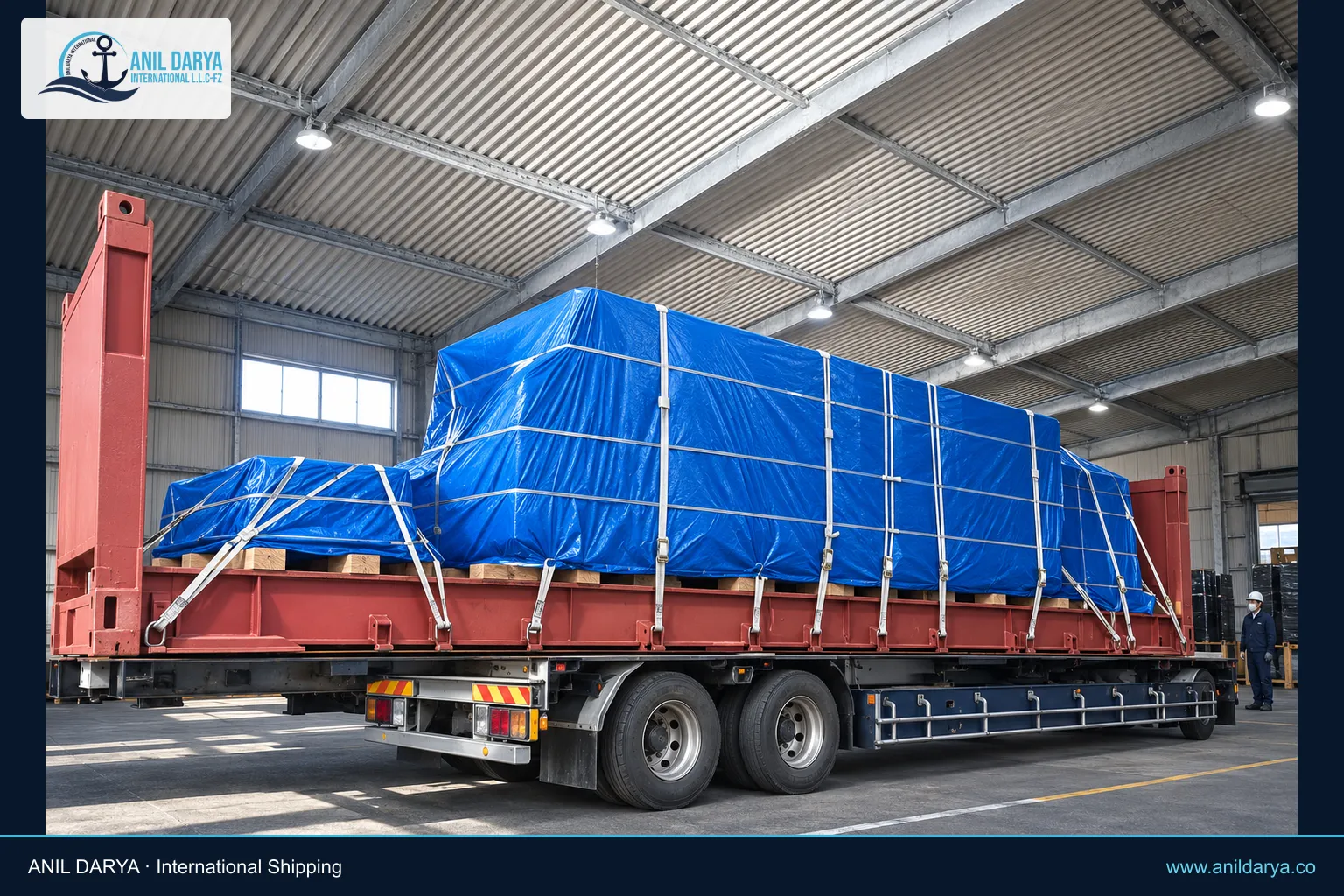
Generator sets are the largest British export to Kenya, and many are too wide, tall or heavy for a closed box. Units within flat rack or open top limits travel on container ships, which gives more sailings; bigger pieces need breakbulk space. Send drawings, weights and lifting points first, because both the mainline ship and the feeder after the relay must accept the piece. For a Kenyan generator project, our break bulk and project cargo team deals with the line, and the guide to flat rack, open top and out-of-gauge cargo lists the size limits of each unit.
Dangerous goods and reefer cargo
Paints, adhesives, aerosols, lab chemicals and lithium batteries inside equipment ship as dangerous goods under the IMDG Code 2024 edition (Amendment 42-24), mandatory since 1 January 2026. KPA says it handles dangerous cargo under international maritime rules. Our dangerous goods desk checks the UN number, class and packing group with the line, on both legs, before we request space. Chilled food and medicines need reefer plugs on every leg, with the set point on the booking.
Shipping used cars and vehicles from the UK to Kenya
Cars are the second largest British export to Kenya, and UK cars are right-hand drive, which suits Kenyan roads. Most of the rules must be met before the car leaves Britain.
Ro-Ro or container?
| Method | Suits | Watch |
|---|---|---|
| Ro-Ro | Single cars, vans, trucks and machinery that can be driven on board | Vehicle must run; no personal goods inside; fewer UK sailings to East Africa |
| Container | High-value cars, two to four cars in a 40ft box, cars plus spare parts | Specialist lashing; each car still needs its own inspection and entry |
[AMIR-FACT: the Ro-Ro lines we actually book from Southampton or other UK ports to Mombasa, and how often they sail]
The age limit and the QISJ inspection
KEBS enforces KS 1515:2000, the code of practice for inspection of road vehicles. Its notice of July 2025 states that used motor vehicles imported into Kenya must not be more than 8 years old from the year of first registration, and KRA's customs FAQ gives the same rule. For a UK car, that year is on the V5C log book.
KEBS uses Quality Inspection Services Japan (QISJ) for used vehicles. Its notice of 5 February 2026 says the QISJ contract for used motor vehicles, mobile equipment and spare parts remains in force, all such consignments continue to be inspected by QISJ, and units arriving without a Certificate of Roadworthiness (CoR) face destination inspection. For a car arriving without a CoR, the July 2025 notice also makes the importer have the log book, deregistration or export certificate validated at QISJ's Kenyan offices, at KES 12,000 per vehicle, before KEBS inspects it.
[AMIR-FACT: confirm the current KEBS cutoff year for UK used cars in 2026 (press reports say only cars first registered from 2019 are accepted) and that QISJ carries out the pre-export roadworthiness inspection in the UK under the contract renewed in May 2026]
UK paperwork and Kenyan duty for a car
Fill in the permanent export section of the V5C, send it to DVLA and keep the rest, which GOV.UK says you need to register the car abroad. A buyer of an export car must get the full V5C, not just the new keeper slip, and any personalised number must be retained before export. The car still needs its own CDS declaration.
In Kenya, KRA values a used car from its Current Retail Selling Price (CRSP), not the UK invoice. Its customs FAQ lists import duty at 25% of the customs value, excise on top, and VAT at 16% on value, duty and excise together. Ask the clearing agent for an estimate from the CRSP table before you buy the car in Britain.
The UK export side: CDS, EORI and licences
Export formalities in Britain belong to the exporter or its customs agent. We agree dates and papers with them, but we do not file in the UK.
- A GB EORI number is needed to export from Great Britain.
- HMRC says the exporter or its representative must submit the export declaration and have it cleared before the goods leave.
- Kenya is not on the short-sea list, so a container is declared at least 24 hours before loading. Ro-Ro cars and breakbulk must be declared at least 2 hours before they leave the port.
- A departure message has been a legal requirement for all exports since 1 January 2022.
- A VAT-registered seller can zero-rate the sale only with proof of export: keep the CDS record and the B/L.
- Military and dual-use items need a licence from the Export Control Joint Unit before shipping.
The UK-Kenya EPA: how to claim lower duty on British goods
Most UK to Kenya guides skip this. The UK-Kenya Economic Partnership Agreement entered into force on 22 March 2021, according to the UK Treaty Series text. Kenyan goods enter the UK duty-free, but Kenya cuts its own duty on British goods in stages, and only for goods of UK origin.
| Kenya's schedule for UK goods | What the treaty says |
|---|---|
| Annex II(a) goods | Duty eliminated on entry into force |
| Annex II(b) goods | Duty cut to 80% of the basic rate seven years after entry into force, then down each year to zero after fifteen years |
| Annex II(c) goods | First cut, to 95%, twelve years after entry into force; zero after twenty-five years |
| Annex II(d) goods | Excluded from any cut |
Seven years from March 2021 is March 2028, so in 2026 only Annex II(a) goods get a lower rate. Everything else still pays the normal EAC rate, even with perfect origin papers. Have the clearing agent check the tariff line against the annexes before you price the deal.
Proof of origin under the EPA
- A movement certificate EUR.1, or an origin declaration on the invoice made out by an approved exporter, or by any exporter when the consignment is worth no more than EUR 6,000.
- The proof is valid for ten months from issue.
- Goods must be wholly obtained or sufficiently processed in the UK; GOV.UK says EU materials can count under the cumulation rules.
Kenya also asks for a general certificate of origin on every commercial consignment, covered below, so have the UK exporter order both documents together.
KEBS conformity checks for British goods in 2026
Kenya checks regulated products against its standards, either before export under the Pre-Export Verification of Conformity (PVoC) programme or on arrival through destination inspection. The rules for general goods changed this year.
- KEBS's notice of 5 February 2026 says the PVoC contracts for general goods expired on 8 February 2026. Goods shipped on board from 9 February without a valid certificate of conformity face destination inspection at 0.6% of the approved customs value.
- The same notice urges testing before export in an ISO/IEC 17025 accredited laboratory, or KEBS product registration or Diamond Mark certification, filed through the National Single Window, plus a certificate that the goods are freely sold in the country of origin.
- SGS reported on 12 March 2026 that KEBS had awarded it a PVoC contract for 2026 to 2029, and that KEBS added Africa, Central Europe, Canada and the USA to destination inspection at 0.6% of CIF value.
Neither text says which route now applies to goods supplied from the UK. Until the broker confirms it, plan for both: accredited test reports and a free sale certificate from the UK supplier, and the KEBS fee at destination.
[AMIR-FACT: confirm whether goods supplied from the UK fall under a PVoC zone (and which inspection company) or under KEBS destination inspection in the 2026 to 2029 cycle]
Kenya customs clearance: agree it before the cargo sails
We do not clear goods in Kenya. The consignee's own licensed clearing agent does, and duty and taxes at destination are paid by the consignee or its broker. Before we confirm a UK booking, we want that agent's name and their yes to this shipment, its KEBS route and its CFS. Cargo that reaches Mombasa with no agreed broker runs up storage and container charges.
The agent lodges the entry in iCMS. KRA lists the Import Declaration Form, the customs entry, the certificate of conformity for regulated products, the Import Standards Mark where it applies, and the exporter's commercial and pro forma invoices.
| Newer Kenyan rule | What it means for UK cargo |
|---|---|
| Certificate of origin on every commercial consignment, fully enforced from 1 October 2025 | The UK exporter supplies one from a competent authority, usually its chamber of commerce |
| Export declaration kept by the importer, from 1 September 2026 | The importer must obtain the UK export declaration and keep it five years; without it, claims on value or origin may fail |
| Local marine cargo insurance, digital enforcement from 1 July 2026 | The importer buys cover from a Kenyan insurer and files it in iCMS, so UK cover under CIF may duplicate it |
| CFS nomination at booking, from 10 December 2025 | Name the Mombasa CFS before the box loads in Britain |

Kenya import duty, VAT and levies
Kenya applies the East African Community Common External Tariff: 0% for raw materials and capital goods, 10% for intermediate goods not available in the region, 25% for intermediate goods available in the region and 35% for finished goods available in the region. Sensitive items pay more.
| Charge | Basis | Note for UK goods |
|---|---|---|
| Import duty | Customs value at the CET band | Lower only for EPA Annex II(a) lines with valid origin proof |
| VAT | 16% on value plus duty and any excise | Applies whatever the origin |
| Excise duty | Listed goods such as vehicles, some drinks and sugar | Finance Act 2026 sets 50% on qualifying antique and classic cars |
| Import Declaration Fee and Railway Development Levy | Customs value | KRA pages show different rates; get the current ones from the broker |
Get a written duty estimate on the exact HS code before the order is placed. VAT and levies often add more to the landed cost than the freight.
Typical cargo on this lane
UK government figures put UK exports to Kenya at £785.0 million in the four quarters to the end of Q4 2025, which makes Kenya the UK's 79th largest export market. The top goods, for the four quarters to the end of Q1 2026:
| UK export to Kenya | Value (£ million) | Usual shipping method |
|---|---|---|
| Mechanical power generators | 65.5 | Flat rack, open top or breakbulk |
| Cars | 33.3 | Ro-Ro or container |
| Refined oil | 28.1 | Mostly tanker, outside this guide; lubricants in drums by container |
| Metal ores and scrap | 19.3 | 20ft containers or bulk |
| Road vehicles other than cars | 16.1 | Ro-Ro or flat rack |
Restricted and prohibited goods in Kenya
The Second Schedule of the EAC Customs Management Act lists prohibited goods in Part A and restricted goods in Part B, which need a permit before release. On British cargo, watch these:
- Used vehicles over the KS 1515:2000 age limit or without the QISJ checks.
- Medicines: registration with the Pharmacy and Poisons Board.
- Plants, seeds and plant products: a KEPHIS import permit issued before the goods ship.
- Regulated manufactured goods: a certificate of conformity or destination inspection.
When routing through Dubai helps
Most UK to Kenya shipments need nothing from the UAE. Dubai helps in two cases.
| Option | How it works | What to check |
|---|---|---|
| Relay at Jebel Ali | The UK box is discharged at Jebel Ali and reloaded on an East Africa vessel under the same carrier B/L | Connection time; Dubai Customs treats transit as its own declaration regime |
| Consolidation or free zone stock | UK goods are held in Jafza, combined with other stock and shipped to Kenya as one lot | EPA preference, KEBS route and origin papers |
Watch the EPA storage rule. Article 15 of the origin protocol allows storage, and splitting by the exporter, in a third country only while the goods stay under customs supervision. Goods that leave customs control in Dubai, or are repacked there, can lose the UK preference. And for KEBS, goods supplied from the UAE fall in Intertek's Gulf and UAE zone, not under the UK route. Confirm both with the Kenyan broker first.
Customs clearance in Dubai is ours, for a fee. When cargo is consolidated or re-exported through Dubai, we file the UAE declaration at Jebel Ali, and Dubai Chambers issues the certificate of origin for re-exported goods. See our Jebel Ali port guide and our article on re-exporting through Jafza.
[AMIR-FACT: whether we route UK to Kenya cargo via Jebel Ali in practice (relay or Dubai consolidation), on which services, and how often]
What drives the cost of shipping from the UK to Kenya?
We do not publish rates, because they change with every booking. These are the parts of the bill.
| Cost part | What moves it |
|---|---|
| UK origin | Collection, packing, haulage or rail to the port, terminal handling, CDS filing |
| Conformity | Lab testing, QISJ inspection, KEBS destination inspection fee |
| Ocean freight | Box type or Ro-Ro unit size, relay hub, season, DG and out-of-gauge surcharges |
| Mombasa and inland | Terminal and CFS charges, delivery order, rail to Nairobi or road delivery |
| Duty, taxes, insurance | CET or EPA rate, VAT, levies, Kenyan marine cover, paid by the consignee or its broker |
| Delays | Storage, demurrage and detention when free time runs out |
Compare quotes on the same Incoterm, UK port, relay hub, discharge point and free time.
How to book this lane, step by step
- Agree the Incoterm with the UK seller.
- Send us the goods, HS code, weights, collection postcode, ready date and any DG, vehicle or out-of-gauge items.
- Name the Kenyan clearing agent and get their written yes. We do not confirm the booking before this.
- With the agent, settle the KEBS route, the EPA position, permits and the Mombasa CFS.
- We quote the routing: load port, relay hub, Ro-Ro or container, free time.
- We book space, with carrier acceptance on every leg for DG, reefer, vehicles or out-of-gauge cargo.
- The UK exporter arranges testing or the QISJ inspection and the origin papers.
- The exporter loads the box or delivers the car and files the CDS declaration in time.
- We check the draft B/L against the invoice, packing list and origin papers, then release the line's B/L to you.
- The importer buys Kenyan marine cover, its agent lodges the iCMS entry, pays duty and taxes and collects the delivery order.
Our Dubai freight forwarding team runs the booking and the follow-up.
[AMIR-FACT: one real cross-trade shipment we handled from the UK to Kenya (cargo, load port, routing, how it went, transit achieved)]
Checklist before the cargo leaves Britain
- Kenyan clearing agent confirmed in writing.
- HS code fixed, duty estimate in hand, EPA annex checked.
- KEBS route agreed, with test reports and a free sale certificate.
- For a car: first registration year checked, QISJ inspection done, V5C export section sent.
- EUR.1 or origin declaration, plus the certificate of origin.
- CDS declaration copy promised to the importer for its five-year file.
- Mombasa CFS named, or the Nairobi depot on the B/L.
- For DG: SDS, IMDG 42-24 declaration and acceptance on both legs.
Common mistakes on this lane
- Shipping before destination clearance is agreed, so Mombasa storage starts on arrival.
- Buying a UK car before checking its first registration year against the Kenyan limit.
- Assuming the EPA makes all British goods duty-free in 2026.
- Repacking UK goods outside customs control on the way and losing the preference.
- No CFS nominated at booking.
- Values that differ between the CDS entry, the invoice and the Kenyan declaration.
Frequently asked questions
How long does shipping from the UK to Kenya take?
It depends on the relay hub and the connection there. Route tools disagree by weeks, so ask each quote for the hub and the carrier's schedule for the exact sailing.
Which UK ports ship to Kenya?
Felixstowe, Southampton and London Gateway carry most container cargo, with Tilbury and Liverpool as options. Cars often go Ro-Ro from Southampton. In Kenya, almost all of it discharges at Mombasa.
Can I ship a used car from the UK to Kenya?
Yes, if it is within Kenya's 8-year limit from the year of first registration under KS 1515:2000 and passes the QISJ checks KEBS requires. Send the V5C export section to DVLA and keep the rest for registration in Kenya.
Are British goods duty-free in Kenya under the EPA?
Only some. Kenya removed duty at once only on goods in Annex II(a) of the UK-Kenya EPA. Other lines start falling seven or twelve years after March 2021, and some are excluded. You also need an EUR.1 or a valid origin declaration.
Do UK goods need a PVoC certificate for Kenya?
Regulated goods need a KEBS check. Since 9 February 2026, goods shipped without a certificate of conformity face destination inspection at 0.6% of customs value. Ask your clearing agent which route applies to goods from the UK.
Does Anil Darya clear the goods in Kenya?
No. The consignee's own clearing agent clears the cargo, and the consignee or its broker pays duty and taxes. We make sure that agent is appointed before we confirm the booking.
Who issues the bill of lading on a UK to Kenya booking?
The shipping line issues its own B/L from the UK port to Mombasa or Nairobi. Anil Darya is agent for many lines, so that B/L reaches you through our Dubai office.
Get a quote for this lane
Send us the collection postcode, the cargo or vehicle details, the ready date and the name of your Kenyan clearing agent, and we will come back with a routing and a price. Use our freight rate inquiry form, or contact our team first for a vehicle, DG, reefer or project shipment.
Sources
- HMRC: Making a full export declaration (updated 13 May 2025)
- GOV.UK: Export goods from the UK
- GOV.UK: Export Control Joint Unit
- GOV.UK: Taking a vehicle out of the UK
- GOV.UK: UK-Kenya EPA, Treaty Series No. 46 (2025)
- GOV.UK: Summary of the UK-Kenya EPA (updated 1 January 2022)
- Business.gov.uk: Exporting to Kenya
- Port of Felixstowe: Container terminals
- Port of Felixstowe: Connectivity
- DP World Southampton: Infrastructure facts
- DP World London Gateway: Infrastructure facts
- Peel Ports: Port of Liverpool
- Kenya Ports Authority: Port of Mombasa
- Kenya Ports Authority: Inland container depots
- Kenya Ports Authority: FAQ
- Maersk: Mombasa CFS nomination notice (January 2026)
- KEBS: Expiry of PVoC contracts for general goods (5 February 2026, archived)
- KEBS: Validation of used motor vehicle documents (July 2025, archived)
- SGS: Kenyan PVoC contract 2026 to 2029 (12 March 2026)
- Intertek: Kenya PVoC zones (11 February 2026)
- KRA: How to import
- KRA: Customs FAQ
- KRA: Mandatory certificate of origin
- KRA: Finance Act 2026
- KRA: Prohibited and restricted goods (EACCMA)
- East African Community: CET bands
- KEPHIS: Plant import permits
- Clyde and Co: Kenya marine cargo insurance (June 2026)
- IMO: IMDG Code 2024 edition
- Dubai Customs: Declaration regimes
- Dubai Chambers: Certificate of origin
Reviewed: 11 November 2026