
Shipping from UK to Qatar is a sea lane from Felixstowe, Southampton, London Gateway or Liverpool to Hamad Port, south of Doha, often with a change of ship at a Gulf hub. The British exporter files on HMRC's Customs Declaration Service and has the invoice and certificate of origin certified by the Arab-British Chamber and legalised by the Qatari Embassy. The Qatari importer's broker then clears the cargo on Al Nadeeb and pays duty, 5% of CIF on most goods. Anil Darya books this lane as a cross-trade from Dubai and keeps the UK shipper, the shipping line and the Qatar broker on one plan.
UK to Qatar shipping at a glance
| Item | Detail |
|---|---|
| Main mode | Sea freight: FCL, LCL, flat rack, open top, breakbulk; Ro-Ro or containers for vehicles |
| UK load ports | Felixstowe, Southampton, London Gateway, Liverpool |
| Qatar discharge port | Hamad Port, operated under Mwani Qatar, with container, general cargo and vehicle terminals |
| Routing | A direct call or a relay at a Gulf hub, depending on the line and the month; the carrier's B/L runs through to Hamad |
| UK export filing | CDS declaration by the exporter or its agent, at least 24 hours before a container is loaded |
| Origin papers | Arab-British certificate of origin and invoice certified as a set, then legalised by the Qatari Embassy (mandatory) |
| Qatar customs | General Authority of Customs, declarations on the Al Nadeeb single window |
| Duty | 5% of CIF value on most goods; 20% on steel and cement; 100% on alcohol and tobacco |
| VAT | None introduced in Qatar so far; excise on tobacco and some drinks |
| UK-GCC trade deal | Concluded 20 May 2026, not yet in force, so UK goods pay the standard rate |
| Who clears in Qatar | The licensed Qatari importer or its broker, agreed before we confirm the booking |
Who does what on a cross-trade booked from Dubai
A cross-trade box never has to touch the UAE. It sails from a British quay to Hamad, and what sits in Dubai is the booking desk, the carrier paperwork and the follow-up with both ends.
| Task | Handled by |
|---|---|
| Choice of line, space, equipment and sailing date | Anil Darya, directly with the shipping line |
| Collection in Britain, packing, stuffing, haulage to the terminal | The UK shipper or its UK agent, working to the cut-offs we send |
| CDS export declaration and any export licence | The UK exporter or its customs agent |
| Chamber, ABCC certification and Qatari Embassy legalisation | The UK exporter, usually through its local chamber |
| Bill of lading | The shipping line's own B/L, issued and released to you through us, as we act as agent for many lines |
| Al Nadeeb declaration, permits, duty, delivery order | The Qatari consignee or its broker |
Agree the Incoterm in the sales contract. Qatari importers often buy on cost and freight. On CFR Hamad the British seller pays the ocean leg, while Hamad terminal charges and duty stay with the buyer. DDP is hard on this lane, because only a business holding a Qatari import licence can clear the goods. Our guide to Incoterms 2020 for sea freight shows where cost and risk pass.
Which British port should you load at?
Pick the port closest to where the goods are made or stored, then compare the Qatar sailings each one offers.
| UK port | Facts from the operator | Good fit for |
|---|---|---|
| Felixstowe | Two container terminals with 9 berths and 28 quay cranes; 54 trains a day to 15 inland terminals | East Anglia, plus Midlands and northern cargo railed to the port |
| Southampton | DP World terminal with 5 container berths and 22 daily rail services; over 2 million TEU in 2025 | Southern England, and vehicles through the Ro-Ro side of the port |
| London Gateway | DP World terminal on the Thames, about 28 miles from London; 3 million TEU in 2025; more than 3,000 reefer points | London, the South East and chilled cargo |
| Liverpool | Peel Ports' Liverpool2 and Royal Seaforth terminals, with ten motorways within ten miles | The North West, Wales and Scotland |
Often the line decides: if the best Qatar service loads at one terminal only, a longer haul in Britain can still pay.
Hamad Port: where British cargo lands
Hamad is Qatar's main commercial port and the default discharge point for UK cargo. Mwani Qatar gives these figures:
- operations started in December 2016, with the official opening on 5 September 2017, on a site of 29 square kilometres;
- two working container terminals with an optimum capacity of 5 million TEU a year, rising to 7.5 million TEU when the third is built;
- general cargo capacity of 7 million tonnes a year and a vehicle terminal for about 500,000 units a year;
- a customs inspection area able to handle 5,600 containers a day, and a free zone next to the port.
A QTerminals presentation from 2020 adds a General Cargo Terminal with a 1,200 m berth and 14 m allowable draft, a Multi Use Terminal with a 770 m berth for Ro-Ro, and a container freight station for LCL with a separate dangerous goods store.
Direct calls, relays and transit time
Many North Europe to Gulf loops call a big hub and pass Qatar cargo to a feeder for the last leg. A direct Hamad call gives one vessel and a firmer arrival date; a relay gives more sailings but adds handling and waiting time.
The Gulf feeder network is dense. Milaha's Intra Gulf Express, for example, is a weekly link between Jebel Ali and Hamad with two ships of 1,015 TEU nominal and 90 reefer plugs each, according to its January 2025 service profile.
Third-party sites print UK to Qatar transit figures that disagree with each other by weeks, and most do not say whether they count collection, the relay or customs. We do not repeat them. Ask every quote which hub it uses, and get the line's schedule for the exact sailing.
[AMIR-FACT: the shipping lines we actually book from Felixstowe, Southampton, London Gateway and Liverpool to Hamad in 2026, which call Hamad direct and which relay (and at which hub), and our real port-to-port days for FCL and LCL]
Sea freight from the UK to Qatar by type of cargo
Power generators are by far the biggest British export to Qatar, so this lane carries more flat racks and breakbulk than a typical consumer-goods route.
FCL and LCL
A 20ft box suits heavy spares, valves and cable drums. A 40ft high cube suits lab equipment, furniture and retail stock. LCL fits small orders and samples, but each lot still needs its own legalised invoice and certificate and its own declaration in Qatar. When the embassy fee is charged per document set, three small lots can cost more in paperwork than one shared box. Our article on FCL vs LCL shows where the break-even lies, and our sea freight service lists the container types we book.
Generators, turbines and project cargo
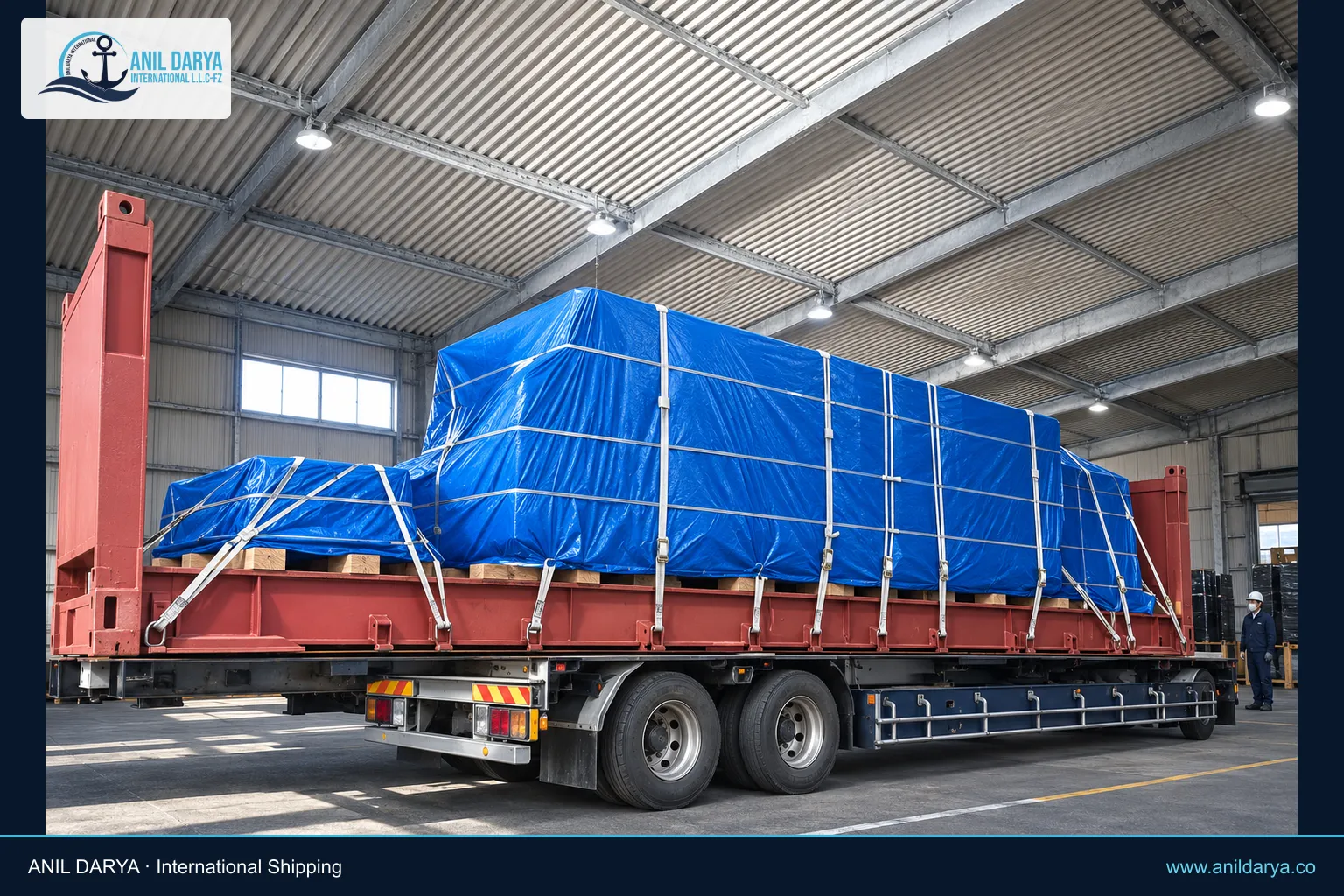
Many generator sets and transformers are too wide, tall or heavy for a closed box. Units within flat rack or open top limits can travel on a container ship. Bigger pieces need breakbulk or heavy-lift space, and the vessel date then drives the whole project plan.
- Collect drawings, weights, centre of gravity and lifting points for every piece.
- Choose flat rack, open top or breakbulk, and get the line's acceptance in writing, relay port included.
- Keep one packing list that matches the invoice, the legalised certificate and the B/L.
- Agree discharge at Hamad's general cargo berth and the road move to site with the consignee's broker.
Our break bulk and project cargo team handles the carrier side, and our guide to flat rack, open top and out-of-gauge cargo sets out the limits of each piece of equipment.
Cars and vehicles
British cars go either Ro-Ro or in containers, and Hamad has a dedicated vehicle terminal. Vehicles are regulated imports, so the Qatari importer should confirm the specification and registration rules before the car is booked. A car that cannot be registered in Qatar is costly to send anywhere else.
Dangerous goods and reefer
Paints, sealants, lab chemicals and lithium batteries inside equipment ship as dangerous goods under the IMDG Code, whose 2024 edition (Amendment 42-24) became mandatory on 1 January 2026. The UK shipper supplies the UN number, class, packing group, Safety Data Sheet and a signed DG declaration. On a relayed route both the mainline ship and the feeder must accept the class, and Qatar bars flammable and radioactive goods unless they are approved, so the broker must clear the product first. Our dangerous goods desk checks the papers before we request DG space. Chilled food and medicines need reefer plugs on every leg, with the set point written into the booking.
The UK export side: CDS, EORI and licences
Export formalities in Britain sit with the exporter or its customs agent. We agree dates and documents with them, but we do not file in the UK.
- EORI. An exporter in England, Wales or Scotland needs an EORI number starting with GB.
- Declaration. The export entry goes on HMRC's Customs Declaration Service, made by the exporter or its representative, and it must be cleared before the goods leave.
- Timing. Qatar is outside the short-sea list, so a container needs its declaration at least 24 hours before it is loaded. Breakbulk and other non-container cargo must be declared at least 2 hours before it leaves port.
- Departure message. Since 1 January 2022 HMRC needs a departure message. Without it, the declaration is not official evidence of export.
- VAT. A VAT-registered UK seller can zero-rate most goods sold to Qatar, but only with proof of export, so keep the CDS records and the carrier's B/L.
Export licences
Military items and dual-use goods need a licence before they leave Britain. The Export Control Joint Unit runs these controls and takes applications through SPIRE. Encryption equipment, some sensors, lab chemicals and parts for gas plants can fall under the dual-use lists. Check the control status while you agree the sales contract, not in the week of sailing.
Arab-British certificate of origin and Qatari Embassy legalisation
This is where most UK to Qatar shipments lose time. The London Chamber of Commerce and Industry lists Qatar among the countries that need the certificate of origin and its commercial invoice certified together as a set. It also states that legalisation is mandatory for Qatar, so the ABCC stamp alone is not enough.
- The exporter applies through its local chamber, often online, with a signed commercial invoice and a packing list if the invoice has no packing details.
- For goods not made in the UK, the exporter adds proof of origin, such as the maker's invoice or a supplier's declaration.
- The chamber checks the set and sends it to the Arab-British Chamber of Commerce (ABCC), which certifies it in up to two working days. LCCI lists the ABCC fee at £59.70 including VAT.
- The certified set then goes to the Qatari Embassy for legalisation. LCCI says this step takes 5 to 15 working days, depending on the embassy, and fees vary.
- The legalised originals are couriered to the Qatari broker before the vessel arrives.
Start the set as soon as the final invoice exists. Three weeks of stamps can outlast a fast sailing.
Qatar import customs for British goods
The General Authority of Customs clears cargo at Hamad under Law No. 40 of 2002 and the GCC common customs law. Declarations go through Al Nadeeb, a web-based single window where the importer or its clearing agent files the declaration, pays duty and authorises an agent. Invest Qatar says import documents must be attested, translated and verified.
Only a business with a Qatari import licence can clear goods. The US International Trade Administration notes that the licence is registered with the Ministry of Commerce and Industry, and the rule applies to foreign-owned firms too. That is why the consignee or its broker always files.
Documents the broker in Doha will want
| Document | Comes from | Point to check |
|---|---|---|
| Commercial invoice | UK seller, ABCC certified and legalised | 12-digit HS code per line, origin, Incoterm, values matching the certificate |
| Certificate of origin | Chamber and ABCC, legalised by the embassy | Same goods, codes and origin as the invoice |
| Packing list | UK seller | Pieces, crates, weights and marks match the B/L |
| Bill of lading | Shipping line, released through us | Consignee and notify party match the Qatari licence holder |
| Import licence and Al Nadeeb declaration | Consignee or broker | Filed before the box is due off the ship |
| Permits and certificates | Shipper or consignee | Food, telecom, medicines and other controlled items |
Origin marks and 12-digit codes
Every piece and carton must show "MADE IN" or "COUNTRY OF ORIGIN", and it must match the invoice and certificate. Trade.gov warns that a mismatch can send the shipment back to origin. Invest Qatar adds that a gap between the goods and the papers found at inspection brings extra duty and a fine. Qatar has also used 12-digit HS codes for imports since January 2025, so the 8-digit UK export commodity code on a British invoice template is not enough on its own.

Customs duty
Qatar applies the GCC common external tariff to the CIF value, so the freight from Britain is part of the duty base.
| Goods | Qatar duty |
|---|---|
| Most goods, including generators and machinery | 5% of CIF |
| Records and musical instruments | 15% |
| Steel and cement | 20% |
| Urea and ammonia | 30% |
| Alcoholic drinks, tobacco products | 100%; cigarettes 100% or QAR 1,000 per 10,000, whichever is higher |
| Fresh or chilled chicken (Amiri Decree 45 of 2026) | Raised from 5% to 18% |
More than 600 goods are exempt under the GCC customs union, including basic foods. Duty and taxes at destination are paid by the consignee or its broker.
Excise and VAT
Qatar charges excise on tobacco, energy drinks and sweetened drinks. Under Cabinet decisions in force since 17 September 2026, excisable goods must be registered with the General Tax Authority before import. Qatar has no VAT, as business.gov.uk and a GCC customs guide verified in April 2026 both say.
Does the UK-GCC deal cut duty on shipping from UK to Qatar?
Not yet. The UK and the GCC concluded their free trade agreement on 20 May 2026. The legal text still has to be signed, pass UK parliamentary scrutiny and be ratified by the UK and every GCC state, Qatar included. On our review date we found no official notice that it is in force, so British goods pay the normal Qatari rate.
Once it applies, the UK government summary says goods must be wholly obtained or significantly changed by processing in the UK or the GCC, and UK exporters will be able to self-certify origin after registering. The GCC side will fully free 90% of its tariff lines within ten years. The summary does not yet set out the rules on goods stored or split in a third country. If you plan to hold British stock in Dubai and send it on to Qatar, ask your broker whether that route will keep the preference before you rely on it.
Product rules and restricted goods in Qatar
We found no Qatari pre-shipment inspection scheme for general goods in the official sources we checked. Business.gov.uk notes that most Qatari standards follow the Gulf Standardisation Organisation, with national rules for building, mechanical and food products.
| British cargo | Rule in Qatar | Who sorts it |
|---|---|---|
| Low voltage appliances and toys | Gulf Conformity Mark (G-Mark) | UK maker, with a GSO notified body |
| Phones, routers, radio kit | Import authorisation from the Communications Regulatory Authority | Consignee |
| Food and drink | Ministry of Public Health conformity programme; Arabic or Arabic and English labels; at least half the shelf life left on arrival | UK exporter and importer |
| Meat and poultry | Health certificate and halal slaughter certificate | UK exporter |
Invest Qatar lists ammunition, explosives, flammable goods, radioactive material, narcotic drugs and goods that infringe trademarks or other property rights as prohibited. Alcohol and pork products pay 100% duty and need a licensed importer. Goods refused at inspection may be returned or destroyed at the owner's cost, so check any borderline item with the broker before packing.
Agree the Qatari broker before the box leaves Britain
We do not clear customs in Qatar. The consignee clears under its own licence or through a broker it appoints on Al Nadeeb, and we only confirm the booking once that is in place. Our order of work:
- We take the consignee's registered name, import licence details and broker contact.
- The broker accepts the job and sends its document list, including how the legalised set must look.
- The importer starts any G-Mark, CRA, food or excise step for the goods.
- The UK exporter confirms that the ABCC and embassy set will be ready before the vessel arrives.
- We confirm the space and send the UK side its cut-off dates.
A box that lands with no broker, or with papers still at the embassy in London, sits at Hamad while storage and line charges build. Our article on demurrage and detention explains how those charges start.
Using Dubai when shipping from UK to Qatar
Most UK cargo for Qatar should go through on one carrier B/L. Dubai helps in three cases.
| Option | How it works | When it fits |
|---|---|---|
| Relay at Jebel Ali | The mainline ship discharges at Jebel Ali and a feeder carries the box to Hamad; the line's B/L still runs UK port to Hamad | When the best UK sailing reaches the Gulf through Jebel Ali |
| Consolidation in Dubai | British cargo meets goods from Europe or Asia in Dubai and goes on as one Qatar shipment | Buyers mixing suppliers from several countries |
| Stock in JAFZA, then re-export | Goods wait in the free zone and go to Qatar in smaller lots | Distributors serving more than one GCC market |
Jebel Ali handles Ro-Ro, breakbulk, reefer and IMDG cargo, as our Jebel Ali port guide explains, and our note on JAFZA re-export covers stockholding. Where goods are cleared into or re-exported from the UAE, Dubai customs clearance is a service we provide for a fee.
Under the GCC customs union, duty is collected at the first point of entry and not charged again in the next member state when payment is proven. Goods in a UAE free zone count as outside the GCC for customs, so stock sent from JAFZA to Qatar is a full import at Hamad. Agree the plan with your Qatari broker before you choose it.
[AMIR-FACT: whether we route UK to Qatar cargo through Jebel Ali in practice (relay, Dubai consolidation or JAFZA stock), which feeder we use to Hamad, and how many days it adds against a direct call]
What British goods go to Qatar?
Business.gov.uk puts total UK exports to Qatar at £4.3 billion in the four quarters to the end of 2025, making Qatar the UK's 32nd largest export market. Its top goods list shows how far generators lead.
| UK export (four quarters to Q1 2026) | Value | Usual method |
|---|---|---|
| Mechanical power generators | £964.7 million | Flat rack, open top or breakbulk |
| Aircraft | £214.9 million | Flown, outside this guide |
| Jewellery | £172.4 million | Air or secure courier |
| Cars | £96.8 million | Ro-Ro or containers |
| Scientific instruments | £77.4 million | Crated in FCL or LCL |
What drives the cost of shipping from UK to Qatar?
Rates change with every sailing, so we do not publish them. These are the parts of the landed cost.
| Cost part | Usually paid by | What moves it |
|---|---|---|
| UK collection, packing, terminal handling, CDS entry | Seller under FOB, buyer under EXW | Distance to port, road or rail, agent's fee |
| Ocean freight and feeder to Hamad | Set by the Incoterm | Box type, flat rack or reefer premium, DG surcharge, direct or relayed, fuel, season |
| Origin papers | Seller, often recharged | Chamber and ABCC fees, Qatari Embassy legalisation, courier of originals |
| Hamad charges and broker fee | Buyer | Terminal handling, delivery order, inspection, trucking to site |
| Duty and excise | Consignee or its broker | 12-digit line, CIF value, steel or excise rates |
Compare quotes on the same Incoterm and scope, feeder to Hamad included.
How to ship from the UK to Qatar step by step
- Agree the Incoterm, Hamad as the discharge port and the delivery site in Qatar.
- Send us the commodity, HS code, weights, sizes, UK collection address and ready date, and flag any DG, reefer, vehicle or oversized piece.
- We return the routing: UK port, line, direct call or relay, and any Dubai option that fits.
- Confirm the Qatar side: import licence, broker, document list and product approvals.
- Check UK export control status and start the ABCC set and embassy legalisation.
- We book the space. DG, reefer and out-of-gauge cargo need the line's written acceptance first.
- The UK shipper loads the cargo and the exporter files the CDS declaration before the cut-off.
- We check the draft B/L against the invoice and packing list, and the line's B/L is issued and released through us.
- We follow the box through any relay; the broker files on Al Nadeeb, the consignee pays duty, and the cargo is delivered.
[AMIR-FACT: one real UK to Qatar cross-trade shipment we booked from Dubai (cargo, UK load port, relay port if any, equipment, days to Hamad and the problem we solved), cleared for publication]
Our Dubai freight forwarding team works through these steps with you on each booking.
Checklist before the sailing
- Incoterm, Hamad and the Qatar delivery site written into the contract.
- Consignee's import licence and broker confirmed, with the broker's document list.
- 12-digit Qatari HS code on the invoice and the certificate of origin.
- "MADE IN" or country of origin marked on every piece and carton.
- Invoice and certificate certified as a set by the ABCC and legalised by the Qatari Embassy.
- G-Mark, CRA, health ministry or excise steps finished where needed.
- GB EORI in place, export control status checked, CDS timed for the 24-hour container rule.
- For DG: SDS, IMDG declaration and acceptance by every ship on the route.
Common mistakes on this lane
- Shipping before destination clearance is agreed. With no licensed importer or broker ready, the box waits at Hamad and costs climb daily.
- Stopping at the ABCC stamp. Qatar also needs embassy legalisation, which can take up to 15 working days.
- Using the 8-digit UK commodity code on the Qatar papers instead of the 12-digit Qatari code.
- Leaving origin marks off crates and cartons.
- Pricing an order on the UK-GCC deal before it is in force.
- Comparing a quote to Jebel Ali with a quote to Hamad without checking the feeder leg.
Frequently asked questions
Which ports are used for shipping from the UK to Qatar?
Cargo usually loads at Felixstowe, Southampton, London Gateway or Liverpool and discharges at Hamad Port, south of Doha. Hamad has container, general cargo and vehicle terminals, so it takes boxes, project pieces and cars.
How long does sea freight from the UK to Qatar take?
It depends on the line and on whether the box calls Hamad direct or relays at a Gulf hub. Published figures from third-party sites disagree, so we quote the carrier's own schedule for the exact sailing.
What duty does Qatar charge on goods from the UK?
Most goods pay 5% of the CIF value. Steel and cement pay 20%, urea and ammonia 30%, and alcohol and tobacco 100%. The consignee or its broker pays.
Do UK export documents need legalising for Qatar?
Yes. The certificate of origin and commercial invoice are certified as a set by the Arab-British Chamber of Commerce, then legalised by the Qatari Embassy. LCCI says legalisation takes 5 to 15 working days.
Does the UK-GCC trade deal remove Qatar duty on British goods?
Not yet. It was concluded on 20 May 2026 but applies only after signature and ratification by the UK and all GCC states. Until then, the normal Qatari tariff applies.
Who issues the bill of lading on a UK to Qatar cross-trade?
The shipping line issues its own B/L from the UK port to Hamad, covering any relay. We act as agent for many lines, so the B/L is checked and released to you through our Dubai office.
Does Anil Darya clear customs in Qatar?
No. The Qatari consignee or its broker clears the goods on Al Nadeeb and pays the duty. We agree that arrangement before we confirm the booking.
Get a quote for shipping from the UK to Qatar
Send us the UK collection point, the delivery site in Qatar, the cargo details and the ready date, plus your broker's name if you have one. Use our freight rate inquiry form, or contact our team to plan a generator, project or DG shipment first.
Sources
- HMRC: Making a full export declaration (CDS, time limits, departure message)
- GOV.UK: Export goods from the UK (GB EORI, licences, VAT zero rate)
- GOV.UK: Export Control Joint Unit (military and dual-use licensing, SPIRE)
- GOV.UK: UK-GCC trade deal conclusion summary (updated 10 June 2026)
- Business.gov.uk: Exporting to Qatar (UK export figures, duty, labels, VAT)
- London Chamber of Commerce and Industry: Arab certificates of origin and legalisation
- Invest Qatar: Customs laws, duty rates, documents, Al Nadeeb, prohibited goods
- US International Trade Administration: Qatar import requirements and documentation
- US International Trade Administration: Qatar moves to 12-digit HS codes
- US International Trade Administration: Qatar labelling and marking
- EY Tax News: Qatar excise update and tariff changes (September 2026)
- Goods Across Borders: GCC customs union explainer (verified April 2026)
- SGS: Qatar food and beverage conformity programme datasheet
- QIMA: Gulf Conformity Mark (G-Mark)
- Gulf Times: CRA import authorisation for telecom equipment
- Mwani Qatar: Hamad Port
- QTerminals: Hamad Port terminals presentation (September 2020)
- Milaha: Intra Gulf Express (MIG) service profile, January 2025
- Port of Felixstowe: Container terminals
- Port of Felixstowe: Connectivity and rail
- DP World Southampton: Infrastructure facts
- DP World London Gateway: Infrastructure facts
- Peel Ports: Port of Liverpool
- UAE ICP: Customs union for GCC states
- DP World: Jebel Ali Port
- IMO: IMDG Code 2024 edition
Reviewed: 11 November 2026