
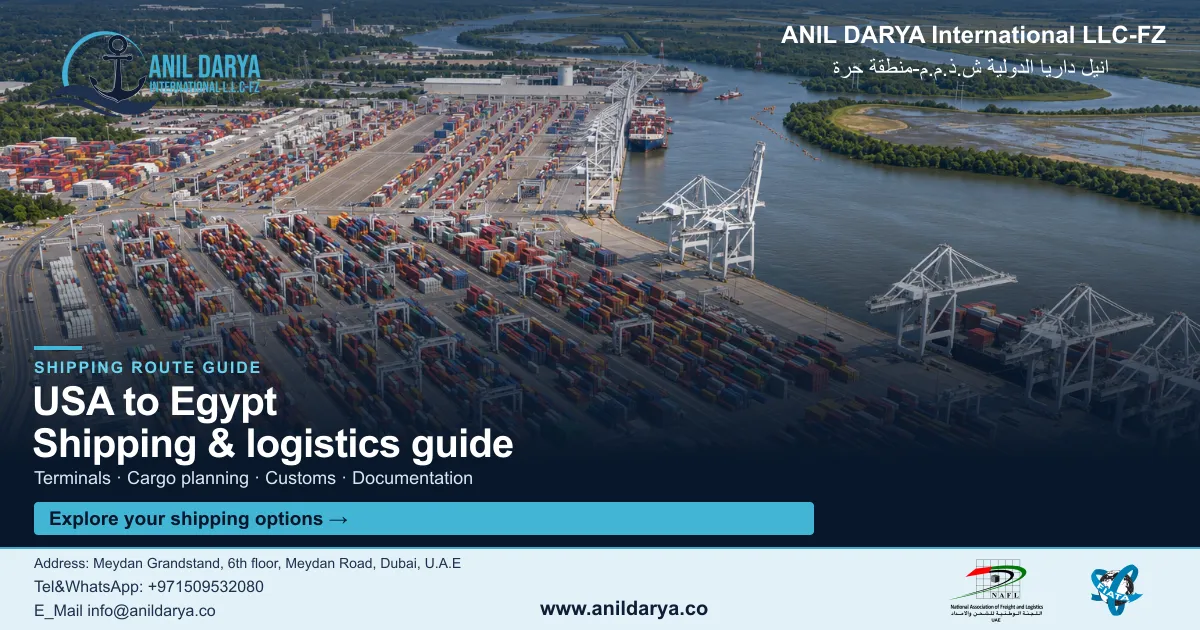
Shipping from USA to Egypt is a long-haul container lane that starts at an Atlantic or Gulf Coast port and ends at a Mediterranean terminal such as Alexandria, Damietta or Port Said. Two papers decide whether the box is released on time: the US exporter's EEI filing before loading, and the Egyptian importer's ACID, which must exist before the box is loaded in the US. We book the ocean freight from Dubai, release the carrier's bill of lading to you, and agree the Egyptian buyer's broker before we confirm the space.
USA to Egypt shipping at a glance
| Item | Detail |
|---|---|
| Type of lane | Cross-trade by sea, United States to Egypt, booked and coordinated by Anil Darya from Dubai |
| Main US load ports | New York and New Jersey, Philadelphia, Baltimore, Norfolk, Charleston, Savannah, Houston; West Coast ports for western states |
| Main Egyptian discharge ports | Alexandria and Dekheila, Damietta and Port Said on the Mediterranean; Sokhna on the Red Sea coast |
| A named weekly service | MSC's EMUSA loop, whose US calls include New York, Philadelphia, Norfolk, Charleston and Savannah, began calling Damietta in September 2026 |
| US export filing | EEI in AES (through ACE) by the US exporter or its US forwarder, at least 24 hours before the box is loaded |
| Egypt pre-shipment rule | Advance Cargo Information: the importer gets an ACID on Nafeza before the cargo ships |
| Trade agreement | No US-Egypt free trade agreement; US goods pay Egypt's normal tariff rates |
| Egypt duty and VAT | Duty mostly 0% to 60% of CIF value; VAT 14%, or 5% on production-line machinery |
| Bill of lading | The shipping line's own B/L, released to you through us as agent for the line |
| Destination clearance | The consignee's licensed customs broker in Egypt, agreed before we confirm the booking |
How shipping from USA to Egypt works as a cross-trade
The cargo leaves a US terminal and is cleared at an Egyptian one, without touching the UAE unless you ask for a Dubai routing.
| Party | Its job on a US to Egypt shipment |
|---|---|
| US exporter or its US forwarder | Packs and loads, trucks or rails the box to the port, files the EEI, gets the certificate of origin certified, uploads the ACI file on CargoX |
| Anil Darya, Dubai | Compares sailings, books the space, checks the ACID and EEI status before the cut-off, tracks the voyage, releases the carrier's B/L |
| Shipping line | Loads only when the ACID is valid, carries the box, lodges the manifest with Egyptian Customs through Nafeza |
| Egyptian importer | Holds its importer registration, requests the ACID, approves the exporter's data, pays duty and VAT |
| Importer's broker in Egypt | Files the declaration, attends GOEIC inspection and sampling, takes the release |
The bill of lading is the carrier's document, not ours. Anil Darya acts as agent for many shipping lines, so a line's B/L for, say, a 40ft box of Texas oilfield spares bound for Alexandria is released to you from our Dubai office. Before release we compare the draft with the US invoice: same consignee, same 9-digit Egyptian tax number, same ACID.
We do not sell customs clearance in Egypt. Duty and taxes at destination are paid by the consignee or its broker. So we first ask the Egyptian buyer who its broker is and whether it works at the discharge port; a Savannah box landing at Damietta while the broker sits in Alexandria loses days. No broker, no confirmed booking.
On CFR or CIF Alexandria the US seller books the ship, but Egyptian terminal charges, duty and VAT stay with the buyer. Our guide to Incoterms 2020 for sea freight shows where risk changes hands.
Which US port should Egypt cargo load at?
Start with the coast nearest the factory. Atlantic ports are the natural gateway, since the ship crosses straight into the Mediterranean.
| US port | Fact we checked | Typical cargo for Egypt |
|---|---|---|
| New York and New Jersey, Philadelphia | Both are East Coast calls on MSC's EMUSA loop (MSC rotation, July 2025) | Machinery, IT hardware, medical supplies, FCL and LCL from the Northeast |
| Norfolk | An EMUSA call; Virginia's gateway for Midwest rail cargo | Machinery, chemicals, auto parts |
| Charleston and Savannah | Both EMUSA calls; Savannah's Ocean Terminal is being rebuilt for 2 million TEU and handles heavy lifts | Retail stock, paper, resins, heavy pieces from the Southeast |
| Baltimore | Maryland's port calls itself the number one US port for Roll-On/Roll-Off cargo | Vehicles, tractors, construction machinery |
| Houston | Port Houston reports 220.1 million short tons of foreign waterborne cargo in 2024, first in the US, and 75% of Gulf Coast container traffic | Oil and gas equipment, petrochemicals, resins |
| Los Angeles, Long Beach, Seattle | West Coast gateways; ask how the box reaches the Mediterranean before you book | Goods made or stored in the western states |
Midwest shippers often rail the box to Norfolk or New York. Price that against a Gulf Coast sailing before you choose.
Which Egyptian port to arrive at
Choose by the buyer's warehouse and by where its broker has people on the ground.
| Egyptian port | What we found | Usually suits |
|---|---|---|
| Alexandria and Dekheila | Egypt's main Mediterranean gateway for general cargo, with several container and multipurpose terminals | Alexandria, the western Delta, 6th of October City and many Cairo importers |
| Damietta | The Damietta Container and Cargo Handling Company received MSC's first EMUSA call at its container quay No. 1 on 21 September 2026 | Damietta, Mansoura and the eastern Delta |
| Port Said (Suez Canal Container Terminal) | 3,355 m of quay, 17 m draft, 7 million TEU capacity and 6,400 reefer plugs, per APM Terminals | Transhipped boxes, the canal cities, the 10th of Ramadan area |
| Sokhna (DP World) | Berth 1 of 750 m and Berth 2 of 1,350 m, 17 m alongside, 584 and 320 reefer points | Suez and eastern Cairo; mostly reached by Asian and Gulf services |
Sokhna makes sense mainly when US goods are combined with Gulf or Asian goods in Dubai.
Direct calls and transhipment: what the carriers publish
The clearest named loop we found is MSC's EMUSA, a weekly East Mediterranean to US East Coast service.
- MSC's July 2025 advisory lists the EMUSA US calls as New York, Philadelphia, Norfolk, Charleston and Savannah, with Mediterranean ports on the other end of the loop.
- Al Mal News reported that the Damietta Container and Cargo Handling Company began handling EMUSA weekly on 21 September 2026, when MSC Mombasa berthed at its container quay No. 1.
Other routings tranship at a Mediterranean hub, where the box changes ship. Each relay adds time, so every quote from us names the vessel, any relay port, and whether the box stays on board to Egypt.
How long does sea freight from the USA to Egypt take?
We found no carrier transit table for this lane that we could check against the order of calls, so we print no day count. Forwarder pages disagree widely, from 12 to 20 days overall to 35 to 55 days from the West Coast, because they mix direct and transhipped routings. Plan on the carrier's schedule for your vessel, then add US export time and Egyptian clearance.
[AMIR-FACT: the carriers and services we actually book from US East Coast, Gulf Coast and West Coast ports to Alexandria, Damietta and Port Said, direct or transhipped, with the real port-to-port days and sailing frequency we see]
Sea freight from USA to Egypt: FCL, LCL, bulk and project cargo
| Option | Typical US cargo for Egypt | Point to check |
|---|---|---|
| FCL 20ft | Chemicals in drums, resins, heavy spares, valves | Weight limit on US roads and on the box |
| FCL 40ft / high cube | Machinery, IT hardware, medical equipment, retail stock | Invoice, packing list and Nafeza entry must show the same counts and weights |
| LCL | Spare parts, samples, small orders from several suppliers | Each consignee in the shared box needs its own ACID |
| Reefer | Frozen meat and poultry, dairy, fruit | Health certificate, halal statement for meat, Egyptian shelf-life rules |
| Flat rack / open top | Generators, drilling equipment, tractors | Dimensions, weight and lifting points per piece |
| Dry bulk | Grain, soybeans and other farm commodities | Chartered vessel, phytosanitary papers, discharge berth |
With three US suppliers, one consolidated FCL usually beats three LCL lots: one ACI filing, one inspection. Our FCL vs LCL comparison explains the break-even, and our sea freight service covers the container booking.
Grain and other bulk commodities
Farm commodities in bulk need a vessel fixture, a US grain terminal berth and an agreed Egyptian discharge port. Our bulk cargo team works on the charter side; the buyer's broker handles plant-health and customs steps.
Machinery and out-of-gauge cargo
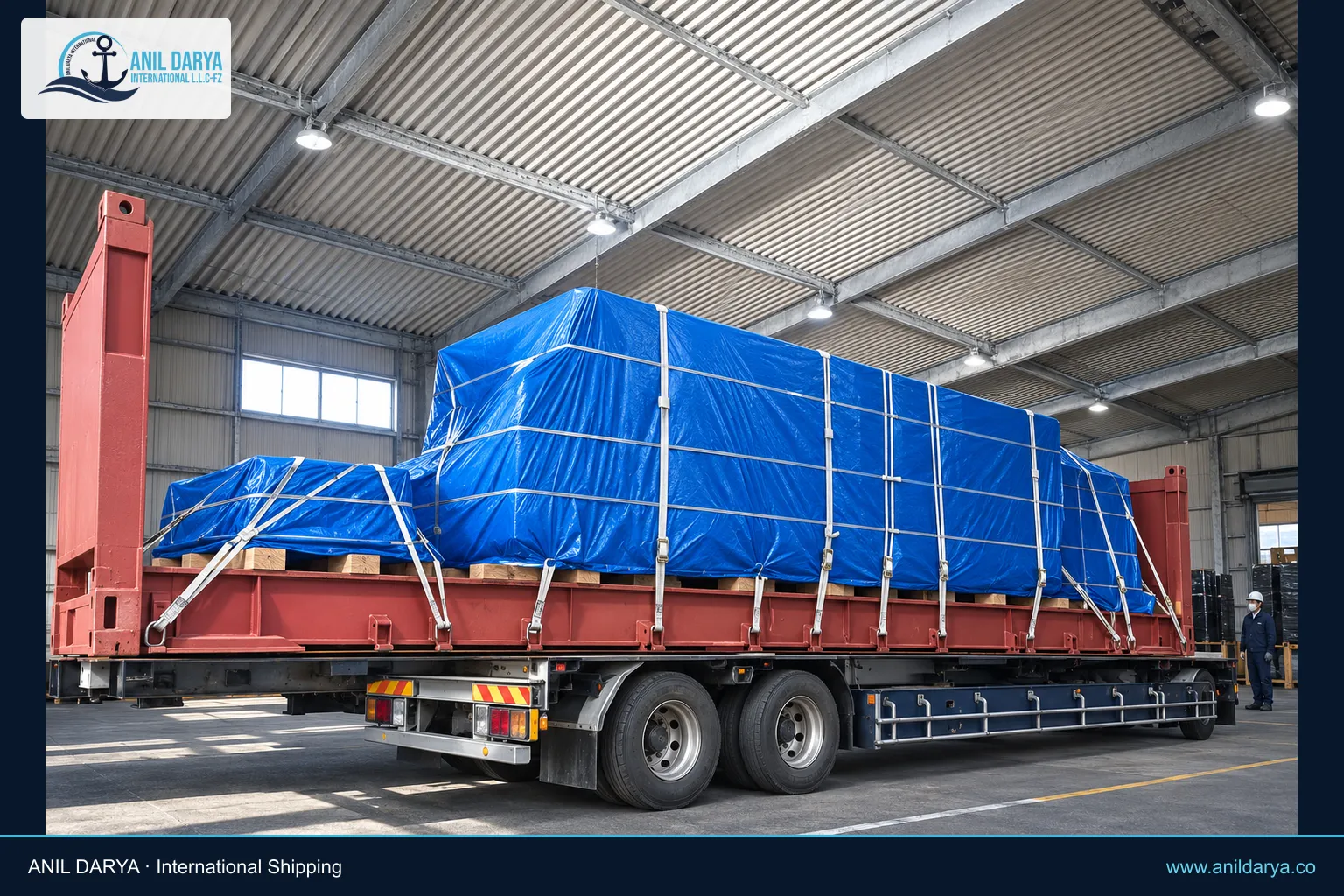
Oil and gas equipment, power generation units and plant machinery often exceed a standard box. Pieces that fit a 40ft flat rack or open top can sail on a container line; larger units need Ro-Ro, multipurpose or heavy-lift tonnage, and we found no current published Ro-Ro schedule from the US into Egypt. Our guide to flat rack, open top and out-of-gauge cargo sets out the limits. Every out-of-gauge piece still needs an ACID and a matching Arabic-language catalogue for machines.
Dangerous goods and chemicals
Paints, solvents, lubricants and many lab chemicals move as dangerous goods under the IMDG Code 2024 edition, Amendment 42-24, mandatory since 1 January 2026. The US shipper supplies the UN number, class, packing group, safety data sheet and DG declaration, and the line approves the booking before the box is stuffed. In Egypt, GOEIC sends imported chemicals to authorised labs and wants an original safety data sheet; analysis reports from earlier shipments are not accepted. Our dangerous goods team gets carrier acceptance first.
The US export side: EEI, licences and certified papers
US export filing belongs to the exporter or its US forwarder; we do not file in the US.
- EEI is required when any Schedule B line is worth more than $2,500, or when the item needs an export licence at any value. It goes into AES, the export module of ACE, and ACE AESDirect is the free portal.
- For vessel cargo the EEI must be filed, and the ITN received, at least 24 hours before the cargo is loaded at the US port. The carrier needs the filing citation or exemption legend before it loads.
- Check the item against the Commerce Control List. Items not on it are EAR99. A listed item needs a licence for Egypt only where the Commerce Country Chart marks its reason for control and no licence exception applies.
Certificate of origin and consular legalization
The US International Trade Administration says the certificate of origin must be authenticated by the Egyptian consulate in the country of origin, and that the commercial invoice needs consular legalization in most cases. Both go in two copies plus the original. The usual first step is a certificate from a US chamber: the National US-Arab Chamber of Commerce (NUSACC), for example, certifies certificates of origin and commercial invoices for $85 per paper document or $60 digitally, and forwards papers to an embassy or consulate only with a cheque for that office's fees. Ask the Egyptian broker which level of legalization it will need before the US seller prints anything.
Is there a trade agreement between the US and Egypt?
No. The ITA list of Egypt's trade agreements covers the EU association agreement, EFTA, the Turkey-Egypt FTA, GAFTA, Agadir, COMESA, AfCFTA and Mercosur, but no free trade agreement with the United States. The two countries have a Trade and Investment Framework Agreement from 1999, which is a dialogue framework and gives no tariff cut.
So there is no EUR.1 to chase and no preference to lose: US goods pay Egypt's normal rate, and an ordinary certificate of origin proves where they were made. Routing them through Dubai, or storing them in a Dubai free zone, does not make them Arab-origin goods, so no GAFTA rate applies. Confirm the rate for your HS code with the broker before you price.
Egypt import customs for US goods: ACI, ACID and Nafeza
Egypt's Advance Cargo Information system runs on Nafeza, the national single window operated by Misr Technology Services. Under Ministry of Finance Decree 38 of 2021, use became mandatory in October 2021. The MTS guide for shipping lines sets the ACI request at least 48 hours before loading, gives Customs up to 48 hours to issue the ACID, and requires lines to lodge the manifest at least 48 hours before berthing.
Every document needs three items: the 19-digit ACID, the importer's 9-digit Egyptian tax number, and the exporter's identification (country code US, ID type and number).
| Step | Who | What happens |
|---|---|---|
| 1 | Egyptian importer or broker | Enters the shipment on Nafeza |
| 2 | Egyptian Customs | Issues the ACID within 48 hours and notifies the importer and the US exporter |
| 3 | US exporter | Verifies its company on CargoX and uploads invoice, packing list, certificate of origin and B/L copy under the ACID |
| 4 | Importer | Confirms the exporter's data on Nafeza |
| 5 | Shipping line | Checks the ACID and loads at the US port |
| 6 | Importer and broker | Pay duty and VAT; the joint port committee inspects; Customs releases the goods |
The ITA customs guide says shipments without an ACID are denied entry and re-exported at the shipper's cost. On CargoX only fully verified companies can file; a sea forwarder registers but does not upload, and simply passes the B/L to the exporter. A sent filing cannot be recalled, so corrections go as a new filing under the same ACID, with no second filing fee.
Documents Egypt expects for goods from the US
| Document | Issued by | What Egypt checks |
|---|---|---|
| Commercial invoice | US exporter, legalized as the broker requires | ACID, tax number, exporter ID, HS codes and values |
| Certificate of origin | US chamber, authenticated by the Egyptian consulate | US origin, with a statement that the details are true and correct |
| Packing list | US exporter | Same weights, packages and descriptions as the invoice and Nafeza |
| Bill of lading | Shipping line, released through us | Shipper name and address, number of originals, the ACID |
| Health or phytosanitary certificate | US authority | For meat, dairy, grain, fruit and other farm goods |
| Safety data sheet | Manufacturer | Original copy for chemicals and DG |
| GOEIC registration proof | US factory or brand owner | For products on the Decree 43 list |

Duty, VAT and GOEIC registration for US cargo
PwC reports Egyptian customs duty of 0% to 60% of CIF value for most goods, rising to as much as 135% for passenger cars, non-essential luxury goods and alcoholic drinks. Machinery for industrial use is usually 0% to 5%, and trucks and heavy equipment 10% to 20%. Import VAT is 14% on CIF value plus duty and other taxes; machinery for production lines pays 5%. Under Law 3 of 2022, VAT on qualifying machinery can be suspended for a year, extendable once. Duties are paid in Egyptian pounds.
| US cargo | Duty range reported by PwC | VAT | Watch for |
|---|---|---|---|
| Industrial machinery and equipment | 0% to 5% | 14%, or 5% for a production line; suspension possible | Proof of industrial use |
| Trucks and heavy equipment | 10% to 20% | 14% | Arabic catalogue; matching data plate and packing |
| Passenger cars | Up to 135% | 14% | Engine size sets the rate; confirm eligibility first |
| Chemicals and resins | Within 0% to 60% by HS code | 14% | Original SDS and lab testing by GOEIC |
| Food and farm goods | By HS code | As the broker confirms | Shelf life, Arabic labels, health certificates |
| Consumer goods on the Decree 43 list | By HS code | 14% | Factory or brand registration with GOEIC |
Decree 43 of 2016 catches many US consumer brands. Factories, trademark owners and distribution centres that export listed products to Egypt must register with GOEIC first. The list includes dairy, chocolate and confectionery, bakery goods, juices, bottled water, cosmetics, toiletries and soap, household appliances, furniture, tableware, toys, home lighting, bicycles, clothing, carpets and footwear. The buyer must also be on the GOEIC importers register, whose rules Decree 271 of 2026 updated from 22 July 2026.
Labels, shelf life and inspection in Egypt
From the ITA guides for Egypt:
- Finished goods for sale must carry Arabic labels with the country of origin, the maker's name and a product description. Importers may not add printed labels after import.
- Food must arrive with at least half of its shelf life left, and the ITA warns that import and customs steps take no less than two weeks.
- Meat and poultry must ship directly from the country of origin, in packaging with Arabic details inside and out and a halal statement.
- Machines need the origin marked on each item and an Arabic catalogue.
- A wooden crate must travel with an official certificate that it is free of wood pests.
Ask the broker to confirm the HS code, sector approvals and label wording before the goods are produced.
What US cargo goes to Egypt?
The ITA reports US exports to Egypt of 6.3 billion dollars in 2025, up from 4.5 billion in 2023, led by agricultural goods, oil and gas, transportation equipment, chemicals, machinery, and computer and electronic products. On this lane that means bulk farm goods, flat racks of energy equipment and boxes of machinery.
When does Dubai help with shipping from USA to Egypt?
Dubai is not on the way from the US to the Mediterranean. It helps only in a few cases:
- Mixed sourcing: US goods combined in Dubai with Gulf or Asian goods into one box for Egypt.
- Stock held in a Dubai free zone and called off in smaller lots for Egyptian buyers. Our article on JAFZA re-export explains how that works.
- US cargo already moving to Jebel Ali for other Gulf buyers, with part of it split off for Egypt. Our Jebel Ali port guide covers the terminal.
From Jebel Ali, Emirates Shipping Line's GRC service, in its October 2024 launch advisory, links Jebel Ali with Sokhna. The Dubai to Egypt leg needs its own ACID, and Dubai Chambers issues certificates of origin for re-exported foreign goods. Where the lane touches Dubai, customs clearance there is a service we provide for a fee through our Dubai freight forwarding team.
[AMIR-FACT: whether we route US cargo for Egypt through Jebel Ali today (consolidation, JAFZA stock or a split from a Gulf shipment), on which carriers, how often, and the real extra days compared with a direct US East Coast sailing]
What drives the cost of shipping from USA to Egypt?
We price each sailing on the day, so this page carries no rates. These are the parts of the bill and who usually pays them on FOB terms.
| Cost part | What moves it | Usually paid by (FOB) |
|---|---|---|
| US inland leg | Truck or rail from the factory, chassis, drayage to the terminal | Exporter |
| US export costs | EEI filing by the US forwarder, terminal handling, export licence if any | Exporter |
| Documents | Chamber certification, consular legalization, CargoX filing and document fees | Exporter, unless agreed otherwise |
| Ocean freight | Box type, load port, direct or transhipped, season, surcharges | Importer |
| Special cargo | Reefer, DG, flat rack, breakbulk or bulk charter | Importer |
| Egyptian port charges | Terminal handling, delivery order, LCL unpacking, storage | Importer |
| Duty and taxes | HS code, CIF value, 14% or 5% VAT, any suspension | Consignee or its broker |
| Delay charges | Missing ACID, unregistered factory, lab testing, late originals | Whoever caused the delay, by contract |
The costliest delay here is usually GOEIC: an unregistered Decree 43 product or a chemical awaiting lab results. Our article on demurrage and detention shows how fast those charges grow.
How to ship from the USA to Egypt step by step
- Agree the Incoterm with the US seller and put it on the contract and invoice.
- Send us the product, HS code, weight, volume, pickup city, ready date, special needs and Egyptian port.
- Name the Egyptian broker. We check with the broker that the importer is registered, the products are clear with GOEIC, and the broker works at the chosen port. Only then do we confirm the booking.
- Get the ACID. The importer applies on Nafeza at least 48 hours before loading and shares the number with the US seller and with us.
- Book the space. We compare direct and transhipped sailings and get DG, reefer or out-of-gauge acceptance first.
- Prepare the US documents. The seller puts the ACID, tax number and exporter ID on every page, has the certificate of origin certified, and arranges legalization if the broker asks for it.
- File the EEI in AES and the ACI documents on CargoX, then deliver the box to the terminal before the cut-off.
- Release the bill of lading. We check the draft against the invoice and ACID and release the carrier's B/L once freight is settled.
- Clearance in Egypt. The consignee's broker files the declaration, attends inspection, pays duty and VAT and takes delivery.
[AMIR-FACT: one real USA to Egypt cross-trade shipment we handled (cargo, US load port, Egyptian port, carrier, direct or transhipped, how the ACID and broker were lined up, door-to-door days), cleared for publication]
Checklist before the box leaves the US
- Incoterm agreed and written on the contract and invoice.
- Egyptian importer registered and holding a valid ACID for this shipment.
- Broker named, agreed and working at the discharge port.
- Products checked against the Decree 43 list, with GOEIC registration in place where needed.
- US exporter verified on CargoX; ACID, tax number and exporter ID on every document.
- Certificate of origin certified, and legalized if the broker requires it.
- ECCN or EAR99 status checked; EEI filed and ITN received 24 hours before loading.
- Arabic labels on finished goods; Arabic catalogue for machines; pest certificate for wooden crates.
- For food: shelf life, health certificate and halal statement. For DG: SDS, DG declaration and carrier approval.
- Insurance arranged and free time at the Egyptian port checked.
Common mistakes on the US-Egypt lane
- Shipping before destination clearance is agreed. A box that reaches Alexandria with no broker in place sits on the quay and builds storage.
- Loading before the ACID exists. The line will not load cargo for Egypt without a valid one.
- Unregistered brand. Cosmetics, appliances, toys or packaged food on the Decree 43 list cannot be released without GOEIC registration.
- English-only labels on goods for retail, or labels added after arrival.
- Food shipped with too little shelf life for a long crossing plus at least two weeks of clearance.
- Data that does not match between the invoice, packing list, B/L and Nafeza entry.
- Paints, solvents or lithium batteries booked as general cargo instead of DG.
Frequently asked questions
How long does shipping from the USA to Egypt take by sea?
It depends on the US port and on whether the box is direct or transhipped. Forwarder estimates range from under three weeks to almost eight from the West Coast. Ask for the carrier's schedule for the named vessel, then add US export time and Egyptian clearance of at least two weeks.
Is there a direct ship from the US to Egypt?
Yes, on some loops. MSC's EMUSA service links US East Coast ports such as New York, Norfolk and Savannah with the East Mediterranean and began calling Damietta in September 2026. Other routings tranship at a Mediterranean hub.
Do US goods pay customs duty in Egypt?
Yes. There is no US-Egypt free trade agreement, so US goods pay Egypt's normal rates: mostly 0% to 60% of CIF value, up to 135% for passenger cars and luxury goods, and 0% to 5% for most industrial machinery.
Is VAT charged on US imports in Egypt?
Yes. Import VAT is 14% on CIF value plus duty and other taxes, or 5% on machinery for production lines. The consignee or its broker pays it.
Who requests the ACID for a shipment from the US?
The Egyptian importer or its broker, on Nafeza, at least 48 hours before loading. The US exporter then verifies its company on CargoX and uploads its documents under that ACID.
Does the certificate of origin need legalization for Egypt?
The ITA says the certificate of origin must be authenticated by the Egyptian consulate and the invoice legalized in most cases. A US chamber certifies first; the broker confirms what it needs.
Does Anil Darya clear the cargo in Egypt?
No. We book the ocean freight, coordinate the US shipper and release the carrier's bill of lading. The consignee's licensed broker clears the goods in Egypt, and we agree that with you before confirming the booking.
Get a quote for shipping from the US to Egypt
Send us the pickup city, the cargo and HS code, the ready date, the Egyptian port and the name of the buyer's broker, and we will reply with sailing options and a price. Use our freight rate inquiry form, or contact our team to talk through a machinery, DG or bulk shipment first.
Sources
- MSC: Port rotation change, EMUSA service (23 July 2025)
- Al Mal News: Damietta Container and Cargo Handling Company receives MSC's EMUSA service (September 2026)
- APM Terminals: Suez Canal Container Terminal
- DP World: Sokhna infrastructure facts
- Emirates Shipping Line: IEX and GRC service launch advisory
- Port Houston: Statistics
- Maryland Port Administration: Port of Baltimore
- Georgia Ports Authority: Ocean Terminal
- US Census Bureau: Automated Export System
- 15 CFR 30.4: EEI filing time limits
- 15 CFR 30.37: EEI exemptions
- 15 CFR 732.3: EAR99 and the Commerce Country Chart
- NUSACC: Commercial document certification
- US International Trade Administration: Egypt import requirements and documentation
- US International Trade Administration: Egypt customs regulations
- US International Trade Administration: Egypt trade agreements
- US International Trade Administration: Egypt market overview
- US International Trade Administration: Egypt labeling and marking requirements
- US International Trade Administration: Egypt standards for trade
- Misr Technology Services via SCZONE: ACI Shipping Lines/Agents Guide v1.5
- CargoX: Advance Cargo Information Egypt
- PwC Worldwide Tax Summaries: Egypt, other taxes (reviewed 17 August 2026)
- AHK Egypt: Registration of manufacturers with GOEIC (Decree 43 of 2016)
- Baker McKenzie: Egypt importers register, Decree 271 of 2026
- IMO: IMDG Code 2024 edition (Amendment 42-24)
- Dubai Legislation Portal: Dubai Chambers Resolution No. 7 of 2024 on certificates of origin
Reviewed: 11 November 2026